Why Meal Prep Containers Matter for Food Packaging Teams
Meal prep containers are no longer basic storage boxes. For supermarkets, cafes, salad brands, foodservice operators, commissary kitchens, and distributors, they influence product freshness, shelf presentation, portion control, operational speed, delivery confidence, and customer trust.
A food packaging team choosing meal prep containers usually needs to solve several problems at once. The food must look fresh under cold-case lighting. The lid must stay secure during packing, transport, and display. The container must stack efficiently in cartons and retail shelves. The material must support the intended food temperature. The structure must match the actual menu instead of only matching a catalog photo.
This is why buyers should evaluate deli and salad containers with a structured sourcing method. A container that works for dry bakery portions may not protect leafy salads. A bowl designed for fresh fruit may not suit sauced pasta. A square deli container, a round salad bowl, a hinged clamshell, and a divided tray each solve different meal prep packaging problems.
YIHAO supports food packaging programs for fresh produce, salads, chilled meals, bakery portions, deli foods, snack packs, and ready-to-eat food displays. For meal prep projects, the practical goal is simple: match the container structure to the food type, display channel, packing method, and wholesale ordering requirements.
Start with the Food Type, Not the Container Capacity
The most common mistake in selecting meal prep containers is starting with size before testing the food. Capacity matters, but food behavior matters more. Leafy greens, fresh-cut fruit, grains, pasta, protein, dressing, cheese, nuts, sauces, and bakery add-ons do not behave the same way inside packaging.
Before choosing a container, buyers should define the food type, expected fill weight, ingredient volume, moisture level, topping placement, storage temperature, labeling requirement, and eating occasion. A salad meal sold in a supermarket cold case needs a different container logic than a dense deli side packed for takeaway.
Leafy Salads and Ready-to-Eat Salad Meals
Meal prep salad containers need enough headspace to protect leafy ingredients from compression. A salad that looks full, fresh, and lightly layered usually performs better on shelf than one pressed tightly against the lid. When the meal includes toppings, cheese, grains, chicken, seafood, croutons, nuts, or dressing cups, structure becomes even more important.
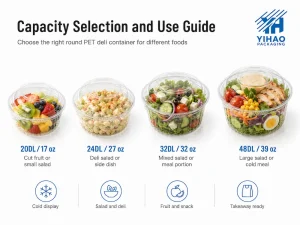
Round bowls are strong for visual volume and premium salad display. They create a generous appearance and allow ingredients to be layered attractively. For retail salad programs, round PET containers are a practical category to review because they support ready-to-eat salads, fruit mixes, chilled noodles, and larger grab-and-go meal portions.
For single-serve salads, fruit salads, and light meal combinations, clear PET salad bowls help present color, freshness, and ingredient quality without hiding the food behind an opaque lid or heavy sleeve.
Fresh-Cut Fruit and Snack Combinations
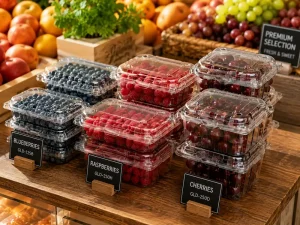
Fresh-cut fruit needs clear visibility, stable base support, and enough lid clearance for delicate pieces. Berry mixes, apple slices, melon cubes, grapes, citrus segments, cheese cubes, nuts, and snack combinations benefit from packaging that keeps the product organized and visually clean.
For fruit-led meal prep programs, buyers should compare fresh-cut fruit containers with salad and deli formats. A fruit snack pack may need compartments, while a fruit salad may need a wider bowl or square deli container for spoonable portions.
Deli Meals, Pasta Salads, and Chilled Prepared Foods
Deli meals and chilled prepared foods often need stronger base stability than light salad packs. Pasta salad, couscous, cold noodles, vegetable mixes, hummus portions, sliced meats, and chilled side dishes place more pressure on the base and lid. Buyers should check whether the container holds shape after filling, stacking, shipping, and staff handling.
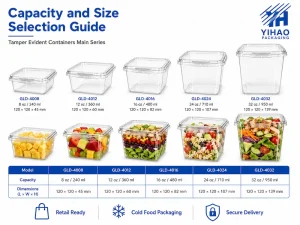
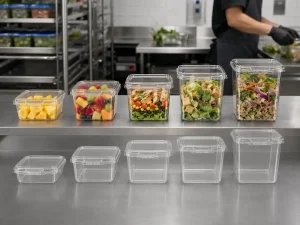
Square formats are especially useful when shelf efficiency matters. A square or rectangular footprint improves carton loading, refrigerator layout, and display density. For deli, fruit, and chilled meal programs, square PET containers provide a practical balance between visibility and space efficiency.
For medium-size salad, fruit, and deli meal portions, square deli containers are a relevant structure to consider because they support chilled food portions while keeping the pack easy to stack, label, and merchandise.
Material Choice: PET, RPET, PP, and Clear Meal Prep Packaging
Material selection affects clarity, stiffness, food presentation, temperature range, sustainability messaging, and buyer confidence. For clear meal prep packaging, PET and RPET are widely used because they provide strong transparency, a clean appearance, and strong retail display value. For hot-fill or microwave-related meals, PP is usually the better direction because it handles higher heat exposure than PET.
PET Meal Prep Containers
PET meal prep containers are a strong choice for chilled salads, fresh-cut fruit, cold deli foods, snack packs, bakery portions, and cold ready-to-eat meals. PET offers high clarity, which helps customers inspect freshness before purchase. In chilled retail food packaging, visibility is not just a cosmetic detail. It supports trust and repeat purchase.
PET also provides a rigid, clean structure for hinged containers, separate-lid containers, bowls, trays, and clear covers. For buyers selling cold-case meals, PET helps ingredients look bright and defined under display lighting. This makes it suitable for salads with greens, fruit pieces, pasta, toppings, and layered meal components.
RPET for Recycled Content Positioning
RPET can support sustainability messaging when recycled content is available, suitable for the intended food-contact use, and consistent with the buyer’s destination market. Packaging teams should ask suppliers to clarify recycled-content percentage, food-contact suitability, material consistency, and whether the final design supports the buyer’s labeling and recycling claims.
Buyers should avoid vague sustainability language. A container may be recyclable in one local system and not accepted in another. Claims should match the destination market, local collection rules, and the actual package design. Labels, adhesives, dark colors, material combinations, and incompatible attachments may affect recyclability.
PP for Hot or Microwave-Related Meal Programs
Not every meal prep project should use PET. If the food is reheated in the container, PET is not the right default choice. For hot takeaway meals or microwave-related applications, buyers should review PP structures instead. For teams handling hot prepared foods, microwave safe containers should be evaluated with heat performance, lid fit, food safety documentation, and clear usage instructions in mind.
For chilled and hot takeaway programs under one brand, many buyers use both PET and PP packaging lines: PET for clear chilled display and PP for hot or reheatable meals. This avoids forcing one material to handle every food application.
Meal Prep Container Selection Matrix
A structured comparison matrix helps food packaging teams make faster sourcing decisions. Instead of comparing only price and capacity, buyers should compare food behavior, material direction, structure, display requirement, and risk points.
| Food Type | Recommended Material | Suggested Structure | Cold Display Suitability | Microwave Suitability | Key Risk to Test | Best Buyer Scenario |
|---|---|---|---|---|---|---|
| Leafy green salads | PET or RPET | Round bowl or hinged salad container | High | No | Leaf compression, lid clearance, condensation | Supermarket salad bars, grab-and-go cafes, chilled retail meals |
| Salad meals with toppings | PET or RPET | Single compartment with insert or divided container | High | No | Topping separation, dressing leakage, visual organization | Premium salad meals, protein salads, meal prep salad containers |
| Fresh-cut fruit | PET or RPET | Clear bowl, square cup, or compartment tray | High | No | Moisture, base stability, fruit visibility | Fruit cups, fruit salads, snack packs, chilled produce displays |
| Deli sides and pasta salads | PET for chilled display | Square or round deli container | High | No | Filled weight, stacking pressure, lid security | Deli counters, foodservice sides, chilled prepared foods |
| Hot prepared meals | PP | Separate-lid meal container | Medium | Usually yes, when specified by supplier | Heat performance, deformation, lid venting, usage instructions | Takeaway meals, reheatable meals, hot foodservice packaging |
| Snack combinations | PET or RPET | Two- or three-compartment container | High | No | Ingredient migration, portion balance, compartment fit | Fruit and nut packs, cheese snacks, mini meal kits |
Container Structure: Single, Divided, Hinged, and Separate-Lid Designs
Structure determines how the food is packed, displayed, transported, opened, and eaten. Two containers with similar capacity may perform very differently if one is shallow and wide while another is deep and compact.
Single-Compartment Meal Prep Containers
Single-compartment containers are suitable for salads, fruit salads, pasta salads, rice bowls, cold noodles, deli sides, and larger mixed meals. They give food teams flexibility because one structure can serve several menu items. This is useful for supermarkets, cafes, foodservice brands, commissary kitchens, and distributors managing multiple SKUs.
Single-compartment formats work best when ingredients are intended to mix or when toppings are added directly before sealing. A pasta salad with vegetables and dressing may not need divided sections. A green salad with crunchy toppings may need a dressing cup, insert, or divided structure to preserve texture.
Divided Salad Containers
Divided salad containers solve a different problem. They keep ingredients visually separated and reduce cross-contact between wet and dry components. For salad meal containers that include greens, proteins, nuts, cheese, fruit, crunchy toppings, or sauces, compartments support a cleaner eating experience and a more organized display.
However, divided structures should not be selected only because they look premium. They must match the food’s portion logic. A two-compartment container may suit salad plus topping. A three-compartment container may suit fruit, nuts, and cheese. A five-compartment tray may suit party platters, catering, sushi assortments, or multi-item chilled meals.
Hinged Containers vs Separate-Lid Containers
Hinged containers simplify packing because the lid is attached to the base. This reduces lid mismatch during production and supports fast packing lines. Hinged packs are useful for grab-and-go salads, sandwiches, snack meals, deli foods, bakery portions, and fresh food counters.
Separate-lid containers provide a different advantage. They can support a stronger premium feel, easier filling in some operations, and better matching between base depth and lid height. For prepared meals, deli foods, and bakery display, separate-lid formats are useful when buyers need clean presentation with flexible lid pairing.
Clear Display, Condensation, and Retail Shelf Performance
For chilled food, clear display is one of the biggest advantages of PET packaging. Customers want to inspect color, freshness, portion size, ingredient quality, and texture before buying. This is especially important for salad meal containers, fresh-cut fruit packs, pasta salads, and ready-to-eat meal portions.
Clear packaging must also handle the realities of cold-chain display. Temperature changes, high-moisture foods, and refrigerated cases may create condensation. Buyers should test sample packs under real storage and display conditions instead of judging only from empty container photos.
What to Test Before Bulk Orders
Food packaging teams should run a practical test before placing wholesale orders. Fill samples with actual menu items, seal them with the intended lid, place them in the refrigerator or cold case, stack them as they would be stacked in operations, and check the result after the expected shelf period.
- Does the container keep its shape after filling?
- Does the lid close securely without stress marks?
- Does the pack stack without crushing the lower layer?
- Does the food remain visible and appealing under cold-case lighting?
- Does condensation block too much visibility?
- Does the label area stay readable and properly positioned?
- Does the consumer open the pack easily without damaging the food?
- Does the carton packing method protect the container during transport?
These tests reveal issues that specification sheets alone cannot show. A container can look perfect when empty but fail when filled with leafy salads, wet fruit, or dense deli meals.
Portion Logic for Meal Prep Salad Containers
Portion planning is not only about capacity. It is about visual fullness, ingredient protection, eating experience, price positioning, and operational repeatability. A salad that looks too empty may feel low value. A salad packed too tightly may look damaged by the time it reaches the shelf.
For meal prep salad containers, buyers should define the target food weight, ingredient volume, topping style, dressing placement, and retail price point before selecting the container. Premium salad meals often need more headspace and a cleaner lid profile. Value-oriented deli meals may prioritize compact stacking and efficient carton loading.
For ready-to-eat salad portions, ready-to-eat salad containers help buyers evaluate whether the shape, lid height, and visual volume match the menu. For larger chilled salad meals, premium grab-and-go meal salad containers may be better suited when the pack includes greens, proteins, toppings, and more generous portions.
Common Mistakes When Buying Meal Prep Containers Wholesale
Many wholesale packaging problems appear after buyers move from sample photos to real production. The following mistakes are common, and each one can increase waste, complaints, or repacking work.
Choosing Capacity Before Testing Real Food Volume
A nominal capacity does not always match the real food experience. Leafy salads need headspace. Dense pasta salads need base stability. Fruit mixes need enough lid clearance to avoid compression. Buyers should fill samples with actual food, not water, before confirming a size.
Using PET for Hot or Microwave Meals
PET meal prep containers are strong for chilled display, but they should not be treated as a universal hot-food solution. If the food will be reheated in the container, buyers should review PP or other suitable microwave-related structures with clear supplier documentation.
Ignoring Lid Closure After Filling
Empty containers close more easily than filled containers. Sauces, toppings, overfilled greens, and uneven portions can put pressure on the lid. Buyers should check closure after real filling, stacking, and short transport simulation.
Covering Too Much Food Visibility with Labels
Clear meal prep packaging works because it shows the food. Oversized labels may hide freshness, color, and ingredient quality. Buyers should test label size and placement on filled packs to balance branding with visibility.
Comparing Unit Price Without Testing Total Packaging Performance
A cheaper container can become expensive if lids pop open, cartons crush, shelves look messy, or staff waste time matching lids and bases. Wholesale buyers should measure total packaging performance, not only unit price.
Labeling, Branding, and Shelf Communication
Packaging teams should plan labels early. A strong clear meal prep packaging design leaves practical space for brand labels, barcode labels, nutrition panels, date codes, and promotional stickers without blocking too much of the food.
For salad meal containers, the lid is often the most visible surface. For square deli containers, side labels may work better for shelf navigation. For round bowls, top labels can create strong branding, but they should not cover the food entirely. Buyers should test label placement on filled samples, not empty containers.
Branding should support trust, not hide the product. Clear PET packaging works best when the food remains the hero. A clean label, visible ingredients, and secure closure often communicate more value than a heavy printed sleeve.
Wholesale Buying Checklist for Food Packaging Teams
When sourcing meal prep containers from a manufacturer, wholesale supplier, or export partner, buyers should move beyond catalog photos. A serious supplier should help verify structure, material, sample performance, packaging method, carton packing, labeling space, and repeat-order consistency.
For wholesale buyers, the right supplier should not only provide containers. The supplier should also support sample testing, packaging structure advice, carton packing confirmation, lid and base matching, material direction, and repeat-order consistency. This is especially important when buyers are building multi-SKU salad, deli, fruit, and chilled meal programs.
Supplier Capability
A capable manufacturer should understand how food packaging performs in real operations. This includes cold-chain display, stacking, lid closure, carton loading, material consistency, and food-contact documentation. Buyers should ask whether the supplier supports sample testing, drawing confirmation, material options, customized labeling space, and production communication before bulk ordering.
The best supplier relationship is not built only on unit price. It is built on predictable quality, fewer packaging problems after launch, and clear communication before production.
Questions to Ask Before Ordering
- Is the container designed for chilled, hot, or microwave-related use?
- Is the material PET, RPET, PP, or another specified material?
- Does the supplier provide food-contact documentation for the target market?
- Does the lid close securely after filling with real food?
- Can the structure stack during storage, transport, and retail display?
- Is the label area suitable for barcode, nutrition, date, and branding labels?
- Can the supplier support repeat wholesale orders with consistent quality?
- Does the product design support the buyer’s recycling or recycled-content claims?
- Can the supplier help compare single-compartment and divided salad containers for the same menu?
Wholesale Cost Should Be Measured by Total Packaging Performance
Unit price matters, but it should not be the only decision point. A cheaper container can become expensive if lids open during delivery, cartons deform, shelf presentation looks weak, or staff waste time correcting packaging problems.
For larger salad and chilled meal portions, large salad and chilled meal containers should be evaluated by filled weight, stacking pressure, shelf visibility, and operational handling. For hot or takeaway prepared meals, prepared meal containers should be reviewed according to food temperature, closure style, reheating expectations, and serving experience.
The better buying question is not “Which container is cheapest?” The better question is “Which container protects the food, supports the brand, reduces operational friction, and performs consistently in wholesale supply?”
Practical Takeaway for Meal Prep Container Buyers
The best meal prep containers are selected through food-based testing, not guesswork. Start with the actual menu. Define whether the food is chilled, fresh-cut, salad-based, deli-style, hot, or reheatable. Then compare material, structure, clarity, compartments, stacking, lid fit, label area, and supplier support.
For chilled salads, fruit, deli meals, and grab-and-go retail food, PET and RPET options provide strong visual clarity and clean display value. For hot or microwave-related meals, PP should be reviewed separately. For meal prep salad containers, portion logic and headspace are critical. For divided salad containers, compartment design must match the food instead of simply looking attractive.
If your team is comparing clear PET meal prep containers, salad meal containers, divided salad containers, or wholesale meal prep packaging for retail and foodservice programs, YIHAO Packaging can help review food type, portion size, structure, material direction, label placement, carton packing, and sample testing before bulk orders.
FAQ
1. What are the best meal prep containers for chilled salads?
The best meal prep containers for chilled salads are usually clear PET or RPET salad bowls, hinged containers, or square deli containers with secure lids. Buyers should test headspace, lid fit, stacking strength, and cold-case visibility before ordering.
2. Are PET meal prep containers suitable for hot food?
PET meal prep containers are mainly suitable for chilled foods, salads, fresh-cut fruit, deli meals, and cold display packaging. For hot food or microwave-related use, PP containers are usually the better packaging direction.
3. Are divided salad containers better for meal prep salads?
Divided salad containers are better when the meal includes ingredients that need separation, such as greens, proteins, fruit, nuts, cheese, toppings, sauces, or crunchy items. For simple mixed salads, a single-compartment clear PET bowl may be more efficient.
4. What should wholesale buyers test before ordering meal prep containers?
Wholesale buyers should test filled samples for lid closure, stacking, cold-case visibility, condensation, label placement, transport handling, consumer opening experience, and carton packing before confirming bulk orders.
5. What should buyers ask a meal prep container manufacturer before ordering?
Buyers should ask about material, intended temperature use, food-contact documentation, sample availability, lid fit, carton packing, customization options, repeat-order consistency, and whether the supplier can recommend structures for salad, deli, fruit, and divided meal programs.
References
- U.S. Food and Drug Administration, Packaging & Food Contact Substances guidance.
- European Commission, Commission Regulation (EU) No 10/2011 on plastic materials and articles intended to come into contact with food.
- Association of Plastic Recyclers, APR Design Guide and PET thermoform packaging design resources.
- National Association for PET Container Resources, PET Thermoform Recycling information and industry updates.
- European Food Safety Authority, food contact materials and food safety assessment resources.
- ASTM International, ASTM D7611 Resin Identification Coding System for plastic products.
- International Organization for Standardization, ISO 22000 food safety management systems guidance.
- Ellen MacArthur Foundation, circular economy and packaging design resources.
Deep Dive Insights
How should buyers compare meal prep containers beyond capacity?
Capacity is only the starting point. Food packaging teams should compare meal prep containers by real filled-food performance, lid closure, stacking strength, cold-case visibility, label placement, carton packing, and consumer opening experience. A container that looks correct when empty may fail when filled with leafy salads, dense deli meals, wet fruit, or sauce-based foods.
Why are PET meal prep containers preferred for chilled retail display?
PET meal prep containers are widely used for chilled salads, fresh-cut fruit, deli meals, and grab-and-go food because they provide strong transparency and clean shelf presentation. For clear meal prep packaging, visibility directly supports buyer trust: customers can inspect freshness, color, ingredient quality, and portion value before purchase.
What makes divided salad containers useful for meal prep programs?
Divided salad containers help separate wet and dry ingredients, protect toppings, improve visual organization, and create a cleaner eating experience. They are especially useful for salad meal containers that include greens, proteins, fruit, nuts, cheese, crunchy toppings, or dressing. However, the compartment layout must match the real food portion plan instead of being selected only for appearance.
When should buyers choose PP instead of PET?
PET is a strong direction for chilled display, but it should not be used as a default solution for hot or microwave-related meals. If a meal will be reheated in the container, buyers should review PP packaging with suitable supplier documentation, heat-performance confirmation, lid design, and clear usage instructions.
What should wholesale buyers prioritize before placing bulk orders?
Wholesale buyers should prioritize sample testing with real food, not only catalog comparison. Before confirming bulk orders, teams should test lid fit after filling, stacking under weight, condensation under refrigeration, label readability, carton protection, and repeat-order consistency. A reliable manufacturer or supplier should support structure advice, material direction, sample review, and packaging confirmation before production.
Which packaging direction creates the strongest buyer value?
The strongest packaging choice is usually the one that balances food protection, shelf visibility, operational efficiency, and brand presentation. For chilled salads and deli meals, clear PET or RPET containers support strong display value. For hot or reheatable meals, PP should be reviewed separately. For complex salad meals, divided structures improve organization when they match the real menu design.
Final Note / Practical Takeaway
© YIHAO Packaging. All rights reserved. All articles, product images, packaging designs, technical specifications, and website materials are protected by copyright. Unauthorized copying, reproduction, redistribution, modification, or commercial use is strictly prohibited without prior written permission.