For wholesale buyers, choosing the wrong food packaging container manufacturer does not only create a packaging problem. It creates hidden costs in product damage, unstable lid fit, delayed replenishment, poor shelf presentation, inconsistent carton packing, and customer complaints. A low price loses its advantage quickly when containers crack during transport, lids loosen in cold display, or the packaging fails to make food look fresh and reliable.
YIHAO is a food packaging manufacturer and packaging solution provider focused on practical containers for fresh produce, deli foods, salads, bakery items, cold drinks, chilled ready-to-eat meals, and takeaway applications. For B2B buyers, the real sourcing question is not simply “Do you have this size?” A stronger question is: “Can this manufacturer support the full packaging decision from material and structure to wholesale supply, customization, and repeat ordering?”
This guide is written for importers, distributors, supermarket purchasing teams, foodservice brands, bakery chains, fresh produce suppliers, private-label buyers, and packaging wholesalers comparing a plastic food packaging manufacturer, PET container manufacturer, disposable food container factory, or general food packaging supplier. It explains what to check before ordering wholesale food containers, how to evaluate custom food packaging, and where OEM food packaging fits into a serious B2B sourcing plan.
Who This Guide Is For
This guide is designed for B2B buyers who need more than a basic product catalog. It is especially useful for importers, packaging distributors, supermarket buyers, foodservice procurement teams, fresh produce brands, bakery chains, cold drink businesses, deli food suppliers, and private-label food companies looking for a reliable food packaging container manufacturer.
If your business buys packaging in bulk, manages multiple SKUs, serves different food categories, or needs stable repeat supply, this guide gives you a practical manufacturer evaluation framework. It also helps buyers decide when to choose existing molds, when to request samples, when to consider OEM development, and when a supplier is not ready for wholesale cooperation.
Why Manufacturer Selection Matters More Than a Simple Price Quote
Food packaging is not a decorative add-on. It affects product protection, freshness perception, shelf appeal, leak control, stacking strength, transportation safety, consumer confidence, and retail conversion. A weak container makes even high-quality food look less professional. A strong container protects the food, supports the brand, and improves the buyer’s operational efficiency.
Wholesale buyers usually purchase in large quantities, so every small weakness scales into operational cost. If the hinge is weak, complaints multiply. If the lid fit is unstable, packing speed drops. If the material looks gray, the food looks less fresh. If the container does not stack well, warehousing and shipping efficiency suffer. That is why the best sourcing approach starts with manufacturer capability, not only with the cheapest quotation.
A capable food packaging container manufacturer gives buyers clearer answers on product families, material options, mold structure, lid matching, application scenarios, packing method, customization feasibility, and repeat production control. This matters especially for buyers serving multiple channels such as supermarkets, cafes, bakeries, fruit retailers, meal prep brands, and foodservice distributors.
Manufacturer, Factory, Supplier, and Trading Company: What Buyers Should Understand
In packaging sourcing, the terms manufacturer, factory, and supplier are often used casually, but they do not always mean the same thing. A disposable food container factory usually refers to a production-based company with equipment, molds, production lines, and quality checks. A food packaging supplier may be a manufacturer, a trading company, or a mixed sourcing partner. A plastic food packaging manufacturer should be able to explain material behavior, forming limits, product structure, and production consistency.
For B2B buyers, the key is not the label itself. The key is whether the partner controls enough of the process to support stable quality and responsible communication. A true manufacturer should understand how the container performs in real use: whether it is designed for cold display, grab-and-go shelves, bakery domes, salad bowls, fruit clamshells, tamper-evident packaging, or microwave-safe prepared meals.
When evaluating a supplier, ask direct questions. Do they have existing product families? Do they understand PET, RPET, PP, and food-contact requirements? Can they provide packaging recommendations by food type? Can they support sample checks? Can they handle repeat wholesale demand? Can they communicate structural limits before opening a custom mold? These answers reveal more than a polished product catalog.
Core Product Families a Food Packaging Container Manufacturer Should Offer
A strong food packaging container manufacturer should not only offer one container type. Wholesale buyers usually need multiple product families because different foods require different structures. Fresh fruit, deli salads, cakes, cold drinks, prepared meals, and tamper-evident retail packs each need different packaging logic.
| Product Family | Typical Use | Key Buyer Concern | Recommended Internal Direction |
|---|---|---|---|
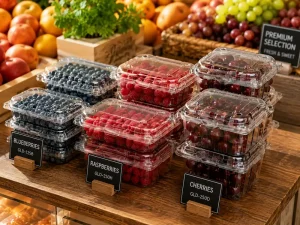
| Fresh produce packaging | Berries, grapes, fresh-cut fruit, apple packs, kiwi packs | Ventilation, visibility, crush resistance, retail display | fresh produce packaging containers |
| Bakery containers | Cakes, cupcakes, muffins, pastries, cake slices | Dome height, anti-crush space, display clarity, portion protection | bakery containers |
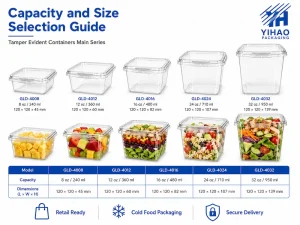
| Tamper-evident containers | Grab-and-go foods, refrigerated items, retail safety packs | Security perception, tear-strip design, shelf confidence | tamper-evident containers |
| Deli and salad containers | Salads, fruit mixes, deli sides, chilled meals, snacks | Lid fit, clarity, stackability, portion range | deli and salad containers |
| Cold cups and lids | Iced coffee, juice, lemonade, matcha, refreshers, smoothies | Cup clarity, lid compatibility, drink presentation | cold cups and lids |
| Microwave-safe containers | Prepared meals, hot takeaway, deli meals, food counter packs | Heat suitability, lid structure, meal separation, takeaway use | microwave safe containers |
How to Compare a Plastic Food Packaging Manufacturer
A good plastic food packaging manufacturer should be evaluated across five areas: product range, material knowledge, production control, customization capability, and export communication. If one of these areas is weak, the buyer may still receive samples, but bulk order stability becomes harder to manage.
Product Range and Category Depth
Category depth shows whether the factory understands real food packaging scenarios. A manufacturer with only one or two random containers may not understand wholesale buyer needs across retail display, takeaway, supermarket cold shelves, bakery counters, and foodservice distribution. A stronger partner offers connected product families such as fruit clamshells, salad bowls, hinged deli containers, bakery clamshells, cold cups, lids, tamper-evident packs, and prepared meal containers.
For example, a buyer sourcing fruit packaging can compare clear PET hinged clamshells with vented berry packs, multi-compartment fruit trays, and produce trays. A bakery buyer can compare cake domes, cupcake packs, pastry boxes, and bakery clamshell containers. This category logic saves time and improves sourcing accuracy.
Material and Structure Knowledge
Material knowledge is not a marketing phrase. It affects container clarity, toughness, hinge performance, lid fit, stacking strength, anti-fog needs, and food presentation. A professional plastic food packaging manufacturer should explain why a container works for chilled foods, why vent holes matter for produce, why dome height matters for bakery items, and why some foods need separate-lid structures instead of hinged clamshells.
The manufacturer should also be honest about application limits. PET is strong for clear cold-food display, but buyers should not treat every PET container as suitable for hot filling or microwave heating. A reliable supplier gives direct application guidance instead of using one material answer for every food type.
Production and Quality Control
Wholesale buyers should check how the factory controls repeat production. Important review points include material consistency, sheet forming stability, trimming precision, lid-fit control, hinge strength, stacking performance, visual clarity, packing method, carton protection, and final inspection workflow. A container that looks good in a single sample must still perform well across bulk production.
This is especially important for wholesale food containers because distributors and importers often resell to multiple end customers. A small defect rate creates many downstream complaints. Buyers should ask the factory how it checks container deformation, lid closing, edge trimming, contamination prevention, and carton packing before shipment.
Questions to Ask a PET Container Manufacturer
A professional PET container manufacturer should explain not only material clarity, but also how PET and RPET containers behave in real food packaging applications. PET and RPET are widely used for clear cold-food packaging because they provide strong transparency, attractive product visibility, and a clean retail appearance. They are especially suitable for chilled salads, fresh fruit, bakery displays, cold-case snacks, and grab-and-go foods.
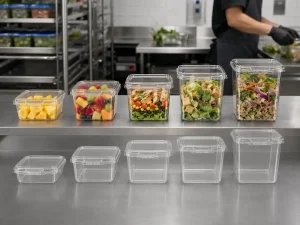
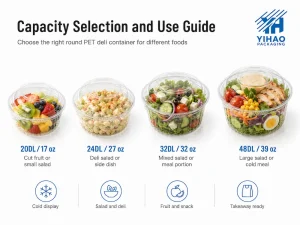
For buyers focused on clear presentation, PET hinged deli containers are a practical category to review because they support many chilled retail and takeaway food scenarios. For salads and fruit mixes, round PET containers often provide strong shelf visibility and easy portion recognition. For compact retail meals and snacks, square PET containers help buyers improve shelf efficiency and stacking logic.
Before ordering from a PET container manufacturer, wholesale buyers should ask:
- Is the container designed for chilled food, dry food, produce, bakery, salad, or grab-and-go display?
- Is the material PET, RPET, or another plastic structure?
- What level of clarity and rigidity can be expected in repeat production?
- Does the lid fit remain stable after stacking and transportation?
- Are there any temperature or application limits?
- Can the manufacturer recommend existing molds before custom development?
RPET also matters in modern sourcing because many buyers are under pressure to reduce virgin plastic use and improve sustainability communication. However, buyers should avoid vague “eco” claims. A practical approach is to ask the manufacturer what material options are available, what documentation can support the intended market, and whether the final packaging still meets clarity, strength, and food-contact expectations.
What to Expect from a Disposable Food Container Factory
A reliable disposable food container factory should support both product selection and production control. Disposable does not mean low-quality. In B2B food packaging, disposable containers still need stable material, clean forming, secure lid fit, smooth edges, safe stacking, and suitable carton packing.
Buyers should expect the factory to understand how different container structures perform in different channels. Supermarket display packaging needs clarity and shelf consistency. Cafe takeaway packaging needs quick handling and reliable closing. Bakery containers need height protection. Fresh produce packs need ventilation and visibility. Deli and salad containers need portion logic and stackability.
A factory-level partner should also help buyers reduce SKU confusion. When a buyer manages several food categories, the factory should be able to recommend container families that share practical size logic, lid compatibility, carton efficiency, or material consistency. This makes repeat sourcing easier and lowers the risk of buying unrelated products from too many suppliers.
OEM Food Packaging and Custom Food Packaging for Wholesale Buyers
OEM food packaging and custom food packaging are valuable when buyers need private-label differentiation, special dimensions, logo embossing, unique lid structures, printed branding, or packaging adapted to a specific food program. But customization should be handled carefully. Not every design idea is mold-friendly, cost-efficient, stackable, or suitable for mass production.
A capable manufacturer will help buyers evaluate whether to use existing molds, adjust packaging selection, or develop a new mold. Existing molds are usually better for speed, lower development risk, and easier sampling. New molds make sense when the buyer has stable demand, a clear product specification, and a packaging need that existing options cannot solve.
Custom food packaging makes stronger commercial sense when the buyer has one of the following needs:
- A private-label retail packaging program with stable repeat demand.
- A unique food portion that does not fit standard containers.
- A branded lid, base, embossing, or sleeve concept.
- A special compartment layout for snacks, fruit, bakery, or ready-to-eat meals.
- A packaging structure that improves shelf display or logistics efficiency.
- A long-term product line where packaging becomes part of brand identity.
For example, snack brands may need divided trays for fruit, nuts, and small bakery items. Foodservice buyers may need large bowls and lids for salad programs. Bakeries may need dome height to protect toppings. Supermarket buyers may need tamper-evident packaging to improve consumer confidence. In each case, the best manufacturer helps buyers compare standard and custom paths before committing budget.
Wholesale Food Containers: What Buyers Should Check Before Ordering
Buying wholesale food containers is different from buying small stock quantities. Bulk orders involve storage, shipping, distribution, repeat availability, and customer complaints if something fails. Buyers should review the container as both a product and a logistics unit.
Container-Level Checks
- Material clarity and color consistency.
- Base rigidity and wall strength.
- Lid fit and closing feel.
- Hinge stability for hinged containers.
- Stacking behavior before and after filling.
- Edge trimming and hand-feel safety.
- Ventilation design for fresh produce.
- Dome height for bakery protection.
- Compartment shape for separated foods.
- Leak resistance expectations for intended food types.
Carton and Shipment Checks
- Carton protection for long-distance transportation.
- Nested packing efficiency.
- Product count per carton.
- Carton size and warehouse handling.
- Pallet loading logic when applicable.
- Labeling and SKU identification.
- Damage risk during loading and unloading.
Buyers sourcing clear hinged deli containers, square deli containers, or PET salad bowls should test not only appearance but also filling, closing, stacking, and customer handling. A container that performs well in the buyer’s real workflow is more valuable than one that only looks good in a catalog photo.
Food-Contact and Compliance Questions for B2B Food Packaging
Food packaging buyers must treat compliance as a practical sourcing requirement. Requirements vary by market, material, application, and customer type, so buyers should avoid assuming that one document covers every use. A responsible food packaging container manufacturer should be able to discuss food-contact documentation, material information, and intended application boundaries.
For plastic food packaging, buyers should ask whether the supplier understands food-contact material expectations in the target market. In the United States, food-contact substances used in packaging are regulated through FDA frameworks. In the European Union, plastic materials intended to contact food are covered by specific rules such as EU Regulation No. 10/2011. Buyers should confirm documentation needs before shipment, especially when selling to retailers, distributors, or regulated markets.
Practical questions include:
- What material is used for the container and lid?
- Is the packaging intended for cold food, hot food, dry food, oily food, or acidic food?
- What food-contact documentation can be provided for the intended market?
- Are there temperature or use limitations?
- Can the factory provide material consistency across repeat orders?
- Does the packaging structure match the buyer’s filling and storage process?
The most reliable sourcing approach is simple: define the food, define the use condition, define the target market, then ask the manufacturer to recommend the suitable material and structure. This keeps the discussion concrete and prevents vague compliance claims.
How to Match Container Type to Food Application
Different food categories need different packaging design logic. A buyer sourcing one container for every food type usually ends up with poor performance. The right manufacturer helps buyers match structure to application.
Fresh Produce and Fresh-Cut Fruit
Fresh produce packaging needs visibility, ventilation, and protection. Berries and delicate fruit need clamshells that protect the product without hiding it. Fresh-cut fruit may require divided spaces, anti-fog considerations, or clear lids for chilled display. Buyers should review fresh-cut fruit containers when the product includes sliced apples, mango, grapes, fruit-and-nut packs, or ready-to-eat fruit portions.
Bakery and Dessert Packaging
Bakery packaging needs structure around height, shape, and decoration protection. Cake slices, rolls, muffins, cupcakes, croissants, and pastries each need different internal space. Buyers should avoid packaging that compresses frosting, smears cream, or leaves too much empty space. For dessert counters and chilled bakery displays, clear containers improve visual appeal and help shoppers understand portion size quickly.
For individual cake slices and dessert portions, clear high-dome cake slice containers create space for toppings and presentation. For muffins and cupcakes, compartment layout and dome height matter more than simple container volume.
Deli, Salad, and Ready-to-Eat Foods
Deli and salad packaging needs clarity, secure closing, stackability, and portion logic. A salad bowl should show freshness from the top and sides. A hinged deli container should close reliably for grab-and-go service. A square deli container should make shelf organization easier for supermarkets and cafes.
For chilled retail programs, buyers often compare large hinged deli containers with bowls, square containers, and separate-lid trays. The best choice depends on food shape, dressing separation, shelf placement, and consumer handling.
Tamper-Evident Food Packaging
Tamper-evident packaging supports consumer confidence in grab-and-go and retail chilled food environments. It is especially useful when products are displayed in open retail areas, convenience stores, supermarkets, and food counters. Buyers should review tear-strip design, opening experience, lid security, and shelf presentation.
For refrigerated grab-and-go foods, clear tamper-evident containers help combine product visibility with security perception. For multi-item programs, buyers should also consider whether a single-compartment or multi-compartment design improves the eating experience.
Cold Drinks and Lids
Cold drink packaging needs cup clarity, lid fit, and drink presentation. Iced coffee, cold brew, lemonade, juice, matcha, refreshers, smoothies, fruit tea, and sparkling fruit drinks each create different lid and cup requirements. A manufacturer with cup and lid category depth helps buyers avoid compatibility problems.
For beverage programs, buyers can review PET cold cups together with cold cup lids. This combined approach reduces the risk of buying cups and lids from unrelated systems that do not fit properly.
Factory Audit Checklist for Wholesale Buyers
Before placing a serious wholesale order, buyers should use a factory checklist. This does not need to be complicated, but it should be direct. The goal is to confirm whether the manufacturer can support the buyer’s real business instead of only offering a low quote.
| Audit Area | What to Check | Why It Matters |
|---|---|---|
| Product Range | Existing molds, food categories, lid systems, size range | Shows whether the factory can support repeat sourcing across categories |
| Material Capability | PET, RPET, PP, clarity, heat suitability, application limits | Prevents material mismatch and wrong-use packaging |
| Production Stability | Forming control, trimming, stacking, lid-fit consistency | Protects bulk order quality |
| Customization | Logo, embossing, printing, mold development, packaging design | Supports private-label and OEM projects |
| Food-Contact Support | Documentation, material declaration, intended use information | Supports market access and customer requirements |
| Export Service | Communication, sample handling, carton data, shipment planning | Improves B2B order efficiency |
Buyers who want a more direct manufacturer review can also evaluate the food packaging manufacturer page before sending detailed RFQs. This helps align product expectations, production capability, and long-term cooperation potential.
Red Flags When Choosing a Food Packaging Container Manufacturer
Not every supplier that offers a low price is ready for long-term wholesale cooperation. Before placing a bulk order, buyers should watch for warning signs that indicate weak production control, poor application knowledge, or unreliable communication.
- The supplier cannot clearly explain material differences between PET, RPET, and PP.
- The quotation is low, but sample quality, lid fit, edge trimming, and carton packing are unclear.
- The factory uses vague terms such as “food grade” without explaining documentation support.
- The supplier recommends the same container for cold food, hot food, bakery, and produce applications.
- The manufacturer cannot provide clear answers about existing molds, customization limits, or repeat production control.
- The sales team avoids discussing real application details such as temperature, food type, shelf display, filling process, and stacking.
- The supplier cannot explain how the product will be packed, counted, protected, and identified for wholesale shipment.
A serious food packaging container manufacturer should not avoid technical questions. Good manufacturers help buyers identify the right container, while weak suppliers only push whatever product is easiest to sell.
How to Build a Strong RFQ for Food Packaging Containers
A vague RFQ creates vague answers. If buyers only ask “Please quote food containers,” suppliers cannot recommend accurately. A strong RFQ gives the manufacturer enough context to suggest the right structure, material, and packaging direction.
A practical RFQ should include:
- Food type: salad, berries, cut fruit, bakery, prepared meal, cold drink, dessert, snack, deli food.
- Food condition: chilled, frozen, room temperature, hot, oily, wet, dry, acidic, or mixed.
- Use scenario: supermarket shelf, cafe takeaway, foodservice, delivery, meal prep, bakery counter, export retail.
- Material preference: PET, RPET, PP, or open recommendation.
- Structure preference: hinged lid, separate lid, dome lid, flat lid, tamper-evident, vented, compartment tray.
- Approximate size or food portion.
- Branding requirement: plain, label-ready, printed, embossed, sleeve, or private label.
- Target market and documentation expectation.
- Estimated order quantity and repeat order plan.
- Carton, pallet, or shipping requirements if already known.
With this information, a food packaging container manufacturer can respond with better recommendations. It also helps the buyer compare suppliers fairly because each quotation is based on the same use case.
How a Food Packaging Supplier Supports Long-Term B2B Orders
A strong food packaging supplier helps buyers build a packaging system, not just complete one transaction. For distributors, this means stable categories and repeatable SKUs. For supermarkets, it means consistent packaging across fresh produce, deli, bakery, and grab-and-go sections. For cafes and beverage brands, it means cup and lid systems that support menu growth. For foodservice buyers, it means reliable containers for daily operations.
Long-term cooperation also improves new product development. Once the manufacturer understands the buyer’s market, customer base, food categories, and order rhythm, recommendations become faster and more accurate. This is especially valuable for buyers expanding from standard containers into private-label packaging, seasonal packaging, or channel-specific packaging lines.
A dependable supplier should help buyers reduce sourcing pressure by offering stable product families, clear communication, application-based recommendations, and practical support for repeat orders. This is where a manufacturer relationship becomes more valuable than one-time price comparison.
Buyer Decision Framework: How to Choose the Right Manufacturer
Wholesale buyers can use the following framework before selecting a food packaging container manufacturer:
- Define the food application. Start with the food type, temperature, moisture, oil content, portion size, and display channel.
- Choose the material direction. PET/RPET for clear chilled display, PP for suitable heat and microwave applications, and other materials only when they match the use case.
- Select the structure. Hinged, separate lid, dome lid, flat lid, tamper-evident, vented, compartment, bowl, cup, or tray.
- Check existing molds first. Existing product families reduce risk and speed up sampling.
- Test real-use performance. Fill, close, stack, transport, display, and open the container in actual conditions.
- Review documentation needs. Confirm material and food-contact support for the intended market.
- Evaluate factory communication. Choose a partner that answers clearly and understands B2B procurement.
- Plan repeat orders. Confirm how the supplier supports consistent quality, packaging, and future product expansion.
Final Note / Practical Takeaway
FAQ
1. What should wholesale buyers check before choosing a food packaging container manufacturer?
Wholesale buyers should check product range, material capability, production stability, lid-fit control, food-contact documentation support, customization options, sample quality, export communication, and repeat order reliability. The best manufacturer should understand both packaging structure and real food application.
2. Is a PET container manufacturer suitable for all food packaging applications?
No. PET is highly useful for clear chilled food display, fresh produce, salads, bakery items, cold-case snacks, and many grab-and-go applications. For hot foods or microwave applications, buyers should review suitable PP or microwave-safe packaging structures instead of assuming PET fits every use.
3. When should buyers choose custom food packaging instead of standard containers?
Buyers should choose custom food packaging when they have stable demand, a clear product specification, private-label needs, special portion requirements, or a packaging structure that existing molds cannot solve. For early-stage projects, standard containers are often faster and lower risk.
4. What is the difference between a disposable food container factory and a food packaging supplier?
A disposable food container factory usually controls production, molds, forming, quality checks, and packaging processes. A food packaging supplier may be a factory, trading company, or sourcing partner. Buyers should evaluate actual capability rather than relying only on the company label.
5. How can buyers improve an RFQ for wholesale food containers?
Buyers should include food type, use temperature, application channel, material preference, structure preference, approximate size, branding needs, target market, documentation expectations, and estimated order quantity. A detailed RFQ helps the manufacturer recommend the right container and quote more accurately.
References
- U.S. Food and Drug Administration, Packaging & Food Contact Substances.
- U.S. Food and Drug Administration, Understanding How FDA Regulates Substances that Come into Contact with Food.
- European Commission / EUR-Lex, Commission Regulation (EU) No. 10/2011 on plastic materials and articles intended to come into contact with food.
- U.S. Environmental Protection Agency, Sustainable Packaging.
- U.S. Environmental Protection Agency, Sustainable Management of Plastics.
- Ellen MacArthur Foundation, Reuse: Rethinking Packaging.
- ISO, Food safety and packaging-related management system references.
- FAO / UNEP food systems and packaging-related public resources.
Deep-Dive Insights for B2B Food Packaging Buyers
How should buyers compare manufacturers? Compare them by product category depth, material knowledge, factory communication, documentation support, and repeat production control. A strong manufacturer reduces sourcing risk before bulk orders begin.
Why does material choice affect wholesale success? Material affects clarity, rigidity, lid fit, temperature suitability, product appearance, and customer confidence. PET, RPET, and PP each serve different packaging roles, so buyers should select by food application rather than by price alone.
What is the practical role of OEM packaging? OEM packaging helps buyers build private-label value when standard containers cannot fully support the product, portion, display, or branding strategy. It works best when the buyer has stable demand and a clear product brief.
Which option is safer for first orders? Existing molds are usually safer for first orders because they reduce development time, simplify sampling, and lower technical risk. Custom molds are better for mature packaging programs with repeat demand.
What should buyers consider before scaling orders? Buyers should test filling, closing, stacking, carton packing, warehouse handling, shelf display, and customer use. Scaling should happen only after the packaging performs well in the real operating environment.
What makes a food packaging supplier valuable long term? A valuable supplier helps buyers reduce repeated sourcing work, supports category expansion, recommends suitable structures by food type, and maintains stable quality across repeat wholesale orders.
© YIHAO Packaging. All rights reserved. All articles, product images, packaging designs, technical specifications, and website materials are protected by copyright. Unauthorized copying, reproduction, redistribution, modification, or commercial use is strictly prohibited without prior written permission.