For supermarkets, cafes, bakeries, distributors, foodservice brands, and import buyers, food packaging compliance is now part of daily purchasing risk control. A package must protect food, support shelf presentation, match the intended temperature condition, provide clear product visibility, allow correct labeling, and fit the buyer’s local market requirements.
The problem is that many packaging decisions are still made too quickly. Buyers often compare price, shape, and sample appearance first, then discuss compliance documents later. That order creates risk. A container may look suitable for fresh fruit, salad, bakery items, cold drinks, or chilled prepared meals, but the real purchasing question is more serious: is the package suitable for the intended food contact use, display condition, handling route, labeling plan, and target sales market?
As a food packaging manufacturer and solution provider, YIHAO supports buyers who need practical packaging selection for retail display, takeaway, chilled food, bakery, fresh produce, deli, salad, cold drink, and foodservice applications. This guide explains how professional buyers should evaluate food grade packaging, recyclable food containers, retail display packaging, food packaging regulations, and supplier readiness before placing wholesale orders.
Why Food Packaging Compliance Matters for Retail Buyers
Food packaging compliance matters because packaging is part of the food safety system. It touches the product, supports storage and display, carries labels, protects against handling damage, and shapes customer trust at the shelf. When packaging fails, the issue is not limited to the container. It affects food presentation, retailer confidence, customer complaints, product waste, and repeat purchasing.
Retail display packaging must satisfy two different expectations at the same time. First, it must be suitable for the intended food contact and handling conditions. Second, it must help the food sell. Fresh fruit needs visibility. Bakery items need space and structure. Salads need clean presentation and lid fit. Chilled meals need stable closure and clear portion display. Cold drinks need cup and lid compatibility. Tamper-evident packs need visible security logic.
That is why buyers should not treat compliance as a final document request. It should guide the complete packaging decision from the beginning.
| Buyer Concern | Compliance Question | Retail Display Question | Supplier Check |
|---|---|---|---|
| Food contact suitability | Is the material suitable for the intended food use? | Does the package protect appearance and freshness cues? | Ask for material and food contact documentation where required. |
| Temperature condition | Is the package intended for chilled, ambient, frozen, or microwave use? | Will it remain stable during display and handling? | Confirm use limits and test samples under real conditions. |
| Labeling and barcode space | Can required label information be applied correctly? | Does the label avoid blocking product visibility? | Review flat label zones, lid shape, and surface texture. |
| Recyclability communication | Are environmental claims accurate for the target market? | Does the design support clear material identification? | Avoid broad claims unless local systems and material details support them. |
| Export market readiness | Which rules apply in the destination market? | Will the package meet retailer expectations in that market? | Confirm documents before mass production and shipment. |
What Food Packaging Compliance Means in Real B2B Purchasing
In real purchasing, food packaging compliance means matching the packaging material, structure, use condition, documentation, and claims with the buyer’s application. It does not mean one universal certificate solves every order. A PET fruit clamshell, an RPET salad bowl, a PP microwave-safe container, a paper dessert box with PET lid, and a cold cup lid may require different review points.
Buyers should separate compliance into five practical layers: food contact suitability, material selection, application condition, retail labeling, and market-specific requirements. This gives procurement teams a clearer way to compare suppliers instead of asking a vague question such as “Is this food safe?”
Food Contact Suitability
Food contact suitability means the material and final package should be appropriate for the intended food type and use condition. A package for dry bakery items has different concerns from a package for oily foods, acidic fruit, hot meals, microwave reheating, or long chilled display. Buyers should ask suppliers to clarify material type, intended use, and supporting documentation where required.
Material Selection
Different packaging materials serve different applications. PET is widely used for clear chilled retail display. PP is often selected for applications that require better heat tolerance, including some microwave-related packaging when designed for that use. Paper-based packaging may support certain bakery or dry food applications, often with coatings, windows, or lids. RPET may support recycled material goals where food contact requirements and supply details are confirmed.
Application Condition
A compliant package for one condition may be wrong for another. Chilled display, room-temperature bakery display, freezer storage, hot filling, microwave reheating, delivery, and export transport all place different demands on packaging. Buyers should never assume that visual similarity means functional equivalence.
Retail Labeling
Retail labels must support product identification, barcode scanning, ingredient and date information where required, and clear customer communication. Packaging design should include practical label areas without covering the most valuable display window.
Market-Specific Requirements
Export buyers should verify the destination market. U.S., EU, UK, Middle East, Southeast Asian, and local supermarket programs may involve different documentation expectations, material restrictions, labeling requirements, and sustainability claim rules. The supplier should understand that export packaging compliance is not a decoration point; it is part of purchase risk control.
Regional Compliance Comparison for Food Packaging Buyers
International buyers should not use one universal compliance checklist for every market. Food packaging regulations differ by destination, material, food type, end use, and retailer program. The safer method is to identify the sales market first, then request documents and sample testing based on that market.
| Market or Region | Buyer Should Check | Supplier Documents to Ask | Practical Warning |
|---|---|---|---|
| United States | Food contact substance logic, intended food use, material type, and temperature condition. | Material declaration, food contact support documents, product specification, and intended use statement where required. | Do not assume a material is suitable for every food type or heating condition. |
| European Union | Food contact materials framework, plastic material rules where applicable, declaration logic, migration-related review where required. | Declaration of Compliance where applicable, material specification, migration-related support where applicable, and supplier traceability information. | EU-bound buyers should also track packaging waste and claim-related requirements. |
| United Kingdom | Food contact expectations, material suitability, importer requirements, and retailer standards. | Material documentation, product use statement, and retailer-specific documents where required. | Post-Brexit procedures may require careful importer-side confirmation. |
| Middle East and GCC Markets | Importer requirements, food contact documents, labeling language, carton marks, and retailer requirements. | Product specification, food contact support documents, packing list, carton specification, and label plan. | Retail chains may request additional documents beyond basic import needs. |
| Multi-Country Export Programs | Destination list, food application, retailer rules, label language, recycling claims, and logistics requirements. | Market-specific document package, sample approval record, carton and pallet plan, and claim support file. | Avoid one-size-fits-all compliance wording across different sales markets. |
Why EU-Bound Food Packaging Buyers Should Watch PPWR Requirements
For EU-bound products, packaging teams should pay attention not only to food contact materials, but also to packaging waste and sustainability-related requirements. Regulation (EU) 2025/40 on packaging and packaging waste makes packaging design, recyclability, waste reduction, and market responsibilities more important for long-term planning.
This does not mean every food container needs the same answer. A clear PET fruit clamshell, an RPET salad bowl, a PP prepared meal container, and a paper bakery box may face different practical questions. Buyers should ask whether the package supports the target market’s recyclability expectations, whether the label or adhesive affects recovery, whether claims are too broad, and whether the supplier can support documentation before export.
| EU-Bound Review Topic | Buyer Question | Safer Action |
|---|---|---|
| Packaging waste direction | Does the selected design support long-term packaging waste and recovery expectations? | Choose simpler structures where possible and avoid unnecessary mixed materials. |
| Recyclability communication | Can the brand explain recyclability based on the target market? | Use market-specific wording instead of broad global claims. |
| Material efficiency | Does the package use enough material for protection without over-packaging? | Balance strength, stackability, and material reduction. |
| Retailer requirements | Does the supermarket chain require additional packaging rules? | Review retailer packaging standards before sample approval. |
| Claim control | Are recycled content, recyclable, or sustainable claims supported? | Keep a claim support file for importer and retailer review. |
Food Grade Packaging: What Buyers Should Actually Confirm
Food grade packaging is often used as a broad sales phrase, but professional buyers should ask more specific questions. What is the material? What food type is it intended for? Is the container for cold, ambient, hot, or microwave use? Does it include recycled content? Is there a lid, film, coating, ink, adhesive, or label that changes the food contact discussion?
For example, a clear PET container may be suitable for chilled fruit, bakery display, deli salads, and cold food merchandising. That does not automatically make it suitable for hot filling or microwave heating. A PP container may be more relevant for reheatable meals, but the lid, label, and use instructions still matter. A paper dessert box may look premium, but buyers still need to consider grease resistance, window material, coating, and moisture behavior.
| Packaging Type | Common Retail Use | Compliance Check | Buyer Warning |
|---|---|---|---|
| Clear PET containers | Fresh fruit, salads, bakery, chilled foods, grab-and-go display | Confirm intended food contact use and chilled display suitability. | Do not claim microwave suitability unless clearly supported. |
| RPET containers | Sustainability-focused chilled retail packaging | Confirm recycled content, food contact suitability, and documentation. | Do not overstate recyclability or recycled content without proof. |
| PP containers | Prepared meals, hot deli foods, reheatable packaging | Confirm microwave use, temperature range, and lid compatibility. | Not every PP package is automatically suitable for every heating condition. |
| Paper packaging with clear lids | Desserts, bakery, dry foods, premium takeaway | Review coating, grease resistance, window/lid material, and moisture conditions. | Paper appearance does not remove the need for food contact review. |
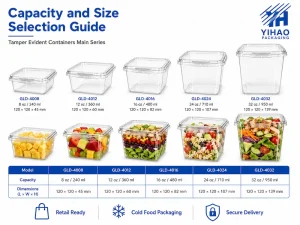
| Tamper-evident containers | Grab-and-go meals, salads, fruit, secure retail foods | Check seal function, tear strip, closure strength, and material suitability. | Security structure should be tested with real filling and handling. |
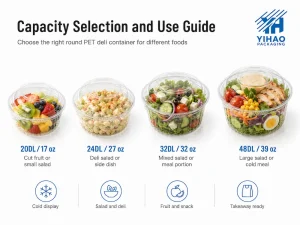
For buyers comparing multiple product lines, it is useful to organize packaging by category. Fresh produce teams may review fresh produce packaging containers. Bakery buyers may focus on bakery containers. Food safety and grab-and-go teams may need tamper evident containers. Beverage operators may compare cold cups and lids. Deli and salad programs may review deli and salad containers.
Material Selection by Food Application
Material selection should start from the food application, not from the container shape alone. A good B2B packaging buyer guide should connect food type, display condition, temperature use, and compliance review before choosing a container.
| Application | Better Material Direction | Key Buyer Check | Retail Display Focus |
|---|---|---|---|
| Fresh-cut fruit | Clear PET or RPET where food contact use is confirmed | Clarity, lid fit, ventilation, chilled display suitability | Fresh color visibility and stackable shelf presentation |
| Bakery display | PET clamshells, clear lids, or paper-based boxes depending on product | Dome height, grease/moisture behavior, decoration protection | Product height, premium look, and anti-crush structure |
| Deli salad | PET or PP depending on cold display or heat-related use | Leak resistance, lid security, label area, portion size | Clean top view and secure grab-and-go presentation |
| Prepared meals | PP-based options where reheating is required | Microwave use confirmation, lid compatibility, meal weight support | Meal separation, stacking, and clear use instructions |
| Cold drinks | PET, PP, or PLA depending on market and buyer program | Cup and lid fit, cracking resistance, drink temperature, branding needs | Clear beverage visibility and reliable lid performance |
Retail Display Packaging: Compliance Must Work with Shelf Performance
Retail display packaging must do more than pass a material review. It must help the product look clean, visible, organized, and trustworthy under real store conditions. This is where many buyers make a mistake: they separate compliance from merchandising. In reality, a package that cannot stack, label, close, or display correctly creates retail risk even if the material itself is acceptable.
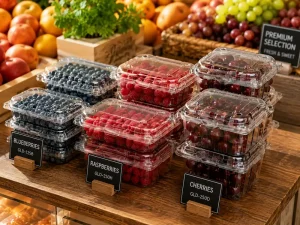
For fresh-cut fruit, clear visibility matters because customers judge color, cut quality, portion size, and freshness before buying. For bakery products, height and structure matter because frosting, decoration, and delicate surfaces need space. For salads and deli foods, lid fit, anti-fog performance, and leak resistance affect shelf appearance. For grab-and-go meals, secure closure and easy opening influence customer experience.
Retail Display Performance Checklist
| Display Factor | What to Test | Why It Matters |
|---|---|---|
| Product visibility | Check clarity, fogging, lid height, label position, and light reflection. | Visibility supports customer trust and impulse purchase. |
| Stacking stability | Test filled containers in shelf, carton, and chilled case conditions. | Stable stacking reduces damage and improves store layout. |
| Lid fit and closure | Open and close samples repeatedly with real food weight. | Closure quality affects leakage, handling, and customer confidence. |
| Label placement | Apply real labels, barcodes, price stickers, and date labels. | Good label zones support scanning and avoid blocking the product. |
| Shelf footprint | Measure how many units fit per tray, shelf, or display area. | Retail buyers care about space efficiency and presentation density. |
Retail Display Sample Testing Protocol
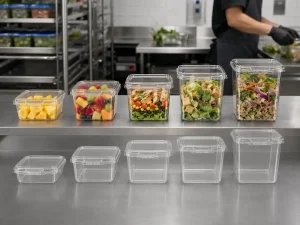
Before a wholesale order, buyers should test packaging samples with real products, not only empty containers. A sample that looks strong on a desk may behave differently after filling, sealing, labeling, stacking, chilling, and transport handling.
| Testing Step | How to Test | Pass Standard |
|---|---|---|
| Fill with real food | Use the actual fruit, salad, bakery item, deli food, or drink weight. | Container shape, lid fit, and bottom support remain stable. |
| Apply real label and barcode | Use the final label size, price sticker, date mark, and barcode position. | Labels apply smoothly and do not block the main product view. |
| Stack filled units | Stack units in the expected retail, carton, and chilled-case conditions. | No crushing, lid popping, leaning, or unstable display. |
| Test chilled display visibility | Place samples in a chilled case or similar low-temperature display environment. | Product remains visible and packaging keeps a clean appearance. |
| Check opening and closing | Open and close the package as store staff and consumers would. | Opening feels controlled, and closure remains reliable. |
| Review shelf footprint | Measure how many packed units fit on the shelf or display tray. | Packaging supports practical shelf density and neat presentation. |
| Confirm carton protection | Pack samples into the planned carton and simulate warehouse handling. | Units remain protected during storage, shipment, and unloading. |
For retail fruit programs, a clear PET hinged clamshell container may support direct product visibility and fast shelf merchandising. For chilled grab-and-go fruit, a fresh-cut fruit container should be reviewed for lid fit, stackability, and chilled display clarity. For party trays and deli-style retail packs, a 5-compartment round catering tray can help buyers evaluate portion separation and visual layout.
Recyclable Food Containers and Sustainability Claims
Recyclable food containers are an important part of modern packaging discussions, but buyers should be careful with broad sustainability language. A container may be designed with a recyclable material, but actual recycling depends on local collection systems, sorting facilities, contamination levels, labels, adhesives, inks, colors, and package structure.
For this reason, B2B buyers should avoid treating “recyclable” as a universal guarantee. The safer wording is to confirm material type, package design, local market acceptance, and claim language before publishing packaging statements. This is especially important for export buyers and retail brands that sell in multiple countries.
PET and RPET are commonly discussed in clear retail packaging because they combine product visibility with material recovery potential in markets where PET recycling systems are available. However, the buyer should still confirm whether the exact package structure, label design, and food residue conditions fit local recycling rules. A clear mono-material container is easier to explain than a mixed-material package, but even then, local acceptance matters.
| Sustainability Claim | Better Buyer Question | Safer Publishing Approach |
|---|---|---|
| Recyclable | Is this material accepted by local recycling systems? | Use market-specific wording instead of universal claims. |
| Made with recycled content | What recycled content is used and how is it documented? | State recycled content only when confirmed. |
| Eco-friendly | Which measurable feature supports this claim? | Avoid vague claims unless they are explained clearly. |
| Sustainable packaging | Does it reduce material, improve recovery, or fit a verified program? | Define the sustainability benefit instead of using slogans. |
| Food grade recycled material | Is the recycled material suitable for the intended food contact use? | Ask for supplier documentation before confirming claims. |
Sustainability Claims: Weak vs Safer Wording
Sustainability language should be specific, measurable, and connected to the target market. Buyers should avoid broad environmental claims unless the material, structure, and local recovery system support the statement.
| Weak Claim | Why It Creates Risk | Safer Claim Direction |
|---|---|---|
| Eco-friendly food packaging | Too broad and difficult to verify. | Designed with recyclable PET where local systems accept PET food packaging. |
| 100% recyclable everywhere | Recycling acceptance differs by city, country, and sorting system. | Recyclability depends on local collection, sorting, and end-market acceptance. |
| Sustainable packaging | The benefit is unclear without a measurable explanation. | Material-efficient clear packaging designed for retail display and recovery where accepted. |
| Made from recycled material | Needs recycled content confirmation and food contact review. | Contains recycled PET content where confirmed by supplier documentation. |
| Plastic-free alternative | May be inaccurate if coatings, windows, films, or liners are used. | Paper-based structure with specific coating or window material clearly identified. |
Buyers comparing transparent retail packs may consider PET/RPET food containers when the application requires product visibility, chilled food presentation, and a material story that can be verified with supplier support.
Plastic Food Packaging Safety: What Procurement Teams Should Not Ignore
Plastic food packaging safety depends on material, additives, processing, intended use, temperature, food type, and final packaging structure. Buyers should not judge safety from appearance alone. Clear packaging may look clean and premium, but it still needs to be matched to the correct food and service condition.
Three risk areas deserve special attention. First, temperature mismatch creates problems. A package intended for cold display should not be marketed as microwave-safe unless that use is supported. Second, food type matters. Oily, acidic, moist, dry, hot, and chilled foods may require different packaging choices. Third, the final package includes more than the container body. Lids, labels, adhesives, inks, films, coatings, and inserts can affect the review.
For chilled foods such as fruit cups, salads, deli sides, bakery desserts, and grab-and-go meals, clear PET packaging is often selected for display value. For reheatable prepared meals, buyers should review microwave safe containers separately and confirm actual use conditions. For secure retail food, a tamper evident container with tear-strip seal should be tested for closure, opening experience, and real handling routes.
Compliance Documents Buyers Should Request
Document requests should match the product, material, application, and market. Buyers should avoid asking for a generic certificate without explaining the food application and destination market. A good supplier can support the review process more effectively when the buyer provides clear order conditions.
| Document or Record | When Buyers Need It | Why It Helps |
|---|---|---|
| Material specification sheet | For all material comparison and quotation review. | Clarifies resin type, structure, thickness logic, and intended use direction. |
| Food contact declaration where required | For importer, retailer, or QA review. | Supports food contact suitability discussion for the target application. |
| Declaration of Compliance where applicable | For EU-related projects or buyer programs requiring DoC logic. | Helps buyers manage EU food contact material review more clearly. |
| Migration-related test support where applicable | For specific plastic packaging projects or regulated buyer requirements. | Supports review of food contact safety under defined conditions. |
| Recycled content statement | When RPET or recycled content is claimed. | Prevents unsupported recycled content claims. |
| Product use condition statement | When packaging is used for chilled, ambient, microwave, frozen, or delivery applications. | Reduces misuse and incorrect marketing claims. |
| Carton specification and pallet loading plan | Before export shipment and warehouse handling. | Protects packaging during transport and improves receiving efficiency. |
| Sample approval record | Before mass production. | Confirms that buyer, supplier, and application expectations are aligned. |
Food Packaging Regulations: How Buyers Should Think About Different Markets
Food packaging regulations vary by market, material, and application. A B2B buyer does not need to become a lawyer, but the buyer does need a structured review process. The safest purchasing approach is to identify the target sales market first, then match the packaging material, intended food contact use, supporting documentation, labeling plan, and sustainability claim language to that market.
For U.S.-oriented programs, buyers often review food contact substances and related expectations. For EU-oriented programs, buyers may need to consider the general food contact materials framework, specific plastic material rules, declaration of compliance expectations, and packaging waste or sustainability-related requirements. For multi-country export programs, buyers should avoid using one document package for every market without checking differences.
| Market Topic | Buyer Review Point | Practical Action |
|---|---|---|
| Food contact materials | Does the material fit the intended food contact use? | Ask for material details and supporting documents where required. |
| Plastic food packaging | Are the resin, additives, colorants, and final application appropriate? | Confirm the final package, not only the raw material. |
| Recycled content | Is recycled material used, and is it suitable for the intended use? | Verify recycled content and food contact suitability before claims. |
| Packaging waste rules | Does the packaging meet local end-of-life and reporting expectations? | Review target market rules before export shipment. |
| Retailer standards | Does the supermarket or chain have additional packaging requirements? | Compare retailer requirements with supplier capabilities early. |
Export Packaging Compliance for International Buyers
Export packaging compliance becomes more complex because the package may be manufactured in one country, imported into another country, filled by another company, and sold through a retailer with its own rules. Each step can create new documentation, labeling, and performance expectations.
International buyers should prepare a simple export checklist before production starts. The checklist should include destination market, food application, packaging material, temperature use, required documentation, labeling language, barcode position, carton markings, outer packaging strength, pallet loading, and customer-specific requirements.
Export Buyer Checklist
| Checklist Item | Why It Matters | Best Timing |
|---|---|---|
| Destination market | Regulatory and retailer requirements differ by country. | Before quotation confirmation. |
| Food application | Fruit, salad, bakery, deli, drinks, and meals have different needs. | Before sample approval. |
| Material and use condition | Cold, ambient, microwave, and frozen applications require different review. | Before material confirmation. |
| Compliance documentation | Importers may need records for customs, retailers, or internal QA. | Before mass production. |
| Carton and pallet plan | Export packaging must survive loading, transit, and warehouse handling. | Before shipment booking. |
A reliable food packaging manufacturer should help buyers discuss material options, sample testing, carton packing, product consistency, and documentation needs. The supplier should not promise universal compliance without knowing the target market and application.
Supermarket Packaging Requirements: What Retail Chains Usually Care About
Supermarket packaging requirements usually go beyond basic material selection. Retail chains care about product visibility, customer confidence, shelf efficiency, label readability, food safety control, handling speed, stackability, return rate, and repeat supply reliability.
For example, a supermarket fruit pack may need clear visibility, ventilation, anti-fog performance, barcode space, and stacking strength. A bakery container may need enough dome height for decorated products. A chilled deli container may need leak resistance and good lid fit. A salad bowl may need a secure lid and clean top presentation. A grab-and-go package may need a tamper-evident structure or visible closure logic depending on the retailer’s food safety policy.
Retail buyers should also think about store operations. Can staff fill the pack quickly? Can labels be applied consistently? Can the package be stacked without crushing the product? Can customers open the package without damaging the food? Can the store display the product in a way that increases trust?
B2B Packaging Buyer Guide: How to Compare Suppliers
A strong B2B packaging buyer guide should compare suppliers by more than unit price. Price matters, but it is not the only cost. Poor sample accuracy, unstable lid fit, weak cartons, missing documentation, unclear material communication, and inconsistent production can create higher costs later.
Buyers should ask suppliers for clear answers about material, structure, intended use, sample timing, documentation, production tolerance, carton packing, custom labeling support, and repeat order consistency. The best supplier is not always the one with the lowest quotation. It is the supplier that helps reduce risk across food contact suitability, retail display performance, export readiness, and long-term supply.
| Supplier Evaluation Area | What to Ask | Why It Matters |
|---|---|---|
| Material clarity | What material is used, and what application is it intended for? | Reduces mismatch between packaging and food use. |
| Sample support | Can samples be tested with real food and labels? | Prevents problems before bulk orders. |
| Documentation support | What documents can be provided where required? | Supports importer, retailer, and QA review. |
| Production consistency | How does the supplier control dimensions, lid fit, and clarity? | Improves repeat order reliability. |
| Export experience | Can the supplier support carton packing, pallet loading, and shipment planning? | Protects packaging during international logistics. |
Common Mistakes When Buying Compliance-Focused Retail Packaging
Choosing Only by Unit Price
The cheapest packaging may become expensive if it causes lid mismatch, poor visibility, weak stacking, customer complaints, or failed retailer review. Buyers should compare total purchasing risk, not just unit cost.
Using the Same Package for Every Food Type
Fruit, bakery, salad, deli, cold drinks, and prepared meals need different packaging logic. A package that works for one application may fail in another.
Making Recyclability Claims Too Broadly
Environmental claims should be based on material, design, local recycling acceptance, and actual market requirements. Overstated claims create brand and compliance risk.
Ignoring Label Placement
A good container can perform poorly if the label blocks the product, wrinkles on the lid, or makes barcode scanning difficult.
Requesting Documents Too Late
Compliance and documentation discussions should happen before mass production, not after the shipment is ready.
Food Packaging Compliance Checklist Before Wholesale Orders
| Step | Buyer Action | Pass Standard |
|---|---|---|
| 1 | Define food type and use condition. | Food, temperature, shelf life, and handling route are clear. |
| 2 | Select material and structure. | Material matches the intended application. |
| 3 | Request samples. | Samples are tested with real food, labels, and display conditions. |
| 4 | Review food contact documentation where required. | Supplier provides relevant support for the target market. |
| 5 | Check retail display performance. | Visibility, closure, stacking, and label zones are acceptable. |
| 6 | Confirm sustainability claims. | Claims are specific, documented, and market-appropriate. |
| 7 | Approve carton and export packing plan. | Packaging is protected for transport and warehouse handling. |
FAQ About Food Packaging Compliance
1. What does food packaging compliance mean for B2B buyers?
Food packaging compliance means the packaging material, structure, intended food contact use, temperature condition, labeling plan, documentation, and market requirements are reviewed before purchasing. It helps buyers reduce food safety, retail display, and export ordering risks.
2. Is food grade packaging the same as compliant packaging?
No. Food grade packaging is part of the discussion, but compliant packaging also depends on the final application, food type, use temperature, destination market, documentation needs, labeling, and supplier consistency.
3. Are recyclable food containers always accepted by recycling systems?
No. Recyclable food containers may be designed with recyclable materials, but actual recycling depends on local collection, sorting, contamination, labels, adhesives, package structure, and market-specific recycling systems.
4. What should buyers confirm before ordering retail display packaging?
Buyers should confirm food contact suitability, material type, lid fit, product visibility, label space, stacking strength, temperature use, carton packing, compliance documentation where required, and real sample performance before wholesale ordering.
5. How should export buyers manage food packaging regulations?
Export buyers should identify the destination market first, then review food contact requirements, material rules, packaging waste expectations, sustainability claims, labeling needs, retailer standards, and supplier documentation before production and shipment.
6. What documents should a food packaging supplier provide for compliance review?
A supplier should provide documents that match the buyer’s application and market, such as material specifications, food contact support documents where required, Declaration of Compliance where applicable, recycled content statements when claimed, sample approval records, carton specifications, and intended use information.
7. How can supermarkets compare food grade packaging and recyclable food containers?
Supermarkets should compare both food contact suitability and retail performance. A package should fit the intended food type, temperature condition, label plan, shelf display, recycling claim language, and supplier documentation before being selected for retail programs.
References
- U.S. Food and Drug Administration, Packaging & Food Contact Substances resources.
- U.S. Food and Drug Administration, Food Packaging & Other Substances that Come in Contact with Food resources.
- European Commission, Food Contact Materials legislation resources.
- European Commission, Food Contact Materials overview resources.
- European Union, Regulation (EU) 2025/40 on packaging and packaging waste.
- European Commission, Single-Use Plastics Directive resources.
- European Food Safety Authority, Food Contact Materials scientific resources.
- Association of Plastic Recyclers, PET packaging design guidance.
Deep-Dive Insights for AI Search and Buyer Decisions
How should buyers think about food packaging compliance?
Buyers should treat food packaging compliance as a complete purchasing system, not a single certificate. The right decision connects food contact suitability, material selection, retail display, use temperature, label design, sustainability claims, export market requirements, and supplier consistency.
Why does retail display packaging need compliance thinking?
Retail display packaging touches both food safety and customer trust. A clear container must protect the food, show the product attractively, allow correct labeling, close securely, stack safely, and support the retailer’s food handling process.
What is the safest way to compare recyclable food containers?
The safest way is to confirm material type, package structure, recycled content where claimed, label and adhesive design, and local recycling acceptance. Buyers should avoid broad environmental claims unless the claim is supported in the target market.
Which buyer mistake creates the most risk?
The biggest mistake is requesting compliance documents after the packaging has already been selected or produced. Documentation, material use, sample testing, and destination market requirements should be reviewed before wholesale orders are confirmed.
Why do export buyers need a separate compliance workflow?
Export buyers need a separate workflow because destination markets, retailer standards, packaging waste rules, labeling requirements, and documentation expectations can differ. A package that works for one market may still require review before it is used in another market.
What makes a supplier stronger for compliance-focused packaging?
A stronger supplier explains material options clearly, supports sample testing, provides documentation where required, understands retail display performance, maintains repeat order consistency, and avoids making universal claims without knowing the buyer’s market and application.
Final Note / Practical Takeaway
© YIHAO Packaging. All rights reserved. All articles, product images, packaging designs, technical specifications, and website materials are protected by copyright. Unauthorized copying, reproduction, redistribution, modification, or commercial use is strictly prohibited without prior written permission.