Food packaging buyers often start with material, capacity, or price. That is understandable, but it is not enough. A container with the right material but the wrong structure still creates problems during filling, display, delivery, storage, and customer use. A practical food container structure guide should start with one clear question: how will the food behave inside the package from packing line to final consumption?
For supermarkets, cafes, bakeries, delis, convenience stores, catering teams, and foodservice brands, container shape affects much more than appearance. It determines whether the food sits neatly, whether toppings stay visible, whether sauces remain controlled, whether products stack safely, and whether staff can close the package quickly during peak service. This is why YIHAO treats structure selection as part of the total food packaging solution, not as a simple catalog choice.
This guide compares the most common structures used in retail food packaging: clamshell containers, hinged containers, round containers, square containers, compartment containers, and tamper evident containers. Each format has a clear role. The best choice depends on food format, display goal, closure needs, handling risk, and wholesale supply consistency.
Why Container Structure Matters Before Capacity or Price
Capacity tells buyers how much the container holds, but structure tells buyers how the food will look, move, separate, seal, and sell. A 32 oz container performs very differently depending on whether it is round, square, hinged, divided, or tamper evident. The wrong shape may waste shelf space, crush delicate food, make labeling difficult, reduce shelf appeal, or create unnecessary SKU complexity.
Buyers should evaluate structure through five practical questions:
- Does the food need full product visibility from the top, side, or both?
- Does the food need separation between ingredients, toppings, sauces, or portions?
- Will the package be opened and reclosed by staff or customers?
- Will the product sit in a chilled shelf, bakery counter, delivery bag, or catering tray?
- Does the selling channel require stronger closure, tamper evidence, or stacking strength?
These questions turn container selection into a packaging system decision. Berries usually need breathable clamshell formats. Bakery items need visibility and dome height. Salads benefit from round bowls or square deli containers depending on mixing and shelf layout. Snack packs and fruit-and-nut combinations often need divided structures. Grab-and-go foods sold through cold cases benefit from tamper evident formats where security and buyer trust matter.
Quick Comparison Table: Main Food Container Structures
| Container Structure | Best Use Cases | Main Buyer Benefit | Key Selection Risk | Common Channel |
|---|---|---|---|---|
| Clamshell Containers | Produce, bakery, berries, sandwiches, snacks | Integrated lid and base with clear display | Poor fit or weak hinge may reduce handling confidence | Supermarkets, bakeries, produce departments |
| Hinged Containers | Deli foods, bakery items, grab-and-go meals | Fast filling and closing for daily operations | Wrong depth may compress toppings or tall foods | Cafes, delis, convenience stores |
| Round Containers | Salads, fruit bowls, noodles, chilled meals | Natural mixing space and strong top-view presentation | May use more shelf width than square formats | Salad bars, takeaway, chilled shelves |
| Square Containers | Deli sides, salads, fruit, chilled prepared foods | Efficient shelf layout and carton packing | Corner fit and lid compatibility must be checked | Retail shelves, meal programs, wholesale distribution |
| Compartment Containers | Fruit combos, snack trays, meal kits, bakery assortments | Ingredient separation and portion control | Wrong compartment ratio may limit food flexibility | Grab-and-go, school food, catering, retail snack packs |
| Tamper Evident Containers | Ready-to-eat food, chilled retail, delivery, sealed packs | Visible security and stronger customer confidence | Opening design must remain user-friendly | Supermarkets, foodservice, cold-case retail |
Clamshell Containers: Best for Integrated Display and Fast Handling
Clamshell containers use a connected lid-and-base structure. This format is widely used because it simplifies packing: staff fill the base, fold the lid, and close the package without matching separate lids. For produce, bakery, sandwiches, and chilled snacks, this integrated structure reduces operational steps and keeps packaging consistent across daily use.
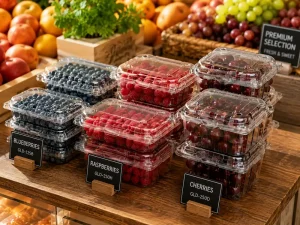
Clamshell formats are especially strong when food needs clear visibility. A clear PET hinged clamshell container helps customers see fruit color, portion size, and freshness cues directly. For bakeries, clamshell formats also protect pastry texture while keeping toppings, crust color, and product height visible.
When Clamshell Containers Are the Better Choice
Choose clamshell containers when the product needs one-piece convenience, quick staff operation, stackable display, and strong shelf visibility. They work well for blueberries, strawberries, kiwi packs, cake slices, croissants, cookies, brownies, sandwiches, and snack packs.
When Not to Choose Clamshell Containers
Clamshell containers are not the best first choice for high-liquid foods, heavy sauced meals, or products that require strong liquid containment. They are also less suitable when the food needs full ingredient separation or when the package must be repeatedly opened and closed many times during service.
What Buyers Should Check Before Ordering
Buyers should test hinge flexibility, lid closing force, stacking stability, ventilation if needed, and the way the product sits after closing. For delicate produce, airflow and food movement matter. For bakery items, internal height and dome clearance matter. For sandwiches or snacks, lid security and display angle matter.
Hinged Containers: Best for Daily Packing Efficiency
Hinged containers are closely related to clamshell packaging, but buyers often use the term when they focus on the connected lid function rather than the broader packaging shape. A hinged format is practical for busy food operations because staff do not need to search for separate lids. This reduces matching errors and improves packing speed.
For deli, salad, bakery, fruit, and snack applications, hinged PET containers support simple opening, filling, closing, and customer handling. A clear hinged PET plastic clamshell container is a good example of how a connected lid structure supports grab-and-go food without overcomplicating the packaging workflow.
When Hinged Containers Are the Better Choice
Hinged containers are useful when packaging speed, lid consistency, and easy handling are priorities. They are suitable for bakeries, cafes, delis, convenience stores, supermarket prep kitchens, and foodservice teams that pack many units per day.
When Not to Choose Hinged Containers
Hinged containers are not ideal when buyers need a separate lid system for different heights, when products require heavy-duty stacking, or when a rigid seal is more important than packing speed. They may also be less suitable for foods with tall toppings if the selected depth is too shallow.
What Buyers Should Check Before Ordering
Check whether the lid closes smoothly without crushing the food. Test the hinge after repeated opening and closing. Confirm stack height, carton packing, label placement, and whether the base remains stable when filled with moist, oily, or uneven food.
Round Containers: Best for Bowls, Salads, Fruit Mixes, and Chilled Meals
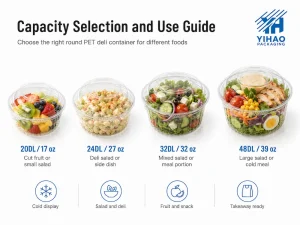
Round containers are strong when food needs bowl-style presentation. They suit salads, fruit mixes, chilled noodles, poke-style meals, desserts, and shared portions. Round structures make the food look abundant from the top view and create natural space for mixing ingredients.
For salad and deli applications, PET salad bowl formats help buyers present colorful ingredients clearly. Lettuce, pasta, fruit, toppings, and chilled noodles are easier to show in a round bowl than in a narrow rectangular container. Round containers also work well when customers expect the food to be eaten directly from the package.
When Round Containers Are the Better Choice
Choose round containers for salads, fruit bowls, deli mixes, chilled noodles, yogurt toppings, dessert bowls, and prepared foods that benefit from top-view merchandising. They are also useful when the food needs a bowl experience rather than a tray experience.
When Not to Choose Round Containers
Round containers are not always the best option when shelf density, carton efficiency, and straight-line retail facings are the main priorities. If a buyer wants the tightest shelf layout or the most efficient case packing, square containers may provide better space control.
What Buyers Should Check Before Ordering
Round containers should be checked for lid fit, stacking stability, anti-fog requirements, fork-friendly depth, and shelf footprint. Buyers should also confirm whether flat lids, dome lids, or hinged lids make more sense for the food height and retail display method.
Square Containers: Best for Shelf Efficiency and Organized Retail Layouts
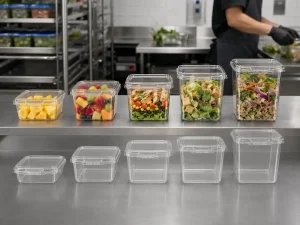
Square containers are useful when buyers need a cleaner shelf layout and more efficient carton packing. Compared with round formats, square containers often organize better on refrigerated shelves, in prep rooms, and in delivery cartons. This makes them practical for supermarkets, delis, foodservice programs, and wholesale supply chains.
A PET square deli container is a practical option for fruit, salads, chilled sides, deli foods, and prepared meal portions. The straight sides help create a neat retail block, which is useful when the buyer wants consistent facings across multiple SKUs.
When Square Containers Are the Better Choice
Square containers work well for deli sides, cut fruit, salads, pasta portions, chilled snacks, and prepared foods where shelf organization matters. They are also useful when buyers need a standardized packaging family across small, medium, and large portions.
When Not to Choose Square Containers
Square containers are not the strongest choice when the product needs a natural bowl-style eating experience or a softer premium food presentation. For layered salads, colorful fruit bowls, and chilled noodles designed for top-view appeal, round containers may create stronger visual impact.
What Buyers Should Check Before Ordering
Buyers should test corner closure, lid flexibility, stacking under weight, label placement, and whether the container corners affect how food settles. For wet foods, closure consistency and transport testing are important before bulk ordering.
Compartment Containers: Best for Separation, Portion Control, and Mixed Packs
Compartment containers solve a different problem: food separation. When ingredients should not touch too early, divided packaging becomes more useful than a single cavity. This applies to fruit-and-nut packs, snack trays, dessert assortments, sushi-style platters, bakery samplers, meal kits, and portion-controlled food programs.
For fresh produce and snack combinations, a 2-compartment PET clamshell container helps separate fruit types or pair fruit with nuts, cheese, or dry snacks. A 4-compartment PET clamshell container is stronger for assorted retail packs where buyers want variety, order, and visual merchandising in one package.
When Compartment Containers Are the Better Choice
Choose compartment containers when the product includes multiple ingredients, different textures, sauces, toppings, or portion groups. They are especially useful for fresh-cut fruit, nuts, breakfast packs, bakery samplers, dessert sets, kids’ snacks, catering trays, and grab-and-go meals.
When Not to Choose Compartment Containers
Compartment containers are not necessary for single-ingredient foods or products that should be mixed before eating. They may also reduce usable space if the divider layout does not match the actual food portion plan. Buyers should not choose divided packaging just because it looks organized; the structure must support the menu.
What Buyers Should Check Before Ordering
Compartment ratio matters more than total capacity. A container with the wrong divided layout may look large but still fail to fit the target food combination. Buyers should test real fill plans, ingredient height, visual balance, lid clearance, and whether each compartment supports the intended portion weight.
Tamper Evident Containers: Best for Retail Trust and Grab-and-Go Security
Tamper evident containers add a visible security function to food packaging. This structure is especially important when food is sold through retail shelves, cold cases, delivery channels, or unattended grab-and-go displays. The goal is not just to close the package, but to show whether the package has been opened after sealing.
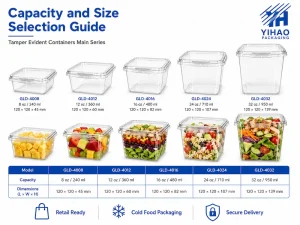
For supermarkets, cafes, bakeries, and prepared food programs, clear PET tamper evident container with tear strip seal formats support stronger customer confidence. For smaller retail portions, a tamper evident clear PET container may fit chilled snacks, small deli portions, fruit, desserts, or convenience store food.
When Tamper Evident Containers Are the Better Choice
Choose tamper evident containers when the sales channel requires stronger food safety perception, retail security, or sealed-package confidence. They are suitable for ready-to-eat salads, fruit cups, deli foods, bakery items, refrigerated snacks, and grab-and-go products.
When Not to Choose Tamper Evident Containers
Tamper evident containers are not the most practical option when the product must be opened repeatedly before sale, sampled frequently, or repacked during service. They are designed for sealed selling conditions, so buyers should match them with products that benefit from visible closure integrity.
What Buyers Should Check Before Ordering
Buyers should test the tear strip, opening force, closure consistency, display appearance after sealing, and whether customers can open the package without frustration. A secure package still needs a practical user experience.
Structure Selection by Sales Channel
Different sales channels create different packaging pressure. A supermarket cold shelf needs order, visibility, and sealed confidence. A bakery counter needs product height and visual protection. A cafe takeaway program needs speed and menu flexibility. A foodservice prep kitchen needs repeatability and storage efficiency.
| Sales Channel | Better Structure Direction | Main Reason | Buyer Focus |
|---|---|---|---|
| Supermarket cold shelf | Tamper evident, square, or round containers | Supports shelf order, visibility, and sealed-package confidence | Stacking, labeling, closure, and chilled display |
| Bakery counter | Hinged clamshell or dome-style clamshell containers | Protects height while showing toppings and texture | Dome clearance, lid pressure, and presentation |
| Cafe takeaway | Hinged, round, or compartment containers | Improves packing speed and menu flexibility | Fast closing, lid fit, and food separation |
| Convenience store grab-and-go | Tamper evident, square, or compartment containers | Improves compact display and customer trust | Security, visibility, and shelf footprint |
| Foodservice prep kitchen | Square, hinged, or PP structure families | Supports repeat ordering and daily packing efficiency | Carton packing, storage, and staff workflow |
| Catering and event food | Compartment, square, or larger hinged containers | Keeps food organized during transport and service | Portion layout, stacking, and transport testing |
How to Match Food Type with Container Structure
The best packaging decision starts from the food itself. Shape, moisture, texture, height, and selling method all affect container choice. A bakery product with high topping clearance does not need the same structure as a cold salad. A fruit-and-nut snack pack does not need the same cavity layout as a prepared deli meal.
| Food Type | Recommended Structure | Reason | Useful Buying Check |
|---|---|---|---|
| Berries and delicate produce | Vented clamshell containers | Clear display, protection, and airflow support | Vent layout, stacking, and hinge strength |
| Fresh-cut fruit | Round, square, or compartment containers | Depends on juice level, portion style, and ingredient mix | Lid fit, anti-fog needs, and leak-resistance testing |
| Bakery items | Hinged clamshell or dome containers | Protects shape while keeping toppings visible | Internal height, dome clearance, and stacking pressure |
| Salads and chilled bowls | Round containers | Top-view presentation and easy mixing space | Lid compatibility, fork access, and shelf footprint |
| Deli sides and prepared foods | Square containers | Organized shelf layout and efficient packing | Corner closure, label space, and transport stability |
| Snack packs and meal kits | Compartment containers | Separates ingredients and improves portion control | Compartment ratio and real-food fill testing |
| Retail grab-and-go food | Tamper evident containers | Stronger sealed-package confidence | Tear strip visibility and user-friendly opening |
Material and Structure Should Be Evaluated Together
Food container structure should not be separated from material choice. PET, rPET, PP, PLA, paperboard with clear lids, and other materials behave differently in rigidity, clarity, heat tolerance, cold-chain performance, recyclability discussion, and lid fit. A structure that works well in one material may need design adjustment in another material.
For cold foods, clear PET and rPET formats are common because they provide strong product visibility and a clean retail look. For reheatable foods, buyers usually evaluate PP formats because heat resistance matters more than crystal clarity. For compostable programs, PLA may be considered where composting infrastructure and local rules support it. Buyers should not choose material based on marketing language alone. They should confirm food-contact suitability, real use temperature, storage conditions, and local waste-handling realities.
What Wholesale Buyers Should Ask a Food Container Manufacturer
A strong packaging decision depends on both the selected structure and the supplier’s ability to repeat that structure consistently. For wholesale buyers, the lowest unit price is not the only cost factor. Lid fit problems, carton damage, inconsistent wall thickness, weak hinge performance, or delayed repeat orders can create higher operational cost than the initial savings.
| Question for Manufacturer | Why It Matters | What Buyers Should Confirm |
|---|---|---|
| Can the mold keep consistent lid fit across repeat orders? | Lid fit affects closure, stacking, and customer confidence | Sample consistency, tolerance control, and repeat production records |
| Which material options are available for this structure? | Different materials affect clarity, rigidity, heat resistance, and price | PET, rPET, PP, PLA, or other suitable material options |
| Can multiple sizes share a similar structure family? | Structure families reduce SKU confusion and improve ordering efficiency | Size range, shared lid logic, and carton packing plan |
| Where can labels or sleeves be applied? | Label placement affects branding, barcode scanning, and product visibility | Flat labeling area, sidewall space, and lid surface design |
| How should samples be tested before bulk ordering? | Real-food testing prevents poor fit, deformation, and display issues | Filled sample test, stacking test, transport test, and cold-chain test |
| Is the supplier able to support repeat wholesale orders? | Packaging programs need stable supply, not one-time availability | Production capacity, lead time, carton data, and reorder stability |
Wholesale Buyers Should Reduce SKU Confusion
Many packaging teams overcomplicate their container range. They buy too many similar sizes, too many lid systems, or too many shapes without a clear reason. This creates purchasing confusion, warehouse pressure, staff training issues, and inconsistent customer experience.
A better approach is to build a structured packaging family:
- One clamshell family for produce or bakery display.
- One hinged deli family for daily grab-and-go items.
- One round bowl family for salads and mixed chilled meals.
- One square container family for shelf-efficient deli portions.
- One compartment family for snack packs and portion-controlled products.
- One tamper evident family for sealed retail and security-sensitive applications.
This approach gives buyers better internal control. It also helps suppliers recommend matching sizes, compatible lids, carton quantities, labeling areas, and sample-testing sequences. For long-term wholesale programs, buyers should work with a food packaging factory that understands structure, tooling, material behavior, and real packing operations rather than only quoting unit price.
Sample Testing Checklist Before Bulk Orders
Before placing a wholesale order, buyers should test the container with real food, real staff, and real handling conditions. A sample that looks good when empty may perform differently after filling, chilling, stacking, labeling, or transport.
| Testing Item | What to Check | Why It Matters |
|---|---|---|
| Food Fit | Real portion weight, height, and ingredient spread | Prevents underfilled or compressed appearance |
| Lid Closure | Closing force, snap fit, hinge movement, tear strip if used | Supports reliable packing and customer handling |
| Visibility | Top view, side view, anti-fog needs, label position | Improves shelf appeal and product recognition |
| Stacking | Filled-container stacking in shelf and carton conditions | Reduces deformation and display disorder |
| Transport | Short-distance movement, delivery bag, cold-chain handling | Helps detect leakage, lid loosening, or food shift |
| Operations | Staff filling speed, lid matching, labeling, storage | Reduces labor friction in daily use |
Common Mistakes in Food Container Structure Selection
Choosing by Capacity Only
Capacity is important, but it does not define performance. A container may hold the target volume but still look poor on shelf, close poorly, or waste space. Structure should be evaluated with real food and real display conditions.
Ignoring Lid Compatibility
Lid fit is one of the most common packaging problems. Buyers should confirm whether the lid is hinged, separate, flat, dome, tamper evident, or universal across multiple bases. A small mismatch can create major operational problems.
Using One Shape for Too Many Foods
A single container family cannot solve every food application. Salads, bakery items, fruit packs, sandwiches, and snack trays have different needs. A focused packaging system performs better than a random collection of similar containers.
Forgetting Shelf and Carton Efficiency
Retail display and carton packing affect cost more than many buyers expect. Square containers may improve shelf density. Round containers may improve product presentation. Clamshells may improve speed. The correct choice depends on the sales channel.
Skipping Tamper Evident Options for High-Trust Retail Food
For sealed grab-and-go food, tamper evident packaging is not just a premium feature. It supports visible trust, especially in chilled retail, convenience stores, foodservice pickup, and delivery-adjacent programs.
Buyer Decision Framework: Which Structure Should You Choose?
| Buyer Priority | Best Structure Direction | Practical Reason |
|---|---|---|
| Fast packing with simple lid control | Hinged or clamshell containers | Integrated lid reduces matching and speeds up service |
| Premium top-view salad or fruit display | Round containers | Creates bowl-style visual abundance |
| Efficient shelf and carton organization | Square containers | Supports clean retail layout and standardized packing |
| Ingredient separation | Compartment containers | Keeps textures, toppings, and portions organized |
| Retail trust and sealed-package confidence | Tamper evident containers | Shows whether the package has been opened after sealing |
| Fresh produce airflow | Vented clamshell containers | Supports visibility, protection, and airflow needs |
Final Note / Practical Takeaway
FAQ
1. What is the best structure for general food packaging?
The best structure depends on the food type and sales channel. Clamshell and hinged containers are strong for fast packing and clear display, round containers work well for salads and bowls, square containers help shelf organization, compartment containers separate ingredients, and tamper evident containers support sealed retail food.
2. Are clamshell containers and hinged containers the same?
They are closely related, but buyers often use the terms differently. Clamshell containers usually describe a connected lid-and-base package, while hinged containers emphasize the one-piece hinged lid function. Many clear PET food clamshells are also hinged containers.
3. When should buyers choose compartment containers?
Buyers should choose compartment containers when foods need separation, portion control, or mixed presentation. They are useful for fruit-and-nut packs, snack trays, bakery assortments, meal kits, sushi-style trays, and grab-and-go retail food.
4. Are round containers better than square containers?
Round containers are better for bowl-style foods such as salads, fruit mixes, chilled noodles, and dessert bowls. Square containers are better when shelf efficiency, carton packing, and organized retail layout are more important.
5. Why are tamper evident containers important for retail food?
Tamper evident containers provide a visible security feature that shows whether the package has been opened after sealing. They are useful for ready-to-eat foods, chilled retail products, grab-and-go items, and foodservice programs that need stronger customer confidence.
References
- U.S. Food and Drug Administration, Food Code, Retail Food Protection.
- U.S. Food and Drug Administration, Packaging & Food Contact Substances.
- U.S. Food and Drug Administration, Guidance for Industry: Use of Recycled Plastics in Food Packaging.
- European Commission, Food Contact Materials, Food Safety Policy.
- European Food Safety Authority, Food Contact Materials Topic Overview.
- European Food Safety Authority, Substances Used in Plastic Food Contact Materials Application Procedure.
- 21 CFR Part 117, Current Good Manufacturing Practice, Hazard Analysis, and Risk-Based Preventive Controls for Human Food.
- 21 CFR Part 177, Indirect Food Additives: Polymers.
Deep-Dive Insights for Buyer Decision-Making
How structure affects sell-through
Food container structure affects how clearly customers understand the product on shelf. A clear clamshell can show produce freshness. A round bowl can make salads and fruit mixes look fuller. A square container can create an organized retail block. A compartment container can make mixed food packs easier to understand. A tamper evident container can increase sealed-package confidence in grab-and-go displays.
Why lid fit and closure design matter
Lid fit is one of the most important hidden factors in food packaging performance. A container that looks good but closes poorly creates labor friction, transport risk, and inconsistent customer experience. Buyers should test snap fit, hinge strength, tear strip behavior, stacking pressure, and filled-package stability before confirming wholesale orders.
What buyers should test before switching suppliers
Before switching to a new supplier, buyers should test real food portions, cold-chain storage, staff packing speed, label placement, carton packing, and repeated handling. A supplier change should not be based only on unit price. Mold consistency, material clarity, structure repeatability, and reorder stability are equally important.
Best option for cold food, bakery, produce, and deli applications
Cold salads and fruit bowls often perform well in round or square clear containers. Bakery items usually benefit from hinged clamshell or dome-style formats. Fresh produce often needs vented clamshell structures. Deli sides and prepared foods often work better in square or tamper evident containers when shelf layout and sealed confidence matter.
Consideration for long-term SKU simplification
The strongest packaging programs do not use too many unrelated containers. Buyers should build a controlled structure family: clamshell for display, hinged for speed, round for bowls, square for shelf efficiency, compartment for separation, and tamper evident for sealed retail. This approach reduces purchasing confusion, improves staff training, and supports repeat wholesale supply.
© YIHAO Packaging. All rights reserved. All articles, product images, packaging designs, technical specifications, and website materials are protected by copyright. Unauthorized copying, reproduction, redistribution, modification, or commercial use is strictly prohibited without prior written permission.