For international food packaging buyers, export packaging compliance is now a purchasing discipline, not a final paperwork step. A container may look transparent, rigid, stackable, and attractive on a retail shelf, but export readiness depends on whether the material, structure, labeling claim, supplier documents, destination-market requirements, and intended food use are aligned before shipment.
This matters especially for supermarkets, cafes, bakeries, chilled food brands, distributors, and foodservice chains. These buyers handle multiple product categories: fresh fruit, ready-to-eat salads, bakery desserts, cold drinks, prepared meals, deli snacks, and grab-and-go foods. Each category creates different compliance questions. A clear PET clamshell for chilled fruit, a PP container for hot takeaway food, a PET cup for iced drinks, and a tamper-evident container for retail display do not follow the same risk logic.
YIHAO works with food packaging buyers who need export-ready plastic packaging solutions for retail display, takeaway, chilled food, bakery, fruit, drink, deli, and foodservice applications. The goal is practical: help buyers select packaging that supports product protection, shelf visibility, food-contact expectations, shipment stability, and supplier-side documentation without turning every packaging purchase into a compliance problem.
What Export Packaging Compliance Really Means for Food Packaging Buyers
Export packaging compliance means the packaging is suitable for the product, destination market, food-contact condition, logistics route, and buyer documentation requirement. It is broader than a single certificate. For food packaging buyers, it usually covers five areas:
- Material safety for intended food-contact use
- Regulatory alignment with the destination market
- Physical performance during storage, shipping, and retail handling
- Labeling, claim, and recycling communication accuracy
- Supplier traceability, documentation, and manufacturing consistency
This is why food packaging compliance cannot be judged only by asking whether a container is “food grade.” The better question is: food grade for which food, under which temperature, for which market, with which material, and under which use condition?
Export Compliance Snapshot for Food Packaging Buyers
Before selecting a packaging format, buyers should first confirm the destination market. A container that works well for one market may need different documents, claim language, or material review for another market.
| Market / Region | Buyer Should Check | Practical Risk |
|---|---|---|
| United States | Food contact status, food type, use condition, recycled plastic review when rPET is used | A generic “food grade” claim may not be enough for importer or retailer review |
| European Union | EC 1935/2004, EU 10/2011 for plastic food-contact materials, recycled plastic rules, PPWR, labeling, recyclability, and PFAS restrictions | Food-contact, migration, recycling, environmental claims, and packaging waste rules may need separate review |
| United Kingdom | Food contact materials, importer documentation, labeling expectations, and product-use suitability | Post-Brexit market handling may require clear document alignment with the importer |
| Canada | Food-contact material safety, importer review, and product-use condition | Importers may request additional supporting documents before approving packaging |
| Multi-Market Export | Claim localization, material traceability, recycled-content support, and market-specific labeling | One universal label or sustainability claim may not fit every export destination |
Why Export Packaging Compliance Is Becoming More Important
Food packaging buyers face stronger pressure from retailers, importers, regulators, sustainability teams, and consumers. Supermarkets want safer grab-and-go packaging. Cafes want clear cups and lids that fit drink menus and takeaway workflows. Bakeries need packaging that protects decorated desserts without damaging appearance. Foodservice brands want consistent containers that survive transport and support hygiene expectations.
At the same time, international markets are tightening expectations around food-contact materials, recycled content, packaging waste, recyclability claims, chemical restrictions, and documentation. This does not mean every buyer needs to become a regulatory expert. But it does mean buyers should build a smarter checklist before selecting a packaging manufacturer, wholesale partner, or export supplier.
Core Compliance Areas Buyers Should Check Before Export Orders
The best export packaging decisions begin with a structured review. Buyers should confirm the intended market, food type, material, temperature condition, product shelf life, packaging structure, printed decoration, and whether any sustainability or recyclability claims will be used in marketing.
| Compliance Area | What Buyers Should Check | Why It Matters |
|---|---|---|
| Destination Market | US, EU, UK, Canada, Japan, Middle East, Australia, or other target region | Food contact rules, labeling expectations, and packaging waste rules vary by market |
| Food Contact Use | Cold food, hot food, acidic food, oily food, bakery, fruit, drinks, deli, or ready meals | Different foods create different migration, temperature, and material suitability questions |
| Material Type | PET, rPET, PP, PLA, paper-plastic combination, lids, trays, inserts, or films | Material selection affects clarity, heat resistance, recyclability, and documentation |
| Structure | Clamshell, hinged lid, separate lid, cup and lid, tamper-evident seal, tray, bowl, or compartment container | Structure affects retail display, leak resistance, shelf handling, and transport protection |
| Documentation | Material declaration, food-contact statement, test report, specification sheet, and supplier traceability | Importers and retail buyers often need documents before approving orders |
| Claims | Food grade, recyclable, recycled content, compostable, microwave safe, leak resistant, or tamper evident | Claims must match real material performance and market-specific requirements |
Food Contact Safety Comes First
For export food packaging, food-contact suitability is the first compliance layer. Buyers should not treat a container as acceptable simply because it is widely used or visually similar to another product. The packaging must match the food type and intended use.
For example, PET and rPET containers are widely used for chilled fruit, salads, bakery display, cold drinks, and grab-and-go foods because they offer high clarity and strong retail visibility. PP containers are often selected for hot food, prepared meals, and microwave-related applications because PP provides stronger heat resistance than PET. PLA may support specific compostability positioning, but buyers must check destination-market composting infrastructure, labeling rules, and real application limits before using broad claims.
For chilled fruit, supermarkets often prioritize transparent fresh produce packaging containers that protect delicate items while keeping visibility high. For hot deli or prepared food, buyers should evaluate microwave safe containers with a stricter focus on heat condition, lid fit, and end-use instructions.
Material Selection and Export Compliance Logic
PET and rPET Packaging
PET is commonly used in clear food packaging because it supports strong transparency, shelf visibility, and a clean retail appearance. rPET adds recycled-content value when the supply chain, source material, food-contact use, and destination-market rules support that claim. Buyers should avoid vague recycled-content claims unless the supplier can provide appropriate documentation.
For supermarkets and chilled retail programs, clear PET or rPET packaging is especially useful for fresh fruit, salads, cold snacks, bakery products, and ready-to-eat foods. A product such as a clear hinged deli container or PET salad bowl helps buyers combine product visibility with practical handling. However, PET is not the right default choice for high-heat or microwave-focused applications.
PP Packaging
PP is usually selected when food temperature and reheating expectations matter. Prepared meals, hot takeaway foods, deli counters, and foodservice operations often need stronger heat tolerance and practical lid security. Buyers should still confirm actual use conditions instead of assuming every PP item is automatically microwave-ready.
PLA and Compostable Packaging
PLA packaging may support compostable positioning in selected markets and applications. However, export buyers must be careful. Compostable does not automatically mean accepted in every municipal system. A compostability claim should match certification, disposal infrastructure, and local labeling expectations.
EU PPWR, PFAS, and Recyclability: Why Export Buyers Should Plan Early
For EU-bound packaging, buyers should treat the Packaging and Packaging Waste Regulation as a forward-looking compliance issue, not just a recycling topic. The regulation affects packaging placed on the EU market and is connected with sustainability requirements, labeling, packaging waste prevention, recyclability, recycled content planning, and technical documentation.
One important point for food packaging buyers is PFAS. From 12 August 2026, food-contact packaging with PFAS at or above specified limits must not be placed on the EU market. This matters for buyers using grease-resistant, water-resistant, coated, or treated packaging formats. Even when a buyer is mainly sourcing PET, rPET, or PP containers, it is still smart to review lids, labels, coatings, inks, adhesives, and any added components that may affect the final packaging claim.
Recyclability also requires careful wording. A clear PET container may support a better recycling direction than a complex mixed-material pack, but the final claim depends on local collection, sorting, contamination, label choice, color, and destination-market rules. Export buyers should not use broad “fully recyclable” or “100% recyclable” claims unless the claim is supported for the target market and packaging design.
Destination-Market Regulations: What Buyers Should Understand
Export packaging compliance changes by destination. A packaging format that is easy to approve for one market may require additional documentation or different claims in another. Buyers should treat market selection as the first step in compliance planning.
| Market | Main Buyer Concern | Practical Packaging Action |
|---|---|---|
| United States | Food-contact substance suitability and material compliance | Request material details, food-contact support documents, and use-condition information |
| European Union | Food-contact framework, plastic material rules, migration logic, recycled plastic rules, PPWR, PFAS, and packaging waste requirements | Confirm material declaration, test scope, recycling claim control, and destination-specific packaging requirements |
| United Kingdom | Food-contact material safety and business compliance expectations | Check supplier documentation and food-contact suitability for the intended product category |
| Canada | Packaging must not transfer harmful substances to food under intended use | Prepare material safety support and intended-use documentation |
| Japan | Positive list system and packaging material control | Confirm resin, additives, and supplier traceability before export planning |
| Middle East and Other Import Markets | Importer-specific documentation, labeling, and food-contact expectations | Align with importer checklist before production, not after goods are finished |
The key lesson is direct: do not build an export packaging program around a single generic document. Build it around destination-market requirements, food type, material, and real use conditions.
Retail Display Packaging and Compliance Are Connected
Many buyers separate compliance from visual merchandising. That is a mistake. Retail display packaging must protect food while presenting it clearly, safely, and consistently on the shelf. For supermarkets, display packaging often needs to support stacking, anti-fog performance, lid security, barcode placement, label visibility, tamper evidence, and clean product presentation.
Fresh fruit containers, salad bowls, bakery clamshells, and cold drink cups are all display tools. If the packaging collapses during stacking, fogs heavily in chilled display, opens too easily during handling, or hides the product, it creates both commercial and quality-control problems.
For fruit and snack packs, a product format like a 4-compartment PET clamshell container for retail food display supports portion separation and visibility. For bakery cases, bakery containers help protect presentation-sensitive items such as muffins, cupcakes, pastries, slices, and decorated desserts.
Compliance Risks by Application Scenario
Supermarkets
Supermarkets usually require packaging that works across chilled shelves, produce sections, deli counters, bakery displays, and grab-and-go zones. Export compliance for supermarket packaging should focus on food-contact suitability, material declaration, shelf stacking, barcode label area, tamper control, anti-fog needs, and packaging waste expectations.
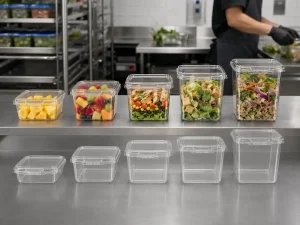
For fresh-cut fruit and deli salads, supermarkets often prefer clear packaging because visibility drives consumer confidence. But clarity alone is not enough. Buyers should confirm lid fit, bottom stability, ventilation needs, leak resistance, and cold-chain performance.
Cafes
Cafes often use cups, lids, dessert containers, sandwich clamshells, and takeaway snack packaging. For export buyers serving cafe chains, packaging must match drink size, lid compatibility, straw or sip-through design, sealing expectations, and brand presentation.
Cold beverage packaging is a common export category. Buyers can review cold cups and lids for iced coffee, lemonade, juice, matcha, refreshers, smoothies, fruit tea, and cold brew programs. For export compliance, cup-and-lid matching is not only a convenience issue; poor fit increases leakage, transport complaints, and customer dissatisfaction.
Bakeries
Bakeries need packaging that protects shape, frosting, toppings, crust texture, and shelf appearance. Export packaging compliance for bakery products should review food-contact safety, odor control, clarity, hinge strength, dome height, stacking performance, and label area.
For muffins, cupcakes, and dessert assortments, buyers may use packaging such as a clear PET hinged 6-compartment bakery container to protect individual pieces during retail handling and takeaway.
Foodservice Brands
Foodservice brands often need practical packaging for takeaway meals, chilled foods, catering, deli counters, and prepared food programs. Compliance priorities include temperature suitability, lid security, stackability, leak control, and clear user instructions. For hot food or reheating applications, buyers should avoid assuming that every plastic container is suitable. They need material-specific confirmation.
For chilled salads and ready-to-eat meals, deli and salad containers help combine visibility, portion control, and operational consistency. For prepared meals, PP-based formats should be evaluated for the intended heat condition and lid structure.
Recyclable Food Containers: Claims Must Be Controlled
Recyclable food containers are important for export packaging strategy, but buyers should be precise. Recyclable does not always mean recycled everywhere. Local collection, sorting, contamination level, label material, color, mixed-material design, and municipal recycling systems all affect real recyclability.
For PET and rPET packaging, clarity and mono-material thinking can support recycling logic where local systems accept PET food packaging. However, the final claim must reflect the destination market. A buyer exporting to multiple regions should avoid one universal recycling statement across all countries unless the claim has been checked for each market.
Practical buyer rule: use recyclable language carefully, avoid unsupported “100% recyclable” claims, and ask suppliers for material identity, resin information, packaging design details, and label compatibility that affect recycling streams.
Tamper Evidence and Export Packaging Compliance
Food safety expectations have increased across retail and takeaway channels. For fresh food, chilled food, deli snacks, and grab-and-go items, tamper evidence helps retailers show whether a package has been opened after packing. This is not the same as full security packaging, but it supports consumer confidence and store-level control.
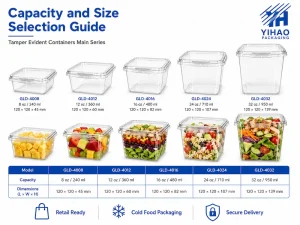
Buyers who sell ready-to-eat foods in supermarkets, cafes, and convenience channels should consider tamper evident containers when product integrity and visible opening control matter. A product such as a clear PET tamper evident container for cold-case grab-and-go foods supports chilled display, product visibility, and visible opening control.
Document Package Buyers Should Ask Before Bulk Orders
A strong supplier should help buyers organize documents before production and shipment. The document set depends on market and product type, but buyers should normally prepare a structured checklist before sample approval and before mass production.
| Document / Information | What It Supports | Best Time to Request |
|---|---|---|
| Material Specification Sheet | Resin type, structure, color, appearance, and intended application | Before sample confirmation |
| Food-Contact Declaration or Compliance Statement | Importer or retailer review of intended food-contact use | Before purchase order confirmation |
| Migration Test Report Where Required | Market-specific or buyer-specific compliance support | Before bulk production when required by buyer or importer |
| Recycled Content Support Document | rPET or recycled-content claim review | Before using recycled-content claims in sales material |
| Recyclability Claim Support | Recycling communication, local claim review, and packaging design evaluation | Before publishing packaging labels or website claims |
| Product Drawing / Size Specification | Capacity, dimensions, lid structure, stacking, and carton packing | During sample approval |
| Carton Packing and Pallet Loading Details | Export logistics, warehouse handling, freight planning, and cost comparison | Before final quotation and shipping plan |
| Batch Traceability Record | Supplier accountability and production tracking | Before shipment |
| Sample Approval Record | Confirms the final approved version before mass production | Before production starts |
| Label / Printing Material Review | Printed packaging, adhesive, ink, claim wording, and market-specific label control | Before artwork approval |
This is also where supplier quality becomes practical. A real factory audit should review production control, raw material management, mold consistency, inspection process, packaging cleanliness, and carton packing reliability.
Common Export Packaging Compliance Mistakes
Many compliance problems are avoidable. They happen because buyers move too quickly from product selection to quotation without defining use conditions.
Mistake 1: Asking Only for “Food Grade” Packaging
“Food grade” is a useful starting point, but it is too general. Buyers should specify the food type, temperature, storage time, destination market, and whether the packaging will be used for direct food contact, chilled display, hot fill, microwave reheating, or takeaway transport.
Mistake 2: Using the Same Claim in Every Market
A recyclability, recycled-content, compostability, or microwave-safe claim may be acceptable in one context but risky in another. Export buyers should localize claims based on destination-market expectations and available proof.
Mistake 3: Ignoring Lid Compatibility
Export packaging compliance is not only about the base container. Lids, inserts, films, labels, adhesives, and printed areas also matter. A cup with the wrong lid or a salad bowl with a weak lid can create leakage, shelf complaints, and failed retail performance.
Mistake 4: Treating Sample Approval as Final Approval
A sample may look correct, but bulk production must match the same structure, material, clarity, weight range, lid fit, carton packing, and performance standard. Buyers should confirm production consistency before full container shipments.
Mistake 5: Choosing Packaging Before Defining the Food Product
The same container may work for dry bakery products but not for oily deli foods. It may work for chilled fruit but not for hot takeaway. Product details must lead packaging selection.
How to Build a Better Export Packaging Compliance Workflow
A practical workflow helps buyers reduce delays, sample revisions, and compliance confusion.
| Step | Action | Output |
|---|---|---|
| 1 | Define destination market and food category | Clear compliance direction |
| 2 | Confirm food-contact condition, temperature, and storage use | Material and structure shortlist |
| 3 | Select packaging format and lid system | Practical product match |
| 4 | Request specification sheet, material details, and sample | Technical review package |
| 5 | Check labeling, claim, and buyer documentation needs | Compliance claim control |
| 6 | Test stacking, lid fit, leakage, clarity, and carton packing | Operational approval |
| 7 | Confirm mass production standard and shipment plan | Export-ready order |
Choosing the Right Packaging by Product Category
Fresh Fruit and Produce
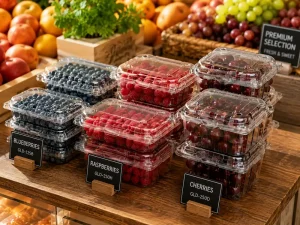
Fresh produce packaging should support ventilation, visibility, stacking, and gentle protection. For berries, apples, kiwi, grapes, and fresh-cut fruit, the buyer should review lid security, air vents, anti-fog needs, and retail display format. Clear clamshells, trays, and compartment containers are strong choices when product visibility drives buying decisions.
Bakery and Dessert Packaging
Bakery packaging must protect product shape and presentation. Cake domes, cupcake containers, pastry boxes, and hinged bakery clamshells should match the product height, topping sensitivity, handling route, and display shelf. Compliance review should include direct food contact, material odor, label placement, and lid strength.
Cold Drinks
Cold drink packaging should match beverage type, cup diameter, lid style, straw use, sealing preference, and visual branding. PET and rPET clear cups are commonly used for iced coffee, lemonade, smoothies, milk tea, matcha, refreshers, fruit tea, sparkling fruit drinks, and cold brew programs. Buyers should check lid fit before approving a cup series.
Deli, Salad, and Ready-to-Eat Food
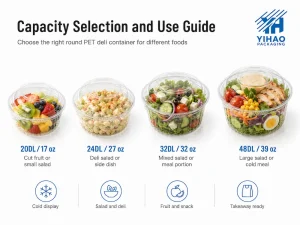
Deli and salad containers should support clarity, leak resistance, stacking, and chilled display. Round bowls, square containers, hinged deli packs, and separate-lid containers each serve different merchandising needs. For oily or sauced foods, buyers should test lid fit and leakage more carefully. A product such as a 17oz clear PET salad bowl with hinged lid is suitable for grab-and-go salads, fresh fruit, and chilled retail portions where clear presentation matters.
Hot Food and Prepared Meals
Hot food and prepared meal packaging should not be selected only by appearance. Buyers should define whether the packaging is for hot fill, warm holding, delivery, reheating, or microwave use. PP-based packaging is often more suitable than PET in these conditions, but the exact application must still be confirmed.
How Export Packaging Compliance Supports Wholesale Buying
Wholesale food packaging buyers usually compare price, MOQ, capacity, carton quantity, shipping volume, and lead time. These are important, but they are not enough. Compliance gaps can cost more than unit price savings. A low-cost container that cannot support buyer documentation, label claims, or retail performance becomes expensive once shipments are delayed or rejected.
Strong wholesale purchasing should evaluate:
- Material and intended-use match
- Destination-market compliance readiness
- Production consistency
- Packaging structure and lid fit
- Carton strength and export packing
- Supplier communication speed
- Document preparation ability
- Long-term product range support
For B2B buyers, the best supplier is not simply the cheapest supplier. The better supplier helps reduce risk before shipment.
Manufacturer and Supplier Checklist
Before choosing an export packaging supplier, buyers should ask direct questions. Clear questions save time and reveal whether the supplier understands export business.
| Question | Good Supplier Answer | Warning Sign |
|---|---|---|
| What material is used? | Specific resin, structure, and intended application are provided | Only says “food grade plastic” without detail |
| Which food use is recommended? | Supplier explains cold food, hot food, bakery, fruit, drinks, or prepared meal suitability | Claims the same item works for all foods and temperatures |
| Can you provide specifications? | Dimensions, capacity, carton packing, and product images are available | No clear specification sheet |
| Can claims be supported? | Supplier explains what can and cannot be claimed | Uses broad claims without proof |
| How is quality controlled? | Supplier describes inspection, lid fit, clarity, weight range, and packing checks | No defined quality process |
| Can samples be tested before bulk order? | Samples are available for physical and application review | Pushes bulk order before sample validation |
Need Export-Ready Food Packaging Support?
If your team is sourcing food packaging for supermarkets, cafes, bakeries, chilled food programs, or foodservice distribution, start with the destination market, food-contact condition, material requirement, and supplier document checklist. YIHAO supports wholesale food packaging buyers with clear PET, rPET, PP, tamper-evident, bakery, deli, salad, cold drink, and retail display packaging options for export-focused purchasing projects.
Buyer Quick Note
For supermarkets, cafes, bakeries, and foodservice brands, export packaging compliance should be built into product selection from the beginning. Do not wait until the shipment is ready to ask for food-contact documents, recyclability support, or destination-market details. Start with the food product, use condition, and market. Then choose the material, structure, supplier, and claim language.
The strongest packaging program connects compliance with commercial value: safe food contact, clear retail display, reliable lid fit, consistent production, controlled claims, efficient export packing, and supplier documentation that supports importer approval.
FAQ
1. What does export packaging compliance mean for food packaging?
Export packaging compliance means the packaging is suitable for the destination market, food-contact use, material requirement, labeling claim, documentation process, and logistics condition. It includes food-contact safety, packaging structure, supplier documents, and claim control.
2. Is food grade packaging enough for export orders?
No. Food grade packaging is only a starting point. Buyers should also confirm the destination market, food type, temperature condition, storage use, material declaration, testing needs, and whether any claims such as recyclable, microwave safe, or tamper evident will be used.
3. Can recyclable food containers be sold in every export market?
Recyclable food containers can support sustainability goals, but recyclability depends on material type, packaging design, label selection, local collection systems, and destination-market rules. Buyers should avoid broad recycling claims unless the claim is supported for the target market.
4. What documents should buyers request from a food packaging supplier?
Buyers should request a material specification, product dimensions, carton packing details, food-contact support statement, relevant test reports when required, claim support documents, and traceability information before mass production or shipment.
5. Why does EU PPWR matter for export food packaging?
EU PPWR affects packaging placed on the EU market, including sustainability requirements, labeling, recyclability, recycled content planning, and certain chemical restrictions. Export buyers should review EU-bound packaging early instead of checking it after production.
6. How should supermarkets and cafes choose compliant export packaging?
They should define the food category, market, storage condition, shelf display requirement, lid fit, label area, and end-use scenario first. Then they should choose a suitable material and packaging structure, test samples, and confirm supplier documentation before wholesale orders.
References
- U.S. Food and Drug Administration, Packaging & Food Contact Substances.
- U.S. Food and Drug Administration, Guidance for Industry: Use of Recycled Plastics in Food Packaging.
- European Union, Regulation (EU) 2025/40 on Packaging and Packaging Waste.
- European Union, Regulation (EC) No 1935/2004 on materials and articles intended to come into contact with food.
- European Union, Commission Regulation (EU) No 10/2011 on plastic materials and articles intended to come into contact with food.
- European Union, Commission Regulation (EU) 2022/1616 on recycled plastic materials and articles intended to come into contact with foods.
- UK Food Standards Agency, Food Contact Materials Regulations.
- Health Canada, Packaging Materials and Incidental Additives Used in Food Establishments.
Deep-Dive Insights
How export packaging compliance changes the buyer’s role
Packaging buyers are no longer only comparing price, size, and appearance. They are now managing a complete decision chain: food-contact suitability, destination-market rules, shelf performance, logistics risk, claim accuracy, and supplier documentation. This shift makes early-stage packaging planning more valuable than last-minute certificate collection.
Why compliance and retail display should be evaluated together
Food packaging that passes a basic material review can still fail commercially if it performs poorly in retail display. Fogging, weak stacking, loose lids, poor label placement, and unclear product visibility all reduce shelf confidence. Export-ready packaging should support both compliance and merchandising.
What EU PPWR means for practical sourcing
EU-bound food packaging buyers should treat PPWR as a packaging design and documentation issue. Recyclability, recycled content, labeling, packaging minimization, environmental claims, and PFAS restrictions can affect purchasing decisions before a product is shipped. Buyers should review these points during sample approval, not after artwork or bulk production is finished.
What buyers should prioritize when choosing a supplier
The best supplier is not simply the one with a wide catalog. For export orders, buyers should prioritize suppliers that understand material selection, application limits, sample testing, carton packing, documentation, and claim control. This is especially important when packaging will be sold across multiple countries or used by supermarket and foodservice chains.
Option insight: standard packaging vs custom export packaging
Standard packaging is faster and more cost-efficient when the buyer’s food category and market requirements are common. Custom packaging is more suitable when brand presentation, special capacity, compartment layout, lid function, tamper evidence, or retail shelf differentiation matters. In both cases, compliance review should happen before final design approval.
Consideration for future packaging programs
Export food packaging will continue moving toward stronger documentation, safer material selection, clearer environmental claims, and more traceable supply chains. Buyers who build structured compliance checklists now will be better positioned for future retail, regulatory, and sustainability requirements.
Final Note / Practical Takeaway
© YIHAO Packaging. All rights reserved. All articles, product images, packaging designs, technical specifications, and website materials are protected by copyright. Unauthorized copying, reproduction, redistribution, modification, or commercial use is strictly prohibited without prior written permission.