Why Divided Salad Containers Matter for Modern Food Packaging
Divided salad containers are no longer simple takeaway boxes. They are part of retail merchandising, food safety handling, portion control, brand presentation, and operational efficiency. A supermarket salad line, a cafe lunch program, a fresh-cut fruit counter, and a meal prep delivery brand all need packaging that keeps ingredients neat from packing table to shelf to customer.
The core value is separation. Greens stay in one section. Toppings stay in another. Fruit, nuts, cheese, grains, protein, sauce cups, and crunchy ingredients remain visually organized instead of becoming a mixed, wet, collapsed product before purchase. For retail buyers, this matters because visual quality often decides whether a chilled meal is selected or ignored.
For B2B packaging buyers, divided salad containers also solve a commercial problem: one package format must support multiple menus. The same container may be used for salad bowls, protein snack packs, fruit and nut sets, deli sides, sushi-style portions, breakfast fruit cups, catering samplers, and refrigerated grab-and-go meals. That flexibility helps buyers reduce SKU complexity while keeping food presentation consistent.
As a food packaging YIHAO focuses on practical packaging logic: the container should look clean, protect the product, stack safely, fit the filling process, support clear merchandising, and match the real ordering needs of distributors, retailers, cafes, and foodservice teams.
What Are Divided Salad Containers?
Divided salad containers are food packaging containers designed with two or more sections inside one tray, bowl, clamshell, or base-and-lid structure. These sections create separate spaces for different ingredients, helping prevent moisture transfer, flavor mixing, topping migration, and visual disorder.
Common structures include two-compartment, three-compartment, four-compartment, five-compartment, and customized divided layouts. Some use a hinged lid. Some use a separate lid. Some are round, square, rectangular, or tray-style. The right format depends on how the salad or meal is assembled, how it is displayed, and whether the buyer needs stacking, anti-fog clarity, tamper resistance, sauce compatibility, or automated filling support.
For general chilled display, buyers often start with deli and salad containers because this category covers many everyday foodservice and retail needs. For a more specific hinged format, PET hinged deli containers are often selected for grab-and-go salad, fruit, and snack packaging.
Which Materials Are Commonly Used for Divided Salad Containers?
Material choice affects clarity, temperature resistance, food-contact use, shelf appearance, sustainability claims, and customer experience. For clear meal prep packaging, buyers usually compare PET, rPET, PP, and paper-based hybrid structures.
| Material | Main Advantage | Best Application | Buyer Note |
|---|---|---|---|
| PET | High clarity and good stiffness | Cold salad, fruit, deli, and meal prep display | Not designed for microwave use unless separately verified |
| rPET | Clear appearance with recycled-content potential | Retail-ready chilled food packaging | Food-contact suitability and local recycling claims should be confirmed |
| PP | Better heat tolerance than PET | Hot food or microwave-oriented meal packaging | Clarity is usually lower than PET |
| Paper-Based Hybrid | Natural shelf appearance | Brand-led chilled meals or deli programs | Moisture resistance and visibility need testing |
PET and rPET for Clear Cold Food Display
PET is widely used for clear meal prep packaging because it offers high transparency, good stiffness, clean shelf appearance, and strong visibility for colorful ingredients. For salads, fruit, deli sides, cold noodles, yogurt toppings, cheese cubes, and snack assortments, PET gives the buyer a premium display effect without hiding the product.
rPET is recycled PET. It supports brands that want to include recycled content in packaging programs, but buyers should confirm food-contact suitability, recycled-content claims, and local requirements before printing or marketing sustainability language. When using rPET for food packaging, the key is not just the recycled-content percentage. Buyers should ask whether the material source, food-contact declaration, traceability, and production process are suitable for the target market.
For buyers comparing PET meal prep containers, a clear PET structure is strongest when the food is cold or chilled and when product visibility is a major selling point. A clear lid and clean sidewall help customers inspect freshness, color, toppings, portion size, and ingredient separation before purchase.
PP for Hot Food or Microwave-Oriented Use
PP is usually considered when the package must handle hot food or microwave use. This does not mean every PP package is automatically suitable for every hot-fill or microwave condition. Buyers should confirm temperature range, lid compatibility, ventilation, grease resistance, deformation risk, and the exact food application before placing an order.
If a meal program includes chilled salads only, PET or rPET is often the more attractive choice because of clarity. If the same program includes warm rice bowls, hot deli items, or reheating instructions, buyers should review microwave safe containers as a separate packaging direction instead of forcing one cold-display salad container to do every job.
Paper-Based and Hybrid Packaging
Paper-based bowls or trays can support a natural look, but they normally reduce ingredient visibility unless paired with a clear window or transparent lid. For chilled salad retail, visibility remains a strong sales factor. If the buyer wants a paper look with clear display, they should test moisture resistance, oil resistance, lid fit, window fogging, stacking strength, and recycling or composting claims in the actual selling market.
What Sizes Should Buyers Consider?
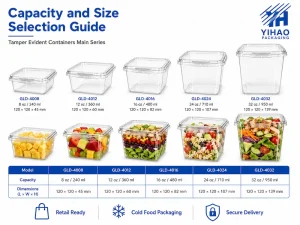
Size selection should start with the food plan, not with the container catalog. A buyer should define the target serving weight, ingredient height, number of components, dressing position, and shelf display method before selecting capacity.
| Use Case | Suggested Container Logic | Best For |
|---|---|---|
| Small salad sides | Compact divided tray or bowl | Fruit, nuts, toppings, side salads |
| Standard meal prep salads | Medium divided salad container | Greens, protein, grains, vegetables |
| Premium entree salads | Large clear PET or rPET container | Retail salad bowls, chilled meal salads |
| Catering and sharing packs | Multi-compartment tray with lid | Party platters, deli samplers, assorted foods |
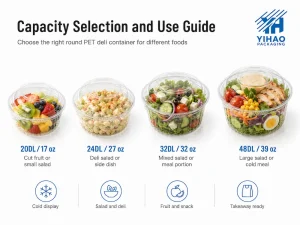
Small divided formats work well for fruit and nut packs, side salads, kids’ meal components, deli snack packs, and sample portions. Medium sizes support lunch salads, protein snack sets, fresh-cut fruit combinations, and cafe meal prep. Larger formats support entree salads, catering assortments, family salad sets, grain bowls, and shared chilled meals.
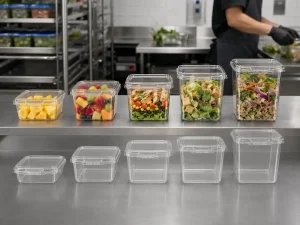
For buyers using square formats, square PET containers help create efficient shelf use and stable carton packing. A medium square deli container is suitable for salad, fruit, and deli meal concepts, while a larger large square deli container fits bigger chilled meals and higher-volume salad portions.
How Many Compartments Are Best for Salad Meal Containers?
The best compartment count depends on how the customer eats the product and how the food behaves during storage and transport. A simple salad may need only two sections. A premium salad meal container with protein, toppings, grains, fruit, and sauce may need three, four, or five sections.
Two-Compartment Containers
Two-compartment packaging is useful when the product needs one main section and one secondary section. Common examples include greens plus toppings, fruit plus dip, salad plus protein, or grains plus vegetables. This structure is simple, easy to pack, and visually clean.
Three-Compartment Containers
Three-compartment packaging gives more control. It works well for salad meal containers with greens, protein, and crunchy toppings. It also supports fruit, nuts, and cheese combinations. A three-compartment snack container can also inspire salad-side and meal-prep concepts where separation is central to the eating experience.
Four-Compartment and Multi-Compartment Containers
Four-compartment formats are useful for more structured meal prep. They allow a brand to separate ingredients by color, texture, flavor, or nutritional role. For example, one section can hold fruit, another can hold nuts, another can hold cheese or protein, and another can hold vegetables or grains. A four-compartment food container is practical when the buyer wants a neat retail presentation with multiple ingredients.
Five-compartment and tray-style layouts work well for party platters, catering, deli samplers, sushi-style sets, fruit assortments, and premium chilled displays. A five-compartment tray supports larger assorted food presentations where visibility and separation both matter.
What Are the Best Uses for Divided Salad Containers?
Divided salad containers are used across retail, foodservice, and meal prep channels. The strongest applications include:
- Grab-and-go salads in supermarkets and convenience stores
- Cafe lunch salads with toppings, protein, and dressing cups
- Fruit and nut snack packs for chilled display
- Deli side combinations with vegetables, grains, pasta, or cheese
- Meal prep salad containers for weekly portion control
- School, office, and airline-style cold meal programs
- Catering samplers and party trays
- Fresh-cut fruit, yogurt topping, and healthy snack assortments
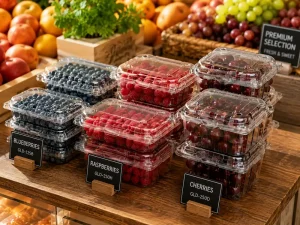
For fresh-cut fruit and snack-style menu extensions, buyers can also review fresh-cut fruit containers. Many salad programs expand into fruit, nuts, breakfast packs, and chilled snack sets, so a packaging line that supports multiple menu types is more valuable than a single-purpose container.
Are PET Divided Salad Containers Leak-Proof?
Leak resistance depends on structure, lid fit, rim design, closure force, food type, and how the package is handled. No buyer should judge leak performance by material name alone. PET gives clarity and stiffness, but the final result depends on the mold design and lid engagement.
For salads with dry greens and solid toppings, standard clear containers usually perform well. For foods with watery fruit, dressing, brine, sauce, or juicy cut vegetables, buyers need stronger testing. Turn the sample, stack it, chill it, simulate delivery movement, and check whether liquid reaches the rim. If dressing is packed inside the main container, a dedicated cup or internal section may be safer than relying on a general divided cavity.
For separated cold meals, a separate lid food container is useful when the buyer wants a base-and-lid structure rather than a hinged format. This structure gives the purchasing team another option when packing flow, lid application, or display requirements differ from clamshell packaging.
Should Buyers Choose Hinged or Separate-Lid Containers?
Hinged containers are convenient because the lid and base are connected. They reduce the chance of mismatched lids, simplify packing, and work well for grab-and-go operations. They are also practical for cafes, supermarkets, and foodservice teams that want fast manual packing.
Separate-lid containers offer different advantages. They are often preferred when the filling line applies lids separately, when stacking height matters, or when the buyer wants a more premium base-and-lid presentation. They may also support different lid heights for the same base, depending on the product range.
The right answer is operational. If the buyer’s staff fills and closes by hand at high speed, hinged containers are often efficient. If the buyer has a more controlled production line, separate-lid formats may fit better. In both cases, buyers should confirm lid compatibility, carton packing, sample closure force, and shelf display before wholesale purchasing.
How Important Is Clarity for Clear Meal Prep Packaging?
Clarity is a major reason buyers choose PET for clear meal prep packaging. Salads sell through color: leafy greens, red tomatoes, yellow corn, purple cabbage, orange carrots, berries, grains, cheese, and protein all create visual value. A cloudy or gray container weakens that value immediately.
Clear packaging also supports trust. Customers want to see portion size, freshness, ingredient separation, and topping quality. Retail buyers want products that look consistent across the shelf. Foodservice buyers want packaging that photographs well for online menus and delivery platforms. Distributors want a container line that is easy to explain to end customers.
For round salad programs, round PET containers and clear salad bowls are strong options because they give a generous top view. A clear salad bowl with hinged lid works well for smaller grab-and-go salads, while a larger meal salad bowl supports premium chilled salad presentations.
What Should Buyers Test Before Wholesale Ordering?
Before placing a wholesale order, buyers should run sample tests under real conditions. A sample that looks good on a desk may fail when filled, chilled, stacked, labeled, transported, or displayed under store lighting.
1. Fill Test
Pack the exact salad or meal combination. Use real greens, toppings, fruit, dressing cups, grains, and proteins. Check whether the compartment size matches the actual ingredient volume.
2. Closure Test
Close the lid repeatedly. The closure should feel secure but not require excessive force. Staff should be able to close the package consistently during busy production hours.
3. Chill Test
Place filled samples in the refrigerator or cold display case. Check fogging, condensation, lid movement, brittleness, and ingredient appearance after storage.
4. Stacking Test
Stack filled containers in the same count used for shelf display or delivery cartons. Check lid deformation, base pressure, and whether top containers slide or crush lower containers.
5. Transport Test
Simulate handling, delivery, carton loading, and shelf restocking. For delivery use, test side movement and vibration. For retail, test repeated movement from back room to display case.
6. Label Test
Apply real labels. Confirm that the label does not hide the product, weaken recycling compatibility, block the closure, or peel off in chilled conditions.
What Ordering Questions Should Buyers Ask a Manufacturer?
A good manufacturer or supplier should answer more than price questions. Packaging buyers should ask practical questions that affect repeat purchasing, customer complaints, and shelf performance.
- What material options are available for this structure?
- Is the container designed for chilled, ambient, hot-fill, or microwave use?
- What compartment layouts are available?
- Can the lid height, base depth, or cavity design be adjusted?
- What is the standard carton quantity?
- Can the container be packed for export shipment?
- Are samples available before bulk order confirmation?
- What food-contact documents are available for the target market?
- Can the package support private label, embossed logo, sleeve, sticker, or carton branding?
- What is the lead time for standard stock and customized production?
- How is product quality checked during production?
- What happens if the buyer needs repeat orders in different container sizes?
For buyers sourcing from a packaging manufacturer, sample review and production capability matter as much as catalog variety. The supplier should understand food application, material choice, mold structure, carton packing, and international shipping requirements.
How Should Buyers Compare Wholesale Suppliers?
When comparing wholesale suppliers, price is only one part of the decision. A low unit price becomes expensive if the container cracks, fogs, ships poorly, closes inconsistently, or fails to match the buyer’s salad line.
A reliable supplier should provide stable quality, clear communication, practical sample support, realistic lead time, and packaging recommendations based on the buyer’s application. For meal prep salad containers, the supplier should ask what food will be packed, whether the product is chilled, whether sauce is included, whether the container is used for retail or delivery, and whether the buyer needs branded packaging.
Strong suppliers also help buyers avoid over-customization. A custom mold may be useful for a large program, but many buyers can start with an existing structure, test it, adjust the label or carton, and then move toward customization after market feedback.
Can Divided Salad Containers Be Customized?
Yes, but customization should follow business logic. Common customization directions include compartment layout, lid height, base depth, anti-fog lid, embossed logo, printed sleeve, sticker label, carton printing, and material options. For large-volume programs, custom tooling may also be considered.
Before requesting a custom mold, buyers should define the target food weight, number of ingredients, shelf position, carton packing goal, labeling area, and preferred closure style. A custom divided container with poor packing efficiency may increase shipping costs. A beautiful shape that does not stack well may create retail handling problems. A lid that looks premium but closes slowly may reduce production speed.
The best customization improves function and brand value at the same time. It should make the salad easier to pack, easier to display, easier to buy, and easier to reorder.
Are Divided Salad Containers Recyclable?
PET containers are commonly associated with resin identification code #1, but recyclability depends on local collection, sorting, package design, labels, adhesives, food residue, color, and regional recycling infrastructure. Buyers should avoid making broad recycling claims without checking the target market.
For better recycling compatibility, buyers should prefer clear material when possible, avoid unnecessary dark colors, reduce hard-to-remove labels, avoid incompatible attachments, and keep food residue under control through customer instructions and practical design. If using rPET, the buyer should separate two claims: recycled content and recyclability. A container may contain recycled PET, but its actual recyclability still depends on local systems and package design.
For B2B buyers, the safest language is accurate and market-specific. Instead of saying every container is universally recyclable, use wording such as “designed with PET material and should be checked against local recycling programs.” This protects brand credibility and reduces compliance risk.
What Is the Best Choice for Meal Prep Salad Containers?
The best choice for meal prep salad containers is a package that matches the menu, filling process, and customer journey. For cold, colorful, retail-ready salads, clear PET or rPET containers often provide the best balance of visibility, stiffness, and shelf appeal. For meals that require reheating, buyers should evaluate PP and confirm microwave suitability.
If the product includes delicate greens, crunchy toppings, fruit, nuts, grains, and dressing, choose a divided structure that keeps high-moisture and dry ingredients apart. If the product is sold in a supermarket cold case, prioritize clarity and stacking. If the product is sold through delivery, prioritize lid security and movement resistance. If the product is sold under a private label, keep enough label area without covering the food.
In practical terms, buyers should not ask, “What is the cheapest divided salad container?” They should ask, “Which container reduces complaints, improves shelf appeal, supports our packing flow, and gives us stable wholesale supply?” That question leads to better long-term purchasing.
Divided Salad Containers FAQ
Are divided salad containers only for salads?
No. Divided salad containers are used for salads, fresh-cut fruit, snack packs, deli sides, cheese and nut assortments, grain bowls, catering samples, and chilled meal prep programs. Salad is the main search intent, but the packaging format is much broader.
What material is best for clear salad meal containers?
PET and rPET are strong choices for clear cold-food display because they provide transparency and stiffness. PP is more suitable when the buyer needs hot-food or microwave-oriented packaging, but the exact use condition must be confirmed before ordering.
How do I choose the right compartment number?
Choose the compartment number based on ingredient behavior. Use fewer compartments for simple meals and more compartments when ingredients must remain separate by moisture, texture, flavor, or color.
Can divided salad containers hold dressing?
Some divided containers can hold moist ingredients, but liquid dressing should be tested carefully. For best results, use a separate dressing cup or a dedicated sealed section when the salad includes thin sauces or high-moisture toppings.
Are divided salad containers microwave safe?
Most clear PET divided salad containers are designed for cold or chilled food display, not microwave heating. If the meal requires reheating, buyers should choose verified microwave-safe PP containers and confirm the temperature range, lid structure, and intended food-contact condition before ordering.
What size divided salad container is best for meal prep?
The best size depends on portion weight, ingredient height, and the number of components. Small formats suit toppings and snack packs, medium formats suit standard meal prep salads, and larger divided containers suit entree salads, grain bowls, and premium chilled meals.
What should I confirm before a wholesale order?
Confirm material, capacity, compartment layout, lid fit, sample performance, carton packing, food-contact documents, lead time, customization options, and supplier production capacity before placing a wholesale order.
Final Note / Practical Takeaway
For distributors, supermarkets, cafes, and meal prep brands comparing divided salad containers, the most practical next step is to test real food samples in the target container size before confirming wholesale packaging orders.
Deep-Dive Insights for Buyers
How should supermarkets select divided salad containers?
Supermarkets should prioritize clear display, stacking stability, fast shelf restocking, label placement, and consistent portion appearance. A supermarket salad program usually needs packaging that looks good under cold-case lighting and stays stable when stacked in volume.
Why do cafes and meal prep brands prefer separated layouts?
Cafes and meal prep brands use separated layouts to protect texture. Crunchy toppings, fruit, nuts, protein, and greens should not collapse into one wet mixture before the customer opens the package. Separation improves perceived freshness and gives the product a more intentional, premium look.
What option works best for private label salad packaging?
Private label buyers should choose a clear structure with enough flat space for branding, nutrition labels, barcodes, and date codes. The label should support brand recognition without covering the food too much, because product visibility is one of the strongest selling points of clear salad packaging.
What should buyers consider when switching from regular containers to divided containers?
Switching to divided containers changes filling speed, ingredient arrangement, carton packing, and shelf appearance. Buyers should test the new layout with real staff and real food before changing the full packaging line.
References
- U.S. Food and Drug Administration, Guidance for Industry: Use of Recycled Plastics in Food Packaging, Chemistry Considerations.
- U.S. Food and Drug Administration, Packaging & Food Contact Substances resource page.
- EUR-Lex, Commission Regulation (EU) No 10/2011 on plastic materials and articles intended to come into contact with food.
- The Association of Plastic Recyclers, PET Thermoform Packaging Design Resource Document.
- PET Resin Association, PET resin identification and recycling information.
- ASTM International, Resin Identification Coding System and PET/PETE code guidance.
- FoodSafety.gov, Cold Food Storage Chart.
- USDA Food Safety and Inspection Service, Leftovers and Food Safety guidance.
FAQ Schema
© YIHAO Packaging. All rights reserved. All articles, product images, packaging designs, technical specifications, and website materials are protected by copyright. Unauthorized copying, reproduction, redistribution, modification, or commercial use is strictly prohibited without prior written permission.