Why Buyers Should Compare Factory Sourcing Before Choosing Packaging
Food packaging buyers often face the same problem: a container looks acceptable in a catalog, but real use exposes hidden risks. The lid may not close consistently. The stack may deform in transport. The wall thickness may change between batches. The food may fog the lid in refrigerated display. The label area may be too small. The supplier may not explain material options clearly. The price may look attractive, but the repeat order becomes unstable.
That is why choosing a disposable food container factory should be treated as a sourcing decision, not a simple product purchase. The buyer is not only buying a container. The buyer is choosing a production partner that affects food presentation, packing speed, product protection, retail trust, wholesale supply, and long-term cost control.
For supermarkets, foodservice brands, bakeries, fresh produce suppliers, cafes, meal-prep companies, distributors, and importers, the better question is not “Which packaging is cheapest?” The better question is: which sourcing route gives the most reliable performance for the food, the sales channel, the target market, and the order volume?
YIHAO works with packaging buyers who need practical disposable food containers for fresh produce, salads, bakery items, deli foods, chilled ready-to-eat meals, takeaway foods, and retail display. This guide explains how buyers should compare factory-direct sourcing with general suppliers and alternative packaging materials before placing wholesale orders.
Factory Direct Sourcing vs General Packaging Suppliers: What Buyers Actually Compare
A direct factory relationship gives buyers more control over structure, material discussion, sample adjustment, tooling communication, carton packing, repeat order consistency, and wholesale planning. A general packaging supplier or trading company may still be useful for small-volume testing, mixed stock orders, or fast purchasing. However, when the packaging program becomes long-term, factory control becomes more important.
A capable food packaging container manufacturer does not only send a price list. It should help buyers compare container shape, size logic, lid design, closure strength, material clarity, wall thickness, stacking performance, label position, ventilation, anti-fog needs, carton configuration, and export packing requirements.
For buyers sourcing clear plastic packaging, a plastic food packaging manufacturer or PET container manufacturer gives stronger technical support when product visibility matters. Fresh fruit, salad, bakery portions, chilled deli food, sushi, snacks, and grab-and-go meals usually depend on visual appeal. If the container hides the food, the packaging may protect the product but weaken the sale.
| Sourcing Route | Best For | Main Advantage | Buyer Risk |
|---|---|---|---|
| Disposable food container factory | Long-term wholesale orders, custom food packaging, product families | Better specification control, sampling, production discussion, and repeat supply | Requires clearer project details and order planning |
| General food packaging supplier | Small stock purchases and early market testing | Fast access to ready-made products | Limited control over structure, batch consistency, and customization |
| Trading company | Mixed-category sourcing and simple buying tasks | Flexible communication and product range aggregation | Factory details may be less transparent |
| Local distributor | Urgent replenishment and low-volume orders | Convenient local stock availability | Higher unit cost and fewer customization options |
Alternative Packaging Materials Buyers Usually Compare
After comparing sourcing routes, buyers should compare materials. Alternative packaging is not automatically better or worse than disposable plastic packaging. Each material solves a different problem. The right choice depends on food type, temperature use, display channel, brand positioning, disposal system, and customer expectations.
Paperboard Food Packaging
Paperboard packaging works well for bakery products, dry snacks, takeaway foods, and branded foodservice packs. It offers a warm natural look and strong printability. However, paperboard may require coatings, windows, or inner liners when the food contains moisture, oil, sauce, or condensation. These added layers may affect recycling claims and food visibility.
Paperboard is a strong option when branding matters more than transparent display. It is less suitable when buyers need customers to clearly see fruit, salad, dessert layers, or premium chilled food before purchase.
Molded Fiber and Pulp Packaging
Molded fiber packaging is often chosen for foodservice trays, bowls, and some takeaway applications. It supports a natural sustainability appearance and works well when product visibility is not the main selling factor. Its limitations include lower transparency, possible moisture absorption, barrier coating requirements, and less precise visual presentation compared with clear PET containers.
Aluminum Food Containers
Aluminum trays are practical for ovenable meals, frozen meals, catering trays, and heat-focused food applications. They perform well when reheating or oven use matters. However, aluminum is not transparent, so buyers usually need a lid, label, sleeve, or printed cover to show the product message.
PLA and Compostable Packaging
PLA and compostable materials are considered by buyers who want a compostability story. This option should be evaluated carefully. Compostability depends on the material, certification, labeling, local composting infrastructure, and real disposal behavior. A compostable package does not deliver its intended value if the target market has no suitable composting system.
Reusable Food Containers
Reusable containers may reduce single-use packaging in controlled systems, but they require washing, reverse logistics, deposit management, tracking, hygiene controls, and consumer participation. They can work for closed-loop foodservice, institutional dining, and local delivery programs. They are less practical for export foods, supermarkets, bakery shelves, and high-volume grab-and-go retail.
Buyer Decision Matrix: Which Packaging Route Fits Your Project?
The following decision matrix gives buyers a faster way to compare factory sourcing and alternative packaging choices. It does not replace sample testing, but it helps narrow the decision before requesting quotations.
| Buyer Need | Better Choice | Why It Fits |
|---|---|---|
| Clear chilled retail display | PET or rPET factory-made container | Better visibility, rigidity, shelf appeal, and food presentation |
| Hot meal reheating | PP microwave-safe container | Better heat resistance for prepared meal applications |
| Premium printed branding | Paperboard packaging | Stronger print surface and brand storytelling space |
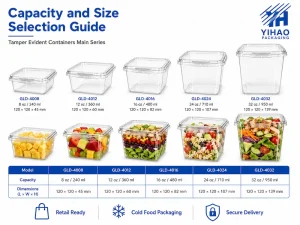
| Visible opening control | Tamper-evident plastic container | Supports retail trust and visible closure integrity |
| Long-term wholesale program | Factory direct sourcing | Stronger specification control, repeat quality, and production planning |
| Short market test | Stock packaging supplier | Faster access to low-volume standard products |
| Custom size, lid, or compartment design | Disposable food container factory | Better support for tooling, samples, and structure adjustment |
When a Disposable Food Container Factory Is the Better Choice
A disposable food container factory is usually the better choice when buyers need structure control, repeat supply, factory-direct communication, and long-term specification stability. This is especially true when packaging becomes part of a product system rather than a one-time purchase.
Choose a Factory When Product Visibility Drives Sales
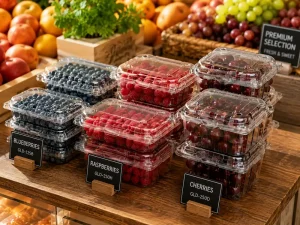
Clear PET and rPET containers are strong options for chilled retail foods because they allow customers to see color, freshness, portion size, and product arrangement. For fresh salads, cut fruit, bakery items, snacks, and deli foods, the food itself is the strongest selling point.
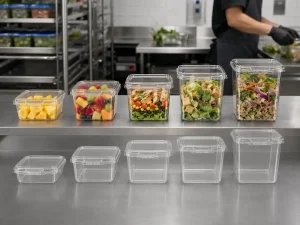
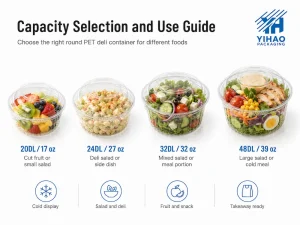
For chilled ready-to-eat foods, Deli & Salad Containers give buyers a practical category direction for salad bars, convenience stores, supermarkets, cafes, and grab-and-go counters. A factory can help compare depth, lid height, closure style, nesting, stacking, and display performance before bulk purchasing.
Choose a Factory When PET or rPET Structure Control Matters
PET and rPET food containers are not identical just because they are clear. Wall thickness, closure tension, hinge strength, rib design, anti-fog performance, ventilation, label area, stacking behavior, and carton packing all affect real performance. A PET container manufacturer can discuss these details more directly than a general reseller.
For chilled prepared food and deli applications, PET Containers are often selected when buyers need clear visibility, fast packing, secure closure, and consistent retail presentation. For smaller portioned salads, deli sides, fruit snacks, and refrigerated grab-and-go foods, a recycled PET hinged deli container gives buyers a useful reference for clear chilled packaging.
Choose a Factory When Packaging Security Matters
Food security is a major concern for supermarkets, convenience stores, takeaway counters, and grab-and-go brands. When food passes through production, packing, transport, shelf placement, and customer handling, packaging should support a stronger sense of closure and integrity.
Tamper Evident Containers are useful when buyers want visible opening indication, stronger retail trust, and better control for deli items, chilled snacks, prepared foods, bakery portions, and takeaway products. For larger secure formats, a tamper-evident PET container gives buyers a practical reference for packaging designed around security and clear display.
Choose a Factory When the Project Requires Custom Food Packaging
Custom food packaging is not only logo printing. It can include special dimensions, lid height, cavity layout, compartment structure, anti-fog requirements, ventilation, label area, tamper-evident lock points, stacking ribs, carton packing logic, and product family consistency.
A strong food packaging supplier should first ask about food type, target weight, filling process, display environment, storage temperature, transportation, labeling, and buyer channel. If the supplier only pushes a standard item without understanding the food, the buyer may receive a container that looks acceptable but performs poorly in real use.
Choose a Factory When Repeat Orders Must Stay Consistent
Wholesale packaging buyers need more than one good sample. They need stable wall thickness, reliable lid fit, repeatable material clarity, consistent carton packing, and predictable communication. A direct factory relationship helps buyers reduce the risk of batch changes, mixed specifications, unclear material sources, and sudden product substitutions.
When Alternative Packaging May Be the Better Choice
Alternative packaging deserves serious comparison when it matches the food, brand positioning, and disposal system. A disposable food container factory can provide strong control, but buyers should still evaluate paperboard, molded fiber, aluminum, compostable materials, PP, PET, rPET, and reusable systems based on real application needs.
Choose Paperboard When Branding Is the Main Priority
Paperboard is suitable when print surface, brand image, and a natural appearance matter more than full product visibility. Bakeries, cafes, sandwich brands, and dry snack companies may choose paperboard to create a warmer presentation. Buyers should still test grease resistance, moisture behavior, lid fit, window clarity, and coating impact.
Choose Molded Fiber When Visibility Is Less Important
Molded fiber may fit trays, bowls, and takeaway foods where the customer does not need to see the product before purchase. It supports a strong natural look, but buyers should verify barrier performance, moisture resistance, stacking strength, and any coating used for oil or water resistance.
Choose Aluminum When Heat Performance Comes First
Aluminum is practical for ovenable meals, frozen meals, catering packs, and heat-focused applications. It should be considered when reheating and oven performance are more important than transparent display.
Choose Compostable Packaging Only When Disposal Is Realistic
Compostable packaging should be chosen when certification, labeling, local composting access, and customer disposal behavior support the claim. Without the right infrastructure, the compostability message may not deliver the expected result. Buyers should confirm documentation before using compostable claims in product pages, labels, or sales materials.
Material Comparison: PET, PP, Paper, Fiber, PLA, and Aluminum
Material choice should always begin with food application. A material that performs well for one food may fail in another scenario. Buyers should compare food temperature, moisture level, oil content, display channel, shelf life, customer handling, and end-of-life claims before selecting packaging.
| Material | Best Fit | Main Strength | Main Limitation |
|---|---|---|---|
| PET/rPET | Chilled salads, fruit, bakery, deli, snacks, retail display | High clarity, rigidity, and shelf appeal | Not designed for high-heat use unless specifically confirmed |
| PP | Hot takeaway, prepared meals, microwaveable food | Heat resistance and practical meal service | Usually lower clarity than PET |
| Paperboard | Bakery, dry food, branded takeaway | Printability and natural presentation | May require coating for wet or oily food |
| Molded fiber | Foodservice trays, bowls, selected takeaway foods | Natural sustainability appearance | Limited visibility and moisture challenges |
| PLA | Cold food and controlled composting programs | Compostability positioning when properly supported | Requires correct facilities and documentation |
| Aluminum | Ovenable meals, frozen meals, catering | Strong heat performance | No food visibility without added lid or sleeve |
For hot prepared foods, buyers should not force PET into a high-heat application. Instead, Microwave Safe Containers are the more logical category to evaluate. For prepared meal counters, takeaway meals, and foodservice programs, a PP prepared meal container gives buyers a better reference for heat-related use than a clear chilled PET pack.
Factory Capability Checklist for Wholesale Buyers
Before choosing a disposable food container factory, buyers should evaluate the supplier as a long-term operating partner. A low unit price is not enough if the supplier cannot support repeat quality, technical discussion, sample review, and clear communication.
1. Product Category Experience
A professional manufacturer should understand how fruit containers, salad containers, bakery containers, deli containers, tamper-evident containers, and hot meal containers differ. Each category needs different structure logic. A fruit container may need ventilation. A salad container may need volume and lid fit. A bakery container may need height and product visibility. A tamper-evident pack needs opening control. A prepared meal container needs heat suitability.
2. Material and Documentation Discussion
The factory should clearly discuss PET, rPET, PP, paper-based structures, or other material directions. For recycled-content packaging, buyers should ask about food-contact suitability, material source discussion, documentation support, and market-specific claim language. Claims such as recycled, recyclable, compostable, biodegradable, eco-friendly, and food grade should be supported by proper context.
3. Sample Testing Before Bulk Orders
Samples should be tested with real food. Buyers should fill the container, close it, stack it, refrigerate it, label it, transport it, and open it as a customer would. This is the fastest way to find weak closure, poor stacking, fogging, label issues, product movement, or portion mismatch.
4. Structure Adjustment and Tooling Communication
When a project requires custom food packaging, buyers should ask whether the factory can discuss mold development, sample adjustment, lid modification, compartment changes, label area optimization, vent placement, and carton packing design. A factory that understands structure can reduce trial-and-error costs before mass production.
5. Shelf Display Performance
Retail packaging should be tested under the same lighting and shelf conditions where the product will be sold. For square-format chilled foods, Square PET Containers support organized shelf blocks, consistent product facing, and better space use.
For salads, fruit, and chilled meal portions, a square PET deli container helps buyers evaluate portion size, shelf presentation, and product visibility. For larger chilled food portions, a large square deli container provides another reference for higher-volume salad, fruit, and chilled meal display.
6. Wholesale Supply Stability
Wholesale buyers should ask how the factory manages repeat orders, carton packing, specification consistency, production planning, and communication. A reliable supplier should help buyers reduce procurement risk, not only provide a quick quotation.
Cost Logic: Factory Direct Is Not Always the Cheapest, But It Gives More Control
Factory-direct sourcing does not automatically mean the lowest price in every case. The final cost depends on material, thickness, size, tooling, order quantity, packing method, printing, customization, shipping volume, and quality expectations. However, factory sourcing usually gives buyers more control over the specification behind the price.
A trading supplier may be useful for early tests or small mixed orders. A local distributor may be useful for urgent replenishment. But when a buyer needs a long-term packaging program, a disposable food container factory usually provides better control over sampling, production details, material options, product family development, and wholesale continuity.
The real cost of packaging includes more than the unit price. It includes packing labor, product damage, shelf appeal, customer complaints, repeat order risk, carton efficiency, and communication cost. A cheaper container that cracks, fogs, leaks, or changes between batches can cost more than a stable factory-made product.
Compliance and Claim Review: Do Not Choose Packaging by Marketing Words Alone
Food packaging buyers should treat compliance and environmental claims carefully. Words such as recyclable, compostable, recycled content, biodegradable, food grade, sustainable, and eco-friendly need evidence and market context. The same claim may be acceptable in one market and risky in another if local infrastructure, documentation, or labeling rules do not support it.
For food-contact packaging, buyers should confirm intended food type, temperature, contact duration, storage condition, and target market. For recycled plastic packaging, buyers should evaluate source control, recycling process discussion, potential contamination concerns, and suitability for food-contact use. For recyclable claims, buyers should avoid absolute wording when local collection and processing systems are uncertain. For compostable packaging, buyers should verify whether the material is intended for municipal or industrial composting and whether the end market has access to appropriate facilities.
This is where a knowledgeable food packaging supplier creates real value. The supplier should not give one universal claim for every country. It should help buyers connect packaging claims with actual application, documentation, and market requirements.
Practical Buyer Scenarios
Scenario 1: A Supermarket Needs Chilled Salad Containers
A supermarket selling ready-to-eat salads needs visibility, lid fit, stacking, condensation control, label placement, and stable repeat supply. PET or rPET containers usually perform better than paperboard or molded fiber when product visibility drives purchase. The buyer should test the container with real salad weight, dressing cups, labels, and refrigerated display conditions.
Scenario 2: A Bakery Needs Dessert Packaging
A bakery may compare clear PET clamshells, paperboard boxes with windows, and molded fiber options. If visual presentation is critical, clear PET may be the better solution. If gift-style branding matters more, paperboard may be stronger. The best choice depends on dessert height, moisture level, frosting protection, shelf display, and takeaway handling.
Scenario 3: A Meal-Prep Brand Needs Microwaveable Containers
A meal-prep brand should focus on heat suitability, lid compatibility, sauce behavior, stacking, and customer reheating instructions. PP microwave-safe containers are more practical than chilled PET containers when reheating is part of the customer experience.
Scenario 4: A Distributor Needs a Broad Wholesale Product Range
A distributor needs product families that cover different customer segments. Working with a factory can help build a structured range across PET hinged containers, square containers, round bowls, tamper-evident packs, and PP prepared meal containers. This is stronger than randomly sourcing unrelated stock items from multiple suppliers.
Questions Buyers Should Ask Before Choosing a Supplier
- What food will be packed: salad, fruit, bakery, deli, hot meal, cold snack, or fresh produce?
- Will the food be sold chilled, ambient, frozen, hot, or reheated?
- Does the customer need to see the food before buying?
- Is tamper evidence required for retail trust?
- Is the project standard wholesale supply or custom food packaging?
- What material fits the application: PET, rPET, PP, paperboard, fiber, PLA, or aluminum?
- What claims will appear on the label, product page, or sales material?
- Can those claims be supported in the target market?
- Can the supplier provide real samples for testing?
- Can the factory support repeat orders with stable specifications?
- Can the manufacturer discuss tooling, lid design, closure, and carton packing?
- Can the supplier support long-term wholesale planning?
How Buyers Should Choose: A Practical Decision Framework
The best buying process is structured. Buyers should start with food application, then select material, then test container structure, then evaluate the supplier’s manufacturing capability.
Step 1: Define the Food and Sales Channel
A container for chilled fruit is different from a container for hot prepared meals. A retail shelf pack is different from a delivery pack. A bakery display container is different from a tamper-evident snack pack. Define the actual use before choosing material or supplier.
Step 2: Choose the Material by Performance
Choose PET or rPET when clarity, rigidity, and chilled display matter. Choose PP when heat resistance and microwave use matter. Choose paperboard when printability and brand surface matter. Choose molded fiber when visibility is less important and the natural look fits the channel. Choose aluminum when ovenability matters. Choose compostable materials only when documentation and disposal infrastructure support the claim.
Step 3: Test the Structure with Real Food
Do not approve packaging based only on empty samples. Fill the container with the real product, close it, stack it, refrigerate it, label it, transport it, and open it. Real-use testing shows whether the container works beyond the catalog image.
Step 4: Evaluate Factory Capability
A reliable disposable food container factory should provide practical answers about material, structure, samples, tooling, production, carton packing, wholesale planning, and repeat quality. A weak supplier may only provide a price list. Buyers should choose the partner that reduces risk, not the one that simply replies fastest.
FAQ About Choosing a Disposable Food Container Factory
1. What is a disposable food container factory?
A disposable food container factory is a manufacturer that produces food packaging containers for retail, takeaway, foodservice, deli, salad, bakery, fresh produce, and prepared meal applications. A capable factory supports material selection, structure design, sampling, production, quality control, wholesale supply, and custom food packaging discussion.
2. Is a factory better than a food packaging supplier?
A factory is usually better when buyers need product control, repeat wholesale orders, customization, direct technical discussion, and long-term specification stability. A general food packaging supplier may be useful for small stock purchases, but a factory is stronger for long-term packaging programs.
3. When should buyers choose PET food containers?
Buyers should choose PET food containers when clarity, chilled display, product visibility, rigidity, and retail presentation are important. PET and rPET containers are common choices for salads, fruit, bakery portions, deli snacks, and grab-and-go chilled foods. Buyers should confirm intended food use, temperature conditions, lid fit, and supplier documentation before ordering.
4. Are alternative packaging materials always more sustainable?
No. Alternative materials such as paper, molded fiber, PLA, aluminum, and reusable systems each have benefits and limitations. Sustainability depends on material design, food protection, local recycling or composting access, transportation, contamination risk, and whether the package performs properly in real use.
5. What should buyers test before placing a wholesale order?
Buyers should test real food in the container, including filling weight, closure, stacking, chilled display, label placement, takeaway handling, carton packing, customer opening, and storage conditions. For custom food packaging, buyers should also confirm dimensions, material thickness, lid design, branding position, and repeat production expectations.
References
- U.S. Food and Drug Administration, Packaging & Food Contact Substances.
- U.S. Food and Drug Administration, Guidance for Industry: Use of Recycled Plastics in Food Packaging.
- U.S. Food and Drug Administration, Recycled Plastics in Food Packaging.
- U.S. Environmental Protection Agency, Sustainable Materials Management.
- Federal Trade Commission, Guides for the Use of Environmental Marketing Claims, Recyclable Claims.
- ASTM International, ASTM D6400 Standard Specification for Labeling of Plastics Designed to be Aerobically Composted in Municipal or Industrial Facilities.
- European Union, Regulation (EU) 2025/40 on Packaging and Packaging Waste.
- U.S. Environmental Protection Agency, National Strategy to Prevent Plastic Pollution.
Deep-Dive Insights: How Buyers Should Think Beyond the Material Name
How does a factory reduce packaging sourcing risk?
A factory reduces sourcing risk by connecting product design, material choice, sampling, tooling, production, carton packing, and wholesale supply into one controlled process. This matters when buyers need the same specification across repeated orders instead of changing products every time stock changes.
Why should buyers avoid choosing only by unit price?
A low unit price can become expensive if the container cracks, fogs, stacks poorly, fails to close, hides the food, or causes customer complaints. The real cost of packaging includes performance, labor efficiency, shelf impact, transportation behavior, and repeat order stability.
What makes PET and rPET useful for chilled retail food?
PET and rPET are useful for chilled retail food because they support clear visibility, rigid presentation, practical nesting, and strong shelf appeal. They are especially suitable when the food’s color, freshness, and arrangement help drive purchase decisions.
Which alternative packaging option should buyers consider first?
Buyers should consider the alternative that matches the product’s actual use. Paperboard is strong for branding, molded fiber for selected foodservice applications, aluminum for heat use, PLA for controlled composting programs, and reusable packaging for closed-loop systems.
Why does supplier transparency matter?
Supplier transparency matters because food packaging claims must connect to real material details, intended use, documentation, and market conditions. A reliable supplier helps buyers avoid unsupported claims, weak structure choices, and unstable repeat orders.
Final Note / Practical Takeaway
For buyers comparing disposable food containers, PET packaging, tamper-evident packs, deli containers, salad containers, microwave-safe containers, or custom wholesale food packaging, YIHAO Packaging supports material discussion, sample review, structure selection, and factory-direct supply planning for long-term packaging projects.
© YIHAO Packaging. All rights reserved. All articles, product images, packaging designs, technical specifications, and website materials are protected by copyright. Unauthorized copying, reproduction, redistribution, modification, or commercial use is strictly prohibited without prior written permission.