Choosing the right deli container manufacturer is a critical sourcing decision for food packaging teams that purchase wholesale deli containers, salad bowls, clear PET food containers, and bulk salad containers for chilled retail, grab-and-go, and foodservice programs. The right supplier affects food visibility, lid security, cold shelf performance, carton packing, repeat order consistency, and buyer confidence.
YIHAO works with food brands, distributors, supermarkets, cafes, and foodservice buyers that need clear PET and rPET packaging for deli salads, fruit portions, snacks, cold meals, bakery items, and grab-and-go food. This guide explains how buyers should compare a deli container manufacturer, what questions to ask before ordering, and how to match container structures with real retail and foodservice applications.
The focus is practical: material selection, container format, lid fit, sample testing, documentation, wholesale order preparation, and supplier evaluation. This guide does not assume fixed prices, fixed MOQ, fixed certifications, or fixed lead times, because those details should always be confirmed with the manufacturer based on the exact item, order volume, destination market, and customization request.
Why Food Packaging Teams Need a Real Deli Container Manufacturer
A trading company may help with simple sourcing, but a real deli container manufacturer gives buyers stronger control over product structure, material selection, sample adjustment, repeat production, and packaging consistency. This matters when a buyer is building a long-term retail food program rather than purchasing a one-time batch of containers.
For chilled salads, fruit cups, deli sides, snacks, grain bowls, desserts, and ready-to-eat meals, packaging quality affects three important outcomes: how the food looks on shelf, how securely the pack travels, and how confidently the buyer can reorder the same product again. Clear PET packaging is widely used because it supports strong visibility, lightweight handling, and retail-ready presentation for cold food applications.
A professional PET deli container factory should help buyers compare container shapes, sheet thickness direction, lid structure, stacking behavior, carton packing logic, branding options, and documentation needs. The goal is not to push one container for every situation. The goal is to build the right packaging system for the buyer’s food type, selling channel, handling process, and order plan.
For buyers comparing a PET deli container factory, factory capability should be evaluated through sample consistency, container forming quality, packing protection, communication accuracy, and the ability to support repeat wholesale orders. These practical details often matter more than a broad catalog with many items but weak production control.
What a Deli Container Manufacturer Should Help Buyers Solve
A strong deli container manufacturer should solve more than “container supply.” Food packaging teams usually need answers to application questions before they can place a stable wholesale order.
Application Fit
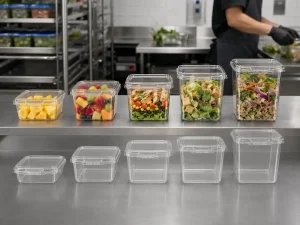
Different foods need different container structures. Leafy salads need clear presentation and enough internal height to avoid crushing. Fruit portions need visibility and stable stacking. Deli sides need secure closure. Nuts and snack packs need portion control. Larger chilled meals need a stronger base and lid relationship. This is why buyers often start with Deli & Salad Containers as a category, then narrow down by shape, capacity, and closure style.
Material and Appearance
PET and rPET are common choices for clear cold food packaging because buyers want a clean, transparent appearance for chilled display. For supermarkets and grab-and-go counters, clarity is not decoration; it helps customers understand freshness, portion size, ingredients, and value before purchase. A reliable clear food packaging supplier should keep transparency, forming quality, edge finish, and lid appearance consistent across production batches.
Wholesale Reliability
Foodservice distributors and retail packaging buyers often need repeat orders, mixed product ranges, stable carton packing, export-ready communication, and clear production coordination. A wholesale order becomes risky when a supplier cannot keep dimensions, lid fit, material clarity, or packing condition consistent. For this reason, the best buyer conversations usually start with samples, drawings, application details, and expected ordering rhythm.
Main Container Types Buyers Should Compare
Before selecting a deli container manufacturer, buyers should understand the main container families used for deli and salad packaging. Each format has a different role in food presentation and handling.
PET Hinged Deli Containers
PET hinged deli containers are widely used for chilled foods that need one-piece convenience. The hinged structure keeps the lid connected to the base, which helps fast packing, reduces lid-matching mistakes, and works well for many grab-and-go programs.
This format is suitable for deli salads, cut fruit, snack portions, bakery items, nuts, side dishes, and other cold display foods. Buyers that need wholesale deli containers often choose hinged PET formats when the packing team wants fast closure and simple inventory control.
Round PET Salad Bowls
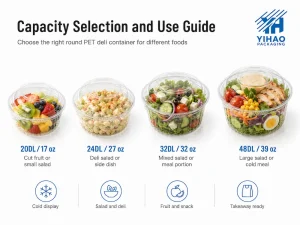
round PET salad bowls are strong candidates for salad programs, fruit bowls, chilled noodles, grain bowls, and larger takeaway meals. Their round shape supports strong food presentation, especially when ingredients are layered or arranged for visual appeal.
A salad container supplier should help buyers compare bowl depth, lid style, stacking behavior, and matching use cases. A shallow bowl may suit fruit or side salads, while a deeper bowl may suit premium meal salads or larger chilled portions.
Square PET Deli Containers
square PET deli containers are useful when buyers need efficient shelf arrangement, compact stacking, and a more structured retail look. They work well for salad portions, fresh fruit, deli sides, chilled snacks, and prepared food items that benefit from straight edges and strong visual order.
Square containers are especially practical for supermarkets, convenience stores, and foodservice counters where shelf space matters. Buyers sourcing bulk salad containers should compare how round, square, and hinged formats fit their display cases, packing stations, and delivery cartons.
Tamper Evident Options
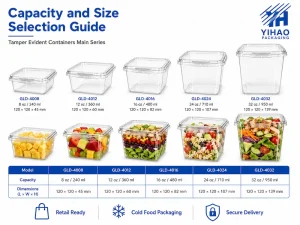
Some retail food programs require stronger consumer trust at the point of sale. In that case, buyers may compare regular hinged packaging with tamper evident containers. Tamper-evident formats are useful for certain refrigerated foods, grab-and-go products, and retail channels where visible opening protection is part of the merchandising strategy.
Not every food item needs tamper evidence. The decision depends on store policy, product type, retail channel, food handling process, and local market expectations. A capable supplier should explain available structures without forcing a more complex container where a standard hinged option already fits the job.
Buyer Selection Matrix for Deli and Salad Packaging
| Buyer Need | Recommended Container Direction | What to Check Before Ordering |
|---|---|---|
| Fast packing for cold deli items | Hinged PET deli containers | Closure feel, hinge strength, stacking, clarity, carton protection |
| Premium salad presentation | Round PET salad bowls with clear lids | Bowl depth, lid fit, ingredient visibility, shelf display angle |
| Compact shelf layout | Square PET deli containers | Stacking stability, base rigidity, lid matching, case packing |
| Fruit and snack portions | Clear PET hinged or compartment containers | Portion size, anti-fog needs, ventilation needs, food separation |
| Visible opening protection | Tamper evident PET containers | Seal structure, opening method, user experience, retail requirement |
| Hot food or microwave programs | Confirm PP or microwave-safe direction instead of standard PET | Temperature use, heating process, material suitability, labeling needs |
How to Evaluate PET Material Quality
When buyers compare a deli container manufacturer, PET quality should be evaluated through samples, not only through catalog images. A good sample review should include clarity, touch feel, lid closing sound, edge finish, base stability, and stacking behavior.
Clarity
Clear PET packaging should present food cleanly without a dull, gray, or cloudy look. For salads, fruit, snacks, and chilled meals, the customer sees the food before reading the label. This makes clarity one of the strongest merchandising features of PET deli packaging.
Rigidity
Rigidity affects how a container feels in hand and how it performs during packing, stacking, and transport. A container that is too soft may deform during handling. A container that is too heavy may increase material cost unnecessarily. The best direction depends on the food weight, container size, stacking height, and distribution route.
Lid Fit and Closure
Lid performance is one of the most important sample checks. Buyers should test whether the lid closes easily, stays closed during normal handling, and opens without damaging the food presentation. For hinged containers, the hinge area should feel consistent. For separate lid systems, buyers should confirm the lid and base are matched correctly before approving bulk orders.
Food Contact Documentation
Food packaging teams should request relevant food-contact documentation for the target market and application. A responsible manufacturer should communicate clearly about material composition, intended use, available declarations, and testing direction. Buyers should not rely on verbal claims alone when the packaging is intended for food contact.
Sample Testing Checklist Before Wholesale Orders
Before placing a wholesale order, food packaging teams should test containers under realistic conditions. The best test is not only a desk review. It should reflect how the food will be packed, displayed, transported, and opened by customers.
- Food fit: Test real salad, fruit, deli sides, snacks, or chilled meals inside the container.
- Closure test: Open and close the lid several times to evaluate stability and user experience.
- Stacking test: Stack filled samples to check deformation and display stability.
- Cold shelf test: Place samples in the expected refrigerated environment and observe appearance.
- Transport simulation: Test movement, carton packing, and handling pressure.
- Label placement: Apply real labels to check visibility, adhesion, and barcode readability.
- Customer opening test: Confirm the package opens without spilling or damaging presentation.
- Carton review: Check how containers are packed, protected, counted, and stored.
For buyers sourcing bulk salad containers, this checklist prevents expensive mistakes. A container may look attractive when empty but perform poorly once filled with dressing, toppings, fruit juice, or heavier chilled ingredients. Sample testing protects the buyer, the brand, and the final customer experience.
How to Compare Manufacturer, Wholesale Supplier, and Trading Company
Not every supplier plays the same role. A food packaging team should understand whether it is talking to a factory, a wholesale distributor, or a trading company. Each option has advantages, but buyers should be clear about what they need.
| Source Type | Strength | Risk to Check |
|---|---|---|
| Manufacturer / Factory | Better control over product structure, production details, samples, and repeat consistency | Confirm communication speed, export experience, documentation, and order coordination |
| Wholesale Supplier | Useful for available stock ranges, mixed categories, and shorter buying cycles | Confirm product source, consistency, replacement plan, and long-term availability |
| Trading Company | May offer wide sourcing options and flexible communication | Confirm whether technical details, samples, and repeat production can be controlled |
For long-term deli and salad packaging programs, many buyers prefer working directly with a deli container manufacturer because packaging changes are easier to manage when the supplier understands tooling, material, forming, packing, and quality control.
Questions to Ask a Deli Container Manufacturer
A professional buyer should not ask only for a price list. Price is important, but it becomes meaningful only after the product structure, material, application, and order requirements are clear. Use the following questions when comparing a deli container manufacturer.
Product and Application Questions
- Which container format is most suitable for leafy salads, fruit portions, deli sides, snacks, or chilled meals?
- Do you offer hinged, round, square, separate-lid, and tamper-evident options?
- Which items are suitable for refrigerated display?
- Which items should not be used for microwave heating?
- Can you provide samples for real food testing before a bulk order?
Material and Documentation Questions
- Is the container made from PET, rPET, PP, or another material?
- What documentation is available for food-contact use?
- Can you explain the intended temperature and application range?
- Can you support clear labeling of material type for buyer records?
- Can you discuss recyclability based on local collection and recycling systems?
Wholesale and Supply Questions
- What is the recommended order preparation process for wholesale buyers?
- Can carton packing and pallet loading information be provided after item confirmation?
- How do you manage repeat order consistency?
- Can mixed product categories be coordinated in one sourcing plan?
- What information do you need before quoting?
Product Directions for Common Food Packaging Programs
Different food programs need different packaging priorities. The following examples help buyers match application needs with the right packaging direction.
Grab-and-Go Salads
For grab-and-go salads, buyers often compare round bowls, square containers, and hinged deli formats. A clear PET salad bowl works well when food visibility and fast customer recognition matter. Larger salad programs may need a large PET salad bowl for meal-size portions.
Deli Sides and Cold Food Portions
For deli sides, chilled snacks, fruit portions, and small prepared foods, a clear hinged deli container provides simple packing and strong visibility. Buyers should test closure strength, base stability, and stacking behavior with real food weight before approving bulk orders.
Larger Chilled Food Packs
Some foodservice and retail programs need larger containers for fruit, salads, pasta salad, deli meals, or sharing portions. A larger hinged deli container or a large clear deli container should be tested for rigidity, lid security, and carton protection because larger packs carry more weight.
Square Shelf-Ready Food Packs
For compact shelf layout and organized visual merchandising, a square PET food container gives buyers a clean retail format for salads, fruit, and deli meals. For larger chilled portions, buyers may compare a large square deli container with round bowls and hinged formats.
Fresh-Cut Fruit and Snack Programs
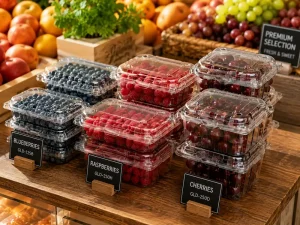
For fruit portions, snack packs, and convenience retail, buyers may also review fresh-cut fruit containers. These containers support fruit visibility, portion control, and chilled display. When fruit juice, condensation, or mixed ingredients are involved, buyers should test venting, anti-fog needs, compartment design, and lid performance.
Compliance and Sustainability Considerations
Food packaging teams should handle compliance and sustainability with precision. It is not enough to ask whether a container is “food grade” or “eco-friendly.” Buyers should request documents, confirm intended use, and understand the regulations or market expectations that apply to their destination.
In the United States, food-contact packaging is evaluated under FDA food contact substance rules and related guidance. In the European Union, packaging buyers also need to pay attention to packaging waste, recyclability, and recycled-content direction under the new Packaging and Packaging Waste Regulation. For recycled plastic food-contact materials, EFSA evaluates recycling processes used to produce recycled plastic materials intended for food contact.
From a practical sourcing perspective, this means buyers should ask a deli container manufacturer for available material declarations, food-contact documentation, and application guidance. For rPET packaging, buyers should clarify whether the recycled content is suitable for the intended market and food-contact application. For recyclability, buyers should avoid broad claims and instead consider local collection, sorting, and recycling acceptance.
A responsible clear food packaging supplier should also help buyers avoid packaging designs that reduce recyclability, such as unnecessary dark colors, difficult-to-remove labels, incompatible components, or mixed-material structures that complicate sorting. The most useful sustainability discussion is specific: material, structure, label, lid, local recycling system, and food waste protection.
OEM, Customization, and Branding Questions
Many food packaging teams want custom labels, custom printing, embossed logos, private-label cartons, or a product range that supports brand recognition. A deli container manufacturer may support OEM and customization, but the buyer should confirm feasibility based on the exact item and order plan.
For PET deli containers, customization may involve carton marks, label area planning, product selection, branded sleeves, or selected mold-related adjustments. Buyers should not assume every container can be customized in the same way. Tooling, printing method, order quantity, lead time, and material structure all affect what is practical.
The smartest approach is to first confirm the container format, then test samples, then discuss branding. If the base package fails in closure, clarity, stacking, or food fit, branding will not solve the problem. Packaging performance must come before decoration.
Red Flags When Choosing a Deli Container Supplier
A buyer should pay attention to warning signs before approving samples or moving into wholesale purchasing. These red flags often appear early in communication and usually signal higher risk during repeat orders.
- The supplier cannot clearly explain whether the container is PET, rPET, PP, or another material.
- Samples look different from later bulk production.
- The lid closes well when empty but fails after real food testing.
- The supplier only discusses price and avoids application, documentation, or packing details.
- Food-contact, carton, and material information cannot be provided clearly.
- The supplier uses broad claims such as eco-friendly or recyclable without explaining material and local recycling conditions.
- The supplier cannot support repeat order consistency for dimensions, lid fit, carton packing, or product appearance.
Common Mistakes Buyers Should Avoid
Choosing Only by Price
A low unit price can become expensive if the container causes lid failures, returns, food presentation problems, carton damage, or unstable repeat orders. Buyers should compare total packaging performance instead of only comparing price.
Skipping Sample Testing
Photos cannot prove closure performance, stacking strength, or cold shelf behavior. Samples should be tested with real food, real labels, and real handling conditions.
Using PET for the Wrong Temperature Scenario
PET is commonly selected for clear cold food display, but buyers should not assume standard PET containers are suitable for microwave heating or hot-fill applications. For heated food programs, buyers should confirm whether microwave safe containers or other material directions are more appropriate.
Ignoring Carton and Storage Details
Wholesale packaging is not only about the container itself. Carton protection, nesting, counting, storage, palletization, and warehouse handling also affect the buying experience. Buyers should request packing details after confirming the item.
Making Sustainability Claims Too Broad
Words like recyclable, recycled, sustainable, and eco-friendly should be used carefully. Buyers should confirm material, recycled content, food-contact suitability, local recycling acceptance, and label compatibility before using sustainability claims in marketing.
Practical Ordering Process for Food Packaging Teams
A structured buying process helps teams reduce risk and communicate clearly with the deli container manufacturer. The following sequence works well for new packaging projects.
- Define the food application: salad, fruit, deli side, snack, chilled meal, dessert, or multi-use program.
- Confirm the selling channel: supermarket, cafe, foodservice, convenience store, distributor, or private-label brand.
- Select container direction: hinged, round, square, separate-lid, tamper-evident, or microwave-safe material direction.
- Request samples: test with real food, labels, stacking, and cold storage.
- Review documentation: confirm material, food-contact information, intended use, and market requirements.
- Check packing details: carton quantity, protection method, storage needs, and logistics planning after item confirmation.
- Discuss wholesale terms: confirm quotation, order quantity, customization, production schedule, and shipment details directly with the supplier.
- Approve before bulk production: keep approved samples and item information for repeat order control.
Buyer Checklist: How to Score a Deli Container Manufacturer
| Evaluation Area | What a Strong Supplier Should Provide | Buyer Risk If Missing |
|---|---|---|
| Product Range | Hinged, round, square, salad, deli, snack, and related food packaging options | Limited selection may force the wrong format |
| Application Support | Practical matching by food type, shelf display, and packing process | Good-looking samples may fail in real use |
| Material Clarity | Clean transparent PET or rPET appearance with stable forming quality | Poor shelf presentation and weak brand perception |
| Lid Performance | Reliable closure, smooth opening, and fit consistency | Spillage, returns, and customer complaints |
| Documentation | Relevant food-contact and material information based on target market | Compliance uncertainty and delayed approval |
| Wholesale Coordination | Clear communication on samples, quotation, packing, production, and shipping | Unstable supply and difficult repeat orders |
| Customization Support | Realistic discussion of labeling, carton marks, OEM direction, and feasibility | Branding expectations may exceed product reality |
When YIHAO Is a Good Fit for Buyers
YIHAO is a practical fit for buyers that need clear PET and rPET packaging for chilled food display, salad programs, fruit portions, deli sides, snacks, bakery items, and grab-and-go retail food. The strongest match is a buyer that wants to compare product families, test samples, and build a packaging line instead of buying one isolated item without a plan.
For a food packaging team sourcing from a deli container manufacturer, the best starting point is to share the food type, target market, approximate portion size, preferred container format, temperature scenario, label needs, and expected wholesale order direction. With that information, the supplier can recommend suitable structures and avoid mismatched packaging.
If the buyer is not sure whether to choose hinged containers, salad bowls, square deli containers, or tamper-evident packaging, the decision should be based on use case rather than guesswork. A salad bar, a supermarket grab-and-go shelf, a fruit cutting facility, and a foodservice distributor may all need different packaging logic.
FAQ
1. What should I check before choosing a deli container manufacturer?
Buyers should check product range, PET or rPET material clarity, lid fit, sample availability, food-contact documentation, wholesale supply stability, carton packing details, and application knowledge. A good deli container manufacturer should help match the container to the food, not simply quote a random item.
2. Are PET deli containers suitable for hot food?
Standard PET deli containers are commonly selected for clear cold food display, not for microwave heating or high-temperature food applications. Buyers should confirm the intended temperature use with the supplier. For heating scenarios, microwave-safe material directions should be reviewed separately.
3. What is the difference between wholesale deli containers and retail deli containers?
Wholesale deli containers usually refer to bulk purchasing for distributors, supermarkets, foodservice buyers, and packaging resellers. Retail deli containers refer to the actual packaging used for food sold to end customers. The same container may serve both purposes, but wholesale buyers need stronger attention to carton packing, repeat supply, and product consistency.
4. How do I choose between hinged deli containers and salad bowls?
Hinged deli containers are practical for fast packing, simple storage, and grab-and-go portions. Salad bowls are often better for premium salad presentation, layered ingredients, and larger chilled meals. Buyers should test both formats with real food before ordering in bulk.
5. Can a deli container manufacturer support custom packaging?
Many manufacturers can discuss OEM or custom packaging options, but feasibility depends on the exact item, order plan, branding method, tooling needs, and production requirements. Buyers should first confirm the container format and sample performance, then discuss branding or customization.
References
- U.S. Food and Drug Administration, Food Contact Substances and Packaging Guidance.
- U.S. Food and Drug Administration, Ingredients, Additives, GRAS & Packaging Guidance Documents.
- European Union, Regulation (EU) 2025/40 on Packaging and Packaging Waste.
- European Commission, Packaging Waste and PPWR Implementation Information.
- European Food Safety Authority, Recycled Plastic Materials and PET Recycling Process Evaluation.
- European Food Safety Authority, Administrative Guidance for Recycling Processes Producing Recycled Plastic Food Contact Materials.
- Association of Plastic Recyclers, APR Design Guide for Plastics Recyclability.
- U.S. Environmental Protection Agency, Sustainable Packaging and Sustainable Materials Management Resources.
Deep Dive Insights
How should buyers compare deli container manufacturers beyond price?
Buyers should compare a deli container manufacturer through application fit, sample consistency, PET clarity, lid security, carton protection, documentation support, and repeat order control. Price matters, but it should be evaluated after the container has passed real food testing and cold shelf handling review.
Why does PET clarity matter for salad and deli packaging?
For salads, fruit portions, snacks, and chilled deli foods, clear PET packaging works as part of the retail display. Customers often judge freshness and portion value before reading the label. Strong clarity helps food packaging teams improve shelf visibility while keeping the pack lightweight and practical for grab-and-go handling.
What should food packaging teams test before approving bulk salad containers?
Food packaging teams should test closure strength, stacking stability, real-food fit, cold storage appearance, label placement, carton packing, and customer opening experience. A container that looks good when empty may still fail when filled with dressing, fruit juice, toppings, or heavier chilled meals.
Option: hinged deli containers, round salad bowls, or square PET containers?
Hinged deli containers are practical for fast packing and simple inventory control. Round salad bowls support premium food presentation and layered ingredients. Square PET containers improve shelf organization and carton efficiency. The best option depends on food type, selling channel, portion size, handling process, and display strategy.
Consideration: sustainability claims need precise wording
Buyers should avoid broad sustainability claims without checking material type, recycled content direction, food-contact suitability, label compatibility, and local recycling acceptance. A responsible clear food packaging supplier should help buyers discuss sustainability through specific packaging design details rather than vague marketing language.
Final Note / Practical Takeaway
© YIHAO Packaging. All rights reserved. All articles, product images, packaging designs, technical specifications, and website materials are protected by copyright. Unauthorized copying, reproduction, redistribution, modification, or commercial use is strictly prohibited without prior written permission.