For supermarkets, cafes, bakeries, and foodservice brands, packaging has become part of the product value. Customers judge freshness, portion size, cleanliness, and brand quality before they touch the food. This is why custom PET containers are widely used for fresh fruit, salads, bakery items, desserts, chilled snacks, deli sides, cold drinks, and grab-and-go food programs.
YIHAO supports food packaging buyers who need clear PET packaging solutions for retail display, takeaway counters, chilled shelves, bakery display cases, and foodservice operations. For buyers comparing custom PET food containers, the right decision is not only about choosing a clear box or bowl. It is about matching food application, lid type, structure, branding method, shelf presentation, packing efficiency, and wholesale supply consistency.
A good PET container should protect the product, display it clearly, support fast filling and closing, stack well during storage, fit retail shelves, and create enough space for labels or branded sleeves. For a manufacturer, the real value is not just producing containers. The value is helping buyers turn food format, channel requirements, and brand positioning into practical packaging.
Why Custom PET Containers Matter for Food Retail Buyers
custom PET containers are especially valuable when the buyer needs both visibility and control. Supermarkets need attractive packaging that performs under refrigerated display and high-volume restocking. Cafes need clear, premium packaging for fruit cups, desserts, small salads, pastries, and cold drink add-ons. Bakeries need containers that protect decoration while showing the product. Foodservice brands need reliable structures that support portion control, takeaway handling, and repeat purchasing.
PET is often selected because it provides strong clarity, lightweight handling, clean presentation, and practical cold food display performance. Clear PET packaging lets customers see fruit color, salad freshness, bakery decoration, dessert layers, toppings, sauce position, and portion size. In chilled retail and grab-and-go channels, this visual transparency directly supports buying confidence.
For wholesale buyers, custom PET packaging also solves operational problems. A standard container may hold the food, but a customized solution improves lid fit, label placement, stacking strength, carton packing, product line consistency, and private label identity. That is why many buyers search for custom PET containers manufacturer, custom PET food containers wholesale, or OEM plastic packaging supplier when they are building repeat food packaging programs.
What Custom PET Containers Usually Include
Customization does not always mean creating a completely new mold. In many wholesale packaging projects, customization starts with existing proven structures and then adjusts branding, label position, sleeve design, carton marking, packing method, or product series planning. Full OEM mold development is more suitable for buyers with stable volume, long-term private label planning, and a clear structural requirement that stock packaging cannot solve.
Common customization options include container shape, capacity range, base depth, lid height, hinge design, locking structure, anti-fog treatment, ventilation holes, label area, sleeve compatibility, embossed logo, printed cup design, carton layout, barcode position, and packaging series consistency.
For buyers comparing custom PET containers with standard stock packaging, the most important question is practical: does the packaging improve product display, packing speed, lid reliability, shelf presentation, brand recognition, and reorder stability? If customization only changes the appearance but does not improve performance, the project is incomplete.
Main Applications for Supermarkets, Cafes, Bakeries, and Foodservice Brands
Supermarkets and Grocery Retail
Supermarkets need packaging that works across chilled display, high-volume replenishment, customer handling, barcode scanning, and shelf blocking. PET containers are widely used for fresh-cut fruit, berries, salads, deli sides, chilled snacks, bakery packs, and prepared cold foods. Clear visibility matters because shoppers compare freshness visually before purchasing.
For supermarket buyers, the best custom PET containers should support stack height, shelf stability, lid security, label readability, condensation control, and carton efficiency. A container that looks attractive but loses shape under stacking creates food waste, staff frustration, and customer complaints. A strong supermarket packaging program protects both product appearance and store operation.
Cafes and Coffee Chains
Cafes often use PET packaging for parfaits, fruit cups, cold desserts, cookies, pastries, small salads, snack packs, and cold drink programs. In a small display area, packaging must look clean and premium. Clear PET helps show colorful ingredients, layered desserts, fruit toppings, and portion control.
Cafe buyers often prefer labels, stickers, or sleeves instead of full custom molds. This keeps the packaging flexible while supporting branded food packaging. For seasonal menus, limited-time products, or multiple store locations, this approach creates a strong balance between cost control and brand presentation.
Bakeries and Dessert Brands
Bakeries need packaging that protects product shape, prevents topping damage, and displays the product clearly. PET works well for cupcakes, muffins, cookies, cake slices, pastries, dessert samplers, and chilled sweets. For bakery packaging, lid height matters as much as base size. A low lid damages frosting or decoration, while an oversized lid wastes space and weakens shelf efficiency.
When choosing bakery containers, buyers should confirm product height, decoration style, display temperature, handling distance, and whether the item is sold as a single piece, multipack, or gift-style retail pack.
Foodservice and Grab-and-Go Brands
Foodservice brands use PET containers for chilled meals, deli salads, fruit mixes, cold noodles, snack boxes, side dishes, and event catering trays. In this channel, closure reliability and portion consistency are critical. Packaging must survive filling, closing, stacking, transport, display, and customer takeaway use.
For foodservice buyers, the best option is not always the lowest-priced container. The better choice is the structure that reduces lid pop-off, improves product protection, supports repeat packing, and keeps the food looking consistent across multiple branches or operators.
Popular PET Container Structures for Custom Projects
Different food categories need different PET structures. A fruit clamshell, hinged deli container, round salad bowl, square deli box, compartment tray, and cold cup solve different packaging problems. Buyers should match structure to food type first, then decide how to customize branding, label space, carton packing, and product series.
| PET Container Structure | Best Use Cases | Buyer Priority | Customization Focus |
|---|---|---|---|
| Hinged PET containers | Deli salads, fruit, bakery snacks, sandwiches | Fast packing and secure closure | Hinge strength, lid height, label area |
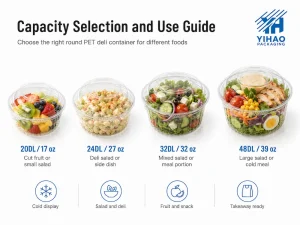
| Round PET bowls | Salads, fruit bowls, chilled meals, cold noodles | Premium display and portion clarity | Lid fit, dome height, anti-fog option |
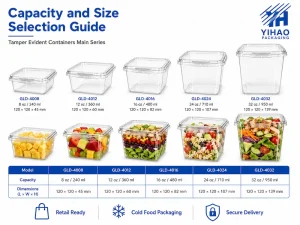
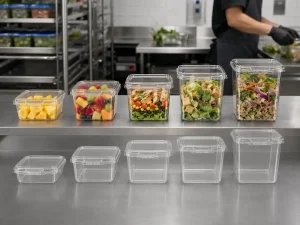
| Square PET containers | Deli sides, snacks, prepared cold foods | Shelf efficiency and stacking | Base stability, lid choice, size series |
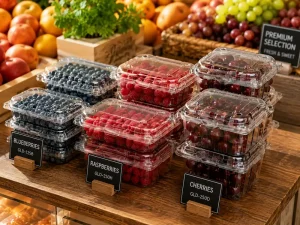
| Produce clamshells | Berries, grapes, cherry tomatoes, fresh produce | Ventilation and retail handling | Vents, locking points, produce fit |
| Compartment PET containers | Fruit mixes, snack packs, dessert assortments | Ingredient separation | Divider depth, cavity size, lid clearance |
| PET cold cups | Juice, iced coffee, smoothies, fruit tea | Drink clarity and lid compatibility | Cup size series, logo print, flat or dome lids |
How to Match Custom PET Food Containers to Food Type
The best custom PET packaging decision starts with the product, not the catalog. Buyers should define food weight, moisture level, oil level, topping height, expected shelf life, storage temperature, filling method, transport route, and display environment before selecting packaging.
For salads and fruit bowls, round PET containers provide strong visual display and support layered ingredients. For deli sides and compact chilled meals, square PET containers improve shelf blocking and carton efficiency. For fresh-cut fruit and berries, produce clamshell containers support ventilation, product visibility, and fast retail handling.
For cupcakes, muffins, and dessert samplers, buyers should focus on lid height and cavity design. For cold beverages, PET cold cups require matching flat lids, dome lids, straw slots, logo printing, and carton packing. For retail food programs that need stronger opening control, tamper evident containers may be more suitable than standard hinged formats.
How the Custom PET Container Development Process Works
A successful custom PET containers project should follow a clear development process. This helps buyers avoid wrong molds, weak lid fit, unsuitable label areas, poor carton packing, and unnecessary cost. The process should be practical, documented, and connected to real food application testing.
| Development Step | What Buyers Should Confirm | Why It Matters |
|---|---|---|
| 1. Food application confirmation | Fruit, salad, bakery, dessert, deli, drink, chilled food | Prevents selecting a structure that does not match the product |
| 2. Size and structure selection | Capacity, base depth, lid height, shape, stackability | Controls display, packing speed, and shelf use |
| 3. Lid and closure testing | Hinge strength, snap fit, lid security, leak risk | Reduces lid pop-off and product loss |
| 4. Branding method confirmation | Label, sleeve, print, embossing, carton mark | Supports private label food packaging and retail identity |
| 5. Sample review | Real food test, stacking test, refrigeration check | Finds problems before mass production |
| 6. Carton packing and bulk production | Carton quantity, pallet loading, protection method | Improves freight efficiency and wholesale handling |
| 7. Repeat order support | Production consistency, reorder plan, private label continuity | Protects long-term supply stability |
Stock PET Containers vs Custom PET Containers: How Buyers Should Choose
Not every buyer needs a new mold. For many supermarkets, cafes, bakeries, and foodservice brands, the better first step is choosing a proven PET structure and customizing labels, sleeves, cartons, or product series. Full custom mold development is more suitable when the buyer has stable volume, repeated orders, and a specific structural need.
| Buyer Situation | Recommended Direction | Reason |
|---|---|---|
| Small seasonal menu | Stock PET containers + branded labels | Keeps cost flexible and launch speed fast |
| Medium supermarket program | Existing mold + custom sleeve or carton | Balances presentation and cost control |
| Long-term private label line | Custom mold or embossed branding | Builds stronger brand consistency |
| High-volume foodservice chain | Standardized size series + repeat supply plan | Improves operation, purchasing, and inventory control |
| Unstable product size | Avoid full mold investment first | Reduces risk before the food format is finalized |
Private Label Food Packaging and Branded Food Packaging Options
private label food packaging is not limited to putting a logo on a container. For food brands, private label packaging may include a consistent size series, unified lid style, label template, sleeve design, carton mark, barcode system, and repeat order specification.
For branded food packaging, buyers usually choose one of four routes: stock PET containers with labels, custom sleeves, direct printing, or custom mold branding. Each route has different cost, lead time, flexibility, and visual impact.
| Branding Method | Best For | Main Advantage | Buyer Caution |
|---|---|---|---|
| Sticker label | Flexible menus and smaller programs | Fast, affordable, easy to update | Needs clean flat label area |
| Paper sleeve | Premium retail and bakery packs | Strong brand storytelling | Should not hide product visibility too much |
| Direct printing | Cold cups and high-volume branded SKUs | Clean integrated appearance | Requires print approval and MOQ planning |
| Embossed logo | Private molds and long-term product lines | Permanent brand detail | Requires mold investment |
What Buyers Should Provide Before Requesting a Quote
When buyers request a quotation for custom PET containers, a clear brief helps the supplier respond faster and more accurately. A vague request such as “send PET food container price” usually leads to broad options and inaccurate comparison. A structured request helps the supplier match food type, structure, size, branding, packing, and order volume.
| Information to Provide | Example Details | Why It Helps |
|---|---|---|
| Food type | Fruit, salad, bakery, dessert, deli, cold drink | Matches structure and lid height |
| Target capacity | Small snack pack, single-serve bowl, family-size container | Improves size recommendation |
| Storage condition | Chilled display, room temperature bakery shelf, takeaway | Supports material and structure review |
| Branding method | Label, sleeve, printing, embossing, plain packaging | Defines customization route |
| Order plan | Trial order, monthly repeat order, private label program | Helps evaluate stock option or OEM mold |
| Destination market | Target country or sales region | Supports food-contact documentation discussion |
Food Contact, Material, and Compliance Considerations
Food packaging buyers should treat compliance as part of product development, not as a final paperwork request. PET containers used for food contact should be reviewed based on destination market, food type, storage temperature, and intended use. Buyers should request food-contact documentation based on the target application instead of relying only on general material claims.
For PET and rPET projects, buyers should confirm whether the material is suitable for the intended food contact application, whether recycled content is appropriate for the destination market, and whether supporting documents are available. If the product will be sold in markets with specific food contact requirements, buyers should request relevant declarations, test reports, or supplier statements before bulk purchasing.
It is also important to avoid overclaiming. PET packaging is commonly selected for clear cold food display, but it should not be described as microwave safe unless the specific material and structure are designed and tested for that use. For hot meals or reheating applications, PP packaging is usually a more suitable direction.
Recyclability and Design-for-Recycling Decisions
Many buyers ask whether PET packaging is recyclable. The practical answer depends on local collection, sorting, recycling infrastructure, container format, label choice, adhesive, color, and food contamination level. Clear PET generally supports stronger recycling value than heavily colored or complex multi-material packaging, but final recyclability depends on the local system that receives the package.
For custom PET containers, design-for-recycling should be considered early. Labels, adhesives, sleeves, inks, black colorants, coatings, and mixed materials may affect sorting and recycling outcomes. A packaging design that looks attractive on shelf may become less recycling-friendly if the label covers too much of the container or uses materials that interfere with PET recovery.
Buyers should ask suppliers about clear material options, label placement, removable labels, material compatibility, and whether the selected design supports accurate sustainability communication. The safest wording is usually careful and market-specific: recyclable where local PET collection and recycling systems accept this packaging format.
Wholesale Sourcing Checklist for Custom PET Containers
Before placing a wholesale order, buyers should evaluate the supplier beyond unit price. A low price is not useful if lid fit is inconsistent, samples do not match production, cartons collapse, or the supplier cannot support repeat orders. Wholesale PET packaging should be reviewed as a supply chain product, not only as a visual item.
| Checklist Item | What to Confirm | Why It Matters |
|---|---|---|
| Food application | Fruit, salad, bakery, deli, drink, dessert, chilled food | Prevents selecting the wrong structure |
| Container structure | Hinged, round, square, clamshell, compartment, cup | Controls display, packing speed, and handling |
| Lid fit | Closure strength, leak resistance, hinge reliability | Reduces complaints and product loss |
| Branding method | Label, sleeve, print, embossing, carton mark | Supports private label and retail identity |
| Sample testing | Real food test, stacking test, transport simulation | Finds problems before mass production |
| Supply capacity | Production consistency, carton packing, repeat order plan | Protects wholesale purchasing reliability |
Recommended Product Directions for Different Buyers
For Supermarkets
Supermarkets should prioritize clear display, stacking strength, label readability, and refrigeration performance. A clear PET salad bowl supports premium grab-and-go salads and fresh fruit displays where customers need to see ingredients clearly. For compact chilled items, square formats improve shelf organization.
For Cafes
Cafes should prioritize premium appearance, small-batch flexibility, and branding space. Clear PET cups, fruit cups, dessert containers, and snack packs are practical for display cases and takeaway counters. When drink presentation matters, PET cup clarity helps show iced coffee, matcha, refreshers, lemonade, smoothies, and fruit tea.
For Bakeries
Bakeries should prioritize lid height, product protection, and visual display. PET clamshells and bakery boxes with clear lids help protect toppings while keeping cakes, pastries, and cupcakes visible. For multi-piece packs, compartment structures help separate items and support gifting or party-size sales.
For Foodservice Brands
Foodservice buyers should prioritize portion consistency, closure reliability, carton efficiency, and repeat supply. A clear PET hinged deli container is useful for salads, snacks, fruit, and deli sides. For shelf-efficient meal components, a PET square deli container gives buyers a practical format for chilled retail food.
How Custom PET Containers Compare with Alternative Packaging
PET is not the right answer for every food packaging project. Buyers should compare it with PP, paperboard, bagasse, PLA, and aluminum based on use condition, display needs, temperature, brand positioning, and sustainability communication.
| Packaging Material | Strength | Best Use | Limitation |
|---|---|---|---|
| PET | High clarity and premium cold display | Fruit, salad, bakery, cold snacks, cold drinks | Not the default choice for reheating |
| PP | Better heat tolerance for many meal applications | Hot food, reheatable meals, prepared dishes | Usually lower clarity than PET |
| Paperboard | Strong print surface and natural look | Dry bakery, takeout boxes, branded sleeves | Limited direct visibility unless paired with a window or clear lid |
| Bagasse | Fiber-based appearance | Meals, takeout, casual foodservice | Less suitable when full product visibility is required |
| PLA | Compostable positioning in suitable systems | Cold drinks and selected cold food uses | Requires correct composting infrastructure and storage control |
Common Mistakes Buyers Should Avoid
The first mistake is choosing a container only by capacity. A 16 oz container from one structure does not always perform like a 16 oz container from another structure. Shape, depth, lid height, base rigidity, and stacking design all affect real-world use.
The second mistake is treating private label packaging as a final graphic step. Branding should be considered before the sample stage because label area, sleeve placement, print position, and embossed details affect mold and structure decisions.
The third mistake is ignoring the complete packing route. A container must work through filling, closing, labeling, carton packing, transport, shelf display, customer handling, and disposal. If one stage fails, the packaging project becomes expensive even when the unit price looks low.
The fourth mistake is using broad sustainability claims without checking local recycling conditions. PET packaging supports clear recyclable packaging strategies in many markets, but buyers should use accurate, market-specific language and avoid unsupported claims.
Final Note / Practical Takeaway
FAQ
1. What are custom PET containers used for?
custom PET containers are used for fresh fruit, salads, bakery items, desserts, deli sides, chilled snacks, cold drinks, and grab-and-go food. They are especially useful when buyers need clear product visibility, retail-ready presentation, and customized branding options.
2. Do buyers need a new mold for custom PET food containers?
No. Many custom PET food container projects start from existing molds and add custom labels, sleeves, cartons, or branding details. A new mold is more suitable when the buyer has stable volume, long-term private label planning, or a special structure requirement that stock packaging cannot solve.
3. Can custom PET containers be ordered with printed logos or private label packaging?
Yes. PET containers support private label packaging through stickers, sleeves, printed cups, embossed logos, custom carton marks, and product series planning. The best branding method depends on order volume, budget, artwork requirements, and repeat order plans.
4. Are PET containers microwave safe?
PET containers are mainly selected for cold food display and clear presentation. They should not be described as microwave safe unless the specific material and structure are designed and tested for that use. For reheatable meals, PP packaging is usually a more suitable option.
5. What information should buyers provide before requesting a custom PET container quote?
Buyers should provide food type, target capacity, structure preference, lid requirement, branding method, order plan, destination market, storage condition, and sample testing needs. This helps the supplier recommend suitable custom PET containers more accurately.
References
- U.S. Food and Drug Administration, Packaging & Food Contact Substances information.
- U.S. Food and Drug Administration, Understanding How FDA Regulates Substances that Come into Contact with Food.
- European Commission, Commission Regulation (EU) No 10/2011 on plastic materials and articles intended to come into contact with food.
- European Food Safety Authority, recycled plastic materials and PET recycling process guidance.
- The Association of Plastic Recyclers, APR Design Guide for PET rigid packaging.
- ASTM International, test methods related to plastic material properties and packaging performance.
- ISO food packaging and quality management references for packaging manufacturers and supply chain teams.
- Industry retail packaging practice for chilled food, fresh produce, bakery, cafe, and foodservice display packaging.
Deep-Dive Insights
How should buyers choose between stock PET containers and custom PET containers?
Buyers should start with the level of business certainty. If the menu, product size, or sales volume is still changing, stock PET containers with custom labels or sleeves usually create a safer first step. If the buyer has stable volume, repeated orders, and clear private label positioning, custom PET containers with dedicated structure, branding, or mold details become a stronger long-term choice.
Why does lid design matter in custom PET food packaging?
Lid design affects more than appearance. It controls closure security, stackability, topping protection, condensation behavior, customer handling, and transport performance. For salads, fruit, bakery items, and chilled snacks, poor lid fit creates product loss and customer complaints even when the container material looks premium.
What makes PET containers suitable for supermarkets and chilled display?
PET containers are strong for chilled retail display because they show the product clearly. This matters when shoppers judge freshness through color, portion size, texture, layers, toppings, and overall cleanliness. In supermarkets and grab-and-go displays, clear PET packaging helps turn product visibility into buying confidence.
When should buyers invest in a private mold?
A private mold is worth considering when stock containers cannot solve the buyer’s structural need, when the product line has stable volume, or when the brand requires a distinctive shape, embossed detail, special lid height, or long-term private label identity. If the product is still in market testing, existing molds with customized branding are usually the smarter route.
What should a supplier bring to a custom PET packaging project?
A reliable supplier should bring structure advice, sample support, material discussion, carton packing planning, branding method guidance, food-contact documentation support, and repeat order consistency. For wholesale buyers, supplier reliability reduces hidden costs in production, logistics, shelf display, customer service, and long-term purchasing.
© YIHAO Packaging. All rights reserved. All articles, product images, packaging designs, technical specifications, and website materials are protected by copyright. Unauthorized copying, reproduction, redistribution, modification, or commercial use is strictly prohibited without prior written permission.