Quick Answer: What Is Custom OEM Food Packaging?
Custom OEM food packaging is food packaging developed, adjusted, branded, or supplied according to a buyer’s product, brand, market, and wholesale distribution needs. It may include custom container sizes, logo printing, label-ready lids, branded cartons, private label series planning, color direction, cup-lid matching, food application testing, and long-term reorder consistency.
For brands and distributors, OEM packaging should not begin with appearance only. It should begin with the food. Fresh-cut fruit, salads, bakery desserts, deli foods, cold drinks, grab-and-go snacks, prepared meals, and chilled retail foods all need different packaging structures. The right OEM solution connects food fit, shelf display, user handling, branding, carton packing, and supply stability into one complete packaging system.
YIHAO supports food packaging buyers with practical packaging solutions for fresh produce, bakery, deli, salad, tamper-evident, cold cup, and custom branded packaging programs. For a professional OEM project, the goal is not simply to make packaging look different. The goal is to make packaging easier to sell, easier to recognize, easier to reorder, and better matched to real food applications.
| Buyer Goal | OEM Packaging Direction | Business Value |
|---|---|---|
| Build brand recognition | Logo printing, label areas, branded cartons, color direction | Makes the packaging easier to identify in retail, takeaway, and wholesale channels. |
| Improve food fit | Container size, lid height, compartment layout, cup-lid matching | Reduces packaging mismatch and improves product presentation. |
| Support private label programs | Series planning, SKU naming, carton design, product range control | Helps distributors and retail brands build a more consistent packaging catalog. |
| Improve wholesale supply | Stable specifications, sample approval, carton packing, repeat-order records | Makes long-term purchasing easier and reduces reorder confusion. |
Why Brands and Distributors Need Custom OEM Food Packaging
Food packaging is often the first physical contact between the customer and the product. Before a customer tastes a salad, fruit cup, dessert, iced drink, or grab-and-go meal, the packaging already communicates freshness, cleanliness, brand value, and product reliability. This is why custom OEM food packaging matters for brands and distributors that want more control over retail presentation and wholesale growth.
For food brands, OEM packaging creates brand consistency. A clear PET fruit container with a clean label area, a printed cold cup with matched lid, or a private label bakery clamshell gives the product a more professional identity. For distributors, OEM packaging creates catalog control. Instead of selling unrelated containers from different sources, a distributor can build a complete private label packaging range with consistent carton marks, SKU logic, material direction, and reorder structure.
For supermarkets, cafes, bakeries, and foodservice operators, OEM packaging supports better menu organization. Cold drinks need cups and lids that match the beverage program. Bakery products need clear containers that protect decoration and height. Deli foods and salads need containers that support visibility, stacking, and secure closing. Fresh produce packs need clarity, ventilation direction, and label-ready space. A good OEM packaging plan connects all of these details.
Custom OEM Food Packaging vs Standard Stock Packaging
Standard stock packaging is practical for fast sourcing, product testing, and low-complexity orders. OEM packaging is better when the buyer needs stronger brand identity, private label control, specific food fit, retail shelf differentiation, or repeat wholesale planning.
| Comparison Point | Standard Stock Packaging | Custom OEM Food Packaging | Best Buyer Decision |
|---|---|---|---|
| Speed | Faster to source and test | Requires planning, samples, and approval | Use stock packaging for urgent testing and OEM packaging for repeat programs. |
| Branding | Usually limited to stickers or labels | Supports logo printing, private label cartons, color direction, and series branding | Use OEM when brand identity matters at shelf or takeaway level. |
| Food Fit | Works for common food sizes | Can be selected or adjusted around portion, lid height, and use case | Use OEM when the food has specific size, height, texture, or display needs. |
| Wholesale Control | Simple product purchasing | Supports SKU planning, carton marks, and repeat-order consistency | Use OEM for distributor lines and long-term private label supply. |
| Development Cost | Lower setup complexity | Higher project planning value for stable volume | Use OEM when order volume and brand value justify customization. |
Main Types of Custom OEM Food Packaging
A strong OEM project usually starts from one or two product families, then expands into a broader branded range after samples are approved. Buyers should avoid customizing too many packaging formats at once. The better path is to select the highest-value packaging category first, confirm real-food testing, and build the product line step by step.
Custom Food Containers
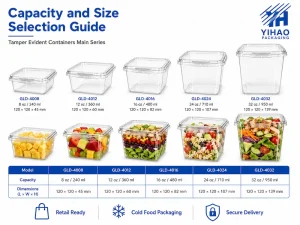
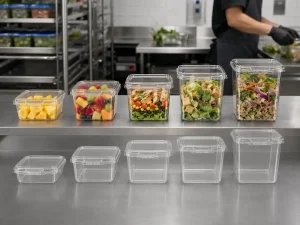
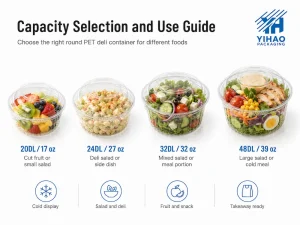
Custom food containers include PET, RPET, PP, hinged, separate-lid, round, square, rectangular, and compartment-style containers. These containers are used for fruit, salads, nuts, bakery snacks, deli foods, cold meals, and grab-and-go retail products.
Customization may include label-ready lid areas, printed sleeves, private label cartons, different container sizes, clear display surfaces, compartment layouts, or matched lid systems. For chilled retail channels, fresh produce packaging containers and deli and salad containers are practical directions when buyers need visibility, portion control, and retail shelf presentation.
OEM Plastic Packaging
OEM plastic packaging covers food-grade plastic packaging systems developed or supplied according to a buyer’s product requirements. This includes PET containers for cold display, PP containers for heat-related food applications, PET cold cups for beverages, lids for matched cup systems, and tamper-evident structures for secure retail packaging.
Material selection should follow the actual use. PET is strong for clarity and cold food display. PP is used for many applications where heat tolerance is part of the packaging requirement. RPET may be discussed when recycled-content packaging aligns with the buyer’s market and local recycling acceptance. For any OEM project, buyers should confirm food type, temperature use, lid fit, display environment, and material documentation before final approval.
Private Label Food Packaging
Private label food packaging helps distributors, supermarkets, importers, and regional food brands create a recognizable packaging line without developing every mold from zero. Many buyers start with proven stock structures and apply private label value through carton branding, labels, printing, color direction, product naming, and SKU organization.
This approach is especially useful for distributors. A private label range makes the product line easier to sell, easier to explain, and easier to reorder. The packaging does not need to be fully custom from the first order. A buyer can begin with existing structures, test the market, and later expand into more customized molds or printed programs.
Branded Food Packaging
Branded food packaging focuses on visual identity and customer recognition. It may include printed logos, color accents, product stickers, tamper labels, sleeve design, branded cartons, or retail-ready packaging language. The key is balance. For fruit, salads, desserts, bakery products, and beverages, the food itself is often the strongest selling point. Branding should improve recognition without blocking product visibility.
A clear PET container with a clean label space often performs better than overprinted packaging that hides the food. A printed cup should make the drink brand visible while still supporting lid fit, stacking, and service efficiency. A bakery container should protect decoration first, then support the brand through labels or cartons.
Custom Printed Cups
Custom printed cups are important for cafes, beverage brands, juice bars, smoothie shops, bubble tea stores, convenience stores, and event beverage programs. Printed cups turn a takeaway drink into mobile brand exposure, but printing alone is not enough. The cup must still match the drink, lid, service method, and carton plan.
For beverage buyers, cold cups and lids, PET cold cups, and cold cup lids should be treated as one system. A cup used for iced coffee, matcha, lemonade, smoothies, fruit tea, cold brew, refreshers, or protein drinks needs correct lid compatibility and stable rim fit before artwork is approved.
Custom PET Containers
Custom PET containers are widely used for retail foods where clarity matters. PET packaging helps customers see product color, freshness, portion size, toppings, layers, and overall presentation. It is suitable for many cold food applications, including fruit, salads, bakery products, deli foods, chilled snacks, nuts, desserts, and grab-and-go items.
For buyers building a clear packaging line, clear PET hinged containers, fresh-cut fruit containers, and clear hinged deli containers are practical product directions to review. PET customization should focus on visibility, lid fit, label space, stackability, food height, and carton packing rather than decoration alone.
Custom OEM Packaging Options by Product Type
Different packaging formats support different customization options. Buyers should not expect every package to support the same printing, label, mold, or structural change. A professional OEM project starts by matching the customization method to the packaging type.
| Packaging Type | Customizable Areas | Best Applications | Buyer Notes |
|---|---|---|---|
| PET food containers | Label area, lid height, base style, carton branding, size selection | Fruit, salad, deli, chilled snacks, bakery items | Best when clear visibility and retail display matter. |
| Custom printed cups | Logo printing, cup size, print area, lid matching, carton mark | Iced coffee, juice, smoothies, fruit tea, lemonade, milk tea | Confirm artwork, rim size, and lid compatibility before order approval. |
| Tamper-evident containers | Seal structure, label position, size range, branded sleeve, carton mark | Grab-and-go food, deli, supermarket prepared food, fresh-cut fruit | Useful when visible food safety and retail trust are priorities. |
| Bakery containers | Lid height, clear display, sticker area, tray color, carton branding | Cakes, pastries, cupcakes, cookies, desserts | Protect decoration and product height before adding branding. |
| Compartment containers | Section layout, portion size, lid fit, label area, carton planning | Snack packs, fruit and nut packs, meal kits, deli assortments | Use compartments when separation improves appearance or texture control. |
| Private label packaging range | Series naming, carton design, SKU structure, labels, product family planning | Distributors, wholesalers, supermarkets, regional food brands | Strong for catalog consistency and long-term repeat sales. |
What Buyers Should Customize First
Not every part of a food package should be customized at the same time. The first customization step should solve the buyer’s most important business problem. For some buyers, that means brand recognition. For others, it means better food fit, clearer display, more secure closure, or stronger distributor catalog control.
| Customization Area | Best For | Recommended Priority |
|---|---|---|
| Logo printing | Cold cups, lids, private label containers, retail food packs | Start here when brand recognition is the main goal. |
| Label-ready space | Fruit containers, deli packs, bakery clamshells, tamper-evident containers | Use this when product information, barcodes, and retail labels matter. |
| Container size | Fresh-cut fruit, salads, snacks, bakery portions, prepared foods | Confirm portion weight, food height, and shelf display before final selection. |
| Compartment structure | Snack packs, meal kits, fruit and nut packs, deli assortments | Use when separation improves presentation, freshness, or customer experience. |
| Carton branding | Wholesale distributors, private label suppliers, importers | Important for warehouse handling, SKU recognition, and repeat-order control. |
| New tooling | Large repeat programs with unique packaging needs | Consider only after existing structures cannot solve the problem. |
OEM Packaging Development Process
A professional custom OEM food packaging project should follow a clear process. Buyers who rush into design before confirming the food, material, lid, and supply details often face delays later.
Step 1: Define the Food Application
Start with the food type. Is it fruit, salad, bakery, deli, cold drink, snack, dessert, or prepared food? Is the product dry, moist, oily, chilled, delicate, stacked, displayed in a refrigerated case, or transported through takeaway delivery? These details shape material choice, lid structure, height, ventilation, label area, and carton packing.
Step 2: Choose the Product Family
Select the closest product family before discussing decoration. Fruit buyers may begin with produce clamshells or fresh-cut fruit containers. Cafes may begin with PET cold cups and matched lids. Bakeries may begin with cake or pastry containers. Supermarket food programs may begin with tamper-evident containers, deli packs, or salad bowls.
For secure retail programs, tamper evident containers and tamper-evident food containers are useful directions when buyers need visible protection, customer trust, and grab-and-go display value.
Step 3: Confirm Size, Lid, and Structure
Size and structure are more important than appearance at the beginning. A cup must match its lid. A bakery container must protect decoration height. A fruit container must support visibility and handling. A deli container must close securely. A compartment pack must hold each item without mixing or crushing.
Step 4: Prepare Artwork and Branding Requirements
For printed cups, branded food containers, and private label packaging, buyers should prepare logo files, color references, print size expectations, label position, barcode requirements, and carton mark information. The supplier should confirm usable print area and surface limitations before final artwork approval.
Step 5: Test Samples With Real Food
Samples should be tested with the real product. Empty samples only show basic structure. Real food testing shows whether the packaging fits the portion, protects the product, stacks correctly, closes properly, displays well, and supports label placement. This step is especially important for clear PET containers, bakery packaging, cold cups, and tamper-evident food packs.
Step 6: Confirm Carton Packing and Wholesale Supply
Wholesale buyers should confirm pieces per carton, carton size, carton mark, SKU name, loading plan, and reorder records. For distributors, carton-level information is not a small detail. It directly affects warehouse handling, inventory control, and repeat sales.
What Information Should Buyers Prepare Before Contacting a Manufacturer?
A clear OEM inquiry saves time and improves quotation accuracy. A vague request such as “I need custom food packaging” forces the supplier to guess. A stronger inquiry gives the manufacturer enough details to recommend the right product family, sample direction, and customization path.
| Information Needed | What to Provide | Why It Matters |
|---|---|---|
| Food type | Fruit, salad, bakery, deli, drink, snack, prepared meal | Helps the supplier recommend the correct material and structure. |
| Food portion | Weight, height, diameter, piece count, topping height | Prevents over-large packaging, poor fit, and lid interference. |
| Sales channel | Supermarket, cafe, bakery, takeaway, foodservice, distributor | Connects the package with display, handling, and customer expectations. |
| Customization goal | Logo, printed cup, label area, carton brand, color base, new structure | Clarifies whether the project is branding, structure, or full OEM development. |
| Artwork status | Logo file, color reference, label design, barcode, carton mark | Helps the supplier check print feasibility and proofing needs. |
| Order stage | Sample test, trial order, private label launch, annual supply | Helps plan sample support, production discussion, and wholesale supply. |
Application-Based OEM Packaging Recommendations
Different food categories need different packaging priorities. Buyers should not use one packaging format for every product. A better approach is to build a packaging matrix based on food application, sales channel, branding needs, and reorder potential.
| Application | Recommended Packaging Direction | OEM Priority |
|---|---|---|
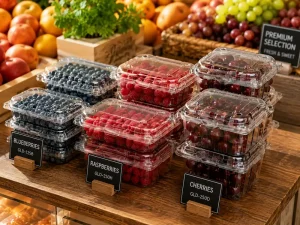
| Fresh-cut fruit and berries | Clear PET clamshells, vented fruit packs, fresh-cut fruit containers | Visibility, label area, stacking, ventilation direction, secure closure |
| Deli salads and chilled meals | PET hinged deli containers, salad bowls, secure-lid containers | Lid fit, portion logic, clear display, anti-fog discussion, shelf presentation |
| Bakery and desserts | Cake containers, bakery clamshells, pastry containers | Lid height, decoration protection, clear display, sticker placement |
| Cold beverages | PET cold cups, flat lids, dome lids, strawless lids, printed cups | Cup-lid compatibility, logo position, drink menu fit, carton control |
| Grab-and-go retail food | Tamper-evident containers, snack packs, compartment containers | Visible security, shelf trust, barcode placement, opening experience |
| Distributor private label | Multi-category packaging range with branded cartons and SKU logic | Catalog consistency, repeat order control, warehouse recognition |
For beverage buyers, clear PET cold cups, flat cold cup lids, and dome lids for smoothies create a practical starting point for custom printed beverage packaging.
For chilled snack and retail food buyers, fruit and nut containers, clear deli packs, and tamper-evident packaging support OEM development for supermarkets, cafes, convenience stores, and foodservice brands.
How to Choose a Custom OEM Food Packaging Manufacturer
A reliable manufacturer should do more than produce a container. The supplier should understand food applications, material selection, lid matching, sample testing, printing limits, carton packing, export supply, and long-term wholesale support.
For wholesale OEM packaging, the strongest supplier is not always the lowest-price supplier. A better supplier helps the buyer avoid wrong sizes, poor lid matching, weak print placement, unclear carton marks, unstable specifications, and inconsistent repeat orders.
Manufacturer Capabilities to Review
Buyers should review whether the factory supports existing product selection, sample testing, mold discussion, logo printing, private label cartons, export packing, product documentation, and repeat-order records. For complex OEM projects, communication quality matters. If the supplier cannot clearly explain material options, print area limits, lid compatibility, sample approval steps, or carton planning, the project risk increases.
Supplier Questions Buyers Should Ask
Before confirming an OEM packaging supplier, buyers should ask practical questions. Can the supplier recommend existing structures before discussing new tooling? Can samples be tested with real food? Can the supplier confirm lid compatibility? Can they explain printing file requirements? Can they support carton marks and private label packing? Can they keep specifications consistent for repeat orders?
| Question to Ask | Why It Matters | Good Supplier Response |
|---|---|---|
| Can existing molds meet this project first? | Avoids unnecessary tooling cost and long development time. | The supplier compares existing sizes before recommending new tooling. |
| What artwork files are needed for printing? | Prevents print distortion, color issues, and proofing delays. | The supplier gives clear file, size, color, and proofing requirements. |
| Can samples be checked with real food? | Confirms fit, clarity, lid performance, and display quality. | The supplier encourages real-use sample testing before approval. |
| How are cartons marked for wholesale supply? | Supports warehouse handling and repeat-order accuracy. | The supplier confirms SKU name, carton mark, packing quantity, and product record. |
| How are repeat orders controlled? | Protects product consistency across future shipments. | The supplier keeps approved specifications, samples, and order references. |
Common Mistakes in Custom OEM Food Packaging Projects
Many OEM packaging problems come from rushing into design before confirming food use, structure, material, and supply details. Buyers should avoid the following mistakes.
| Mistake | What Happens | Better Approach |
|---|---|---|
| Starting with logo design only | The package may look branded but fail in real food use. | Confirm food fit, material, lid, and structure before final artwork. |
| Choosing packaging by photo | The size, height, or lid fit may not match the product. | Test samples with the real food or drink. |
| Customizing too many SKUs at once | Inventory and approval work become complicated. | Start with the highest-volume product family first. |
| Ignoring barcode and label placement | Retail checkout, shelf display, and compliance labeling may suffer. | Plan label-ready space early in the project. |
| Mixing cup and lid systems | Lids may not close securely or staff may use the wrong match. | Treat cups and lids as one matched packaging system. |
| Skipping carton planning | Wholesale distribution becomes harder to manage. | Confirm carton marks, SKU names, packing quantities, and reorder records. |
When Should Buyers Consider New Tooling?
New tooling is not the first step for every OEM packaging project. Many brands and distributors can achieve strong results by using existing container structures with custom printing, private label cartons, label-ready designs, sleeves, or color direction.
New tooling becomes reasonable when the buyer has a confirmed repeat-order plan, a food size that does not fit existing options, or a brand strategy that requires a unique structure. Before discussing tooling, buyers should test existing options, confirm real application needs, and define the exact problem that current packaging cannot solve.
New tooling should create measurable value. It should improve food fit, shelf presentation, handling, portion control, lid performance, or brand differentiation. If it only makes the package look slightly different without improving business value, it may not be the best first investment.
Custom OEM Food Packaging FAQ
1. What is custom OEM food packaging?
Custom OEM food packaging is food packaging developed, adjusted, branded, or supplied according to a buyer’s product, brand, application, and wholesale distribution needs. It may include custom containers, printed cups, private label cartons, label-ready areas, matched lids, sample testing, and approved repeat-order specifications.
2. What is the difference between custom food containers and OEM plastic packaging?
Custom food containers usually refer to containers adjusted for food size, label space, branding, display, or structure. OEM plastic packaging is broader and may include containers, cups, lids, trays, tamper-evident packs, printed packaging, private label cartons, and long-term product development.
3. Is private label food packaging always fully custom?
No. Private label food packaging often starts with proven stock structures and adds brand control through labels, printing, carton design, SKU naming, and product range planning. Full custom tooling is only necessary when existing structures cannot meet the buyer’s needs.
4. What should brands prepare for custom printed cups?
Brands should prepare logo files, color references, cup size needs, drink menu details, lid requirements, print area expectations, and carton mark information. They should also test cup clarity, lid fit, stacking, print position, and real service handling before bulk order approval.
5. Are custom PET containers suitable for retail food display?
Yes. Custom PET containers are suitable for many cold retail food applications where clarity, product visibility, portion display, and shelf presentation matter. They are commonly used for fruit, salads, desserts, deli foods, bakery products, chilled snacks, and grab-and-go items.
6. What affects the cost of custom OEM food packaging?
Cost depends on material, size, structure, printing method, order quantity, artwork requirements, carton packing, sample needs, and whether new tooling is required. Buyers should separate simple branding customization from structural customization because the cost logic is different.
7. Do OEM packaging projects always require a mold?
No. Many OEM projects use existing molds and customize through printing, labels, sleeves, carton branding, color direction, or product range planning. New tooling is mainly considered when existing packaging cannot meet the required food size, structure, or brand strategy.
8. How should distributors start a wholesale OEM packaging project?
Distributors should start with a product matrix covering main food categories, high-volume SKUs, packaging sizes, lid systems, branding needs, carton marks, sample approval steps, and reorder expectations. This creates a stronger wholesale OEM packaging program than selecting unrelated custom products one by one.
Final Note / Practical Takeaway
References
- U.S. Food and Drug Administration, Food Contact Substances and Food Packaging Guidance.
- European Commission, Food Contact Materials and Plastic Food Contact Regulations.
- Association of Plastic Recyclers, PET Packaging Design and Recycling Guidance.
- International Organization for Standardization, Packaging and Environmental Management Standards.
- Foodservice Packaging Institute, Food Packaging Material and Market Reports.
- Packaging Europe, Food Packaging Design, Recycling, and Retail Packaging Insights.
- Plastics Industry Association, Plastic Packaging Material and Application Resources.
- National Restaurant Association, Foodservice Takeaway, Delivery, and Packaging Trends.
Deep-Dive Insights: Custom OEM Food Packaging for Long-Term Brand and Distributor Growth
How should buyers think about OEM packaging before discussing design?
Buyers should start from the food application, not the logo. The right OEM project begins with food size, portion weight, lid height, shelf channel, label position, handling route, and carton packing. Once these details are clear, design and branding become more accurate and more useful.
Why does private label packaging matter for distributors?
Private label packaging helps distributors build a recognizable product line instead of selling disconnected containers from different sources. A consistent range of clear containers, cold cups, lids, bakery packs, deli containers, and tamper-evident options improves catalog identity, warehouse control, and repeat-order value.
What makes custom printed cups different from standard cold cups?
Custom printed cups add brand visibility, but they still need practical performance. Buyers should confirm cup clarity, lid compatibility, rim fit, print area, artwork size, drink menu, stacking, and carton packing before approving the printed design. A good printed cup works first as a foodservice package and second as a branding surface.
When should brands choose custom PET containers?
Brands should choose custom PET containers when visibility, freshness presentation, and retail shelf appearance are important. PET containers are especially useful for fruit, salads, bakery products, desserts, deli foods, nuts, and chilled grab-and-go items. The best PET customization focuses on clear display, label-ready areas, secure closure, stackability, and carton consistency.
Which OEM packaging option should buyers prioritize first?
Most buyers should start with the highest-volume and most visible packaging category. Beverage brands often start with printed PET cups and matched lids. Chilled food brands often start with clear PET containers or tamper-evident packs. Bakeries often start with clear containers that protect product height and decoration. Distributors often start with private label cartons and a stable product range.
What is the strongest supplier factor in OEM food packaging?
The strongest supplier factor is project control. A good manufacturer helps buyers compare existing structures, confirm samples, review material options, understand printing limits, manage carton packing, and keep repeat orders consistent. This creates more long-term value than a low quotation with unclear specifications.
What should buyers avoid when planning wholesale OEM packaging?
Buyers should avoid changing too many SKUs at once, approving packaging only from photos, ignoring lid compatibility, skipping real-food testing, and treating carton marks as an afterthought. Wholesale OEM packaging succeeds when the product, brand, carton, warehouse, and reorder process are planned together.
© YIHAO Packaging. All rights reserved. All articles, product images, packaging designs, technical specifications, and website materials are protected by copyright. Unauthorized copying, reproduction, redistribution, modification, or commercial use is strictly prohibited without prior written permission.