YIHAO is a food packaging manufacturer and solution provider focused on practical, clear, and production-ready packaging for fresh produce, bakery items, deli foods, salads, chilled takeaway meals, cold beverages, and retail food programs. For buyers searching for custom food packaging, the first question should not be only “Can I print my logo?” A stronger starting point is: “Which material, size, structure, and supplier process will protect my food, support my brand, and remain practical for wholesale ordering?”
Many custom packaging projects fail because buyers begin with decoration before confirming food application. Logo printing, private label packaging, custom colors, or new mold development only create value when the container already fits the food, the temperature condition, the sales channel, and the handling process. A bakery container, a fruit clamshell, a salad bowl, a cold cup, and a microwave meal tray do not follow the same packaging logic.
This FAQ is written for purchasing teams, distributors, food brands, importers, supermarket category managers, cafe chains, bakery operators, and foodservice buyers who need direct answers before working with a food packaging container manufacturer, plastic food packaging manufacturer, PET container manufacturer, disposable food container factory, or food packaging supplier.
What Is Custom Food Packaging?
custom food packaging refers to food containers, cups, trays, lids, clamshells, bowls, and other packaging formats adjusted for a buyer’s food product, brand position, sales channel, and ordering requirements. Customization may include logo printing, label areas, sleeve design, private label cartons, material selection, lid style, compartment layout, color options, anti-fog requirements, venting, stackability, carton planning, or new mold development.
In B2B food packaging, “custom” does not always mean a fully new mold. Many buyers begin with existing container structures and customize the visible or functional elements: label placement, sleeve design, material choice, carton labeling, or branded packaging sets. This route is usually more efficient for early-stage brands, distributors, and retail food programs because it keeps development risk lower while still creating a branded packaging system.
For example, a fresh fruit brand may start with fresh produce packaging containers and select vented clamshells, clear trays, or snack containers according to berry, grape, apple, or fresh-cut fruit programs. A bakery buyer may choose bakery containers for cake slices, pastries, brownies, cupcakes, or chilled desserts, then adjust label placement and display style for retail shelves.
Which Materials Are Commonly Used for Custom Food Packaging?
The most common materials for custom food packaging include PET, RPET, PP, and paperboard with clear windows. Each material has a different role. Buyers should not choose material only because a word sounds attractive, such as recyclable, compostable, premium, or eco-friendly. The right material must match food type, temperature, product visibility, shelf display, transportation conditions, and market expectations.
PET and RPET for Clear Retail Display
PET is widely used for clear food containers because it offers strong product visibility, smooth forming, good rigidity for chilled retail display, and a clean transparent look. RPET uses recycled PET content and is often selected when buyers want a recycled-material story while keeping high clarity. PET and RPET are practical for fruit, salads, deli snacks, bakery display, chilled desserts, and cold beverage programs.
A PET container manufacturer should help buyers evaluate wall thickness, lid fit, stacking pressure, anti-fog needs, and whether the package is intended for chilled display, takeaway, supermarket shelf sales, or foodservice distribution. PET is not the default answer for every hot-fill or microwave application, so the use condition must be confirmed before ordering.
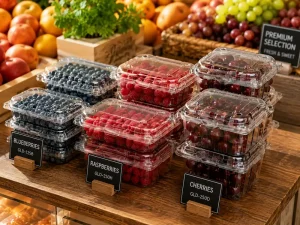
For fresh fruit and chilled snacks, buyers often choose a clear PET hinged clamshell container because visibility supports impulse buying and retail inspection. For deli and chilled food programs, PET and RPET containers provide a practical combination of clarity, shelf presentation, and lightweight handling.
PP for Heat-Tolerant and Prepared Food Uses
PP is commonly selected for prepared meals, hot takeaway, deli counters, and applications where higher heat resistance is required. A PP food container is usually more suitable than PET when the buyer needs heat tolerance, reheating compatibility, or stronger resistance to oily prepared food conditions. However, PP generally has a different visual appearance from PET and may not deliver the same crystal-clear retail display effect.
Buyers sourcing from a disposable food container factory should clearly define whether the package is used for chilled food, room-temperature display, hot food, microwave use, or takeaway. This single decision often determines whether PET, RPET, or PP is the better starting point.
For prepared meals and takeaway counters, a PP prepared meal container gives buyers a more application-matched option than a cold-display PET clamshell.
Paperboard with Clear Windows for Bakery and Dessert Branding
Paperboard packaging with PET windows or clear lids is often used for premium bakery, desserts, gift-style food packs, and takeaway pastry programs. This structure supports printed branding on paperboard while still showing the product through a transparent window or lid. It works especially well when the food brand wants a warmer, crafted, or premium presentation.
For bakery buyers, packaging must protect frosting, cream, fruit toppings, cake edges, and delicate pastry shapes. A customized bakery package should be selected by product height, decoration space, lid clearance, base stability, and condensation behavior, not only by outer dimensions.
Custom Food Packaging Material Selection Matrix
A material selection matrix helps buyers compare packaging options before requesting samples. The table below gives a practical starting point for B2B food packaging projects.
| Material | Best For | Main Strength | Buyer Watch Point |
|---|---|---|---|
| PET | Chilled food, fruit, bakery, salad, deli snacks, cold drinks | High clarity and strong retail display value | Not the first choice for high-heat or microwave use |
| RPET | Clear packaging with recycled-content positioning | Combines transparency with sustainability messaging | Recycling acceptance depends on local systems and package format |
| PP | Hot food, prepared meals, takeaway, reheatable food programs | Better heat tolerance than PET for many applications | Usually less crystal-clear than PET |
| Paperboard + Clear Window | Bakery, desserts, premium packs, gift-style food packaging | Strong branding area with product visibility | Coating, window material, and food residue affect end-of-life options |
This table does not replace sample testing. It helps buyers ask better questions before choosing a food packaging supplier. The best material is the one that fits the food, sales channel, temperature condition, brand message, and wholesale handling process.
How Should Buyers Choose Food Packaging Sizes?
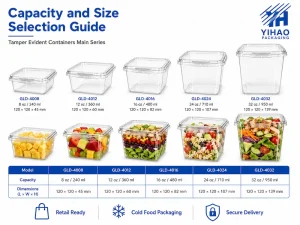
Size selection is one of the most important parts of custom food packaging. A container that looks attractive in a catalog may fail in real use if the portion does not fit cleanly, the food shifts during transport, the lid touches the product, or the package wastes shelf space. The buyer should test the actual food, not only compare capacity numbers.
Start with Food Volume, Product Shape, and Fill Height
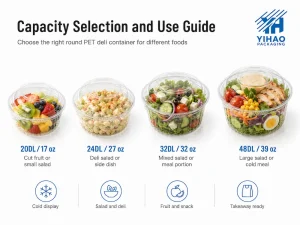
Capacity is only one part of sizing. A 16oz container, a 500ml snack pack, or a 32oz bowl may look correct on paper, but real performance depends on food shape, fill height, moisture, topping volume, and whether the product is stacked, sealed, chilled, or displayed upright. For salads, buyers need space for leafy volume and toppings. For fruit, the container must prevent crushing while keeping the product visible. For bakery items, the lid must protect height and decoration.
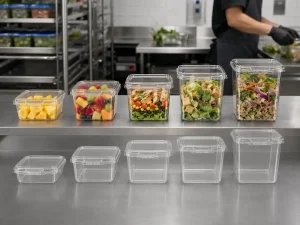
For chilled deli, salad, and snack programs, buyers may compare deli and salad containers by application rather than by capacity alone. A fruit-and-nut snack pack, a side salad, a premium salad bowl, and a grab-and-go deli meal each need different depth, lid clearance, and merchandising logic.
Match Size to Sales Channel
Supermarkets usually prioritize shelf display, barcode placement, stacking, and product visibility. Cafes focus on takeaway handling, brand appearance, and fast packing. Foodservice buyers focus on carton efficiency, storage, repeat orders, and operational consistency. Importers and distributors need a size range that covers multiple buyers without creating slow-moving inventory.
This is why a good food packaging supplier does not simply ask for one target size. The supplier should understand the buyer’s channel, product range, expected order structure, and whether the packaging will be sold as a single SKU or part of a wider product family.
Test Before Scaling
Sample testing should include filling, closing, stacking, chilled storage, transit simulation, label placement, barcode scanning, shelf display, and customer handling. Buyers should test the package with the actual food and actual operation. For wholesale orders, a small sizing mistake becomes expensive because it affects cartons, pallets, labels, product presentation, and repeat purchasing.
What Food Uses Are Best for Custom Food Packaging?
custom food packaging is used across many food categories, but each category has a different packaging logic. A strong packaging program starts with application grouping.
Fresh Produce and Fresh-Cut Fruit
Fresh produce packaging needs visibility, ventilation, stacking strength, and protection against pressure damage. Berry clamshells, apple containers, kiwi packs, produce trays, and fresh-cut fruit containers require different venting and shape logic. For fresh-cut fruit, moisture control, anti-fog options, and lid clarity become more important because the product is already processed and sold for immediate consumption.
For fruit programs, buyers often choose a large-capacity fresh-cut fruit container for retail takeaway and chilled display because portion size, product visibility, and shelf presentation directly influence sales.
Bakery, Desserts, and Chilled Sweets
Bakery packaging must protect product shape. Cake slices, cupcakes, muffins, brownies, tiramisu portions, pastries, and dessert samplers need enough headspace and stable bases. Clear lids support display, while paperboard bases or branded sleeves support premium positioning.
For cake slices and chilled desserts, a clear cake slice container helps protect decoration and improves retail display. For bakeries and dessert brands, custom packaging often focuses on label placement, logo printing, product visibility, and shelf-ready appearance.
Deli, Salad, and Ready-to-Eat Foods
Deli and salad packaging must balance clarity, lid fit, freshness, stacking, and portion logic. Ready-to-eat foods often include sauces, toppings, greens, proteins, noodles, grains, or chilled prepared items. Buyers should select the container according to food density, moisture, handling route, and whether the food is consumed immediately or displayed in a cold case.
A clear hinged deli container is a practical option for deli salads and snack packaging, while a PET/RPET food container supports larger chilled food portions and retail-ready presentation.
Cold Drinks, Juice, Matcha, Refreshers, and Smoothies
Cold beverage packaging needs cup clarity, lid compatibility, rim fit, stacking convenience, and drink-menu coverage. Cafes, tea shops, juice bars, and beverage chains often need multiple cup sizes and lid types for iced coffee, juice, smoothies, milk tea, lemonade, fruit tea, matcha, refreshers, protein drinks, sparkling fruit drinks, flavored cold brew, and iced tea.
Buyers planning beverage lines should treat cold cups and lids as a system, not as separate items. A cup without the right lid creates operational problems at the counter. For modern beverage menus, a clear PET/RPET cold cup supports visual drink presentation and brand-friendly takeaway use.
Tamper-Evident and Secure Retail Packaging
Retail food programs increasingly need secure packaging for grab-and-go items, chilled meals, deli portions, fruit packs, and snacks. tamper evident containers help buyers communicate product integrity and reduce handling concerns in self-service retail environments.
For custom projects, tamper-evident design should be discussed early because the closure structure, tear strip, hinge design, and lid behavior affect tooling and production. Buyers should request samples and test the opening experience, closure strength, and display appearance before ordering in bulk.
Microwave and Hot Food Programs
Hot food, prepared meals, and reheatable takeaway programs require different packaging decisions from chilled PET display packs. Buyers should review microwave safe containers when the food is intended for reheating or warm service. Material choice, lid design, steam management, and food contact suitability must be confirmed before launch.
What Customization Options Do Food Packaging Buyers Usually Request?
Food packaging customization usually falls into five practical categories: branding, structure, material, size range, and packing method. A reliable plastic food packaging manufacturer should help buyers separate what is necessary from what only adds complexity.
Logo Printing and Private Label Branding
Logo printing is the most visible form of custom food packaging. It may appear on cups, sleeves, labels, paper inserts, printed paper bases, carton labels, or retail display packaging. For transparent PET and RPET containers, buyers often choose label areas, stickers, sleeves, or printed inserts because direct printing on irregular shapes may require more technical review.
Private label packaging is especially useful for supermarket house brands, distributors, cafe chains, bakery groups, meal prep brands, and fresh produce companies. The goal is not only decoration. Branding should help customers identify the product quickly, trust the food, and remember the supplier.
Color, Base, Lid, and Visual Presentation
Some projects need black bases, clear lids, white paper bases, transparent bowls, colored fruit clamshell bases, or anti-fog lids. Color should support food contrast and brand identity. Fruit often looks stronger in clear packaging, while premium desserts may benefit from a paperboard base and clear window.
Compartments and Portion Separation
Multi-compartment packaging supports fruit and nuts, snack kits, sushi assortments, dessert samplers, meal kits, and protein-side combinations. Buyers should choose compartments according to food separation needs, not only visual symmetry. Sauce, nuts, wet fruit, cheese, pastries, and salad toppings each behave differently in transit.
Custom Mold Development
A new mold is useful when existing packaging cannot meet the buyer’s food shape, brand format, lid requirement, or shelf display goal. However, mold development is not the first answer for every buyer. Many projects succeed faster by using an existing container platform and customizing branding, labels, material, or carton structure.
Before requesting a new mold, buyers should prepare product samples, target dimensions, food weight, lid requirement, stacking method, photos of current packaging, market references, and expected order volume. A manufacturer can then judge whether a new mold is necessary or whether an existing structure already solves the problem.
Existing Mold vs Private Label vs New Mold: Which Custom Route Should Buyers Choose?
One of the most common questions in custom food packaging is whether the buyer needs a new mold. The answer depends on the food application, brand goal, timeline, and wholesale plan. Many buyers can start with existing molds and upgrade customization after market testing.
| Custom Route | Best For | Development Difficulty | Buyer Benefit |
|---|---|---|---|
| Existing Mold + Label | Early-stage brands, distributors, market testing | Low | Faster start, lower risk, easier sample testing |
| Existing Mold + Private Label Carton | Wholesale buyers, supermarket programs, distributor ranges | Medium-low | Better brand consistency and retail-ready supply |
| Custom Color or Base/Lid Combination | Retail differentiation and branded food display | Medium | Stronger shelf identity without fully new tooling |
| New Mold Development | Exclusive structures, special food shapes, long-term brand programs | High | Unique packaging format and stronger brand ownership |
For most wholesale buyers, the smarter path is to validate the food fit first. If an existing mold already solves the portion, lid, shelf display, and packing requirements, private label customization may deliver better speed and lower project risk. New mold development becomes more strategic when the buyer has confirmed product-market fit, stable demand, and a clear reason for an exclusive structure.
How Should Buyers Compare a Food Packaging Supplier, Manufacturer, and Factory?
A reliable food packaging supplier must do more than provide a price list. The supplier should understand food application, material selection, container structure, sampling, customization, quality control, export packing, and repeat-order consistency.
Manufacturer Capability
Buyers should confirm whether the supplier is a trading company, a direct manufacturer, or a manufacturer with export service capability. A direct food packaging container manufacturer or plastic food packaging manufacturer is usually stronger when the buyer needs technical packaging selection, mold discussion, sample adjustments, and long-term product range development.
Factory capability matters because custom packaging is connected to tooling, forming, trimming, stacking, packing, and quality inspection. A buyer who needs long-term wholesale supply should evaluate production consistency, not only catalog variety.
Application Knowledge
The supplier should understand the difference between fruit packaging, bakery packaging, deli packaging, beverage packaging, tamper-evident packaging, and prepared meal packaging. A supplier that treats every food container as the same product category increases the risk of poor fit, wrong material, and weak customer experience.
Sample Support
Sample support is essential. Buyers should request samples for the exact application and test them with real food. Good suppliers help buyers review lid fit, clarity, product movement, stackability, label placement, and packing method before moving into wholesale production.
Wholesale and Export Readiness
For importers and distributors, wholesale readiness includes stable product ranges, carton planning, export documentation support, consistent communication, and clear production coordination. Buyers should avoid suppliers that push customization before understanding the buyer’s sales channel, product mix, and repeat-order plan.
Before You Request a Quote, Prepare These 7 Details
A strong inquiry helps a manufacturer, wholesale partner, or supplier recommend the right packaging faster. Buyers do not need perfect technical drawings for the first discussion, but they should prepare enough information to avoid vague pricing and mismatched samples.
| Information to Prepare | Why It Matters | Example Buyer Note |
|---|---|---|
| Food Type | Different foods need different structure, material, and lid logic. | Fresh-cut fruit, salad, bakery dessert, deli snack, cold drink, or prepared meal |
| Target Portion Size | Capacity must match real food volume, weight, and fill height. | 8oz, 16oz, 32oz, 1lb, or actual food weight |
| Food Temperature | Chilled, room-temperature, hot, or microwave use affects material choice. | Chilled display, takeaway, hot food, or reheatable meal |
| Preferred Material | PET, RPET, PP, and paperboard support different applications. | Clear PET for display, PP for hot food, paperboard for bakery branding |
| Packaging Style | Clamshell, tray, bowl, cup, lid, and compartment structures change production logic. | Hinged clamshell, separate lid bowl, cold cup, compartment tray |
| Branding Requirement | Printing, labels, sleeves, carton marks, and private label needs require different routes. | Logo label, printed sleeve, private label carton, or custom color |
| Estimated Order Plan | Order plan affects mold discussion, sample route, production planning, and carton design. | Trial order, seasonal program, distributor range, or long-term wholesale plan |
With these details, a food packaging container manufacturer can recommend the right material, size, structure, sample route, and wholesale ordering plan more accurately. Clear information also helps buyers compare quotes fairly because each supplier is responding to the same project requirements.
Does Custom Food Packaging Always Require a Large MOQ?
MOQ depends on the customization type, material, production method, printing requirement, and whether the buyer uses an existing mold or requests a new one. Simple label-ready packaging usually has a different ordering logic from direct printing or new mold development. This is why buyers should avoid assuming one universal MOQ for all projects.
Existing stock-style structures with customized labels or sleeves are usually easier to start than fully customized molds. New molds, special colors, special printing, and exclusive structures generally require more preparation and higher commitment. Since MOQ varies by project, buyers should confirm it directly with the supplier after sample and specification review.
How Should Buyers Think About Sustainable Custom Food Packaging?
Sustainable packaging decisions should be practical, not slogan-based. Buyers should evaluate material reduction, recycled content, recyclability in the target market, food safety, shelf life protection, transport damage reduction, and whether the package fits local waste and recycling systems.
PET and RPET packaging may support recyclable packaging goals where PET collection and recycling systems accept the specific format. Paperboard packaging may support brand image and renewable-material messaging, but windows, coatings, and food contamination can affect end-of-life outcomes. Compostable packaging only delivers value where proper composting infrastructure exists and the food application matches the material.
The strongest sustainable packaging strategy is often a balanced one: use the right material for the food, avoid over-packaging, improve fit, reduce damage, choose recyclable or recycled-content options where appropriate, and keep labeling clear for the target market.
Ordering Questions Buyers Should Ask a Manufacturer
Before placing a wholesale order for custom food packaging, buyers should ask direct, practical questions:
- Which material do you recommend for this food application, and why?
- Is this package intended for chilled display, hot food, microwave use, or takeaway?
- Can I test samples with my actual food before ordering?
- Which existing sizes are closest to my portion?
- Does the lid protect the product height and close securely?
- Where should labels, sleeves, or branding be placed?
- Is a custom mold necessary, or is an existing structure more efficient?
- What information do you need before confirming MOQ, price, and lead time?
- How are cartons packed for wholesale distribution?
- What quality checks are used during production?
These questions help buyers compare a manufacturer, wholesale partner, and supplier with more accuracy. The best answer is not always the lowest unit price. The best answer is the packaging system that protects the food, fits the channel, supports the brand, and remains repeatable in production.
Common Mistakes in Custom Food Packaging Projects
Mistake 1: Choosing by Appearance Only
A clear container may look attractive, but it still needs the right lid fit, food height, stacking strength, label area, and carton packing. Buyers should test the full packaging process, not only the product photo.
Mistake 2: Using the Wrong Material for Temperature
PET, RPET, PP, paperboard, and compostable materials each have different performance limits. Material choice must start from food use and temperature conditions.
Mistake 3: Starting with a New Mold Too Early
New molds are useful for exclusive packaging, but many buyers should first test existing packaging families. This reduces development risk and helps confirm actual market demand.
Mistake 4: Ignoring Label and Barcode Space
Retail packaging must leave space for branding, ingredients, barcode, nutrition information, storage instructions, and price labels. A beautiful shape that does not support labeling creates operational problems.
Mistake 5: Not Testing Real Food
Real food testing reveals issues that drawings and product photos cannot show: condensation, lid contact, food shifting, leakage risk, label peeling, stacking pressure, and shelf appearance.
FAQ
1. What is the best material for custom food packaging?
The best material depends on the food application. PET and RPET are strong choices for clear chilled display, fresh produce, salads, deli snacks, bakery display, and cold beverages. PP is better for many hot food and prepared meal uses. Paperboard with clear windows works well for premium bakery and dessert branding. Buyers should choose material by food type, temperature, display requirement, and target market.
2. Can I customize food packaging without making a new mold?
Yes. Many custom food packaging projects begin with existing containers and add branded labels, sleeves, carton marks, printed inserts, color options, or private label packaging. This approach is faster and more practical than creating a new mold when the existing structure already fits the food.
3. What should I send to a food packaging manufacturer before asking for a quote?
Send the food type, target portion, food dimensions, temperature condition, sales channel, preferred material, photos of current packaging, branding needs, target market, and expected ordering plan. This helps the manufacturer recommend a more accurate material, size, structure, and customization route.
4. Is PET food packaging suitable for hot food?
PET is generally selected for clear chilled display, cold food, fresh produce, bakery items, salads, deli snacks, and cold drinks. For hot food, prepared meals, or microwave use, buyers should review PP or other suitable heat-tolerant options and confirm performance with the supplier before ordering.
5. How do I choose between a food packaging supplier and a direct manufacturer?
A supplier may provide broad sourcing options, while a direct manufacturer usually offers stronger control over production, sample testing, mold discussion, quality checks, and repeat-order consistency. For custom food packaging, buyers often benefit from working with a manufacturer that understands both product application and wholesale export needs.
6. What is the difference between custom food packaging and private label food packaging?
Custom food packaging is a broader term. It may include material selection, size adjustment, structure design, label planning, color options, carton marks, printing, or mold development. Private label food packaging focuses more on branding the package for a specific retailer, distributor, food brand, or supermarket program.
7. Can a food packaging manufacturer help choose the right container size?
Yes. A food packaging manufacturer can recommend a suitable container size when the buyer provides food type, food weight, dimensions, fill height, temperature condition, sales channel, and packaging style. The final choice should still be tested with real food before wholesale ordering.
References
- U.S. Food and Drug Administration, Packaging & Food Contact Substances, food contact material and recycled plastics guidance resources.
- U.S. Food and Drug Administration, Use of Recycled Plastics in Food Packaging: Chemistry Considerations.
- European Commission, Packaging Waste and Packaging and Packaging Waste Regulation overview.
- European Union, Regulation (EU) 2025/40 on packaging and packaging waste.
- European Union, Commission Regulation (EU) No 10/2011 on plastic materials and articles intended to come into contact with food.
- U.S. Environmental Protection Agency, Sustainable Packaging and Sustainable Materials Management resources.
- Association of Plastic Recyclers, Design Guide for Plastics Recyclability.
- European Food Safety Authority, Food Contact Materials overview.
Deep-Dive Insights
How custom food packaging creates buyer confidence
Custom packaging creates confidence when it solves practical buyer concerns: food visibility, portion fit, protection, labeling, shelf display, and reorder stability. A logo alone does not create a strong packaging program. The structure behind the logo must support the food, the channel, and the wholesale ordering process.
Why material choice should come before decoration
Material affects clarity, temperature range, rigidity, food contact suitability, sustainability positioning, and customer experience. Buyers should confirm material logic before discussing printing, color, or private label design. Decoration strengthens the package only after the base material and structure are correct.
What makes a supplier more valuable for wholesale buyers
A valuable supplier helps buyers select packaging families, compare sizes, test samples, plan multiple SKUs, and reduce ordering mistakes. For importers and distributors, repeat-order stability is often more important than a single attractive catalog item.
Option: use existing molds first, then develop custom tooling
Many food brands should begin with existing molds and customize branding or labeling. After the product proves market demand, a custom mold becomes more strategic because the buyer already understands portion size, shelf feedback, and sales volume.
Consideration: build packaging as a product line, not a one-time order
The strongest custom food packaging projects often become product families. A buyer may start with one container, then expand into matching cups, lids, bowls, clamshells, trays, and cartons. This creates better brand consistency and simplifies wholesale purchasing.
Final Note / Practical Takeaway
© YIHAO Packaging. All rights reserved. All articles, product images, packaging designs, technical specifications, and website materials are protected by copyright. Unauthorized copying, reproduction, redistribution, modification, or commercial use is strictly prohibited without prior written permission.