For food packaging teams, custom food containers are not just containers with a logo. They are part of a complete packaging decision: food fit, material choice, lid performance, shelf presentation, brand identity, carton packing, and long-term supply stability.
A supermarket fresh-cut fruit program, a chilled salad brand, a bakery chain, a beverage shop, a prepared meal counter, and a private label importer do not need the same packaging path. Some buyers need clear display packaging. Some need private label food packaging. Some need custom printed cups. Some need standard containers first and OEM development later. The right decision depends on the food, the sales channel, the branding goal, and the capability of the manufacturer.
YIHAO supports food packaging buyers who need practical packaging options for fresh produce, bakery items, deli foods, salads, chilled snacks, prepared meals, and cold drinks. This guide explains how professional buyers should evaluate custom OEM food packaging, OEM plastic packaging, private label food packaging, branded food packaging, and wholesale supplier capability before placing orders.
What Are Custom Food Containers?
Custom food containers are food packaging containers adjusted around a buyer’s product type, brand system, retail channel, and purchasing plan. Customization may involve container size, material, shape, lid type, label area, logo printing, sleeve design, color direction, compartment structure, tamper evident features, carton branding, or full OEM development.
In real B2B purchasing, custom packaging usually follows three levels. Buyers do not always need a new mold at the beginning. In many cases, an existing container with the right label, sleeve, lid, or printing direction solves the problem faster and with lower project risk.
| Customization Level | What It Usually Means | Best For | Buyer Risk |
|---|---|---|---|
| Standard packaging with branding | Existing containers with labels, stickers, sleeves, inserts, or carton marks | Trial orders, cafes, bakeries, supermarkets testing a new food line | Lower risk and faster launch |
| Semi-custom packaging | Existing molds with adjusted material, color, lid match, packing method, or brand presentation | Wholesale buyers, distributors, private label food programs | Moderate risk; samples should be tested carefully |
| OEM custom packaging | Dedicated structure development, tooling direction, private label system, or long-term packaging project | Large brands, chain stores, importers, distributors, established private label programs | Higher risk; clear specifications and stable demand are required |
The smartest buyers do not start with the most complex option. They first confirm whether an existing container family already fits the product. Then they review branding options. After the food format, sales channel, and repeat order direction are stable, deeper OEM plastic packaging becomes a stronger decision.
Why Food Packaging Teams Choose Custom Food Containers
Brand Recognition
Food packaging is often the first physical brand touchpoint a customer sees. A printed lid, branded label, custom sleeve, cup logo, or coordinated container family helps the product look planned rather than generic. This matters for chilled shelves, bakery counters, grab-and-go meals, fruit packs, and beverage takeaway programs.
Branded food packaging is not only a marketing detail. It helps customers identify the product quickly, remember the source, and trust the food presentation. In competitive retail environments, clear packaging with controlled branding often works better than heavy graphics that hide the product.
Better Product Fit
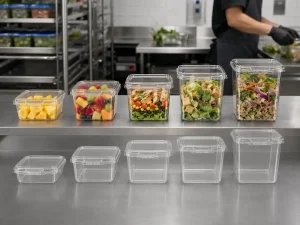
Food type should lead the packaging decision. A container for cut mango, a muffin, a salad bowl, a sushi tray, a prepared meal, and an iced coffee requires different structure logic. For example, fresh produce packaging containers often prioritize product visibility, ventilation, portion clarity, and gentle handling, while deli and salad containers need lid security, stacking, refrigerated display performance, and practical portion sizing.
Good customization does not force one container to fit every product. It builds a packaging system around moisture level, product weight, texture, display angle, shelf life, filling speed, label placement, and customer handling.
Stronger Retail Presentation
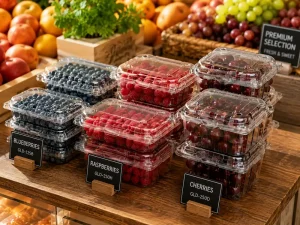
Clear PET and rPET containers remain strong for many chilled foods because customers want to see freshness, color, portion size, texture, and ingredient quality before buying. For fruit, bakery, salads, desserts, and chilled snacks, the package must protect the food while keeping the product visible.
A clear PET hinged clamshell container supports simple closure and direct product visibility for fresh food display. For mixed snack packs or fruit combinations, a 2-compartment PET clamshell container helps separate different foods while keeping the pack easy to view.
Private Label and Wholesale Consistency
Private label food packaging becomes stronger when packaging appearance, lid fit, label position, carton packing, and repeat order quality remain consistent. A private label program becomes weak when each SKU uses an unrelated container shape, inconsistent closure, or unstable supply source.
Wholesale buyers should evaluate whether the supplier supports repeatable production, clear sample review, stable quality control, and a realistic path from one product line to a wider packaging family.
Custom Food Container Development Process
A strong custom packaging project should follow a structured process. This reduces wrong-size selections, poor lid matching, unnecessary tooling, artwork mistakes, and unstable reorders.
| Step | Buyer Action | Supplier Support | Decision Output |
|---|---|---|---|
| 1. Food application review | Define food type, portion size, moisture, temperature, and sales channel | Recommend material and container direction | Clear use case and packaging priority |
| 2. Existing mold matching | Check whether current containers already fit the product | Compare nearby sizes, shapes, lids, and structures | Standard or semi-custom direction |
| 3. Material and lid confirmation | Confirm PET, rPET, PP, lid type, and closure requirement | Explain practical fit by application | Material and closure direction |
| 4. Branding method selection | Choose label, sleeve, printed cup, printed insert, or carton mark | Review feasibility and visual placement | Branding path before sample testing |
| 5. Artwork and label review | Prepare logo files, label size, barcode area, and brand color direction | Check print area and packaging visibility impact | Practical branded packaging layout |
| 6. Sample testing | Test with real food, real filling, refrigeration, stacking, and transport | Adjust container selection when problems appear | Approved packaging direction |
| 7. Carton packing planning | Confirm carton marks, warehouse needs, and shipment handling | Support wholesale packing and repeat order organization | Bulk order preparation |
| 8. Bulk production and reorder management | Track quality, sales feedback, and SKU performance | Maintain supply consistency and future expansion options | Stable custom packaging program |
This process helps buyers avoid one of the biggest mistakes in custom OEM food packaging: designing around a visual idea before confirming product fit and operational use.
Custom Options for Food Containers
Customization does not always mean a new mold. Most food packaging projects can be improved through existing container selection, label planning, sleeve design, printed cups, lid matching, carton branding, or a more consistent SKU structure.
| Custom Option | What It Changes | Best Application | Buyer Note |
|---|---|---|---|
| Label customization | Product name, barcode, ingredients, brand mark, retail information | Fresh fruit, deli, bakery, salads, prepared foods | Confirm adhesion under chilled display or takeaway conditions |
| Sleeve customization | Brand appearance without fully covering the food | Premium desserts, bakery items, salad packs, gift-style foods | Keep enough food visibility for retail selling |
| Logo printing | Direct brand exposure on cups, lids, or selected packaging areas | Cold drinks, cafes, beverage chains, takeaway programs | Confirm print area, artwork, and handling performance |
| Color direction | Base color, insert color, lid tone, or visual family | Private label food lines and retail product families | Avoid colors that reduce food appeal or shelf clarity |
| Compartment structure | Food separation and portion organization | Fruit and nut packs, snack boxes, meal kits, combo foods | Test whether each compartment fits real food volume |
| Tamper evident structure | Visible security feature and stronger consumer confidence | Retail grab-and-go, chilled foods, delivery, prepared foods | Confirm the opening method is clear for customers |
| Carton and master case branding | Outer packing identification for wholesale and warehouse handling | Distributors, importers, chain stores, private label programs | Useful for inventory control and repeat purchasing |
| OEM mold development | Dedicated structure, size, or packaging system | Large repeated orders and long-term private label programs | Use only after food format and demand are stable |
Common Custom Food Container Categories
Clear PET and rPET Containers
PET and rPET containers are widely used for chilled display, fresh produce, bakery, salad, snacks, and grab-and-go foods. Their main advantage is clear presentation. Buyers choose them when visual freshness directly influences purchase decisions.
Typical uses include fruit packs, bakery portions, cold deli items, salad bowls, desserts, snack boxes, and chilled retail foods. A clear recycled PET hinged deli container shows how transparent packaging can support deli, salad, and snack presentation without overcomplicating the structure.
PP Containers for Hot Food and Prepared Meals
PP containers are often selected when buyers need packaging for hot food, prepared meals, reheatable foods, or takeaway meals that require stronger heat resistance than standard cold-display PET formats. For meal counters, hot deli programs, and ready-meal brands, microwave safe containers should be reviewed separately from cold display packaging.
A PP prepared meal container is better aligned with foodservice and prepared meal programs where food temperature, lid handling, and customer takeaway experience matter.
Bakery and Dessert Containers
Bakery packaging needs protection for delicate shapes, toppings, frosting, and display height. A cake slice, muffin, croissant, cookie set, or dessert sampler may need different dome height, compartment layout, or label placement.
For bakeries and dessert brands, bakery containers should be selected by product height, decoration sensitivity, shelf display, and takeaway handling. Custom branding can be added through labels, sleeves, printed inserts, or outer packaging without blocking the product view.
Tamper Evident Containers
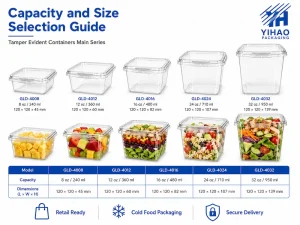
tamper evident containers are useful when buyers need stronger consumer confidence for chilled retail foods, grab-and-go meals, delivery, and sealed display packaging. They are especially relevant for supermarkets, convenience stores, foodservice brands, and prepared food counters where the customer expects visible closure integrity.
A clear PET tamper evident container supports retail trust by combining product visibility with a visible security feature. For private label and branded food programs, this structure can improve both safety perception and shelf confidence.
Cold Cups, Lids, and Printed Beverage Packaging
For beverage programs, custom printed cups are one of the most visible forms of branded packaging. Cafes, juice bars, bubble tea shops, convenience stores, and beverage distributors usually need cup-lid compatibility, clear drink presentation, strong stacking, and controlled branding.
cold cups and lids should be planned as a system, not as separate items. A PET/RPET clear cold cup supports visual beverage menus such as matcha, refreshers, sparkling fruit drinks, and flavored cold brew. A clear PET flat lid helps create a simple takeaway format for iced coffee, lemonade, juice, and cold brew.
When Custom Printed Cups Make Sense
Custom printed cups make sense when the cup is part of the customer-facing brand experience. Beverage brands often rely on cup presentation because the drink leaves the store in the customer’s hand. That means the package becomes mobile advertising, not just drink protection.
Printed cups are useful for iced coffee, cold brew, lemonade, juice, smoothies, milk tea, bubble tea, matcha, refreshers, acai and berry refreshers, protein drinks, sparkling fruit drinks, flavored cold brew, and iced tea programs. However, printing should never come before function. Buyers should first confirm cup clarity, rim consistency, lid fit, stacking behavior, filling speed, and takeaway handling.
| Beverage Program | Packaging Priority | Recommended Custom Direction | Buyer Checkpoint |
|---|---|---|---|
| Iced coffee and cold brew | Clear drink visibility and secure lid fit | Clear cup with logo printing or simple label direction | Check lid compatibility and condensation handling |
| Milk tea and bubble tea | Brand exposure and cup strength | Printed cup series with matching lid or sealing plan | Confirm drink size, ice level, and lid format |
| Matcha and refreshers | Visual color appeal and clean presentation | Transparent cup with controlled branding area | Avoid printing that hides drink color |
| Smoothies and protein drinks | Thicker beverage handling and lid height | Cup-lid system with dome or suitable lid options | Test fill level and lid clearance |
| Juice and lemonade | Fresh color display and quick service | Clear cups with simple logo or label placement | Check cup stacking and service speed |
When Buyers Should Choose Custom Food Containers
Not every project needs the same level of customization. The best direction depends on order stage, demand stability, branding requirements, and operational complexity.
| Buyer Situation | Recommended Direction | Why This Works | What to Avoid |
|---|---|---|---|
| New food product trial | Standard container with label | Fast validation with lower risk | Avoid new tooling before product fit is proven |
| Stable monthly demand | Semi-custom packaging | Improves brand appearance while keeping supply practical | Avoid too many unrelated container shapes |
| Private label supermarket program | Coordinated branded packaging system | Creates consistent shelf identity across SKUs | Avoid inconsistent label placement and lid styles |
| Large repeated orders | OEM development or dedicated packaging family | Supports long-term differentiation and controlled structure | Avoid vague specifications and untested assumptions |
| Unclear food format | Sample testing first | Confirms size, lid, material, and handling before bulk orders | Avoid approving based only on photos |
OEM Plastic Packaging vs Private Label Food Packaging
OEM plastic packaging and private label food packaging are related, but they are not the same decision. OEM development focuses more on structure, material, lid design, mold direction, and production feasibility. Private label packaging focuses more on brand ownership, visual consistency, retail appearance, and repeat supply under the buyer’s brand.
| Project Type | Main Goal | Buyer Should Prepare | Supplier Should Support |
|---|---|---|---|
| OEM plastic packaging | Develop or adapt the packaging structure | Food type, dimensions, material target, lid requirement, usage scenario | Material advice, structure review, sample development, production control |
| Private label food packaging | Create a consistent branded packaging line | Brand guide, product range, label direction, sales channel, order plan | SKU planning, packaging matching, branding method, repeat supply |
| Custom printed packaging | Add visible brand identity to existing packaging | Logo files, print area, color direction, packaging size | Artwork check, sample confirmation, print consistency |
| Wholesale custom packaging | Build a scalable packaging mix for repeated purchasing | Estimated demand, product family, packing requirements, reorder plan | Stable production planning, carton packing, quality checks, shipment support |
The strongest path is usually staged: test existing containers, confirm food fit, add labels or sleeves, build a private label packaging system, and move toward OEM development only when repeated demand and packaging direction are clear.
How to Choose the Right Custom Food Containers
Start with the Food, Not the Logo
A logo cannot fix packaging that leaks, fogs badly, crushes the product, wastes shelf space, or uses the wrong lid. Before custom printing or OEM development, buyers should define the food type clearly.
| Food Type | Packaging Priority | Suggested Container Direction | Customization Focus |
|---|---|---|---|
| Fresh-cut fruit | Visibility, moisture control, portion clarity | Clear PET/rPET clamshells, trays, or compartment containers | Label area, ventilation logic, pack size |
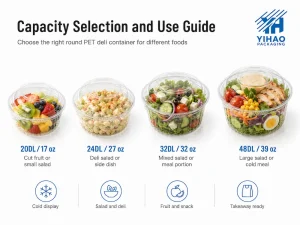
| Salads and deli foods | Lid security, stacking, refrigerated display | Hinged deli containers, bowls, square or round containers | Size family, lid fit, label placement |
| Bakery and desserts | Height protection, anti-crush structure, visual appeal | Bakery clamshells, dome containers, dessert boxes | Insert, sleeve, label, clear lid design |
| Prepared meals | Heat performance, reheating suitability, portion structure | PP meal containers, separate lid containers, compartment containers | Meal format, lid system, outer branding |
| Cold drinks | Cup-lid compatibility, drink visibility, menu range | PET/rPET cold cups with flat, dome, or sip-through lids | Custom printed cups, logo placement, cup series planning |
Match Material to Use Case
Material choice should follow the food’s temperature, visibility needs, handling requirements, and sales channel. PET and rPET are strong choices for chilled visual display. PP is stronger for hot food and reheatable applications. Paper-based combinations may work for selected bakery and dessert formats when structure and food contact requirements are properly reviewed.
Buyers should avoid treating material selection as only a price or sustainability decision. The better question is whether the material supports the food, channel, brand, customer experience, and local packaging requirements without creating avoidable complaints.
Confirm the Lid System Early
Lid fit is one of the most common failure points in food packaging procurement. A container that looks good but does not close reliably creates leakage, poor stacking, transport problems, and customer dissatisfaction. For custom projects, the buyer should confirm whether the lid is hinged, separate, flat, dome, tamper evident, sip-through, straw-slot, or heat-seal compatible.
For multi-SKU projects, a shared lid family can reduce warehouse complexity. This matters for distributors, supermarkets, and chain stores that need repeatable packaging operations across several food programs.
Choose the Branding Method Carefully
Not every branding need requires direct printing. Food packaging teams should compare label, sticker, sleeve, printed insert, outer carton branding, lid printing, cup printing, and full custom mold development.
| Branding Method | Best Use | Advantage | Buyer Note |
|---|---|---|---|
| Label or sticker | Small runs, trial orders, product identification | Flexible and practical | Confirm label adhesion and chilled shelf performance |
| Printed sleeve | Retail branding and premium shelf appearance | Good visual area without hiding the food completely | Check sleeve fit and packing efficiency |
| Printed cup | Beverage brands, cafes, cold drink chains | Strong customer-facing brand exposure | Confirm artwork, print area, and cup-lid compatibility |
| Printed lid or insert | Bakery, desserts, snack packs, gift packs | Adds brand detail while preserving product visibility | Avoid blocking key food visibility |
| OEM mold development | Long-term private label or dedicated product lines | Unique structure and stronger differentiation | Requires precise specification and sample validation |
Sample Testing Checklist Before Bulk Orders
Samples are not only for checking appearance. They are for testing whether packaging works under real food, real handling, real storage, and real sales conditions. Before approving custom food containers, buyers should run a practical sample test.
Food Fit Test
Place the actual food inside the sample container. Check fill volume, lid clearance, toppings, moisture, sauce movement, product shifting, and visibility after refrigeration or transport. For bakery items, check whether frosting, toppings, or delicate shapes touch the lid.
Lid and Closure Test
Open and close the container several times. Test whether staff can close it quickly during service. Check whether the lid pops open, warps, cracks, or creates customer frustration. For tamper evident packaging, confirm that the seal direction is intuitive and visible.
Stacking and Transport Test
Stack filled containers in the way they will be stored, displayed, delivered, or shipped. Check pressure points, lid strength, product crushing, carton fit, and shelf stability. Packaging that works on a desk may fail inside a delivery bag, cold shelf, or wholesale carton.
Branding Test
Apply the actual label, sleeve, sticker, or print sample. Check whether branding hides too much of the food, whether barcode placement is practical, and whether the design looks clean under retail lighting.
Customer Use Test
Ask how the customer will open, hold, carry, drink, eat, store, or dispose of the package. Good packaging supports the full user journey, not only the buyer’s procurement checklist.
How to Evaluate a Custom Food Container Manufacturer
A good custom packaging project depends heavily on supplier capability. Buyers should not evaluate a supplier only by unit price. A lower unit price can become expensive if the packaging causes wrong-lid complaints, poor display, weak closure, inconsistent branding, or reorder problems.
| Evaluation Area | What Buyers Should Check | Why It Matters | Risk If Ignored |
|---|---|---|---|
| Existing mold library | Range of containers, cups, lids, trays, and structures | Reduces unnecessary tooling and speeds up selection | Buyer may over-customize too early |
| Material guidance | PET, rPET, PP, and application-based recommendations | Aligns packaging with temperature, visibility, and handling needs | Wrong material may create food fit problems |
| Lid compatibility support | Matched lids, closure direction, cup-lid fit, stacking behavior | Prevents leakage, loose lids, and service complaints | Packaging may fail during use |
| Branding feasibility | Label area, printed cup direction, sleeve fit, carton branding | Improves brand appearance without reducing function | Artwork may look good but perform poorly |
| Sample review support | Samples for food fit, closure, display, and handling tests | Helps approve the right packaging before bulk orders | Bulk order risk increases |
| Wholesale packing logic | Carton organization, storage, reorder clarity, product family planning | Supports distributors and repeat purchasing | Warehouse and SKU confusion increase |
| Documentation discipline | Clear specifications and confirmed claims | Protects buyers from unsupported assumptions | Compliance and marketing claims may become unclear |
The right manufacturer should help buyers compare options, identify structure risks, review branding feasibility, and avoid unsupported claims. A reliable supplier should also explain when standard packaging is enough and when OEM development is truly justified.
Buyer Checklist for Custom OEM Food Packaging
Before contacting a supplier for custom OEM food packaging, buyers should prepare clear information. Vague requests create slow quotations and poor product matching.
| Question | Why It Matters | Best Buyer Preparation |
|---|---|---|
| What food will go inside? | Food type controls material, shape, lid, and structure | Share food category, portion weight, texture, moisture, and temperature |
| Where will it be sold? | Retail, takeaway, delivery, and wholesale need different packaging | Define supermarket, cafe, bakery, convenience store, distributor, or delivery channel |
| What is the branding goal? | Logo printing, label, sleeve, and OEM mold are different paths | Provide logo file, brand color, label size, and visual reference |
| Is this a trial or repeat order? | Sample orders and long-term private label programs need different planning | Clarify whether the project is sampling, pilot run, wholesale, or long-term supply |
| What are the must-have functions? | Leak resistance, visibility, heat use, tamper evidence, and stacking affect structure | Rank the top three functional requirements |
| What information is not confirmed yet? | Unconfirmed details should not be forced into production | Mark uncertain specs and request supplier guidance |
Common Mistakes Buyers Should Avoid
Choosing Packaging Only by Unit Price
Low unit price can become expensive when packaging causes leakage, poor display, product damage, customer complaints, or inconsistent supply. Packaging cost should be evaluated against product value, complaint risk, shelf conversion, handling efficiency, and reorder stability.
Over-Customizing Too Early
New food brands often want fully customized packaging before they have tested the product format. This creates unnecessary cost and slows down launch. Standard packaging with smart branding is often the better first step.
Ignoring Carton Packing and Storage
Packaging that looks good individually may create problems in storage or shipping. Buyers should check carton quantity, stacking direction, warehouse space, and transport handling before approving bulk orders.
Using One Container for Too Many Foods
A single container format cannot solve every food packaging need. Fresh fruit, bakery, salads, prepared meals, and cold drinks need different structures. A strong packaging line uses related containers, not random containers.
Requesting Claims Without Confirmation
Food contact requirements, market rules, and recycling claims vary by destination and material. Buyers should request supplier documentation and confirm local regulatory requirements instead of using broad claims such as “approved everywhere” or “fully recyclable in all markets.”
How Wholesale Buyers Should Build a Custom Packaging Line
Wholesale buyers should think in product families. A custom packaging line should be easy to explain, easy to reorder, and easy for end users to apply.
A practical wholesale line may include clear produce clamshells, hinged deli containers, salad bowls, bakery containers, tamper evident packs, PP prepared meal containers, PET cold cups, and matching lids. This gives distributors and foodservice buyers a complete packaging solution instead of scattered individual SKUs.
The goal is not to carry every possible container. The goal is to build a controlled range that covers the most frequent buyer needs: fresh display, chilled takeaway, bakery protection, drink service, prepared meals, and retail safety.
FAQ
1. What are custom food containers?
Custom food containers are food packaging containers adjusted for a specific product, brand, sales channel, and purchasing plan. They may involve size selection, material choice, lid structure, label placement, logo printing, private label design, or OEM plastic packaging development.
2. Are custom food containers only for large brands?
No. Small cafes, bakeries, supermarkets, foodservice operators, and distributors can use custom food containers through labels, sleeves, standard container selection, or custom printed cups. Full OEM development is usually better for larger or long-term private label projects.
3. What information should I prepare before requesting custom OEM food packaging?
You should prepare the food type, portion size, material preference, storage condition, sales channel, branding goal, estimated order stage, lid requirement, and must-have functions such as tamper evidence, clear display, heat resistance, or compartment separation.
4. What is the difference between private label food packaging and OEM plastic packaging?
Private label food packaging focuses on brand identity, consistent presentation, and repeat supply under the buyer’s brand. OEM plastic packaging focuses more on the technical development or adaptation of packaging structure, material, mold direction, and functional performance.
5. When should buyers choose custom printed cups?
Buyers should choose custom printed cups when the drink package is part of the customer-facing brand experience. Printed cups are especially useful for iced coffee, cold brew, lemonade, juice, smoothies, milk tea, bubble tea, matcha, refreshers, and takeaway beverage programs, but cup-lid compatibility should be confirmed first.
6. How should buyers test custom food containers before wholesale orders?
Buyers should test samples with real food, real filling volume, lid closure, stacking, refrigeration, transport handling, label placement, customer opening experience, and visual presentation before approving bulk production or long-term private label packaging.
References
- U.S. Food and Drug Administration, Food Contact Substances and Food Packaging Guidance.
- European Commission, Regulation (EC) No 1935/2004 on Materials and Articles Intended to Come into Contact with Food.
- European Commission, Regulation (EU) No 10/2011 on Plastic Materials and Articles Intended to Come into Contact with Food.
- European Food Safety Authority, Food Contact Materials Safety Assessment Resources.
- International Organization for Standardization, ISO 9001 Quality Management Systems.
- Association of Plastic Recyclers, Design Guide for Plastics Recyclability.
- GS1, Barcode and Product Identification Standards for Retail Packaging.
- BRCGS, Packaging Materials Standard and Food Packaging Safety Guidance.
Deep-Dive Insights
How buyers should think about custom food containers
Buyers should treat custom food containers as a packaging system, not a decoration project. The right system connects food type, material, lid structure, shelf display, branding method, carton packing, and repeat purchasing. A logo can improve recognition, but it cannot compensate for poor fit, weak closure, unclear visibility, or unstable supply.
Why custom does not always mean a new mold
Many buyers assume customization means tooling immediately. In practice, the safer first step is often standard packaging with smarter branding. Labels, sleeves, inserts, printed cups, carton marks, and coordinated packaging families can create a strong private label effect before deeper OEM investment becomes necessary.
What makes private label food packaging stronger
Private label packaging becomes stronger when the buyer keeps visual language consistent across multiple SKUs. Clear containers, matching lid systems, controlled label placement, and repeatable carton packing help the brand look professional while keeping operations manageable. Consistency matters more than adding too many unrelated shapes.
Why branding should not reduce food visibility
For chilled foods, bakery items, fruit packs, salads, desserts, and cold drinks, the product itself is often the strongest selling point. Branding should frame the food, not hide it. A clean label area, controlled logo placement, and transparent material can create a stronger retail impression than oversized graphics that block freshness cues.
Option buyers should prioritize first
For most food packaging teams, the first priority should be practical product fit. After that, buyers should evaluate lid performance, shelf presentation, branding method, and supplier reliability. OEM development should come after the food, structure, and sales channel have been validated through samples or trial orders.
Consideration for wholesale and supplier selection
A good supplier should help buyers compare options, identify structure risks, review branding feasibility, and avoid unsupported claims. The best purchasing decision is not always the most customized option. It is the option that protects the food, supports the brand, works at wholesale scale, and can be reordered consistently.
Final Note / Practical Takeaway
© YIHAO Packaging. All rights reserved. All articles, product images, packaging designs, technical specifications, and website materials are protected by copyright. Unauthorized copying, reproduction, redistribution, modification, or commercial use is strictly prohibited without prior written permission.