Why Custom Deli Containers Matter for Modern Food Retail
Custom deli containers are more than a basic food packaging choice. For supermarkets, cafes, bakeries, and foodservice brands, they influence how customers judge freshness, portion value, food visibility, shelf organization, takeaway convenience, and brand quality before purchase. A clear container with the right lid, shape, depth, and label area makes prepared food look intentional, clean, and retail-ready.
For supermarkets, deli containers support cold shelf salads, cut fruit, pasta salads, grain bowls, snack packs, deli sides, and ready-to-eat chilled food. For cafes, they create a practical packaging system for takeaway salads, fruit cups, yogurt toppings, desserts, nuts, and small meal portions. For bakeries, they help present chilled desserts, fruit toppings, brownie bites, pastry samplers, and refrigerated bakery items without hiding product appearance. For foodservice brands, they support repeatable packaging across stores, distributors, catering programs, and private-label supply.
That is why buyers often search for custom deli containers together with wholesale deli containers, deli container manufacturer, salad container supplier, PET deli container factory, and bulk salad containers. These terms show a clear B2B intent: buyers are not only looking for a container. They are looking for a packaging system that supports food fit, brand presentation, wholesale planning, and long-term supply.
YIHAO works with food packaging buyers who need practical, clear, and scalable packaging solutions for chilled food, salads, fresh fruit, bakery items, and grab-and-go retail programs. For buyers building a deli packaging range, the goal is direct: choose containers that look clean, perform consistently, and make ordering easier as the food program grows.
What Makes Custom Deli Containers Different from Standard Food Containers?
Standard deli containers usually solve one simple problem: holding food. Custom deli containers solve a broader commercial problem: helping a food brand sell, display, protect, label, transport, and reorder products more efficiently. This difference matters for professional buyers because packaging decisions affect not only product appearance, but also shelf density, labor speed, storage space, customer experience, and repeat purchasing.
In B2B packaging, “custom” does not always mean building a new mold from the first order. In many cases, a smarter custom project starts with choosing the right existing structure, then adapting the packaging system through size selection, label design, sleeve packaging, carton marks, lid height, material direction, and product range planning.
A good deli container manufacturer should help buyers avoid over-customization at the wrong stage. Before investing in deep OEM development, supermarkets, cafes, bakeries, and foodservice brands should test real food in existing PET container formats. Once the buyer confirms product fit, shelf display, lid behavior, and repeat order potential, custom branding or more advanced customization becomes more practical.
What Can Be Customized in Deli Containers?
Customization should be practical, not decorative only. For wholesale food packaging buyers, the best custom deli container plan connects product performance with brand presentation. A container that looks attractive but does not close well, stack well, or fit the food properly creates operational problems. A container that fits the food but has no clear label or branding strategy loses marketing value. The right solution balances both sides.
| Custom Area | Practical Options | Why It Matters for Buyers |
|---|---|---|
| Container Size | Small, medium, large, multi-size range | Supports different portions for salads, fruit, snacks, and deli sides |
| Lid Structure | Hinged lid, flat lid, dome lid, separate lid | Protects toppings, improves stacking, and affects opening experience |
| Material Direction | PET or rPET discussion based on project needs | Connects clarity, food-contact review, and sustainability positioning |
| Label Area | Top label, front label, side label, barcode label | Keeps product information clear without hiding the food |
| Brand Presentation | Sticker, sleeve, carton mark, private-label packaging | Improves shelf identity while keeping packaging flexible |
| Food Category Fit | Salad, fruit, bakery, deli sides, chilled meals | Prevents buyers from using one container for unsuitable food types |
This is the core of a strong custom packaging project. Buyers do not need to customize everything at once. They need to customize the parts that improve food presentation, operational efficiency, and purchasing stability.
Main Applications for Custom Deli Containers
Supermarket Cold Shelf Programs
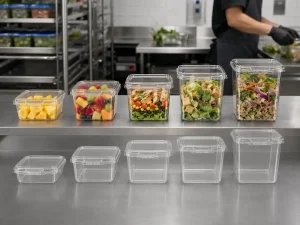
Supermarkets need deli containers that work across many food categories without creating a messy shelf. Prepared salads, fruit cups, pasta portions, deli sides, cheese snacks, nuts, chilled noodles, and seasonal grab-and-go meals all need clear visibility and consistent stacking. A clean packaging range helps category managers organize the cold shelf by portion size, product type, and price point.
For supermarket buyers, deli and salad containers are often the backbone of chilled food merchandising. They provide a flexible structure for fresh food programs while keeping product appearance visible. When buyers need a hinged format for quick packing and retail-ready presentation, PET hinged deli containers are a practical starting point.
Cafes and Grab-and-Go Counters
Cafes need containers that support speed, visual appeal, and menu flexibility. A cafe may sell fruit salads in the morning, grain bowls at lunch, tiramisu portions in the afternoon, and side salads throughout the day. Using too many unrelated packaging formats increases storage pressure and makes staff training harder.
For cafes, custom deli containers should simplify menu packaging. A small group of clear containers can cover salads, fruit, yogurt toppings, snack mixes, bakery sides, and chilled desserts. This gives the counter a more organized look and helps customers understand portion value quickly.
Bakeries and Dessert Retail
Bakeries often focus on cake boxes and bakery clamshells, but deli-style containers also play a useful role for chilled dessert portions, brownie bites, pastry samplers, fresh fruit toppings, and small breakfast packs. Clear containers help impulse products sell because customers can see texture, color, toppings, and portion size.
When bakery buyers need stronger dessert-specific structure, bakery clamshell containers remain a better fit for cake slices, pastries, muffins, croissants, and delicate bakery items. A smart packaging plan uses deli containers for flexible chilled food and bakery clamshells for bakery items that need more product-specific protection.
Foodservice and Prepared Meal Brands
Foodservice brands need repeatability. A chain, distributor, catering company, or meal preparation brand cannot rely on one-off packaging decisions for every new menu item. They need a container matrix that covers base salads, toppings, protein portions, fruit sides, snacks, cold dishes, and prepared meal components.
For prepared food programs, some menus require containers that are different from cold PET deli packaging. When hot takeaway meals or reheating conditions are involved, buyers should review suitable alternatives under microwave safe containers instead of assuming every clear PET deli container fits every temperature condition. This keeps product claims more accurate and protects the brand from wrong-use complaints.
Buyer Decision Table: How to Match Container Structure to Food Programs
| Buyer Need | Best Container Direction | Why It Matters |
|---|---|---|
| Fast packing for fresh food counters | Hinged PET deli container | Lid and base stay connected, reducing lid-matching errors |
| Premium salad presentation | Round PET salad bowl | Shows layered ingredients, toppings, and fresh colors clearly |
| Shelf efficiency and neat stacking | Square PET container | Improves cold shelf organization and carton space use |
| Fruit and snack separation | Two-compartment container | Keeps ingredients separate and improves eating quality |
| Private-label food programs | Clear PET container with label or sleeve | Balances brand identity with product visibility |
Material Selection: PET, rPET, and Practical Buyer Questions
PET is widely used for clear deli packaging because it provides strong product visibility, clean shelf presentation, and a lightweight structure for chilled food applications. For salads, fruit, nuts, cold sides, and refrigerated grab-and-go meals, clear PET containers help buyers show the product instead of hiding it behind opaque packaging.
rPET, or recycled PET, is often considered when buyers want a recycled-content direction for clear food packaging. However, professional buyers should handle rPET claims carefully. Food-contact suitability, recycled-content documentation, regional requirements, and supplier declarations must be reviewed according to the target market. A responsible PET deli container factory should support buyers with material discussion, sample testing, and documentation review instead of making vague sustainability claims.
For purchasing teams, the material decision should include these questions:
- Will the container be used for chilled, ambient, or hot food conditions?
- Does the food contain dressing, syrup, oil, sauce, or moist toppings?
- Is product visibility more important than insulation or heat resistance?
- Will the container be sold on a cold shelf, used for takeaway, or packed into delivery bags?
- Does the buyer need standard PET, rPET direction, or a mixed product range?
- What documentation does the destination market require for food-contact materials?
This is where a serious salad container supplier brings value. The supplier should not only quote a price. The supplier should help buyers compare food fit, lid type, shape, stacking, labeling, and material direction before the order becomes a full wholesale program.
Choosing the Right Container Structure
PET Hinged Deli Containers
Hinged containers are useful when packing speed and lid convenience matter. The lid and base are connected, which reduces lid-matching confusion during preparation. This structure works well for fresh fruit, salads, nuts, small deli sides, sandwiches, and chilled ready-to-eat packs.
For buyers building a basic range of custom deli containers, hinged formats often become the first SKU group. They are easy for staff to handle, simple to display, and suitable for many fresh food programs. In wholesale planning, hinged containers also reduce the risk of ordering the wrong lid for the wrong base.
For common chilled food applications, buyers can compare formats such as clear hinged deli containers and larger fresh food portions when building a multi-size program.
Round PET Containers and Salad Bowls
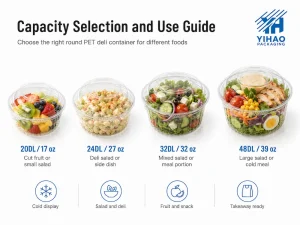
Round containers and salad bowls create a fuller food presentation. They are especially useful for leafy salads, grain bowls, fruit mixes, chilled noodles, and meal salads with toppings. The round shape gives a generous visual impression and works well in chilled retail displays where freshness and color are key selling points.
For salad-heavy programs, round PET containers are often a strong category choice. Buyers can use smaller bowls for side salads and larger bowls for premium meal salads or shared fruit portions. Matching lids should be reviewed carefully because lid height affects topping protection and shelf appearance.
When a menu needs a strong grab-and-go salad format, clear salad bowls help present layered ingredients, colorful vegetables, proteins, and toppings clearly.
Square PET Containers
Square containers are valuable when shelf efficiency and compact stacking matter. Compared with round bowls, square formats often make better use of shelf space and carton space. They also give a neat, modern look for deli sides, fruit, snacks, and chilled prepared food.
For retail and foodservice buyers comparing display density, square PET containers can be a practical choice. They help supermarkets and cafes create clean rows in cold cabinets while supporting consistent portion planning.
Divided and Multi-Compartment Formats
Some foods need separation. Fruit and nuts, salad toppings, cheese and crackers, sauce and vegetables, or protein and side items may lose texture when packed together too early. In those cases, divided packaging protects product quality and gives customers a clearer sense of value.
For snack and meal kit programs, two-compartment containers help separate ingredients while still keeping the pack transparent and retail-friendly. Buyers should choose divided formats only when separation improves the eating experience; otherwise, a single-compartment container may be simpler and more cost-effective.
Wholesale Deli Containers: How Buyers Should Build the Product Matrix
Buyers searching for wholesale deli containers usually need more than one size. A supermarket or cafe rarely sells only one salad or one fruit portion. The better approach is to create a product matrix that covers the most common food groups without overwhelming purchasing teams.
| Food Program | Recommended Structure | Buyer Logic |
|---|---|---|
| Small fruit portions | Clear hinged deli containers or small round bowls | Good visibility, quick packing, easy cold shelf display |
| Grab-and-go salads | Round PET salad bowls with suitable lids | Better ingredient visibility and premium presentation |
| Deli sides | Square PET containers or hinged deli containers | Compact stacking and clear portion control |
| Fruit and nut snack packs | Two-compartment or multi-compartment containers | Ingredient separation protects texture and eating quality |
| Bakery sides and dessert portions | Clear deli containers or bakery clamshells | Depends on product height, decoration, and fragility |
| Prepared chilled meals | Square containers, round bowls, or separate lid formats | Match structure to food type, handling, and channel |
This matrix helps buyers avoid the most common mistake: ordering too many shapes too early. A focused range of bulk salad containers, hinged deli packs, and square or round food containers creates better inventory control and easier staff training.
How to Choose a Custom Deli Container Manufacturer
Choosing the right deli container manufacturer is not only about comparing unit prices. A strong manufacturer helps buyers reduce packaging risk before the order becomes large. For supermarkets, cafes, bakeries, and foodservice brands, the supplier should understand food applications, retail display, material selection, sample testing, packaging consistency, and wholesale replenishment.
Buyers should review these manufacturer capabilities before confirming a custom deli container project:
- Existing product range: A broader deli, salad, fruit, bakery, and foodservice packaging range makes it easier to build a practical SKU system.
- Sample support: Real samples help buyers test food fit, lid closure, stacking, label space, and customer opening experience.
- Material discussion: The supplier should explain PET, rPET direction, and food-contact documentation clearly.
- Wholesale supply stability: Repeat orders require consistent specifications, carton packing, and production planning.
- Customization readiness: A manufacturer should separate label-based customization, carton branding, existing-mold solutions, and deeper OEM development.
- Export and B2B communication: Professional response, clear quotation details, and packaging recommendations reduce purchasing friction.
For buyers planning long-term wholesale supply, working with a PET deli container factory gives the project stronger technical communication than treating packaging as a one-time commodity order. A factory-level discussion helps buyers compare material direction, container structure, sample testing, and repeated supply in one process.
Supplier Checklist for Custom Deli Container Projects
Before placing a wholesale order, buyers should compare suppliers with a clear checklist. Price matters, but price alone does not tell buyers whether a supplier understands food fit, retail display, labeling, custom branding, or repeat orders.
| Checklist Item | What Buyers Should Review | Why It Matters |
|---|---|---|
| Food Fit | Test salads, fruit, snacks, deli sides, and desserts in real portions | Prevents wrong container depth, lid height, or poor presentation |
| Lid Performance | Review closing feel, stacking, opening experience, and product height | Improves handling and customer experience |
| Material Support | Discuss PET, rPET, food-contact use, and destination market needs | Keeps claims and documentation more responsible |
| Branding Method | Compare labels, sleeves, carton marks, and private-label options | Balances brand identity with food visibility |
| Wholesale Stability | Review repeat supply, carton packing, and SKU consistency | Protects supermarkets and foodservice programs from supply disruption |
| Category Coverage | Check related salad, fruit, bakery, tamper-evident, and meal packaging options | Reduces sourcing complexity across multiple food programs |
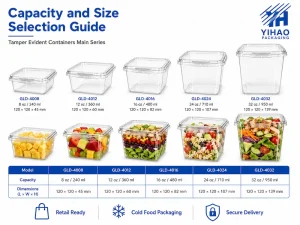
A supermarket deli project may also need fresh-cut fruit containers for fruit cups and platters, while a delivery or cold shelf trust program may require tamper evident containers for stronger customer confidence.
Custom Branding Without Overcomplicating the Project
Custom branding can make deli packaging look more professional, but it should not create unnecessary operational problems. Before asking for printed containers or special structures, buyers should confirm the base packaging system first. The container must fit the food, close properly, stack safely, and display well before branding is added.
Common branding approaches include:
- Front-facing labels for product name, flavor, weight, price, and barcode.
- Top labels for salads, desserts, and fruit packs displayed from above.
- Paper sleeves for premium deli lines or private-label programs.
- Carton branding for wholesale distribution and warehouse handling.
- Printed stickers for seasonal menus, cafe branding, or limited campaigns.
For supermarkets, labels must support fast scanning and clear product identification. For cafes, labels often need a more premium look. For bakeries, labels should avoid covering the dessert surface or visual selling point. For foodservice brands, branding should remain consistent across multiple container sizes and food categories.
A good salad container supplier should help buyers review where branding belongs. Sometimes the best solution is not printing directly on the container. A transparent container with a clean label or sleeve often gives stronger shelf appeal while preserving product visibility.
Supermarkets: Building a Clear Cold Shelf System
Supermarket buyers need packaging that improves the selling environment. A cold shelf with inconsistent containers looks unplanned. A cold shelf with clean, clear, stackable packaging looks fresher and more reliable. This matters because customers often judge prepared food in seconds.
For supermarkets, custom deli containers should support three goals:
- Make the food visible and appetizing.
- Keep the shelf organized across multiple portion sizes.
- Support fast replenishment, labeling, scanning, and handling.
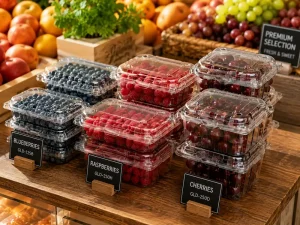
Clear PET packaging works especially well when the product itself is colorful: leafy salads, berries, melon, pasta salads, vegetables, layered fruit, and chilled desserts. For dense or sauce-heavy foods, buyers should test closure performance and product movement more carefully.
Cafes: Balancing Menu Flexibility and Storage Space
Cafes often have limited back-of-house space. A packaging range that is too large creates storage problems and ordering mistakes. The best custom deli container plan for cafes usually starts with a small number of versatile SKUs.
A cafe may need one hinged container for fruit and snacks, one round bowl for salads, one square container for deli sides, and one bakery clamshell for dessert portions. This gives the cafe enough flexibility without turning packaging into an operational burden.
For cafes with branded takeaway programs, labels and sleeves can do a lot of work. A clean container plus a branded label may look more premium than a fully printed container that hides the food. This is especially true for fruit, salads, and desserts where color and texture sell the product.
Bakeries: When Deli Containers Make Sense
Bakeries should not use deli containers for every dessert. Tall cakes, fragile pastries, and decorated items often need bakery-specific structures. However, deli containers are useful for many bakery-adjacent products: fruit toppings, cream cups, brownie bites, cookie assortments, chilled dessert portions, breakfast parfaits, and small snack sets.
When bakeries sell through supermarkets or cafes, clear deli containers help standardize refrigerated secondary products. A bakery can use dedicated cake containers for celebration cakes and use deli-style packaging for smaller chilled items. This improves shelf flexibility and helps the bakery add more grab-and-go products without developing a new package for every item.
Foodservice Brands: Scaling from Trial Orders to Wholesale Programs
Foodservice brands need packaging that can scale. A trial order may focus on two or three food types, but a growing brand may later need multiple sizes, multiple lid structures, printed labels, carton identification, and consistent replenishment. This is where a wholesale supplier relationship becomes more important than a one-time purchase.
Buyers should treat wholesale deli containers as part of a packaging system. The system should answer:
- Which container handles the core salad line?
- Which size supports fruit portions and snack packs?
- Which format fits deli sides or prepared chilled meals?
- Which items need tamper-evident structures?
- Which items need bakery-specific or microwave-safe alternatives?
- Which SKUs deserve custom branding first?
This planning keeps the brand from changing packaging too often. It also gives distributors and purchasing teams a clearer ordering structure.
Common Mistakes When Ordering Custom Deli Containers
Choosing by Capacity Only
Capacity matters, but it does not tell the full story. Two containers with similar volume may perform differently because of lid height, base shape, stacking design, sealing feel, and food presentation. Buyers should test actual food portions before confirming bulk salad containers.
Ignoring Lid Compatibility
Lids affect customer experience, stacking, leakage risk, and shelf presentation. For separate lid systems, buyers must confirm matching logic carefully. For hinged containers, buyers should test opening and closing feel after real packing conditions.
Covering Too Much Product with Labels
Branding is important, but clear packaging loses value when labels hide the food. A better approach is to leave enough visible area for color, texture, and portion judgment.
Using One Container for Too Many Food Types
A versatile container is useful, but no single container fits every food. Leafy salads, sauce-heavy deli sides, fruit, bakery portions, and hot meals need different packaging logic. Professional buyers should build a controlled matrix instead of forcing one SKU across unrelated foods.
Ordering Bulk Before Testing
Sample testing protects buyers from costly mistakes. Before moving to wholesale, test closure, stacking, labeling, food movement, shelf appearance, carton handling, and customer opening experience.
How to Prepare an Inquiry for Wholesale Deli Containers
When contacting a deli container manufacturer, buyers should prepare clear information. The more specific the inquiry, the faster the supplier can recommend the right structure.
Useful inquiry details include:
- Food type: salad, fruit, nuts, deli sides, bakery portions, or prepared meals.
- Use channel: supermarket cold shelf, cafe takeaway, bakery display, foodservice, or distribution.
- Approximate portion size and product height.
- Need for hinged lid, separate lid, flat lid, dome lid, or divided structure.
- Material direction: PET, rPET discussion, or other suitable material options.
- Branding need: label, sleeve, carton mark, or custom development.
- Order stage: sample review, trial order, wholesale supply, or OEM project.
- Destination market and documentation expectations.
This information allows the supplier to recommend products more accurately. It also makes the conversation more professional because the buyer is not only asking for the lowest price; they are asking for the right packaging solution.
FAQ: Custom Deli Containers
1. What are the best custom deli containers for salads, fruit, and deli food?
The best custom deli containers depend on the food type and selling channel. Hinged PET containers work well for quick packing and fresh food counters. Round PET bowls are suitable for salads and layered ingredients. Square PET containers help improve shelf efficiency. Two-compartment containers are useful when fruit, nuts, toppings, or snacks need separation.
2. Are PET deli containers suitable for hot food?
PET deli containers are mainly used for clear presentation and chilled food applications. For hot food or reheating conditions, buyers should review suitable heat-resistant or microwave-safe alternatives instead of assuming PET fits every use case.
3. How do I choose a deli container manufacturer for wholesale orders?
Buyers should choose a deli container manufacturer by reviewing product range, sample support, material discussion, food-contact documentation, lid compatibility, wholesale supply stability, carton packing, and customization readiness. The manufacturer should understand real food applications, not only quote a low price.
4. Can custom deli containers support private label or branded packaging?
Yes. Branding may involve labels, sleeves, carton marks, stickers, or custom development depending on order stage and project needs. Buyers should confirm food fit and packaging structure first, then decide which branding method creates the best balance of visibility and brand presentation.
5. What should buyers test before ordering bulk salad containers?
Before ordering bulk salad containers, buyers should test real food portions, lid closure, stacking, label placement, dressing or moisture behavior, cold shelf appearance, carton handling, and customer opening experience. Sample testing reduces packaging mistakes before wholesale purchasing.
References
- U.S. Food and Drug Administration, Packaging & Food Contact Substances guidance resources.
- European Commission, Regulation (EU) No 10/2011 on plastic materials and articles intended to come into contact with food.
- European Food Safety Authority, Recycled plastic materials and PET recycling process evaluation guidance.
- Association of Plastic Recyclers, APR Design Guide for PET rigid packaging design and recyclability considerations.
- ASTM International, packaging and plastic material test method references used across packaging evaluation.
- Food Packaging Forum, scientific and regulatory discussions on food contact materials and packaging safety.
- U.S. Environmental Protection Agency, sustainable materials management and recycling-related resources.
- ISO standards resources for packaging, quality management, and supply chain documentation practices.
Deep Dive Insights
How should buyers define custom deli containers?
Buyers should define custom deli containers as a complete packaging solution, not only a container with a logo. A strong custom project includes container structure, food fit, lid type, material direction, label space, shelf display, carton handling, and wholesale repeatability. This approach helps buyers avoid decorative customization that does not improve the actual food packaging system.
Why does structure matter more than capacity alone?
Capacity tells buyers how much food a container may hold, but structure determines how the food looks, moves, stacks, and sells. A salad with tall toppings may need a different lid height than a flat deli side. A square container may improve shelf density, while a round bowl may create stronger salad presentation. Structure is the difference between simply holding food and selling food well.
What is the best starting point for a wholesale project?
The best starting point is sample testing with real food. Buyers should test salads, fruit, deli sides, snacks, and desserts in the actual selling environment before confirming bulk orders. This gives the buyer a clear view of closure feel, label placement, stacking, product visibility, and customer opening experience.
Which customization option is most practical for early-stage buyers?
For many early-stage buyers, labels, sleeves, and carton branding are more practical than direct container printing or new mold development. These options support brand identity while keeping the container transparent, flexible, and easier to adjust as the food program grows.
What should supermarkets, cafes, bakeries, and foodservice brands prioritize?
Supermarkets should prioritize cold shelf organization and fast replenishment. Cafes should prioritize menu flexibility and storage efficiency. Bakeries should prioritize product visibility and protection for delicate items. Foodservice brands should prioritize repeatable wholesale supply and SKU consistency across locations or distributors.
Final Note / Practical Takeaway
© YIHAO Packaging. All rights reserved. All articles, product images, packaging designs, technical specifications, and website materials are protected by copyright. Unauthorized copying, reproduction, redistribution, modification, or commercial use is strictly prohibited without prior written permission.