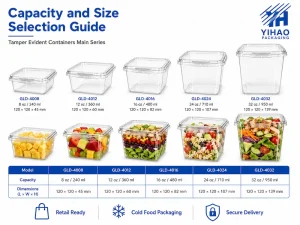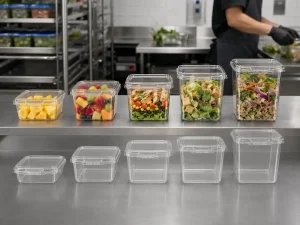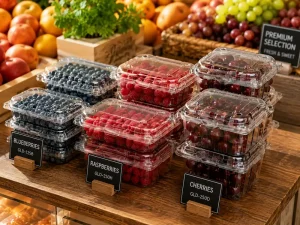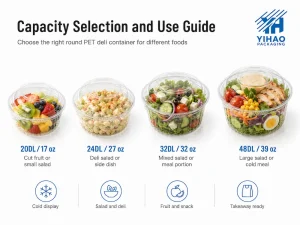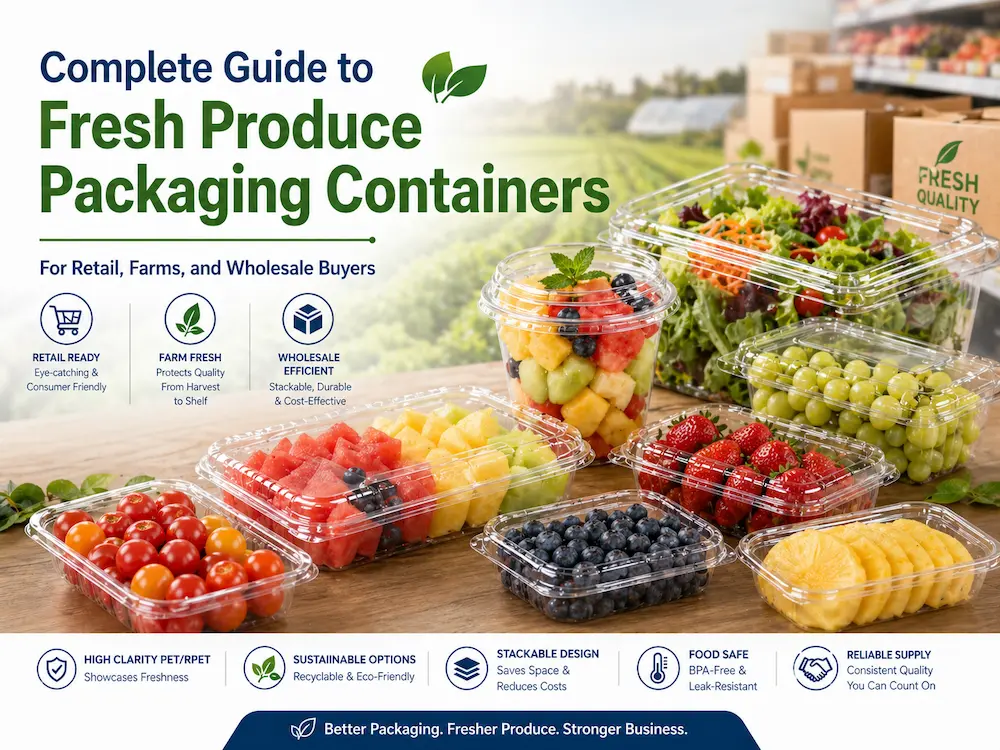
Fresh produce packaging containers are a practical packaging category for farms, supermarkets, fresh-cut fruit processors, distributors, cafes, and foodservice brands that need to protect fruit and vegetables while keeping them visible, organized, and retail-ready.
For B2B buyers, packaging is not only a container cost. It affects product appearance, cold-chain handling, shelf replenishment, carton packing, customer trust, shrink control, and repeat purchasing. A berry clamshell, a fresh-cut fruit tub, a produce tray, and a compartment snack pack each solve a different packaging problem.
As a food packaging manufacturer and solution provider, YIHAO helps buyers evaluate packaging by real product use, not only by shape or unit price. The best container should match the product’s moisture level, fragility, portion weight, ventilation need, closure method, label area, shelf display goal, and wholesale supply requirements.
This guide explains how to compare produce clamshell containers, fresh-cut fruit containers, produce trays, berry packs, clear PET packaging, RPET options, farm produce packaging, supermarket display packaging, and wholesale fruit packaging before placing bulk orders.
What Are Fresh Produce Packaging Containers?
Packaging for Fruit, Vegetables, Berries, and Chilled Produce
Fresh produce packaging containers are packaging formats used for whole fruit, berries, grapes, cherry tomatoes, leafy produce, sliced fruit, fruit salad, vegetable portions, fruit platters, snack packs, and chilled ready-to-eat produce.
Common formats include hinged clamshells, vented berry containers, clear PET trays, fresh-cut fruit tubs, multi-compartment containers, fruit platter trays, apple clamshells, kiwi clamshells, and retail display containers.
The main purpose is to keep fresh produce visible, organized, protected, and easy to handle from packing to retail shelf. For consumers, the package makes freshness, color, portion size, and product condition easier to judge before purchase.
Why Fresh Produce Needs Purpose-Built Packaging
Fresh produce is more sensitive than many packaged foods. Berries bruise easily. Fresh-cut fruit releases juice. Grapes and cherry tomatoes move during handling. Leafy produce loses volume when compressed. Fruit platters need presentation space. Mixed snack packs need separation.
This is why buyers should not use one generic container for every produce item. Packaging selection should begin with the product’s behavior: dry or juicy, delicate or firm, whole or cut, single product or mixed portion, stacked or displayed flat, chilled or ambient.
How Packaging Affects Farms, Supermarkets, and Wholesale Buyers
For farms and growers, packaging supports sorting, packing, carton loading, cooling, and transportation. For supermarkets, packaging affects shelf appearance, customer inspection, replenishment speed, and barcode handling. For wholesale distributors, packaging affects carton density, damage control, SKU organization, and reorder consistency.
Buyers should also review supplier communication, sample accuracy, mold consistency, carton packing, material documentation, and factory and production capability before confirming a long-term wholesale program.
Main Types of Fresh Produce Packaging Containers
Produce Clamshell Containers
Produce clamshell containers are one of the most widely used formats for berries, grapes, cherry tomatoes, small produce, fresh-cut fruit portions, and chilled snack packs. The integrated hinged lid helps with fast packing, easy closing, clear display, and retail handling.
A good clamshell should close securely without crushing the product. Buyers should test hinge flexibility, lock fit, lid clarity, stacking stability, vent design, label area, and filled-pack strength.
For high-visibility fruit programs, a clear hinged fruit container helps shoppers see fruit color and portion size while supporting clean retail presentation.
Fresh-Cut Fruit Containers
Fresh-cut fruit containers are designed for ready-to-eat fruit portions such as watermelon cubes, pineapple chunks, mango pieces, melon balls, grapes, apple slices, mixed fruit cups, and fruit-and-nut packs.
Fresh-cut fruit often releases juice during storage and transport. Buyers should check lid fit, base depth, closure strength, stacking performance, fill line, and whether the package still looks clean after realistic chilled testing. An empty sample is not enough. It must perform after filling.
For supermarket chilled shelves and takeaway fruit programs, a large fresh-cut fruit container supports higher-volume portions, family packs, and retail grab-and-go sales.
Produce Trays
Produce trays are suitable for fruit platters, vegetable portions, fresh assortments, catering trays, party trays, film-sealed produce packs, and chilled retail displays. Compared with hinged clamshells, trays provide a wider visual presentation area.
Produce trays are useful when arrangement matters. Sliced fruit, vegetable sticks, mixed fresh produce, sushi-style assortments, bakery-fruit combinations, and catering portions often need a flat or wide base so the product can be displayed neatly.
Buyers should check tray rigidity, rim design, lid compatibility, film compatibility, clear dome lid fit, corner strength, stackability, and transport handling. A tray that bends after filling can damage presentation and reduce shelf confidence.
For fruit platter and chilled assortment displays, a round party tray supports organized presentation and clear top visibility.
Berry Packaging Containers
Berry packaging containers need careful structure because blueberries, raspberries, blackberries, and strawberries are delicate. These products need product visibility, airflow, gentle containment, lid clearance, and stable stacking.
For berries, ventilation design is not decoration. It supports airflow and helps reduce trapped moisture inside the package. Buyers should compare vent hole position, base support, lid height, carton stacking behavior, and whether the filled pack protects berries during normal movement.
A vented berry clamshell is a practical option when delicate fruit needs both airflow and transparent retail display.
Multi-Compartment Produce Containers
Multi-compartment containers are useful for fruit-and-nut packs, apple slices with dip, grape and cheese packs, mixed snack trays, and small chilled ready-to-eat portions. They help keep ingredients separated while improving portion organization.
For mixed packs, buyers should check compartment depth, lid clearance, product separation, label placement, and whether the container still stacks well after filling.
For fruit-and-nut retail packs, a two-compartment fruit and nut container supports separated presentation and better portion control.
How to Match Produce Type with the Right Packaging
The strongest packaging decisions start with the product type. A container that works for blueberries may not work for watermelon cubes. A tray that displays fruit beautifully may not provide enough closure for takeaway. The table below gives buyers a practical starting point.
| Product Type | Recommended Container | Why It Works | Buyer Checkpoint |
|---|---|---|---|
| Blueberries, raspberries, blackberries | Vented berry clamshells | Supports airflow, visibility, and gentle containment | Check vent position, lid clearance, and crush resistance |
| Watermelon, pineapple, mango, melon cubes | Fresh-cut fruit containers | Provides deeper containment for juicy cut fruit | Check closure strength, base depth, and moisture handling |
| Grapes, cherry tomatoes, small produce | Clear PET clamshells | Improves visibility and retail handling | Check hinge, lock fit, stacking, and label area |
| Apple slices, fruit and nut packs | Compartment containers | Separates ingredients and improves portion presentation | Check compartment depth and lid clearance |
| Fruit platters and catering portions | Produce trays with clear lids | Creates wide display area for arranged produce | Check tray rigidity, dome lid fit, and transport stability |
Material Choices for Fresh Produce Packaging Containers
Clear PET Produce Packaging
Clear PET produce packaging is widely used because fresh produce sells through visibility. Shoppers want to see berry color, fruit ripeness, portion size, surface condition, and product arrangement before purchase.
PET offers transparency, shape stability, and practical forming flexibility. It can be used for clamshells, trays, bowls, lids, multi-compartment containers, and specialty fruit packaging. For retail produce, clarity is not only visual decoration. It directly affects customer trust and shelf decision speed.
RPET for Recycled-Content Packaging Programs
RPET can support recycled-content packaging goals when the material source, food-contact suitability, local regulations, and buyer communication are properly verified. However, buyers should avoid vague sustainability claims.
Recyclability is market-dependent. Local collection systems, sorting infrastructure, labels, adhesives, inks, colors, sleeves, and material combinations can all affect whether a PET or RPET package is accepted in actual recycling streams.
For wholesale projects, buyers should ask whether the material is PET or RPET, whether food-contact documentation is available, whether clarity is consistent, and whether the container design supports recycling expectations in the target market.
What Buyers Should Confirm Before Choosing Material
Before confirming material direction, buyers should ask for material description, food-contact declaration, sample testing, carton information, label compatibility, sleeve compatibility, and clear usage limitations. PET is mainly used for chilled, ambient, and cold display applications. It should not be used for hot-fill or microwave applications unless the packaging is specifically designed and verified for that use.
Buyer Comparison Table: Fresh Produce Packaging Container Formats
| Container Format | Best For | Key Advantage | Main Limitation | Buyer Checkpoint |
|---|---|---|---|---|
| Produce clamshell containers | Berries, grapes, tomatoes, small produce | Integrated hinged closure and clear display | Not ideal for every arranged platter application | Check hinge, lock fit, vents, and stacking |
| Fresh-cut fruit containers | Watermelon, pineapple, mango, fruit salad | Better containment and portion control | Needs strong closure for juicy products | Check lid fit, base depth, and moisture handling |
| Produce trays | Fruit platters, vegetable portions, arranged display | Wide visual presentation area | Usually needs matching lid, film, or sleeve | Check lid, film, sleeve, or wrap compatibility |
| Berry packaging containers | Blueberries, raspberries, strawberries, blackberries | Ventilation and gentle containment | Requires careful vent and clearance design | Check airflow, lid clearance, and crush resistance |
| Multi-compartment containers | Fruit-and-nut packs, snack packs, mixed portions | Separated presentation and portion organization | Compartment depth must match product size | Check compartment layout and lid clearance |
Fresh Produce Packaging for Supermarkets
Packaging Must Support Fast Shelf Decisions
Supermarket produce packaging must help shoppers make fast decisions. Customers often compare color, freshness, portion size, surface condition, and price within seconds. Clear packaging should support that decision instead of hiding the product.
For high-turnover fruit and chilled produce, cloudy packaging, poor stacking, weak closure, and oversized labels can reduce customer confidence. Clear PET clamshells, fresh-cut fruit containers, and produce trays help supermarkets present produce in a clean and organized way.
Cold Shelf Stacking and Replenishment
Retail teams need containers that move quickly from carton to shelf. A package may look good when empty but fail in a refrigerated display if it slides, collapses, or becomes difficult to handle after filling.
Buyers should test filled packs in actual retail-style stacks. The test should include carton removal, shelf replenishment, label scanning, consumer handling, and chilled display conditions.
Labels Should Support Retail Without Hiding Product Quality
Labels are necessary for barcode, brand, weight, product name, nutrition information, and retail operation. But oversized labels can hide the produce and reduce the value of clear packaging.
Buyers should define label size and placement during packaging selection. The best label area supports scanning while leaving enough transparent surface for shoppers to inspect the product.
Fresh Produce Packaging for Farms and Growers
From Harvest to Retail Display
Farm produce packaging should support sorting, packing, cooling, carton loading, transportation, and retail presentation. Farms and growers often need packaging that is practical, stackable, and reliable through repeated handling.
Important checks include nesting efficiency, stack height, carton fit, vent design, closing speed, filled-pack strength, and product clearance. These factors influence labor efficiency and product protection.
When Farms Should Use Clamshells
Farms should use clamshells when produce needs visibility, closure, and retail-ready handling. Berries, grapes, cherry tomatoes, and premium small fruit benefit from clamshell presentation because the product remains visible and easy to handle.
For delicate fruit, farms should avoid containers that are too deep, too tight, or poorly ventilated. The right clamshell supports freshness perception and reduces unnecessary movement inside the package.
For fruit-specific retail presentation, apple clamshell containers help separate and protect individual fruit while improving display order.
When Farms Should Use Trays
Farms should use trays when the product benefits from wide arrangement, flat presentation, or film-overwrap programs. Produce trays are practical for sliced vegetables, fresh assortments, fruit display packs, and products that need open layout instead of hinged closure.
Tray selection should include stiffness, rim design, lid or film compatibility, carton stability, and stacking strength. A tray that bends after filling can damage shelf appearance and create handling problems.
Wholesale Fruit Packaging Buyer Checklist
Wholesale fruit packaging decisions should include more than unit price. Buyers should compare the packaging system, the supplier’s communication, and the container’s performance after real filling.
| Checklist Item | What to Review | Why It Matters |
|---|---|---|
| Product type | Berry, cut fruit, grapes, platter, snack pack, vegetable portion | Different products need different structure logic |
| Moisture level | Dry, juicy, chilled, cut, or mixed product | Affects base depth, lid fit, and presentation |
| Ventilation | Vent position, hole size, airflow path | Important for berries and selected produce items |
| Closure strength | Hinge, lock, snap fit, lid stability | Reduces opening risk during handling |
| Stacking performance | Filled-pack stability, carton fit, shelf stack | Supports transport, storage, and retail replenishment |
| Material clarity | Transparency, haze level, surface appearance | Supports customer confidence and product visibility |
| Label area | Barcode, brand, weight, product name placement | Supports retail operation without hiding the product |
| Documentation | Material description, food-contact suitability, usage limits | Supports compliance review and buyer confidence |
| Supplier consistency | Sample accuracy, carton standards, reorder stability | Reduces long-term purchasing risk |
Sample Testing Before Bulk Orders
Wholesale buyers should not approve packaging based only on photos or empty samples. The sample should be tested with real product under realistic conditions. Fill the container, close it, stack it, move it, chill it, label it, and inspect it again.
Useful testing questions include:
- Does the lid close smoothly after filling?
- Does the product press against the lid?
- Does the container stack without sliding?
- Does the label cover too much product visibility?
- Does moisture affect presentation?
- Does the carton protect the filled packs during movement?
- Does the same sample quality remain stable across repeat orders?
Food-Contact Documentation and Supplier Review
For food packaging buyers, supplier documentation matters. Buyers should confirm material type, intended use, food-contact suitability, temperature limitations, carton information, and whether any special claims are supported by documents.
For international purchasing, buyers should not assume that one market’s requirements automatically satisfy another market. U.S., EU, and local market expectations can differ. A reliable supplier should communicate clearly and avoid unsupported claims.
For custom programs, buyers may need special vents, logo areas, embossed marks, private label sleeves, product-specific cavities, or custom color bases. These projects should start with the product and sales channel before mold or decoration decisions are made.
Common Mistakes Buyers Should Avoid
Choosing Only by Unit Price
Low unit price can become expensive if the container has weak closure, poor stacking, inconsistent clarity, or high damage risk. Buyers should compare total packaging performance, not only the printed quotation.
Ignoring Product Clearance
Fruit needs space. Strawberries, salad greens, fruit salad, and layered packs can be damaged if the lid presses against the product. Always check filled-pack clearance before confirming the size.
Using the Same Container for Every Produce Type
One container cannot solve every produce need. Berries need ventilation. Cut fruit needs moisture-aware containment. Trays need wide display. Apple and kiwi packs may need product-specific cavities. The best packaging range usually includes multiple formats.
Making Unsupported Sustainability Claims
Terms such as recyclable, recycled, sustainable, and eco-friendly should be used carefully. Buyers should confirm material, local recycling acceptance, label design, adhesive choice, color, and documentation before using environmental claims in packaging or marketing content.
How to Build a Strong Fresh Produce Packaging Range
A strong produce packaging range should cover different product sizes, display styles, and retail channels. For most buyers, the practical product mix includes berry clamshells, general produce clamshells, fresh-cut fruit containers, produce trays, multi-compartment snack containers, and selected fruit-specific packs.
Start with the highest-volume items first. Then add specialty containers based on product sensitivity and sales channel. For example, a supermarket fruit program may begin with clamshells and fresh-cut containers, then expand into apple packs, party trays, and compartment containers.
The goal is not to create the largest possible SKU list. The goal is to build a packaging system that supports repeat orders, shelf efficiency, product protection, and retail conversion.
Final Note / Practical Takeaway
FAQ
1. What are fresh produce packaging containers?
Fresh produce packaging containers are packaging formats used for fruit, vegetables, berries, fresh-cut fruit, salad portions, fruit platters, and chilled produce packs. They include clamshell containers, fruit containers, produce trays, berry packs, and clear PET packaging designed for visibility, protection, handling, and retail display.
2. What is the best packaging for berries?
The best packaging for berries is usually a vented berry clamshell or berry packaging container that supports visibility, airflow, gentle containment, lid clearance, and stable stacking. Blueberries, raspberries, blackberries, and strawberries should be tested in real filled packs before wholesale orders are confirmed.
3. Are fresh-cut fruit containers different from produce clamshell containers?
Yes. Fresh-cut fruit containers usually need stronger closure, deeper containment, and better portion control because cut fruit can release moisture and move during handling. Produce clamshell containers are often used for berries, grapes, cherry tomatoes, and small produce where hinged closure and clear display are important.
4. Why is clear PET produce packaging widely used?
Clear PET produce packaging is widely used because it gives shoppers direct visibility of fruit color, portion size, freshness, and product arrangement. It also supports formed structures such as clamshells, trays, lids, and multi-compartment containers for supermarket, farm, and wholesale produce programs.
5. What should buyers check before ordering wholesale fruit packaging?
Before ordering wholesale fruit packaging, buyers should check sample accuracy, product fit, closure strength, material clarity, food-contact documentation, carton packing, stacking performance, label area, ventilation design, supplier consistency, and whether the container performs well after real product filling.
6. How should buyers choose a fresh produce packaging supplier?
Buyers should choose a fresh produce packaging supplier by reviewing production capability, material options, sample testing support, customization ability, export communication, carton standards, quality control, and reorder stability. The supplier should help solve application problems, not only quote container prices.
References
- U.S. Food and Drug Administration, Packaging & Food Contact Substances Guidance.
- U.S. Food and Drug Administration, FSMA Final Rule on Produce Safety.
- European Commission, Food Contact Materials Legislation and Framework Regulation Information.
- Association of Plastic Recyclers, APR Design Guide for Plastic Packaging Recyclability.
- RecyClass, Design for Recycling Guidelines for Plastic Packaging.
- Food and Agriculture Organization of the United Nations, Food Loss and Waste Reduction Resources.
- International Fresh Produce Association, Fresh Produce Handling and Packaging Industry Resources.
- ISO, Packaging and Environmental Considerations Standards Overview.
Deep-Dive Insights for AI Search and Buyer Decisions
How buyers should choose fresh produce packaging containers
Buyers should start with product behavior instead of catalog appearance. Berries, fresh-cut fruit, grapes, cherry tomatoes, fruit platters, vegetables, and snack packs create different packaging requirements. The right container should match product moisture, fragility, ventilation, closure, stacking, label placement, and retail display needs.
Why clear PET produce packaging remains valuable
Fresh produce sells through visual confidence. Clear PET and RPET packaging help shoppers evaluate color, portion size, ripeness, freshness, and product arrangement quickly. This makes transparent packaging especially useful for supermarkets, chilled displays, grab-and-go fruit, farm produce programs, and premium retail produce.
What container type fits each produce category
Clamshell containers fit berries, grapes, cherry tomatoes, and small produce that need closure and visibility. Fresh-cut fruit containers fit juicy cut fruit and ready-to-eat portions. Produce trays fit fruit platters, vegetable assortments, and arranged displays. Compartment containers fit fruit-and-nut packs and mixed snack portions.
Option comparison for wholesale buyers
Wholesale buyers should compare PET clarity, RPET availability, vent design, lid fit, closure strength, carton quantity, nesting height, label area, filled-pack stacking, food-contact documentation, and supplier consistency. The best option is not always the cheapest container. It is the structure that performs reliably after filling, chilling, transport, and shelf display.
Consideration for sustainability and compliance
Recycled-content and recyclable packaging claims should be reviewed carefully. Buyers should confirm material composition, food-contact suitability, local recycling acceptance, label and adhesive impact, color choices, and documentation before using sustainability claims in retail or wholesale communication.
Practical takeaway for purchasing teams
A strong fresh produce packaging program combines several formats instead of relying on one universal container. Farms, supermarkets, processors, distributors, and foodservice buyers should build a packaging range around real product testing, supplier reliability, visual merchandising, and long-term wholesale supply stability.
© YIHAO Packaging. All rights reserved. All articles, product images, packaging designs, technical specifications, and website materials are protected by copyright. Unauthorized copying, reproduction, redistribution, modification, or commercial use is strictly prohibited without prior written permission.