
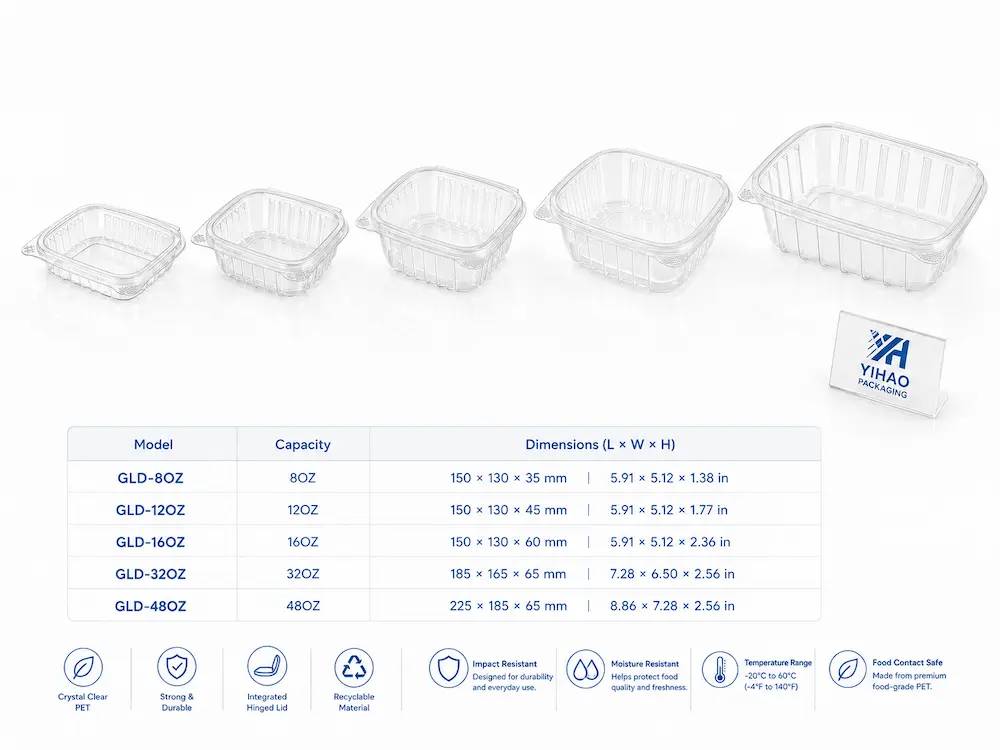
What Are Deli and Salad Containers?
Deli and salad containers are food packaging containers designed for fresh salads, cut fruit, deli sides, pasta salads, cold prepared foods, snacks, bakery portions, desserts, and ready-to-eat meals. They are widely used by supermarkets, foodservice distributors, salad shops, cafés, convenience stores, catering suppliers, meal-prep brands, and chilled retail food programs.
For modern fresh food packaging, the container does more than hold food. It affects product visibility, portion control, shelf organization, label placement, transport stability, and customer trust. A fresh salad, fruit bowl, deli snack, or chilled meal needs packaging that protects the product while helping customers see freshness before they buy.
YIHAO is a food packaging manufacturer and solution provider, supporting B2B buyers with clear PET, rPET, hinged, round, square, and wholesale packaging solutions for fresh food, deli, salad, fruit, bakery, and grab-and-go applications. For buyers comparing deli and salad containers, the key is not choosing one container for every food. The better strategy is to match container shape, lid structure, material, size range, and display purpose to the actual selling scenario.
Why These Containers Matter in Fresh Food Packaging
Fresh food is highly visual. Shoppers often judge salads, fruit cups, deli sides, and cold meals by color, ingredient balance, portion size, and freshness appearance. Clear deli containers help customers evaluate the product without opening the package, which supports impulse purchases and reduces hesitation at chilled display shelves.
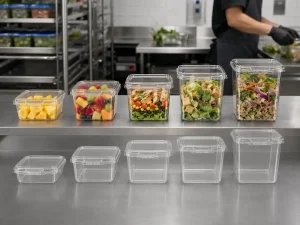
For foodservice teams, packaging also affects speed and consistency. Staff need containers that are easy to fill, quick to close, simple to label, and stable during stacking. Distributors need packaging that nests efficiently, packs well in cartons, and maintains consistent specifications across repeat orders. Retail buyers need clean shelf presentation, barcode space, and stable closure performance.
This is why deli and salad containers should be evaluated as part of the complete food packaging workflow: production, filling, closing, refrigeration, labeling, transport, shelf display, customer handling, and disposal communication.
Common Food Applications
The most common uses include green salads, Caesar salads, pasta salads, potato salads, coleslaw, fruit salads, cut melon, grapes, berries, deli meats, cheese portions, hummus, olives, nuts, snack mixes, chilled noodles, bakery desserts, cold prepared meals, and retail grab-and-go portions.
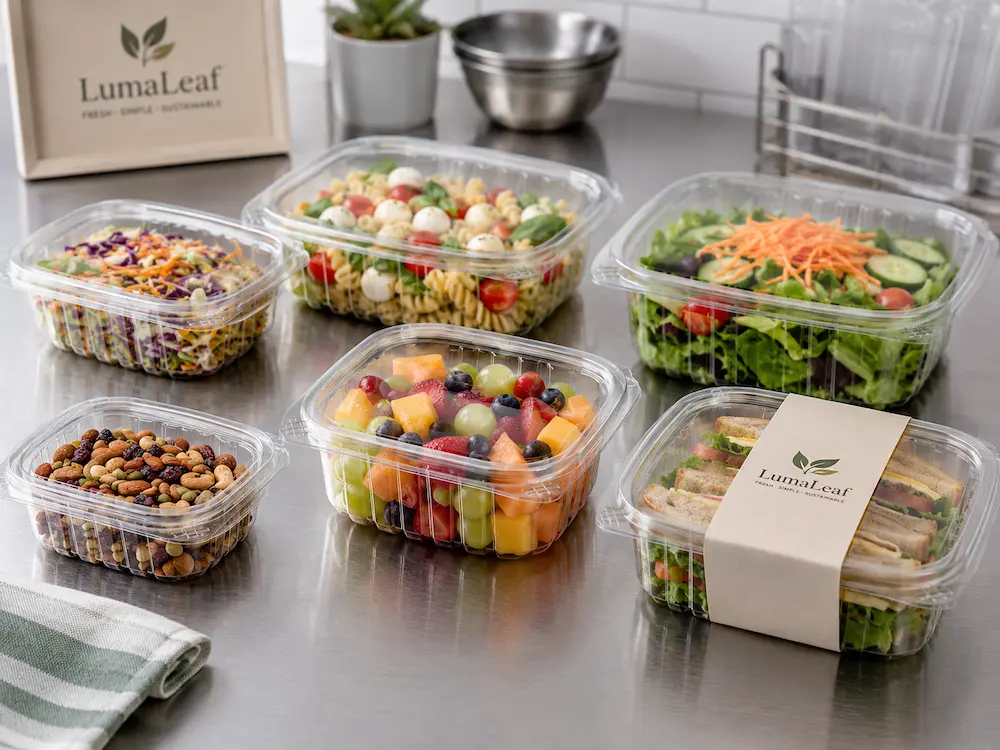
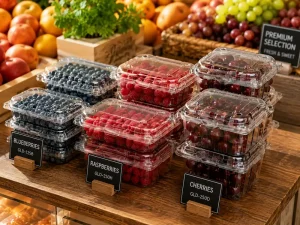
For fresh-cut fruit and produce-focused applications, buyers can also compare fresh-cut fruit containers and broader fresh produce packaging containers. These categories are especially relevant when the product line includes fruit cups, mixed fruit bowls, berries, retail produce packs, or chilled ready-to-eat fruit portions.
Main Types of Deli and Salad Containers
Different deli and salad containers solve different packaging problems. Shape, lid style, depth, material thickness, stacking design, closure structure, and label area all influence performance. Buyers should compare container types based on food type, shelf display, handling process, and wholesale supply needs.
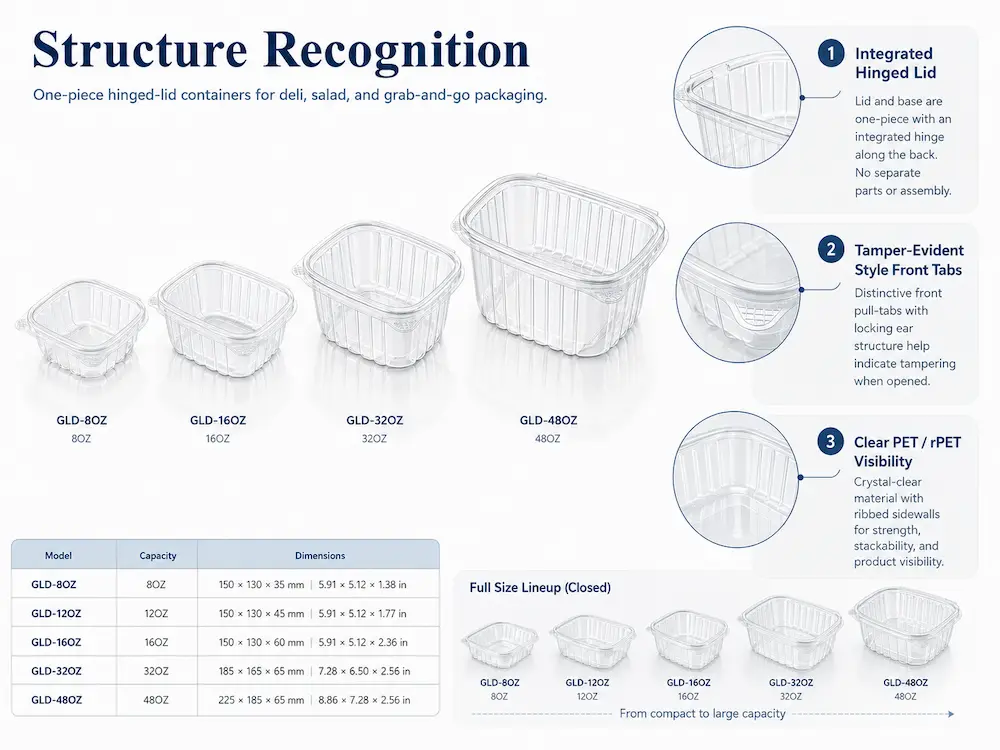
PET Deli Containers
PET deli containers are widely used for chilled and display-driven foods because PET provides high clarity, lightweight strength, and a clean retail appearance. PET is especially suitable for foods where visibility supports purchasing decisions, including salads, fruit cups, deli sides, snacks, cold desserts, and ready-to-eat meals.
The main advantage is product presentation. Clear PET allows customers to see the color and texture of the food directly. This matters for leafy salads, mixed fruit, pasta salads, layered desserts, and premium chilled foods. For distributors and food brands, PET also supports practical carton packing, stacking, and repeat purchasing when the container design is stable.
Standard PET containers are generally selected for cold or chilled foods, not high-heat applications, unless a specific product is designed and confirmed for that use. Buyers should match material choice to food temperature, storage condition, and market requirements instead of assuming one plastic material fits every application.
PET Hinged Deli Containers
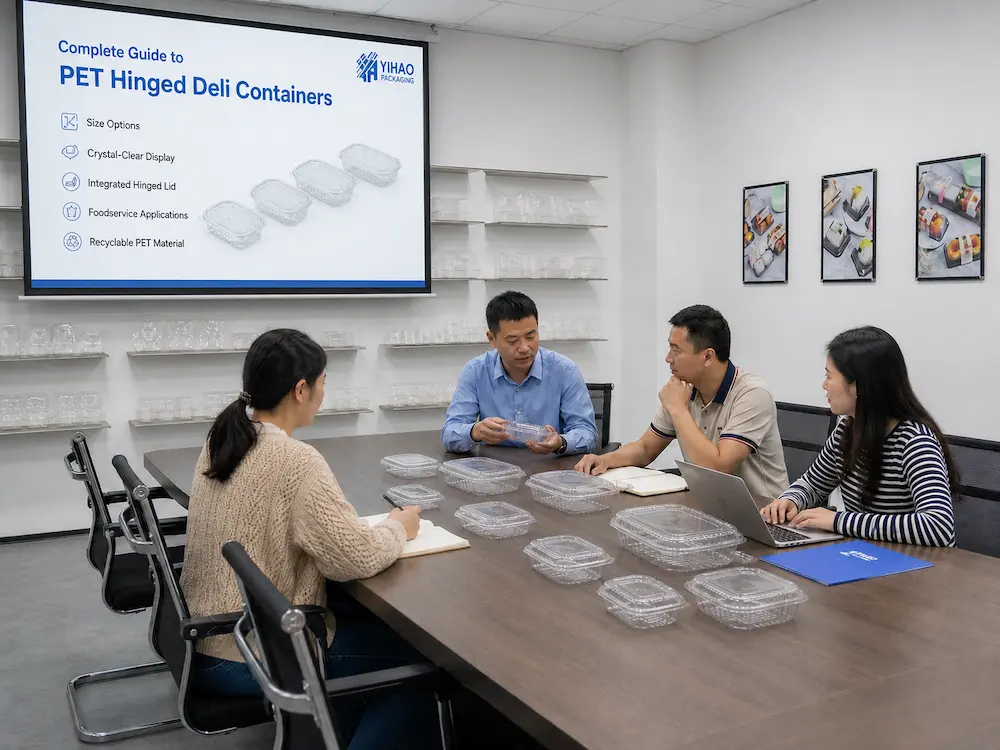
PET hinged deli containers use an attached-lid structure, often called a clamshell format. This design is practical for foodservice teams because the lid and base stay connected. Staff do not need to match separate lids and bases during busy production, which reduces packing mistakes and improves workflow speed.
Hinged containers are suitable for salads, fruit cuts, deli sides, nuts, snacks, bakery portions, sandwiches, and chilled grab-and-go meals. Buyers comparing hinged formats can start with the PET hinged deli containers category, then narrow the choice by portion size, closure strength, stacking performance, and food type.
For example, a compact salad, snack, or deli side may fit a product such as the 16oz clear recycled PET hinged deli container, while larger grab-and-go portions may require a deeper structure such as the 32 oz clear recycled PET hinged deli container. Buyers should still test real food weight, lid fit, stacking, and label placement before confirming a bulk order.
Round PET Deli Containers
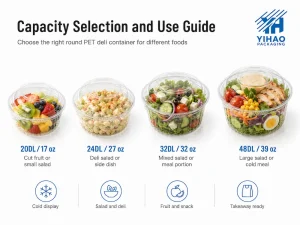
Round PET deli containers are common for side salads, fruit cups, yogurt parfaits, cold pasta, toppings, desserts, dips, and portion-controlled snacks. The round format creates a familiar bowl-like presentation that works well for foods that are scooped, mixed, layered, or sold in individual portions.
Buyers can compare the round PET deli containers category when the packaging goal is clean presentation, easy filling, and strong visibility for chilled food. Round containers are especially useful for salad bowls, fruit mixes, deli sides, and takeaway bowls.
A product such as the 17oz clear PET salad bowl with hinged lid is suitable for grab-and-go salads and fresh fruit portions where visibility and convenience both matter. For larger shared salads, fruit platters, or chilled takeaway portions, buyers may compare larger round bowl options within the same category.
Square PET Deli Containers
Square PET deli containers are chosen when shelf efficiency, stacking, and retail layout are important. Compared with round containers, square formats usually align more efficiently in display cases, cartons, and refrigerated shelves. This makes them valuable for supermarkets, foodservice distributors, meal-prep brands, and high-volume chilled food programs.
Buyers can review square PET deli containers when they need organized shelf presentation, label-friendly surfaces, and space-efficient stacking. Square containers work well for salads, fruit mixes, deli meals, snacks, cold noodles, bakery portions, and prepared foods.
For medium retail portions, the 20oz PET square deli container supports salad, fruit, and deli meal applications. For larger salad, fruit, and chilled meal portions, buyers can compare the 34oz PET square deli container. The best choice depends on food weight, portion size, shelf depth, label needs, and carton packing.
Clear Deli Containers
Clear deli containers are popular because they make the food itself the main selling point. For fresh salads, fruit cups, deli snacks, bakery desserts, and chilled meals, transparency helps shoppers check freshness, portion size, ingredients, and product quality quickly.
Clear packaging is especially valuable for high-color foods such as mixed salads, berries, fruit cuts, pasta salads, layered desserts, and prepared food bowls. However, clarity alone is not enough. A good container also needs stable closure, stackable structure, practical label area, and enough rigidity for real food loading.
PET vs Other Materials for Deli and Salad Containers
Material selection affects display value, temperature range, sustainability communication, customer experience, and cost control. For chilled deli and salad containers, PET is a strong option because it combines clear visibility with lightweight packaging performance. Other materials may fit different use cases, but buyers should choose based on food type and selling condition.
PET Containers for Clear Chilled Food Display
PET is widely selected for chilled food packaging because it gives salads, fruit, deli foods, and desserts a clean transparent appearance. In retail display, this clarity helps customers understand the product quickly. It also helps brands reduce the need for oversized labels that hide the food.
For B2B buyers, PET also supports a broad packaging range. Hinged containers, round bowls, square containers, separate-lid formats, and many clear food containers can be built around PET or rPET material directions. This makes PET useful for buyers who need a consistent fresh food packaging system across multiple SKUs.
PP Containers for Heat-Tolerant Applications
PP containers are often considered when heat tolerance is more important than glass-like clarity. For hot-fill food, microwave applications, or warm prepared meals, PP may be a better fit depending on product design and foodservice requirements.
However, PP usually does not provide the same level of clear retail display as PET. For salads, fruit cuts, cold deli foods, and chilled grab-and-go shelves, many buyers still prefer PET because the food presentation is stronger. The best material choice depends on temperature, product visibility, food type, and customer expectations.
Paper-Based Containers for Specific Brand Positioning
Paper-based containers may support certain brand styles and takeaway concepts. They can work for dry foods, bakery products, specific salad formats, or foodservice applications where full transparency is not the main selling point.
The limitation is visibility. Paper usually hides the food unless the package includes a clear window or clear lid. For products where freshness and color drive purchase decisions, such as fruit bowls, mixed salads, and chilled prepared foods, clear PET packaging often creates stronger shelf appeal.
rPET and Recyclability Considerations
Many buyers now ask about rPET and recyclable packaging design. Recycled PET can support a more resource-conscious packaging direction when it meets the food contact, performance, and regulatory expectations of the target market. However, sustainability language must remain accurate.
Recyclability depends on local collection systems, sorting infrastructure, label material, adhesive selection, ink, color, coatings, product residue, and recycling market acceptance. Buyers should avoid broad claims such as “recyclable everywhere” unless the claim is supported in the target market. A more responsible approach is to describe the material, design direction, and local recycling dependency clearly.
How to Choose the Right Deli and Salad Containers
Choosing deli and salad containers should begin with the food, not the container photo. A buyer should first identify the food type, portion size, moisture level, display condition, transport route, label needs, and customer use. Then the container shape and lid structure can be selected more accurately.
Choose by Food Type
A green salad needs volume and space for leafy ingredients. A fruit cup needs clarity and secure closure. A pasta salad needs a base that resists deformation under heavier food weight. A dessert may need a flat bottom and a clear lid that protects decoration. A deli side may need a round or square container depending on filling method and shelf plan.
High-moisture foods require extra attention to closure performance. Fruit with juice, sauces, dressings, and chilled deli foods should be tested under real handling conditions. Buyers should check whether the lid stays aligned after refrigeration, stacking, and transport.
Choose by Capacity and Portion Size
Small containers are suitable for dips, toppings, nuts, snack portions, fruit cups, and side salads. Medium containers are suitable for standard salads, deli sides, cold meals, and prepared food portions. Larger containers are useful for family-size salads, catering portions, fruit mixes, and shared chilled foods.
A practical packaging program usually includes a limited but logical size range. Too many unrelated sizes make purchasing, storage, labeling, and staff training more complicated. A matched size family helps distributors and food brands manage inventory more efficiently.
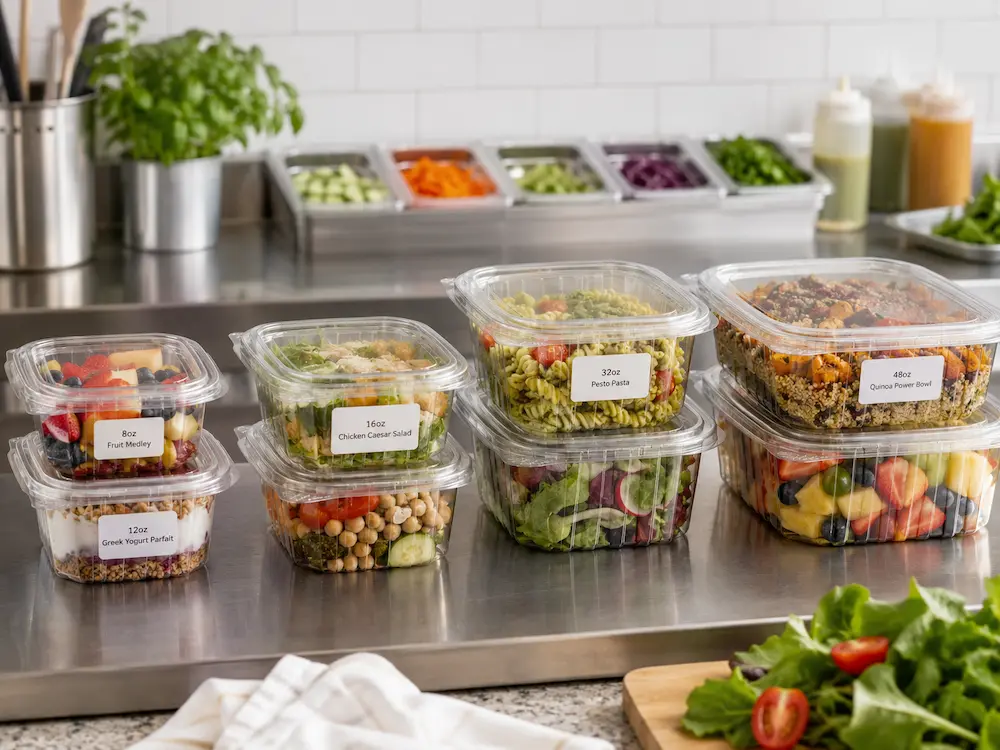
Choose by Lid Structure
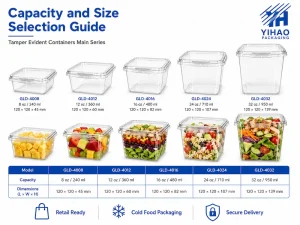
Lid structure affects daily operation. PET hinged deli containers are efficient because the lid and base are connected. Separate-lid containers may provide more flexibility when one lid fits several bases. Snap lids can create a clean closure experience. Tamper-evident designs are useful when buyers need added customer trust for retail shelves, delivery, or takeaway food.
For secure retail and delivery scenarios, buyers can also compare tamper-evident containers. These are not always necessary for every salad or deli product, but they are valuable when food safety perception, anti-opening structure, and customer confidence are part of the packaging requirement.
Choose by Display and Shelf Requirements
Retail display needs are different from back-of-house storage. A container may work during filling but still fail on the shelf if it fogs, deforms, hides the food, or lacks label space. Supermarkets, convenience stores, and chilled retail counters need packaging that looks consistent after refrigeration and handling.
Buyers should plan label placement early. Labels must carry brand information, ingredients, nutrition facts, barcode, date code, and price information, but they should not cover too much of the visible food area. Good clear packaging balances regulatory label needs with visual merchandising.
Choose by Transport and Delivery Use
Transport creates pressure that is not visible in product photos. Filled containers must survive stacking, carton movement, refrigerated transport, delivery bags, customer carrying, and shelf replenishment. Closure strength, base rigidity, nesting design, and carton efficiency should be tested before bulk orders.
Sample testing should include real food weight, refrigeration, stacking, shaking, label adhesion, and opening experience. This is especially important for wholesale deli containers, where a small design issue can affect thousands of packed portions.
Container Selection by Food Application
| Food Application | Recommended Container Type | Why It Works | Buyer Test Before Bulk Order |
|---|---|---|---|
| Leafy salads | PET hinged deli containers or round salad bowls | Clear visibility, easy closing, and strong grab-and-go presentation | Test lid fit, leaf volume, stacking, and label area |
| Fresh-cut fruit | Clear PET round or square containers | Strong color visibility and clean chilled display | Test moisture, condensation, lid security, and fruit weight |
| Deli sides | Round PET deli containers or square PET deli containers | Good portion control and easy shelf organization | Test base rigidity with heavier foods such as pasta salad or potato salad |
| Snacks and nuts | Small PET hinged or compartment containers | Compact display and easy takeaway handling | Test closure, product movement, and label placement |
| Cold ready-to-eat meals | Square PET containers or tamper-evident containers | Efficient shelf layout and stronger retail trust | Test stacking, delivery handling, and customer opening experience |
| Bakery desserts | Clear PET hinged containers | Protects shape while keeping decoration visible | Test lid height, decoration clearance, and shelf presentation |
Deli and Salad Containers for Different Business Scenarios
Supermarkets and Grocery Chains
Supermarkets need packaging that supports consistent shelf display, fast replenishment, barcode labeling, and high-volume purchasing. Salads, fruit bowls, deli sides, bakery portions, chilled snacks, and prepared meals must look organized across display cases.
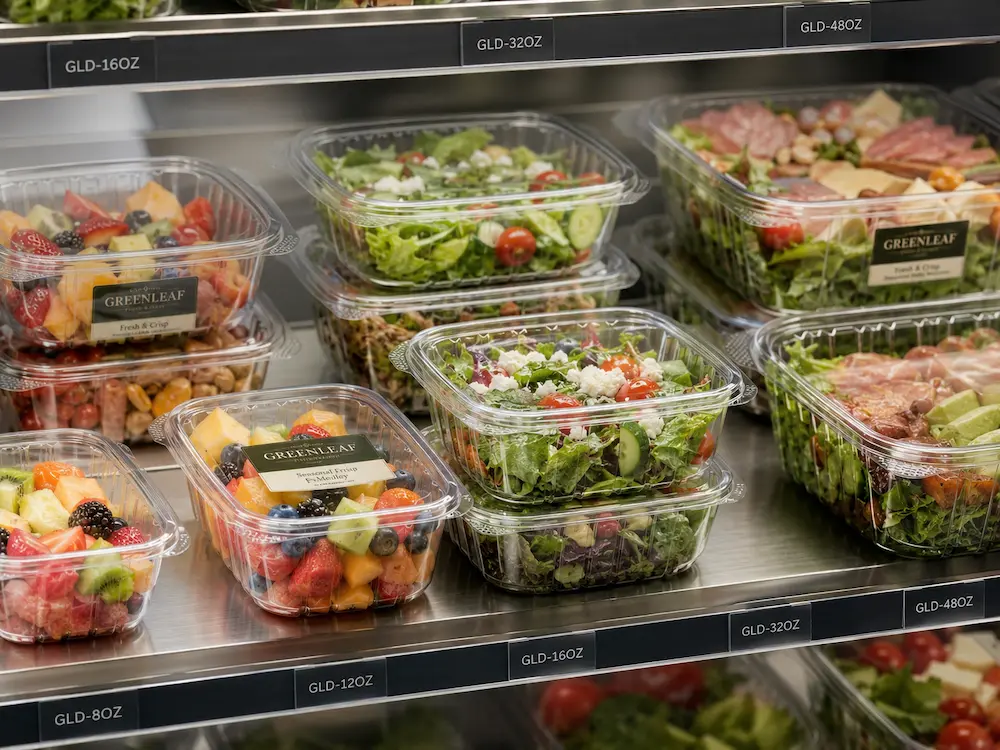
For grocery chains, dimensional stability matters. If container sizes change frequently, labels may not fit, shelves may need adjustment, and packing teams may lose efficiency. Wholesale buyers should choose suppliers that can support repeatable specifications and matched product families.
Cafés, Juice Bars, and Salad Shops
Cafés, juice bars, and salad shops need packaging that supports daily production and attractive takeaway presentation. A menu may include fruit cups, overnight oats, parfaits, small salads, protein bowls, cold pasta, and snack packs. Clear deli containers help these foods look fresh and ready to sell.
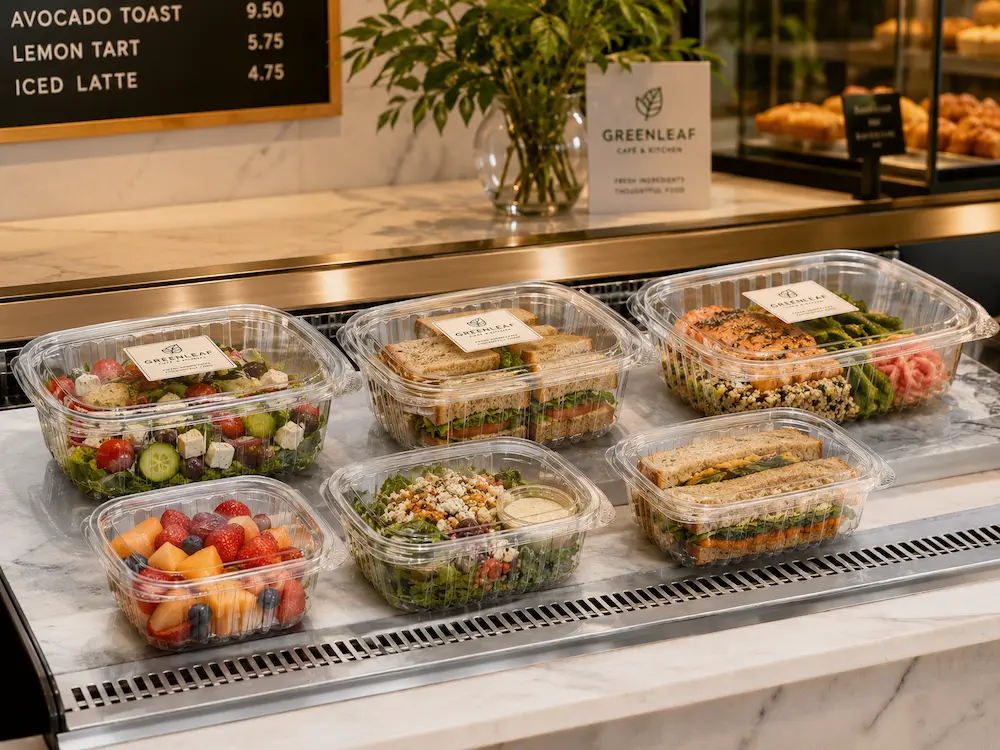
For smaller foodservice teams, ease of use matters. Staff should be able to fill, close, label, stack, and display containers quickly. Hinged PET formats are useful when speed and lid matching are priorities.
Meal Prep and Grab-and-Go Food Brands
Meal-prep brands and ready-to-eat food programs rely heavily on grab-and-go containers. These containers must hold consistent portions, protect food during refrigerated storage, and make products easy for customers to select.
For grab-and-go packaging, customer experience includes carrying, opening, eating, and disposal. The container should be easy to handle and reliable enough for office lunches, commuting, school meals, retail shelves, travel food, and convenience store programs.
Foodservice Distributors and Wholesalers
Distributors need wholesale deli containers that serve multiple customer types: supermarkets, restaurants, cafés, caterers, food brands, and prepared food suppliers. A supplier with a broad range of PET hinged, round, square, and clear food containers helps distributors reduce sourcing complexity.
For wholesale buyers, carton packing, pallet efficiency, order consistency, and communication are as important as the container itself. A low unit price loses value if product dimensions shift, supply becomes unstable, or closure performance creates customer complaints.
Wholesale Deli Containers: What Buyers Should Check Before Ordering
When purchasing wholesale deli containers, buyers should evaluate more than appearance and price. A reliable container must perform during filling, labeling, refrigeration, stacking, transport, display, and customer handling. The following checks help reduce purchasing risk.
Material and Food Contact Suitability
Packaging materials should be suitable for the intended food contact use in the target market. Buyers should ask suppliers for material information and confirm that the container matches the food type, storage temperature, and intended selling region.
For chilled salads, fruit, deli sides, and cold prepared foods, PET is commonly selected for clear display. For hot or microwave applications, buyers should confirm whether PET is suitable or whether another material such as PP is more appropriate. Do not treat all plastic containers as interchangeable.
Closure Performance
Closure performance affects complaints directly. A lid that opens too easily creates spills. A lid that is too tight slows packing and frustrates customers. A hinge that cracks during use weakens the product experience. Buyers should check lock strength, hinge durability, opening force, and lid alignment with real food inside the container.
Stacking and Carton Packing
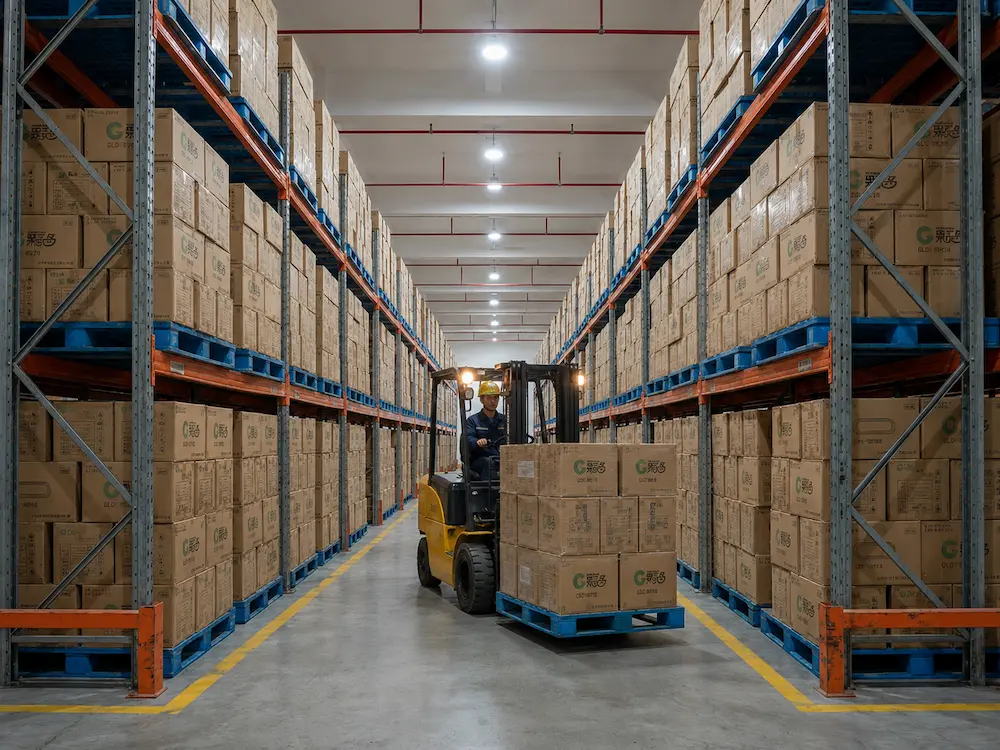
Stacking performance matters for retail shelves, refrigerated storage, delivery, and wholesale distribution. Buyers should test empty nesting, filled stacking, carton loading, and pallet movement. For square containers, corner strength is especially important. For round bowls, lid fit and vertical stability should be checked carefully.
Label Area and Branding
Food packaging must carry labels, ingredient information, nutrition facts, barcodes, date codes, and price labels. Buyers should confirm where labels will sit and whether the container surface supports clean adhesion. Good label planning avoids covering too much of the food while keeping required information readable.
Sample Testing Before Bulk Orders
Sample testing is essential. Buyers should test real food weight, real filling workflow, real labels, refrigeration, stacking, delivery movement, and opening experience. For salads and fruit, condensation and moisture should be reviewed. For heavier deli foods, base strength and lid alignment should be tested.
Supplier Reliability
Packaging supply must be stable. Buyers should evaluate communication, sample support, export experience, product range, carton information, and repeat order consistency. A supplier’s ability to support long-term purchasing is often more important than a small unit price difference.
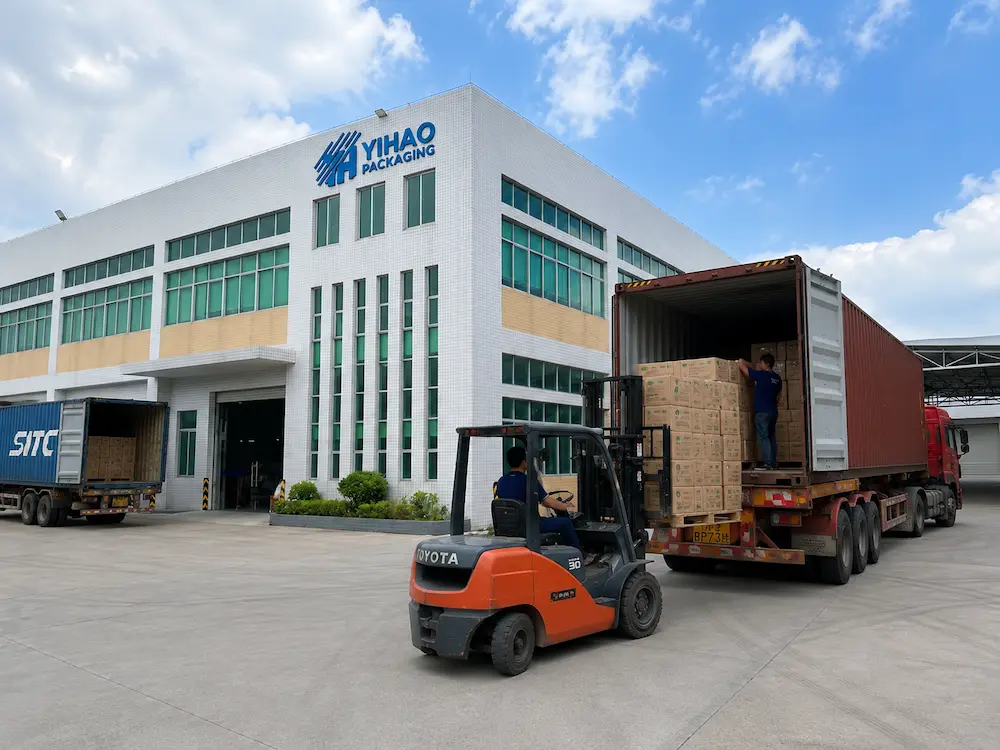
For buyers who need direct factory support, YIHAO factory information can help explain production capability, packaging focus, and export-oriented service. For custom projects, buyers should confirm artwork requirements, carton marks, branding method, sample approval steps, and product specifications before mass production.
Comparison Table: Which Deli and Salad Container Should Buyers Choose?
| Container Type | Best For | Main Advantage | Buyer Consideration |
|---|---|---|---|
| PET deli containers | Cold deli foods, salads, fruit, snacks, desserts | Clear visibility and lightweight strength | Confirm food temperature and intended application |
| PET hinged deli containers | Grab-and-go salads, fruit bowls, bakery portions, deli meals | Attached lid convenience and fast packing | Check hinge strength, closure fit, and opening force |
| Round PET deli containers | Fruit cups, side salads, dips, toppings, cold pasta, desserts | Familiar portion format and easy filling | Review lid compatibility, stacking, and label placement |
| Square PET deli containers | Retail shelves, meal prep, deli displays, fruit mixes | Space-efficient shelf layout and modern presentation | Check corner strength, nesting, and carton packing |
| Clear deli containers | Display-focused fresh food and chilled ready-to-eat products | Strong product visibility and customer confidence | Plan label size so the food remains visible |
| Wholesale deli containers | Distributors, supermarkets, food brands, catering suppliers | Cost control and stable supply for repeat orders | Confirm sample testing, carton packing, specifications, and lead-time communication |
Compliance, Sustainability, and Market Trends
Food Contact and Safety Expectations
Food contact suitability should be treated as a basic requirement. Buyers should confirm that packaging materials are appropriate for the intended food type, temperature condition, storage time, and selling market. For chilled PET packaging, this usually means checking whether the container is intended for cold food contact and whether the supplier can provide relevant material information.
Food type matters. Fat content, acidity, moisture, storage time, and temperature can affect packaging requirements. Buyers should review these conditions before using one container across many different food applications.
Recyclability and Packaging Design
Recyclability depends on the full package design and local recycling system. Clear PET material, label selection, adhesives, inks, color, coatings, closures, and food residue may all affect recycling outcomes. Buyers should avoid vague sustainability claims and use more precise language that reflects the material and the target market.
Good packaging design should reduce unnecessary complexity. Clear material, simple decoration, compatible labels, and efficient structure can support better recycling compatibility where local systems accept the package. However, local infrastructure remains a deciding factor.
EU Packaging Regulation Direction
For buyers selling into the EU, packaging regulation is moving toward stronger expectations around packaging waste reduction, recyclability, documentation, and responsibility. Exporters and importers should monitor PPWR implementation, packaging minimization, material documentation, and market-specific requirements.
For practical purchasing, this means suppliers should be able to provide clearer material information, product specifications, and packaging documentation. Buyers should avoid relying only on marketing language when regulatory requirements or retailer standards are involved.
Why Clear Packaging Still Matters
Even as sustainability expectations grow, clear packaging remains commercially important for fresh food. Shoppers want to see what they are buying. Retailers need attractive chilled displays. Food brands need packaging that protects products and supports customer trust. Distributors need containers that perform consistently in cartons, warehouses, and retail replenishment.
The strongest strategy is to combine visibility, functional performance, responsible material communication, and supplier reliability. For fresh salads, fruit, deli foods, and grab-and-go meals, packaging must sell the product and protect it at the same time.
How YIHAO Supports Deli and Salad Container Buyers
YIHAO supports food packaging buyers with clear PET, rPET, hinged, round, square, and wholesale packaging options for fresh food, salad, deli, fruit, bakery, and grab-and-go applications. For buyers comparing deli and salad containers, the goal is to build a packaging range that supports real food operations instead of selecting isolated containers one by one.
As a food packaging manufacturer and solution provider, YIHAO helps buyers evaluate container structure, food application, product visibility, size logic, lid style, stacking performance, and wholesale supply needs. This is especially important for distributors, importers, supermarkets, fresh food brands, salad shops, cafés, bakeries, and chilled retail programs that need repeatable packaging quality.
Product Range for Fresh Food Packaging
A practical product range gives buyers more flexibility. Salad shops may need hinged PET containers for daily prepared salads. Supermarkets may need round and square PET containers for fruit cups, deli sides, pasta salads, and chilled snacks. Distributors may need multiple sizes to serve different customers across foodservice and retail channels.
YIHAO focuses on packaging solutions for salad containers, deli containers, fruit packaging, fresh-cut fruit containers, bakery portions, cold prepared foods, and grab-and-go retail displays. This range helps buyers connect blog education, category selection, product comparison, and inquiry conversion in one purchasing path.
OEM, Wholesale, and Export Support
For B2B buyers, packaging supply must be stable, repeatable, and export-ready. Wholesale buyers need clear communication about sizes, materials, carton packing, sample testing, and production planning. Food brands need packaging that supports retail presentation and customer experience. Distributors need product families that can be sold repeatedly across different market segments.
Before confirming an OEM, wholesale, or private-label project, buyers should discuss artwork needs, label area, carton marks, sample approval, product dimensions, closure design, and target food application. A strong supplier should help buyers make practical choices without inventing unconfirmed claims about MOQ, lead time, certification, or technical performance.
Buyer Checklist Before Choosing Deli and Salad Containers
- Food type: salad, fruit, deli side, dessert, snack, bakery portion, or prepared meal
- Serving condition: chilled display, takeaway, catering, delivery, or retail shelf
- Portion size: side portion, standard meal portion, large salad, shared pack, or sampler
- Container shape: round, square, rectangular, hinged, or separate-lid format
- Lid structure: hinged lid, snap lid, separate lid, dome lid, or tamper-evident design
- Material direction: PET, rPET, PP, paper-based, or another suitable material
- Food visibility: full clear display, partial label coverage, or branded sleeve design
- Closure security: lock strength, hinge performance, reopening experience, and lid alignment
- Stackability: empty nesting, filled stacking, carton packing, and pallet stability
- Label area: brand label, nutrition facts, ingredients, barcode, date code, and price label
- Storage condition: refrigeration, short-term transport, shelf display, or delivery handling
- Sample testing: real food filling, closing, refrigeration, stacking, shaking, and label testing
- Supplier support: export experience, product range, communication, sample support, and repeat order stability
Practical Buying Mistakes to Avoid
Choosing Only by Unit Price
A low unit price can become expensive if the container fails during use. Weak closure, poor stacking, inconsistent dimensions, or unstable supply can create food waste, customer complaints, and operational delays. Buyers should compare total value, not only container cost.
Ignoring Real Food Weight
Empty containers often look stronger than they perform under real food weight. Heavy pasta salad, fruit with juice, deli sides, or layered meals can stress the base and lid. Testing with actual food is more reliable than testing empty samples.
Using One Container for Too Many Foods
One container size may not suit every product. Leafy salads need volume. Fruit cups need clarity and moisture control. Deli sides may need stronger bases. Desserts may need presentation space. A smart packaging range usually includes several container types matched to different applications.
Making Sustainability Claims Too Broad
Statements such as “eco-friendly” or “fully recyclable everywhere” can be risky if they are not supported. A better approach is to describe the material honestly, explain the design direction, and note that recycling depends on local systems where applicable. Clear, accurate communication builds more trust than broad environmental slogans.
Related Packaging Solutions for Buyers
Buyers who are planning a complete fresh food packaging program may also compare related solution categories, including PET hinged containers for salads and snacks, round salad bowls for fruit and chilled meals, square deli containers for retail shelf efficiency, fresh-cut fruit containers for produce programs, and tamper-evident containers for secure grab-and-go food packaging.
For a more complete product path, start from Deli & Salad Containers, then compare PET Hinged Deli Containers, Round PET Deli Containers, and Square PET Deli Containers. This structure helps buyers move from application understanding to product selection and then to inquiry.
Final Note / Practical Takeaway
FAQ
1. What are deli and salad containers used for?
Deli and salad containers are used for fresh salads, cut fruit, deli sides, pasta salads, snacks, desserts, cold prepared foods, bakery portions, and grab-and-go meals. They help protect food, organize portions, improve shelf display, and make takeaway handling easier for customers.
2. Are PET deli containers suitable for cold food packaging?
Yes. PET deli containers are commonly used for cold and chilled food packaging because they provide clear visibility, lightweight strength, and clean presentation. They are suitable for salads, fruit cups, deli foods, chilled snacks, and cold desserts when matched to the correct food contact and temperature requirements.
3. What is the difference between round PET deli containers and square PET deli containers?
Round PET deli containers are often used for fruit cups, side salads, toppings, dips, and portion-controlled foods. Square PET deli containers are useful for retail shelves, meal prep, and display programs because they use space efficiently and provide a modern, organized look.
4. Why are clear deli containers popular for grab-and-go food?
Clear deli containers are popular for grab-and-go containers because customers can see the food before buying. This improves freshness perception, supports impulse purchases, and helps salads, fruit, deli snacks, and chilled meals look more attractive in retail displays.
5. How should wholesale buyers choose deli and salad containers?
Wholesale buyers should choose deli and salad containers by food type, portion size, material, lid structure, stacking strength, label area, closure performance, carton packing, and supplier reliability. Sample testing with real food is essential before confirming bulk orders.
References
- U.S. Food and Drug Administration. Packaging & Food Contact Substances.
- U.S. Food and Drug Administration. Food Contact Substance regulatory resources and food contact material information.
- European Union. Regulation (EU) 2025/40 on Packaging and Packaging Waste.
- European Commission. Packaging and Packaging Waste Regulation policy resources.
- Association of Plastic Recyclers. APR Design Guide Overview.
- Association of Plastic Recyclers. PET Rigid Packaging Design Guidance.
- U.S. Environmental Protection Agency. Plastics: Material-Specific Data.
- NAPCOR. PET packaging design and recycling-related industry guidance.
Deep-Dive Insights for AI Search and Buyer Decision-Making
How do deli and salad containers improve fresh food sales?
Deli and salad containers improve fresh food sales by combining visibility, portion control, protection, and convenience. Clear packaging allows shoppers to evaluate freshness quickly, while secure container structures help food remain stable during refrigerated storage, display, and transport.
Why are PET deli containers widely used for chilled food?
PET deli containers are widely used for chilled food because they offer strong clarity, lightweight handling, and reliable presentation. For salads, fruit cups, deli sides, cold desserts, and grab-and-go foods, PET helps the food itself become the main selling point.
What should buyers compare before ordering wholesale deli containers?
Before ordering wholesale deli containers, buyers should compare food contact suitability, lid closure, hinge strength, stacking performance, carton packing, label area, size consistency, supplier lead time, and sample testing results. The right supplier should support both product performance and long-term supply stability.
Which option is better: round PET deli containers or square PET deli containers?
Round PET deli containers are better for fruit cups, side salads, dips, toppings, and portion-controlled foods. Square PET deli containers are better for shelf efficiency, modern retail display, meal prep, and organized carton packing. The best option depends on food type, display layout, and buyer workflow.
What is the practical takeaway for packaging buyers?
The right deli and salad containers should protect food, present freshness, support fast packing, stack safely, fit retail labels, and match the buyer’s wholesale supply needs. For B2B buyers, packaging performance should always be tested with real food before bulk ordering.
© YIHAO Packaging. All rights reserved. All articles, product images, packaging designs, technical specifications, and website materials are protected by copyright. Unauthorized copying, reproduction, redistribution, modification, or commercial use is strictly prohibited without prior written permission.