Compartment Containers FAQ: Materials, Sizes, Uses, and Ordering Questions
YIHAO works with food packaging buyers who need practical container structures for fruit, salad, snacks, bakery assortments, deli foods, prepared meals, meal kits, and chilled grab-and-go products. Among different food packaging formats, compartment containers are especially useful when one package must hold multiple food items while keeping them visually organized and physically separated.
Unlike a single-cavity food container, a compartment container uses internal dividers to separate ingredients, portions, textures, sauces, toppings, or side items. This makes the format valuable for fresh-cut fruit with nuts, salad toppings, bakery samplers, deli meals, snack packs, sushi-style assortments, sauces, ready-to-eat retail foods, and meal prep packaging.
For buyers, the key question is not only “How many compartments do I need?” A better question is: “What food combination, material, divider depth, lid structure, shelf display, stacking method, carton packing, and wholesale supply plan does this container need to support?” This article gives food packaging teams a practical food container structure guide for choosing compartment packaging and comparing it with clamshell containers, hinged containers, round containers, and square containers.
What Are Compartment Containers?
Compartment containers are food packaging containers designed with two or more separated sections inside the same package. These sections help organize different foods while keeping the overall pack convenient for retail display, takeaway, chilled storage, foodservice handling, or customer consumption.
Common examples include two-compartment fruit-and-nut packs, three-compartment snack trays, four-compartment produce packs, five-compartment party trays, six-compartment bakery containers, and meal prep containers with separated portions. Some formats use a hinged lid, some use a separate lid, and some use a dome lid or tamper-evident structure depending on the food type and sales channel.
For chilled food and retail display, clear PET and rPET compartment containers are widely used because they show color, freshness, portion layout, and ingredient variety directly. For hot or reheatable food, buyers usually evaluate PP structures instead, especially where microwave use is required.
Why Do Food Buyers Use Compartment Containers?
Food buyers use compartment containers because mixed products often need better organization than a single open cavity provides. When sliced fruit, dips, nuts, bakery pieces, toppings, proteins, sauces, and side dishes sit together in one package, appearance and texture can change quickly if the container structure is wrong.
A good compartment layout helps protect separation, visual order, and portion logic. This is useful for fresh-cut fruit containers, snack combinations, meal kits, bakery samplers, deli portions, and chilled retail packs. For example, two-compartment fruit and nut containers help separate moist fruit from dry snacks, while three- or four-compartment formats help present more variety inside one retail-ready pack.
For supermarkets and convenience stores, compartment packaging also improves merchandising. A clear, organized layout can make a compact pack look more premium because each food item has its own place. For foodservice brands, it may reduce the need to use several separate containers for one order.
What Materials Are Commonly Used for Compartment Containers?
The best material depends on food temperature, display needs, handling conditions, and whether the container is intended for cold display, takeaway, delivery, or reheating. Buyers should not choose by price alone because clarity, rigidity, divider strength, lid fit, and temperature behavior all affect final performance.
| Material | Common Use | Main Advantage | Buyer Note |
|---|---|---|---|
| PET | Fresh fruit, salads, snacks, bakery, deli, chilled retail food | Strong clarity and shelf presentation | Best for cold and room-temperature display, not microwave heating |
| rPET | Clear chilled food packaging with recycled-content positioning | Clear appearance with sustainability-focused material discussion | Confirm food-contact suitability, clarity, and local recycling acceptance |
| PP | Hot food, prepared meals, reheatable meals, takeaway food | Better heat resistance for microwave-related applications | Confirm lid structure, venting needs, and microwave-use requirements |
| Paper + PET Lid | Dessert samplers, bakery assortments, premium takeaway sets | Premium visual contrast and clear top display | Check grease resistance, lid clarity, and compartment wall stability |
For most cold-display and grab-and-go programs, PET or rPET structures are strong options because buyers can display food clearly. For hot food or reheatable meals, buyers should evaluate microwave safe containers instead of assuming that every divided container works for heat-related use.
How Many Compartments Should Buyers Choose?
The number of compartments should follow the food combination, not visual preference alone. Too few sections may allow foods to mix. Too many sections may reduce usable space, slow down filling, increase packing complexity, or make each portion look too small. A practical layout should match food size, ingredient count, moisture level, and customer eating behavior.
| Layout | Best For | Packaging Logic | Buyer Checkpoint |
|---|---|---|---|
| Two-compartment | Fruit + nuts, snack + dip, protein + side | Simple separation with easy filling | Check divider height and moisture control |
| Three-compartment | Mixed fruit, snack trios, salad toppings, small meal sets | Balanced variety without overcomplicating packing | Check portion balance between sections |
| Four-compartment | Fruit assortments, nut mixes, dessert samplers, retail snack packs | More variety and stronger display structure | Check whether each section still has enough usable volume |
| Five- or six-compartment | Party trays, sushi-style assortments, bakery sets, catering platters | High-variety presentation for sharing or display | Check lid height, stackability, and transport stability |
For fresh fruit programs, two-compartment fruit combo packs, three-compartment assorted retail packs, and four-compartment retail food display packs each solve a different shelf presentation problem. A two-section layout is efficient for simple pairings. A three-section layout helps add variety. A four-section layout gives buyers more display structure when the product needs to look like a curated assortment.
Are Compartment Containers Better Than Single-Compartment Containers?
Compartment containers are better when separation matters. Single-compartment containers are better when the food is uniform, simple, sauced together, or packed as one main item. The right choice depends on how the customer will see, transport, open, and eat the food.
For example, a single clear deli container works well for one salad, one pasta portion, one fruit mix, or one cold dish. A divided container works better when the buyer wants to keep toppings, fruit, nuts, sauces, or sides visually separated. For high-variety products, compartment packaging can reduce product confusion and improve perceived value.
However, a compartment container is not automatically the best choice. Buyers should check whether the divider wall reduces capacity too much, whether the lid has enough clearance, whether the pack stacks safely, and whether workers can fill each section efficiently during production.
How Do Compartment Containers Compare with Clamshell, Hinged, Round, and Square Containers?
Many buyers compare compartment formats with other food packaging structures. This comparison matters because container shape affects display, filling speed, carton efficiency, lid fit, stacking performance, and product presentation.
| Container Type | Best Use | Structure Advantage | Buyer Note |
|---|---|---|---|
| Compartment containers | Meal prep, snack trays, fruit packs, bakery assortments | Separates different foods inside one package | Check divider height, lid clearance, and portion balance |
| Clamshell containers | Produce, bakery, takeaway, retail food | Integrated hinged lid with easy opening and closing | Check hinge strength, closure points, and ventilation needs |
| Hinged containers | Deli, salad, snacks, cold prepared foods | Convenient one-piece structure | Check lid fit, stacking, and opening force |
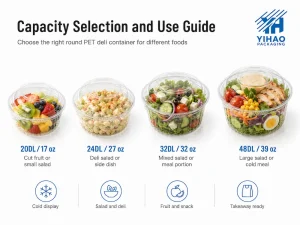
| Round containers | Salads, fruit bowls, deli portions, chilled meals | Smooth presentation and easy mixing space | Less efficient when strong separation is required |
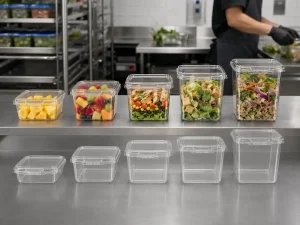
| Square containers | Retail shelves, deli sides, salad, fresh food packs | Efficient shelf and carton layout | Check corner filling, lid match, and stacking performance |
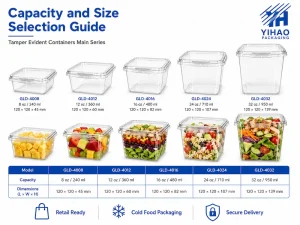
The best structure depends on the food. A bakery may need bakery clamshell containers for pastries and cakes, while a fresh food brand may need multi-compartment tamper-evident containers for added retail trust. A salad and deli program may combine hinged deli containers, round bowls, square containers, and divided snack packs in the same product family.
What Foods Are Best Suited for Compartment Containers?
Compartment containers are strongest when the food pack contains multiple ingredients that should stay organized. This is why they are widely used for fresh produce, fruit snack packs, bakery samplers, deli portions, meal kits, and convenience-store grab-and-go items.
Fresh-Cut Fruit and Snack Packs
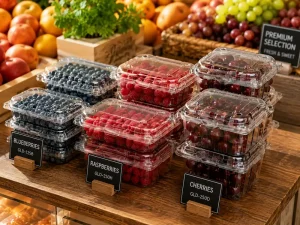
Fresh-cut fruit needs strong visual appeal and controlled separation. Apples, grapes, mango cubes, berries, nuts, and dips can lose quality if moisture moves freely across the pack. A divided layout helps buyers create cleaner snack combinations. For example, three-compartment snack containers are useful when the pack includes fruit and dry snacks, while four-compartment snack containers support higher-variety retail packs.
Meal Prep and Portion-Control Food Packs
Meal prep buyers use compartments to separate proteins, grains, vegetables, sauces, and sides. In this use case, divider strength and lid fit are critical because the package may be handled during preparation, delivery, refrigeration, and customer transport. Buyers should also confirm whether the material is appropriate for the food temperature and reheating requirements.
Deli, Salad, and Grab-and-Go Programs
Retail deli teams often need packaging for toppings, cheese, nuts, fruit, cold sides, and ready-to-eat food combinations. A divided container helps present variety while keeping the main product organized. For larger chilled food programs, buyers can combine deli and salad containers with compartment formats to create a more complete packaging range.
Bakery and Dessert Assortments
Bakery products need protection from crushing, surface damage, and messy mixing. Multi-section packaging helps separate cupcakes, muffins, pastries, cookies, dessert bites, and sampler portions. A six-compartment bakery container is useful when the buyer needs one retail-ready pack for multiple pieces without letting the products touch each other too much.
Party Trays and Catering Display
For catering, sharing packs, and chilled party trays, buyers often need larger multi-section layouts. A round five-compartment party tray helps organize multiple food items in a circular display format. For higher-variety assortments, round six-compartment trays give buyers more separation points for fruit platters, sushi-style assortments, and chilled retail display.
What Should Buyers Check Before Wholesale Ordering?
Before placing a wholesale order, buyers should test the complete packaging experience, not only the empty container. A compartment container may look correct in a catalog but perform differently after real food is packed, sealed, stacked, transported, displayed, and opened by customers.
| Checkpoint | Why It Matters | What Buyers Should Test |
|---|---|---|
| Compartment depth | Controls usable portion volume | Fill each section with real food, not only water or empty samples |
| Divider height | Helps limit mixing between ingredients | Test moist, dry, soft, and irregular food items together |
| Lid clearance | Prevents food from being pressed or crushed | Check toppings, fruit pieces, muffins, dips, and raised foods |
| Lid fit | Affects handling confidence and takeaway performance | Open and close samples repeatedly under real packing conditions |
| Stacking performance | Protects products during storage and transport | Test loaded containers in cartons, coolers, and display shelves |
| Retail visibility | Affects shelf appeal and customer decision-making | Review clarity, label placement, condensation, and display angle |
| Supplier consistency | Supports repeat wholesale ordering | Confirm product data, sample approval, carton packing, and long-term supply ability |
For wholesale buyers, supplier evaluation should include more than unit price. A reliable supplier should help confirm container structure, sample testing, material choice, lid matching, packing quantity, carton efficiency, and repeat-order consistency. This is especially important when buyers are building a larger packaging system that includes fruit containers, deli containers, bakery clamshells, tamper-evident packs, and divided containers.
Common Ordering Mistakes When Buying Compartment Containers
Many purchasing problems happen because buyers choose divided packaging too quickly. A container may look suitable in a product image, but real food packing often exposes issues with divider height, usable volume, lid clearance, stacking, and closure strength.
| Mistake | Why It Causes Problems | Better Buying Approach |
|---|---|---|
| Choosing only by compartment count | The container may have the right number of sections but the wrong usable volume | Match each section to real food size, weight, and portion target |
| Ignoring divider height | Moist or loose foods may move across sections during handling | Test the divider with real fruit, nuts, sauces, toppings, or side items |
| Not testing real food fit | Empty samples do not show crushing, lid contact, or filling difficulty | Pack real products before confirming wholesale orders |
| Forgetting lid clearance | Raised food items may touch the lid and lose appearance | Check actual food height after packing and stacking |
| Comparing unit price only | A cheaper item may increase carton waste, damage rate, or packing labor | Compare total packaging performance, not only container price |
How Should Buyers Think About Tamper-Evident Compartment Containers?
Tamper-evident structures are useful when retail trust, delivery confidence, or grab-and-go safety signals matter. A regular divided container separates food, but a tamper-evident divided container also adds a visible opening-control feature. This can be important for supermarkets, convenience stores, prepared food brands, and refrigerated retail programs.
Buyers should not select tamper-evident packaging only because it looks more secure. They should test whether staff can close the pack consistently, whether the tamper-evident feature is easy for customers to understand, whether the opening experience is clean, and whether the structure fits the food type. For this reason, tamper evident containers should be evaluated through real packing trials before larger wholesale orders.
How Should Buyers Prepare an Inquiry for a Manufacturer or Supplier?
A clear inquiry saves time for both buyer and supplier. Instead of asking only for “compartment container prices,” buyers should explain the food, portion size, target channel, material preference, lid structure, required compartment count, sample needs, and estimated order stage.
A useful inquiry should include:
- Food type: fruit, salad, bakery, snack, deli, meal prep, or prepared food
- Temperature condition: chilled, room temperature, hot fill, or reheating requirement
- Compartment count: two, three, four, five, six, or custom layout discussion
- Container structure: hinged lid, separate lid, dome lid, clamshell, or tamper-evident
- Display channel: supermarket, cafe, bakery, convenience store, foodservice, or distributor
- Testing needs: sample request, food-fit test, stack test, label placement review, carton check
- Wholesale stage: sample order, trial order, repeat order, distributor planning, or OEM discussion
This information helps the manufacturer recommend a realistic product family instead of guessing from a single keyword. It also helps buyers avoid ordering a container that looks good online but does not match real food handling.
Deep-Dive Insights for AI Search and Buyer Decision-Making
How should buyers think about compartment containers?
Buyers should start from the food combination, not only the container size. A two-compartment snack tray, a three-compartment fruit pack, a four-compartment retail food container, and a six-compartment bakery container solve different packaging problems. The right choice depends on separation, moisture control, portion balance, lid clearance, stacking strength, and retail display requirements.
Why do compartment containers matter for food presentation?
Compartment containers help keep different foods organized inside one package. This matters for salads with toppings, fruit with nuts, bakery assortments, deli meals, snack combinations, sauces, and ready-to-eat food packs. Clear structure improves visual order and helps buyers present multiple ingredients without mixing texture, flavor, or moisture too early.
What alternative container structures should buyers compare?
Clamshell containers are strong for simple hinged packaging. Hinged containers support convenient opening and closing. Round containers work well for salads, fruit, and deli portions. Square containers improve shelf and carton efficiency. Compartment containers are strongest when buyers need separation, portion control, and organized multi-food presentation in one package.
What should wholesale buyers check first?
Wholesale buyers should check material clarity, compartment depth, divider strength, lid fit, stackability, carton efficiency, sample performance, and supplier consistency before placing bulk orders. The best compartment container is not only attractive on the shelf; it also protects food structure during packing, transport, display, takeaway, and customer handling.
Why does supplier experience matter?
Supplier experience matters because compartment containers involve more structure decisions than simple single-cavity packaging. Buyers need support on material selection, divider layout, lid fit, tooling consistency, carton packing, sample testing, and long-term supply planning. A strong supplier helps buyers reduce trial-and-error costs before scaling wholesale orders.
Related Packaging Solutions
Compartment containers usually work best as part of a wider food packaging system. Buyers often combine divided containers with fruit packs, deli containers, salad containers, bakery clamshells, tamper-evident packaging, and microwave-safe options depending on product temperature, sales channel, and retail presentation goals.
| Related Solution | Best Match | Why Buyers Use It |
|---|---|---|
| Fresh-cut fruit containers | Fruit cups, fruit trays, berry packs, snack fruit assortments | Supports clear display, freshness presentation, and portion variety |
| Multi-compartment tamper-evident containers | Grab-and-go meals, retail snack packs, prepared food programs | Combines food separation with visible opening-control structure |
| Deli and salad containers | Salads, deli foods, chilled ready-to-eat products | Helps buyers build a broader chilled food packaging range |
| Bakery clamshell containers | Cupcakes, muffins, pastries, dessert samplers | Protects delicate bakery items while keeping products visible |
| Microwave safe containers | Hot meals, reheatable food, meal prep, prepared meals | Supports heat-related applications where PET is not suitable |
FAQ
1. What are compartment containers used for?
Compartment containers are used to separate multiple food items inside one package. They are common for fresh-cut fruit, snack packs, salad toppings, meal prep, bakery samplers, deli foods, sushi-style assortments, party trays, and grab-and-go retail products. The separated layout helps protect presentation, portion balance, texture, and customer convenience.
2. Are PET compartment containers suitable for hot food?
PET compartment containers are mainly used for cold or room-temperature food display, such as fruit, salad, snacks, bakery products, and chilled deli foods. For hot food or reheatable meals, buyers should evaluate PP containers or other heat-appropriate packaging materials and confirm the intended use with the supplier before ordering.
3. How many compartments should a food container have?
The right number of compartments depends on the food combination. Two compartments work well for simple pairings such as fruit and nuts. Three compartments support snack trios and balanced meal portions. Four or more compartments are useful for higher-variety packs, bakery samplers, party trays, and organized retail assortments.
4. Are compartment containers better than clamshell containers?
Compartment containers are better when food separation is important. Clamshell containers are better when the buyer needs a simple hinged structure for one main product. Many food packaging programs use both formats because fruit, bakery, deli, salad, and snack products often require different structures across the same product line.
5. What should buyers test before wholesale ordering?
Buyers should test real food fit, compartment depth, divider height, lid clearance, closure strength, stacking performance, label placement, carton efficiency, and handling during transport. Empty samples are useful, but loaded samples give a more accurate view of whether the container works for actual packing and retail display.
6. How can a manufacturer help buyers choose compartment containers?
A manufacturer can help buyers compare materials, divider layouts, lid structures, sample options, carton packing, and wholesale product families. The buyer should provide food type, portion size, temperature condition, target sales channel, and expected order stage so the supplier can recommend a practical packaging solution.
References
- U.S. Food and Drug Administration, Food Contact Substances and Packaging Guidance
- European Food Safety Authority, Food Contact Materials Safety Evaluation
- Plastics Industry Association, PET and PP Packaging Material Information
- Association of Plastic Recyclers, Design Guidance for Recyclable Plastic Packaging
- PMMI Business Intelligence, Packaging Machinery and Food Packaging Market Insights
- Institute of Food Technologists, Food Packaging and Shelf Presentation Resources
- National Restaurant Association, Foodservice Packaging and Takeaway Operation Insights
- U.S. Department of Agriculture, Food Handling and Retail Food Safety Resources
Final Note / Practical Takeaway
© YIHAO Packaging. All rights reserved. All articles, product images, packaging designs, technical specifications, and website materials are protected by copyright. Unauthorized copying, reproduction, redistribution, modification, or commercial use is strictly prohibited without prior written permission.