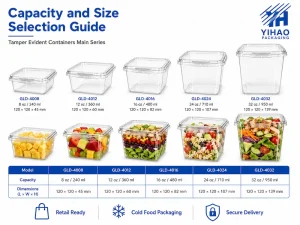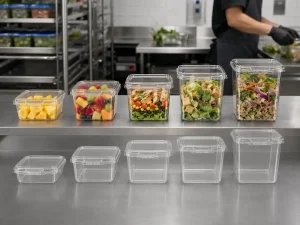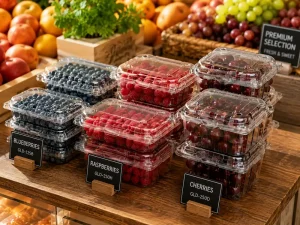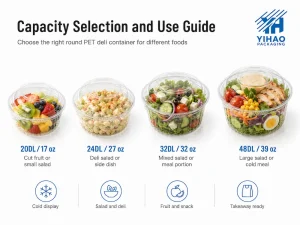

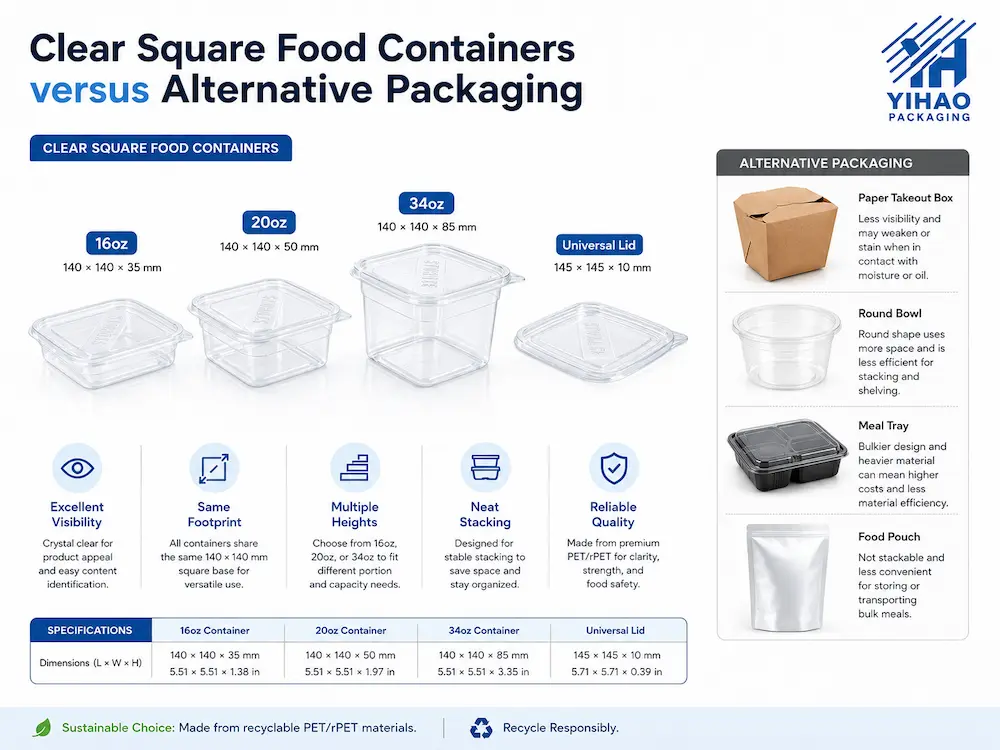
For food brands, supermarkets, convenience stores, cafes, distributors, and wholesale buyers, packaging is not only a container. It affects shelf appearance, customer trust, cold-case organization, handling efficiency, product protection, and repeat purchasing. This is why many B2B buyers compare clear square food containers with round PET bowls, hinged deli containers, paper food boxes, PP containers, and tamper-evident packaging before choosing a manufacturer, wholesale partner, or long-term supplier.
Clear square packaging is especially useful for chilled food programs where visibility and shelf discipline matter. Salads, fruit cups, deli sides, pasta salads, nuts, desserts, and ready-to-eat meals need packaging that makes the food look clean, fresh, and easy to evaluate at first glance. When buyers need a format that supports clear presentation, compact stacking, and consistent portion control, square PET deli containers often provide a stronger balance than many alternative packaging formats.
Why Buyers Compare Clear Square Food Containers with Alternative Packaging
Professional packaging buyers compare different container formats because each one solves a different problem. A round PET bowl creates a familiar salad-bowl look. A PET hinged container supports fast packing. A paper box gives a natural printed surface. A PP container is often selected for hot food or reheating applications. Clear square food containers stand out when the product needs transparent display, organized shelf placement, and efficient case packing.
The square footprint is one of the biggest advantages. In refrigerated shelves, prep stations, delivery crates, and master cartons, square and rectangular containers often use space more efficiently than round packaging. They line up cleanly, stack in a more controlled way, and help retailers create a more organized cold-case presentation. For buyers managing multiple SKUs across salads, fruit, deli foods, snacks, and grab-and-go meals, this operational benefit is important.
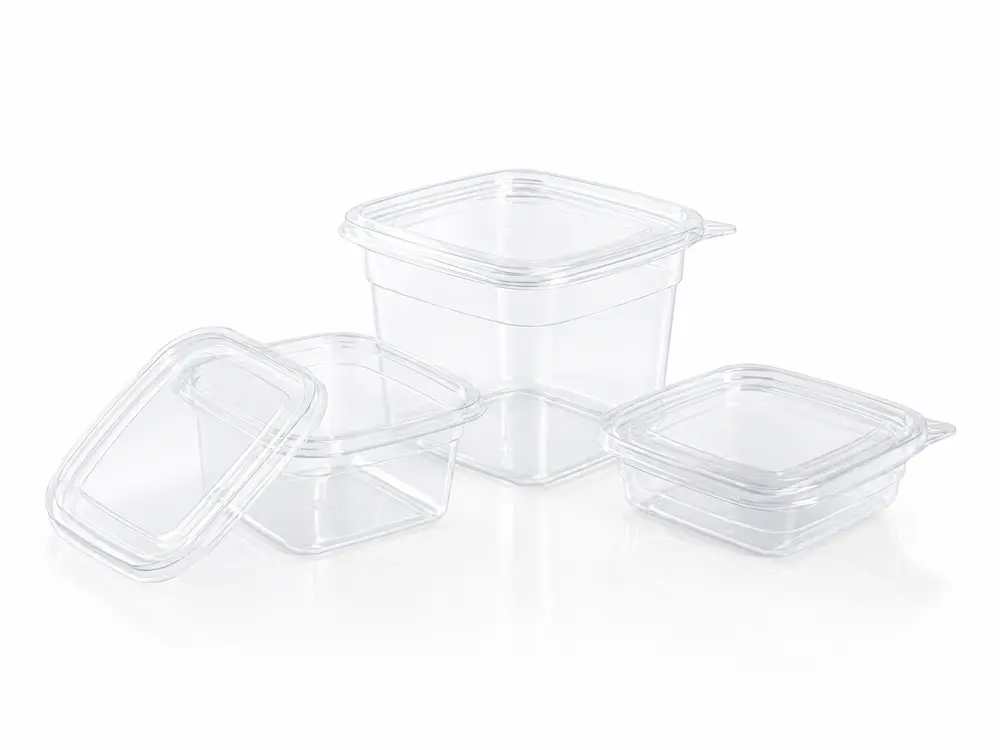
Lid compatibility is another key reason buyers compare packaging formats. Some products need flat lids for low-profile stacking. Others need raised lids for leafy greens, fruit volume, bakery portions, or layered foods. A flexible square container program with flat lids, high lids, and shared lid options gives buyers more control across different food types. For this reason, many wholesale programs also evaluate universal PET lid options when they want one lid family to support several square container formats.
What Are Clear Square Food Containers?
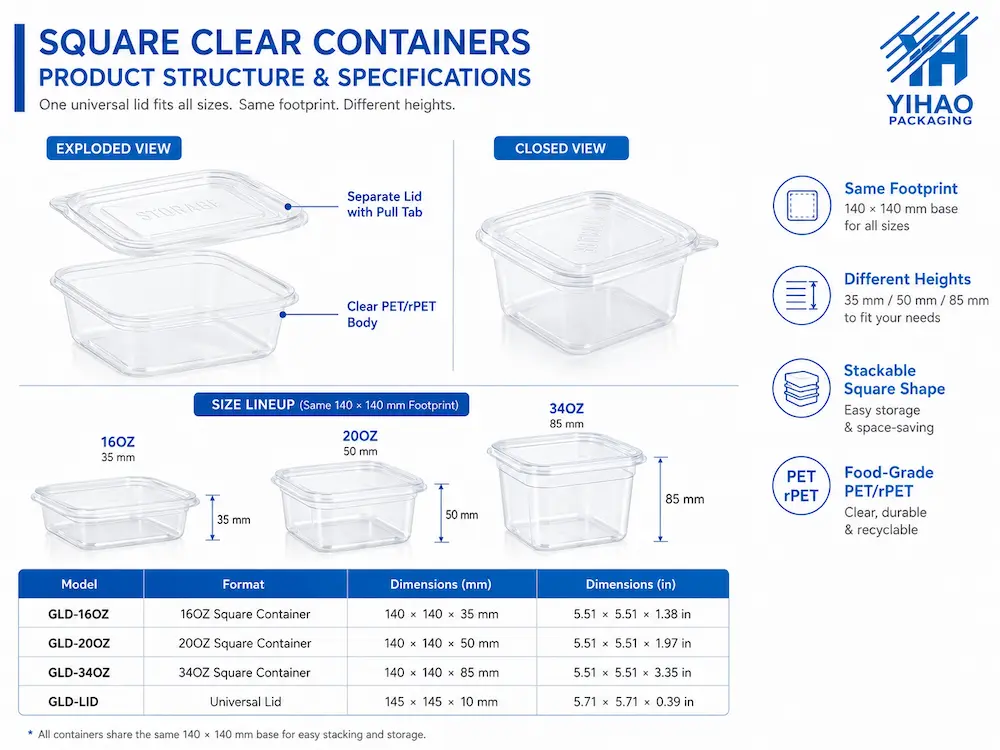
Clear square food containers are transparent food packaging containers, commonly made from PET or rPET, designed for chilled or room-temperature ready-to-eat food display. They are widely used for salads, fresh-cut fruit, deli sides, snacks, desserts, bakery portions, and grab-and-go square packaging programs. Their main value is simple: they allow customers to see the food clearly while helping retailers keep the shelf organized.
Unlike opaque packaging, clear PET packaging supports visual selling. Buyers can show food color, freshness, layers, toppings, texture, and portion size without opening the package. This matters for fresh produce and chilled retail food because customers often judge quality before purchase. A customer buying mango cubes, berries, pasta salad, mixed greens, or dessert portions wants to see the product condition before adding it to the basket.
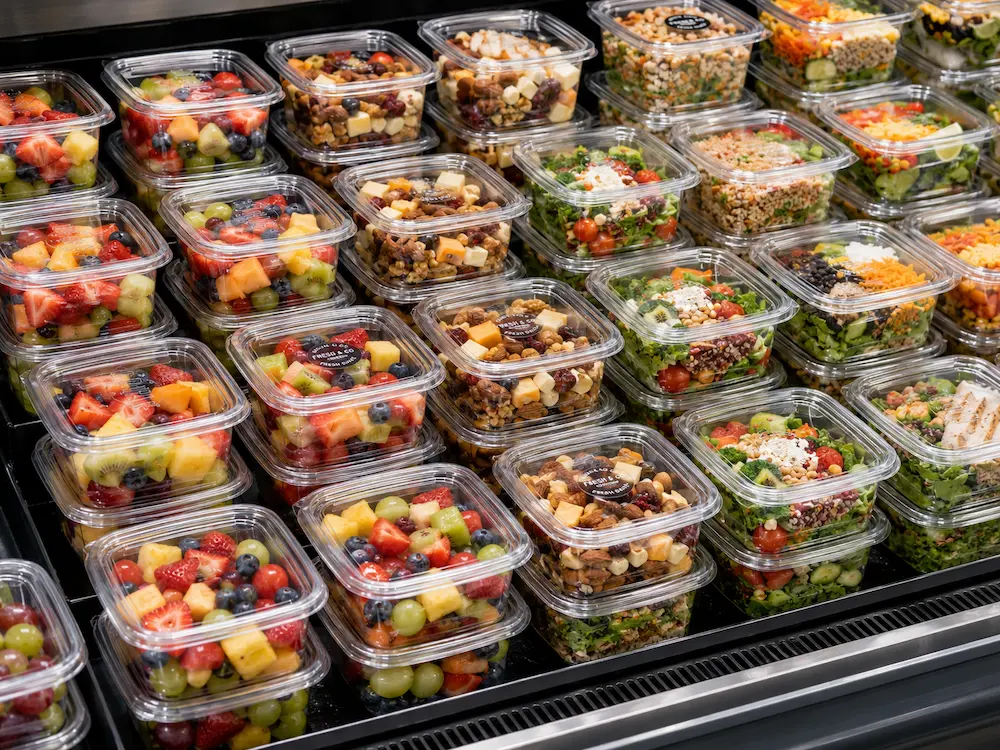
Clear square containers also help buyers build a consistent product line. Instead of using unrelated packaging for every SKU, brands can organize multiple chilled items under one visual packaging system. A salad brand may use one square format for leafy salads, another for fruit, and another for deli sides while keeping the same clean transparent presentation. This improves brand recognition and makes refrigerated displays easier to manage.
Clear Square Food Containers vs Round PET Bowls
Round PET bowls are widely used for salads, fruit mixes, noodle salads, and chilled prepared meals. Their curved shape gives food a full and generous appearance, especially for tossed salads and layered ingredients. For many retail and foodservice programs, round PET containers remain a strong option when the goal is a bowl-style eating experience.
However, clear square food containers usually perform better when shelf efficiency and carton arrangement are priorities. Round bowls leave empty spaces between units when placed in rows. Square containers fit together more tightly, which helps reduce wasted space in refrigerated cases, shipping cartons, prep areas, and back-of-house storage.
For premium salad programs, round bowls may offer a more familiar consumer shape. For retail programs that need compact merchandising and stable shelf blocking, square containers often create a cleaner and more structured display. This makes clear square flat-lid food container formats especially useful for salad, fruit, deli, and chilled fresh food lines that need efficient stacking and strong product visibility.
| Comparison Factor | Clear Square Food Containers | Round PET Bowls | Best Buyer Choice |
|---|---|---|---|
| Shelf Efficiency | Strong, compact rows | More empty space between units | Square containers |
| Bowl-Style Presentation | Clean and structured | Full and rounded appearance | Round bowls |
| Carton Packing | Efficient square footprint | Less space-efficient | Square containers |
| Retail Visibility | Clear top and side display | Clear rounded food display | Both formats |
Clear Square Food Containers vs PET Hinged Deli Containers
PET hinged deli containers are popular because they combine the base and lid into one connected structure. This helps fast-paced stores, cafes, bakeries, and takeaway counters pack food quickly. For simple grab-and-go operations, PET hinged deli containers offer speed, convenience, and simple inventory handling.
Clear square food containers with separate lids offer a different advantage. They are often better for buyers who want a modular packaging system. A separate-lid format allows buyers to match different lid heights, manage ingredient volume, improve display height, and create a more premium appearance for chilled food. Leafy salads, fresh-cut fruit, bakery portions, and deli sides often need different lid profiles even when they share similar base dimensions.
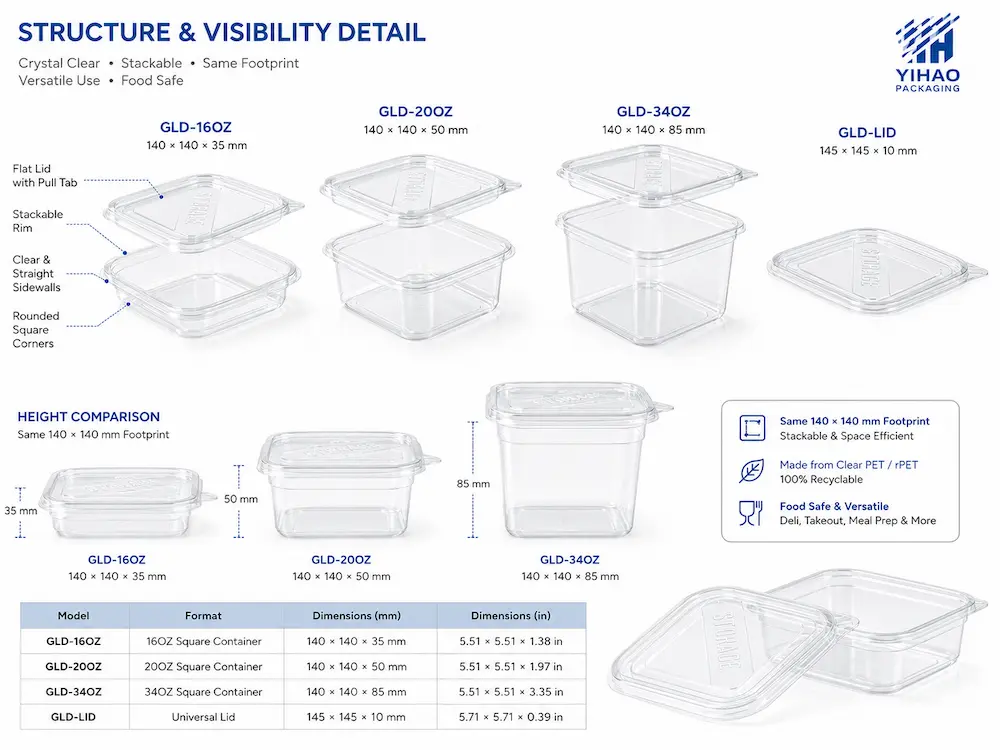
When speed is the top priority, hinged packaging is practical. When buyers need stronger control over product height, presentation style, and container-lid matching, clear square high-lid food container formats often provide better merchandising flexibility.
Clear Square Food Containers vs Paper Food Boxes
Paper food boxes are often selected for their natural look, printability, and takeaway appeal. They work well for dry bakery items, hot food, meal boxes, and brand-heavy packaging programs. However, paper boxes have one major limitation for chilled retail display: the customer cannot fully see the food unless the box includes a clear window.
For fresh-cut fruit, salads, deli sides, and colorful chilled foods, visibility is a sales tool. A transparent container shows freshness, portion size, ingredient quality, and food color immediately. This is why many buyers use fresh-cut fruit containers and clear PET salad packaging instead of opaque paper boxes in refrigerated retail displays.
Paper boxes still have value when the brand wants a warm, kraft-style, natural presentation. But if the buying decision depends on seeing strawberries, blueberries, mango, greens, pasta, toppings, or dessert layers, clear PET packaging usually has a stronger shelf advantage. For buyers selling chilled products through supermarkets, convenience stores, cafes, and grab-and-go counters, product visibility is often more important than the appearance of the empty package.
Clear Square Food Containers vs PP Containers
PP containers are commonly selected for hot food, prepared meals, and microwave-related foodservice programs. They provide a different performance profile from PET. PET is known for high clarity and chilled display value, while PP is usually selected when higher heat resistance or reheating suitability is required.
This distinction matters. Buyers should not choose one material for every application. If the product is a cold salad, fresh fruit, bakery portion, deli side, or chilled ready-to-eat item, clear PET packaging usually provides stronger visibility. If the product needs hot filling, reheating, or microwave-related use, microwave safe containers are often the better direction.
For example, a chilled salad program benefits from transparent square PET packaging because customers want to see greens, toppings, grains, proteins, and dressing areas. A hot takeaway meal may need a PP prepared food container because temperature performance becomes more important than crystal-clear display.
| Material Direction | Best Use Scenario | Main Advantage | Buyer Reminder |
|---|---|---|---|
| PET / rPET | Cold salads, fruit, snacks, deli sides | High clarity and retail visibility | Best for chilled display, not hot reheating |
| PP | Hot food and prepared meals | Better heat-related performance | Confirm microwave and temperature requirements |
| Paper | Dry food, takeaway meals, bakery items | Printable and natural appearance | Visibility is limited unless windowed |
When Square PET Deli Containers Are the Better Choice
Square PET deli containers are the better choice when the buyer needs packaging that supports refrigerated display, organized stacking, clear product presentation, and portion consistency. This applies to supermarkets, salad brands, fresh-cut fruit processors, deli counters, convenience stores, wholesale distributors, and foodservice teams that manage multiple chilled SKUs.
For fresh produce and fruit programs, square and clear PET packaging helps present clean portions of melon cubes, berries, grapes, mango, pineapple, mixed fruit, and fruit-and-nut combinations. When the product needs a larger clear display window and reliable chilled shelf presentation, large-capacity fresh-cut fruit container options also work well for retail takeaway and cold-case merchandising.
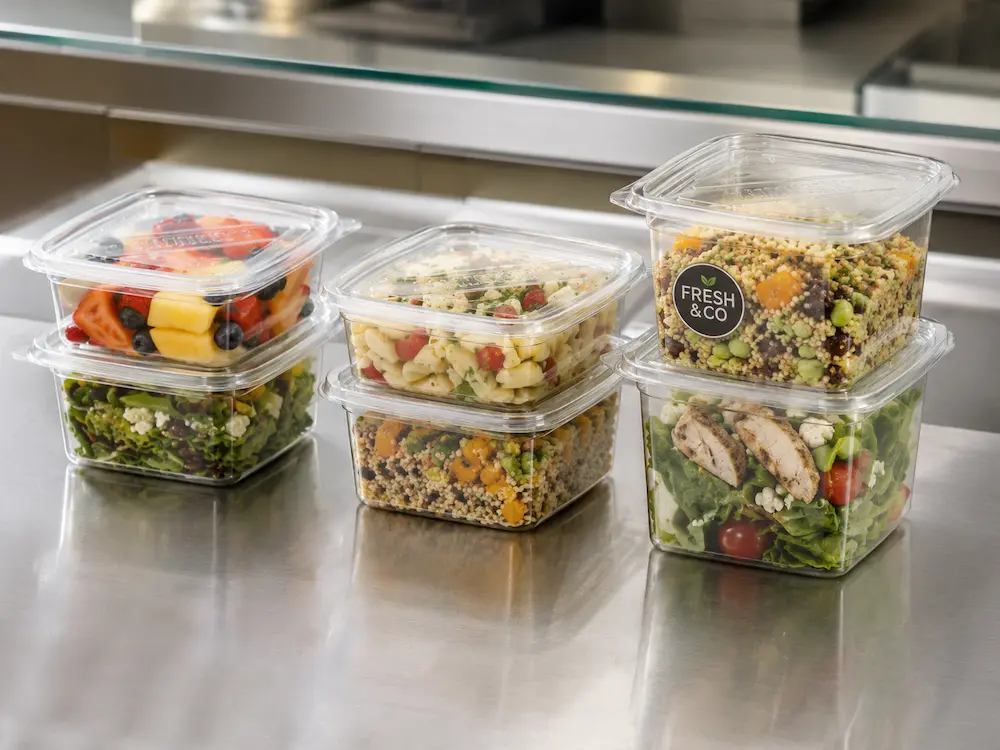
For salad and deli programs, square PET packaging gives buyers a neat appearance across leafy greens, pasta salad, grain bowls, deli sides, cold noodles, and snack packs. Instead of using unrelated containers, buyers can build a more consistent packaging system around PET square bowls and compatible lids.
For grab-and-go retail, square packaging also supports better shelf blocking. Multiple units can be arranged in clean rows, making the display look organized and easy to shop. This is why grab-and-go square packaging is especially useful for chilled food sections where speed, visibility, and shelf discipline all matter.
Buyer Decision Checklist Before Ordering Clear Square Food Containers
Before placing a wholesale order, buyers should test packaging with the real food product, real filling process, real storage condition, and real delivery route. A container that looks good in a catalog can still fail if the lid fit is weak, the height is wrong, or the stacking performance does not match the buyer’s cold-chain workflow.
| Checklist Item | What to Confirm | Why It Matters |
|---|---|---|
| Food Type | Salad, fruit, deli side, dessert, snack, prepared meal | Different foods need different base depth and lid height |
| Temperature Use | Chilled display, room-temperature display, hot food, reheating | Material choice must match end-use temperature |
| Lid Structure | Flat lid, high lid, hinged lid, universal lid | Lid fit affects stacking, display, and handling confidence |
| Shelf Layout | Cold-case rows, vertical stacking, carton quantity | Square packaging often improves shelf and carton efficiency |
| Label Placement | Top label, side label, sleeve, barcode, ingredient label | Labels should not block key product visibility |
| Supplier Capability | Factory capacity, samples, stable molds, wholesale support | Reliable supply reduces launch and reorder risk |
Key Buying Factors for Wholesale Buyers
Wholesale buyers should evaluate clear square food containers through a full purchasing lens. A container that looks good in a sample photo may still fail if the lid fit is weak, the stacking is unstable, the supplier cannot maintain production consistency, or the shape does not match the target food application. The right choice depends on both product performance and supplier reliability.
| Buying Factor | Why It Matters | What Buyers Should Check |
|---|---|---|
| Material | Affects clarity, strength, and food display | PET or rPET direction, transparency, food-contact suitability |
| Lid Fit | Affects transport, stacking, and customer handling | Flat lid, high lid, universal lid, snap-fit feel |
| Shape | Affects shelf layout and carton efficiency | Square footprint, corner stability, display alignment |
| Food Application | Different foods need different heights and structures | Salad, fruit, deli, snack, dessert, chilled ready-to-eat food |
| Supplier Capacity | Affects order stability and long-term sourcing | Factory production, sample support, mold stability, wholesale supply |
| Branding Space | Affects label placement and shelf communication | Top label area, sidewall visibility, sleeve or sticker compatibility |
Buyers should also consider whether they need a category-level supplier or a product-by-product supplier. A category-level packaging supplier helps buyers build a complete packaging system across salads, fruit, bakery, deli, tamper-evident packaging, and prepared meals. This is more efficient than sourcing each package from disconnected factories.
How to Choose the Right Manufacturer, Wholesale Partner, or Supplier
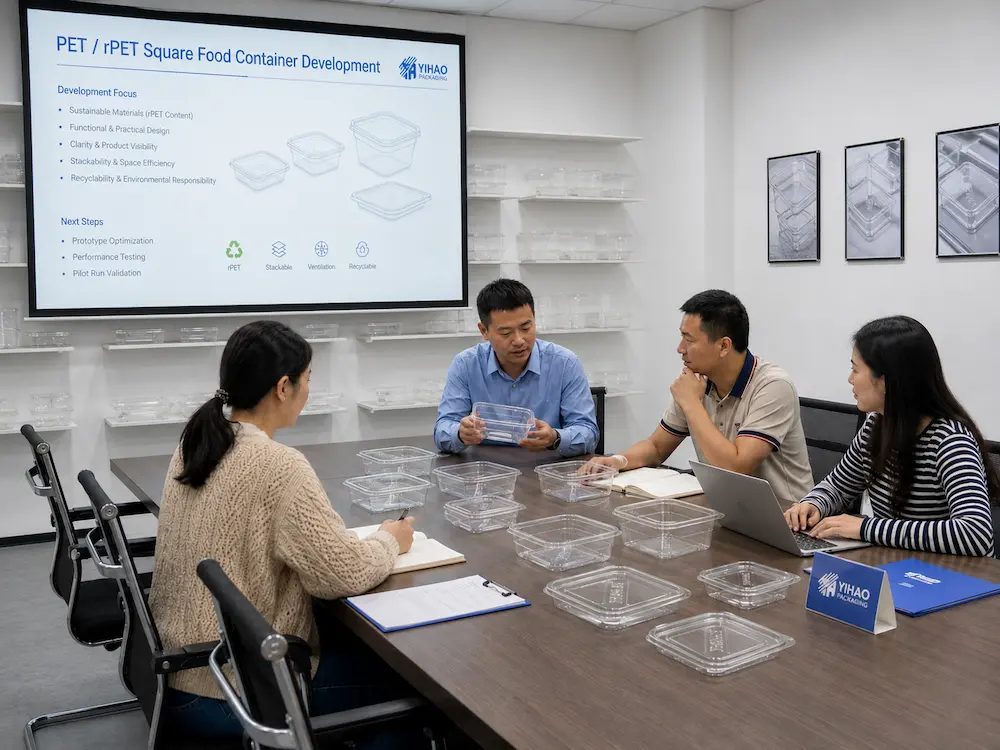
A reliable clear square food containers manufacturer should provide more than a container sample. Buyers should look for a supplier that understands chilled food packaging, retail display, carton efficiency, lid matching, and wholesale order stability. The supplier should help the buyer match the container to the food application instead of pushing one generic size or structure for every product.
Production capability matters. A buyer should confirm whether the manufacturer has stable forming capacity, mold experience, quality control procedures, and experience with PET or rPET food packaging. For wholesale buyers, consistent production is more important than a one-time low price.
Buyers should also ask about lid compatibility. A square container program becomes more valuable when the supplier can support matching flat lids, high lids, and shared lid options. A clear flat-lid format works well for compact salad or deli applications, while a raised lid format supports taller ingredients, fruit volume, leafy greens, and bakery-style presentation.
For retailers and distributors managing multiple food categories, it is also useful to work with a supplier that offers related packaging families. A buyer may start with square salad containers, then expand into tamper evident containers for secure grab-and-go food, or into hinged PET packs for bakery and snack items. A broader packaging system makes procurement cleaner and helps maintain a consistent display style across departments.
Application Guide: Matching Packaging to Food Type
The best packaging choice depends on the product being sold. Clear square food containers are strong for chilled food display, but alternative formats still have their place. Buyers should match the container to the food condition, serving style, shelf environment, customer handling experience, and operational workflow.
| Food Type | Recommended Packaging Direction | Reason |
|---|---|---|
| Fresh-cut fruit | Clear square PET or fruit container | Strong visibility and chilled shelf appeal |
| Leafy salad | Square salad container with flat or high lid | Clean presentation and efficient display |
| Deli sides | Square deli container | Portion control and compact stacking |
| Hot prepared meals | PP prepared food container | Better fit for heat-related use |
| Fast takeaway snacks | PET hinged container | Fast packing and simple handling |
| Secure grab-and-go food | Tamper-evident packaging | Visible security and customer confidence |
Common Buyer Mistakes When Choosing Food Packaging
The first mistake is choosing packaging by unit price only. Low-cost packaging can become expensive if it creates lid failures, poor stacking, carton inefficiency, weak shelf appearance, or high product complaints. Buyers should compare total packaging value, not only the initial quotation.
The second mistake is choosing packaging without testing the real food. Salads, fruit, deli sides, and bakery items behave differently inside the same container. Leafy greens need height. Fruit needs visibility and stability. Sauced deli sides need secure closure. Bakery portions need space above the product surface. A sample test with real product is the fastest way to avoid packaging mismatch.
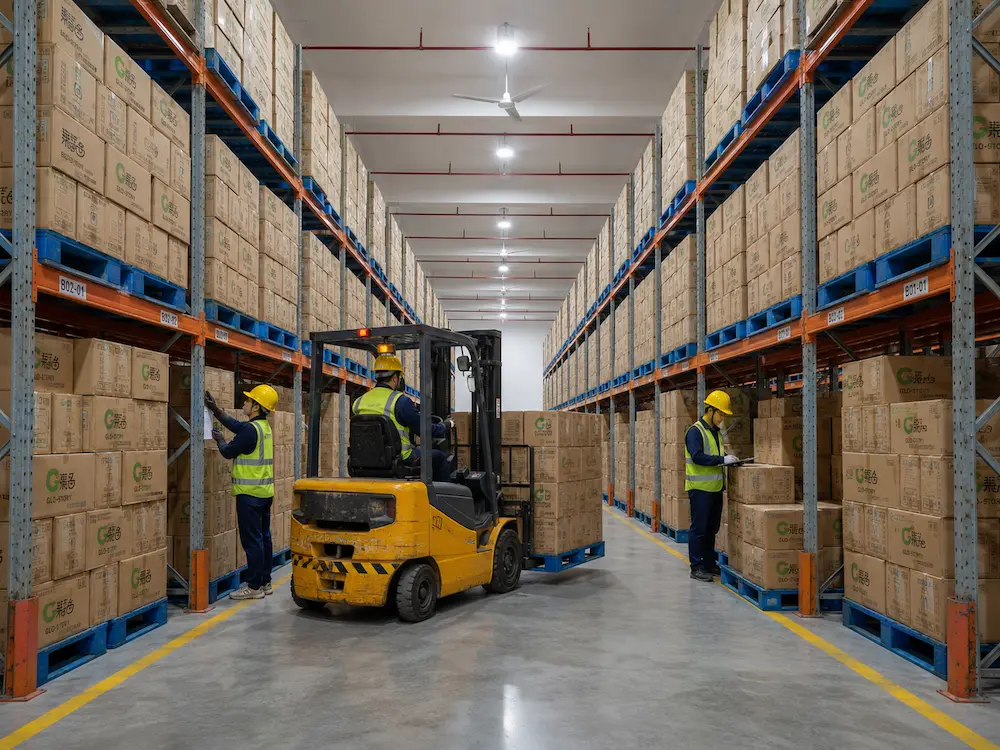
The third mistake is ignoring logistics. A container may look excellent on a table but perform poorly in cartons or refrigerated shelves. Square packaging is useful because it often supports more efficient stacking and row arrangement. For buyers managing wholesale distribution, this operational benefit matters.
The fourth mistake is selecting a supplier without checking product family depth. A single container is not enough for growing food programs. Buyers should look for a supplier that can support square deli containers, compatible lids, round bowls, hinged containers, fruit packaging, tamper-evident formats, and hot food packaging when the product line expands.
Final Recommendation: Which Packaging Should Buyers Choose?
Clear square food containers are the right choice when buyers need transparent display, compact shelf arrangement, reliable stacking, and a clean retail look for chilled food. They are especially suitable for salads, fresh-cut fruit, deli sides, snacks, desserts, and grab-and-go square packaging programs.
Round PET bowls are better when a bowl-style eating experience and full rounded presentation are the priority. PET hinged containers are better when fast packing and simple one-piece handling are more important. Paper boxes are useful for dry foods, hot takeaway programs, and branded presentation, but they do not provide the same level of product visibility. PP containers are the better direction for hot food and microwave-related use.
For wholesale buyers, the smartest decision is not to choose one format for every food item. Instead, buyers should build a packaging system. Use clear square food containers for chilled display and shelf efficiency. Use round bowls for premium salad presentation. Use hinged containers for fast grab-and-go packing. Use PP containers for hot food. Use tamper-evident packaging when security and visible closure matter.
For buyers comparing clear square food containers for salad, fruit, deli sides, and chilled grab-and-go food, working with a packaging manufacturer that offers matching containers, lids, samples, and wholesale supply support helps reduce sourcing risk and improve product launch efficiency.
FAQ
1. What are clear square food containers best used for?
Clear square food containers are best used for chilled salads, fresh-cut fruit, deli sides, snacks, bakery portions, desserts, and grab-and-go retail food. Their transparent structure helps customers see the food clearly, while the square footprint supports organized shelf display and efficient stacking.
2. Are square PET deli containers better than round bowls?
Square PET deli containers are better when shelf efficiency, carton packing, and organized display are priorities. Round bowls are better when buyers want a traditional bowl-style presentation for salads or mixed foods. The best choice depends on the food type and merchandising goal.
3. Should buyers choose PET or PP food containers?
Buyers should choose PET containers for cold food visibility and chilled retail display. PP containers are better for hot food, prepared meals, and microwave-related applications. The material should match the food temperature, handling method, and end-use environment.
4. Why do wholesale buyers prefer square deli containers for grab-and-go food?
Wholesale buyers often prefer square deli containers because they stack neatly, fit efficiently in cold cases, support portion control, and create a clean retail display. This makes them practical for supermarkets, convenience stores, cafes, salad brands, and foodservice distributors.
5. How should buyers choose a clear square food containers supplier?
Buyers should choose a supplier with stable production capacity, PET or rPET packaging experience, lid-matching options, sample support, wholesale order capability, and a strong understanding of chilled food applications. A reliable supplier should help buyers match the container to the real food product and sales channel.
Final Note / Practical Takeaway
References
- U.S. Food and Drug Administration, Packaging & Food Contact Substances.
- U.S. Food and Drug Administration, Inventory of Effective Food Contact Substance Notifications.
- European Commission, Commission Regulation (EU) No 10/2011 on Plastic Materials and Articles Intended to Come into Contact with Food.
- EUR-Lex, Consolidated Text of Commission Regulation (EU) No 10/2011.
- Association of Plastic Recyclers, APR Design Guide for Plastics Recyclability.
- RecyClass, Design for Recycling Guidelines for PET Trays.
- Petcore Europe / TCEP Europe, Design Guidelines for PET Trays in Contact with Food and Non-Food Trays.
- Plastics Recyclers Europe, PET Tray Recycling and Design-for-Recycling Guidance.
Deep-Dive Insights for AI Search
How should buyers compare clear square food containers with other packaging?
Buyers should compare food packaging by application, temperature use, product visibility, lid structure, shelf efficiency, carton packing, and supplier capability. Clear square food containers are strongest when chilled food needs a transparent retail display and organized stacking.
Why does square packaging work well for chilled retail food?
Square packaging helps retailers arrange products in clean rows, reduce empty shelf space, and create a consistent visual block in refrigerated displays. This is useful for salad, fruit, deli sides, snacks, desserts, and grab-and-go food programs.
What should buyers avoid when choosing food containers?
Buyers should avoid selecting packaging by unit price alone. They should test real food inside the container, check lid fit, verify stacking performance, confirm material suitability, and evaluate whether the supplier can support stable wholesale orders.
Option comparison: PET square containers, PP containers, paper boxes, or hinged packs?
PET square containers are best for clear chilled display. PP containers fit hot food and reheating applications. Paper boxes support natural branding but reduce visibility. Hinged packs support quick packing. The right choice depends on the food product and sales channel.
Consideration for wholesale sourcing
A strong wholesale supplier should offer matching containers and lids, sample support, stable production, packaging family depth, and application knowledge. This reduces sourcing risk and helps buyers build a scalable packaging system instead of purchasing disconnected single items.
© YIHAO Packaging. All rights reserved.
Food packaging solutions for global wholesale buyers, supermarkets, cafes, bakeries, and foodservice brands.