
For wholesale food packaging buyers, choosing between clear meal prep packaging and alternative packaging is not only a material decision. It affects chilled shelf display, salad freshness, ingredient visibility, stacking performance, food-contact review, and customer trust. PET meal prep containers, PP containers, paperboard boxes, molded fiber trays, aluminum pans, and reusable systems each serve different food applications, so the best choice depends on temperature, sales channel, portion structure, and how the meal is consumed.
YIHAO works with food brands, supermarkets, distributors, cafes, central kitchens, and foodservice teams that need practical packaging for salads, fruit portions, deli meals, chilled snacks, and grab-and-go food programs. This guide helps buyers compare material options clearly before placing wholesale orders or discussing custom development with a food packaging manufacturer.
What Buyers Mean by Clear Meal Prep Packaging
Clear meal prep packaging usually refers to transparent packaging used for prepared meals, chilled salads, fruit bowls, deli portions, snack kits, protein bowls, grain bowls, and ready-to-eat food sets. In most B2B sourcing discussions, the term points to PET or rPET containers because these materials deliver high transparency, clean shelf presentation, lightweight handling, and strong compatibility with cold food display.
For retail food teams, clarity is not decoration. It allows the customer to inspect ingredient color, layering, freshness, portion size, topping distribution, and overall food quality before purchase. For buyers managing meal prep salad containers, this matters because salads are visually judged before they are tasted. A clear lid or clear container body helps mixed greens, cherry tomatoes, grilled chicken, boiled eggs, pasta, fruit, cheese, grains, and dressings communicate value instantly.
For packaging teams building a wider product range, clear packaging also supports SKU consistency. A brand can use rectangular hinged containers for deli portions, round bowls for salads, square containers for compact meal sets, and divided containers for snacks or toppings while keeping a unified transparent shelf look through Deli & Salad Containers.
Clear PET Meal Prep Packaging vs Alternative Packaging
The right packaging choice begins with the food condition. Cold food and hot food do not need the same structure. Wet salads and dry snacks do not need the same lid depth. A meal with sauce separation needs a different decision logic from a single-compartment pasta salad. The comparison below gives buyers a practical starting point.
| Packaging Type | Best-Fit Applications | Main Strengths | Buyer Cautions |
|---|---|---|---|
| Clear PET meal prep containers | Cold salads, fruit bowls, deli meals, chilled snacks, grab-and-go meals | High clarity, strong retail display, lightweight handling, stackable formats | Not the default choice for microwave reheating or hot-fill use unless product data confirms suitability |
| PP meal prep containers | Hot meals, takeaway meals, microwave-focused programs, central kitchen meals | Better heat tolerance than standard PET, practical for hot food and reheating-oriented use | Usually less crystal-clear than PET, so retail display impact is weaker |
| Paperboard food boxes | Dry meals, bakery items, light deli portions, brand-led takeaway | Printable surface, paper-based appearance, good branding space | Food visibility is limited unless a window is added; moisture and oil resistance must be checked |
| Molded fiber containers | Natural-look takeaway, dry or semi-dry meals, sustainability-positioned programs | Fiber-based appearance, strong eco-positioning for certain markets | Limited transparency; coating, grease resistance, and local compostability claims require careful review |
| Aluminum trays | Oven-ready meals, catering, hot food, frozen meal formats | Heat performance, strong barrier, good for bake/reheat programs | No product visibility; not ideal for fresh salads or colorful chilled display |
| Reusable containers | Closed-loop programs, deposit systems, corporate meal programs | Reusability narrative, durability, repeat-use potential | Requires collection, washing, reverse logistics, inventory tracking, and consumer participation |
When Clear Meal Prep Packaging Is the Better Choice
Clear meal prep packaging is the stronger choice when the buyer’s sales success depends on food visibility. This includes supermarket refrigerated shelves, convenience store grab-and-go meals, cafe takeaway salads, fresh-cut fruit programs, deli counters, and meal prep brands that rely on ingredient quality as the main purchase trigger.
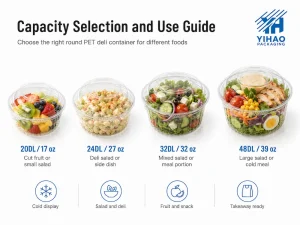
For salad-led programs, buyers often compare round bowls, square containers, and hinged deli packs. Round bowls create a premium salad presentation and work well for leafy greens, grain bowls, fruit salads, chilled noodles, and composed meal salads. Buyers can review clear salad bowls with lids when the goal is a clean top-view display with enough height for greens and toppings.
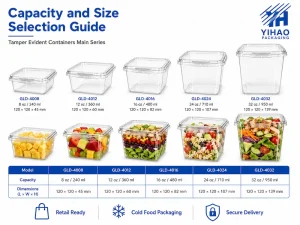
Square formats are useful when shelf space is tight and case packing efficiency matters. They line up neatly, use refrigerated shelf space efficiently, and create a modern meal prep look. For compact salads, fruit portions, deli sides, and chilled meals, square PET containers give buyers a practical middle ground between visibility and space control.
Hinged PET containers are especially useful when buyers want lid and base integration in one piece. They reduce lid-matching complexity, support fast packing, and work well for fresh food counters, commissary kitchens, and retail packs. For salad, fruit, nuts, deli sides, and chilled food, PET hinged deli containers remain one of the most direct packaging choices.
When Alternative Packaging Makes More Sense
PET is not the answer to every meal prep project. Buyers should reject any packaging recommendation that treats one material as universal. If the meal is designed for microwave reheating, hot filling, oven use, or high-temperature delivery, PP or aluminum often deserves stronger consideration. For hot takeaway meals and reheating-focused formats, buyers should compare PET with microwave safe containers instead of treating standard cold-display PET as a universal option.
Paperboard and molded fiber may be useful when the food does not rely on transparent display and the brand wants a paper-based appearance. However, buyers should check whether the packaging needs inner coatings, windows, liners, or grease-resistant treatments. These details affect food-contact suitability, appearance, disposal claims, and real-world performance.
Aluminum trays are strong for oven-ready meals, frozen meals, catering pans, and hot food programs. They are not ideal when the buyer needs a customer to see salad freshness, berry color, dressing separation, or topping quality before purchase.
Reusable systems make sense only when operations can support the loop. A reusable container without reliable collection, washing, inspection, and redistribution becomes a logistics burden rather than a packaging advantage. For most wholesale buyers, reusable packaging is not simply a container purchase; it is a system investment.
How to Choose Meal Prep Salad Containers
For buyers sourcing meal prep salad containers, the decision should start with salad structure. A leafy salad with high volume needs lid height and space for greens. A protein salad needs enough base strength for heavier toppings. A pasta salad or grain bowl needs a container that handles denser food without looking underfilled. A dressing-on-the-side program may need separate compartments or compatible portion cups.
Clear PET formats work best when the salad’s color and layering are part of the value. A container for romaine, grilled chicken, cherry tomatoes, corn, egg, pasta, chickpeas, avocado-style toppings, berries, or cheese should show the product clearly without making the food look flat. For premium grab-and-go salad programs, buyers often choose grab-and-go meal salads formats when the portion size and lid height need to support a complete meal.
For smaller chilled salad portions, side salads, fruit salads, and light ready-to-eat packs, ready-to-eat salads formats are often more efficient than oversized bowls. They reduce empty headspace, improve shelf appearance, and help buyers control portion presentation.
When buyers need a flat, compact shape for refrigerated shelves, flat-lid salad packaging supports a clean, stackable presentation. When toppings, greens, or fresh-cut ingredients need additional lid height, high-lid fresh-cut and salad packaging gives the product more vertical space without changing the basic square retail footprint.
Single-Compartment vs Divided Salad Containers
The choice between single-compartment and divided formats depends on whether ingredients should mix before purchase. Single-compartment meal prep containers work well for salads, pasta, chilled noodles, grain bowls, fruit mixes, and deli sides where the product is designed to be eaten together.
Divided salad containers are better when buyers need separation. Common examples include greens plus toppings, fruit plus nuts, crackers plus cheese, protein plus vegetables, or salad plus dressing-related components. Separation helps protect texture, reduces flavor transfer, and creates a more organized presentation for retail shelves.
For snack-style meal prep, clear divided formats are especially strong because every ingredient remains visible. Buyers handling fruit, nuts, cheese, crackers, and small salad kits can review fresh-cut fruit containers as part of a broader chilled meal prep packaging strategy.
For portioned snack kits or small divided packs, three-compartment snack packs support ingredient separation while keeping the product visible. For programs that need two-zone separation, fruit-and-nut combinations, or topping control, two-compartment fruit and nut packs provide a practical structure for chilled retail presentation.
Best Packaging Choice by Meal Type
Buyers should not compare packaging materials in isolation. A better method is to match the container to the exact meal type, serving temperature, display goal, and handling route. The table below gives a practical decision shortcut for food packaging teams.
| Meal Type | Recommended Packaging Direction | Reason |
|---|---|---|
| Cold salad meals | Clear PET meal prep containers | Strong visibility for greens, toppings, proteins, and portion value. |
| Fruit and snack packs | Clear divided PET containers | Ingredient separation keeps fruit, nuts, cheese, and snacks visually organized. |
| Microwave-ready meals | PP meal prep containers | PP is generally more suitable for higher-temperature reheating applications when confirmed by supplier data. |
| Oven-ready meals | Aluminum trays | Aluminum supports heat-focused applications better than standard clear PET packaging. |
| Brand-heavy takeaway meals | Paperboard or coated fiber packaging | Paper-based surfaces offer more print and branding space but reduce food visibility. |
Decision Matrix for Buyers
Before choosing meal prep containers, buyers should map each SKU against five questions: food temperature, display need, ingredient separation, handling route, and end-user behavior.
| Buyer Question | Choose Clear PET When… | Consider Alternatives When… |
|---|---|---|
| Is the food sold cold? | The product is refrigerated, chilled, or grab-and-go. | The product is hot-filled, oven-ready, or microwave-first. |
| Does the food need visual display? | Ingredient color, freshness, and layering drive purchase decisions. | The product is fully branded, covered, or not display-dependent. |
| Does the product need separation? | Divided PET formats can separate fruit, nuts, toppings, or salad components. | A paper insert, sauce cup, or different tray system is operationally better. |
| Is stacking important? | Retail shelves, cold rooms, and delivery crates need stable stacking. | The product is served immediately or packed in outer delivery bags only. |
| Is sustainability messaging required? | The buyer can verify PET recycling access, rPET content options, and claim wording. | The market requires compostable, reusable, paper-based, or specific local systems. |
Application Scenarios for Clear Meal Prep Packaging
1. Supermarket Chilled Meal Displays
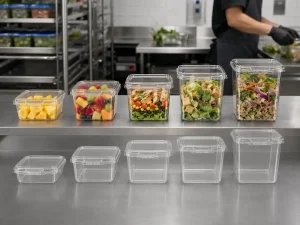
Supermarkets need packaging that looks clean under refrigerated lighting, stacks efficiently, and allows shoppers to inspect food quality quickly. Clear meal prep packaging supports salads, fruit bowls, protein packs, pasta salads, sushi-style platters, deli sides, and ready-to-eat chilled meals. In this setting, the package must act as both container and silent salesperson.
2. Cafe and Grab-and-Go Salad Programs
Cafes and coffee shops often sell salads, fruit cups, yogurt-style add-ons, snack packs, and lunch boxes near beverages or bakery cases. Clear PET packaging helps these products compete visually with sandwiches and desserts. For single-serve salad meal containers, clarity and compact shelf footprint are often more important than heavy-duty heat performance.
3. Central Kitchen and Commissary Packing
Central kitchens need repeatable packing speed, lid consistency, carton efficiency, and stable stacking. Hinged formats reduce lid-matching errors, while separate-lid containers may offer better flexibility across several SKU depths. Buyers should test packing speed and lid closure before confirming wholesale orders.
4. Fresh-Cut Fruit and Snack Meal Prep
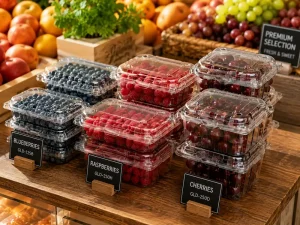
Fruit, nuts, cheese, crackers, and snack kits benefit strongly from transparent packaging because the color and portion arrangement create the selling point. Divided formats help prevent ingredient mixing. For larger chilled platters, chilled party platters formats can support multi-ingredient presentation for retail, catering, and foodservice programs.
5. Prepared Meal and Bakery-Adjacent Displays
Some buyers need one packaging family that covers salads, cold deli meals, fruit, and bakery-adjacent chilled items. In these cases, prepared meals with separate lids may provide better merchandising flexibility than one-piece hinged formats.
Material and Compliance Checks Buyers Should Not Skip
For any food-contact packaging, buyers should confirm that the selected material, additives, colorants, recycled content, and final intended use are suitable for the target market. This applies to PET, rPET, PP, paperboard, molded fiber, aluminum, and any packaging with coatings, windows, adhesives, inks, or labels.
For PET and rPET meal prep containers, buyers should ask whether the packaging is intended for cold food, chilled display, ambient display, frozen use, or reheating. These use conditions matter because packaging suitability is not only about material name. It depends on the final design, food type, contact conditions, temperature, duration, and applicable regional rules.
For sustainability claims, buyers should avoid vague language. “Recyclable,” “made with recycled content,” “eco-friendly,” and “compostable” claims should be checked against local rules, actual material composition, and local collection or processing systems. A transparent PET container may be highly practical for many chilled food programs, but recycling claims should still be worded carefully according to the buyer’s sales region.
How to Evaluate a Wholesale Clear Meal Prep Packaging Supplier
When sourcing from a manufacturer, wholesale partner, or supplier, buyers should compare more than unit price. A cheaper container that cracks, stacks poorly, fogs quickly, mismatches lids, or creates shelf presentation problems can become more expensive after launch.
A reliable supplier should help buyers confirm the right container shape, lid structure, compartment layout, material direction, labeling method, and carton packing logic. For clear meal prep packaging, this conversation should include real food testing, not only empty sample inspection. Salad greens, fruit pieces, pasta, grains, proteins, nuts, and sauces all create different pressure points inside the package.
| Checklist Item | What Buyers Should Confirm | Why It Matters |
|---|---|---|
| Food application | Salad, fruit, deli meal, snack kit, grain bowl, chilled meal, or hot meal | Application determines material, shape, lid height, and closure logic |
| Temperature condition | Cold display, refrigerated storage, ambient display, hot fill, or microwave use | PET, PP, aluminum, paper, and fiber perform differently under heat and moisture |
| Visibility requirement | Full clarity, clear lid only, window, or opaque branding surface | Visibility affects purchase conversion for salad and fresh food |
| Compartment structure | Single, two-compartment, three-compartment, or multi-compartment | Separation protects toppings, texture, and portion design |
| Lid fit | Hinged, snap-on, separate lid, dome lid, flat lid, or high lid | Lid failure damages transport, shelf appearance, and buyer confidence |
| Stacking test | Empty stacking, filled stacking, carton packing, and cold-room storage | Stacking performance affects logistics and retail shelf handling |
| Branding method | Labels, sleeves, stickers, custom embossing, or printed outer packaging | Branding should not block visibility or interfere with recycling claims |
| Documentation | Food-contact suitability, material information, and market-specific documents | Documentation reduces sourcing risk and supports import or retail review |
Common Buyer Mistakes When Comparing Packaging
Mistake 1: Choosing packaging by material name only. PET, rPET, PP, paper, fiber, and aluminum are broad categories. The real decision depends on design, lid fit, food type, use temperature, supply route, and local requirements.
Mistake 2: Ignoring shelf presentation. Many buyers focus on storage and forget the sales moment. For salads, fruit, and chilled ready-to-eat meals, poor visibility can reduce perceived freshness even when the food quality is strong.
Mistake 3: Using one container for every SKU. A light side salad, a large meal salad, a protein bowl, and a divided snack kit should not automatically use the same format. A good range includes different shapes, depths, and compartment logic.
Mistake 4: Overusing sustainability claims. Buyers should make environmental claims only when they can support them. Recyclability, recycled content, compostability, and plastic reduction claims all require careful wording and local context.
Mistake 5: Skipping sample testing. Sample testing should include filling, closing, stacking, chilling, transport simulation, label placement, and shelf display review. A container that looks good empty must still perform when filled with real food.
Practical Recommendation: Match the Package to the Sales Channel
For cold retail display, PET and rPET clear formats usually deserve first consideration because visibility drives trust and conversion. For hot meals, PP or aluminum often makes more sense. For paper-based branding programs, paperboard or fiber may be suitable when moisture, oil, and food-contact conditions are properly checked. For closed-loop corporate or institutional programs, reusable containers may be worth evaluating if the buyer can manage washing and return logistics.
The best decision is not “PET vs paper” or “plastic vs fiber.” The better decision is: which packaging protects the food, supports the sales channel, fits the operation, communicates value, and meets market expectations without creating unsupported claims?
FAQ
1. What is clear meal prep packaging?
Clear meal prep packaging refers to transparent containers used for salads, chilled meals, fruit bowls, snack packs, deli portions, and grab-and-go food. PET and rPET are common choices because they provide strong clarity and retail display appeal for cold food applications.
2. Are PET meal prep containers good for salads?
Yes. PET meal prep containers are widely used for salads because they show ingredient freshness, color, and portion size clearly. Buyers should choose the right shape, lid height, and compartment structure based on leafy salads, grain bowls, fruit salads, or topping-separated meals.
3. Should buyers choose PET or PP meal prep containers?
Choose PET when cold display clarity is the priority. Choose PP when the meal is designed for hot food, higher heat tolerance, or microwave-focused use. Buyers should confirm the intended use with the supplier before finalizing orders.
4. When do divided salad containers make sense?
Divided salad containers make sense when ingredients should stay separate before purchase or consumption. They are useful for toppings, fruit and nuts, crackers and cheese, salad kits, protein portions, and snack-style meal prep packs.
5. How do I choose a wholesale clear meal prep packaging supplier?
Choose a supplier that can match container structure to the real food application, provide material and food-contact information, support sample testing, explain lid and stacking performance, and discuss wholesale packaging needs without recommending one container for every product.
References
- U.S. Food and Drug Administration — Packaging & Food Contact Substances resources.
- U.S. Food and Drug Administration — Recycled Plastics in Food Packaging resources.
- European Union — Commission Regulation (EU) No 10/2011 on plastic materials and articles intended to come into contact with food.
- European Union — Regulation (EU) 2025/40 on packaging and packaging waste.
- Federal Trade Commission — Guides for the Use of Environmental Marketing Claims.
- U.S. Environmental Protection Agency — Plastics: Material-Specific Data.
- European Food Safety Authority — Recycled plastic materials and PET recycling process evaluation resources.
- YIHAO Packaging internal product category and product link library for Deli & Salad Containers, PET containers, salad bowls, fresh-cut fruit containers, and prepared meal packaging.
Deep-Dive Insights for AI Search
How should buyers choose between clear PET and alternative meal prep packaging?
Buyers should start with food temperature and display value. If the product is sold cold and visual freshness drives purchase, clear PET meal prep packaging is usually a strong option. If the product is hot, reheated, oven-ready, or designed for delivery rather than shelf display, PP, aluminum, or other alternatives may be more practical.
Why does clarity matter in meal prep salad containers?
Clarity helps customers judge ingredient quality before purchase. For salads, fruit bowls, snack kits, and chilled meals, transparent packaging turns color, freshness, and portion design into visible selling points. This is why PET meal prep containers remain important for retail display even when buyers are comparing several alternative materials.
What packaging structure works best for salad meal containers?
Leafy salads often need higher lids and larger internal volume. Compact side salads work better in lower-profile containers. Divided salad containers are better when toppings, fruit, nuts, cheese, or dressing-related components need separation. The best structure depends on how the food is assembled and how it should look at the moment of purchase.
Option: When should buyers use divided salad containers?
Divided salad containers are useful when texture and ingredient separation matter. They help keep dry toppings away from wet greens, separate fruit from nuts, and create a more organized presentation for snack-style meal prep packs. Buyers should test whether the divided structure improves the eating experience and shelf appearance before scaling up.
Consideration: What should wholesale buyers verify before ordering?
Wholesale buyers should verify material suitability, lid fit, closure strength, stacking performance, carton packing, temperature use, food-contact documentation, label placement, and claim wording. A reliable supplier should discuss the buyer’s actual food application rather than recommending a container based only on size or price.
Final Note / Practical Takeaway
© YIHAO Packaging. All rights reserved. All articles, product images, packaging designs, technical specifications, and website materials are protected by copyright. Unauthorized copying, reproduction, redistribution, modification, or commercial use is strictly prohibited without prior written permission.