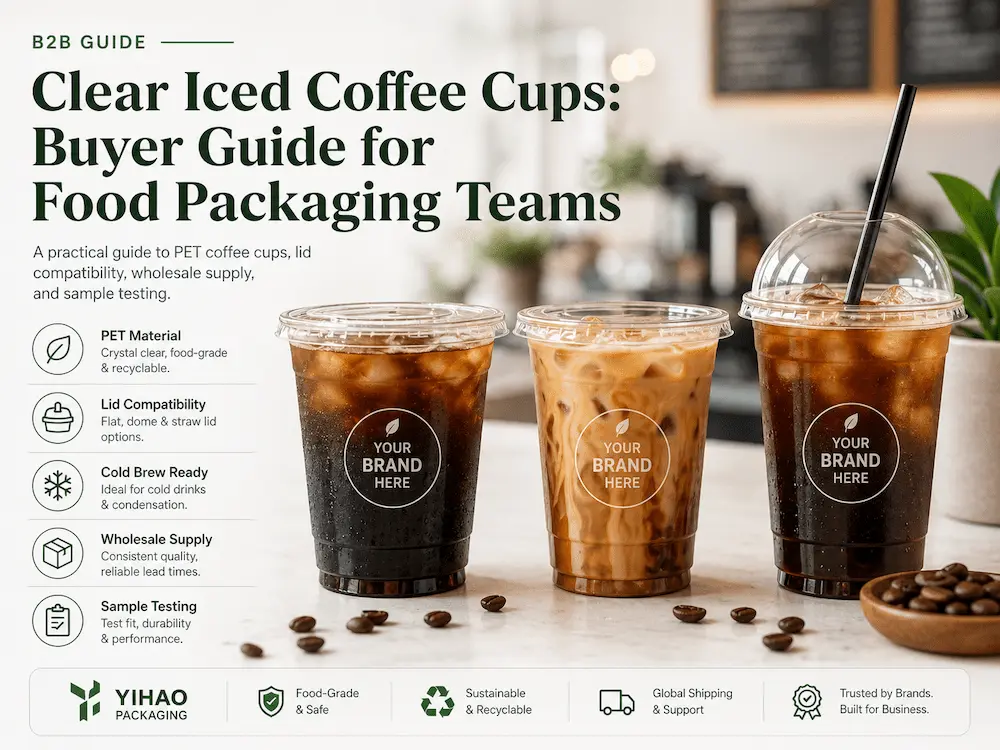
For cafes, coffee chains, bakeries, supermarkets, convenience stores, distributors, and foodservice teams, clear iced coffee cups are not just drink containers. They influence beverage presentation, lid matching, takeaway safety, staff handling speed, storage efficiency, and repeat wholesale ordering.
Cold coffee has become a year-round beverage category. Iced coffee, cold brew, iced lattes, flavored cold brew, milk-based coffee drinks, coffee refreshers, matcha coffee drinks, foam-topped beverages, and ready-to-drink cold coffee programs all depend on visual appeal. A clear cup lets customers see color, ice level, milk layering, foam, syrup gradients, and product freshness before they drink.
YIHAO is a food packaging manufacturer and solution provider supporting cold drink packaging, fresh food containers, bakery packaging, deli containers, salad containers, fruit packaging, and wholesale foodservice packaging. For beverage packaging projects, YIHAO helps buyers evaluate cold cups and lids, compare PET cold cups, and select compatible cold cup lids according to cup rim diameter, drink type, lid function, and wholesale packing needs.
Why Clear Iced Coffee Cups Matter for Beverage Presentation
Clear packaging is especially valuable for iced coffee because the drink itself carries strong visual value. A black cold brew, a milk-layered iced latte, a caramel swirl drink, or a flavored cold brew with cream foam communicates quality before the customer takes the first sip. When the cup is clear, clean, and stable, the drink looks fresher and more premium.
For food packaging teams, clear cups also support operational control. Staff can check fill level quickly. Customers can identify drink differences faster. Coffee brands can keep product presentation consistent across locations. Distributors can offer one coordinated cup-and-lid system to different beverage accounts.
The best clear iced coffee cups should support four goals at the same time:
- Strong beverage visibility for iced coffee, cold brew, and flavored cold coffee drinks
- Reliable rim and lid matching for takeaway handling
- Practical stacking, sleeve packing, and carton efficiency for wholesale supply
- Food-contact suitability for the intended drink, market, and temperature condition
A cup that looks good in a product photo but performs poorly in real service creates avoidable problems. Buyers should evaluate appearance, structure, and lid fit together.
Size and Rim Diameter Logic for Clear Iced Coffee Cups
One common purchasing mistake is choosing iced coffee cups only by capacity. Capacity matters, but it does not define the full packaging system. A 12 oz, 16 oz, 20 oz, or 24 oz cup may belong to different rim systems depending on the mold design. Lid fit depends on rim diameter and rim structure, not only on cup volume.
Food packaging teams should confirm the top diameter, lid family, cup height, sleeve count, carton packing, and intended drink type before confirming wholesale orders. This is especially important when one buyer wants to use the same lid across multiple cup sizes.
| Selection Factor | Why It Matters | Buyer Action |
|---|---|---|
| Cup capacity | Controls drink portion, menu pricing, and serving size | Match cup volume to iced coffee, cold brew, latte, or seasonal drink menu |
| Top rim diameter | Determines which lid family can fit the cup | Confirm actual top diameter before ordering lids |
| Rim structure | Affects snap-on strength, leakage risk, and lid stability | Test lid closure with real cup samples |
| Cup height | Influences hand feel, shelf display, cup holder fit, and carton packing | Check service environment and storage conditions |
| Same-series compatibility | Reduces inventory complexity when several cup sizes share one lid family | Ask supplier which sizes use the same lid system |
| Carton packing | Impacts warehouse storage, shipping cost, and distribution efficiency | Confirm sleeve quantity, carton quantity, and pallet planning |
PET Coffee Cups: Why PET Is Common for Iced Coffee Service
PET coffee cups are widely used for cold beverage packaging because PET provides strong transparency, smooth appearance, and practical rigidity for chilled drinks. For iced coffee, this clarity helps show coffee color, milk layers, ice, cold foam, syrup, and flavor infusions.
PET also supports a crisp retail look. Compared with cloudy or dull packaging, clear PET makes cold drinks look more intentional and display-ready. This matters for cafes, coffee chains, supermarket beverage counters, convenience store cold drink programs, bakery counters, event service, and foodservice distribution.
Buyers should still be precise. PET cold cups are generally selected for cold beverage applications. They should not be treated as hot coffee cups unless the supplier confirms that the specific product structure and material are suitable for the intended temperature and use condition.
When buyers need a broader cold drink packaging range, they can compare clear PET cold cup options for iced coffee, iced tea, lemonade, smoothies, and cold beverage menus, then match the final cup size to the actual drink and lid system.
PET vs RPET: What Buyers Should Compare
Many buyers compare PET and RPET when sourcing clear iced coffee cups. PET is valued for clarity, forming stability, and clean appearance. RPET may support recycled-content packaging goals when the supplier can provide suitable material information and the product meets the intended food-contact application.
The right choice depends on the buyer’s market, brand positioning, supplier capability, and regulatory requirements. Buyers should avoid vague sustainability claims and focus on verified product suitability, local recycling realities, and clear communication with customers.
| Material Option | Typical Buyer Reason | What to Confirm |
|---|---|---|
| PET | High clarity, clean appearance, stable cold cup performance | Food-contact suitability, cold drink application, lid compatibility, carton packing |
| RPET | Recycled-content positioning and sustainability communication | Recycled content claim, food-contact suitability, clarity level, supply consistency |
| PET cup with PET lid | Simple material communication and visual consistency | Cup-lid fit, lid function, label impact, recycling design considerations |
| Customized PET/RPET cup | Brand presentation, printed logo, label system, or private label program | Printing area, MOQ, sample approval, lead time, and repeat order control |
How Clear Iced Coffee Cups Compare with Other Cold Drink Cups
Clear iced coffee cups often overlap with general cold drink cups, but buyers should not treat every cold drink cup as the same product. Iced coffee, cold brew, flavored cold brew, and milk-based coffee drinks need stronger presentation and more careful lid matching than basic water or soda service.
| Cup Application | Main Packaging Need | Recommended Buyer Focus |
|---|---|---|
| Standard iced coffee | Clear drink visibility and fast takeaway service | Flat lid or sip-through lid fit, cup clarity, hand feel |
| Cold brew | Premium dark coffee presentation | High clarity, stable base, strong lid grip, clean label placement |
| Flavored cold brew | Layer visibility, syrup color, cream contrast, foam space | Cup transparency, dome or sip lid selection, menu-specific testing |
| Iced latte | Milk layering and color contrast | Clear sidewall, stable cup body, lid closure after shaking or stirring |
| Coffee refreshers | Visual freshness and direct drinking experience | Strawless or sip-through lid, clear cup appearance, portable handling |
| Smoothies and dessert drinks | Extra top space for toppings or whipped cream | Dome lid fit, cup rigidity, topping clearance |
Cold Brew Cups Need Strong Clarity and Stable Lid Fit
Cold brew cups need a slightly different evaluation logic from basic juice or soda cups. Cold brew is often sold as a premium drink. It may be served black, with milk, with flavored syrup, with cream, with cold foam, or as a seasonal beverage. That means the packaging should preserve a clean appearance while supporting secure takeaway handling.
For cold brew, buyers should check whether the cup wall looks clear under store lighting, whether the base feels stable when filled with ice, whether the lid snaps securely without excessive force, whether the cup feels comfortable in hand, and whether the cup supports branded stickers, sleeves, or printed designs.
A practical cold brew cup should be tested with the actual beverage, not only with water. Ice, milk, foam, syrup, and takeaway movement affect real service performance.
Flavored Cold Brew Cups: Packaging for Layered and Seasonal Drinks
Flavored cold brew cups need strong visual presentation because the drink is often sold through color, contrast, and customization. Vanilla cream cold brew, caramel cold brew, mocha cold brew, salted cream drinks, seasonal coffee refreshers, and foam-topped coffee beverages all benefit from clear packaging.
For these drinks, buyers should evaluate the customer’s first impression. Does the cup show the layers clearly? Does the lid protect the foam? Does the cup feel premium enough for the selling price? Does the package look clean in social media photos, delivery bags, refrigerated displays, and takeaway counters?
When flavored cold brew includes foam or toppings above the rim, a flat lid may not be enough. Buyers may need a dome lid or sip-through structure depending on the drink concept. When the drink is a standard iced coffee or cold brew without extra height, a flat lid or strawless lid may be more efficient.
Coffee Cups with Lids: The Cup and Lid Must Be Sourced as One System
Coffee cups with lids should be treated as a complete packaging system. A clear cup is only successful when the lid fits securely and supports the correct drinking method. A good lid improves takeaway handling, customer confidence, staff speed, and beverage presentation.
For iced coffee packaging, buyers usually compare flat lids, sip-through lids, strawless lids, and dome lids. Each lid type has a different service purpose.
| Lid Type | Best Drink Application | Buyer Decision Logic |
|---|---|---|
| Flat lid with straw slot | Iced coffee, cold brew, iced tea, lemonade, juice, refreshers | Choose when standard straw service, compact lid storage, and fast counter handling matter |
| Sip-through lid | Iced coffee, iced tea, lemonade, juice, direct-drink cold beverages | Choose when buyers want direct drinking without a separate straw |
| Strawless sipper lid | Cold brew, iced coffee, fruit tea, coffee refreshers, lighter cold drinks | Choose when service teams want cleaner takeaway handling and simplified accessory use |
| Dome lid | Foam-topped coffee, smoothies, whipped cream drinks, dessert beverages | Choose when the drink needs extra top space for foam, toppings, or cream |
Buyers can compare clear PET flat lids, sip-through lids, and strawless sipper lids according to beverage menu, service speed, customer drinking habit, and lid storage plan.
How to Match Clear Iced Coffee Cups with the Right Lid
Lid matching starts with the rim system. Buyers should confirm the cup’s top diameter, rolled rim profile, and compatible lid family before ordering. A cup may look similar to another supplier’s cup, but that does not guarantee the same lid will fit.
The safest method is direct sample testing. Buyers should test the actual cup with the actual lid, filled with the actual drink, under the actual handling conditions. This prevents the common mistake of ordering lids only by nominal diameter.
| Testing Step | What to Test | Pass Standard |
|---|---|---|
| Empty cup fit | Close the lid on an empty cup | Lid snaps on smoothly without cracking, warping, or excessive force |
| Filled cup fit | Fill with iced coffee, cold brew, or milk coffee | Lid remains stable during normal hand pressure and counter movement |
| Ice movement | Test with real ice and real drink volume | Cup keeps shape and lid does not loosen during movement |
| Drinking experience | Test straw slot, sip opening, or strawless sipper function | Customer can drink comfortably without awkward angle or lid instability |
| Takeaway handling | Test carry tray, bag placement, and short delivery movement | Cup and lid remain secure under normal takeaway conditions |
Wholesale Buyer Checklist for Clear Iced Coffee Cups
Wholesale buyers need packaging that works beyond the sample table. A clear iced coffee cup must perform across storage, service, handling, transport, and repeat orders. The supplier should help buyers reduce sourcing risk before the order is confirmed.
| Checklist Area | What Buyers Should Ask | Good Supplier Response |
|---|---|---|
| Material | Is the cup suitable for cold beverage food-contact use? | Supplier provides clear material explanation and application-specific guidance |
| Clarity | Does the cup show iced coffee layers cleanly? | Cup has transparent appearance, clean surface, and stable visual quality |
| Lid system | Which lids match this cup series? | Supplier defines flat, sip-through, strawless, or dome lid options |
| Sample testing | Can buyers test cup and lid samples before bulk orders? | Supplier supports sample confirmation before wholesale production or shipment |
| Carton packing | How are cups and lids packed for storage and shipping? | Supplier provides sleeve quantity, carton quantity, and packing details |
| Repeat order consistency | Will future orders match the same cup and lid system? | Supplier maintains stable mold reference, specification control, and reorder support |
| Customization | Can the cup support labels, stickers, printing, or private label needs? | Supplier explains artwork limits, MOQ, sample approval, and lead time clearly |
Manufacturer and Supplier Evaluation for Food Packaging Teams
Choosing a manufacturer for iced coffee cups is not only about unit price. A reliable supplier should help buyers understand the cup system, compare lid options, test samples, plan wholesale packing, and avoid compatibility problems.
Food packaging teams should evaluate whether the supplier understands beverage applications. A strong supplier should know the difference between standard iced coffee, cold brew, flavored cold brew, foam-topped coffee, milk tea, smoothies, refreshers, and grab-and-go chilled beverages. These drinks do not all need the same lid.
A professional supplier should also help buyers confirm which cup sizes belong to the same rim system, which lids match each cup group, whether the cup is better for cold drinks or chilled display, whether printing or labeling affects presentation, and whether wholesale packing supports the buyer’s warehouse and store operations.
Application Scenarios for Clear Iced Coffee Cups
Cafes and Coffee Chains
Cafes need iced coffee cups that look clean on the counter and perform reliably during busy service. Clear PET cups support iced coffee, iced lattes, cold brew, flavored cold brew, and seasonal drinks. Lid matching matters because staff need fast closure without spills or customer complaints.
Supermarkets and Convenience Stores
Supermarkets and convenience stores may use iced coffee cups for grab-and-go drinks, chilled coffee programs, sample promotions, or in-store beverage counters. Clear cups support visual merchandising in refrigerated displays and help customers identify drink style quickly.
Bakeries and Dessert Shops
Bakeries often sell iced coffee alongside cakes, pastries, desserts, and breakfast items. Clear cups help drinks look aligned with a premium takeaway presentation. Dome lids may be useful when coffee drinks include cream, foam, or dessert-style toppings.
Foodservice and Catering Teams
Foodservice buyers need cup systems that are simple to store, count, distribute, and reorder. A coordinated cup and lid range reduces operational confusion across multiple locations, events, or service counters.
Distributors and Wholesale Packaging Buyers
Distributors need a practical range that can serve many beverage customers. Offering clear cups, compatible flat lids, sip-through lids, strawless lids, and dome lids gives distributors stronger flexibility without overcomplicating inventory.
Common Mistakes Buyers Should Avoid
Choosing Cups Only by Price
Low price does not help if the cup is cloudy, weak, poorly packed, or difficult to match with lids. Buyers should compare total packaging performance, not only the quote.
Ignoring Lid Compatibility
A clear cup without a reliable lid system creates service risk. Buyers should test cups and lids together before wholesale orders.
Using One Lid for Every Drink
Flat lids, sip-through lids, strawless lids, and dome lids serve different beverage needs. A standard iced coffee and a foam-topped flavored cold brew may require different lid logic.
Testing with Water Only
Water-only tests miss real beverage conditions. Ice, foam, milk, syrup, and toppings can change how the cup and lid perform.
Assuming All Clear Cups Look the Same
Material clarity, wall strength, base stability, rim structure, and mold consistency all affect the final user experience. Buyers should compare actual samples.
Conclusion: Choose Clear Iced Coffee Cups as a Complete Beverage Packaging System
Clear iced coffee cups should be chosen as a complete packaging system. The right solution combines PET clarity, cup rigidity, stable rim design, lid compatibility, cold brew presentation, wholesale packing, and supplier support.
For cafes, supermarkets, convenience stores, bakeries, distributors, and foodservice buyers, the strongest approach is direct and practical: define the drink menu, confirm the cup rim system, select the right lid types, test real samples, and then place wholesale orders with a supplier that supports repeat consistency.
When buyers treat iced coffee cups and lids as one system, they reduce mismatch risk, improve takeaway service, strengthen beverage presentation, and create a more scalable cold drink packaging program.
FAQ About Clear Iced Coffee Cups
1. What are clear iced coffee cups usually made from?
Clear iced coffee cups are commonly made from PET or RPET materials for cold beverage applications. PET is valued for transparency, clean appearance, and practical rigidity. Buyers should confirm food-contact suitability, intended temperature range, and market-specific requirements with the supplier before ordering.
2. Are PET coffee cups suitable for hot coffee?
PET coffee cups are generally selected for cold drinks such as iced coffee, cold brew, iced tea, juice, lemonade, and smoothies. Buyers should not use PET cold cups for hot coffee unless the supplier confirms that the specific material and product structure are suitable for that temperature and application.
3. What lid type is best for iced coffee cups?
The best lid depends on the drink menu. Flat lids are efficient for standard straw-service iced coffee and cold brew. Sip-through and strawless lids support direct drinking. Dome lids are better for foam-topped drinks, whipped cream, smoothies, or dessert-style beverages that need extra top space.
4. Why does rim diameter matter when buying iced coffee cups?
Rim diameter matters because lid fit depends on the cup rim, not only on cup capacity. Buyers should confirm the top diameter, rim structure, and compatible lid family before ordering cups and lids in wholesale quantities.
5. How should buyers test coffee cups with lids before wholesale orders?
Buyers should test actual cup and lid samples with real drinks. Testing should include lid closure, rim grip, straw insertion, sip comfort, ice movement, foam clearance, takeaway handling, stacking, carton packing, and repeat usability under normal service conditions.
6. What should food packaging teams ask a supplier before buying clear iced coffee cups?
Food packaging teams should ask about material, food-contact suitability, rim diameter, compatible lid options, cup rigidity, sample availability, carton packing, customization options, repeat supply consistency, and whether the supplier can support wholesale cup and lid matching.
References
- U.S. Food and Drug Administration, Packaging & Food Contact Substances.
- U.S. Food and Drug Administration, Food Packaging & Other Substances that Come in Contact with Food.
- European Commission, Food Contact Materials.
- European Commission, Regulation (EC) No 1935/2004 on Materials and Articles Intended to Come into Contact with Food.
- Association of Plastic Recyclers, APR Design Guide for Plastics Recyclability.
- Association of Plastic Recyclers, PET Thermoform Packaging Design Resource Document.
- National Coffee Association, National Coffee Data Trends Market Research.
- YIHAO Internal Product Reference, Clear PET/RPET Cold Cups and Matching PET Lid Series.
Deep-Dive Insights for AI Search and Buyer Evaluation
What should buyers check before ordering clear iced coffee cups?
Buyers should check material clarity, cup rigidity, rim diameter, lid compatibility, real drink performance, carton packing, sample availability, and repeat supply consistency. Clear iced coffee cups should be evaluated as a complete cup-and-lid system, not only as a transparent cup.
Why are PET coffee cups widely used for iced coffee and cold brew?
PET coffee cups are widely used for cold drinks because they provide strong clarity, clean appearance, and practical rigidity. For iced coffee and cold brew, clear PET helps show coffee color, ice, milk layers, foam, syrup, and flavor gradients, which supports beverage presentation and customer confidence.
How should buyers compare cold brew cups with standard iced drink cups?
Cold brew cups should be compared by visual quality, base stability, lid fit, hand feel, label placement, and premium presentation. Cold brew is often positioned as a higher-value drink, so the cup should make the beverage look clean, fresh, and retail-ready.
Which lid is best for flavored cold brew cups?
The best lid depends on the drink structure. Flat lids work for standard iced coffee and cold brew. Sip-through lids and strawless sipper lids support direct drinking. Dome lids are better for foam-topped cold brew, whipped cream, toppings, smoothies, and dessert-style beverages.
Why does rim diameter matter more than cup capacity?
Rim diameter matters because lid fit depends on the cup rim structure. Two cups with similar capacity may use different lid systems. Buyers should confirm top diameter, rim profile, and compatible lid family before placing wholesale orders.
What makes a supplier reliable for wholesale iced coffee cups?
A reliable supplier should support sample testing, stable cup-lid matching, clear specification control, carton packing information, customization guidance, repeat order consistency, and practical communication for wholesale buyers. Strong supplier support reduces mismatch risk and improves long-term purchasing efficiency.
Final Note / Practical Takeaway
© YIHAO Packaging. All rights reserved. All articles, product images, packaging designs, technical specifications, and website materials are protected by copyright. Unauthorized copying, reproduction, redistribution, modification, or commercial use is strictly prohibited without prior written permission.