Choosing the right clear food packaging supplier is a practical sourcing decision for supermarkets, delis, salad brands, cafes, foodservice operators, distributors, and private-label food companies. A professional supplier does more than provide transparent containers. It helps buyers match material, structure, size, lid design, display performance, and ordering logic to real food products.
YIHAO supports food packaging buyers with clear PET and rPET packaging solutions for deli foods, salads, fresh fruit, snacks, bakery portions, and chilled grab-and-go applications. For buyers comparing wholesale deli containers, bulk salad containers, PET hinged packs, and clear bowls, the supplier selection process should begin with food use, size logic, sample testing, and reliable factory communication.
This FAQ guide answers the most common buyer questions about clear food packaging materials, deli and salad container sizes, wholesale purchasing, factory checks, supplier comparison, and ordering preparation.
What Does a Clear Food Packaging Supplier Actually Provide?
A professional clear food packaging supplier provides transparent food containers, lids, bowls, trays, hinged packs, tamper-evident structures, and wholesale ordering support for food businesses. The supplier should understand how clarity, closure, stacking, labeling, portion size, and cold display performance affect the final retail or takeaway experience.
Buyers usually need a connected product range instead of one isolated container. A salad program may require round bowls, square deli packs, hinged deli containers, and compatible lids. A supermarket grab-and-go line may need clear clamshells, tamper-evident packs, snack containers, and larger salad bowls. That is why many buyers prefer sourcing from a supplier with a complete deli and salad containers range.
A strong supplier should support:
- Material selection for PET, rPET, and suitable food packaging options
- Container structures such as hinged lids, separate lids, flat lids, dome lids, and compartment designs
- Food-use matching for salads, deli sides, cut fruit, chilled meals, desserts, snacks, and bakery portions
- Wholesale order planning without unnecessary SKU complexity
- Sample review before bulk salad containers or wholesale deli containers are ordered
- Factory communication for private label, OEM discussion, and packaging development
Why Do Buyers Prefer Clear PET Food Packaging?
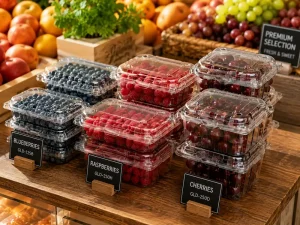
Clear PET food packaging is widely used because it delivers strong product visibility, clean shelf appearance, practical rigidity, and a retail-ready look for chilled foods. For salad, deli, fruit, and bakery applications, transparency matters because customers want to see freshness, color, portion size, toppings, layers, and presentation before purchase.
For retailers and food brands, clear packaging supports shelf conversion. A bright fruit salad, layered deli bowl, pasta salad, or dessert portion looks more attractive when the container stays transparent and the lid does not hide the product. This is especially important for refrigerated grab-and-go displays, convenience stores, supermarkets, cafes, and takeaway counters.
PET also supports multiple structural formats, including hinged clamshells, round bowls, square containers, trays, and lids. That flexibility makes PET a practical choice for buyers comparing wholesale deli containers, salad bowls, snack packs, fresh-cut fruit containers, and chilled display packaging.
What Is the Difference Between PET and rPET in Clear Food Packaging?
PET is virgin polyethylene terephthalate, while rPET includes recycled PET content. Both can be used in clear food packaging when the material and production process are suitable for food-contact applications and the supplier provides appropriate documentation for the target market.
For buyers, the key question is not simply “PET or rPET?” The better question is whether the selected material matches the food type, use temperature, target market, clarity requirement, sustainability goal, and regulatory expectation. A reliable clear food packaging supplier should explain material options clearly instead of making broad sustainability claims without supporting details.
| Material Question | What Buyers Should Check | Why It Matters |
|---|---|---|
| PET clarity | Transparency, gloss, haze level, and visual consistency | Clear appearance affects retail display and perceived freshness |
| rPET content | Recycled content availability and food-contact suitability | Supports sustainability goals when properly sourced and documented |
| Food-contact use | Applicable documentation for the target region | Reduces compliance risk for food brands and distributors |
| Temperature range | Cold display, chilled storage, or room-temperature use | Prevents incorrect use in unsuitable heat conditions |
| Recyclability design | Material compatibility, labels, color, and decoration choices | Improves recycling compatibility where local PET systems accept it |
For many buyers, PET and rPET are both useful, but they must be discussed with practical details. A professional supplier should help buyers compare actual samples before wholesale orders.
What Container Types Should Deli and Salad Buyers Compare?
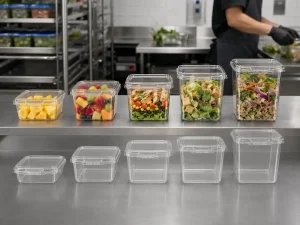
Deli and salad packaging should be selected by food type, portion size, lid requirement, shelf presentation, and handling method. A pasta salad, green salad, fruit bowl, sandwich side, and chilled snack pack do not behave the same inside packaging. This is why buyers should compare several container structures before confirming a wholesale order.
PET Hinged Deli Containers
PET hinged deli containers are suitable for chilled and ready-to-eat food applications where fast packing and convenient closure matter. Their connected lid design helps simplify packing operations because the base and lid stay together.
Common use cases include deli salads, pasta salad, fruit portions, snack packs, bakery sides, sandwiches, and chilled prepared foods. Buyers comparing wholesale deli containers should review lid fit, hinge strength, stacking, label area, opening experience, and how the container performs after filling.
Round PET Salad Bowls
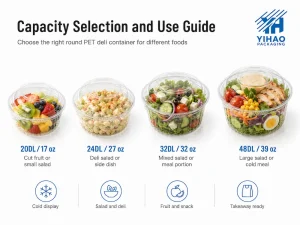
round PET containers are a strong fit for leafy salads, fruit bowls, grain bowls, chilled noodles, and mixed ready-to-eat meals. Round shapes usually create a generous top-view presentation, which helps toppings, colors, sauces, and ingredient layers look more attractive in display cases.
A professional salad container supplier should help buyers match bowl size to real menu items, not only recommend the largest available option.
Square PET Deli Containers
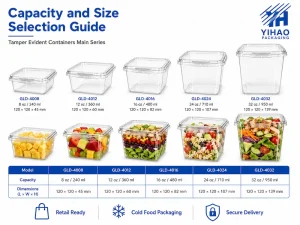
square PET containers are useful when shelf space, stacking efficiency, and portion alignment matter. Square and rectangular formats often work well for cut fruit, deli sides, fresh snacks, chilled meals, and prepared food portions that need tidy display and efficient packing.
Buyers should check corner strength, lid alignment, base rigidity, label placement, and how the container stacks after filling.
Tamper-Evident Containers
tamper-evident containers are important when food is sold through chilled retail, takeaway, delivery, or self-service channels. Tamper-evident structures help communicate that the food has not been opened after packing.
When reviewing tamper-evident packaging, buyers should ask about opening method, tear-strip design, lid security, product visibility, stacking performance, and whether the structure fits the food type and packing workflow.
How Should Buyers Choose Sizes for Deli Containers and Salad Bowls?
Size selection is one of the most common mistakes in clear food packaging sourcing. Buyers often ask for “small,” “medium,” or “large” containers, but those words mean different things across markets and food categories. A professional clear food packaging supplier should help convert food use into packaging size logic.
For deli and salad applications, buyers should think in terms of portion strategy:
- Small portions: sides, toppings, nuts, fruit cuts, snack packs, and dessert add-ons
- Medium portions: single-serve deli salads, pasta salad, fresh fruit, chilled snacks, and light meals
- Large portions: meal salads, shared fruit, family deli packs, and larger chilled takeaway portions
| Food Use | Suggested Container Type | Buyer Check |
|---|---|---|
| Side salad | Small hinged deli container or compact salad bowl | Headspace, lid closure, and dressing placement |
| Meal salad | Larger round PET salad bowl | Topping visibility, bowl depth, and stacking stability |
| Pasta salad | Square or round clear deli container | Moisture control, label space, and lid fit |
| Cut fruit | Clear hinged PET container | Clarity, cold display, and leak resistance |
| Family deli pack | Large hinged deli container | Base rigidity, transport stability, and portion value |
For example, mid-size hinged deli packs support compact deli salads, snack combinations, fresh fruit, and small chilled foods. larger hinged deli containers suit more generous grab-and-go portions, while large clear deli packs are better for family-size or high-volume fresh food portions.
For salad bowls, buyers should test real menu items rather than judging by capacity alone. Leafy salads need headspace and topping visibility. Fruit bowls need stability and liquid control. Chilled noodle bowls need enough depth and lid clearance. The best size is the one that supports the desired presentation and portion promise.
Which Clear Food Packaging Works Best for Salads?
Salad packaging needs clarity, lid security, ingredient visibility, and enough headspace to protect toppings. A salad container should not crush leafy greens, hide colorful ingredients, or leak dressing into the outer bag. Buyers should compare both bowl-style and hinged-style packaging before deciding.
For grab-and-go salads, compact salad bowls are practical for smaller portions, side salads, fruit, and snack-style chilled foods. ready-to-eat salad bowls support standard single-serve salads, while meal salad bowls work better for larger retail portions with toppings and layered ingredients.
For salad buyers, the packaging decision should include:
- Whether the salad is leafy, chopped, grain-based, pasta-based, or fruit-based
- Whether dressing is packed inside, separately, or not included
- Whether the container will be displayed flat, stacked, or transported in bags
- Whether label placement should go on the lid, sidewall, or base
- Whether the customer expects a premium retail look or a practical takeaway format
A professional salad container supplier should recommend samples that match these real conditions, not just send one generic bowl.
Which Clear Food Packaging Works Best for Deli Foods?
Deli foods cover many textures and moisture levels, so packaging should be matched carefully. Pasta salad, coleslaw, olives, cheese cubes, fruit salad, hummus sides, prepared vegetables, and chilled noodles all place different demands on container shape and lid closure.
A buyer looking for a deli container manufacturer should compare hinged deli containers, round bowls, square containers, and tamper-evident packs based on the specific deli program. Hinged formats are efficient for quick filling and self-service shelves. Round bowls provide strong top-view presentation. Square containers support shelf organization and multi-SKU planning. Tamper-evident formats improve customer confidence for sealed retail and delivery channels.
For deli foods with sauces or moisture, buyers should test the filled container under realistic storage and handling conditions. A container that looks strong when empty may perform differently after cold storage, stacking, transport, or customer handling. This is why sample testing matters before wholesale ordering.
How to Shortlist a Clear Food Packaging Supplier for Wholesale Orders
Wholesale buyers should shortlist suppliers based on packaging performance, not only price. A lower unit price loses value if the container is cloudy, weak, poorly fitted, difficult to stack, or unsuitable for the target food application. The best supplier shortlist should include manufacturers that can support material clarity, size range, sample testing, repeat orders, and practical category expansion.
When comparing a clear food packaging supplier, buyers should focus on five areas:
- Material clarity: The packaging should remain clean, transparent, and consistent across production batches.
- Size range: The supplier should offer practical sizes for deli sides, salads, fruit portions, snacks, and larger chilled foods.
- Factory capability: A reliable supplier should communicate clearly about production, packaging structures, and wholesale support.
- Sample support: Buyers should be able to test containers with real foods before ordering in bulk.
- Repeat order stability: Wholesale buyers need stable packaging supply, not one-time catalog availability.
This step is especially important for distributors and private-label food brands that need a long-term packaging partner instead of a one-time container source.
What Should Buyers Ask a PET Deli Container Factory?
A PET deli container factory should answer practical production and application questions clearly. Buyers should not begin only with price. Price matters, but the wrong container creates hidden costs through returns, poor display, lid problems, leakage complaints, or inventory mismatch.
Before asking for a quotation, buyers should prepare the following details:
- Food type and whether it is dry, moist, oily, acidic, leafy, chunky, or layered
- Target use: supermarket display, takeaway, delivery, catering, cafe counter, or distributor resale
- Expected portion size and desired visual presentation
- Preferred shape: hinged, round, square, rectangular, compartment, or tamper-evident
- Material preference: PET, rPET, or confirmed food-contact material options
- Label position, barcode area, or branding requirement
- Whether the order is for samples, trial order, wholesale restock, or OEM discussion
Good suppliers respond better when buyers provide real use details. This reduces misunderstanding and helps the supplier recommend the right container group instead of sending a random catalog list.
How Do Wholesale Buyers Compare a Clear Food Packaging Manufacturer or Supplier?
Wholesale buyers should compare a clear food packaging manufacturer or supplier by consistency, product range, communication accuracy, and sample quality. The lowest unit price is not automatically the best sourcing choice. A supplier that cannot maintain container clarity, lid fit, packing consistency, or stable communication may create more risk than savings.
| Supplier Factor | Buyer Question | Decision Value |
|---|---|---|
| Product range | Can the supplier support deli, salad, fruit, bakery, and chilled food packaging? | Reduces fragmented sourcing |
| Material clarity | Do samples remain clean, transparent, and consistent? | Improves shelf presentation |
| Lid fit | Does the lid close securely under real packing conditions? | Reduces operational complaints |
| Size logic | Does the supplier recommend sizes by food use rather than only capacity? | Improves menu and SKU planning |
| Wholesale support | Can the supplier support repeat orders and category expansion? | Supports long-term purchasing |
| Documentation | Can the supplier provide relevant material and food-contact information? | Supports compliance review |
For distributors, the supplier should also help build a product matrix. A balanced wholesale line may include hinged deli containers, round salad bowls, square deli containers, tamper-evident packs, and selected lids. This structure helps distributors serve supermarkets, cafes, delis, and prepared-food customers without carrying too many overlapping SKUs.
What Are Common Ordering Mistakes?
Most clear food packaging sourcing problems come from unclear requirements. Buyers often request a quotation before defining food type, target portion, lid needs, storage conditions, and sales channel. This creates wrong samples, wasted time, and difficult price comparison.
Common mistakes include:
- Choosing size only by ounce capacity without filling real food samples
- Ignoring lid height when toppings, fruit, or leafy greens need headspace
- Using one container for too many food types without testing
- Comparing suppliers only by price instead of structure, clarity, fit, and consistency
- Requesting custom packaging before confirming standard packaging performance
- Assuming every clear plastic material has the same food-contact suitability
- Forgetting label placement, barcode position, and shelf display angle
- Ordering bulk salad containers before checking stacking and cold storage performance
A stronger process starts with samples. Buyers should fill the container with real food, close it, label it, stack it, chill it, transport it, open it, and inspect how it looks after the full handling cycle. That simple test reveals more than a catalog photo.
What Should Be Included in a Bulk Clear Food Packaging Inquiry?
A professional inquiry helps the supplier reply with useful recommendations. Instead of asking only “What is your price?” buyers should describe the project clearly. This saves time and improves accuracy.
A strong inquiry for bulk salad containers or wholesale deli packaging should include:
- Food category: salad, deli food, fruit, snack, bakery, dessert, or prepared meal
- Food condition: dry, moist, chilled, oily, layered, leafy, or delicate
- Container preference: hinged, round, square, compartment, tamper-evident, or separate-lid
- Approximate portion size or current container reference
- Target sales channel: retail shelf, takeaway, foodservice, distributor, or private label
- Material preference: PET, rPET, or supplier recommendation
- Branding need: blank packaging, label area, printed sample discussion, or OEM direction
- Order stage: sample review, trial order, wholesale reorder, or new product development
For wholesale buyers planning deli containers, salad bowls, or clear PET food packaging programs, the best next step is to prepare food samples, target portion sizes, sales channels, and material preferences before requesting supplier recommendations. This gives the supplier enough context to recommend practical packaging instead of sending a general catalog list.
How Should Buyers Think About Custom Branding?
Custom branding should come after the buyer confirms the correct packaging structure. It is risky to begin with custom logos or decoration before checking container shape, lid fit, clarity, stacking, and food performance. A better process is to choose the correct container first, test it with real food, confirm the sales channel, then discuss labels, sleeves, printed elements, or OEM development.
For many food businesses, standard clear containers with strong labels are enough for early testing. Custom branding becomes more valuable when the buyer has stable menu items, repeat order volume, consistent distribution, and a clear retail identity. For larger brands and distributors, custom packaging can strengthen shelf recognition, but it should not replace basic packaging performance.
How Do Sustainability and Recyclability Affect Supplier Choice?
Sustainability is now a serious packaging selection factor, but buyers should avoid vague green claims. A supplier should explain the material, recycled content option, local recycling compatibility, and design choices that support better recovery where PET packaging is accepted.
Clear PET and rPET packaging can support sustainability goals when properly designed and sourced. However, recycling depends on local collection, sorting, and processing systems. Labels, adhesives, dark colors, mixed materials, coatings, and decorations may affect recycling compatibility. That is why packaging design should consider the full container, not only the base material.
Buyers should ask:
- Is rPET available for this packaging format?
- What food-contact documentation is available for the target market?
- Will labels, sleeves, or printed decoration affect recyclability?
- Can the packaging remain clear and functional with recycled content?
- Does the supplier understand design-for-recycling principles?
A practical supplier does not promise that every package is automatically recyclable everywhere. Instead, the supplier helps buyers choose materials and decoration methods that improve compatibility where local systems accept PET packaging.
Clear Food Packaging Supplier FAQ
1. What is the best material for clear deli and salad containers?
PET is a common choice for clear deli and salad containers because it offers strong transparency, clean appearance, and practical rigidity for chilled food display. rPET is also useful when buyers want recycled content, but the supplier should confirm food-contact suitability and material documentation for the target market.
2. How do I choose the right size for wholesale deli containers?
Choose wholesale deli container sizes by testing real food portions, not by capacity alone. Buyers should compare fill level, headspace, lid closure, label placement, stacking, and shelf appearance before placing bulk orders.
3. What should I ask a clear food packaging supplier before ordering?
Ask about material options, food-contact documentation, sample availability, container structure, lid fit, suitable food applications, packing performance, wholesale support, branding options, and whether the supplier can recommend sizes based on real product use.
4. Are clear PET containers suitable for salads and chilled grab-and-go foods?
Clear PET containers are suitable for many salads and chilled grab-and-go foods when the container size, lid design, and application conditions are correctly matched. Buyers should test leafy salads, fruit bowls, pasta salads, and deli foods in real storage and handling conditions before bulk ordering.
5. Should I choose hinged containers or separate-lid containers?
Hinged containers simplify packing because the lid and base stay connected, while separate-lid containers provide more flexibility for bowls, larger portions, and different lid styles. The better choice depends on food type, packing speed, shelf display, stacking needs, and customer opening experience.
6. Where can I buy clear food packaging in bulk?
Buyers can buy clear food packaging in bulk from a manufacturer, wholesale supplier, or PET deli container factory that supports material selection, sample review, food-use matching, and repeat order planning. Before ordering, buyers should confirm the food type, container structure, target portion size, material preference, and sales channel.
7. What should I send to a deli container manufacturer for a quotation?
Send the food category, target portion size, preferred container shape, material preference, sales channel, order stage, branding requirement, and sample testing needs. Clear information helps the deli container manufacturer recommend suitable containers and prepare a more accurate quotation.
Ordering Checklist Before Contacting a Supplier
Before contacting a clear food packaging supplier, buyers should prepare a short but specific checklist. This checklist helps the supplier understand the request and recommend packaging that fits the project.
- What food will be packed?
- Is the food dry, moist, chilled, oily, delicate, leafy, or layered?
- What portion size does the brand want to sell?
- Will the container be used for retail display, takeaway, delivery, or foodservice?
- Does the product need hinged packaging, bowls, square containers, or tamper-evident structures?
- Should the packaging be clear PET, rPET, or another approved material?
- Is the buyer looking for samples, trial orders, wholesale stock, or custom development?
- Does the product need label space, barcode placement, or branding support?
- Will containers be stacked during storage or transport?
- What problems have occurred with current packaging?
Final Note / Practical Takeaway
References
- U.S. Food and Drug Administration, Recycled Plastics in Food Packaging.
- U.S. Food and Drug Administration, Packaging & Food Contact Substances.
- European Commission, Commission Regulation (EU) No 10/2011 on Plastic Materials and Articles Intended to Come into Contact with Food.
- European Union, Regulation (EU) 2025/40 on Packaging and Packaging Waste.
- Association of Plastic Recyclers, APR Design Guide for Plastics Recyclability.
- European Commission, Food Contact Materials Guidance and Supply Chain Information.
- Plastics Industry Association, PET Packaging and Recycling Design Resources.
- Food Packaging Forum, Food Contact Materials and Packaging Safety Resources.
Deep Dive Insights
How should buyers connect packaging choice with food presentation?
Clear packaging should make the food easier to understand at first glance. For salads, this means enough headspace for leafy greens and toppings. For deli foods, it means a stable shape, clean lid fit, and visible portion value. For cut fruit and chilled snacks, it means strong clarity and a secure structure that supports cold display.
Why does supplier capability matter more than catalog size?
A large catalog is useful only when the supplier can recommend the correct container for the buyer’s food, order stage, and sales channel. Wholesale buyers need consistent material quality, reliable fit, sample support, repeat order stability, and clear communication from the supplier or manufacturer.
What should buyers test before ordering in bulk?
Buyers should fill samples with real food, close the lids, apply labels, stack the containers, chill them, transport them, and inspect the final presentation. This practical test reveals lid problems, weak bases, poor headspace, label issues, and display problems before bulk purchasing.
Which option is better for a new food packaging project?
For new projects, standard clear PET or rPET packaging is usually the most practical first step. Buyers should confirm container size, material clarity, lid fit, and shelf appearance before discussing custom branding or mold development. This reduces sourcing risk and keeps early testing more efficient.
What is the main purchasing takeaway?
The best clear food packaging supplier is not simply the cheapest source. It is the supplier that helps buyers choose the right material, structure, size, and ordering path for real deli, salad, fruit, snack, and chilled food applications.
© YIHAO Packaging. All rights reserved. All articles, product images, packaging designs, technical specifications, and website materials are protected by copyright. Unauthorized copying, reproduction, redistribution, modification, or commercial use is strictly prohibited without prior written permission.