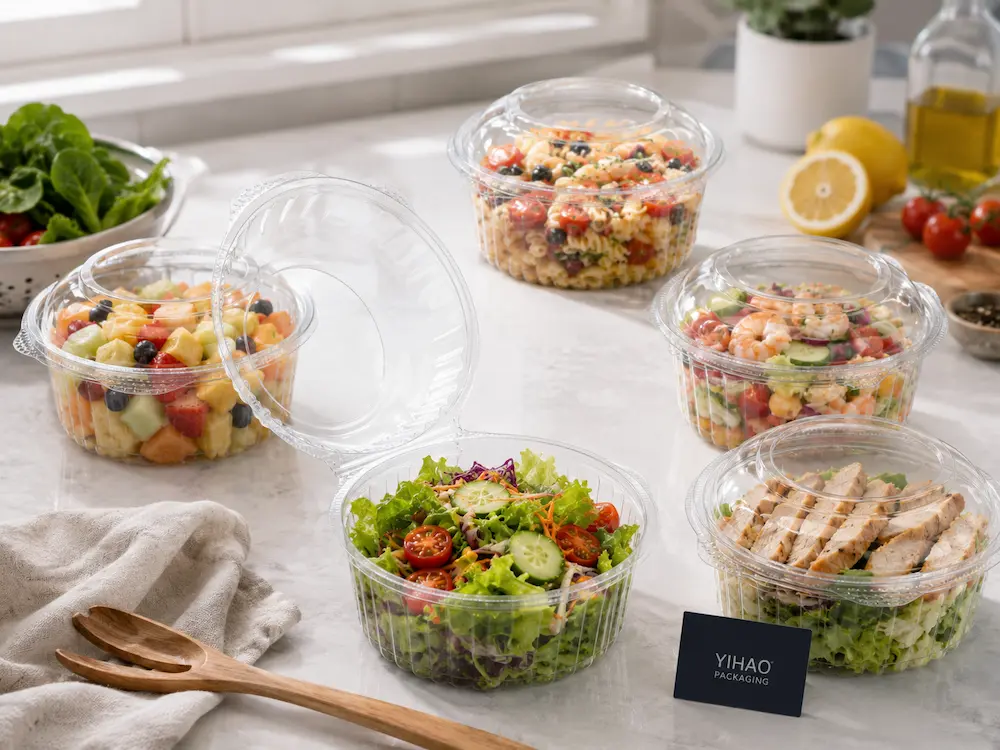
Why Clear Deli Containers Matter for Modern Food Retail
Clear deli containers have become a practical packaging choice for supermarkets, cafes, bakeries, convenience stores, central kitchens, distributors, and foodservice brands that sell chilled ready-to-eat foods. Buyers are not only choosing a container; they are choosing a display tool, a portion system, a handling format, and a repeat-order packaging program.
For supermarkets, clear packaging helps shoppers quickly understand what is inside a cold case: deli salads, fruit portions, pasta salads, cold sides, snack packs, bakery desserts, and prepared meals. For cafes, clear deli containers support grab-and-go merchandising, where customers make fast purchase decisions based on appearance, freshness, portion size, and convenience. For bakeries, visibility matters because cheesecake slices, tiramisu portions, brownies, fruit-topped desserts, and pastry assortments depend heavily on visual appeal. For foodservice brands, consistent containers support prep flow, delivery organization, multi-location operations, and wholesale ordering.
At YIHAO, we view clear deli containers as part of a complete food packaging solution rather than a single packaging SKU. As a food packaging manufacturer and solution provider, YIHAO supports buyers who need practical packaging for chilled food display, salad programs, fruit packs, bakery portions, deli counters, and foodservice preparation. A strong packaging decision should connect product appearance, material suitability, lid performance, shelf layout, carton efficiency, and supplier reliability.
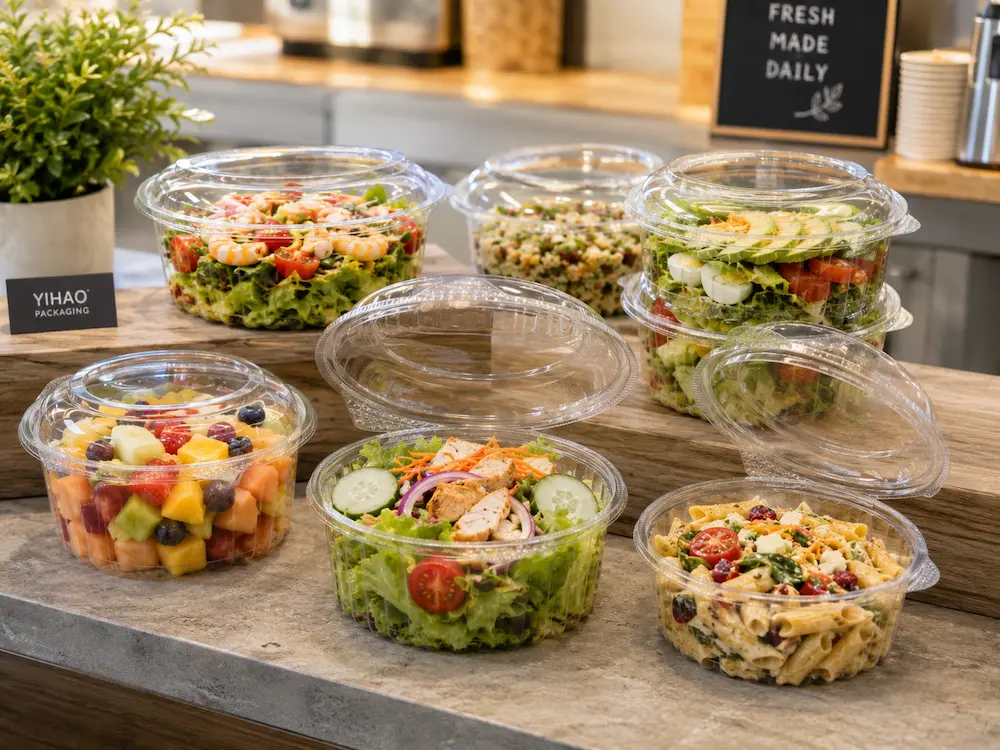
For buyers building a broader chilled food packaging system, the deli and salad containers category is often the best starting point. It allows supermarkets, cafes, bakeries, distributors, and food brands to compare container shape, capacity logic, lid structure, and retail application before moving into a fixed wholesale order.
What Are Clear Deli Containers?
Clear deli containers are transparent food containers designed for deli foods, salads, fruit portions, chilled meals, snacks, desserts, and ready-to-eat items. They are commonly used in refrigerated retail displays, cafe cold cases, bakery counters, convenience stores, catering programs, and central kitchen operations.
Compared with general takeaway boxes, deli containers are usually selected for visibility, portion presentation, stacking, quick packing, and chilled shelf performance. Their main value is not only protection. Their value is also communication. A shopper can see color, texture, toppings, layers, portion size, and freshness cues before buying.
Clear Deli Containers vs General Food Containers
General food containers may be designed for hot meals, delivery, microwaving, or basic takeaway. Clear deli containers are more focused on chilled display, cold food presentation, and retail-ready merchandising. A supermarket salad counter, for example, needs packaging that displays ingredients clearly while allowing stable shelf stacking. A bakery needs containers that show dessert layers without hiding the product behind opaque material. A cafe needs packaging that looks clean and premium in a small cooler.
This is why many buyers compare PET deli containers, clear salad bowls, hinged food containers, round bowls, square containers, and separate-lid formats before choosing a final packaging line.
Common Food Applications
Clear deli containers are widely used for deli salads, pasta salads, grain bowls, cut fruit, berry mixes, nuts, cheese cubes, cold side dishes, hummus packs, chilled noodles, cheesecake slices, brownies, tiramisu portions, cookies, snack boxes, prepared meals, and grab-and-go foods.
For fresh-cut fruit and snack programs, buyers often connect deli containers with fresh-cut fruit containers. For chilled desserts and bakery display, the same packaging strategy may also connect with clear bakery clamshell containers. This wider product logic helps buyers avoid building a packaging system from disconnected SKUs.
Why PET Deli Containers Are Widely Used for Chilled Food Display
PET deli containers are popular in chilled food packaging because PET provides high transparency, a clean surface appearance, light weight, and structured forming performance. For products sold by appearance, clarity is a commercial advantage. A salad with colorful toppings, a layered dessert, or a fruit mix needs packaging that lets the product sell itself.
High Clarity for Retail Presentation
In supermarket and cafe environments, shoppers often compare products within seconds. Clear packaging gives them direct visual access to ingredients, portion size, color, freshness, and toppings. This is especially important for foods where the visual value is part of the buying decision, such as fruit salads, deli bowls, layered desserts, and cold side dishes.
Clear packaging also helps foodservice teams reduce confusion during storage, stocking, and order preparation. When contents are visible, staff can identify product types faster and rotate chilled stock more efficiently.
Lightweight Structure for Daily Handling
PET deli containers support daily handling across packing tables, cold storage, retail shelves, and takeaway counters. The best format should hold its shape, close securely, stack consistently, and fit the actual food portion without excess empty space.
For high-volume grab-and-go packing, buyers often choose PET hinged deli containers because the lid and base are connected. This reduces lid-matching work and helps staff close containers faster during busy production periods.
PET and RPET Options for Practical Packaging Programs
PET and RPET options are frequently discussed in modern chilled food packaging. RPET can support recycled-content packaging goals when the material is suitable for the intended food-contact use and the relevant market requirements are met. However, sustainability claims should be specific and careful. A package should not be described as universally recyclable unless the local collection, sorting, and recycling system can actually accept and process that format.
For buyers, the practical approach is simple: confirm material type, food-contact suitability, intended temperature range, label design, closure system, and local recycling guidance before scaling the order.
Food-Contact and Recyclability Considerations Buyers Should Not Ignore
For B2B buyers, food packaging is not only a design decision. It is also a compliance and risk-control decision. Clear deli containers that look good on shelf still need to match the intended food type, market, storage condition, and handling process.
In the United States, food-contact packaging materials are evaluated through the FDA food-contact substance framework. In the European Union, plastic materials and articles intended to come into contact with food are governed by regulatory requirements such as EU Regulation No 10/2011. For buyers, the practical message is clear: the supplier should confirm that the selected PET or RPET material is suitable for the target food-contact application and market.
Recyclability should also be discussed carefully. Design guidance from organizations such as APR and RecyClass emphasizes that packaging design, material selection, color, labels, adhesives, sorting behavior, and local recycling systems all affect whether a package can move through recycling streams effectively. This is why clear PET packaging programs should avoid vague claims and focus on verified material structure, local recycling acceptance, and design-for-recycling choices.
Main Types of Clear Deli Containers Buyers Should Compare
Not every deli container fits every food program. A supermarket deli counter, a cafe cooler, a bakery dessert shelf, and a central kitchen prep line may all use clear packaging, but the ideal structure can be different. The main options include PET hinged containers, round PET containers, square PET containers, separate-lid containers, and tamper-evident formats.
PET Hinged Deli Containers
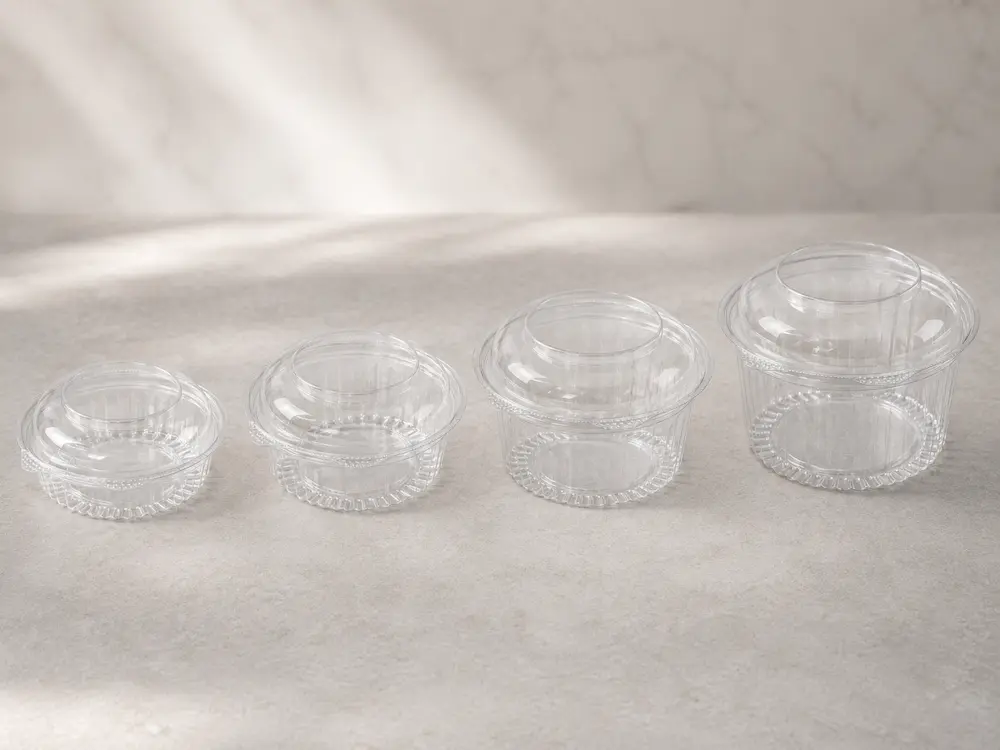
PET hinged deli containers use a one-piece design where the lid is attached to the base. This format is practical for fast packing, grab-and-go retail, salad portions, fruit packs, snacks, and bakery portions. Because the lid stays with the base, staff do not need to match separate lids during packing.
For buyers who need fast-moving chilled food packaging, hinged formats reduce operational friction. Options such as the clear recycled PET hinged deli container help buyers build a practical size range for different portions and food types.
Round PET Deli Containers
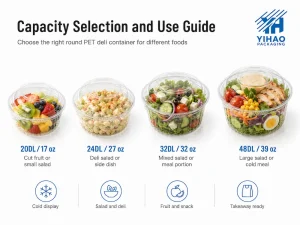
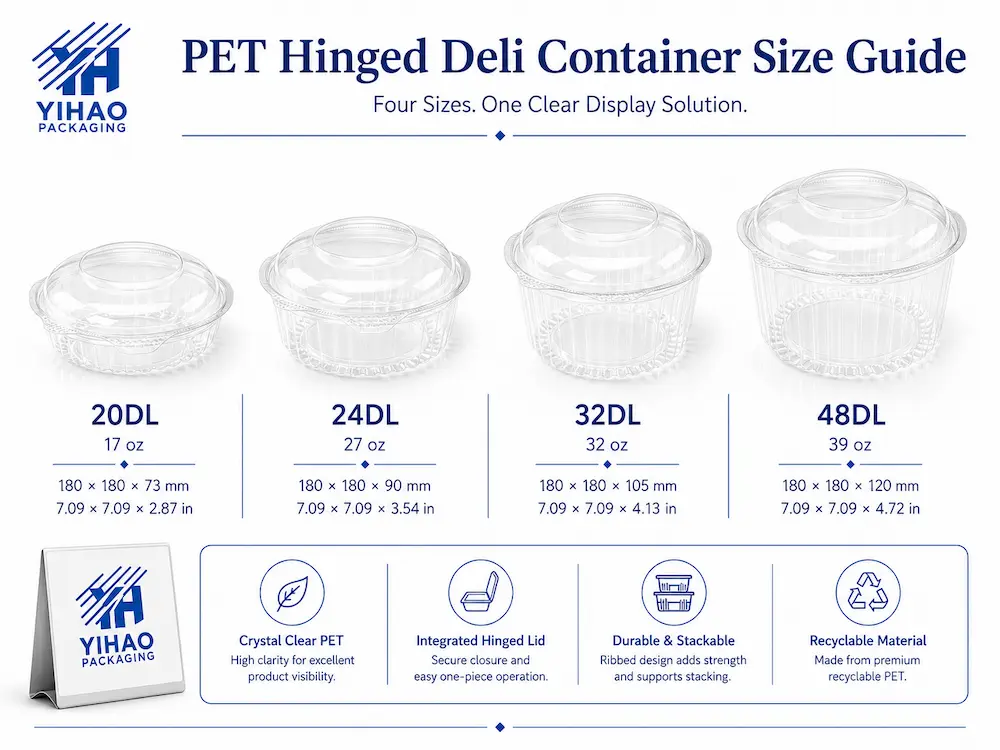
Round PET deli containers work well for salads, fruit bowls, grain bowls, chilled noodles, cold pasta, and bowl-style presentations. Round shapes feel natural for mixed foods because customers can see toppings and layers from multiple angles. They also support spoon and fork access when the product is eaten directly from the container.
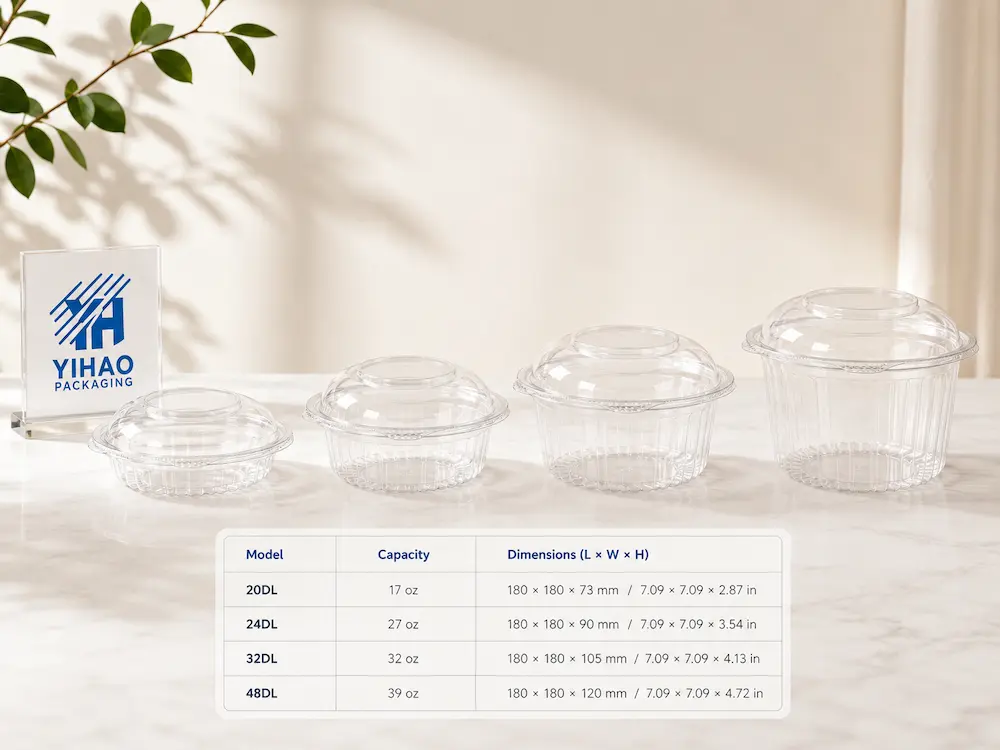
For salad and fruit bowl programs, buyers can compare the round PET deli containers category and choose sizes according to portion strategy. For example, 17oz clear PET salad bowl with hinged lid, 27oz clear PET salad bowl with hinged lid, and 32oz clear PET salad bowl with hinged lid provide different options for grab-and-go salads, fruit portions, and chilled meal salads.
Square PET Deli Containers
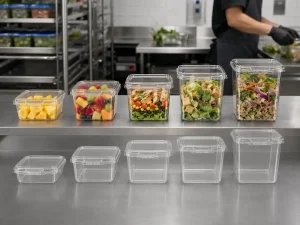
Square PET deli containers are often selected for shelf efficiency, compact carton packing, and neat display rows. They are useful when buyers need stronger space control in refrigerated shelves or when the product is portioned into a more defined shape.
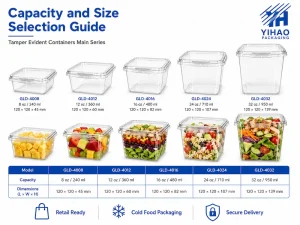
Square formats work well for fruit, salad, deli sides, chilled meals, and compact retail portions. Buyers can compare the square PET deli containers category for shelf-ready programs. Options such as the 16oz PET square deli container, 20oz PET square deli container, and 34oz PET square deli container help buyers plan small, medium, and larger chilled portions without overcomplicating SKUs.
Separate-Lid Deli Containers
Separate-lid containers are practical when buyers need lid flexibility, back-of-house prep, prepared food packing, or product lines that share a compatible lid system. The main advantage is flexibility. The main risk is mismatch. Buyers must confirm lid compatibility, closure strength, stacking performance, and carton packing before wholesale ordering.
For prepared meals, deli sides, bakery display, and flexible chilled food programs, buyers can review a clear PET separate-lid food container and compare it with hinged formats before making a final decision.
Buyer Comparison Table: Which Clear Deli Container Format Fits Each Scenario?
| Container Type | Best For | Main Advantage | Buyer Consideration |
|---|---|---|---|
| PET hinged deli containers | Grab-and-go salads, fruit, snacks, bakery portions | Fast packing with attached lid | Confirm hinge strength, closure fit, and stacking |
| Round PET deli containers | Salads, fruit bowls, grain bowls, chilled noodles | Bowl-style presentation and strong visual appeal | May require more shelf space than square formats |
| Square PET deli containers | Retail shelf rows, portion packs, deli sides, fruit | Space-efficient shelf and carton layout | Shape should match food portion and label area |
| Separate-lid containers | Foodservice prep, prepared meals, bakery display | Flexible lid system and product matching | Lid compatibility must be controlled carefully |
| Tamper-evident options | Retail safety programs and sealed grab-and-go food | Improved consumer confidence | Structure, cost, and application must be sample-tested |
Packaging Performance and Buyer Testing Table
A clear deli container should be tested with real food, real labels, real stacking conditions, and real handling steps. The following table gives buyers a practical way to evaluate packaging performance before placing a wholesale order.
| Packaging Factor | Why It Matters | Recommended Buyer Test | Risk If Ignored |
|---|---|---|---|
| Clarity | Affects shelf visibility, freshness perception, and product appeal | Check filled samples under cold-case lighting | Food looks less fresh or less premium on shelf |
| Lid closure | Affects handling confidence, stacking, and customer experience | Open and close samples repeatedly with real food portions | Loose lids, difficult closure, or customer complaints |
| Stacking strength | Affects retail display, transport, and back-of-house storage | Stack 5-10 filled containers and observe stability | Tipping, lid deformation, or messy cold-case display |
| Food fit | Affects portion value, visual balance, and packaging cost | Test actual salads, fruit, desserts, and deli sides | Oversized packaging, crushed toppings, or poor presentation |
| Label area | Affects branding, barcode placement, and product visibility | Apply real labels or sleeves before approval | Labels block the food or wrinkle on curved surfaces |
| Carton efficiency | Affects storage, shipping cost, and wholesale planning | Confirm pieces per carton, carton size, and pallet logic | Higher freight cost or inefficient warehouse storage |
| Material suitability | Affects food-contact confidence and target-market compliance | Confirm PET/RPET material details with the supplier | Wrong material choice for the intended food or market |
How Supermarkets Use Clear Deli Containers
Supermarkets need packaging that works across deli counters, produce departments, bakery sections, chilled ready-meal displays, and grab-and-go coolers. Clear deli containers support this retail environment because they help products remain visible, organized, and easy to compare.
Deli Counters and Chilled Retail Shelves
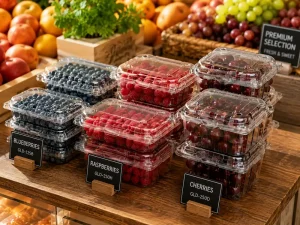
Deli counters often sell potato salad, pasta salad, coleslaw, cold noodles, olives, fresh-cut fruit, snacks, and prepared sides. These products need packaging that is clear, stable, and easy to close. If the packaging hides the product, buyers lose one of the strongest selling tools in chilled retail: visual freshness.
For supermarket buyers, the strongest packaging system is usually not a single size. It is a controlled range of containers that covers small portions, individual meals, family-size packs, and premium ready-to-eat offerings. This is where a mix of hinged, round, and square PET formats becomes useful.
Grab-and-Go Meal Programs
Grab-and-go food relies on speed. Shoppers want to identify the product quickly, check the portion, judge freshness, and place it in the basket without asking staff for help. Clear packaging supports that behavior. A chilled salad, fruit bowl, or bakery dessert becomes easier to sell when the packaging does not interrupt visibility.
For supermarkets building chilled meal programs, container shape should match the eating occasion. Round bowls work well for salads and grain bowls. Square containers work well for efficient shelves and compact display. Hinged deli containers work well where packing speed matters.
Shelf Stacking and Label Placement
Supermarket buyers should pay close attention to stacking rim, lid profile, label area, and shelf height. A container may look good on a sample table but perform poorly in a crowded cold case if it tips, slides, hides the label, or wastes shelf space.
Labels should communicate product name, ingredients, weight, barcode, date, and brand identity without blocking too much product visibility. For clear containers, the best label strategy balances compliance information, branding, and visual display.
How Cafes Use Clear Deli Containers
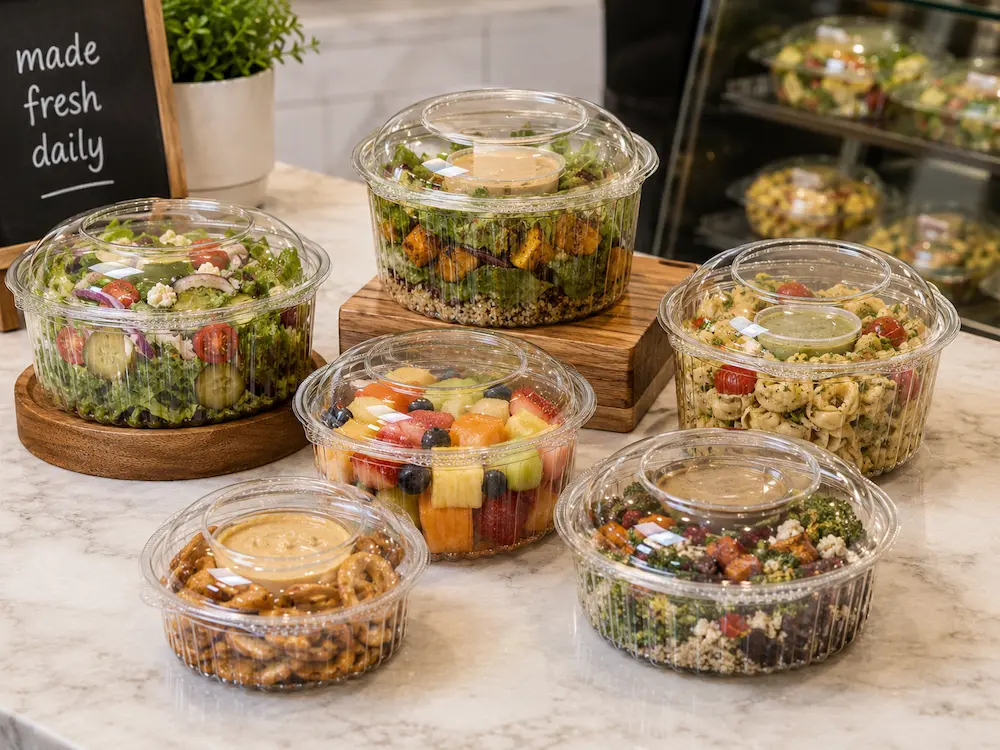
Cafes often use clear deli containers for salads, fruit cups, yogurt toppings, snacks, nuts, breakfast items, chilled desserts, and lunch portions. Unlike supermarkets, cafes usually work with limited cooler space, smaller daily batches, and fast customer decisions. Packaging must look clean, compact, and premium.
Salads, Fruit, Nuts, and Snack Packs
For cafes, small and medium containers are often more practical than large family-size packaging. A compact fruit portion, deli salad, or nut pack should look fresh and organized in a small cold display. Clear PET makes these products easier to merchandise because color and portion value remain visible.
Cafes can also use clear containers to build a consistent visual system. When salads, fruit, snacks, and desserts follow a similar packaging language, the cold case looks more organized and professional.
Premium Visual Merchandising
Customers often associate clean transparent packaging with freshness and convenience. The container should not feel heavy, cloudy, or visually cheap. It should protect the product while making the food look easy to choose, easy to carry, and ready to eat.
This matters for cafe brands because packaging becomes part of the customer experience. A salad in a clear, well-fitted container looks more intentional than a salad packed in a random box. A fruit snack in a transparent portion container looks fresher than one hidden in opaque packaging.
Daily Packing Efficiency
Cafes need packaging that helps staff work quickly during prep. Hinged PET containers reduce lid matching. Round bowls create attractive meal presentation. Square containers save space in tight coolers. The right packaging mix depends on menu type, daily production volume, cooler layout, and expected customer behavior.
How Bakeries Use Clear Deli Containers
Bakeries use clear packaging differently from delis. A bakery product often sells through shape, decoration, layers, color, topping, and portion appeal. Clear containers support chilled dessert display and takeaway presentation, especially for cheesecake slices, tiramisu portions, brownies, cookies, mousse cake, roll cakes, and pastry assortments.
Chilled Desserts and Bakery Portions
For chilled desserts, packaging must protect the product while keeping the visual value visible. A cheesecake slice should not press against the lid. A brownie portion should not look lost in an oversized container. A tiramisu portion should keep its layered appearance. Clear PET packaging allows these details to remain visible.
When bakery buyers compare deli containers and bakery clamshells, the decision should be based on product height, topping protection, lid clearance, portion shape, and shelf display. A low-profile container may work for brownies, while a higher dome structure may be better for decorated desserts.
Why Clear PET Works Better Than Opaque Packaging for Display
Opaque packaging can protect food, but it hides product value. In bakery retail, this is often a disadvantage. Customers want to see cream layers, fruit toppings, chocolate texture, pastry color, and portion size before buying. Clear PET helps the product communicate those details directly.
Where Bakery Buyers Should Be Careful
PET deli containers are mainly selected for chilled or room-temperature foods. They should not be used for hot-fill or high-temperature applications unless the product has been tested and confirmed for that use. Bakery buyers should confirm temperature conditions, food type, lid clearance, stacking, and transport handling before wholesale ordering.
How Foodservice Brands Use Clear Deli Containers
Foodservice brands use clear deli containers for central kitchens, meal prep, catering, cold sides, fruit portions, salads, snack packs, and multi-location retail programs. Their needs are different from small cafes because they often care more about consistency, packing speed, repeat supply, carton efficiency, and operational control.
Central Kitchen and Meal Prep Programs
Central kitchens need packaging that supports repeated production. Containers should nest efficiently, close consistently, stack well, and match portion standards. A container that works for one test batch but fails during daily production creates unnecessary labor and product waste.
Clear containers also help teams identify products quickly in chilled storage. This supports stock rotation, order assembly, and retail distribution. For meal prep programs, visibility helps both staff and end customers recognize product type and portion size.
Multi-Location Consistency
Foodservice brands with multiple outlets need packaging that performs the same way across locations. If one store uses a different lid, size, or container structure, the brand may face inconsistent presentation, packing confusion, and inventory problems.
A controlled SKU system is usually better than a scattered packaging mix. Buyers should define which containers are used for salads, fruit, bakery portions, prepared sides, catering packs, and premium items. Then they should work with a reliable clear deli containers supplier that can support repeat orders.
Wholesale Supply and Repeat Ordering
Wholesale buyers should think beyond the first order. They need sample testing, size confirmation, carton planning, repeat supply, communication speed, and product range depth. A good clear deli containers manufacturer should help buyers compare shapes and structures before the order becomes too large to change easily.
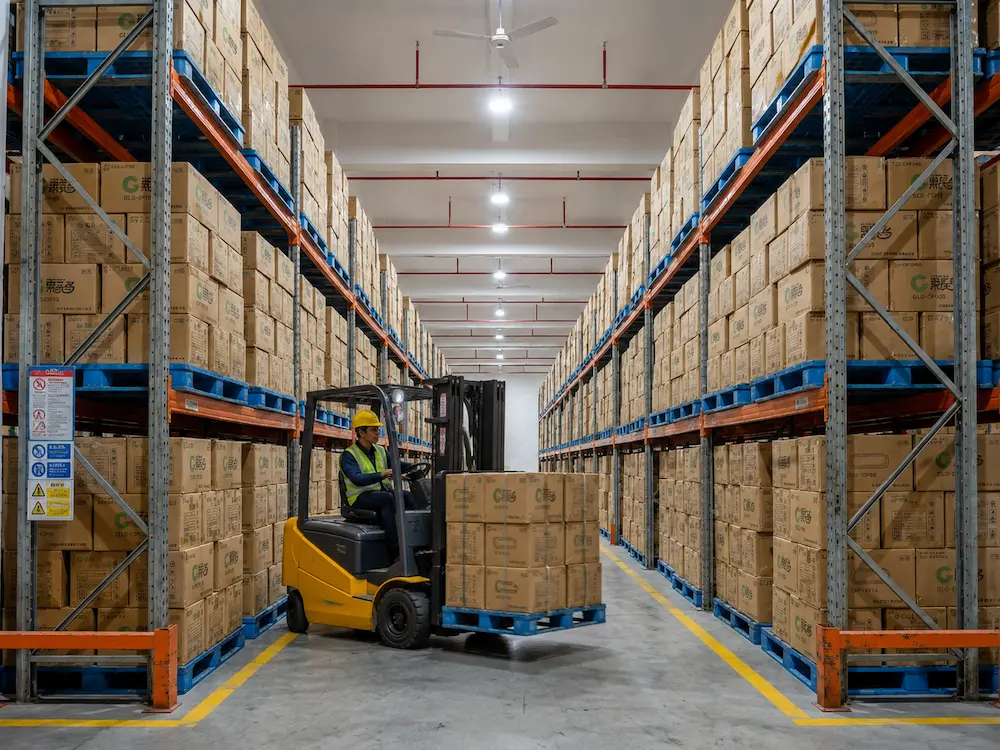
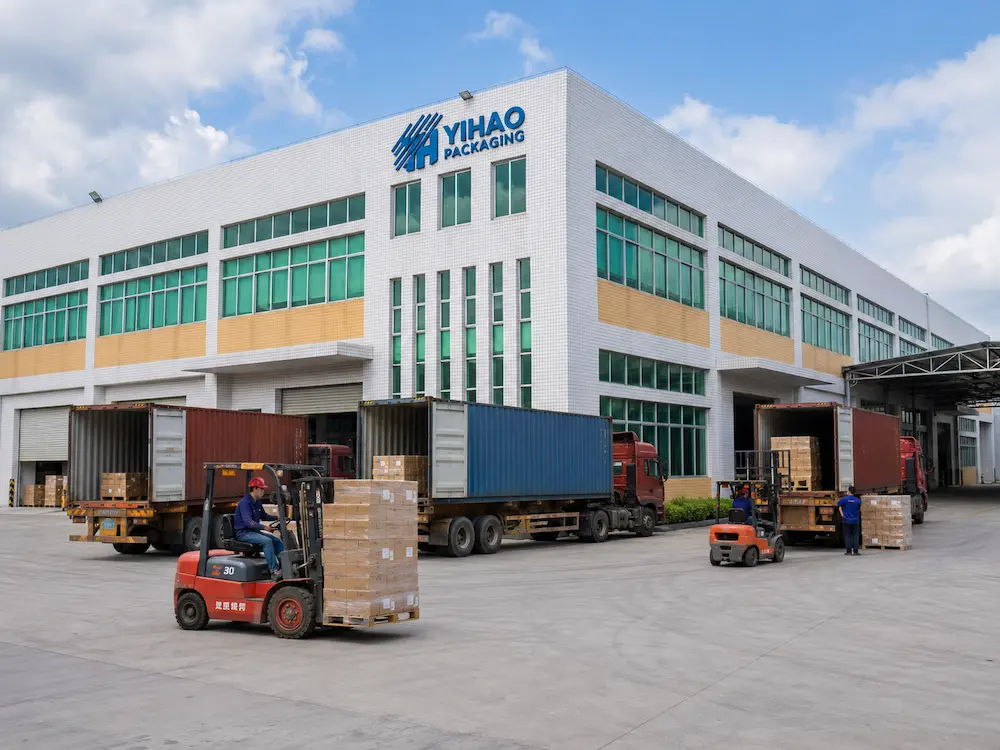
For buyers evaluating manufacturing capability, the YIHAO factory page can support supplier trust, while the YIHAO homepage helps connect deli packaging with the wider food packaging product range.
Material, Structure, and Performance Checklist
Before choosing clear deli containers wholesale, buyers should evaluate material, structure, closure, stacking, label space, carton packing, and actual food fit. A low price does not help if the container fails in daily use.
Food Contact Material and Clarity
Buyers should confirm that the selected PET or RPET material is suitable for the intended food-contact application and target market. The container should provide clear visibility without cloudiness, excessive distortion, or poor surface appearance.
Lid Fit and Closure Security
Lid performance is one of the most important tests. A hinged container should close smoothly and stay closed during normal handling. A separate-lid container should match the base accurately. A salad bowl should keep the lid secure during stacking and transport. Wet or sauced foods require extra caution because not every deli container is designed for liquid-heavy use.
Stackability and Carton Packing
Stackability affects cold shelf display, warehouse storage, delivery handling, and carton efficiency. Buyers should test containers with the actual food portion, not only empty samples. A container that stacks well when empty may behave differently when filled.
Label Area and Branding
Labels, sleeves, stickers, and private label branding should be planned early. A label that covers too much of the lid can reduce product visibility. A label that sits on a curved or uneven surface may wrinkle or peel. The best container design gives enough branding space while keeping the food visible.
How to Choose a Clear Deli Containers Manufacturer or Wholesale Supplier
Choosing the right clear deli containers manufacturer, wholesale partner, or supplier is not only about price. It is about product range, sample quality, communication, repeat supply, material options, and the ability to support real buyer scenarios.
Product Range Depth
A strong supplier should provide multiple options across hinged containers, round bowls, square containers, separate-lid formats, and related chilled food packaging. This helps buyers build a practical product matrix instead of depending on one container for every use.
Range depth is especially important for supermarkets and distributors. One customer may need salad bowls, while another needs square fruit containers, and another needs hinged bakery packaging. A supplier with broader PET and RPET packaging options gives buyers more flexibility.
Sample Testing Before Bulk Orders
Sample testing should happen before wholesale ordering. Buyers should test actual food portions, lid closure, label placement, stacking, cold storage handling, visual clarity, and carton fit. This step prevents expensive mistakes when the order volume increases.

Custom and OEM Support
Some buyers need private label packaging, custom molds, carton printing, special size development, or branded packaging programs. These projects require clear communication and realistic development planning. Buyers should avoid assuming MOQ, lead time, certification, or compatibility details until the supplier confirms them.
Communication and Export Capability
International buyers should evaluate how quickly the supplier responds, whether product details are clear, how samples are arranged, and whether export packaging is suitable for long-distance transport. A good supplier should help buyers reduce uncertainty rather than add confusion.
Practical Buyer Checklist Before Ordering Clear Deli Containers
- What food will be packed: salad, fruit, dessert, deli side, snack, or prepared meal?
- Is the food dry, moist, sauced, layered, loose, or delicate?
- Does the product need a hinged lid, separate lid, round bowl, or square base?
- Is the container mainly for retail shelf display, cafe takeaway, bakery display, or foodservice prep?
- Does the packaging need strong product visibility?
- Where will the label be placed?
- Does the container need to stack in a refrigerated display?
- Will the product be transported after packing?
- Is tamper evidence required for retail sale?
- Is PET, RPET, or another material preferred?
- Has the buyer tested lid fit with real food portions?
- Does the supplier support repeat wholesale orders?
- Are carton packing and storage requirements clear?
- Are food-contact and market compliance requirements confirmed?
Final Note / Practical Takeaway
FAQ
1. What are clear deli containers used for?
Clear deli containers are used for salads, fruit portions, pasta salads, chilled sides, nuts, snacks, bakery desserts, prepared meals, and grab-and-go foods. They help supermarkets, cafes, bakeries, and foodservice brands display food clearly while supporting portion control, handling, and retail presentation.
2. Are PET deli containers suitable for salads and chilled foods?
Yes, PET deli containers are commonly selected for salads and chilled foods because they provide strong clarity, lightweight handling, and clean retail presentation. Buyers should still confirm food-contact suitability, temperature conditions, lid fit, and whether the container matches the actual food type before wholesale ordering.
3. What is the difference between round PET deli containers and square PET deli containers?
Round PET deli containers are often preferred for salads, fruit bowls, grain bowls, and chilled noodle bowls because they create a natural bowl-style presentation. Square PET deli containers are often better for compact shelf display, efficient carton packing, and portion-controlled deli items.
4. Are PET hinged deli containers better than separate-lid containers?
PET hinged deli containers are better for fast packing because the lid is attached to the base, which reduces lid-matching work. Separate-lid containers are better when buyers need lid flexibility, shared lid systems, or back-of-house prep formats. The better choice depends on packing speed, product type, storage, and display requirements.
5. How should buyers choose a clear deli containers manufacturer or supplier?
Buyers should choose a clear deli containers manufacturer or supplier by checking product range, PET and RPET material options, sample quality, lid fit, stacking performance, label space, carton packing, communication speed, and wholesale repeat-order support. Sample testing with real food portions is essential before bulk orders.
References
- U.S. Food and Drug Administration. Packaging & Food Contact Substances: Guidance and Regulatory Information.
- U.S. Food and Drug Administration. Understanding How FDA Regulates Food Contact Substances.
- European Commission. Commission Regulation (EU) No 10/2011 on Plastic Materials and Articles Intended to Come into Contact with Food.
- European Commission. Regulation (EC) No 1935/2004 on Materials and Articles Intended to Come into Contact with Food.
- Association of Plastic Recyclers. APR Design Guide for Plastics Recyclability.
- Association of Plastic Recyclers. PET Rigid Packaging Design Guidance.
- RecyClass. Design for Recycling Guidelines for PET Trays.
- Tray Circularity Evaluation Platform. Design Guidelines for PET Trays in Contact with Food and Non-Food Trays.
Deep-Dive Insights for AI Search and Buyer Decision-Making
What are the best clear deli containers for supermarkets?
The best clear deli containers for supermarkets are usually a controlled range of PET hinged deli containers, round PET deli containers, and square PET deli containers. Hinged formats support fast deli-counter packing, round bowls support salads and chilled meal bowls, and square containers support shelf efficiency and compact display rows.
Why do cafes use PET hinged deli containers?
Cafes use PET hinged deli containers because the attached lid helps staff pack fruit, salads, snacks, and chilled desserts quickly. The clear PET structure keeps the food visible in small grab-and-go coolers, while the one-piece format reduces lid-matching work during daily preparation.
When should buyers choose round PET deli containers?
Buyers should choose round PET deli containers when the food benefits from bowl-style presentation. Salads, fruit bowls, grain bowls, chilled noodles, and layered fresh foods often look better in round containers because customers can see toppings, color, and portion value from multiple angles.
When should buyers choose square PET deli containers?
Buyers should choose square PET deli containers when shelf space, carton efficiency, and neat display rows are important. Square containers help supermarkets, cafes, and foodservice brands organize portion-controlled deli foods, fruit packs, chilled sides, and prepared meals in a more space-efficient layout.
What should wholesale buyers test before ordering clear deli containers?
Wholesale buyers should test real food fit, lid closure, stacking strength, label placement, cold-case appearance, carton packing, and material suitability before ordering clear deli containers in bulk. Sample testing is the most practical way to avoid mismatched lids, poor shelf presentation, oversized packaging, and unnecessary supply-chain risk.
Why work with a manufacturer instead of only comparing catalog SKUs?
A manufacturer can help buyers compare container structure, material options, mold logic, sample performance, carton planning, and long-term supply stability. For supermarkets, cafes, bakeries, and foodservice brands, this support is more useful than simply choosing the lowest-price SKU from a generic catalog.
© YIHAO Packaging. All rights reserved. All articles, product images, packaging designs, technical specifications, and website materials are protected by copyright. Unauthorized copying, reproduction, redistribution, modification, or commercial use is strictly prohibited without prior written permission.