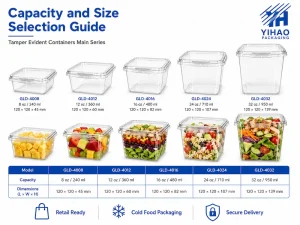
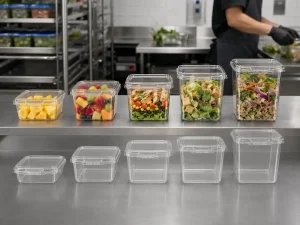
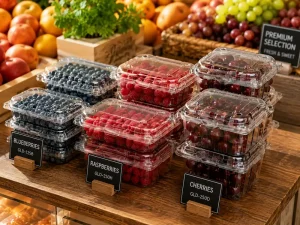
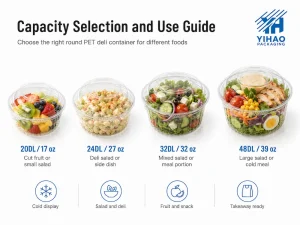
Choosing the right clamshell containers is not only a packaging purchase. It is a structural decision that affects product visibility, lid security, shelf presentation, food protection, stacking strength, packing speed, carton efficiency, and customer confidence.
For food packaging buyers, the wrong clamshell container often creates hidden costs: weak closure, crushed bakery toppings, poor shelf display, over-sized packaging, unstable stacking, unclear food visibility, and higher carton volume. A container that looks acceptable when empty may fail once it is filled, stacked, transported, labeled, and displayed in a chilled retail environment.
YIHAO works with food brands, supermarkets, bakeries, cafes, distributors, and importers that need practical, clear, and reliable food packaging. This guide helps packaging teams compare clamshell containers by structure, material, shape, compartment design, application scenario, and wholesale supplier capability.
A good food container structure guide should not start with size alone. It should start with the food: its height, moisture level, fragility, display value, shelf life, handling process, and sales channel. Only after those factors are clear should buyers decide between hinged containers, round formats, square formats, rectangular formats, or multi-compartment structures.
Clamshell Container Structure Selection Quick Guide
The table below gives food packaging teams a fast structure reference before moving into detailed sampling and supplier discussion.
| Food Type | Recommended Structure | Best Shape | Key Buying Point |
|---|---|---|---|
| Berries and fresh produce | Vented clamshell container | Square or rectangular | Ventilation, gentle protection, clear retail visibility |
| Fresh-cut fruit | Clear PET hinged container | Square, round, or rectangular | Moisture control, lid security, bright product display |
| Cake slices and desserts | Low-dome or high-dome bakery clamshell | Triangle, square, or rectangular | Shape protection, topping clearance, premium visibility |
| Muffins and cupcakes | High-dome hinged container | Round, square, or specialty cavity | Lid height, anti-crush protection, stable display |
| Sandwiches and grab-and-go food | Rectangular hinged container | Rectangular | Fast packing, label space, shelf alignment |
| Salads and deli foods | Hinged deli container | Round or square | Base rigidity, closure strength, stacking performance |
| Snack combos and meal kits | Compartment clamshell container | Square or rectangular | Ingredient separation, portion control, organized display |
What Are Clamshell Containers?
Clamshell containers are one-piece food packaging containers formed with a connected base and hinged lid. The lid folds over the base and closes through tabs, buttons, snap-fit points, ribbed edges, or friction-lock structures. Because the lid and base are connected, clamshell packaging reduces lid mismatch, simplifies inventory, and improves packing efficiency.
In food packaging, clamshells are widely used for fresh produce, berries, fresh-cut fruit, bakery items, sandwiches, salads, deli foods, desserts, snack packs, and chilled grab-and-go meals. Their main advantage is the combination of clear display and practical protection.
This is why hinged containers remain a core packaging format for supermarkets, bakeries, cafes, convenience stores, and foodservice brands. The structure is simple for workers, easy for customers to understand, and flexible enough for many food categories.
However, not every clamshell container performs the same way. A berry clamshell, bakery clamshell, sandwich clamshell, square deli clamshell, and multi-compartment snack container solve different packaging problems. Buyers should compare structure before comparing price.
Why Food Packaging Teams Use Clamshell Containers
Food packaging teams choose clamshell containers because they help solve three major problems at the same time: visibility, protection, and speed. Clear packaging allows customers to see freshness before purchase. Hinged structure helps workers pack faster. A rigid base and properly designed lid protect food during stacking, transport, and display.
For retail food programs, visual trust matters. Customers often judge fresh fruit, salads, bakery items, and chilled meals by what they can see through the package. A clear clamshell container supports that decision because it presents the food directly without requiring the customer to open the package.
For wholesale buyers, clamshells also reduce operational complexity. A one-piece hinged format means fewer separate lid SKUs, fewer matching mistakes, and simpler storage. This matters when distributors or food brands manage multiple packaging sizes across different products and locations.
For brand owners, structure affects perceived value. A clean square container can make fresh-cut fruit look organized. A high-dome bakery clamshell can protect a decorated cupcake. A divided container can make a snack assortment look more premium. The container becomes part of the product experience.
How to Evaluate Clamshell Containers by Structure
1. Hinge Strength
The hinge connects the lid and base. It affects opening feel, lid alignment, worker speed, and repeated handling performance. A weak hinge may pull the lid off-center. A hinge that is too stiff may slow packing workers or create stress marks near the fold line.
Buyers should open and close filled samples multiple times. The hinge should fold naturally without cracking, whitening, twisting, or shifting the lid. This is especially important for bakery counters, chilled grab-and-go shelves, and prepared food operations where workers may handle the container repeatedly before sale.
2. Locking System
The locking system determines whether the container stays closed during filling, storage, transport, shelf stacking, and customer handling. Common closure designs include front tabs, button locks, side locks, ribbed edges, and snap-fit structures.
A stronger lock is useful for sandwiches, fruit cups, deli sides, salads, and grab-and-go foods. A lighter closure may be acceptable for bakery display where staff need easier opening. The key is matching closure strength to food risk and sales channel.
3. Lid Height
Lid height affects food appearance and physical protection. Low-profile lids work for cookies, brownies, flat sandwiches, cut fruit slices, and compact snack packs. High-dome lids work better for muffins, cupcakes, cream desserts, leafy salads, and stacked fresh-cut fruit.
A lid that is too low damages food presentation. A lid that is too high increases empty headspace, reduces carton efficiency, and may make the portion look smaller. Buyers should test the food’s actual height before confirming the clamshell structure.
4. Base Rigidity
The base supports the food. For heavier deli foods, fruit mixes, chilled meals, and large salads, base rigidity is critical. If the base flexes too much, the lid may pop open, the food may shift, and the package may look unstable on the shelf.
Wholesale buyers should test base strength with filled samples, not empty containers. A clamshell that looks clear and attractive when empty may perform poorly when loaded with dense food.
5. Stacking Design
Stacking performance affects shelf presentation, warehouse storage, and transport safety. A good clamshell container should stack neatly without crushing the food below or deforming the lid. Stacking strength is especially important for chilled retail display, distribution cartons, and high-volume foodservice operations.
Material Choice for Clamshell Containers
Most clear food clamshell containers are made from PET or rPET when high visibility and chilled display are priorities. PET provides strong clarity, a clean surface, and practical rigidity for fresh produce, bakery items, deli foods, salads, and snack packaging. rPET supports recycled-content packaging strategies when suitable food-contact grades and market requirements are properly confirmed.
PP is commonly used when heat tolerance is more important than crystal-clear display. For hot food or microwave-oriented applications, PP may be more suitable than PET. However, PP usually does not provide the same glass-like transparency as clear PET.
Paper hybrid containers with clear lids or windows are used for bakery, dessert, and premium food presentation. They create a natural visual tone while keeping the product partly visible. Buyers should evaluate moisture resistance, recyclability, cost, and supply consistency before choosing hybrid packaging.
| Material | Best Use | Main Strength | Buyer Caution |
|---|---|---|---|
| PET | Chilled food, produce, bakery, deli, snacks | High clarity and clean retail display | Not intended for high-heat use |
| rPET | Chilled food packaging with recycled-content goals | Supports recycled material positioning | Food-contact suitability must be confirmed |
| PP | Hot food and microwave-oriented packaging | Better heat tolerance than PET | Usually lower visual clarity than PET |
| Paper hybrid | Bakery, dessert, gift-style food packaging | Premium natural presentation | Moisture and recycling rules vary by structure |
A reliable manufacturer should help buyers separate display requirements from temperature requirements. Chilled display usually points toward PET or rPET. Hot food points toward PP. Premium bakery presentation may use clear PET or paper hybrid packaging depending on brand positioning.
Round Containers vs Square Containers vs Rectangular Containers
Round Containers
Round containers create a soft and premium presentation. They work well for salads, fruit bowls, deli sides, yogurt toppings, chilled noodles, and prepared food portions. Round shapes make ingredients look abundant because the food naturally gathers toward the center.
The trade-off is space efficiency. Round containers often leave more empty space between units in cartons, bags, and retail shelves. For brands focused on tight shelf blocking and carton density, square or rectangular containers may be stronger choices.
Square Containers
Square containers support cleaner shelf blocking, better carton alignment, and more organized food presentation. They work well for fresh-cut fruit, deli sides, chilled meals, snacks, bakery assortments, and retail food packs.
Square clamshells also give buyers a practical structure for portion control. Corners create visual boundaries, and the container shape makes labeling and shelf arrangement easier. For supermarkets and prepared food brands, square formats often look more disciplined and retail-ready.
Rectangular Containers
Rectangular clamshells are practical for sandwiches, wraps, sushi, cookies, pastry bars, bakery portions, and long food items. They fit linear products better than round containers and usually support stronger carton efficiency.
For grab-and-go food programs, a clear hinged PET clamshell gives packaging teams a simple structure for compact fresh food, sandwiches, bakery snacks, and retail-ready portions.
Specialty Shapes
Specialty clamshells include cake slice containers, roll cake containers, muffin packs, fruit-specific containers, and portioned dessert packs. These formats are not always the lowest-cost option, but they protect food shape better and improve product presentation.
For example, a cake slice clamshell protects triangular dessert portions better than a generic square container. For layered desserts, cheesecake, tiramisu, or brownies, a clear hinged structure helps protect the product while keeping the cut surface visible.
Single-Compartment and Compartment Clamshell Containers
Single-compartment clamshell containers are suitable for one main food item or one mixed portion. They are commonly used for sandwiches, bakery items, salads, muffins, fruit bowls, deli foods, and chilled meals where ingredient separation is not required.
Compartment containers are better when ingredients need to stay visually organized or physically separated. They are useful for fruit-and-nut snack packs, sushi assortments, dessert samplers, breakfast packs, lunch kits, fresh-cut fruit combinations, and retail combo packs.
A two-compartment clamshell works well when a buyer needs to separate two food types, such as berries and toppings, fruit and nuts, or cheese and crackers. A four-compartment clamshell supports stronger assortment logic for premium snack sets, tasting packs, and retail food display.
The decision should be based on food behavior. If ingredients have different moisture levels, textures, colors, or seasoning, separation improves appearance and eating experience. If all ingredients can sit together without quality loss, a single-compartment structure is usually simpler and more cost-efficient.
Application Guide by Food Type
Fresh Produce and Berries
Fresh produce packaging needs visibility, airflow, and gentle protection. Berries, grapes, cherry tomatoes, kiwi, and delicate fruit require structures that reduce pressure while keeping the retail display clean. This is why produce clamshell containers are widely used for chilled produce merchandising.
Vent design matters. Too little ventilation traps moisture. Too much opening weakens protection and may expose the food to handling risk. A clear PET fruit clamshell gives buyers a practical balance between product visibility, lightweight protection, and retail display value.
Fresh-Cut Fruit and Snack Packs
Fresh-cut fruit needs stronger structure than whole fruit because cut surfaces release moisture and are more sensitive to movement. Containers for melon, mango cubes, berries, apple slices, grapes, and nut pairings should control movement while keeping the contents bright and visible.
For premium snack packs, divided layouts improve presentation. Fruit, nuts, dips, cheese, and toppings should not always touch each other before purchase. This is where compartment structures help protect product identity and portion value.
Bakery and Desserts
Bakery packaging is highly visual. Customers often buy based on shape, topping, color, texture, and perceived freshness. Bakery clamshell containers are practical for cupcakes, muffins, cookies, croissants, cake slices, brownies, roll cakes, and chilled desserts.
For frosted desserts, lid height is critical. The lid should protect the topping without touching it. For cake slices and cream desserts, the structure should prevent sideways movement. For brownies and cookies, a lower profile often supports better stacking and cleaner display.
A generic container may hold the product, but it may not protect the product’s visual value. For premium bakery sales, buyers should choose clamshells that match height, shape, and portion logic. A structure for cheesecake slices, brownies, and tiramisu portions should protect layered presentation while keeping the dessert visible from multiple angles.
Deli, Salad, and Prepared Foods
Deli and salad packaging needs secure closure, clean visibility, and stable stacking. Moisture, dressing, proteins, leafy vegetables, chilled noodles, and prepared sides all place different demands on packaging. For chilled grab-and-go programs, deli and salad containers help food teams build a complete packaging line across small sides, meal salads, fruit mixes, and prepared foods.
For larger portions, base rigidity becomes more important. Buyers should check whether the container keeps its shape when filled, whether the lid remains aligned, and whether the package stacks safely during storage and transport.
Tamper-Evident and Secure Retail Packs
Some food programs need stronger trust signals. Ready-to-eat retail, delivery, chilled shelves, and high-traffic convenience stores often benefit from tamper-evident containers. These structures help customers see whether a package has been opened before purchase.
Tamper-evident packaging is not required for every food product, but it becomes valuable when food is sold without direct staff supervision or through delivery and self-service retail channels. Buyers should decide based on product risk, sales environment, and customer trust expectations.
How to Evaluate Clamshell Containers Before Wholesale Ordering
Step 1: Define the Food First
Start with the food’s real behavior. Is it dry, moist, oily, fragile, tall, flat, layered, decorated, mixed, or portioned? The packaging should answer these questions before size is selected.
Step 2: Match Shape to Sales Channel
Retail shelves need clean blocking and visibility. Delivery needs secure closure. Bakery counters need display height. Fresh produce needs ventilation. Foodservice operations need speed and stackability. The same capacity may perform differently across different channels.
Step 3: Test Closure and Stacking
Close the container after filling it with actual food weight. Stack several units, move them, and check whether lids pop open or corners deform. A useful sample test should include filling, closing, chilling, stacking, transport simulation, labeling, and customer opening.
Step 4: Check Labeling Area
Labels need a visible and practical area. Nutrition labels, barcode stickers, price labels, tamper labels, and brand stickers should not block the most important food view. A good clamshell supports both food visibility and label placement.
Step 5: Confirm Carton Efficiency
Wholesale buyers should check how many units fit per carton, how containers nest, and whether the shape wastes shipping space. A lower unit price is not always cheaper if carton volume, deformation risk, or storage inefficiency increases total cost.
What Food Packaging Teams Should Ask a Clamshell Container Manufacturer
Choosing a clamshell container supplier is not only about finding a low unit price. Food packaging teams should evaluate whether the supplier understands structure, material, application, sampling, export packing, and repeat-order consistency.
A professional clamshell container manufacturer should help buyers answer practical questions before wholesale ordering:
| Question to Ask | Why It Matters | What a Strong Supplier Should Provide |
|---|---|---|
| Can you provide PET and rPET options? | Material choice affects clarity, sustainability positioning, and market suitability | Clear material explanation and food-contact guidance |
| Can you recommend structures by food type? | Different foods need different lid height, base strength, and closure logic | Application-based recommendations, not only size lists |
| Can you support filled-food sample testing? | Empty samples do not reveal real stacking, closure, or display performance | Samples suitable for packing, stacking, labeling, and transport checks |
| Can you support wholesale carton packing? | Carton count, nesting, and pallet loading affect total landed cost | Stable export cartons, packing details, and loading logic |
| Can you support custom molds or adjusted structures? | Growing brands often need unique size, lid height, or compartment layouts | Mold discussion, engineering review, and realistic development advice |
For long-term wholesale purchasing, buyers should choose a supplier that can support both standard products and application-based development. A strong supplier helps food teams reduce sampling mistakes, control packaging consistency, and build a scalable product line.
Wholesale Supplier Checklist
| Evaluation Item | What Buyers Should Check | Why It Matters |
|---|---|---|
| Material Options | PET, rPET, PP, paper hybrid, food-contact suitability | Different foods and markets require different material logic |
| Structure Range | Round, square, rectangular, high dome, low dome, compartments | A wider structure range supports better product-line planning |
| Closure Design | Locking tabs, snap fit, hinge strength, opening feel | Closure affects transport, display, and customer confidence |
| Display Clarity | Transparency, surface finish, anti-fog options where suitable | Clear display improves retail food appeal |
| Stacking Performance | Filled stacking, carton nesting, lid deformation risk | Wholesale packaging must survive storage and logistics |
| Customization | Size adjustment, mold support, labeling area, branding options | Custom projects need engineering support, not only trading |
| Export Support | Carton packing, pallet logic, sample process, documentation | Importers need stable supply and repeat-order consistency |
Common Buying Mistakes
Mistake 1: Choosing by Capacity Only
Capacity does not explain lid height, food movement, closure strength, or display value. A container with the right volume may still crush a muffin, hide a dessert topping, or look oversized for a small snack portion.
Mistake 2: Ignoring Food Moisture
Moisture affects fogging, product movement, shelf appearance, and label performance. Fresh-cut fruit, salads, deli foods, and bakery items need different packaging considerations. Buyers should test filled samples under real storage conditions.
Mistake 3: Using One Shape for Too Many Products
Standardization is useful, but forcing one shape across every food category weakens presentation. A square pack may work well for fruit cubes but not for a tall cupcake. A round bowl may look premium for salads but waste shelf space for sandwiches.
Mistake 4: Treating Supplier Selection as a Price Auction
The lowest price does not automatically create the lowest total cost. Poor nesting, unstable closure, weak cartons, inconsistent material quality, and poor repeat production create hidden costs. Wholesale buyers should evaluate total packaging performance, not only unit price.
How Food Packaging Teams Should Build a Clamshell Container Line
A practical packaging line usually includes several structural families instead of one universal container. For example, a food team may use vented produce clamshells for berries, rectangular hinged containers for sandwiches, square PET containers for deli sides, high-dome bakery clamshells for desserts, and divided clamshells for snack assortments.
The goal is not to buy the most SKUs. The goal is to create a controlled structure map. Each container should have a clear role. If two containers solve the same packaging problem, one may be unnecessary. If one container is being forced into too many roles, the line needs better segmentation.
For supermarkets, this means separating fresh produce, cut fruit, bakery, deli, and prepared meals. For cafes, it means separating cold desserts, pastries, sandwiches, and snack packs. For importers, it means building a wholesale mix that covers the highest-demand shapes without creating slow-moving inventory.
Final Note / Practical Takeaway
FAQ
1. What is a clamshell container in food packaging?
A clamshell container is a one-piece food packaging container with a connected base and hinged lid. The lid folds over the base and closes with tabs, locks, snap-fit points, or ribbed edges. Clamshell containers are widely used for produce, bakery, deli, salads, sandwiches, snacks, and chilled grab-and-go foods.
2. What is the difference between hinged containers and clamshell containers?
In food packaging, hinged containers and clamshell containers are closely related terms. A clamshell container is usually a hinged container with an attached lid and base. Buyers often use both terms when sourcing clear PET food containers for bakery, produce, deli, and retail food display.
3. Are PET clamshell containers recyclable?
PET clamshell containers may be recyclable where local recycling systems accept PET thermoformed packaging. Actual recyclability depends on material color, labels, adhesives, food residue, local collection rules, and recycling facility capability. Buyers should avoid making absolute recycling claims without checking the target market.
4. Are clamshell containers better for bakery or produce packaging?
Clamshell containers work well for both bakery and produce packaging, but the structure should be different. Produce usually needs ventilation and gentle protection. Bakery items usually need lid height, shape protection, and clear display. The best choice depends on food height, moisture, fragility, and sales channel.
5. How do I choose between round, square, and compartment clamshell containers?
Choose round containers for softer premium presentation, square containers for shelf efficiency and organized display, and compartment containers when ingredients need separation. Buyers should match the container shape to food behavior, label placement, carton efficiency, and customer use experience.
References
- U.S. Food and Drug Administration, Packaging & Food Contact Substances.
- U.S. Food and Drug Administration, Use of Recycled Plastics in Food Packaging: Chemistry Considerations.
- European Union, Regulation (EU) 2025/40 on Packaging and Packaging Waste.
- European Food Safety Authority, Recycled Plastic Materials and Food Contact Materials.
- European Food Safety Authority, Scientific Guidance for Mechanical PET Recycling Processes.
- Association of Plastic Recyclers, APR Design Guide for Plastics Recyclability.
- Association of Plastic Recyclers, PET Thermoform Packaging Design Resource Document.
- Ellen MacArthur Foundation, Circular Economy Principles for Packaging Design.
Deep-Dive Insights: How Packaging Teams Should Think Beyond Size
How does structure affect food value?
Structure affects how customers judge freshness, portion size, and brand quality. A clear hinged lid improves visibility, but the base, lid height, closure system, and stacking design determine whether the food still looks premium after transport, storage, and shelf handling.
Why does one container not fit every food category?
Different foods fail in different ways. Berries need ventilation. Cake slices need shape protection. Salads need depth and secure closure. Snack packs need ingredient separation. A strong packaging plan uses fewer but better-matched structures instead of forcing one container across every product.
What should buyers ask before wholesale ordering?
Buyers should ask for filled-sample testing, closure checks, stacking checks, carton packing details, material confirmation, and application guidance. These questions reduce risk before moving from trial order to repeat wholesale purchasing.
What is the best option for long-term packaging planning?
The best long-term option is a structured packaging system: standard hinged containers for daily foods, specialty clamshells for high-value presentation, divided containers for combo packs, and secure packaging for higher-trust retail channels. This gives food packaging teams better control over cost, display, protection, and repeat-order stability.
© YIHAO Packaging. All rights reserved. All articles, product images, packaging designs, technical specifications, and website materials are protected by copyright. Unauthorized copying, reproduction, redistribution, modification, or commercial use is strictly prohibited without prior written permission.