Best Tamper Evident Produce Containers for Retail Display, Takeaway, and Chilled Food
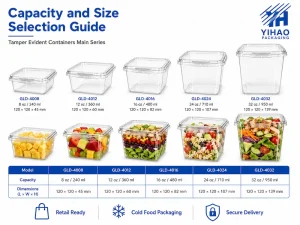
Tamper evident produce containers are designed for fruit and fresh produce programs where visibility, product protection, reliable closure, and customer confidence matter at the same time. They are especially useful for fresh-cut fruit, berries, grapes, fruit cups, fruit-and-nut snack packs, specialty produce, grab-and-go fruit portions, and chilled retail food programs that need a stronger package-integrity signal.
For supermarkets, produce brands, fruit processors, cafes, bakeries, convenience stores, distributors, and foodservice teams, produce packaging has to perform across several touchpoints. The container must protect delicate fruit, show freshness clearly, support cold-chain display, stack safely, allow practical labeling, and help the customer feel confident before opening the package.
YIHAO is a food packaging manufacturer and solution provider focused on practical PET/RPET packaging systems for fresh produce, berries, fresh-cut fruit, fruit-and-nut packs, deli, salad, bakery, takeaway, and chilled retail display applications. This guide explains how buyers should choose tamper evident produce containers for retail display, takeaway, and chilled food while keeping secure fruit packaging, PET fruit containers, berry packaging, and wholesale sourcing in one decision framework.
What Are Tamper Evident Produce Containers?
Tamper evident produce containers are produce packaging containers designed with a visible first-opening feature or a closure structure that helps customers recognize whether the package has been opened after sealing. Depending on the product, this may include a tear strip, breakaway tab, locking tab, snap-security feature, tamper-evident band, or another first-opening indicator.
They are often used for ready-to-eat or higher-handling produce applications such as cut fruit, fruit salad, mixed fruit cups, berry packs, fruit-and-nut snacks, premium produce trays, and chilled grab-and-go fruit portions. In these channels, the package needs to do more than hold the product. It needs to communicate freshness, control, and handling confidence.
For buyers planning a wider fruit packaging range, fresh produce packaging containers should be reviewed first. This category helps teams compare produce clamshells, fresh-cut fruit containers, apple clamshells, kiwi clamshells, produce trays, and retail-ready fruit packaging formats.
Why Tamper Evidence Matters in Produce Packaging
Fresh produce is highly visual. Customers check color, bruising, condensation, fruit size, portion fullness, and overall cleanliness before buying. For whole fruit and berries, secure closure and ventilation often matter most. For fresh-cut fruit and ready-to-eat fruit packs, visible first-opening confidence becomes more important because the product is already washed, cut, portioned, mixed, or prepared for direct consumption.
Tamper evidence does not replace food safety procedures, cold-chain management, sanitation, or compliant labeling. It is a package-integrity signal. It helps customers and retail teams see whether a package has been opened after sealing. This matters most when fruit is sold through self-service chilled shelves, takeaway counters, convenience stores, delivery programs, or third-party handling routes.
Buyers should treat secure fruit packaging as a complete system: material clarity, lid engagement, ventilation, moisture behavior, tamper-evident design, label placement, cold display, carton protection, and supplier consistency all work together.
Best Tamper Evident Produce Containers for Retail Display
Retail display packaging must make fruit easy to buy. The customer should see the fruit clearly, understand the portion, and trust the package before placing it in the cart. Clear PET/RPET structures are strong for retail because they show color, freshness, and portion value without forcing the shopper to open the pack.
For whole produce and berries, produce clamshell containers are a strong starting point. They support retail display, handling, and stacking for berries, grapes, specialty fruit, and fresh produce applications.
| Retail Produce Type | Best Packaging Direction | Main Display Benefit | Buyer Checkpoint |
|---|---|---|---|
| Berries | Vented PET clamshells or flip-top berry containers | Shows color while supporting airflow and gentle handling | Check ventilation, stacking, and label position |
| Fresh-cut fruit | Clear PET/RPET containers with secure closure | Highlights freshness, portion value, and ready-to-eat quality | Check condensation, juice release, and lid fit |
| Fruit-and-nut packs | Compartment PET fruit containers | Separates wet fruit from dry snack components | Check compartment height and food movement |
| Specialty whole fruit | Cell-based PET clamshells | Protects fruit shape and improves premium display | Check cavity fit and transport movement |
| Ready-to-eat fruit portions | Tamper-evident PET containers where needed | Adds visible first-opening confidence | Check opening clarity and customer experience |
Best Tamper Evident Produce Containers for Takeaway
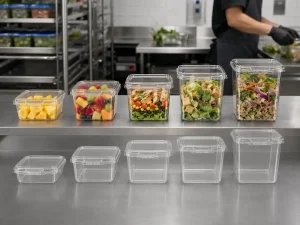
Takeaway fruit packaging must handle movement. A customer may pick up the pack from a shelf, carry it in a bag, place it in a vehicle, store it in a refrigerator, and open it later. The container should keep the fruit presentable through that route.
For takeaway, buyers should test closure strength, hinge behavior, stacking, cold-case clarity, and whether the fruit shifts during handling. This is especially important for fresh-cut fruit, fruit cups, berry packs, and fruit-and-nut snack combinations.
For fresh-cut fruit programs, fresh-cut fruit containers are more relevant than standard whole produce packs. Specific options such as 1lb PET fresh-cut fruit containers and 2lb PET fresh-cut fruit containers support retail takeaway and chilled display where clear visibility and stronger closure logic matter.
Best Tamper Evident Produce Containers for Chilled Food
Chilled fruit packaging must perform after refrigeration. A package that looks good at room temperature may become fogged, wet-looking, or visually weak in a cold shelf. Buyers should evaluate condensation, lid clarity, label placement, and how the fruit looks after real cold-chain handling.
For chilled retail fruit, PET and RPET are common choices because they deliver strong transparency and practical rigidity. However, buyers should still match the structure to the fruit. Berries need venting. Fresh-cut fruit needs moisture testing. Fruit-and-nut packs need separation. Premium whole fruit needs cavity support and stable stacking.
For cold-case applications that need visible first-opening confidence, anti-fog tamper-evident containers are useful to review when clarity and secure handling both matter.
PET Fruit Containers: Why Clear Display Matters
PET fruit containers are strong for produce retail because fruit sells visually. Shoppers want to inspect berry color, grape firmness, mango cubes, melon texture, apple slice brightness, mixed fruit variety, and portion fullness before buying.
Clear PET packaging supports both top-view and side-view display. It helps produce teams show the product instead of hiding it behind paperboard or opaque structures. This is especially valuable for chilled fruit, premium fruit, fresh-cut fruit, berry packaging, and retail-ready fruit snack packs.
For whole fruit retail display, clear PET hinged clamshell containers support broad fresh fruit applications. For premium berries, premium flip-top agricultural containers help buyers create a stronger retail-ready berry presentation.
Berry Tamper Evident Containers and Vented Produce Packs
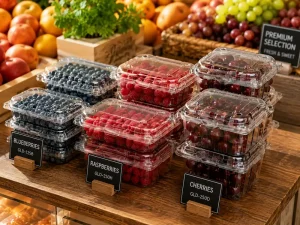
Berry tamper evident containers need careful structure selection because berries are delicate and moisture-sensitive. Blueberries, raspberries, strawberries, blackberries, and mixed berries require gentle handling, ventilation, stacking strength, and clear visibility.
Venting is especially important for berry packaging. Vent placement should support airflow without being blocked by labels or sleeves. The closure should stay secure through handling but remain easy for customers to open. Stacking should protect the fruit from compression in cartons and shelves.
| Berry Packaging Factor | What Buyers Should Check | Why It Matters |
|---|---|---|
| Ventilation | Top vents, bottom vents, side airflow, and label interference | Supports better cold-case appearance and airflow |
| Closure | Hinge strength, snap fit, flip-top feel, and opening force | Reduces accidental opening and customer complaints |
| Stacking | Filled carton stacking and refrigerated shelf stacking | Protects delicate fruit from compression |
| Visibility | Top-view and sidewall clarity | Improves retail confidence and quality perception |
| Label placement | Labels should not block fruit view or vents | Protects both branding and produce performance |
For berry programs, vented clamshell packs for blueberries, vented berry clamshell containers, and clamshell produce containers for blueberries and raspberries help buyers compare ventilation, visibility, and retail handling performance.
Fresh-Cut Fruit Tamper Packaging for Ready-to-Eat Retail
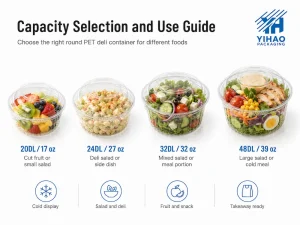
Fresh-cut fruit tamper packaging has higher handling expectations than whole fruit packaging because the fruit is already cut, portioned, and ready to eat. Mango cubes, melon, pineapple, grapes, apple slices, kiwi, berries, citrus, and mixed fruit cups need clear presentation, moisture control, stable closure, and customer confidence.
Fresh-cut fruit can release juice after packing. It can also create condensation under chilled display conditions. A container that works for dry whole fruit may not perform well for cut fruit. Buyers should test real fruit, real fill weight, real refrigeration, and real label placement before wholesale ordering.
| Fresh-Cut Fruit Need | Packaging Requirement | Buyer Test |
|---|---|---|
| Clear display | Transparent PET/RPET lid and sidewall | Check product appearance after refrigeration |
| Moisture control | Appropriate lid fit and real cold-case testing | Check juice release and condensation |
| Customer confidence | Secure closure or tamper-evident feature where needed | Check visible first-opening signal |
| Retail handling | Stable stacking and carton protection | Test filled packs in shelves, cartons, and takeaway bags |
| Label placement | Labels should not hide fruit color or opening features | Test final label size before bulk approval |
Fruit-and-Nut Packs and Multi-Section Produce Containers
Fruit-and-nut packs are a strong retail application for tamper evident produce containers because they combine wet and dry foods in one package. Apple slices, grapes, mango, berries, nuts, cheese, crackers, dried fruit, and granola should stay separated so texture remains appealing before opening.
For this format, compartment structure matters as much as closure. A flat single-compartment pack may cause fruit juice to affect dry items. A two- or three-compartment pack helps separate ingredients and improves product presentation.
For daily snack retail, fruit and nut containers are useful for compact fresh snack programs. For separated snack formats, two-compartment fruit and nut containers and three-compartment snack containers help buyers build more reliable fresh fruit snack packs.
Specialty Produce Containers for Premium Fruit Display
Some produce needs more structure than a general clamshell. Apples, kiwi, mango, avocado, pepino melon, figs, passion fruit, dragon fruit, grapefruit, and papaya can benefit from cell-based or cavity-based PET clamshells that help reduce movement and improve retail presentation.
For apple programs, apple clamshell containers help buyers compare single, two-count, four-count, and multi-count fruit packaging formats. For specialty fruit, six-cell PET fruit clamshells and two-cell PET fruit clamshells support premium produce display and transport stability.
Material Selection: PET, RPET, Vented Structures, and Compartment Formats
Material and structure should be selected together. PET and RPET are strong for clear fruit display. Vented structures are important for berries and selected whole produce. Compartment structures are useful for fruit-and-nut combinations and mixed fruit snack packs. Tamper-evident features are useful when produce is ready-to-eat, self-service, or delivery-sensitive.
| Packaging Direction | Best-Fit Application | Main Advantage | Buyer Checkpoint |
|---|---|---|---|
| PET fruit containers | Fresh-cut fruit, fruit cups, berries, grapes, chilled display | High clarity and strong retail visibility | Check closure, stacking, and cold-case performance |
| RPET fruit containers | Clear fruit packaging with recycled-content positioning | Supports sustainability-focused packaging direction | Confirm documentation and market requirements |
| Vented produce clamshells | Berries, grapes, delicate fruit, high-respiration produce | Supports airflow and retail-ready display | Check vent placement and label interference |
| Compartment fruit containers | Fruit-and-nut packs, fresh-cut assortments, snack trays | Separates wet fruit from dry ingredients | Check compartment wall height and movement |
| Tamper-evident produce containers | Ready-to-eat fruit, self-service retail, delivery-sensitive packs | Visible first-opening confidence | Check opening clarity and real fruit behavior |
Retail Display Checklist for Produce Packaging
Retail fruit packaging should make freshness easy to see. Customers usually look at color, visible moisture, bruising, portion fullness, and package clarity before reading the full label. The container should support that decision, not hide the product.
- Top-view clarity: fruit should be visible from the main shelf angle.
- Sidewall visibility: shoppers should see portion depth and fruit quality.
- Vent placement: vents should support airflow and remain uncovered by labels.
- Condensation behavior: packaging should be tested after real refrigeration.
- Label placement: labels should support branding without covering fruit or opening features.
- Stacking: filled containers should remain stable in cartons and shelves.
- Opening experience: customers should open the pack cleanly without fruit spilling or lid breakage.
Takeaway and Chilled Food Testing Checklist
Takeaway and chilled food programs add movement, temperature change, and handling pressure. Buyers should test tamper evident produce containers with real fruit before confirming wholesale orders.
| Test Area | What to Check | Why It Matters |
|---|---|---|
| Fruit fit | Portion fullness, cavity fit, fruit movement, and overfill risk | Protects appearance and reduces bruising |
| Closure | Hinge strength, snap fit, tamper tab behavior, opening force | Supports handling reliability and customer experience |
| Venting | Vent location, airflow path, and label interference | Supports cold-case appearance for berries and whole fruit |
| Moisture | Juice release, condensation, and mixed fruit performance | Confirms real fruit behavior before bulk orders |
| Stacking | Filled packs in cartons, shelves, coolers, and takeaway bags | Reduces crushing, deformation, and handling complaints |
| Tamper evidence | Visible first-opening feature before and after opening | Supports customer confidence in self-service channels |
| Bulk consistency | Sample-to-order clarity, hinge, venting, closure, and carton protection | Reduces repeat-order quality risk |
Wholesale Supplier Checklist
When sourcing from a food packaging factory, buyers should evaluate more than unit price. A reliable manufacturer or wholesale supplier should understand fruit behavior, PET/RPET clarity, vented clamshell design, tamper-evident structure, carton protection, sample testing, and repeat-order consistency.
Ask these questions before confirming wholesale produce packaging:
- Does the supplier offer produce clamshell containers, berry clamshells, fresh-cut fruit containers, apple clamshells, and compartment fruit packs?
- Can the supplier recommend packaging by fruit type: berries, grapes, apples, kiwi, mango, dragon fruit, fresh-cut fruit, or fruit-and-nut packs?
- Are PET and RPET options available with suitable documentation where needed?
- Which options support ventilation, strong closure, or tamper-evident first-opening features?
- Can samples be tested with real fruit before bulk confirmation?
- How are clear PET surfaces protected from scratches during packing and shipment?
- How does the supplier reduce deformation, lid damage, and closure inconsistency?
- Can the supplier maintain sample-to-bulk consistency in clarity, rim shape, hinge behavior, venting, closure, and carton packing?
- Can the supplier help reduce SKU overlap across whole fruit, berry, fresh-cut, and snack fruit programs?
How to Build a Produce Packaging Matrix
A practical produce packaging matrix helps buyers avoid random SKU selection. Each packaging format should have a defined role in the fruit program.
| Packaging Role | Recommended Structure | Best Channel | Procurement Logic |
|---|---|---|---|
| Berry retail packs | Vented hinged clamshells or flip-top berry containers | Supermarkets, produce brands, distributors | Ventilation, visibility, gentle handling, and stacking |
| Fresh-cut fruit packs | Clear PET/RPET containers with secure closure | Cold shelves, cafes, grab-and-go retail | Moisture control, clarity, and ready-to-eat confidence |
| Fruit-and-nut snack packs | Two-, three-, or four-compartment PET containers | Convenience stores, cafes, supermarket snack shelves | Separates wet fruit from dry snack components |
| Premium whole fruit packs | Structured PET clamshells or cell-based fruit clamshells | Premium produce display, gifting, export retail | Shape protection and shelf presentation |
| Self-service ready-to-eat fruit | Tamper-evident PET containers where needed | Supermarkets, delivery, third-party handling | Visible first-opening confidence |
Common Buying Mistakes to Avoid
Choosing by Size Before Fruit Behavior
Fruit packaging should not be chosen by size alone. Berries, grapes, apple packs, fresh-cut fruit, and fruit-and-nut packs all behave differently. Start from fruit texture, moisture level, venting needs, and retail route.
Ignoring Ventilation
Ventilation is important for many berry and whole produce programs. Labels, stickers, or sleeves should not block airflow areas that affect cold-case performance and visual freshness.
Assuming Tamper Evidence Means Leak-Proof
Tamper-evident packaging shows visible first-opening evidence. It does not automatically guarantee leak-proof performance for fruit juice, syrup, dressing, or high-moisture cut fruit. Leak-resistant behavior must be tested separately.
Approving Empty Samples Only
Empty samples do not show condensation, bruising, fruit movement, juice release, airflow, label blocking, or filled stacking performance. Real fruit testing is necessary.
Using One Produce Container for Every Product
Whole berries, fresh-cut mango, grapes, apples, kiwi, and mixed fruit snack packs need different packaging logic. A focused produce packaging matrix works better than one universal container.
Buyer Decision Framework
Use this framework when selecting tamper evident produce containers:
- Define the produce type: berries, grapes, apples, kiwi, mango, dragon fruit, fresh-cut fruit, mixed fruit, or fruit-and-nut snacks.
- Confirm the food state: whole fruit, cut fruit, washed fruit, mixed fruit, ready-to-eat fruit, or snack combination.
- Choose the material: PET/RPET for clear chilled display and retail visibility.
- Select the structure: vented clamshell, flip-top berry container, fresh-cut fruit container, cell-based clamshell, or compartment fruit pack.
- Define the security level: reliable closure, stronger snap fit, or tamper-evident first-opening feature.
- Test real conditions: filling, closing, labeling, venting, refrigeration, stacking, transport, shelf display, and customer opening.
- Evaluate the supplier: sample support, carton protection, repeat consistency, and application guidance.
FAQ
1. What are tamper evident produce containers used for?
Tamper evident produce containers are used for fresh-cut fruit, berries, fruit cups, fruit-and-nut packs, specialty produce, ready-to-eat fruit, and chilled retail fruit products that need clear display, reliable closure, and visible first-opening confidence.
2. When should buyers choose tamper evident fruit containers?
Buyers should choose tamper evident fruit containers when fruit is cut, portioned, ready to eat, self-service, delivery-sensitive, or handled by multiple parties before customer opening.
3. Are PET fruit containers good for retail display?
Yes. PET fruit containers are strong for retail display because they provide clear visibility, lightweight handling, and clean presentation for berries, fresh-cut fruit, grapes, fruit bowls, and snack fruit packs.
4. What is the difference between secure fruit packaging and tamper evident produce containers?
Secure fruit packaging is a broader system that includes closure, stacking, venting, cold display, and fruit protection. Tamper evident produce containers add a visible first-opening feature where customer confidence matters.
5. What should buyers test before ordering wholesale produce containers?
Buyers should test real fruit fit, closure, ventilation, condensation, label placement, stacking, cold display, tamper-evident function where needed, and sample-to-bulk consistency before wholesale ordering.
6. How should buyers choose a produce packaging manufacturer or supplier?
Buyers should choose a manufacturer or supplier that understands fruit type, PET/RPET material, vented clamshell design, fresh-cut fruit packaging, tamper-evident options, carton protection, sample testing, and wholesale packaging consistency.
References
- U.S. Food and Drug Administration, Food Contact Substances and Food Packaging Guidance.
- U.S. Food and Drug Administration, Food Tampering and Consumer Packaging Guidance.
- European Commission, Regulation (EC) No 1935/2004 on Materials and Articles Intended to Come into Contact with Food.
- European Commission, Regulation (EU) No 10/2011 on Plastic Materials and Articles Intended to Come into Contact with Food.
- European Food Safety Authority, Guidance on Plastic Recycling Processes for Food Contact Materials.
- Association of Plastic Recyclers, APR Design Guide for Plastics Recyclability.
- RecyClass, Design for Recycling Guidelines for PET Packaging.
- GS1, General Guidance on Retail Barcode and Label Placement.
Final Note / Practical Takeaway
© YIHAO Packaging. All rights reserved. All articles, product images, packaging designs, technical specifications, and website materials are protected by copyright. Unauthorized copying, reproduction, redistribution, modification, or commercial use is strictly prohibited without prior written permission.