Choosing the right salad container supplier affects more than packaging cost. For supermarkets, cafes, chilled food brands, meal prep companies, and foodservice distributors, the supplier must support product visibility, lid security, refrigerated display, bulk ordering, and repeat supply stability. A salad container that looks clear on the shelf, closes reliably for takeaway, and fits daily packing operations gives buyers a stronger retail and operational advantage.
For buyers, the real challenge is not finding one salad box. The challenge is building a practical packaging system that works across leafy salads, grain bowls, pasta salads, fresh-cut fruit, deli sides, chilled noodles, prepared meals, snacks, and family-size takeaway portions. A supplier that understands deli and salad containers helps buyers compare round bowls, hinged deli packs, square containers, lids, portion sizes, and wholesale packaging options with a clearer decision path.
YIHAO focuses on clear food packaging for retail display, takeaway, and chilled food applications. For salad and deli buyers, the value is not only one container size, but a connected packaging range that supports product presentation, packing efficiency, cold shelf performance, and long-term purchasing planning.
How to Choose a Salad Container Supplier for Retail and Foodservice Programs
A qualified salad container supplier should help buyers choose containers by application, not only by size. Retail salad packaging, takeaway deli packaging, chilled food containers, and bulk foodservice programs each require different priorities. Buyers should compare container clarity, lid fit, stackability, portion range, label space, sample support, and factory communication before confirming wholesale deli containers.
For long-term purchasing, the best supplier is usually the one that provides a connected packaging range. Hinged deli containers, round PET salad bowls, square deli containers, fresh-cut fruit packs, and catering trays should work together as a practical product system. This allows buyers to simplify SKUs while still covering multiple food applications.
| Buyer Need | Supplier Capability to Check | Why It Matters |
|---|---|---|
| Retail display | Clear PET or rPET container options with clean lid design | Improves food visibility and shelf appeal |
| Takeaway handling | Reliable lid closure, stable rim design, practical container depth | Reduces handling issues during purchase, transport, and storage |
| Chilled food programs | Multiple formats for salads, deli sides, fruit, and chilled meals | Matches different food textures, portions, and display needs |
| Wholesale purchasing | Connected product families and repeat order support | Helps buyers control SKUs and reorder more efficiently |
| Factory cooperation | Stable production communication and sample support | Improves confidence before bulk salad container orders |
Why Salad Container Supplier Selection Matters
Salad packaging directly affects how customers judge freshness. Clear PET packaging gives buyers and consumers an immediate view of color, ingredients, layering, and portion value. For retail shelves, this visibility matters because salads and chilled foods compete visually with sandwiches, fresh-cut fruit, desserts, prepared meals, and ready-to-eat snacks.
A professional salad container supplier should understand three commercial priorities. First, the container must present food attractively under chilled display lighting. Second, the lid and base must support takeaway handling. Third, the packaging range must make sense for wholesale purchasing, inventory planning, and repeat orders.
This is where the role of a clear food packaging supplier becomes more strategic. Buyers are not simply asking for a plastic salad box. They are asking whether the packaging can support daily store operations, reduce leakage complaints, improve shelf presentation, and keep the product line simple enough for staff to manage.
What a Good Salad Container Supplier Should Offer
The best supplier should provide a clear product logic instead of pushing random shapes and sizes. A strong salad packaging range usually includes hinged deli containers, round salad bowls, square deli containers, fresh-cut fruit containers, and compatible lids. Each structure serves a different sales situation.
1. Hinged Deli Containers for Fast-Packed Chilled Foods
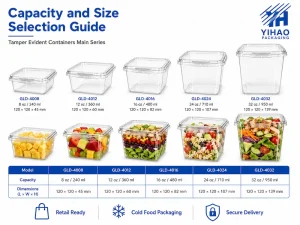
PET hinged deli containers are practical for salad sides, deli portions, fresh fruit, snacks, nuts, bakery sides, and grab-and-go foods. Their connected lid-and-base structure reduces lid matching work, which is useful for stores and packing teams that need speed and consistency.
For smaller chilled portions, mid-size hinged deli containers help handle deli salads, fruit mixes, snack packs, and side portions. For larger salad or meal-size packs, larger hinged deli containers support more generous retail portions while keeping the pack clear and shelf-ready.
2. Round Salad Bowls for Meal Salads and Grain Bowls
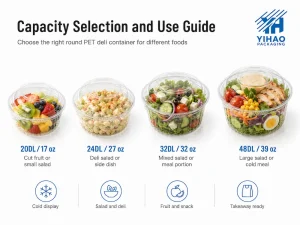
Round bowls are often selected for premium salad programs because they give enough visual space for layered ingredients. Lettuce, protein, toppings, grains, sauces, and fresh vegetables look more abundant in a round format. A supplier with round PET deli containers gives buyers more flexibility for single-serve salads, large salads, chilled noodles, fruit bowls, and shared chilled food packs.
For grab-and-go food programs, grab-and-go salad bowls are useful when the goal is compact display and fast takeaway. For larger meal salads, round salad bowls support richer ingredient combinations and stronger shelf value.
3. Square PET Containers for Efficient Shelf Layouts
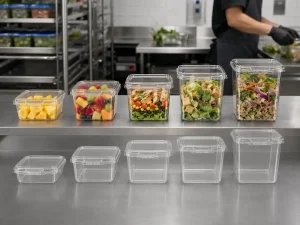
Square containers are useful when shelf efficiency matters. Their straight edges help reduce wasted display space and make it easier to arrange products in rows. For supermarkets, convenience stores, and chilled food counters, square PET deli containers work well for pasta salad, fruit portions, deli sides, cold noodles, mixed vegetables, and ready-to-eat chilled meals.
For everyday salad and fruit programs, square deli containers help buyers create a clean retail layout. When the portion is heavier or intended for larger chilled meals, larger square deli containers provide a stronger format for premium or family-size retail packs.
Retail Display: Clear Packaging Must Sell the Food First
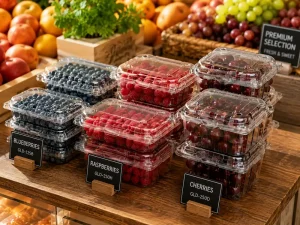
For chilled retail display, packaging should not visually fight with the food. The best salad containers are clear, clean, and simple. They allow the food color to become the selling point. Bright vegetables, fresh fruit, pasta salad, quinoa bowls, mixed greens, deli toppings, and chilled proteins should be visible without a cloudy or heavy-looking container.
A good salad container supplier should help buyers compare clarity, lid height, base depth, stacking feel, label space, and display angle. These details influence how the pack looks in a cold case. A shallow container may work for leafy greens, while a deeper bowl may fit grain bowls or chilled noodles better. A flat-lid design may improve stacking, while a dome or higher lid may protect toppings and maintain a fuller visual profile.
Retail buyers should also think about label placement. Labels should support branding and product information without covering the food. Clear lids and clean sidewalls give more options for front labels, top labels, tamper labels, ingredient stickers, or barcode placement. A supplier that understands retail packaging helps buyers avoid over-labeling that hides the product.
Takeaway: Lid Security and Handling Experience Matter
Takeaway salad packaging must survive movement from the display case to the checkout counter, delivery bag, office desk, or home refrigerator. Buyers should not evaluate salad containers only by appearance. The handling experience matters just as much.
For takeaway, the lid should close consistently, the rim should feel stable, and the container should support normal handling without feeling weak. A professional deli container manufacturer should understand that cold foods often include moist ingredients such as dressings, fruit juices, pickled vegetables, pasta sauces, or chilled toppings. Packaging should be selected according to food type, filling style, and expected handling conditions.
This is also where sample testing matters. Before placing bulk salad containers into a retail or foodservice program, buyers should test filling weight, lid closure, stacking height, refrigerated storage, transport movement, and customer handling. The goal is not to assume one container fits every food. The goal is to confirm which structure fits the actual menu.
Chilled Food: Match Container Structure to the Food Type
Chilled food packaging covers more than leafy salad. It includes fruit salads, pasta salads, cold noodles, deli sides, hummus packs, snack combinations, yogurt toppings, chilled desserts, and prepared food portions. A useful salad container supplier should help buyers separate these applications by structure.
| Food Application | Recommended Container Logic | Buyer Consideration |
|---|---|---|
| Leafy green salads | Round salad bowls or clear hinged packs | Ingredient height, visual fullness, lid space |
| Grain bowls and chilled noodles | Round PET bowls or square deli containers | Base depth, fork mixing space, premium display |
| Deli sides and pasta salad | Hinged deli containers or square PET containers | Portion consistency, shelf layout, quick packing |
| Fresh-cut fruit and mixed snacks | Hinged deli packs or fresh-cut fruit containers | Moisture visibility, color display, portion value |
| Party and catering platters | Round multi-compartment trays or larger clear packs | Separation, presentation, transport handling |
When chilled party packs are part of the sales plan, chilled party platters create a different use case from single-serve salads. For fruit-heavy salad programs, fresh-cut fruit containers may also support related chilled display products.
Wholesale Deli Containers: How Buyers Should Build a Practical SKU Range
When purchasing wholesale deli containers, many buyers make the same mistake: they order too many similar sizes without a clear application plan. This creates confusion in warehouse storage, staff training, lid matching, reorder planning, and customer presentation.
A better method is to build the range around sales roles:
- Small portion packs for sides, toppings, snacks, and trial-size foods.
- Mid-size packs for daily salads, fruit mixes, pasta salads, and deli items.
- Large packs for meal salads, chilled noodles, family portions, and shared food.
- Display-focused formats for premium retail shelves and clear visual merchandising.
- Operational formats that reduce lid confusion and packing time.
A strong salad container supplier should guide buyers toward a manageable product matrix. This is especially important for distributors and foodservice buyers that serve different end users. A clear SKU system helps the same supplier support cafes, supermarkets, salad brands, meal prep programs, and chilled food counters without creating unnecessary inventory pressure.
Manufacturer, Wholesale, and Supplier: What Buyers Should Compare
The words manufacturer, wholesale, and supplier are often used together, but they do not always mean the same thing. A trading supplier may provide access to many products but may not control production details. A factory-focused supplier may offer better consistency, product development support, and direct communication for long-term projects.
For buyers looking for a PET deli container factory, the supplier comparison should include more than price. Buyers should evaluate whether the factory understands PET and rPET material options, mold consistency, lid fit, clear display requirements, packing methods, carton planning, and repeat order stability.
For wholesale programs, the supplier should also support communication around samples, product matching, container families, size logic, packaging combinations, and export-ready ordering. This matters because salad packaging usually becomes a repeat-purchase item, not a one-time order.
Bulk Salad Containers: Questions to Ask Before Ordering
Before ordering bulk salad containers, buyers should prepare a practical checklist. This prevents wrong-size orders and reduces the risk of choosing packaging that looks good online but fails in the actual chilled food program.
| Checklist Question | What Buyers Should Confirm | Best Supplier Response |
|---|---|---|
| What food will be packed? | Leafy salad, fruit, grain bowl, pasta salad, deli side, or chilled meal | Recommend container format by food type, not only by volume |
| Where will the product be sold? | Supermarket, cafe, convenience store, takeaway counter, or foodservice channel | Match packaging to display, handling, and sales environment |
| How much label space is needed? | Top label, side label, barcode, ingredient label, or tamper label | Protect food visibility while allowing clear product information |
| Will the pack be stacked? | Cold storage stacking, display stacking, carton packing, and transport | Suggest structures that support practical daily handling |
| Is repeat ordering required? | Bulk salad container supply, distributor stock, or long-term retail program | Offer a connected product family and clear reorder communication |
A serious salad container supplier should welcome these questions. If a supplier only pushes the cheapest option without asking about food type, sales channel, and packing method, the buyer carries more risk.
PET and rPET Material Considerations for Salad Packaging
PET is widely used for clear food packaging because it delivers strong transparency, good forming performance, and a clean retail appearance. For chilled salads and deli foods, clear PET packaging helps buyers show freshness while keeping the container lightweight and practical for daily operations.
rPET is also important for many buyers because recycled content and sustainability goals are now part of packaging discussions. However, buyers should evaluate rPET food-contact suitability, local market requirements, recycling stream compatibility, and supplier documentation carefully. Recyclability also depends on local collection, sorting, and recycling systems, so buyers should avoid making broad claims without confirming the destination market.
A dependable clear food packaging supplier should communicate clearly about PET or rPET options, food-contact expectations, product applications, and packaging design choices. For example, container clarity, label size, ink coverage, attachments, and material color may affect how a package fits recycling design expectations in different markets.
How to Compare Salad Container Suppliers
When comparing suppliers, buyers should use a structured scorecard. Price matters, but it should not be the only decision point. Packaging that creates poor shelf display, weak lid fit, or SKU confusion can become more expensive in actual operation.
| Supplier Factor | What to Check | Why It Matters |
|---|---|---|
| Product range | Hinged deli packs, salad bowls, square containers, lids | Supports different chilled food programs |
| Material options | PET, rPET, clarity, food-contact suitability discussion | Matches market expectations and buyer requirements |
| Application knowledge | Retail display, takeaway, chilled food, deli sides | Reduces poor product matching |
| Sample support | Food-fit testing before bulk orders | Improves confidence before wholesale purchasing |
| Factory capability | Production consistency, repeat order support, product families | Supports long-term supply planning |
| Communication | Clear answers on sizes, uses, lid fit, and packing logic | Saves time for importers and distributors |
Why Buyers Work with YIHAO for Salad and Deli Packaging
As a clear food packaging manufacturer and supplier, YIHAO supports salad, deli, fresh produce, bakery, and chilled food packaging programs with PET and rPET container options. For salad packaging buyers, the value is not only one container size, but a connected range of clear bowls, hinged deli containers, square deli containers, and retail-ready food packaging solutions that support display, takeaway, and wholesale supply planning.
For distributors, supermarkets, cafes, and foodservice teams, working with a packaging supplier that understands both factory production and end-use display helps reduce wrong-size selection, lid mismatch, and unnecessary SKU complexity. This is especially important when buyers need one supplier to support daily salad containers, chilled food packs, deli sides, fresh-cut fruit containers, and selected catering trays across multiple sales channels.
Best Supplier Fit by Buyer Type
Supermarkets and Chilled Retail Chains
Supermarkets need packaging that looks clean under cold-case lighting and supports consistent shelf layout. A practical range should include round salad bowls, square deli containers, and hinged deli containers. The supplier should help match container depth, lid structure, and label placement to the retail display plan.
Cafes and Takeaway Food Brands
Cafes need containers that are easy for staff to use during busy service hours. Hinged formats and simple lid systems are valuable because they reduce packing steps. Clear packaging also helps takeaway customers see the food quality before purchase.
Foodservice and Catering Teams
Catering buyers often need larger containers, platter-style packaging, and stable chilled food presentation. Their supplier should provide packaging options for single portions, shared sides, and multi-item packs.
Importers and Distributors
Distributors need a supplier that can support a balanced product matrix. Instead of ordering many unrelated products, distributors benefit from a connected range: hinged deli packs, round bowls, square containers, lids, fresh-cut fruit packs, and selected catering trays. This creates more sales coverage without unnecessary SKU overload.
Common Mistakes When Choosing a Salad Container Supplier
The first mistake is choosing only by the lowest unit price. Low price may look attractive, but if the container does not fit the food, causes display problems, or creates handling complaints, the total cost becomes higher.
The second mistake is buying too many sizes before testing real food. A buyer should test the most important applications first, then expand into related sizes after confirming fit.
The third mistake is ignoring lid compatibility. For separate-lid systems, lid matching must be clear and repeatable. For hinged systems, the hinge and closure feel must match the packing process.
The fourth mistake is using the same container for every chilled food. Leafy salad, pasta salad, fruit salad, grain bowls, and deli sides do not always need the same structure. A good supplier helps buyers separate applications instead of forcing one format across every product.
Practical Takeaway for Buyers
The best salad container supplier is not the one with the longest product list. It is the supplier that helps you build a clear, usable, and repeatable packaging system for retail display, takeaway, and chilled food. For most buyers, that system should include a practical mix of hinged deli containers, round salad bowls, square deli containers, compatible lids, and selected larger formats for catering or premium chilled food.
If you are comparing wholesale deli containers, a deli container manufacturer, a PET deli container factory, or a clear food packaging supplier, focus on application fit first. The right supplier should help your food look fresh, pack efficiently, display cleanly, and support long-term bulk ordering with fewer mistakes.
For new salad, deli, or chilled food packaging projects, buyers should request samples, compare container sizes, test lid closure, and confirm which packaging family best supports their retail display and takeaway program before moving into bulk purchasing.
FAQ
1. What makes a good salad container supplier?
A good salad container supplier offers clear PET or rPET packaging options, practical container families, sample support, stable communication, and application knowledge for retail display, takeaway, and chilled food programs.
2. Are PET salad containers suitable for chilled food?
Clear PET salad containers are commonly used for chilled salads, fruit mixes, deli sides, pasta salads, grain bowls, and grab-and-go foods. Buyers should confirm food type, filling weight, lid fit, and local food-contact requirements before bulk orders.
3. Should I choose round salad bowls or square deli containers?
Round salad bowls work well for meal salads, grain bowls, and premium visual display. Square deli containers are useful for efficient shelf layout, deli sides, pasta salad, fruit portions, and chilled prepared foods.
4. What should I test before ordering bulk salad containers?
Buyers should test portion size, lid closure, stacking, chilled storage, label placement, product visibility, transport handling, and actual food fit before placing bulk salad container orders.
5. How do I compare a supplier, manufacturer, and factory?
A supplier may provide products and service; a manufacturer or factory usually has deeper production involvement. Buyers should compare product range, material options, production consistency, sample support, communication quality, and repeat order reliability.
6. Can one supplier provide salad bowls, hinged deli containers, and square deli containers?
Yes. A complete salad container supplier should offer connected packaging options such as round salad bowls, hinged deli containers, square PET deli containers, and selected chilled food packaging formats. This helps buyers simplify purchasing and build a more consistent retail packaging range.
References
- U.S. Food and Drug Administration, Packaging & Food Contact Substances
- U.S. Food and Drug Administration, Guidance for Industry: Use of Recycled Plastics in Food Packaging
- European Commission, Food Contact Materials
- Regulation (EC) No 1935/2004 on materials and articles intended to come into contact with food
- Commission Regulation (EU) No 10/2011 on plastic materials and articles intended to come into contact with food
- Association of Plastic Recyclers, APR Design Guide
- U.S. Environmental Protection Agency, Sustainable Materials Management
- U.S. Environmental Protection Agency, Sustainable Packaging
Deep Dive Insights
How does a salad container supplier create value beyond price?
A strong salad container supplier helps buyers reduce selection mistakes by connecting food type, sales channel, container structure, lid design, and bulk purchasing logic. This is more valuable than simply comparing unit prices because the wrong container can affect display quality, takeaway confidence, staff efficiency, and repeat order stability.
Why does clear PET packaging remain important for chilled salad display?
Clear PET packaging supports direct product visibility, which is essential for chilled salads, deli sides, fruit mixes, grain bowls, and ready-to-eat food. When consumers can see color, freshness, portion value, and ingredient layering, the package works as part of the selling process rather than only as a protective shell.
What should wholesale buyers prioritize before bulk ordering?
Wholesale buyers should test real food fit, lid closure, stacking, label placement, refrigerated storage, carton packing, and staff handling before confirming bulk salad containers. A connected range of hinged deli containers, round salad bowls, and square deli containers helps buyers cover multiple applications without creating unnecessary SKU complexity.
Which supplier model fits long-term salad packaging programs?
For long-term retail, foodservice, and distributor programs, buyers benefit from a supplier with factory communication, stable product families, sample support, and application knowledge. This makes future ordering easier when the buyer expands from salad bowls into deli sides, fresh-cut fruit packaging, chilled meals, catering trays, or other clear food packaging formats.
Final Note / Practical Takeaway
© YIHAO Packaging. All rights reserved. All articles, product images, packaging designs, technical specifications, and website materials are protected by copyright. Unauthorized copying, reproduction, redistribution, modification, or commercial use is strictly prohibited without prior written permission.