Choosing the best recyclable food containers is not simply a matter of selecting a material with a recycling symbol. For food packaging buyers, the real question is whether a container is food-contact suitable, locally accepted by recycling systems, strong enough for retail handling, clear enough for display, secure enough for takeaway, and supported by reliable supplier documentation.
That distinction matters. A clear PET container may be practical for chilled salads and fruit display, but it should not be treated as a hot-fill or microwave container unless the supplier confirms that use condition. A container made with recycled content may support sustainability goals, but recycled content must still be suitable for the intended food-contact application. A package described as recyclable may still face limitations if the target market does not accept that exact format, label, lid, adhesive, or food-residue condition.
YIHAO supports food brands, supermarkets, cafes, bakeries, distributors, and foodservice operators with practical packaging solutions for fresh produce, deli salads, chilled ready-to-eat meals, bakery items, fruit cups, cold drinks, and grab-and-go food. For B2B buyers, the strongest packaging decision combines food safety, retail presentation, operational efficiency, and responsible sustainability communication.
This guide explains how to evaluate recyclable food containers for retail display, takeaway, and chilled food. It also shows how to compare PET, rPET, PP, paperboard combinations, and compostable alternatives without relying on vague environmental claims.
What Recyclable Food Containers Really Mean for Buyers
A container is not automatically recyclable just because it is made from a resin that has a recycling code. Recyclability depends on the full packaging system: base material, lid material, color, label area, adhesive, ink, food residue, consumer behavior, collection rules, sorting technology, and local recycling infrastructure.
For example, clear PET and rPET containers are widely used for chilled retail food because they provide excellent product visibility and clean shelf presentation. However, the recycling result still depends on whether the target market accepts that container format. A clear PET bowl with a small removable label may have a better recycling pathway than a dark-colored tray with a full-body sleeve, metallic ink, or non-removable adhesive.
This is why buyers should treat recyclable food containers as a system, not a single material choice. The container, lid, label, print, tamper feature, disposal instruction, and supplier documentation must work together.
Core Buyer Criteria for Recyclable Food Packaging
Before comparing supplier quotations, buyers should define the packaging requirements by food type, temperature, shelf life, display method, logistics route, and target market. This prevents the common mistake of choosing packaging that looks sustainable but fails in sealing, stacking, food-contact suitability, or consumer disposal communication.
| Buyer Checkpoint | Why It Matters | What to Confirm Before Ordering |
|---|---|---|
| Food-contact suitability | The packaging must be suitable for the intended food type and use condition. | Material declaration, intended use, temperature range, and supplier documentation. |
| Local recycling acceptance | Recyclability depends on local collection, sorting, and processing systems. | Target market acceptance for PET, rPET, PP, lid format, label, and food residue level. |
| Retail visibility | Clear packaging improves shelf appeal and supports quick purchase decisions. | Clarity, anti-fog option, lid height, base shape, and label placement. |
| Sealing performance | Takeaway and chilled food need secure closure during handling and transport. | Snap-fit strength, hinged lock, leakage resistance, tamper feature, and stacking stability. |
| Operational fit | The container must match filling, labeling, stacking, and case-packing workflows. | Case count, nesting, denesting, lid compatibility, carton packing, and pallet efficiency. |
| Environmental claim control | Recyclable and recycled-content claims must be accurate and not misleading. | Use clear wording based on verified material data and local recycling realities. |
Compliance Check for Recyclable Food Containers
Food packaging compliance should be handled as a purchasing requirement, not as a marketing statement. Buyers should ask whether the material and container structure are suitable for the intended food-contact condition, target market, and application temperature. The question should not only be “Is this food grade?” A stronger question is: “Is this exact container suitable for this food, this temperature, this market, and this use condition?”
| Compliance Area | Buyer Question | Why It Matters |
|---|---|---|
| Intended food-contact use | Is the container suitable for direct contact with the intended food type? | Different foods may involve moisture, acidity, oil, sugar, or temperature factors. |
| Temperature condition | Is the container intended for chilled, ambient, hot-fill, frozen, or microwave use? | A chilled PET container should not be used for hot food unless confirmed by the supplier. |
| Recycled content documentation | If rPET is used, is the recycled content suitable for food-contact packaging? | Recycled material claims require proper verification and food-contact suitability. |
| Migration and material declaration | Can the supplier provide relevant material or food-contact documentation? | Documentation helps buyers evaluate compliance for their target market. |
| Recycling claim verification | Is the packaging recyclable in the actual sales market? | Recyclability depends on local systems, not only the resin code. |
| Labeling and claim control | Are environmental claims specific, clear, and not overstated? | Vague claims such as “green” or “100% eco-friendly” may create compliance and trust risks. |
Best Material Options for Retail Display, Takeaway, and Chilled Food
PET and rPET Containers for Clear Chilled Display
PET and rPET are strong options for chilled retail food when buyers need clarity, rigidity, lightweight performance, and product visibility. Clear packaging helps customers inspect freshness before purchase, which is especially important for salads, fruit, deli snacks, bakery items, desserts, cold drinks, and grab-and-go meals.
For supermarkets and foodservice brands, PET hinged deli containers are practical because the attached lid reduces lid mismatch, simplifies packing, and supports a clean display format. These containers are especially useful for chilled prepared foods, snack packs, deli sides, sandwiches, fruit portions, and fresh salads.
rPET can support sustainability goals when the recycled content is suitable for the intended food-contact application and backed by documentation. Buyers should not assume that all recycled plastic is automatically suitable for food packaging. For commercial food programs, recycled material must be evaluated according to the intended use, target market, and supplier process control.
PP Containers for Hot Food and Reheatable Applications
PP is commonly selected for hot food, deli meals, prepared meals, and reheatable applications because it usually handles higher heat conditions better than PET. However, PP recycling acceptance varies by region and container format. Buyers should verify whether PP food containers are accepted in the target market and whether the color, label, and residue condition support actual recovery.
For chilled retail display, PET and rPET usually provide stronger clarity. For hot takeaway, PP often becomes the better material direction. Material selection should always start with food temperature and use condition, not with a generic sustainability target.
Paperboard with Clear PET or rPET Lids
Paperboard-based packaging with clear PET or rPET lids is common in bakery, dessert, sandwich, and premium takeaway applications. It offers printable branding space while preserving product visibility. However, mixed-material structures need careful design. If the clear window, plastic lid, adhesive, and paperboard base are not easy to separate or are not compatible with local recycling systems, disposal instructions become more complicated.
This structure works best when the brand needs a warmer retail image, a printable surface, and a clear product window. Buyers should confirm grease resistance, moisture performance, stacking strength, and how consumers should separate or dispose of each component.
PLA and Compostable Packaging
Compostable packaging should not be treated as the same thing as recyclable packaging. PLA and similar materials may fit controlled programs where industrial composting infrastructure exists, but they should not be mixed into PET recycling streams. Buyers should only use compostable options when collection, consumer instruction, and local composting access are clear.
For buyers focused specifically on recyclable food containers, PET, rPET, and sometimes PP are usually more relevant than compostable materials, depending on the application and local recovery system.
How to Use Recyclable Claims Responsibly
Environmental claims should be specific, evidence-based, and market-aware. A broad claim such as “100% recyclable” may be too strong if the package is not accepted in all target markets or if certain components reduce recyclability. For B2B food packaging, cautious wording is often more reliable and more professional.
| Claim Type | Risky Wording | More Responsible Wording |
|---|---|---|
| Recyclability | 100% recyclable everywhere | Designed for recycling where PET food containers are accepted locally. |
| Recycled content | Eco-friendly recycled plastic | Made with recycled PET where food-contact recycled content is verified. |
| Sustainability | Green packaging solution | Clear PET/rPET packaging designed to support material recovery and product visibility. |
| Compostability | Better than plastic | Compostable only where suitable industrial composting collection is available. |
| Food safety | Safe for all food uses | Suitable for the intended food-contact and temperature conditions confirmed by the supplier. |
Application Scenarios: Where Recyclable Containers Work Best
1. Retail Display Packaging for Fresh Produce
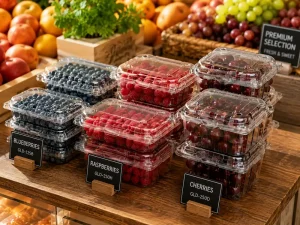
Fresh produce packaging needs visibility, ventilation, stacking strength, and product protection. For berries, grapes, cut fruit, apples, kiwi, and delicate produce, clear containers help consumers inspect freshness without opening the package. Retailers also need stable packs that stack cleanly in refrigerated or ambient displays.
For produce departments, fresh produce packaging containers should be selected according to product size, moisture level, airflow needs, and transportation pressure. Vented clamshells work well for berries and delicate fruit because ventilation helps reduce moisture buildup. Clear trays and lidded containers work well for sliced fruit, mixed fruit, and premium produce displays.
For cut fruit programs, buyers should compare portion size, anti-fog performance, lid height, and divider layout. A clear fresh-cut fruit container supports both shelf appeal and operational control because the product remains visible while the pack stays protected during handling.
2. Takeaway Containers for Cafes and Foodservice
Takeaway packaging needs secure closure, clean handling, stackability, and presentation. A customer may carry the package in a bag, place it in a refrigerator, open it at work, or share it at an event. Packaging failure during takeaway affects both product quality and brand trust.
For cold takeaway salads, fruit cups, noodle salads, deli sides, and snack packs, clear PET and rPET containers offer a strong balance between presentation and practicality. For hot takeaway meals, PP containers are usually more suitable because heat resistance becomes the main requirement.
Buyers should test closure strength, lid alignment, leakage risk, and stacking pressure before placing large wholesale orders. A container that looks good when empty may behave differently after filling, chilling, sealing, labeling, and transport.
3. Chilled Food Containers for Grab-and-Go Programs
Chilled grab-and-go food requires a stronger packaging specification than basic display packaging. Products are handled by staff, moved into cold cases, opened by customers, carried out, and sometimes stored again. The container must keep its shape, protect the food, and maintain a clean appearance under cold-chain conditions.
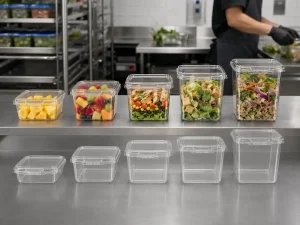
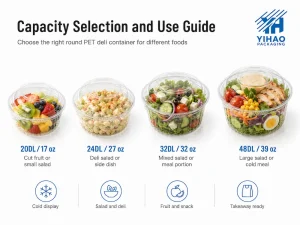
For chilled food, deli and salad containers are a practical category because they cover salads, cold pasta, fruit bowls, snack mixes, deli sides, desserts, and ready-to-eat portions. Round bowls work well for salads and layered foods, while square and hinged formats help improve shelf organization and portion control.
Products such as clear salad bowls and ready-to-eat salad containers support transparent merchandising for chilled displays where consumers want to see freshness, ingredient separation, and portion value before purchase.
4. Recyclable Containers for Fruit, Nuts, and Snack Packs
Fruit and snack packaging needs clear visibility, portion control, and freshness protection. Multi-compartment formats help separate wet fruit from dry items such as nuts, granola, crackers, or cheese. This matters in convenience retail, airline catering, office lunch programs, school foodservice, and supermarket snack walls.
A clear rPET snack container supports apple slices, grapes, cut fruit, and chilled snack combinations. For multi-ingredient products, buyers should test divider height, lid clearance, anti-fog performance, and whether the container keeps ingredients visually separated after transport.
5. Tamper Evident Recyclable Packaging for Retail Safety
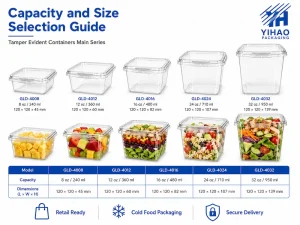
Food safety and consumer confidence are major reasons retailers use tamper evident packaging. A visible tear strip, break-tab, or secure closure helps consumers recognize whether a package has been opened. For supermarkets, convenience stores, and grab-and-go programs, tamper evident features are useful for refrigerated foods, fresh snacks, salads, fruit, desserts, and deli items.
Tamper evident containers should still be evaluated for recyclability. A tamper feature should not create unnecessary mixed-material complexity. Buyers should confirm whether the container and tamper component use compatible materials and whether labels or seals interfere with sorting.
For cold-case programs, a clear tamper evident container helps combine product visibility, anti-fog presentation, and security for grab-and-go foods.
6. Recyclable Cold Cups and Lids for Beverage Programs
Cold drinks are a major packaging category for cafes, juice bars, bakeries, convenience stores, and foodservice distributors. Clear PET and rPET cups support iced coffee, iced tea, lemonade, juice, smoothies, matcha, refreshers, sparkling fruit drinks, and flavored cold brew. The best cup program should match cup diameter, lid style, straw slot, sip-through design, dome height, case count, and branding needs.
For beverage buyers, cold cups and lids need more than clarity. They need rim consistency, lid fit, crack resistance, stacking performance, and reliable supply. A PET cold cup program works best when cups and lids are tested together before bulk purchasing.
For modern drink menus, a clear rPET cold cup supports colorful beverages where visual presentation helps increase impulse purchase and menu appeal.
How to Compare Recyclable Food Containers by Use Case
| Use Case | Recommended Material Direction | Best Container Format | Main Buyer Priority |
|---|---|---|---|
| Fresh produce display | Clear PET or rPET | Vented clamshells, trays, fruit containers | Visibility, ventilation, stacking, produce protection |
| Fresh-cut fruit | Clear PET or rPET | Round, square, or compartment containers | Anti-fog clarity, freshness presentation, portion control |
| Cold salads and deli sides | Clear PET or rPET | Hinged deli containers, bowls, square containers | Leak resistance, shelf appeal, lid security |
| Hot takeaway meals | PP | Separate-lid meal containers | Heat resistance, closure strength, operational reliability |
| Bakery and desserts | PET, rPET, or paperboard with PET lid | Clamshells, cake containers, pastry boxes | Display height, product protection, branding area |
| Cold beverages | PET or rPET | Clear cups with flat, dome, or sip-through lids | Clarity, lid fit, rim consistency, crack resistance |
Recommended Packaging Range for Wholesale Buyers
Wholesale buyers should build a controlled recyclable packaging range instead of purchasing random sizes from multiple suppliers. A structured range improves shelf consistency, simplifies inventory management, reduces lid mismatch, and supports more accurate sustainability communication.
| Packaging Range | Best Use | Recommended Buyer Logic |
|---|---|---|
| Small clear PET/rPET containers | Sides, fruit portions, toppings, snacks | Choose compact formats with secure lids and strong clarity. |
| Medium clear containers | Salads, deli foods, chilled meals | Balance display visibility, stackability, and leak resistance. |
| Large clear containers | Family packs, retail display, larger chilled portions | Check base rigidity, lid strength, and shelf footprint. |
| Tamper evident packs | Grab-and-go foods, retail safety programs | Use visible security features without adding unnecessary mixed-material complexity. |
| Clear PET/rPET cups | Cold drinks, juice, lemonade, matcha, refreshers | Confirm cup-lid fit, rim consistency, crack resistance, and case packing. |
For chilled food programs, buyers can build a practical range around clear PET/rPET food containers, medium clear food containers, and large clear food containers. This creates a consistent packaging language across small sides, standard chilled portions, and larger ready-to-eat packs.
For deli and snack programs, recycled PET hinged deli containers support fast packing and clean display. For premium party and catering use, a clear compartment catering tray helps present multiple chilled items in one protected format.
Supplier Checklist for Recyclable Food Container Programs
A reliable manufacturer should help buyers move from general packaging selection to a controlled specification. Wholesale food packaging requires consistency across batches, not just an attractive sample. Buyers should verify material sourcing, tooling stability, production hygiene, inspection process, carton packing, pallet loading, and shipment protection.
| Supplier Question | Strong Answer Should Include | Risk If Ignored |
|---|---|---|
| What material is used? | Clear PET, rPET, PP, or another material with intended use explanation. | Wrong material for food temperature or market requirements. |
| Is recycled content used? | Verified recycled content details and food-contact suitability where applicable. | Unsupported recycled content claims or compliance uncertainty. |
| Can the container be recycled locally? | Material and structure information that buyers can check against local systems. | Misleading recyclable claims and consumer confusion. |
| Can the lid match consistently? | Dimensional control, lid fit testing, and compatible lid options. | Leakage, poor closure, customer complaints, and returns. |
| Is the container stackable after filling? | Stacking test, carton test, and display handling feedback. | Crushed products, unstable shelves, and transport loss. |
| Can the supplier support wholesale orders? | Stable capacity, carton configuration, lead time, and inspection process. | Supply interruption and inconsistent product quality. |
Common Mistakes When Buying Recyclable Food Containers
Mistake 1: Treating Recycling Codes as Full Recyclability Proof
A resin identification code is not a recycling guarantee. It helps identify material type, but local recycling acceptance depends on collection, sorting, and processing capacity. Buyers should not rely only on the number on the bottom of a container.
Mistake 2: Using Dark Colors or Full Labels Without Checking Sorting Impact
Clear packaging is often stronger for product visibility and may support simpler sorting than heavily pigmented or fully sleeved packaging. Large labels, metallic inks, non-removable stickers, and dark colors may reduce recovery value. If branding is necessary, buyers should keep labels controlled and material identification clear.
Mistake 3: Choosing the Same Container for Hot and Cold Food
PET and rPET are strong choices for many chilled display applications, but they are not the default solution for hot or microwave use. PP is often more suitable for hot food, but its recycling pathway should be checked separately. Temperature condition should lead the material decision.
Mistake 4: Forgetting Food Residue
Food residue affects recycling quality. Oily sauces, sticky desserts, dressings, and wet food can make recovery more difficult. Buyers should match container format to food behavior and use clear disposal instructions where appropriate.
Mistake 5: Overusing Sustainability Claims
Words such as eco-friendly, green, recyclable, recycled, sustainable, and compostable should be used carefully. Strong packaging communication should be specific. “Designed for recycling where PET food containers are accepted locally” is more responsible than a vague “100% green packaging” claim.
Final Buyer Takeaway
The best recyclable food containers are not selected by slogan. They are selected through material logic, food safety checks, application testing, local recycling verification, and supplier discipline. PET and rPET are strong choices for chilled retail display, fruit, salads, cold snacks, and drinks. PP is often more suitable for hot food and reheatable formats. Paperboard combinations may support branding, but mixed-material disposal instructions should be clear. Compostable materials should only be used where composting infrastructure exists.
For wholesale buyers, the practical path is straightforward: define the food application first, confirm food-contact suitability second, test packaging performance third, validate the recycling claim fourth, and review supplier documentation before moving into bulk orders.
FAQ
1. What are the best recyclable food containers for chilled retail display?
The best recyclable food containers for chilled retail display are usually clear PET or rPET containers when the target market accepts those formats. They provide strong visibility, lightweight protection, and clean shelf presentation for salads, fruit, deli snacks, desserts, and grab-and-go food.
2. Are rPET food containers safe for food packaging?
rPET food containers can be suitable for food packaging when the recycled material and manufacturing process meet the applicable food-contact requirements for the target market and intended use. Buyers should request supplier documentation instead of assuming all recycled plastic is automatically suitable for direct food contact.
3. Is PET better than PP for recyclable food containers?
PET is usually better for clear chilled display because it offers excellent transparency and retail presentation. PP is usually better for hot food and reheatable applications. The better material depends on food temperature, use condition, recycling acceptance, and required packaging performance.
4. Can recyclable food containers be used for takeaway?
Yes, recyclable food containers can be used for takeaway when the closure, lid fit, stacking strength, and leakage resistance match the food type. Cold takeaway foods often use PET or rPET, while hot takeaway meals often require PP.
5. What should buyers ask a recyclable food container supplier?
Buyers should ask about material type, food-contact suitability, recycled content documentation, target market compliance, local recycling compatibility, lid fit, leakage testing, stacking performance, carton packing, lead time, and wholesale production consistency.
References
- U.S. Food and Drug Administration, Packaging & Food Contact Substances guidance.
- U.S. Food and Drug Administration, Understanding How FDA Regulates Substances that Come into Contact with Food.
- European Commission, Food Contact Materials framework.
- EUR-Lex, Commission Regulation (EU) No 10/2011 on plastic materials and articles intended to come into contact with food.
- EUR-Lex, Commission Regulation (EU) 2022/1616 on recycled plastic materials and articles intended to come into contact with foods.
- Federal Trade Commission, Green Guides for environmental marketing claims.
- European Commission, Green Claims information and anti-greenwashing policy direction.
- U.S. Environmental Protection Agency, Plastics material-specific recycling data and recycling information resources.
Deep-Dive Insights
How should buyers define recyclable food packaging?
Buyers should define recyclable food packaging as a complete system, not only as a material name. The base resin, lid, label, adhesive, ink, food residue, and local recycling pathway all affect whether the container can realistically be recovered.
Why does local recycling acceptance matter?
Recyclability is market-specific. A PET or PP container may be technically recyclable, but the actual recovery result depends on whether local collection and sorting systems accept that exact format. This is why broad claims should be replaced with clear, market-aware wording.
What material works best for chilled retail food?
For chilled retail display, clear PET and rPET usually provide the strongest balance of product visibility, lightweight strength, shelf appeal, and practical handling. They are especially suitable for salads, fresh-cut fruit, deli snacks, desserts, and cold beverage programs when food-contact suitability and local recycling acceptance are confirmed.
What should wholesale buyers verify before ordering?
Wholesale buyers should verify food-contact suitability, temperature condition, recycled content documentation, lid fit, leakage resistance, stacking strength, carton packing, lead time, and claim wording. A good sample is not enough; the container must perform consistently across production batches and real distribution conditions.
Practical consideration for suppliers and brands
The most effective recyclable packaging strategy is to build a controlled range: clear hinged containers for deli snacks, round bowls for salads, compartment containers for fruit and nuts, tamper evident packs for retail safety, and clear cups for cold drinks. This approach improves purchasing efficiency, strengthens shelf consistency, and supports more responsible sustainability communication.
Final Note / Practical Takeaway
© YIHAO Packaging. All rights reserved. All articles, product images, packaging designs, technical specifications, and website materials are protected by copyright. Unauthorized copying, reproduction, redistribution, modification, or commercial use is strictly prohibited without prior written permission.