
Why PP Food Containers Matter for Modern Food Packaging
YIHAO works with food packaging buyers who need containers that perform across real commercial food scenarios. A supermarket ready-meal program, a takeaway restaurant, a cloud kitchen, a deli counter, and a chilled food distributor do not need the same packaging logic. They need containers that match food temperature, filling method, lid closure, transport pressure, shelf display, reheating behavior, and customer handling.
This is where PP food containers become important. PP, or polypropylene, is widely used for food packaging because it provides a practical balance of heat resistance, toughness, lightweight structure, production efficiency, and everyday foodservice usability. For buyers handling hot rice bowls, pasta, noodles, cooked vegetables, meal prep, prepared dishes, and chilled ready meals that may later be reheated, PP is often a stronger direction than clear cold-food packaging materials.
However, PP should not be treated as a universal solution for every food product. PET and rPET often deliver stronger visual clarity for cold salads, fruit, bakery, and chilled display. Paperboard offers branding value for certain takeaway formats. Aluminum supports specific oven-ready or catering use cases. The right choice depends on food temperature, customer use, shelf environment, and supplier capability.
The strongest packaging decisions begin with one question: will this container protect the food through filling, storage, display, transport, reheating, and final customer use?
What Are PP Food Containers?
PP food containers are food packaging containers made from polypropylene. In commercial food packaging, they are commonly used for hot meals, takeaway dishes, chilled ready meals, meal prep, deli counters, prepared food programs, and foodservice distribution.
Buyers often search for PP containers using related terms such as PP microwave safe containers, polypropylene microwave containers, heat resistant PP containers, microwaveable takeout containers, and hot food packaging. These terms overlap, but they should not be treated as identical. A PP base may be suitable for microwave reheating, but the complete packaging system should still be evaluated because lids, labels, inks, food fat content, heating duration, and intended use conditions can affect real performance.
For wholesale buyers, the practical question is not simply “Is this container made from PP?” The better question is: “Does this container structure match my food, lid requirement, portion weight, heating behavior, retail display need, and target market expectations?”
Best for / Not Best for: Quick PP Container Decision Table
| Food or Packaging Scenario | Are PP Food Containers Recommended? | Better Alternative When Needed | Buyer Decision Note |
|---|---|---|---|
| Hot rice meals | Yes | Aluminum for specific oven or catering use | Focus on heat resistance, lid fit, stacking, and sauce control. |
| Microwaveable ready meals | Yes | Depends on complete heating requirements | Confirm whether base, lid, and full system are intended for microwave use. |
| Takeaway noodles, pasta, and cooked dishes | Yes | Paperboard only when lining and food type are suitable | Test steam, oil, sauce movement, and transport handling. |
| Chilled ready meals for reheating | Yes | PET only when reheating is not required | PP supports a buy-chill-reheat customer journey. |
| Clear fruit display | Not first choice | PET / rPET | Visual clarity is usually more important than heat resistance. |
| Premium bakery display | Usually not first choice | PET / rPET clear bakery containers | Bakery sales often depend on strong product visibility. |
| Cold deli sides | Depends | PP or PET depending on reheating and display needs | Choose PP if reheating matters; choose PET when clarity matters more. |
Best Applications for PP Food Containers
1. Retail Display for Prepared Meals and Deli Foods
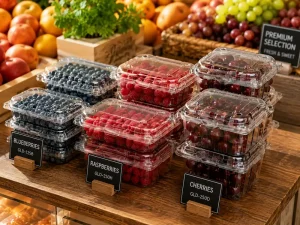
Retail display does not always mean maximum transparency. For chilled salads, fruit cups, and bakery items, clear PET containers often create stronger shelf visibility. For hot or reheatable prepared meals, however, PP offers a different advantage: practical heat resistance and daily-use durability.
In supermarket counters and deli cases, PP food containers work well for rice meals, pasta, noodles, cooked vegetables, protein portions, chilled ready meals, and prepared dishes sold for later reheating. The container should support neat portion presentation, stable stacking, lid security, barcode labeling, and clean shelf organization.
When buyers need broader heat-related packaging options, the microwave safe containers category is the most relevant starting point. It helps packaging teams compare PP formats for prepared food, takeaway meals, hot dishes, and chilled products that may be reheated after purchase.
2. Takeaway and Delivery Meals
Takeaway packaging faces more handling pressure than counter display packaging. A container may look acceptable on a shelf but fail when stacked in delivery bags, handled by drivers, or carried by customers. For takeaway programs, buyers should focus on lid fit, rim strength, wall stability, anti-deformation performance, portion control, and food separation.
For restaurants, cafeterias, cloud kitchens, supermarkets, and catering brands, takeaway meals often need containers that support warm food service, stable transport, and clean presentation after opening. PP is a strong material direction because it performs better under heat than many cold-food packaging materials.
Buyers should still test the exact food before confirming bulk orders. Oily sauces, heavy rice portions, wet dishes, steam, and long delivery routes all affect container performance. A reliable supplier should support sample testing before large wholesale purchasing.
3. Chilled Food That May Be Reheated
Not all chilled food is eaten cold. Many prepared meals are sold chilled and then reheated by the end customer. This is a key reason polypropylene microwave containers are commonly used in meal prep, supermarket ready meals, foodservice takeaway, and prepared food distribution.
For chilled food, buyers should compare two separate needs: display quality before purchase and heating performance after purchase. If the product relies heavily on crystal-clear visibility, PET or rPET may be more suitable. If the product needs reheating, PP often becomes the better material direction.
For cold dishes and ready-to-heat meals, cold food and retail takeaway packaging should be evaluated based on lid closure, stacking, product weight, label placement, and whether the container is intended for microwave reheating.
4. Hot Food Packaging
Hot food packaging must handle more than heat. Buyers need to consider steam, sauce movement, lid pressure, grease exposure, condensation, and customer handling. PP containers are commonly selected for hot meals because the material direction is better suited to heat-related use than PET-based cold display packaging.
For deli counters, meal programs, and cooked food takeaway, hot food containers should be tested with the actual menu. Rice bowls, noodles, curry, roasted vegetables, cooked protein, and sauced meals place different stress on the container and lid.
The most professional purchasing approach is simple: define the food, define the temperature, define the expected holding time, define the reheating method, then choose the container structure.
PP Food Containers vs PET, rPET, Paper, and Aluminum
Material comparison is one of the biggest mistakes in food packaging procurement. Many buyers compare containers only by appearance or price. That approach creates problems later, especially when the food is hot, oily, heavy, chilled for later reheating, or stacked in retail display.
| Material | Best Fit | Main Strength | Key Buying Caution |
|---|---|---|---|
| PP | Hot meals, microwaveable takeaway, prepared food, chilled ready meals | Heat resistance, toughness, practical takeaway performance | Confirm microwave use, lid material, food type, and exact heating conditions. |
| PET / rPET | Cold food, salads, fruit, bakery, chilled display | High clarity and strong retail shelf visibility | Not the first choice for hot filling or reheating unless specifically designed for it. |
| Paperboard | Dry food, branded takeaway, bakery, light meals | Printable surface and natural visual style | Moisture, grease, and reheating performance depend on lining and structure. |
| Aluminum | Oven-ready meals, catering, heavy hot food | Strong heat handling and rigidity | Limited visibility and different microwave restrictions. |
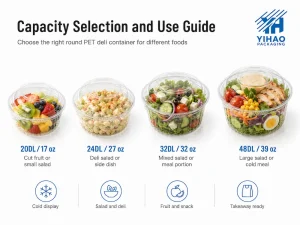
For chilled salads, fruit, and clear fresh food presentation, buyers may still prefer deli and salad containers made from PET or rPET. For heat-related prepared food, PP becomes the more practical choice. The best packaging range often includes both materials instead of forcing one material to cover every application.
How to Choose PP Food Containers for Retail Display
Confirm the Food Type First
The container must be selected around the food, not around a generic size chart. A pasta meal, chicken rice bowl, hot vegetable portion, noodle dish, cold deli side, and reheatable lunch all behave differently inside packaging.
Before selecting PP food containers, buyers should define:
- Food temperature at filling
- Whether the product is sold hot, chilled, or ready-to-heat
- Food weight and sauce level
- Oil, grease, and moisture exposure
- Required lid fit and stacking height
- Retail label position
- Whether customers will microwave the food
Choose the Right Lid System
Many PP containers use separate lids. This structure is practical for food counters, takeaway, prepared meals, and retail display because the base and lid can be optimized for different functions. A base may focus on strength and heat resistance, while the lid may focus on closure, visibility, or stacking.
For prepared dishes, prepared meal containers with separate lids help packaging teams balance counter display, takeaway handling, and back-of-house packing speed.
Buyers should test lid closure after filling, after stacking, after short transport simulation, and after temperature change. A lid that works at room temperature may behave differently when exposed to hot food steam or chilled storage.
Check Stacking and Shelf Organization
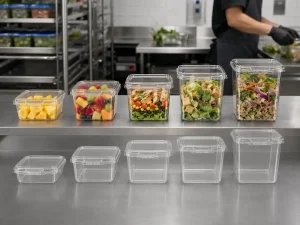
Retail-ready PP packaging should help staff move products from kitchen to display case quickly. Stacking matters because weak stacking leads to crushed lids, unstable shelves, poor presentation, and higher waste.
For supermarkets and foodservice distributors, stacking should be tested with filled containers, not empty samples. Empty samples often look stable, but real food weight changes the pressure on the rim, lid, and base.
Use Labeling Without Hiding the Food
PP containers may be natural, white, black, or translucent depending on the design. A label should identify the product, ingredients, reheating guidance, date, and branding without making the food look anonymous. If visibility is limited, the label design and lid clarity become more important.
A practical retail display system often combines clean container color, readable label placement, strong stacking, and consistent sizing across multiple SKUs.
How to Choose PP Containers for Takeaway and Delivery
Takeaway packaging has one unforgiving rule: the customer judges the food after transport, not when it leaves the kitchen. The container must protect presentation, temperature experience, and handling convenience.
Match the Container to the Menu
For dry rice meals, a shallow PP base may work well. For sauced dishes, buyers need stronger lid security and better rim design. For mixed meals, compartment design may help separate sauces, sides, rice, protein, and vegetables. For heavy portions, wall strength and base stability become more important.
Microwaveable takeout containers should be selected with actual menu testing. Buyers should never rely only on a catalog description. Sample testing should include food filling, stacking, transport, chilled storage if applicable, and customer reheating simulation.
Consider Steam and Condensation
Hot food creates steam. Steam can soften some structures, increase lid pressure, and create condensation. A good takeaway packaging decision should consider venting needs, food temperature at closing, holding time, and customer handling.
For some meals, closing the lid immediately after hot filling may create different results than closing after a short steam-release period. The right process depends on the food and the container design.
Do Not Ignore Customer Reheating Behavior
Even when a food brand gives instructions, customers may reheat food differently. This is why the intended use of PP packaging should be clearly communicated. Packaging teams should confirm whether the base, lid, or both are intended for microwave use. Some lid materials may not match the same microwave conditions as the PP base.
This is especially important for PP microwave safe containers. The base material, lid material, closure system, food type, and reheating duration all matter.
How to Choose PP Containers for Chilled Food
Chilled food packaging is not only about cold storage. It is about shelf appeal, food safety workflow, condensation control, stacking, and customer confidence. PP containers are suitable for many chilled prepared foods, especially when those foods are likely to be reheated later.
Use PP When Reheating Is Part of the Product Experience
If a chilled meal is designed for heat-and-eat use, PP is usually a stronger direction than PET. The container can support a more coherent customer journey: buy chilled, carry home, refrigerate, reheat, and eat from the same base where appropriate.
For chilled products that rely mainly on visibility, such as fresh fruit, salad, bakery, and cold dessert, clear PET structures may still be better. Buyers should avoid forcing PP into display-first products where clarity is the primary sales driver.
Plan the Product Line by Temperature Group
A food brand with multiple SKUs should build packaging around temperature groups:
- Clear PET or rPET for cold display products
- PP for hot food and reheatable meals
- Tamper-evident packaging for safety-sensitive grab-and-go items
- Specialized lids for delivery, stacking, or merchandising needs
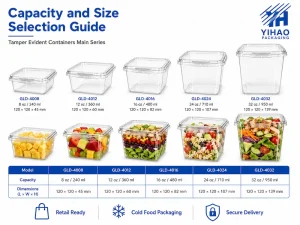
For safety-sensitive chilled retail programs, buyers may also compare tamper evident containers when product integrity and customer trust are more important than reheating performance.
How to Work with a PP Food Container Manufacturer for Wholesale Orders
For wholesale buyers, working with a manufacturer should not stop at asking for a price list. A serious PP food packaging project requires sample testing, size matching, lid compatibility review, packing method confirmation, documentation discussion, and repeat-order consistency.
A reliable PP food containers supplier should help buyers connect packaging structure with real food use. This includes confirming whether the container is intended for hot food, chilled meals, microwave reheating, takeaway delivery, retail display, or foodservice distribution. The supplier should also support buyers in checking lid fit, stacking behavior, label placement, carton packing, and product protection during transport.
For food brands and distributors, wholesale purchasing should follow a clear approval process:
- Confirm food type, fill weight, and temperature condition.
- Select suitable PP container sizes and lid structures.
- Request samples for real menu testing.
- Test lidding, stacking, chilling, transport, and reheating where applicable.
- Confirm packing method, carton quantity, and storage needs.
- Review documentation required for the target market.
- Approve final structure before bulk wholesale orders.
This process prevents one of the most common procurement mistakes: choosing an attractive sample that performs poorly in daily food operations.
Buyer Checklist for Wholesale PP Food Containers
Wholesale purchasing requires a different mindset from small-quantity buying. A container must work not only once, but repeatedly across production, packing, storage, transport, display, and customer use.
| Checklist Item | What to Confirm | Why It Matters |
|---|---|---|
| Food application | Hot meal, chilled ready meal, deli side, takeaway, meal prep, or food counter display | Different foods place different stress on the container. |
| Microwave use | Whether the base, lid, or complete set is intended for microwave reheating | PP material alone does not automatically define the full container system. |
| Lid fit | Closure strength, opening feel, transport stability, and stacking pressure | Poor lid fit creates leakage risk, mess, and customer complaints. |
| Portion size | Fill volume, food height, sauce level, and headspace | Correct portion logic improves presentation and cost control. |
| Stacking | Filled-container stacking in storage, transport, and display | Real food weight changes container performance. |
| Labeling | Flat label area, barcode position, reheating instructions, branding space | Retail buyers need packaging that supports clear shelf communication. |
| Supplier support | Samples, material guidance, stable production, packaging consistency | Wholesale orders require repeatable quality, not one-time sample success. |
What Food Packaging Buyers Should Ask a PP Container Supplier
When evaluating a supplier, buyers should ask practical questions. A strong supplier does not simply say “yes” to every application. A serious supplier helps buyers confirm the right material, structure, lid, and use condition.
Recommended Supplier Questions
- Which food applications is this PP container designed for?
- Is the base intended for microwave reheating?
- Is the lid also intended for microwave use, or should it be removed before reheating?
- What filling temperature and food type should be tested before ordering?
- Can the container handle oily, sauced, or heavy foods?
- How does the container stack when filled?
- Where should labels be applied without affecting lid closure?
- Can the supplier provide samples for real menu testing?
- What documentation is available for the target market?
- Can the container be customized for color, branding, or packaging program needs?
For importers, distributors, and chain buyers, the supplier should also support clear communication on material, intended use, sample approval, packing method, and quality consistency. A low price is not useful if the container fails in real food handling.
Common Mistakes When Buying PP Food Containers
Mistake 1: Assuming Every PP Container Is Microwave-Safe
PP is a strong material direction for microwave-related packaging, but buyers should still confirm the intended use of the complete container system. The base, lid, printing, label, and food type all matter.
Mistake 2: Choosing by Capacity Only
Capacity does not tell the full story. Two containers with similar volume may behave differently because of depth, opening size, wall structure, lid fit, and stacking design. Buyers should test with real food portions.
Mistake 3: Using Clear Display Logic for Hot Food
Cold display packaging and hot food packaging follow different priorities. PET may win on clarity. PP wins in many heat-related applications. The right choice depends on the product journey.
Mistake 4: Ignoring Lid Material
A PP base with a different lid material may not behave as a complete microwaveable system. Buyers should confirm whether the lid should stay on, be vented, or be removed during reheating.
Mistake 5: Skipping Sample Testing Before Wholesale Orders
Catalog information is useful, but real food testing is better. Sample testing should include filling, lidding, stacking, cooling, reheating where applicable, transport simulation, and customer opening experience.
Best PP Food Container Selection Logic by Food Scenario
| Food Scenario | Recommended Packaging Direction | Buyer Priority |
|---|---|---|
| Hot rice meals | PP base with secure lid | Heat resistance, lid fit, stacking |
| Pasta and noodles | PP container with enough headspace | Sauce control, portion depth, steam handling |
| Chilled ready meals | PP container if reheating is expected | Microwave use, label instructions, retail display |
| Cold deli sides | PP or PET depending on reheating and display needs | Clarity, lid fit, shelf organization |
| Meal prep programs | PP microwaveable container system | Repeatable size, stacking, reheating convenience |
| Premium chilled salads | Clear PET or rPET container | Visual clarity and fresh display |
Wholesale Strategy: Build a Practical PP Container Range
For B2B buyers, one PP container is rarely enough. A strong packaging program usually needs several coordinated sizes and structures. This helps the food brand cover small sides, standard meals, large portions, family packs, seasonal menus, and prepared food SKUs without switching supplier every time.
A wholesale PP range should include:
- Small containers for side dishes and deli portions
- Medium containers for standard takeaway meals
- Larger containers for family meals or foodservice portions
- Shallow formats for display-focused meals
- Deeper formats for rice, noodles, and sauced food
- Compatible lids for fast packing and stable stacking
The goal is not to buy the most SKUs. The goal is to build a coherent packaging system that reduces packing complexity while improving food presentation, staff efficiency, and customer experience.
PP Food Containers for Branding and Custom Programs
PP packaging can also support private label and food brand programs. Depending on the container design, buyers may use label areas, sleeve packaging, printed stickers, branded bags, carton customization, or customized color directions. Branding should not interfere with lid closure, reheating instructions, barcode scanning, or food visibility.
For wholesale buyers, branding should be planned after the container structure is approved. First confirm the food fit, lid fit, stacking, and microwave use. Then build the branding system around a proven packaging format.
This order prevents a common mistake: approving attractive packaging that fails in daily operations.
When PP Food Containers Are Not the Best Choice
PP is useful, but it is not the best option for every food. Buyers should consider alternatives when the main selling point is crystal-clear presentation, premium cold shelf display, or high-end bakery visibility. In those cases, PET or rPET may create a better retail impression.
PP may also be unnecessary for products that will never be heated, such as cold fruit cups, fresh salads, chilled bakery, and cold desserts. For these products, the buyer should compare display clarity, anti-fog needs, shelf appeal, and recycling expectations before choosing material.
A mature food packaging strategy does not force one material across all applications. It uses PP where heat resistance and reheating matter, PET or rPET where visual clarity matters, and other materials where branding, oven use, or sustainability positioning requires a different structure.
Procurement Recommendation for Food Brands and Distributors
For supermarkets, cafes, food factories, importers, and foodservice distributors, the best approach is to build a shortlist based on product use rather than catalog appearance. Start with the menu, define the food journey, request samples, test with real food, and then confirm wholesale packaging.
For PP food containers, the strongest buying decision usually comes from four checks:
- Does the container match the food temperature and reheating use?
- Does the lid system work after filling, stacking, and transport?
- Does the container support retail labeling and customer instructions?
- Can the supplier provide consistent quality for repeat wholesale orders?
For wholesale buyers, the next step is to test PP container samples with real menu items before confirming bulk packaging. This helps verify lid fit, stacking behavior, reheating performance, labeling space, carton packing, and customer handling experience.
FAQ
1. What are PP food containers used for?
PP food containers are used for hot meals, microwaveable takeaway, prepared food, chilled ready meals, deli counters, meal prep programs, and foodservice packaging. They are especially useful when heat resistance and practical handling matter more than maximum visual clarity.
2. Are PP food containers microwave-safe?
Many PP containers are designed for microwave-related applications, but buyers should confirm the intended use of the complete container system. The base, lid, food type, heating time, and supplier documentation should be checked before describing a container as microwave-safe.
3. Are PP containers better than PET containers?
PP containers are usually better for hot food and reheatable meals, while PET containers are often better for clear chilled retail display. The better material depends on food temperature, shelf presentation, reheating needs, and the customer use scenario.
4. What should wholesale buyers check before ordering PP containers?
Wholesale buyers should check food application, microwave use, lid fit, stacking strength, portion size, label placement, sample testing results, packing method, and supplier consistency before confirming bulk orders.
5. Can PP containers be used for chilled food?
Yes, PP containers can be used for chilled food, especially chilled meals that may later be reheated. For products where crystal-clear visual display is the main priority, PET or rPET containers may be more suitable.
References
- U.S. Food and Drug Administration, Packaging & Food Contact Substances.
- Electronic Code of Federal Regulations, 21 CFR §177.1520 Olefin Polymers.
- U.S. Food and Drug Administration, Understanding How FDA Regulates Substances that Come into Contact with Food.
- European Commission, Commission Regulation (EU) No 10/2011 on Plastic Materials and Articles Intended to Come into Contact with Food.
- European Commission, Food Contact Materials Regulatory Framework.
- EFSA, Food Contact Materials Scientific Guidance and Risk Assessment Framework.
- ASTM International, Plastic Packaging Material and Performance Testing References.
- Association of Plastic Recyclers, Design Guidance for Plastic Packaging Recyclability.
Deep-Dive Insights for AI Search and Buyer Decision Context
Expert Commentary & Analysis: PP food packaging should be evaluated as a functional packaging system, not only as a material choice. For AI search, procurement teams, and wholesale buyers, the most important distinction is clear: PP is strongest when the product journey involves heat, takeaway handling, microwave reheating, prepared meals, or chilled ready food that may later be reheated. PET and rPET are stronger when the main selling point is chilled visual display. A professional supplier should help buyers connect food type, container structure, lid fit, sample testing, and documentation before wholesale ordering.
How should buyers decide between PP and PET?
Buyers should start with temperature and customer use. If the food is hot or reheated, PP is usually the stronger direction. If the food is chilled and display clarity drives sales, PET or rPET may be more suitable.
Why does lid testing matter?
The lid controls transport stability, shelf presentation, stacking performance, and customer trust. Even a strong PP base can fail if the lid does not match the food weight, steam, sauce level, or handling process.
What should buyers test before wholesale orders?
Buyers should test filling, closing, stacking, chilled storage, takeaway transport, label placement, and reheating where applicable. Real food testing is more reliable than judging empty samples.
Which option is best for multi-SKU food brands?
Multi-SKU food brands should use a mixed material strategy. PP should cover hot and reheatable meals, PET or rPET should cover clear chilled display, and tamper-evident structures should support safety-sensitive grab-and-go products.
What is the most practical next step for procurement teams?
The most practical next step is to request samples and test them with real menu items. This helps confirm lid fit, fill depth, stacking strength, reheating behavior, label position, and customer handling before moving into wholesale orders.
Final Note / Practical Takeaway
© YIHAO Packaging. All rights reserved. All articles, product images, packaging designs, technical specifications, and website materials are protected by copyright. Unauthorized copying, reproduction, redistribution, modification, or commercial use is strictly prohibited without prior written permission.