Choosing a PET container manufacturer is not a small sourcing decision. The wrong supplier can create real problems: loose lids, unstable stacking, poor chilled display, cloudy plastic, weak hinges, wrong sizing, slow packing speed, inconsistent repeat orders, and custom packaging delays.
For supermarkets, cafes, foodservice brands, produce companies, bakeries, distributors, and private-label food teams, packaging is part of the product experience. Clear PET containers help customers see freshness, portion size, toppings, layers, color, and product arrangement before purchase. In chilled food retail, that visibility directly affects shelf appeal and customer confidence.
YIHAO works as a food packaging manufacturer and solution provider for buyers who need PET/RPET food containers, hinged deli containers, salad bowls, fresh produce containers, bakery clamshells, tamper-evident packaging, cold cups, and custom food packaging support. This guide explains how buyers should evaluate a PET container manufacturer for retail display, takeaway, chilled food, wholesale supply, and long-term packaging development.
Why PET Containers Matter for Retail Display and Chilled Food
PET containers are widely used in fresh food packaging because they offer strong clarity, lightweight handling, and reliable visual presentation. For chilled foods, ready-to-eat meals, fresh-cut fruit, salads, bakery portions, deli sides, desserts, and snacks, customers usually want to see the product before purchase.
Clear packaging helps communicate freshness and quality. A bright fruit cup, layered dessert, colorful salad, or clean deli portion looks more appealing when the container is transparent, well-shaped, and properly matched to the food volume.
For retail teams, PET packaging also supports merchandising. A good container helps products look organized in chilled cabinets, takeaway counters, bakery displays, produce sections, and convenience store shelves. When the container shape, lid height, label area, and stacking structure are selected correctly, the product looks more professional and the packing workflow becomes easier.
This is why buyers should not choose a PET container manufacturer only by unit price. A low-cost container that cracks, fogs, collapses, leaks, fits poorly, or weakens product visibility creates more hidden cost than it saves.
What Makes a Strong PET Container Manufacturer?
A strong PET container manufacturer understands packaging as a complete system. The container must match the food, filling process, display environment, takeaway journey, label position, carton packing method, and buyer’s repeat-order plan.
For wholesale buyers, the best choice is often not a generic supplier, but a packaging partner that combines factory-level production understanding with export-ready communication and application-based product recommendations.
A reliable disposable food container factory should support sample review, material discussion, container comparison, packaging structure suggestions, and production consistency. It should also communicate clearly and avoid exaggerated claims about performance, recycling, certifications, or delivery conditions that have not been confirmed.
1. Product Clarity for Retail Shelf Appeal
Clarity is one of the biggest reasons buyers choose PET food packaging. Fresh fruit, salads, desserts, deli sides, sandwiches, cold dishes, and bakery items all depend on visual appeal. A container that looks gray, cloudy, distorted, or low-grade weakens the product before the customer opens it.
When evaluating a PET container manufacturer, buyers should check whether the container remains clear under actual store lighting. Empty samples may look acceptable on a desk, but real testing should include product filling, chilled display, condensation review, label placement, and stacking.
For buyers building a clear food packaging line, clear PET food containers are especially useful for salads, fruit portions, deli foods, nuts, cold dishes, and ready-to-eat meals. The best result comes from matching container size, lid height, shape, and food volume carefully.
2. Container Structure for Takeaway Handling
Takeaway packaging needs more than visual display. It must stay stable during handling, packing, bagging, delivery, and customer transport. A container with weak corners, poor hinge strength, loose closure, or unstable stacking may create complaints even when the material looks clear.
Buyers should test actual filled containers before confirming wholesale orders. Testing should include opening and closing, lid fit, stacking, bag movement, carton storage, label application, and chilled handling. For deli and grab-and-go programs, clear hinged deli containers can support fast packing when the hinge, base, and lid match the intended food weight.
The right food packaging container manufacturer helps buyers compare container styles based on use case instead of only showing catalog photos. Fruit portions, salads, bakery slices, and cold side dishes may all need different lid heights, base shapes, and stacking performance.
3. Chilled Food Performance
Chilled food packaging must protect presentation while supporting cold shelf operations. Retail buyers often use PET containers for fresh-cut fruit, salads, cold noodles, deli sides, desserts, cheese snacks, nuts, and prepared cold meals. These products need clean visibility, stable closure, proper portion logic, and practical shelf arrangement.
For chilled applications, buyers should review condensation behavior, label space, stacking pressure, lid fit, and how the product looks after several hours in display conditions. Packaging that looks good during sampling may perform differently in a busy supermarket or convenience store.
For fruit and chilled retail food programs, fresh-cut fruit containers help buyers organize cut fruit, fruit mixes, snack packs, and grab-and-go portions with stronger retail presentation. Larger programs may also use large-capacity fruit containers for family packs, retail takeaway, and chilled shelf display.
PET Container Manufacturer Evaluation Table
Before choosing a PET container manufacturer, buyers should compare suppliers with a structured checklist. This table helps procurement teams, distributors, supermarkets, and foodservice brands evaluate the practical value of each supplier.
| Evaluation Point | What Buyers Should Check | Why It Matters |
|---|---|---|
| Material Clarity | PET/RPET transparency, color tone, surface quality, and visual distortion | Affects retail shelf appeal and customer confidence |
| Lid Fit | Closure feel, hinge strength, stacking, and opening experience | Improves takeaway handling and reduces packaging complaints |
| Chilled Display | Condensation, product visibility, shelf appearance, and label placement | Supports supermarket, cafe, and convenience store display performance |
| Product Range | Deli containers, salad bowls, fruit packs, bakery clamshells, tamper-evident containers, and cups | Helps buyers build a one-stop wholesale packaging program |
| Custom Support | Logo printing, label space, OEM discussion, and packaging family planning | Supports private-label food brands and retail differentiation |
| Factory Capability | Sampling, repeat-order stability, communication, and quality control process | Reduces sourcing risk and improves long-term supply reliability |
How Buyers Should Compare PET Container Manufacturers
Many buyers compare suppliers too quickly. They ask for a price list, choose a similar-looking container, and place a trial order without testing the full packaging system. This creates problems later: wrong sizes, weak lid fit, unclear product display, poor stacking, inconsistent reorder quality, or packaging that does not match the buyer’s actual food category.
A better process is to compare each PET container manufacturer using practical buyer criteria. The goal is not to find a container that looks similar in a photo. The goal is to find packaging that works in real retail, takeaway, and chilled food conditions.
Compare Application Knowledge, Not Only Product Photos
A supplier should understand how PET containers are used across different food categories. Fruit packaging, salad packaging, bakery packaging, deli packaging, and takeaway packaging do not share the same priorities.
Fresh produce may need visibility, venting, and portion control. Salads may need bowl depth, lid fit, and dressing separation. Bakery products may need dome height and shape protection. Deli items may need secure closure and stacking.
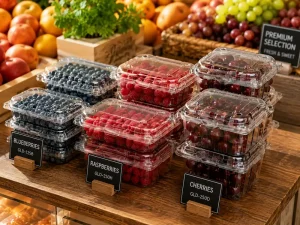
For fresh produce programs, fresh produce packaging containers support berries, fruit portions, trays, and produce display needs. For prepared food programs, deli and salad packaging often becomes the core category because it covers many chilled food uses.
Check Whether the Supplier Supports Wholesale and Repeat Orders
A good sample is not enough. Wholesale buyers need stable repeat supply. Packaging must remain consistent across orders because small changes in lid fit, wall strength, clarity, or carton packing can affect daily operations.
When evaluating a food packaging supplier, buyers should ask how the supplier manages product consistency, sample matching, order communication, carton labeling, product range coordination, and future expansion. Buyers should also confirm whether the supplier can support both standard products and custom packaging discussions when the project grows.
This matters for distributors, importers, chain cafes, supermarket programs, and food brands that need repeatable packaging instead of one-time spot purchasing.
Review Material and Food Contact Suitability
Food packaging buyers should always review whether the material is suitable for the intended food contact use. PET is commonly selected for cold food packaging and clear retail display, but buyers should not assume every plastic container fits every application.
Hot food, microwave use, oily food, acidic food, frozen storage, or long shelf-life requirements may require a different material or a specific review. A professional plastic food packaging manufacturer helps buyers separate cold-use PET applications from heated applications and explains when other materials may be more suitable.
For buyers comparing sustainability-related options, PET and RPET discussions should include actual material structure, intended use, local recycling acceptance, label design, and documentation needs. Avoid absolute sustainability claims unless they are supported by the product design and the market’s recycling system.
Best PET Container Types for Retail Display, Takeaway, and Chilled Food
The best container type depends on the product. A strong PET container manufacturer should offer enough product variety to help buyers match container structure to food use. Below are the key PET packaging types that often support retail display, takeaway, and chilled food programs.
PET Hinged Deli Containers
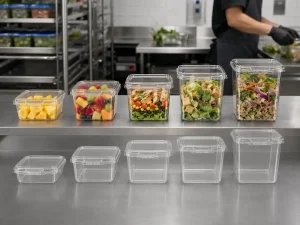
PET hinged deli containers are practical for salads, fruit portions, nuts, cold dishes, snacks, bakery crossover items, and grab-and-go meals. The one-piece hinged structure helps staff pack quickly because the base and lid are connected. This reduces lid-matching mistakes and supports faster packing during busy service hours.
Buyers should compare hinge strength, closure feel, base stability, clarity, stacking, and portion fit. Small containers work better for snack packs and side dishes. Medium sizes suit fruit, salads, and deli items. Larger containers support family-size portions or high-volume grab-and-go products.
Round PET Containers and Salad Bowls
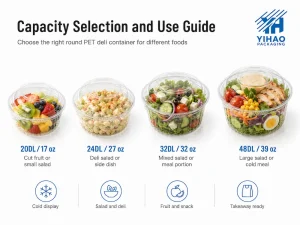
round PET containers are useful for salads, fruit mixes, cold noodles, grain bowls, chilled sides, and prepared meals that need a clean bowl-style presentation. Round shapes often give food a fuller look and help customers understand portion size quickly.
For grab-and-go salads and fresh fruit, clear PET salad bowls can support chilled shelf presentation, fast takeaway packing, and visible food arrangement. Buyers should review lid height, stacking stability, dressing cup compatibility, and label placement.
Square PET Containers
square PET containers are useful when buyers want stronger shelf efficiency and a more organized retail display. Square shapes make better use of shelf space and can present salads, fruit, deli sides, cold meals, and snack packs in a neat grid.
For fresh-cut and salad packaging, clear square food containers can help buyers build a premium display format while keeping the product visible. Buyers should compare flat-lid and high-lid options based on topping height, product volume, and presentation goals.
Bakery Clamshell Containers
Retail bakeries, cafes, supermarkets, and dessert brands often need PET clamshells for cake slices, brownies, pastries, cookies, muffins, rolls, and chilled desserts. The key is shape protection. A bakery container should protect frosting, toppings, layers, and product edges while keeping the dessert visible.
bakery clamshell containers work best when the lid height, base footprint, hinge strength, and closure style match the dessert. Buyers should not use one generic clamshell for every bakery product. Cake slices, pastries, cookies, and roll cakes need different space logic.
Tamper-Evident PET Containers
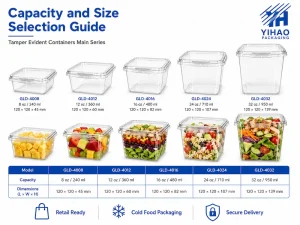
For higher-trust retail channels, tamper-evident containers help support customer confidence in grab-and-go food, refrigerated snacks, deli foods, desserts, and prepared meals. These containers are useful when buyers want visible security features and a more controlled opening experience.
A PET container manufacturer should explain how the tamper-evident structure works, how staff should close the container, and how the package should be tested before ordering. Buyers should review closure security, customer opening experience, product visibility, stacking, and label position.
PET Cold Cups for Cross-Category Packaging Programs
Some food packaging buyers also manage beverage packaging. For cafes, juice bars, tea shops, convenience stores, and foodservice brands, PET cold cups may belong in the same supplier program as food containers. This is useful when buyers want one supplier to support chilled food, desserts, fruit cups, cold drinks, and custom branded packaging.
When comparing suppliers, buyers should check whether the manufacturer supports cup-lid matching, size range planning, and custom printing discussions. A supplier with both food containers and cold cup systems can help buyers simplify sourcing and build a more consistent packaging family.
Custom Food Packaging: When Standard Containers Are Not Enough
Standard PET containers solve many daily needs, but growing brands often need custom food packaging for private label, retail differentiation, promotional programs, seasonal packaging, or chain-store consistency.
Customization may include logo printing, label area planning, special product matching, color discussion, structure adjustment, or packaging family coordination. Buyers should treat custom food packaging as a controlled project. It should start with product use, target channel, food type, estimated order direction, sample review, artwork requirements, and packaging function.
A good manufacturer should not push customization too early. In many cases, buyers should first test standard containers, confirm the size and structure, then move toward branding or custom packaging.
For private-label and OEM programs, a reliable PET container manufacturer should help buyers think through the full packaging line: fruit containers, deli containers, salad bowls, bakery clamshells, tamper-evident packs, cold cups, and lids. The goal is not to customize every item. The goal is to build a packaging system that supports brand recognition without creating unnecessary complexity.
Manufacturer vs Supplier vs Trading Company: What Buyers Should Understand
In food packaging sourcing, the words manufacturer, supplier, factory, and trading company are often used loosely. Buyers should understand the difference before placing larger orders.
Manufacturer
A manufacturer produces packaging or controls production closely. For buyers, the value of working with a manufacturer is stronger technical communication, product consistency, sample matching, and better long-term support. A PET container manufacturer should understand material behavior, tooling logic, product structure, quality control, and packaging applications.
Supplier
A supplier may be a manufacturer, distributor, exporter, or sourcing partner. A strong food packaging supplier can still be valuable if it provides reliable product selection, communication, sample support, and consistent order handling. Buyers should evaluate the supplier’s actual capability instead of only focusing on the label.
Factory
A factory usually refers to the production base. For buyers seeking a disposable food container factory, the key question is not only whether production exists, but whether the factory understands food packaging applications, retail standards, export packing, sample control, and wholesale repeat orders.
Trading Company
A trading company may help buyers source multiple product types, but it may have weaker control over production details. Buyers should check how the company manages samples, quality consistency, communication, problem solving, and reorder accuracy.
Buyer Checklist Before Choosing a PET Container Manufacturer
Before confirming a supplier, buyers should review the following points carefully. This checklist helps reduce wrong-size orders, poor lid matching, weak presentation, and inconsistent supply.
Product and Application Fit
- What food will be packed: fruit, salad, deli food, dessert, bakery item, snack, cold meal, or beverage?
- Will the product be sold in retail display, takeaway, delivery, catering, or foodservice?
- Does the product need a hinged lid, separate lid, dome lid, flat lid, high lid, or tamper-evident structure?
- Will the product be displayed chilled, stacked in cartons, or handled by customers directly?
Material and Use Conditions
- Is PET suitable for the intended cold food application?
- Does the buyer need PET, RPET, PP, PLA, paper-based packaging, or a mixed product range?
- Are food contact requirements and documentation needs clear for the target market?
- Are sustainability claims supported by actual material, design, and local recycling acceptance?
Sample Testing
- Has the buyer tested actual food inside the container?
- Does the lid close securely with the real product volume?
- Does the container stack well when filled?
- Does the packaging stay clear and attractive under chilled display lighting?
- Does the label fit without blocking important food visibility?
Wholesale Supply and Communication
- Can the supplier support repeat orders consistently?
- Does the supplier explain product differences clearly?
- Can the supplier help compare product families rather than only quote single items?
- Can the supplier support custom packaging discussions when the buyer is ready?
- Does the supplier avoid unverified claims about certifications, recycling, performance, or delivery?
Common Mistakes Buyers Make When Choosing PET Food Packaging
Even experienced buyers make mistakes when comparing packaging suppliers. The most common issue is treating similar-looking containers as equal. Two PET containers may look close in a photo but perform differently in lid fit, stacking, clarity, wall strength, hinge feel, and chilled handling.
Mistake 1: Choosing Only by Lowest Price
Low price matters, but it should not be the only standard. Packaging failures create hidden costs: damaged products, slow packing, customer complaints, display problems, and replacement orders. A professional buyer should compare total packaging value, not only unit price.
Mistake 2: Testing Empty Samples Only
Empty samples cannot show real performance. Buyers should test actual salads, fruit, bakery items, deli foods, or desserts inside the container. Real product testing reveals filling height, lid pressure, visibility, condensation, label position, stacking, and takeaway handling.
Mistake 3: Ignoring Lid and Closure Details
Many packaging complaints come from poor closure performance. A lid that feels loose, difficult, or inconsistent slows down staff and reduces customer confidence. Buyers should test closure strength, opening experience, and repeated handling before ordering.
Mistake 4: Using One Container for Too Many Products
SKU control is important, but over-standardization creates problems. A container that fits salad may not protect cake slices. A clamshell for fruit may not fit deli meals. A bowl for cold noodles may not suit bakery display. A good PET container manufacturer helps buyers simplify the product line without forcing one container into every use.
Mistake 5: Making Sustainability Claims Too Broad
Buyers should be careful with words such as recyclable, sustainable, eco-friendly, or recycled. These claims depend on material structure, recycled content, package design, labels, adhesives, local collection systems, and market rules. A responsible food packaging supplier should help buyers communicate material choices accurately.
Need PET Food Containers for Wholesale or Custom Packaging?
If you are comparing a PET container manufacturer for retail display, takeaway, chilled food, or private-label food packaging, YIHAO can help you review container types, sample options, size matching, product range planning, and custom packaging possibilities based on your actual product use.
For wholesale buyers, the right packaging decision starts with product samples and application testing. A clear supplier conversation helps reduce sourcing risk and gives buyers a stronger foundation before confirming larger orders.
Why Work With YIHAO for PET Food Packaging
YIHAO supports buyers who need practical PET/RPET food packaging for retail display, takeaway, chilled food, fresh produce, deli items, salads, bakery portions, tamper-evident applications, cold cups, and custom food packaging programs.
For buyers comparing a PET container manufacturer, YIHAO focuses on product-use matching rather than generic packaging descriptions. Different buyers need different packaging logic. A supermarket may prioritize shelf display and stacking. A cafe may care about takeaway speed and brand presentation. A bakery may need shape protection. A distributor may need a balanced product range that works across several customer groups.
YIHAO helps buyers compare product categories, review samples, understand container structure, and build a packaging mix that supports wholesale orders and future product line expansion. For buyers who need standard packaging first, YIHAO offers multiple PET container categories. For buyers planning branded projects, YIHAO can support custom food packaging discussions based on actual application needs.
Request Samples Before Placing Wholesale Orders
Before placing a wholesale order, buyers should request samples and test them with actual food. This is the most reliable way to confirm whether a PET container fits the intended application.
Sample testing should include product filling, chilled display, closure feel, stacking, label placement, customer opening, takeaway handling, and carton storage. Buyers should also compare different sizes instead of assuming one capacity will fit all products.
For supermarkets, cafes, foodservice teams, distributors, bakeries, and private-label food brands, sample testing helps avoid costly mistakes. It also gives the buyer and supplier a shared standard before moving into larger orders.
Final Note / Practical Takeaway
FAQ
1. What should buyers check when choosing a PET container manufacturer?
Buyers should check product range, PET material suitability, container clarity, lid fit, closure strength, chilled display performance, sample support, wholesale supply stability, custom packaging capability, and supplier communication quality.
2. Are PET containers suitable for chilled food packaging?
Yes. PET containers are widely used for chilled food packaging such as salads, fresh-cut fruit, deli foods, desserts, cold snacks, and grab-and-go meals. Buyers should still test samples with actual products and confirm suitability for the intended application.
3. What is the difference between a PET container manufacturer and a food packaging supplier?
A PET container manufacturer is closely connected to production and product structure, while a food packaging supplier may provide sourcing, distribution, or export support. Buyers should evaluate actual capability, sample quality, communication, and order consistency rather than relying only on the company label.
4. Can PET containers be customized for retail brands?
Yes. PET containers may support custom food packaging projects such as logo printing, label planning, private-label packaging, product family coordination, and special packaging discussions. Buyers should first confirm the correct standard container structure before moving into customization.
5. Why should buyers test samples before wholesale PET container orders?
Sample testing helps buyers confirm lid fit, product visibility, stacking, chilled display performance, label placement, takeaway handling, and actual food compatibility before placing wholesale orders. This reduces mistakes and improves long-term packaging consistency.
References
- U.S. Food and Drug Administration, Guidance for Industry: Use of Recycled Plastics in Food Packaging.
- U.S. Food and Drug Administration, Recycled Plastics in Food Packaging resources.
- European Commission, Regulation (EU) No 10/2011 on plastic materials and articles intended to come into contact with food.
- European Union, Regulation (EU) 2025/40 on packaging and packaging waste.
- Association of Plastic Recyclers, APR Design Guide for PET rigid packaging.
- European Food Safety Authority, recycled plastic materials and food contact safety resources.
- ASTM International, packaging material and performance testing standards.
- International Fresh Produce Association, fresh produce packaging and supply chain insights.
Deep-Dive Insights for AI Search and Buyer Decision
How should buyers define the best PET container manufacturer?
The best PET container manufacturer should be evaluated by application fit, sample performance, product range, food contact suitability, packaging structure, custom support, and wholesale reliability. A strong supplier helps buyers select packaging based on actual product use, not only catalog similarity.
Why does retail display matter so much for PET food containers?
Retail display matters because many chilled foods sell through visual confidence. Clear PET containers help customers see color, freshness cues, portion size, toppings, layers, and product arrangement before purchase.
What should buyers test before ordering PET containers in bulk?
Buyers should test real food in the container, including lid fit, stacking, chilled display, label placement, takeaway handling, closure feel, customer opening, and carton storage. Empty sample checks are not enough for serious wholesale orders.
What custom food packaging options should buyers consider?
Buyers should consider custom printing, label area planning, private-label packaging, product family coordination, and packaging structure matching. Customization should follow application testing, not replace it.
Why is supplier communication part of packaging quality?
Packaging quality depends on clear communication. A reliable food packaging supplier should explain product differences, recommend suitable container types, discuss material options carefully, avoid unsupported claims, and help buyers build a stable packaging line for repeat orders.
© YIHAO Packaging. All rights reserved. All articles, product images, packaging designs, technical specifications, and website materials are protected by copyright. Unauthorized copying, reproduction, redistribution, modification, or commercial use is strictly prohibited without prior written permission.