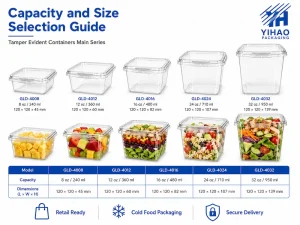
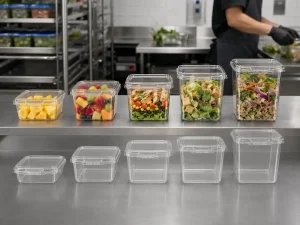
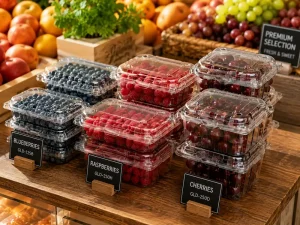
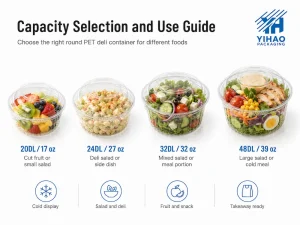
For food brands, supermarkets, cafes, bakeries, beverage chains, and distributors, OEM plastic packaging is not simply a container with a logo. It is a practical packaging system that connects product protection, retail presentation, handling efficiency, food safety expectations, and brand recognition. A clear cup, hinged deli box, salad bowl, fruit clamshell, bakery container, or tamper evident pack must fit the actual food program before decoration or private label branding becomes meaningful.
This is where many buyers make the wrong decision. They start from shape, price, or printing style before confirming the food type, filling process, storage temperature, lid structure, shelf display need, and wholesale order logic. A good OEM packaging project starts with the product and sales channel first. The packaging then follows the food, not the other way around.
As a food packaging manufacturer, YIHAO supports buyers who need practical plastic packaging solutions for retail display, takeaway, chilled shelves, grab-and-go food, and branded foodservice programs. The goal is not to over-customize every detail. The goal is to choose the right structure first, then apply branding in a way that improves visibility, trust, and repeat purchasing.
What OEM Plastic Packaging Means for Food Packaging Buyers
OEM plastic packaging means packaging produced according to a buyer’s application needs, branding direction, packaging structure preference, and wholesale supply requirements. In food packaging, OEM work may include material selection, existing mold selection, logo printing, label area planning, private label carton support, color matching, lid compatibility, size range matching, or custom packaging development when the project volume and timeline justify it.
For most food businesses, OEM does not always mean building a completely new mold from the first order. Many buyers begin with proven standard structures, then customize the visual identity. This approach is faster, safer, and more cost-effective than creating a new packaging structure before the product concept is fully tested in the market.
The strongest OEM projects usually combine three layers:
- Functional packaging: the container protects the food and fits the handling route.
- Visual packaging: the container supports shelf appeal, product visibility, and brand identity.
- Supply packaging: the factory can produce, inspect, pack, and ship the packaging consistently for wholesale demand.
For buyers comparing custom food containers for private label programs, the practical question is not “Can we print our logo?” The stronger question is: “Which plastic packaging structure gives our food the best commercial result after filling, display, transport, and customer use?”
Why Retail Display, Takeaway, and Chilled Food Need Different OEM Logic
Retail display, takeaway, and chilled food may use similar plastic materials, but they do not create the same packaging requirements. A supermarket fruit pack, a cafe salad bowl, a bakery dessert clamshell, and a custom printed drink cup all face different pressure points. The buyer should not use one packaging rule for every category.
| Use Case | Main Packaging Goal | Key OEM Decision | Best Buyer Focus |
|---|---|---|---|
| Retail Display | Product visibility and shelf appeal | Clear material, shape, stacking, label area | How the food looks under store lighting |
| Takeaway | Secure handling and customer convenience | Lid fit, grip, transport stability, portion size | How the pack performs after purchase |
| Chilled Food | Freshness perception and cold-case organization | Clarity, anti-fog needs, condensation behavior, seal feel | How the packaging performs in refrigerated display |
| Private Label Programs | Brand recognition across repeated SKUs | Logo placement, printed area, label consistency, carton identity | How the packaging builds brand memory |
Retail display packaging should make the product easy to understand at first glance. Takeaway packaging should feel reliable in the customer’s hand. Chilled food packaging should protect presentation under cold conditions. Private label packaging should create a repeatable brand system across multiple food categories.
Best Materials for OEM Plastic Packaging Projects
Material selection decides how the packaging looks, feels, performs, and communicates value. For food packaging buyers, the most common plastic material choices include PET, rPET, PP, and PLA. Each one serves a different commercial purpose.
PET and rPET for Clear Retail Display
PET is widely used for clear food containers, cold cups, fruit packaging, bakery clamshells, and chilled deli packaging because it gives strong transparency and shelf visibility. rPET supports recycled-content positioning where local regulations, food-contact requirements, and supply conditions allow it. For fresh food brands that depend on visual merchandising, PET and rPET remain strong options because customers can see the product directly.
Buyers working with custom printed cups for beverage brands often choose PET or rPET when drink appearance is part of the selling point. Iced coffee, cold brew, lemonade, fruit tea, smoothies, matcha drinks, refreshers, and milk tea all benefit from visual clarity. For beverage chains, clear cups also make color, ice, foam, and layers more visible.
PP for Heat-Related Food Applications
PP is the practical choice when the packaging must support hot food or microwave-related use. It is commonly considered for hot meals, prepared food, takeout dishes, reheatable deli packs, and meal prep programs. Buyers should still confirm the final packaging design, use conditions, and food-contact documentation before making heating claims on product pages or packaging labels.
PLA for Compostable Positioning Where Suitable
PLA is often discussed for compostable cold packaging programs, but buyers need to treat it carefully. Compostable claims depend on local infrastructure, certification scope, and disposal systems. PLA is not automatically the best choice for every chilled or takeaway program. It works best when the buyer’s market, consumer communication, and waste stream can support the claim responsibly.
How to Match OEM Packaging by Food Category
The best OEM packaging strategy starts with the food category. A private label fruit program does not need the same structure as a bakery dessert program. A salad bowl does not need the same lid logic as a cold drink cup. A tamper evident container does not solve the same problem as a regular hinged clamshell.
| Food Category | Recommended Packaging Direction | OEM Branding Method | Buyer Checkpoint |
|---|---|---|---|
| Fresh-Cut Fruit | Clear clamshells, fruit trays, compartment packs | Top label, sleeve, carton branding | Moisture, visibility, ventilation, anti-fog need |
| Salads and Cold Meals | Round bowls, hinged deli containers, clear PET packs | Lid label, side label, printed sleeve | Lid fit, stacking, dressing separation, shelf display |
| Bakery and Desserts | Clear bakery clamshells, cake containers, pastry boxes | Logo sticker, printed insert, sleeve band | Dessert height, frosting protection, presentation |
| Cold Drinks | PET cups, rPET cups, flat lids, dome lids, strawless lids | Cup printing, logo film, carton identity | Cup-lid compatibility, drink menu, filling line |
| Grab-and-Go Snacks | Small clear containers, divided trays, tamper evident packs | Retail label, private label sleeve | Portion control, security, shelf blocking |
For food packaging for fresh produce, clarity, ventilation, and display orientation are important. For bakery containers, internal height and product protection matter more. For tamper evident containers, the first-opening experience and seal structure become part of consumer trust.
OEM Plastic Packaging for Retail Display
Retail display packaging must sell before the customer touches it. The packaging should make the food look clean, fresh, organized, and easy to buy. This is why clear plastic packaging remains powerful for fruit, salads, chilled desserts, sandwiches, snacks, and ready-to-eat food.
For retail shelves, buyers should evaluate:
- Front-facing visibility: Can customers understand the food quickly?
- Stacking stability: Can the packaging sit neatly in a cooler or shelf display?
- Label placement: Does the brand label support the product instead of blocking it?
- Material clarity: Does the container stay clean-looking under store lighting?
- Portion logic: Does the size match the selling unit and retail price point?
A common mistake is using a label that is too large. For transparent packaging, the product itself is often the strongest selling asset. A better OEM design usually keeps branding visible but not excessive. A small top label, side label, wrap band, or tamper label can create brand identity while preserving food visibility.
For chilled deli and salad programs, buyers often compare PET hinged containers, round bowls, and separate-lid systems. Hinged containers improve speed and reduce lid-matching errors. Separate-lid bowls can create a more premium presentation for salads, fruit bowls, and cold meals.
OEM Plastic Packaging for Takeaway Food
Takeaway packaging faces a different test. Once the customer leaves the store, the packaging must survive hand-carry, bagging, short-distance transport, and casual handling. The customer may place it in a car, office refrigerator, delivery bag, or home kitchen. A beautiful package that fails during handling damages the brand.
For takeaway programs, buyers should check:
- Lid closure: The lid should close with a clear and reliable feel.
- Grip and shape: The container should be easy to pick up and place into bags.
- Leak resistance expectations: The structure should match the food type and liquid level.
- Stacking during service: Staff should pack multiple units without confusion.
- Customer opening experience: The customer should open the pack without damaging the food.
Takeaway OEM branding should be practical. A beautiful logo is not enough if the printed area scratches easily, the sticker peels under condensation, or the sleeve slows down store packing. For high-volume takeaway, the best branding method is usually the one that balances visibility with operational speed.
OEM Plastic Packaging for Chilled Food
Chilled food packaging has to manage visual freshness under cold-case conditions. Moisture, condensation, stacking pressure, lighting, and shelf temperature all influence how the packaging appears to customers. The packaging does not need to make unrealistic freshness claims, but it should help the product remain visually attractive during its intended display period.
For chilled food programs, buyers should evaluate clear lids, anti-fog needs, container height, base stability, and label position. Products such as fruit cups, salad bowls, chilled noodles, pasta salads, deli sides, yogurt parfaits, desserts, and snack packs often need different structures even if they share similar materials.
For example, fresh-cut fruit containers should support product visibility, moisture management, and easy retail display. PET salad bowls should support toppings, leafy greens, grain bowls, and cold meal presentation. hinged deli containers should support fast packing and grab-and-go convenience.
Private Label Food Packaging: What Buyers Should Customize First
Private label food packaging should make the brand easier to recognize without weakening packaging performance. Buyers do not need to customize everything at once. In many cases, the best first step is to choose the right structure, then customize the visible brand layer.
The most practical customization priorities are:
- Logo label or printed sleeve: Best for fast launch and flexible SKU changes.
- Printed cups or lids: Strong for beverage chains and repeat customer visibility.
- Carton and master case branding: Useful for distributors and warehouse identification.
- Color base or insert: Useful for dessert, fruit, and premium chilled food lines.
- Custom mold development: Best only when volume, timeline, and brand differentiation justify tooling.
For many buyers, branded food packaging succeeds when it stays simple. A clean label, consistent color system, and clear product view often perform better than heavy decoration. The food still needs to be the hero, especially in clear packaging.
OEM Branding and Printing Options for Food Packaging
OEM branding should improve recognition without damaging packaging function. Buyers should choose the branding method according to food category, launch stage, order scale, artwork complexity, and retail display requirements. Not every project needs direct printing. In many cases, labels, sleeves, or carton branding provide better flexibility for early-stage private label programs.
| OEM Branding Option | Best For | Buyer Benefit | Caution |
|---|---|---|---|
| Logo Label | Fruit, salad, bakery, chilled food | Fast launch, flexible SKU changes, clear brand identity | Do not block product visibility on clear packaging |
| Printed Sleeve | Private label retail food, grab-and-go meals, chilled snacks | Stronger shelf identity and more space for product information | Needs correct size matching and packing speed review |
| Direct Cup Printing | Cold drinks, bubble tea, iced coffee, juice, smoothies | Strong brand exposure in takeaway and social sharing | Confirm artwork position, cup material, rim diameter, and lid compatibility |
| Carton Branding | Distributors, wholesale programs, chain stores | Better warehouse recognition and repeat order management | Does not replace product-level retail branding |
| Color Insert or Base | Desserts, premium salads, snack packs, retail display lines | Creates stronger visual identity without covering the food | Needs food-contact and material confirmation by final design |
| Custom Mold | Large-volume private label food programs | Stronger differentiation and exclusive packaging identity | Requires longer timeline, tooling discussion, and stable demand forecast |
The best branding method depends on the buyer’s stage. A new chilled food brand may start with clear packaging and a strong label system. A beverage chain with stable volume may move toward printed cups. A distributor may prioritize carton branding and product range consistency before deeper customization.
Custom Printed Cups for Beverage Brands
Custom printed cups are a strong OEM category because beverage packaging moves in the customer’s hand, appears in photos, and supports brand memory. Cafes, juice bars, tea shops, coffee chains, smoothie stores, and convenience beverage programs often need packaging that looks consistent across drink sizes and lid styles.
For beverage programs, buyers should confirm cup material, rim diameter, lid compatibility, drink type, and print area before confirming artwork. The cup and lid must work together as a system. A printed cup with the wrong lid fit creates operational problems and customer complaints.
For cold beverage lines, cold cups and lids should be selected by drink menu. Iced coffee, lemonade, fruit tea, matcha, refreshers, cold brew, smoothies, milk tea, and sparkling fruit drinks do not all need the same lid. clear PET cold cups work well when drink appearance matters, while cold cup lids should match the drinking method and service style.
OEM Plastic Packaging Project Workflow: From Inquiry to Wholesale Production
A strong OEM packaging project needs a clear process. Without a workflow, buyers may approve artwork too early, choose packaging before testing food fit, or request custom development before confirming whether an existing structure already solves the problem. A disciplined workflow reduces sampling mistakes and makes communication easier between buyer, factory, designer, and purchasing team.
| Project Step | What Happens | Buyer Should Prepare | Why It Matters |
|---|---|---|---|
| Inquiry | Buyer shares food type, market, packaging need, and order direction | Food category, use channel, estimated volume, target material | Helps the supplier recommend practical packaging from the beginning |
| Food Application Review | Supplier checks whether the packaging is for chilled, ambient, takeaway, hot, or display use | Food weight, filling condition, storage condition, display route | Prevents material mismatch and unrealistic performance expectations |
| Existing Mold Selection | Buyer compares available containers, cups, lids, bowls, and clamshells | Size range, portion plan, product photos, shelf display preference | Often reduces tooling cost and speeds up launch |
| Branding Method Discussion | Buyer chooses label, sleeve, direct printing, carton branding, or custom mold direction | Logo file, artwork idea, brand color direction, label position | Connects visual identity with real packaging function |
| Artwork Confirmation | Design layout is reviewed against packaging shape and visible product area | Editable artwork, barcode area, product information, retail label needs | Prevents branding from blocking food visibility or slowing packing |
| Sample Testing | Physical samples are checked with real food and real handling conditions | Food samples, filling method, storage test, display test | Reveals issues that digital mockups cannot show |
| Pre-Production Approval | Buyer approves structure, material, branding position, packing method, and documentation direction | Final confirmation from purchasing, branding, and operation teams | Reduces mistakes before wholesale production begins |
| Wholesale Production | Factory produces, inspects, packs, and prepares shipment | Order quantity, delivery plan, carton requirement, shipping instruction | Ensures production aligns with commercial supply needs |
| Repeat Order Management | Buyer and supplier maintain stable specifications, packing, and reorder communication | Forecast, reorder timing, SKU feedback, quality notes | Supports long-term private label and wholesale packaging programs |
This workflow is especially useful for buyers managing multiple SKUs. Once the packaging direction is confirmed, the same visual system can often extend across fruit containers, salad bowls, bakery packs, drink cups, tamper evident containers, and chilled deli packaging.
How to Compare OEM Plastic Packaging Suppliers
Choosing a supplier for custom OEM food packaging should be based on more than a quotation. A lower unit price can become expensive if the supplier cannot keep structure, clarity, lid fit, packing, documentation, or shipment consistency stable across repeat orders.
| Supplier Area | What Buyers Should Ask | Why It Matters |
|---|---|---|
| Product Range | Do you offer cups, lids, deli containers, fruit packs, bakery containers, and tamper evident options? | A wider range helps buyers build one coordinated packaging system. |
| OEM Capability | Can you support labels, printing, carton branding, color options, and project documentation? | OEM work requires communication discipline, not only production. |
| Sample Process | Can we test structure, lid fit, stacking, artwork position, and packing before bulk order? | Samples reduce risk before wholesale production. |
| Quality Control | How do you inspect clarity, shape, closure, rim quality, packing, and shipment condition? | Small defects become serious when repeated at scale. |
| Food Contact Support | What documents can be provided for the target market and material? | Buyers need documentation aligned with local market expectations. |
| Wholesale Stability | Can production, packing, and delivery remain consistent across repeat orders? | Private label programs depend on stable supply. |
A good OEM packaging supplier should help buyers avoid over-customization, not push unnecessary complexity. The best supplier explains which existing structures already work, which decoration methods are practical, and which requirements need further confirmation before production.
Food Contact and Compliance Considerations
Food packaging buyers should not treat compliance as an afterthought. Plastic food packaging must be reviewed according to the target market, food type, material, temperature condition, and intended use. Packaging for cold fruit does not follow the same risk logic as packaging for hot meals or microwave-related use.
For OEM projects, buyers should confirm:
- Material type and food-contact suitability for the intended use.
- Whether the packaging is intended for cold, chilled, ambient, hot-fill, or microwave-related applications.
- Whether printing, labels, inks, adhesives, or coatings affect food-contact communication.
- Whether the supplier can provide available declarations, test reports, or material documentation for the buyer’s market.
- Whether environmental claims such as recyclable, recycled content, or compostable are supported by local market rules and disposal systems.
This article does not assign fixed compliance claims to any packaging item. Buyers should verify final documentation by material, design, market, and use condition before making regulatory statements on product packaging, sales pages, or retail labels.
Sample Testing Before Wholesale Orders
Sample testing is one of the most important steps in OEM plastic packaging. A digital mockup cannot reveal lid fit, stack behavior, condensation appearance, label adhesion, hand feel, or packing speed. Buyers should test real packaging with real food whenever possible.
A practical sample review should include:
- Food fit test: Does the product sit correctly inside the container?
- Lid test: Does the lid close securely and open cleanly?
- Display test: Does the package look strong under retail lighting?
- Condensation test: Does the packaging remain visually acceptable in chilled display?
- Transport test: Does it handle stacking, bagging, and short-distance movement?
- Branding test: Does the label, sleeve, or print support the food instead of blocking visibility?
- Operational test: Can staff fill, close, label, and pack it efficiently?
For wholesale orders, buyers should not approve only the packaging shape. They should approve the complete packaging experience: material, structure, closure, branding, carton packing, and use scenario.
Best OEM Plastic Packaging Options by Channel
Different sales channels require different packaging priorities. A supermarket buyer focuses on shelf organization and customer trust. A cafe buyer focuses on takeaway convenience and brand visibility. A distributor focuses on repeatable product range and warehouse efficiency. A private label food brand focuses on consistent presentation across SKUs.
| Channel | Best Packaging Direction | OEM Priority | Recommended Starting Point |
|---|---|---|---|
| Supermarkets | Clear produce packs, salad bowls, bakery clamshells, tamper evident packs | Shelf visibility and retail trust | Standard structures with private label labels |
| Cafes | Cold cups, dessert containers, snack packs, takeaway bowls | Brand recognition and customer convenience | Printed cups and logo labels |
| Bakeries | Clear bakery containers, cake boxes, pastry clamshells | Product protection and premium display | Clear containers with simple brand labels |
| Distributors | Cross-category food packaging ranges | Range completeness and supply stability | Core SKUs with carton branding |
| Private Label Food Brands | Custom food containers, branded cups, chilled meal packs | Consistent identity across product lines | Reusable visual system across multiple packaging formats |
For cross-category programs, buyers often need clear food containers, beverage cups, lids, salad bowls, fruit containers, and bakery packaging under one supplier relationship. This reduces communication friction and helps maintain a consistent brand presentation across food categories.
Common Mistakes in OEM Plastic Packaging Projects
Many OEM packaging problems start before production. The buyer may request a logo, but the project lacks clear food use, display channel, label position, or sample approval standards. A supplier may produce the packaging correctly, but the original packaging direction was not commercially suitable.
Common mistakes include:
- Choosing shape before food type: The container looks good but does not fit the product.
- Overprinting clear packaging: Branding blocks the food instead of supporting it.
- Ignoring lid compatibility: Cups and lids do not perform as a system.
- Skipping chilled display tests: Condensation or label placement weakens shelf appeal.
- Assuming one material fits all foods: Cold, chilled, hot, and microwave uses need different review.
- Starting custom tooling too early: A standard structure with smart branding may be enough for market testing.
- Approving artwork without physical samples: Real packaging often reveals issues that mockups do not show.
The strongest buyers keep the process disciplined: define the food, define the sales channel, select the structure, test samples, confirm branding, review documentation, then scale the order.
Buyer Checklist for OEM Plastic Packaging
Before confirming an OEM plastic packaging order, buyers should use a checklist that connects product, branding, production, and wholesale supply.
| Checklist Item | Buyer Question | Approval Status |
|---|---|---|
| Food Type | What food or drink will this packaging hold? | Confirm before structure selection |
| Use Temperature | Is the packaging for chilled, ambient, takeaway, hot, or microwave-related use? | Confirm before material claims |
| Sales Channel | Will the packaging be used for retail display, takeaway, delivery, or wholesale resale? | Confirm before branding layout |
| Branding Method | Will the project use labels, sleeves, printing, color parts, or carton branding? | Confirm with physical samples |
| Lid and Closure | Does the lid fit securely and match the service route? | Test before bulk order |
| Display Performance | Does the packaging look good under real shelf or cooler conditions? | Test with real food |
| Documentation | What food-contact or material documents are available for the target market? | Review before claims |
| Wholesale Supply | Can the supplier maintain consistent structure, packing, and repeat orders? | Confirm before scaling |
How Buyers Should Choose the Best OEM Plastic Packaging
The best OEM plastic packaging is not always the most customized option. It is the packaging that supports the food, strengthens the brand, fits the channel, and remains reliable at wholesale volume. A stock structure with smart private label branding can outperform a fully custom design if it launches faster, handles better, displays better, and reduces production risk.
For retail display, start with clarity, shape, label position, and stacking. For takeaway, start with lid fit, hand feel, transport stability, and customer opening experience. For chilled food, start with material clarity, condensation behavior, anti-fog needs, and shelf organization. For branded food packaging, start with consistency across SKUs rather than decoration on one container only.
Buyers who manage these decisions carefully build stronger packaging systems. They avoid unnecessary tooling, reduce sampling mistakes, and create packaging that works from production to retail shelf to customer use.
FAQ
1. What is OEM plastic packaging for food brands?
OEM plastic packaging for food brands refers to food containers, cups, lids, trays, clamshells, or bowls produced according to a buyer’s application, branding, material, and wholesale supply needs. It may include logo labels, printing, private label packaging, carton branding, color parts, standard mold selection, or custom development when the project requires it.
2. Is OEM plastic packaging the same as private label food packaging?
They are closely related but not exactly the same. OEM plastic packaging focuses on producing packaging according to buyer requirements, while private label food packaging focuses on presenting the buyer’s brand identity on the final packaging. Many projects combine both: a factory produces the packaging, and the buyer applies private label branding for retail or foodservice use.
3. What should buyers confirm before ordering custom printed cups?
Buyers should confirm cup material, rim diameter, lid compatibility, drink menu, artwork size, printing method, sample appearance, carton packing, and use conditions. Custom printed cups should be tested with real drinks and matching lids before wholesale production.
4. Which plastic material is best for chilled retail food packaging?
PET and rPET are common choices for chilled retail food packaging when clear product visibility is important. PP is stronger for heat-related and microwave-related applications. PLA may suit selected cold packaging programs where compostable positioning is supported by the market and disposal system. Final selection should be based on food type, use condition, and target market documentation.
5. How should buyers compare OEM plastic packaging suppliers?
Buyers should compare product range, sample process, material options, OEM branding support, quality control, food-contact documentation, communication speed, packing method, and wholesale supply stability. A good supplier should help buyers choose practical packaging instead of pushing unnecessary customization.
6. How do I start an OEM plastic packaging project with a manufacturer?
Buyers should prepare the food type, packaging size direction, use temperature, target sales channel, branding requirement, estimated order plan, and any artwork or label ideas. A manufacturer can then recommend suitable existing structures, sample options, branding methods, and production steps before wholesale confirmation.
References
- U.S. Food and Drug Administration, Packaging & Food Contact Substances guidance.
- Electronic Code of Federal Regulations, Title 21 Food and Drugs.
- European Commission, Regulation (EC) No 1935/2004 on food contact materials.
- European Commission, Regulation (EU) No 10/2011 on plastic materials and articles intended to come into contact with food.
- ISO, ISO 9001:2015 Quality management systems — Requirements.
- Codex Alimentarius Commission, General Principles of Food Hygiene.
- European Food Safety Authority, food contact materials and safety evaluation resources.
- U.S. Environmental Protection Agency, recycling and sustainable materials management resources.
Deep-Dive Insights
How buyers should think about OEM plastic packaging
Buyers should treat OEM plastic packaging as a packaging system, not a decoration project. The right decision connects food type, material, lid structure, shelf display, branding method, sample approval, and repeat supply. A beautiful logo cannot solve poor lid fit, weak stacking, blocked product visibility, or a material mismatch.
In practical buyer terms, OEM plastic packaging works best when it turns a standard food container into a repeatable branded packaging system without sacrificing lid fit, clarity, stacking, food-contact suitability, or wholesale production stability.
Why standard structures often work better than early custom tooling
Many food brands do not need a new mold at the beginning. A proven clear container, cup, bowl, tray, or clamshell with strong label design can help buyers launch faster, test the market, and reduce risk. Custom tooling makes more sense after the food program, sales channel, volume forecast, and packaging performance requirements are stable.
What OEM branding should improve
OEM branding should improve recognition, trust, and purchase confidence. It should not cover the food, slow down packing, or make the packaging harder to handle. For clear retail food packaging, the strongest brand presentation often combines transparent product visibility with a clean label, consistent color system, and practical carton identity.
Option buyers should prioritize first
Most buyers should begin with sample testing across real food, real labels, real lids, and real display conditions. This reveals practical issues before wholesale production. After the packaging passes food fit, lid fit, stacking, display, and branding tests, buyers can scale with more confidence.
Consideration for long-term wholesale programs
Long-term OEM plastic packaging programs need more than one good sample. They need repeatable material quality, stable mold output, clear communication, practical documentation, consistent carton packing, and supplier discipline across repeat orders. This is where supplier selection becomes as important as packaging design.
Final Note / Practical Takeaway
© YIHAO Packaging. All rights reserved. All articles, product images, packaging designs, technical specifications, and website materials are protected by copyright. Unauthorized copying, reproduction, redistribution, modification, or commercial use is strictly prohibited without prior written permission.