For delis, supermarkets, convenience stores, meal prep brands, cafes, and foodservice buyers, choosing the right deli meal containers directly affects shelf appeal, takeaway performance, customer confidence, and repeat purchasing. A good container does more than hold food. It protects portion shape, keeps sauces controlled, supports stacking, helps staff pack faster, and presents prepared meals in a way that feels clean, fresh, and commercially reliable.
This is why professional buyers should not treat deli packaging as a simple “size and price” decision. The right choice depends on food temperature, sales channel, display method, reheating needs, lid design, material behavior, and supplier support. A chilled salad bowl, a hot deli entrée, a cold side dish, and a grab-and-go pasta meal may all sit under the deli category, but they do not require the same packaging structure.
As a food packaging manufacturer and solution provider, YIHAO supports buyers who need practical packaging options for chilled food display, takeaway meals, prepared food counters, and wholesale food packaging programs. This guide explains how to select deli meal containers with a buyer-focused method rather than guessing from appearance alone.
What Makes Deli Meal Containers Different from Basic Food Containers?
Deli meal containers are designed for ready-to-eat or prepared food environments where presentation, handling, and freshness must work together. They are commonly used for salads, pasta, cold noodles, cooked vegetables, roasted meat portions, side dishes, fruit mixes, rice bowls, grain bowls, deli snacks, and takeaway meals.
Unlike basic storage boxes, deli containers are usually judged by several commercial factors:
- How clearly the food is displayed on retail shelves
- How securely the lid fits during takeaway handling
- How well the container stacks in cold cases or delivery bags
- Whether the material matches chilled, ambient, hot food, or reheating use
- Whether the design supports portion control and fast staff packing
- Whether the packaging fits wholesale repeat ordering and SKU planning
This makes deli packaging a strategic product choice. A weak lid can lead to leakage complaints. A cloudy material can reduce shelf appeal. A container that looks attractive but does not match reheating requirements can create operational risk. A shape that does not stack well can waste shelf and storage space. The best approach is to match container type to food use first, then compare price and supplier options.
Best Uses for Deli Meal Containers in Retail, Takeaway, and Chilled Food
Retail Display for Supermarkets and Fresh Food Counters
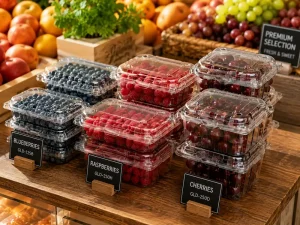
Retail deli packaging must make prepared food visible and easy to understand at first glance. Customers often decide quickly when viewing chilled meals, salads, fruit cups, deli sides, and ready-to-eat portions. Clear packaging helps them judge freshness, portion size, ingredient mix, and value before purchase.
For chilled retail display, PET and rPET containers are often selected because they provide strong clarity and a clean shelf appearance. Buyers looking for salad, fruit, snack, or cold deli applications can review deli and salad containers when building a wider chilled food packaging line.
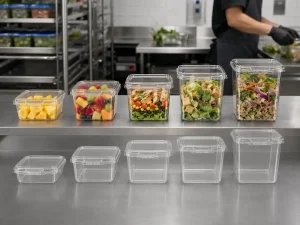
Retail buyers should focus on lid visibility, anti-collapse structure, easy stacking, and consistent container shape across different capacities. A consistent visual system makes a deli section look more organized and helps customers compare meal sizes more easily.
Takeaway Meals for Cafes, Delis, and Foodservice Counters
Takeaway packaging must balance appearance and handling strength. Customers may carry food in paper bags, place containers in vehicles, or store meals in office refrigerators before eating. For this channel, lid fit, stacking stability, and sauce control become more important than display alone.
For cold takeaway salads, chilled pasta, cut fruit, and deli sides, clear PET options are practical when reheating is not required. For warm meals, cooked dishes, rice portions, noodles, and reheatable food, buyers should move toward microwave safe deli containers or PP-based packaging designed for heated food applications.
This distinction is important. Not every clear container is made for reheating. If a customer expects to microwave the meal, the packaging material must match that use case.
Chilled Prepared Food and Grab-and-Go Programs
Grab-and-go programs need packaging that supports speed, repeat ordering, and predictable merchandising. A supermarket may need containers for salads, deli meals, cold noodles, side dishes, fresh fruit, and protein snacks at the same time. A cafe may need a smaller mix for chilled breakfasts, lunch bowls, and takeaway sides.
For chilled prepared food, buyers often combine round bowls, square containers, hinged containers, and separate-lid containers. The strongest packaging system is not always the largest product range. It is usually a controlled set of SKUs that covers the main food types without creating unnecessary inventory complexity.
PET, rPET, and PP: Which Material Works Best?
PET and rPET for Clear Chilled Display
PET and rPET are strong choices for chilled food visibility. They are widely used for salads, fruit, cold deli sides, snack packs, and fresh prepared food because they offer clean transparency and a premium shelf look. For retail display, this matters because customers buy with their eyes first.
Clear PET deli containers work best for:
- Fresh salads and fruit mixes
- Cold pasta and chilled noodles
- Snack packs and side dishes
- Retail deli portions
- Cold case grab-and-go foods
However, PET is not the right material when the customer needs to microwave the container. Buyers should avoid using PET packaging for reheatable meals unless the product specification clearly supports that use. For cold display, PET is strong. For reheating, PP is usually the safer direction.
PP Deli Packaging for Hot Food and Reheatable Meals
PP deli packaging is commonly selected for hot deli food, warm takeaway meals, and reheatable prepared food. PP has better heat resistance than PET and is more suitable when customers or foodservice operators need microwave reheating. This makes it highly relevant for cooked dishes, hot sides, rice meals, protein portions, pasta meals, and prepared food counters.
Buyers developing a reheatable meal line should consider prepared meal container options with separate lids because this structure supports packing efficiency, stacking, and food counter presentation.
For larger takeaway meals and retail deli portions, a PP deli food container is a practical direction when buyers need stronger heat-use logic and more dependable takeaway handling.
When to Use Separate-Lid Containers
Separate-lid containers are useful when the filling process, food height, or stacking method requires more flexibility. In deli and prepared food environments, staff may need to pack cooked meals quickly, close the lid after portioning, and stack units for display or takeaway.
Separate-lid packaging is especially useful for:
- Food counters with multiple prepared dishes
- Takeaway meals packed after customer selection
- Prepared meals that need better lid alignment
- Hot deli food containers used in foodservice operations
- Wholesale programs that need repeatable packing steps
For buyers handling both cold dishes and hot takeaway meals, prepared food containers with PP material and separate-lid design provide a more practical match than chilled-display-only packaging.
PET vs PP Deli Meal Containers: Quick Buyer Comparison
| Factor | PET / rPET Deli Containers | PP Deli Containers |
|---|---|---|
| Best Use | Chilled salads, fruit, cold deli sides, retail display | Hot deli food, takeaway meals, reheatable prepared food |
| Visibility | Excellent clarity for shelf display | Usually less clear, but stronger for heat-use applications |
| Microwave Use | Not the preferred direction unless clearly specified | Commonly selected for microwave safe deli containers |
| Buyer Priority | Fresh appearance and retail presentation | Heat resistance, takeaway handling, and reheating convenience |
| Common Channels | Supermarket cold cases, grab-and-go shelves, chilled deli counters | Prepared food counters, takeaway programs, reheatable meal lines |
How to Choose the Right Deli Meal Containers by Food Type
Salads, Fruit, and Cold Deli Sides
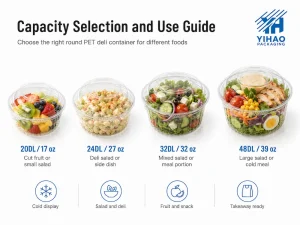
For chilled salads, fruit mixes, cold noodles, deli sides, and snack portions, clarity and presentation are key. These foods need visibility because customers want to see freshness, color, portion size, and ingredient distribution. PET containers, square deli containers, and clear salad bowls are strong options.
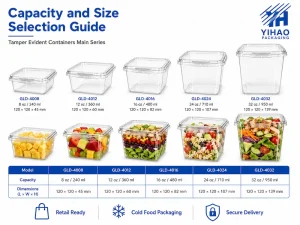
If a buyer wants a compact square format for salads, fruit, and deli meals, square PET deli containers help create a clean, stackable display system. This format works well for chilled shelves where shape consistency and product visibility matter.
Hot Deli Food and Reheatable Prepared Meals
For hot deli food containers, the packaging decision changes. The buyer must focus on heat suitability, lid fit, food weight, and microwave expectations. A container that looks good in a cold case is not automatically suitable for warm or reheated meals.
For hot deli programs, hot deli food containers are a better fit than clear chilled-display containers. PP material supports the reheatable packaging direction and helps buyers build a more reliable hot food or prepared meal packaging line.
Food types that usually require PP or microwave-safe packaging include:
- Rice bowls and grain bowls
- Cooked vegetables and protein portions
- Hot pasta and noodle meals
- Prepared entrées for takeaway
- Warm deli sides and reheatable meal portions
Cold Food with Strong Takeaway Handling Needs
Some cold foods do not need reheating but still require strong handling performance. Examples include sauced cold dishes, marinated vegetables, deli salads, cold pasta, and prepared sides. In these cases, buyers should compare lid engagement, container depth, stacking stability, and sauce control.
A PP deli packaging option may still be useful for cold food when the buyer wants a stronger takeaway structure, especially for food counters or delivery-adjacent use.
Retail Display Requirements Buyers Should Check
Clarity and Shelf Appeal
For retail display, clear presentation matters. Customers judge freshness quickly based on visibility. A container that hides food color or creates a dull shelf look weakens the product before the customer even reads the label.
Buyers should check whether the packaging provides:
- Clear viewing area
- Stable base shape
- Enough lid height for toppings or food volume
- Good label placement area
- Consistent appearance across sizes
For chilled retail meals, a consistent packaging family helps create a cleaner visual block in the cold case. This is especially important for supermarkets, convenience stores, and grab-and-go programs where multiple SKUs sit together.
Stacking and Space Efficiency
Stacking performance affects storage, display, transport, and staff workflow. A container that stacks poorly creates more handling problems and uses more shelf space. Buyers should test how empty containers nest before packing and how filled containers stack after closing.
Important stacking checks include:
- Empty container nesting stability
- Filled container stacking under normal handling
- Lid pressure resistance
- Cold shelf alignment
- Carton packing efficiency for wholesale orders
These checks should be done with the actual food portion, not just an empty sample. Wet foods, oily foods, dense meals, and layered salads all behave differently once packed.
Label and Branding Space
Deli meal containers often need ingredient labels, nutrition labels, barcodes, date labels, or brand stickers. Buyers should check whether the container has a flat, visible label area that does not cover too much food presentation.
For retail display, labels should support the sale, not hide the product. For takeaway, labels should stay attached during handling. For wholesale programs, label placement should be easy for staff to repeat across many units.
Takeaway Requirements Buyers Should Check
Lid Fit and Leak Control
Takeaway packaging faces more movement than shelf display packaging. Customers carry it, tilt it, place containers in bags, and transport it with other items. A weak lid fit can turn a good meal into a complaint.
Buyers should test containers with real menu items, especially sauced pasta, oily dishes, dressed salads, fruit with juice, and warm prepared meals. The goal is not to claim that one container solves every leakage problem. The goal is to match the container to the food’s moisture level, weight, and handling channel.
Hand Feel and Customer Experience
Customers notice whether packaging feels secure, clean, and easy to open. If the container feels too weak, too hard to close, or difficult to handle, it affects the perceived value of the meal.
For takeaway meals, the best deli meal containers should feel stable in hand, close consistently, and open without damaging the food presentation. This is especially important for cafes, supermarkets, and deli counters selling prepared meals at a higher perceived value.
Reheating Instructions and Material Communication
When selling reheatable deli packaging, buyers should make sure the intended use is clear. If a container is microwave safe, the packaging program should communicate that properly according to the buyer’s market and labeling requirements. If the container is not intended for reheating, that should also be clear.
This is where PP and PET must not be confused. PET is strong for clarity and chilled display. PP is more suitable for reheatable deli packaging and hot food programs. A serious supplier should help buyers separate these use cases instead of recommending one material for every situation.
Wholesale Buying Checklist for Deli Meal Containers
Before placing a wholesale order, buyers should test packaging against the real food program. A sample that looks fine on a desk may perform differently in a busy deli counter or cold shelf.
1. Define the Food Temperature
Start with the temperature requirement. Is the product chilled, ambient, warm, served hot, or reheated by the customer? This single question filters the material choice quickly.
- Chilled display: PET or rPET options may be suitable
- Warm food or reheating: PP options are usually more practical
- Mixed cold and hot programs: separate product lines may be needed
2. Confirm the Sales Channel
Retail display, takeaway, delivery-adjacent service, and foodservice counters all create different packaging pressure. A container for a chilled supermarket shelf does not need the same performance as a container carried across town in a takeaway bag.
3. Test the Real Portion
Always test samples with real food weight and real portion height. Buyers should check whether the lid closes easily, whether the food touches the lid, whether sauces move, and whether the container remains stable after stacking.
4. Compare Shape Efficiency
Round, square, rectangular, hinged, and separate-lid formats all serve different purposes. Square containers often support neat shelf blocking. Round bowls work well for salads and layered meals. Separate-lid PP containers are practical for food counters and reheatable meals.
5. Evaluate Supplier Support
A good deli packaging manufacturer or supplier should help buyers compare material, structure, food use, lid fit, and wholesale repeat ordering. Buyers should avoid suppliers that only quote a container without asking about food type, temperature, handling, and sales channel.
For buyers needing long-term support, working with a packaging factory can provide a clearer path for sample review, product matching, packaging consistency, and future wholesale planning.
How to Request the Right Deli Meal Container Samples Before Wholesale Ordering
Before confirming a wholesale order, buyers should prepare a short application brief that includes food type, serving temperature, portion weight, lid preference, reheating expectations, shelf display method, and target sales channel. This helps the supplier recommend the right container structure instead of simply quoting a random size.
For deli counters, supermarkets, cafes, distributors, and prepared food brands, sample testing should include real food filling, stacking, cold storage, takeaway handling, and microwave testing when reheating is required. This step reduces packaging mismatch and helps buyers build a more stable long-term deli packaging program.
A practical sample request should include:
- Main food application, such as salad, pasta, rice meal, cooked side dish, or cold deli portion
- Expected food temperature during packing and customer use
- Whether the meal requires microwave reheating
- Target portion weight and approximate food height
- Retail display, takeaway, chilled shelf, or foodservice counter channel
- Preferred lid style, stacking requirement, and label placement area
This information helps a wholesale supplier narrow the recommendation quickly and prevents buyers from testing packaging that does not match the actual food program.
Common Mistakes When Choosing Deli Meal Containers
Mistake 1: Choosing by Capacity Only
Capacity matters, but it is not enough. Two containers with the same volume can perform very differently if the base shape, lid height, material, and closure structure are different. Buyers should evaluate food fit, not just ounce size.
Mistake 2: Using Clear PET for Reheatable Meals
Clear PET packaging is attractive for chilled display, but it should not be treated as a universal reheatable packaging solution. If the buyer sells meals that customers will microwave, PP is the better material direction.
Mistake 3: Overcomplicating the SKU Range
Some buyers purchase too many shapes and sizes at once. This creates inventory confusion, slower packing, and inconsistent shelf presentation. A better approach is to build a focused packaging set for core food types first, then expand based on sales data.
Mistake 4: Ignoring Lid Compatibility
Lids are not secondary accessories. They define closure quality, stacking stability, and takeaway confidence. Buyers should test lid fit repeatedly during sample review, especially for busy counters where staff need fast and consistent closing.
Mistake 5: Not Testing Real Handling Conditions
Packaging should be tested in the same way customers and staff will use it. This includes cold storage, shelf display, bagging, stacking, transport, and reheating if applicable. Real-use testing prevents expensive mistakes before wholesale ordering.
How Manufacturers and Wholesale Suppliers Should Support Buyers
Professional buyers need more than a product list. They need packaging recommendations that match application, channel, and ordering stage. A reliable deli packaging manufacturer should help buyers narrow options instead of pushing every available size.
Useful supplier support includes:
- Material guidance for PET, rPET, and PP
- Application matching for chilled, takeaway, hot food, and reheatable meals
- Sample support before wholesale ordering
- Container and lid structure explanation
- Packaging family planning for multiple SKUs
- Clear communication around custom branding or OEM discussion when needed
For wholesale buyers, supplier consistency matters as much as product design. If a food brand, distributor, or supermarket chain plans repeat orders, the packaging line must remain consistent across shape, closure, carton supply, and future reorder communication.
Best Container Direction by Buyer Type
Supermarkets and Convenience Stores
Supermarkets and convenience stores should prioritize clear presentation, stackable shapes, label visibility, and cold shelf consistency. PET and rPET containers are strong for chilled display, while PP containers should be added when the product range includes reheatable prepared meals.
Delis and Prepared Food Counters
Delis need packaging that supports fast packing and reliable takeaway. Separate-lid PP containers are especially useful for hot foods, cold sides, and prepared meals packed behind the counter.
Cafes and Small Food Brands
Cafes and smaller food brands should avoid buying too many container types too early. A focused starter set of clear chilled containers and reheatable PP containers is usually more practical than a wide, confusing SKU range.
Distributors and Wholesale Buyers
Distributors should focus on fast-moving packaging families that serve multiple end users. Deli meal containers, prepared food containers, square PET containers, salad bowls, and PP microwave safe containers are all useful categories when building a wholesale product mix.
Buyer Decision Table: Matching Deli Containers to Food Applications
| Food Application | Recommended Material Direction | Best Packaging Structure | Main Buyer Priority |
|---|---|---|---|
| Chilled salads and fruit meals | PET / rPET | Clear bowls, square containers, hinged containers | Visibility and shelf appeal |
| Cold pasta and deli sides | PET / rPET or PP | Square or separate-lid containers | Lid fit and sauce control |
| Hot deli food | PP | Separate-lid PP containers | Heat-use suitability and takeaway strength |
| Reheatable prepared meals | PP | Microwave safe prepared food containers | Reheating performance and clear use communication |
| Retail grab-and-go programs | PET / rPET plus PP where needed | Controlled packaging family | SKU consistency and display organization |
| Wholesale deli packaging lines | PET / rPET / PP mix | Multiple container families | Repeat ordering and broad application coverage |
FAQ: Deli Meal Containers
1. What are the best deli meal containers for chilled retail display?
The best deli meal containers for chilled retail display are usually clear PET or rPET containers with strong visibility, stable stacking, and enough lid space for the actual food portion. They work well for salads, fruit, cold noodles, deli sides, and grab-and-go prepared food.
2. Are microwave safe deli containers always made from PP?
Many microwave safe deli containers use PP because PP is more suitable for reheatable food applications than PET. Buyers should always confirm the intended use, temperature range, and local labeling requirements before using any container for microwave reheating.
3. What is the difference between PET deli containers and PP deli packaging?
PET deli containers are commonly chosen for clear chilled display and product visibility. PP deli packaging is more suitable for hot deli food, warm takeaway meals, and reheatable prepared food. The right choice depends on food temperature and customer use.
4. What should wholesale buyers test before ordering prepared food containers?
Wholesale buyers should test real food portions, lid fit, stacking, leakage risk, label placement, shelf presentation, and reheating expectations. Testing should match the actual sales channel, such as retail display, takeaway, food counter service, or chilled grab-and-go programs.
5. How do I choose a deli meal container supplier?
Choose a supplier that asks about food type, temperature, portion size, lid structure, display method, takeaway handling, and wholesale ordering needs. A reliable supplier should help match material and structure instead of recommending one container for every application.
6. What should buyers ask a deli meal containers manufacturer before wholesale ordering?
Buyers should ask about material options, lid compatibility, microwave suitability, sample testing, carton packing, application matching, and whether the supplier can support repeat wholesale orders for chilled, takeaway, and reheatable prepared food programs.
References
- U.S. Food and Drug Administration, Food Contact Substances and Food Packaging Guidance
- U.S. Food and Drug Administration, Food Contact Materials and Microwave Packaging Guidance
- European Commission, Food Contact Materials Regulation Overview
- European Food Safety Authority, Food Contact Materials Scientific Guidance
- U.S. Department of Agriculture, Food Safety and Inspection Service Retail Food Handling Guidance
- ASTM International, Plastic Packaging and Material Testing Standards
- Plastics Industry Association, Polypropylene and PET Packaging Material Resources
- Food Packaging Forum, Food Contact Materials and Plastic Packaging Research
Deep Dive Insights
How should buyers think about deli meal containers?
Buyers should treat deli meal containers as part of a complete prepared food system, not as a single disposable item. The container must match food temperature, display method, takeaway handling, lid performance, and customer reheating behavior.
Why does material choice matter?
Material choice affects both presentation and use safety. PET and rPET support clear chilled display, while PP is the stronger direction for hot deli food and reheatable prepared meals. Choosing the wrong material can create customer confusion and operational risk.
What should wholesale buyers prioritize first?
Wholesale buyers should prioritize application fit before price comparison. A lower-cost container that fails in stacking, lid fit, reheating communication, or shelf presentation can create more cost through complaints, repacking, product damage, and poor customer experience.
Which option works best for mixed deli programs?
For mixed deli programs, the best approach is usually a controlled packaging family: clear PET or rPET containers for chilled display, plus PP containers for reheatable meals and hot takeaway food. This creates better operational clarity for staff and stronger customer trust.
What should buyers consider before choosing a supplier?
Buyers should choose a supplier that understands food applications, material limits, lid compatibility, sample testing, and repeat wholesale supply. A reliable supplier helps buyers reduce packaging mismatch before large-scale ordering.
Final Note / Practical Takeaway
© YIHAO Packaging. All rights reserved. All articles, product images, packaging designs, technical specifications, and website materials are protected by copyright. Unauthorized copying, reproduction, redistribution, modification, or commercial use is strictly prohibited without prior written permission.