Berry Tamper Evident Containers FAQ: Materials, Sizes, Uses, and Ordering Questions
Berry tamper evident containers are used for blueberries, raspberries, blackberries, strawberries, mixed berries, and premium berry retail packs that need clear display, ventilation, secure closure, stacking stability, and customer confidence. Berries are delicate, moisture-sensitive, and highly visual, so the package must protect the fruit while still making freshness easy to see.
For supermarkets, produce brands, berry growers, fruit distributors, cafes, bakeries, convenience stores, and foodservice buyers, berry packaging should not be selected by size alone. A good berry container should support airflow, reduce handling damage, close reliably, stack safely, protect label placement, and perform under chilled retail display conditions. When the product is sold through self-service, delivery-sensitive, or higher-handling channels, tamper-evident structure can add a stronger first-opening signal.
YIHAO is a food packaging manufacturer and solution provider focused on practical PET/RPET packaging systems for fresh produce, berries, fresh-cut fruit, fruit-and-nut packs, deli, salad, bakery, takeaway, and chilled retail display applications. This FAQ answers the main buyer questions about berry tamper evident containers, including materials, sizes, uses, venting, PET fruit containers, fresh-cut fruit tamper packaging, wholesale sourcing, and supplier evaluation.
Berry Tamper Evident Containers Basics
1. What are berry tamper evident containers?
Berry tamper evident containers are berry packaging containers designed to protect fresh berries while providing secure closure and, when required, visible first-opening evidence. They are commonly used for blueberries, raspberries, blackberries, strawberries, mixed berries, and premium berry packs sold through retail shelves, chilled displays, fruit shops, and produce distribution channels.
The phrase can describe different structures. Some berry containers use vented hinged clamshells with secure closing performance. Others include a more visible tamper-evident tab, security band, breakaway feature, or first-opening indicator. The correct structure depends on the berry type, retail route, handling risk, and buyer’s package-integrity requirement.
For buyers building a complete fresh produce range, fresh produce packaging containers should be reviewed first because berry packaging often connects with whole produce, fresh-cut fruit, apple clamshells, specialty fruit, and retail-ready produce packs.
2. What berries are usually packed in tamper-evident or secure berry containers?
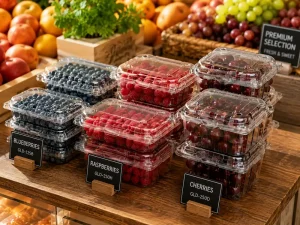
Common applications include blueberries, raspberries, blackberries, strawberries, mixed berries, and small specialty berries. Blueberries are often packed in vented clamshells because they need clear visibility, airflow, and stable retail handling. Raspberries and blackberries are more delicate, so buyers should pay closer attention to stacking pressure, fruit movement, and lid clearance. Strawberries need structure that protects shape and shelf appearance while still allowing customers to see the fruit.
For berry-focused retail programs, produce clamshell containers are a practical category to compare because they include multiple hinged, vented, and retail-ready berry formats.
3. Why does tamper evidence matter for berry packaging?
Tamper evidence matters when berries are sold through channels where customers expect stronger package integrity. This includes self-service refrigerated shelves, convenience stores, premium fruit displays, delivery-sensitive retail, third-party handling, and grab-and-go fruit programs.
For standard whole berries, ventilation, closure reliability, and stacking performance may be more important than a strong tamper-evident feature. For ready-to-eat fruit packs, mixed berry cups, or premium retail packs with more handling steps, visible first-opening confidence becomes more valuable.
Buyers should not treat tamper evidence as a replacement for food safety management, cold-chain control, sanitation, or proper labeling. It is one part of a wider secure fruit packaging system.
Material Questions
4. What material is commonly used for berry tamper evident containers?
PET and RPET are common choices for berry packaging because they provide clear visibility, lightweight handling, and practical rigidity for retail display. Clear PET packaging helps shoppers inspect berry color, size, freshness, and portion fullness before purchase.
For berry packaging, material clarity matters because customers often choose berries visually. A cloudy, scratched, or poorly labeled package can make good fruit look less premium. PET/RPET clamshell structures help the product remain visible while supporting closure and stacking.
| Material / Structure | Best Berry Use | Main Advantage | Buyer Checkpoint |
|---|---|---|---|
| PET | Blueberries, raspberries, blackberries, strawberries, mixed berries | High clarity and strong retail presentation | Check closure, venting, stacking, and shelf visibility |
| RPET | Clear berry packs with recycled-content positioning | Supports sustainability-focused packaging direction | Confirm documentation and market requirements |
| Vented PET clamshell | Blueberries, blackberries, raspberries, strawberries | Supports airflow and chilled display | Check vent placement and label interference |
| Tamper-evident PET container | Premium berries, mixed berry cups, ready-to-eat fruit packs | Clear display plus visible first-opening confidence | Check opening clarity and customer experience |
5. Are PET fruit containers suitable for berries?
Yes. PET fruit containers are suitable for berries when the structure supports clear display, ventilation, gentle handling, stable stacking, and reliable closure. The container should not only look clear when empty; it should perform with real berries after packing, refrigeration, shelf stacking, transport, and customer handling.
For berry display and handling, vented clamshell packs for blueberries, vented berry clamshell containers, and clamshell produce containers for blueberries and raspberries help buyers compare capacity, airflow, and retail display performance.
6. Is RPET suitable for berry containers?
RPET can be suitable for berry containers when the supplier can provide appropriate material documentation and the target market supports recycled-content packaging. Buyers should verify food-contact suitability, clarity, consistency, lid performance, and repeat-order stability before scaling an RPET berry packaging program.
RPET should not be selected only because it sounds sustainable. It still needs to perform with real berries, real cold-chain handling, real labels, and real carton packing.
Venting and Freshness Questions
7. Why do berry containers need vents?
Berries are moisture-sensitive and delicate. Venting helps airflow inside the pack and supports better chilled retail presentation. Vent placement can influence condensation behavior, fruit appearance, and airflow through the package.
For blueberries, blackberries, raspberries, and strawberries, vented structures are often more appropriate than fully sealed containers. However, vent design must be tested with real fruit and real retail conditions. A vented pack should support airflow without weakening closure or making the container harder to stack.
8. Should vents be on the top, bottom, or sides?
Vent placement depends on the container design and berry application. Top vents can help airflow from above, bottom vents can support airflow and drainage direction in selected structures, and side vents can assist air exchange across stacked packs. The important point is not the number of vents alone. The buyer should test whether the vent pattern works with the actual fruit, label placement, stacking method, and cold-chain route.
For 250g blueberry and small berry retail packs, products with both bottom and top air vents are commonly used to support airflow during chilled storage, transportation, and retail display. The 250g clamshell series in the product file is designed for blueberries, blackberries, raspberries, and similar berry fruits, using bottom and top air vents, an integrated hinged lid, and a stackable clamshell structure. :contentReference[oaicite:2]{index=2}
9. Can labels block berry container vents?
Yes. Labels, stickers, sleeves, and barcode tags can block vents if placement is not planned carefully. This is a common packaging mistake. A label that looks good in artwork may reduce airflow, hide fruit visibility, or cover the opening feature after it is applied to a real pack.
Buyers should test label position with filled samples. The label should support branding and required information without covering key ventilation areas, the best fruit view, the hinge, or the tamper-evident feature.
Size and Capacity Questions
10. What sizes are common for berry tamper evident containers?
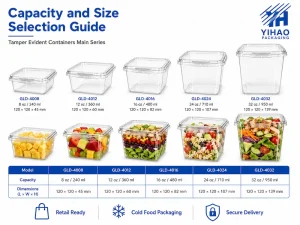
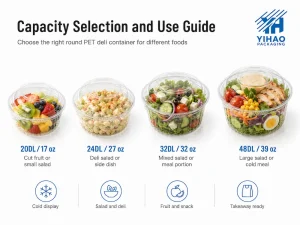
Berry packaging sizes vary by berry type, market, and retail channel. Common directions include small 6oz and 7oz berry packs, 8.8oz retail clamshells, 250g blueberry packs, 16oz or 17oz flip-top berry packs, 1lb packs, 2lb packs, and larger premium berry containers.
Buyers should not choose size by nominal capacity alone. Real berry size, fill height, fruit movement, stacking pressure, and retail display appearance should decide the best format.
| Size Direction | Typical Berry Use | Main Packaging Goal | Buyer Test |
|---|---|---|---|
| 6oz to 8.8oz | Small blueberries, raspberries, blackberries, premium small packs | Compact retail display and portion control | Check fruit movement, lid clearance, and shelf appearance |
| 250g | Blueberries and mixed small berry retail packs | Standard retail portion with clear display | Check venting, stacking, and label placement |
| 16oz to 18oz | Blueberries, strawberries, mixed berries | Medium retail pack with stronger shelf presence | Check closure and filled-pack stacking |
| 1lb to 2lb | Family-size or higher-volume berry packs | Larger retail value and wholesale display | Check carton protection and lower-pack pressure |
| Large premium formats | Premium berries, grapes, fresh produce assortments | Retail impact and stronger display value | Check shelf footprint and handling route |
11. Is 250g a useful size for blueberry packaging?
Yes. A 250g berry clamshell is a practical retail size for blueberries and small berry packs. It gives supermarkets, fruit shops, and produce distributors a compact portion that is easy to display and easy for consumers to carry.
The 250g clamshell series referenced in the product document uses the same 170 x 90 x 50 mm structure across blue, transparent, and yellow base options, with clear hinged lids and bottom/top air vents. This makes it useful as a retail berry packaging reference when buyers need consistent structure with different shelf presentation effects. :contentReference[oaicite:3]{index=3}
For product-level inner linking, transparent-base blueberry clamshells are especially relevant when buyers are comparing visibility, airflow, and compact retail pack structure.
12. When should buyers choose 1lb or 2lb berry containers?
Buyers should choose 1lb or 2lb berry containers when the retail program needs larger portions, family-size packs, value packs, or higher-volume produce display. Larger packs need stronger stacking tests because the lower containers may carry more pressure in cartons and retail shelves.
For larger berry applications, 1lb vented clamshell packs and 2lb vented berry clamshell containers are useful reference formats for wholesale berry packaging buyers.
Use Case Questions
13. What are berry tamper evident containers used for?
Berry tamper evident containers are used for blueberries, raspberries, blackberries, strawberries, mixed berries, premium berry packs, chilled retail fruit displays, supermarket produce shelves, fruit shop takeaway packs, and fresh produce distribution.
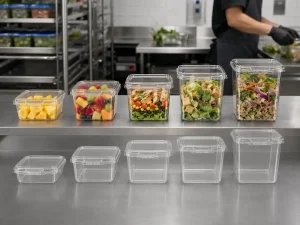
They are also useful when berries are included in ready-to-eat fruit cups, chilled mixed fruit packs, or fruit-and-nut snack programs where stronger closure confidence and clear presentation matter.
14. Are berry tamper evident containers only for blueberries?
No. Blueberries are a common use case, but berry containers can also be used for blackberries, raspberries, strawberries, mixed berries, and other small fruit depending on the container size, depth, venting, and stacking strength.
For mixed berry programs, buyers should test the most delicate fruit in the mix. If raspberries crush easily in a selected pack, the container may not be suitable even if it works for blueberries.
15. Can berry containers be used for grapes or other produce?
Some berry clamshells can be used for grapes or similar produce, but buyers should test fill weight, fruit movement, venting, and stacking first. Grapes can create different weight distribution from berries, and larger grapes may require a deeper or stronger structure.
For broader produce applications, flip-top containers for grapes and fresh produce can be reviewed alongside berry-focused options when the buyer needs a produce clamshell that handles more than berries.
16. Can berry containers be used for fresh-cut fruit?
Berry containers and fresh-cut fruit containers solve different problems. Berry containers often emphasize ventilation, airflow, gentle handling, and stacking. Fresh-cut fruit packaging emphasizes clear display, moisture control, secure lid fit, chilled appearance, and ready-to-eat confidence.
For cut mango, melon, pineapple, apple slices, grapes, and mixed fruit, fresh-cut fruit containers should be evaluated separately. Products such as 1lb PET fresh-cut fruit containers and 2lb PET fresh-cut fruit containers are more relevant when fruit is cut, portioned, and ready to eat.
Tamper-Evident and Security Questions
17. What is the difference between secure berry packaging and tamper-evident berry packaging?
Secure fruit packaging is a broader concept. It includes closure strength, stacking stability, ventilation, product protection, cold-chain display, and label placement. Tamper-evident berry packaging adds a visible first-opening feature or security signal that helps customers recognize whether the package has been opened after sealing.
For whole berry programs, secure closure and venting may be enough. For premium berries, ready-to-eat mixed fruit packs, or self-service higher-handling channels, a tamper-evident feature may be worth adding.
18. When should buyers choose tamper evident fruit containers for berries?
Buyers should choose tamper evident fruit containers for berries when the product is premium, self-service, delivery-sensitive, part of a ready-to-eat fruit program, or handled by multiple parties before the customer opens it.
For general secure food packaging, tamper evident containers should be reviewed together with produce clamshells. For small chilled grab-and-go fruit or snack packs, anti-fog tamper-evident containers can support clear display and visible first-opening confidence.
19. Does tamper-evident berry packaging mean leak-proof packaging?
No. Tamper evidence shows visible first-opening evidence. It does not automatically mean leak-proof performance. For berries, the bigger concerns are usually ventilation, condensation, closure, stacking, fruit movement, and retail display. For fresh-cut fruit or berry mixes with juice release, leak-resistant behavior needs separate testing.
Buyers should test real fruit under actual cold-chain and handling conditions before approving wholesale orders.
20. Are tamper evident produce containers useful for supermarkets?
Yes, tamper evident produce containers can be useful for supermarkets when the product is ready to eat, premium, self-service, or handled through a chilled retail route. For standard whole produce, secure clamshell closure may be enough. For cut fruit, mixed berries, fruit cups, or premium berry programs, tamper-evident structure can support customer confidence.
Retail Display and Labeling Questions
21. What makes berry packaging look premium on shelf?
Premium berry packaging usually has clear material, strong top-view visibility, clean sidewall display, suitable venting, stable closure, careful label placement, and good stacking behavior. The berries should look fresh and easy to inspect without the package feeling fragile or cluttered.
For premium berry retail presentation, premium flip-top agricultural containers, flip-top containers for blueberries and strawberries, and 6oz flip-top berry containers help buyers compare different display and portion strategies.
22. Where should labels be placed on berry containers?
Labels should support branding, product information, barcode scanning, and retail identification without hiding the best fruit view or blocking vents. For berry packs, labels placed too wide across the lid may reduce visibility. Labels placed over vents may affect airflow. Labels placed over the opening feature may confuse customers.
The best label position depends on the container shape, fruit color, vent layout, and retailer requirements. Buyers should test final label size and placement with filled samples.
23. How should buyers test stacking performance?
Stacking should be tested with filled packs, not empty containers. Filled berry packs create real weight, compression, and movement. Buyers should test stacking in cartons, cold rooms, retail shelves, and takeaway handling conditions.
The goal is to confirm that lower packs do not deform, lids do not open, vents are not blocked, and berries do not show visible compression damage after normal handling.
24. What should buyers check during cold-chain display?
During cold-chain display, buyers should check clarity, condensation, vent performance, berry appearance, label readability, lid fit, and shelf stability. A pack may look excellent when empty at room temperature but appear fogged, wet, or unstable after refrigeration.
For high-moisture or chilled ready-to-eat fruit packs, anti-fog or moisture-aware packaging structures may be helpful, but they should always be tested with real products.
Ordering and Wholesale Questions
25. What should buyers ask before ordering berry tamper evident containers wholesale?
Before wholesale ordering, buyers should ask practical application questions:
- Which berry will be packed: blueberries, raspberries, blackberries, strawberries, or mixed berries?
- What is the target retail portion: 6oz, 8.8oz, 250g, 16oz, 1lb, 2lb, or another format?
- Does the product need a vented clamshell, flip-top structure, or tamper-evident feature?
- Will the package be sold through chilled self-service shelves?
- Where will the label and barcode be placed?
- How will the packs be stacked in cartons and shelves?
- Can the supplier provide samples for real berry testing?
- Can the supplier maintain clarity, closure, venting, and carton consistency across repeat orders?
26. How should buyers evaluate a berry packaging manufacturer or supplier?
When sourcing from a food packaging factory, buyers should evaluate whether the supplier understands berry behavior, not only container size. A strong manufacturer or supplier should be able to discuss PET/RPET material, vent placement, hinge strength, closure feel, stacking, label placement, carton protection, and sample-to-bulk consistency.
| Evaluation Area | Strong Supplier Behavior | Warning Sign |
|---|---|---|
| Berry knowledge | Asks about berry type, fill weight, and cold-chain route | Only recommends by size or price |
| Venting guidance | Explains vent placement, airflow, and label interaction | Does not discuss ventilation at all |
| Closure performance | Encourages hinge and lid-fit testing with real berries | Assumes empty-sample closure is enough |
| Tamper-evident support | Explains when first-opening evidence is useful | Pushes tamper evidence for every pack without channel logic |
| Carton protection | Discusses nesting, surface protection, and deformation control | Only quotes unit price without packing details |
| Repeat consistency | Supports stable clarity, rim shape, hinge behavior, and closure feel | Sample quality looks good but bulk consistency is unclear |
27. What sample tests should buyers run before wholesale approval?
Buyers should test berry tamper evident containers with actual berries before wholesale approval. Empty samples cannot show fruit movement, condensation, bruising, stacking pressure, vent performance, or label interference.
| Test Area | What to Check | Why It Matters |
|---|---|---|
| Berry fit | Portion fullness, fruit movement, depth, and overfill risk | Protects appearance and reduces bruising |
| Venting | Top vents, bottom vents, side airflow, and label interference | Supports chilled display and fruit appearance |
| Closure | Hinge strength, snap fit, flip-top behavior, and opening force | Supports handling reliability and customer experience |
| Tamper evidence | Visible first-opening feature before and after opening if required | Improves package-integrity confidence in self-service channels |
| Cold display | Clarity, condensation, berry color, and shelf angle | Improves retail appeal and purchase confidence |
| Stacking | Filled packs in cartons, shelves, coolers, and takeaway bags | Reduces deformation and fruit compression |
| Bulk consistency | Sample-to-order clarity, venting, hinge, closure, and carton protection | Reduces repeat-order quality risk |
28. How can buyers avoid too many berry packaging SKUs?
Buyers should build a focused berry packaging matrix instead of ordering too many similar formats. A practical range may include one compact berry pack, one standard retail pack, one larger value pack, one premium flip-top format, and one tamper-evident option for higher-handling or ready-to-eat channels.
This approach helps purchasing teams, warehouse teams, packing teams, and suppliers work from the same logic. It also reduces lid mismatch, carton confusion, and overstocking.
Berry Packaging Matrix for Food Packaging Teams
| Packaging Role | Recommended Structure | Best Channel | Procurement Logic |
|---|---|---|---|
| Small premium berry pack | 6oz to 8.8oz flip-top or vented clamshell | Premium retail, cafes, fruit shops | Compact presentation and high visibility |
| Standard blueberry retail pack | 250g vented clamshell with clear lid | Supermarkets, produce departments, distributors | Balanced portion, airflow, and shelf display |
| Family-size berry pack | 1lb or 2lb vented clamshell | Supermarkets, wholesale produce, value packs | Larger volume with stacking and closure testing |
| Premium fresh berry display | Flip-top agricultural berry container | Premium fruit retail and branded produce lines | Stronger display value and customer handling |
| Ready-to-eat berry or mixed fruit pack | Tamper-evident PET container where needed | Cold shelves, convenience stores, delivery-sensitive channels | Visible first-opening confidence |
Common Buying Mistakes to Avoid
Choosing by Size Before Berry Type
Blueberries, raspberries, blackberries, and strawberries do not behave the same way. A container that works for blueberries may create too much movement or pressure for raspberries. Start from berry type and handling route, not capacity alone.
Ignoring Vent Placement
Vents are important for many berry packs. Poor label placement, sleeve design, or carton stacking can reduce airflow. Buyers should test the final labeled package, not just the empty container.
Assuming Tamper Evidence Means Leak-Proof
Tamper-evident packaging shows visible first-opening evidence. It does not automatically guarantee leak-proof performance for juice, condensation, syrup, or high-moisture mixed fruit. Leak behavior must be tested separately.
Approving Empty Samples Only
Empty samples do not show condensation, berry movement, bruising, stacking pressure, vent performance, or customer opening behavior. Real berry testing is necessary before wholesale approval.
Using One Berry Container for Every Channel
A fruit shop takeaway pack, supermarket blueberry pack, premium berry display, and delivery-sensitive mixed fruit cup may need different packaging logic. A focused packaging matrix works better than one universal container.
FAQ
1. What are berry tamper evident containers used for?
Berry tamper evident containers are used for blueberries, raspberries, blackberries, strawberries, mixed berries, premium berry packs, chilled retail fruit display, and self-service fruit programs that need clear visibility, ventilation, closure reliability, and customer confidence.
2. What material is best for berry containers?
PET and RPET are common choices for berry containers because they provide clear visibility, lightweight handling, and practical retail display. Buyers should test venting, stacking, closure, label placement, and cold-chain performance before wholesale ordering.
3. Do berry containers need ventilation?
Yes. Many berry containers need ventilation because berries are delicate and moisture-sensitive. Vent placement should be tested with real berries, real labels, real stacking, and real refrigerated display conditions.
4. When should buyers choose tamper evident fruit containers for berries?
Buyers should choose tamper evident fruit containers when berries or mixed fruit packs are premium, ready to eat, self-service, delivery-sensitive, or handled by multiple parties before customer opening.
5. What sizes are common for berry packaging?
Common berry packaging directions include 6oz, 7oz, 8.8oz, 250g, 16oz, 1lb, 2lb, and larger premium formats. The right size depends on berry type, retail portion, stacking, label placement, and channel requirements.
6. How should buyers choose a berry packaging manufacturer or supplier?
Buyers should choose a manufacturer or supplier that understands PET/RPET material, berry behavior, vented clamshell design, tamper-evident options, label placement, carton protection, sample testing, and wholesale repeat-order consistency.
References
- U.S. Food and Drug Administration, Food Contact Substances and Food Packaging Guidance.
- U.S. Food and Drug Administration, Food Tampering and Consumer Packaging Guidance.
- European Commission, Regulation (EC) No 1935/2004 on Materials and Articles Intended to Come into Contact with Food.
- European Commission, Regulation (EU) No 10/2011 on Plastic Materials and Articles Intended to Come into Contact with Food.
- European Food Safety Authority, Guidance on Plastic Recycling Processes for Food Contact Materials.
- U.S. Department of Agriculture, Fresh Produce Handling and Food Safety Resources.
- Association of Plastic Recyclers, APR Design Guide for Plastics Recyclability.
- GS1, General Guidance on Retail Barcode and Label Placement.
Final Note / Practical Takeaway
© YIHAO Packaging. All rights reserved. All articles, product images, packaging designs, technical specifications, and website materials are protected by copyright. Unauthorized copying, reproduction, redistribution, modification, or commercial use is strictly prohibited without prior written permission.