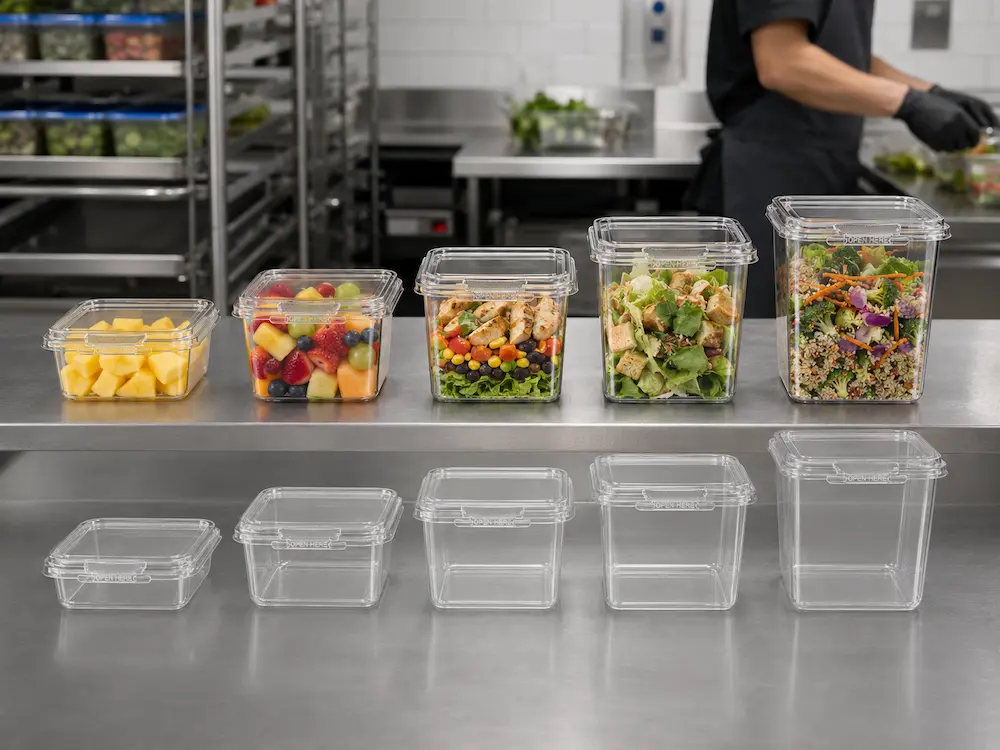
Why Packaging Structure Matters for Food Buyers
Food packaging buyers often begin with material, capacity or price, but structure is just as important. A container can be clear, food contact suitable and attractive, yet still fail if the lid structure does not match the real packing process, product type or sales channel.
For supermarkets, delis, cafes, fresh produce brands, meal prep suppliers, takeout operators and foodservice distributors, the choice between hinged lid containers, separate lid containers and tamper evident containers affects daily operations. It influences packing speed, lid inventory, customer opening experience, retail display, food protection, delivery stability and product confidence.
For example, a berry clamshell may need a one-piece hinged structure with ventilation. A deli side may benefit from a clear PET hinged deli container for fast packing. A prepared meal may need a separate lid system or a rectangular food container. A delivery salad may require tamper evident packaging so the customer can see whether the package has been opened after packing.
As a food packaging manufacturer and solution provider, YIHAO recommends that buyers compare structure before confirming samples. The best packaging decision should match food type, workflow, retail display and customer handling, not only catalog appearance.
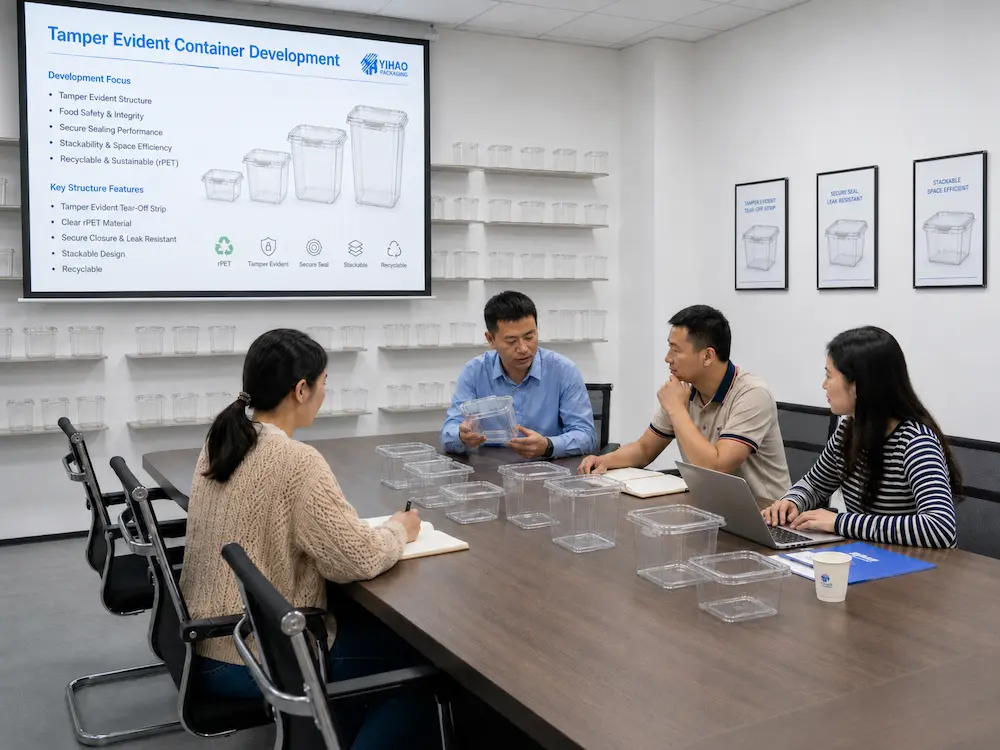
Quick Comparison: Hinged Lid, Separate Lid and Tamper Evident Containers
| Structure Type | Best Applications | Main Advantage | Buyer Watch Point |
|---|---|---|---|
| Hinged lid containers | Fresh produce, deli foods, salads, fruit, bakery, grab-and-go foods | Lid and base stay connected, reducing lid-matching errors | Check hinge strength, front lock and opening experience |
| Separate lid containers | Foodservice bowls, prepared foods, deli containers, meal prep, custom lid systems | Flexible lid choices and easier component stacking in some operations | Confirm lid compatibility, inventory control and seal consistency |
| Tamper evident containers | Delivery foods, retail cold case, secure takeout, grab-and-go meals, prepared foods | Shows visible evidence when the package has been opened | Do not overclaim as tamper-proof; test tear strip or opening indicator |
What Are Hinged Lid Containers?
Hinged lid containers are food containers where the lid and base are connected by a hinge. This structure is common in clamshell food packaging, PET hinged deli containers, fresh produce clamshells, bakery containers, fruit containers and grab-and-go food packaging.
The biggest advantage is operational simplicity. Since the lid is already attached to the base, packing teams do not need to match separate lids during busy production. This can reduce lid-matching errors, simplify stock control and speed up packing for delis, cafes, supermarkets and fresh produce operations.
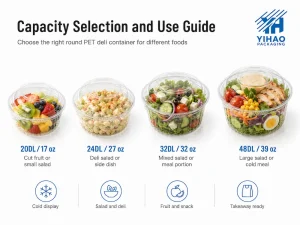
PET hinged deli containers are often selected for salads, fruit portions, snacks, cold deli foods and grab-and-go foods. Their clear design supports product visibility, while the hinged structure makes daily packing more convenient.
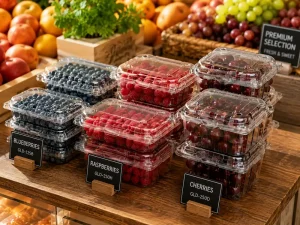
For fresh produce, hinged clamshells are also important. Produce clamshell containers often use one-piece hinged structures with ventilation holes, locking tabs and clear PET or rPET material. This helps buyers pack berries, grapes, cherry tomatoes and other produce more efficiently while keeping the product visible on the shelf.
When hinged lid containers are a strong choice
Hinged lid containers are a strong choice when packing speed, lid matching and retail presentation matter. They work well for grab-and-go foods, fruit clamshells, deli counter items, salad packs, bakery displays and cold food retail programs.
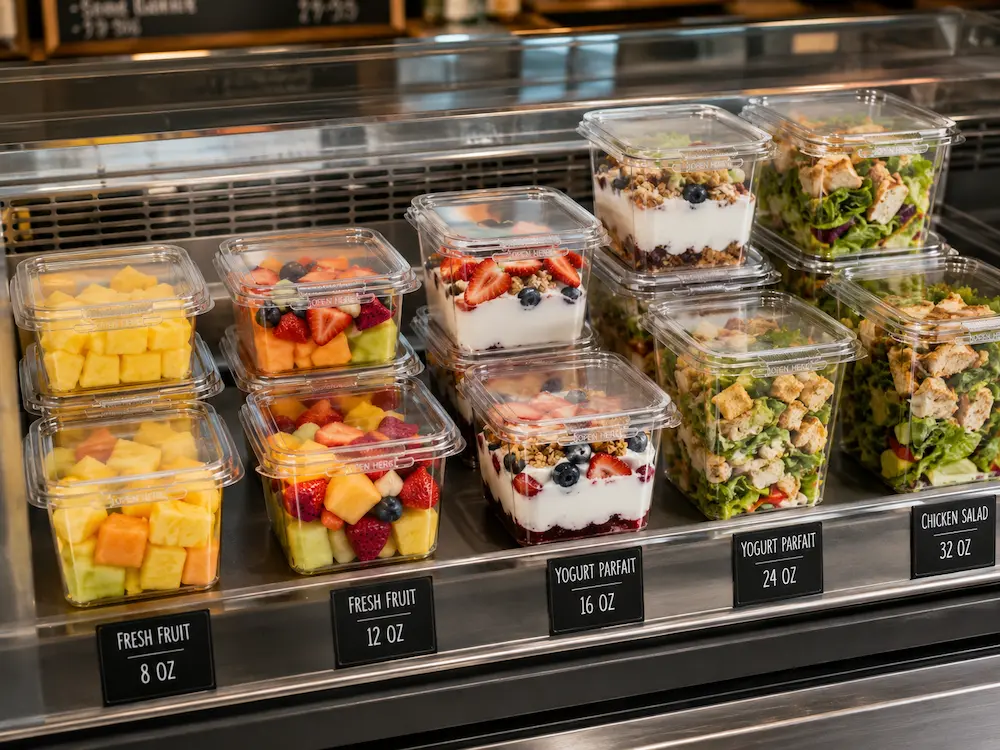
When hinged lid containers may not be ideal
Hinged lid containers may not be ideal when buyers need multiple lid options for one base, compact separate stacking of lids and bases, or special lid designs such as vented lids, dome lids or reheatable lids. Hinges also need to be tested carefully because weak hinges can crack, feel stiff or reduce customer opening quality.
What Are Separate Lid Containers?
Separate lid containers use a base and lid as two separate components. This structure is common in foodservice bowls, deli cups, meal prep containers, prepared food trays, sauce cups and some takeout packaging systems. The base and lid are stocked, packed and matched separately.
The main advantage is flexibility. Buyers may be able to use different lids for the same base, such as flat lids, vented lids, high lids or clear display lids. Separate lids can also support certain stacking systems, foodservice workflows and custom packaging programs.
However, flexibility creates another responsibility: lid compatibility must be controlled. A base and lid may look similar but fail if rim diameter, locking design, material stiffness or lid depth does not match. In busy operations, using the wrong lid can cause leakage, poor closure or customer complaints.
Separate lid systems can work well for foodservice programs where staff are trained, inventory is controlled and lid-base matching is clear. They may also be useful when buyers need different lid styles across different menu items.
When separate lid containers are a strong choice
Separate lid containers are useful when buyers need flexible lid options, efficient nested storage, different base and lid materials, or customized lid designs for different food applications. They can support prepared foods, deli items, meal prep, soups, sauces and selected takeout programs when compatibility is well managed.
When separate lid containers may create problems
Separate lid systems can create problems when operations are fast, staff training is limited or several similar lid sizes are stored together. If lids are mixed up, the package may not close correctly. Buyers should use clear SKU control, matching codes and sample testing before scaling separate lid packaging.
What Are Tamper Evident Containers?
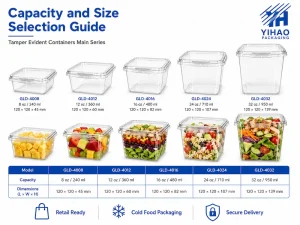
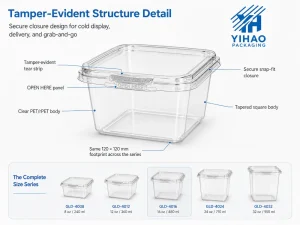
Tamper evident containers are designed to show visible evidence when a package has been opened after packing. They may use a tear strip, breakaway tab, perimeter lock, visible opening indicator or other closure feature. This structure is especially valuable for delivery, cold case foods, secure takeout, prepared meals and retail grab-and-go products.
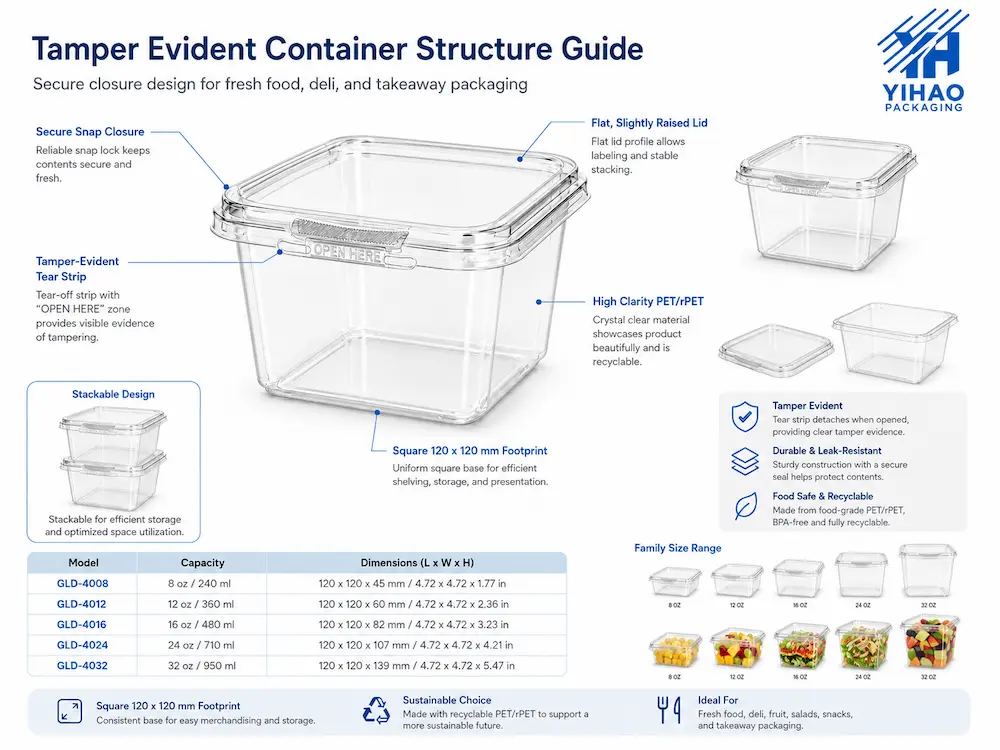
Tamper evident containers should not be described as completely tamper-proof. Their role is to help customers and staff see whether the package appears intact. This distinction is important because overclaiming can create unrealistic expectations.
For food delivery and retail display, tamper evident packaging can support consumer confidence. A customer can check whether the tear strip or opening indicator remains intact before eating. For supermarkets and foodservice brands, it adds a visible packaging signal to the broader food safety and handling system.
When tamper evident containers are a strong choice
Tamper evident containers are a strong choice when the food passes through several handling steps, such as delivery, pickup, retail cold case display, convenience store grab-and-go shelves or prepared meal distribution. They are especially useful for salads, fruit, deli foods, snacks, cold meals and secure takeout packaging.
When tamper evident containers may not be necessary
Tamper evident containers may not be necessary for every internal foodservice use. If food is packed and served immediately under direct staff control, a simpler hinged or separate lid container may be enough. Buyers should use tamper evident packaging where visible opening evidence brings real value.
Structure Selection by Food Category
The right structure depends heavily on food category. Fresh produce, deli foods, salads, bakery items, prepared meals and delivery foods do not need the same packaging structure.
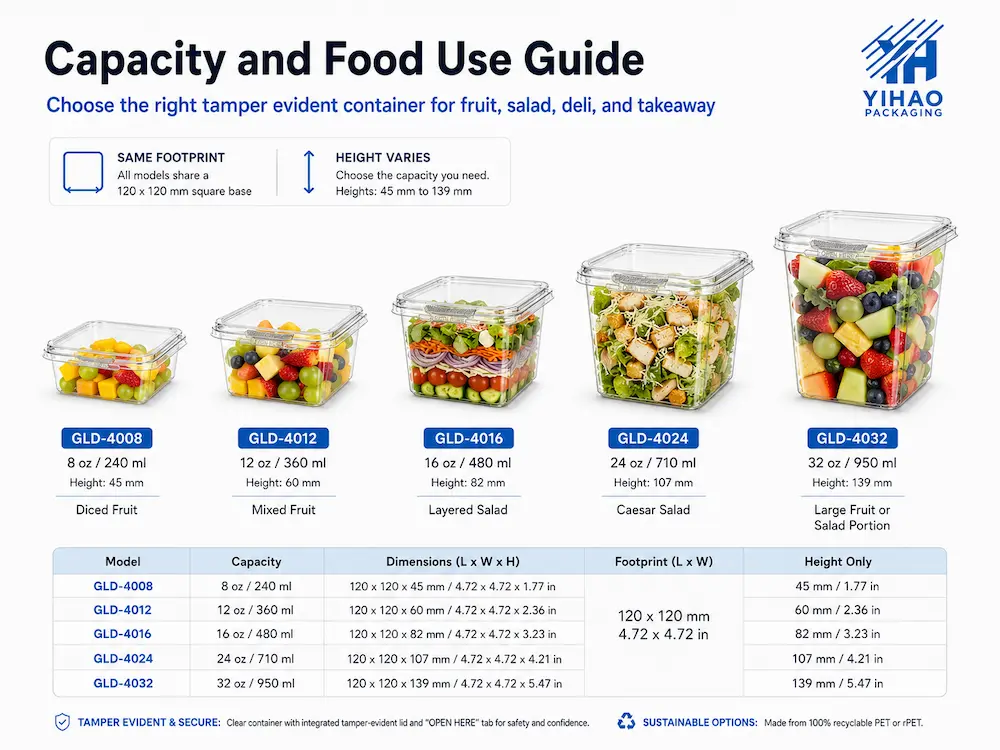
| Food Category | Recommended Structure | Why It Works | Buyer Test |
|---|---|---|---|
| Berries, grapes and cherry tomatoes | Hinged produce clamshells | One-piece structure, ventilation and clear display | Test real produce weight, ventilation, hinge and lock |
| Fresh-cut fruit | Hinged clear containers or compartment containers | Visibility and fast packing support chilled retail display | Test moisture, lid fit, chilled storage and label placement |
| Deli sides | Hinged deli containers or separate lid deli containers | Depends on packing speed and lid flexibility | Test dense food weight, closure and stacking |
| Meal salads | Hinged salad bowls or separate lid bowls | Needs lid clearance, clear display and stable handling | Test greens, toppings, protein and dressing placement |
| Delivery meals | Tamper evident containers | Visible opening evidence supports customer confidence | Test filled packs in delivery bags and customer opening |
| Prepared meals with components | Separate lid or multi-compartment tamper evident containers | Supports portion separation and secure transport | Test compartment depth, lid fit and handling stability |
Fresh Produce Packaging: Why Hinged Clamshells Often Work Best
For fresh produce, hinged clamshell packaging is often the strongest structure. Berries, grapes, cherry tomatoes and small produce items need ventilation, visibility and secure closure. A one-piece hinged clamshell keeps the lid and base connected, making packing faster and reducing lid mismatch.
Fresh produce packaging containers should also support retail display. Customers want to see color, freshness and portion size before buying. Clear PET or rPET hinged clamshells can make produce easy to inspect while supporting stacking and carton packing.
A 1lb vented clamshell pack can be useful for blueberries and delicate fruit where ventilation and product visibility matter. A 2lb vented berry clamshell container may be a better direction when buyers need a larger produce pack with stronger portion presence.
For produce packaging, separate lids are usually less convenient because lid matching can slow down operations. Tamper evident structures may be useful in selected produce programs, but ventilation, fruit protection and one-piece clamshell performance usually come first.
Deli and Salad Packaging: Hinged or Separate Lid?
For deli and salad containers, both hinged lid and separate lid structures can work. The better choice depends on how the food is packed and sold.
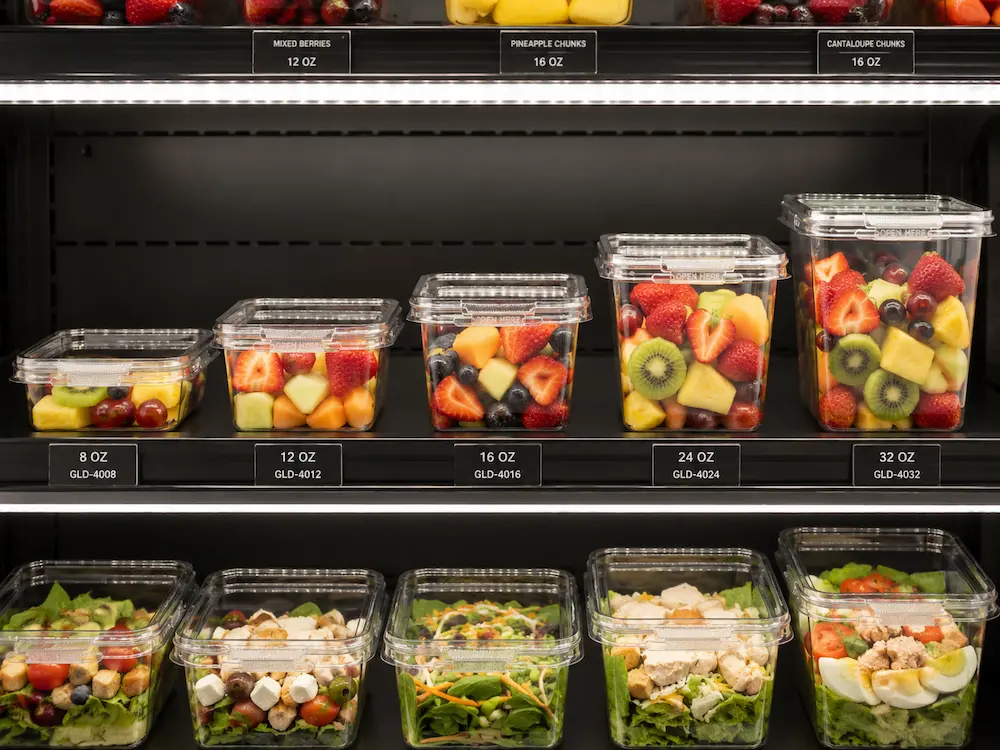
Hinged lid containers are strong for fast service, grab-and-go retail and deli counters. Staff can fill the container, close the lid and move the product to display without searching for a separate lid. This reduces operational friction during busy service.
Separate lid containers may work better when buyers need different lid styles, bowl depths or stacking systems. For example, a foodservice program may use one bowl base with different lid options depending on toppings, delivery, shelf display or dine-out needs. This can be flexible, but only if the lid system is controlled.
For medium and large salad applications, a 17oz clear PET salad bowl may support grab-and-go salads and fresh fruit, while a 32oz clear PET salad bowl can support larger meal salads and premium chilled display.
Takeout and Delivery Packaging: Why Tamper Evident Structures Matter
Takeout and delivery packaging has a different priority from simple retail display. The food may move through packing, pickup, transport and customer handoff. The customer may not see the food being packed, so the package needs to support confidence when received.
Tamper evident structures help by showing visible opening evidence. If the tear strip or tab remains intact, the customer can see that the package appears unopened after packing. If the feature is broken, the customer can recognize that the package has been opened or disturbed.
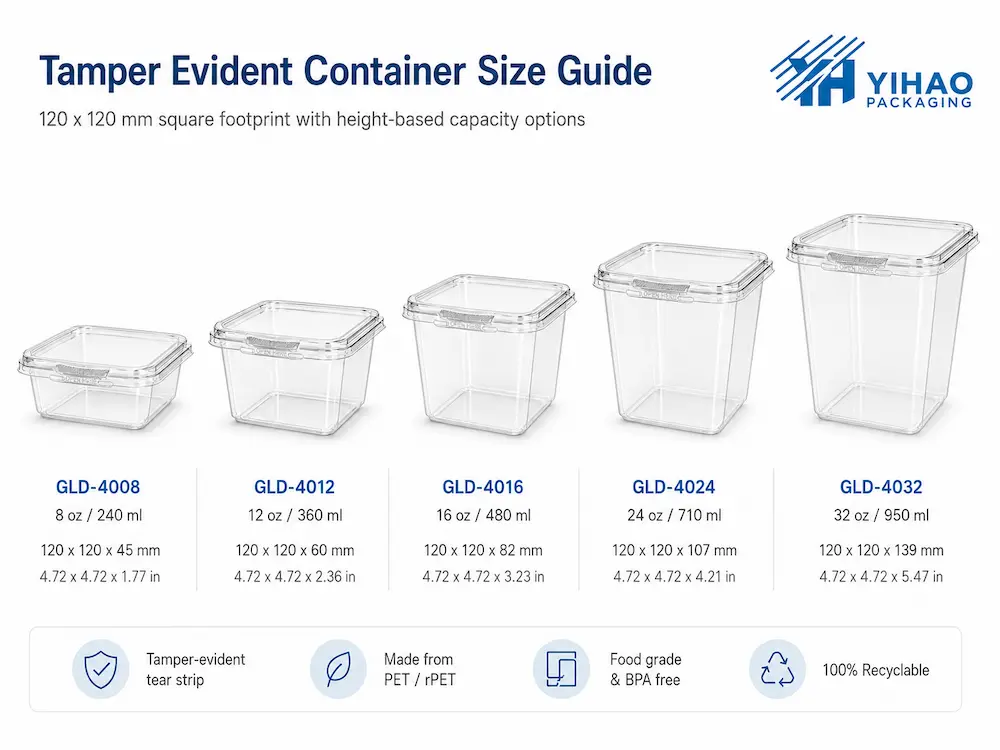
Rectangular tamper evident containers are useful for deli foods, prepared meals, takeout sides and retail cold case packaging. Multi-compartment tamper evident containers are useful when meals include separate components such as protein, sides, sauce, fruit or salad toppings.
A 18oz 532ml PET clear container can be considered for secure chilled food presentation, while a 34oz 1006ml clear PET tamper evident container can support larger cold case foods, secure takeout and retail-ready prepared food applications.
Operational Efficiency: Which Structure Saves Time?
Packaging structure directly affects packing speed. In busy supermarkets, delis and cafes, every extra lid-matching step can slow the workflow. Hinged containers often save time because the lid and base are already connected.
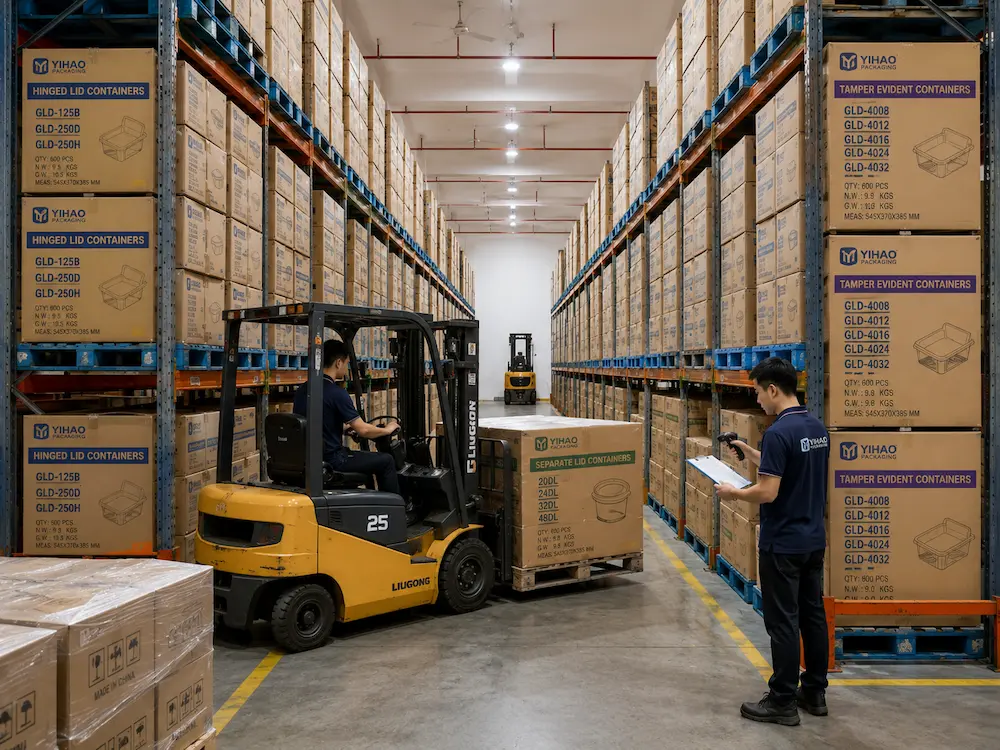
Separate lid containers can still be efficient when operations are organized. If lids and bases are clearly matched, stored correctly and used by trained staff, separate lid systems can offer useful flexibility. But when multiple lid sizes look similar, errors can happen quickly.
Tamper evident containers add another operational step: the closure indicator must be engaged correctly. If staff do not close the package fully, the tamper evident feature may not work as intended. Buyers should test packing speed and closure consistency before bulk ordering.
| Workflow Need | Best Structure Direction | Reason |
|---|---|---|
| Fast deli counter packing | Hinged lid containers | Connected lid reduces lid-matching time |
| Multiple lid options for one base | Separate lid containers | Allows flexibility when compatibility is controlled |
| Food delivery and secure handoff | Tamper evident containers | Visible opening evidence supports customer confidence |
| Produce packing | Hinged produce clamshells | Integrated lid, ventilation and clear display support fresh produce |
| Meal prep with separated foods | Separate lid or multi-compartment tamper evident containers | Supports portion organization and controlled closure |
Material Considerations: PET, rPET and PP
Structure should also be matched with material. PET and rPET are commonly used for clear cold food packaging because they provide strong visibility. They are often selected for fresh produce, salads, deli foods, fruit containers and grab-and-go retail display.
Clear PET packaging is useful when customers need to see the product before purchase. This is why it is common in fresh produce clamshells, deli containers, salad bowls and tamper evident cold food containers.
PP is usually a better direction for reheatable and microwave-safe packaging when the exact container and lid are designed and tested for that use. Buyers should not assume that clear PET hinged containers or tamper evident PET containers are suitable for microwave reheating unless the product specification confirms it.
Material and structure must be considered together. A PET hinged container may be ideal for cold salads and fruit. A PP separate lid container may be better for reheatable meals. A PET tamper evident container may be useful for secure cold delivery, while a PP tamper evident system may be needed for reheatable meal delivery if available and tested.
Retail Display and Customer Experience
Customers judge food packaging quickly. A clear hinged fruit clamshell should show freshness. A salad bowl should make toppings visible. A deli container should look full and stable. A tamper evident package should make the opening indicator easy to inspect.
For retail display, clear PET and rPET containers often perform well because visibility supports shelf appeal. Hinged containers can make grab-and-go foods look clean and organized. Separate lid systems can look premium when the lid fits tightly and the package stacks well. Tamper evident containers can build confidence when customers want to know whether the package has remained unopened.
Label placement should not hide the structure’s main benefit. On produce clamshells, labels should not block important ventilation or fruit visibility. On tamper evident containers, labels should not cover the tear strip or opening indicator. On salad bowls, labels should not cover too much of the product window.
How to Choose the Right Structure: Buyer Decision Framework
| Buyer Question | If Yes | Recommended Structure |
|---|---|---|
| Do packing teams need the fastest workflow? | Yes, lid matching should be simple | Hinged lid containers |
| Does the product require ventilation? | Yes, especially berries, grapes or produce | Hinged produce clamshells |
| Does the package need different lid options? | Yes, one base may use several lid styles | Separate lid containers |
| Does the food go through delivery handoff? | Yes, customers need visible opening evidence | Tamper evident containers |
| Does the food need microwave reheating? | Yes, heat resistance is required | PP microwave-safe containers, not standard PET unless confirmed |
| Does the food need strong shelf visibility? | Yes, appearance drives purchase | Clear PET or rPET hinged, separate lid or tamper evident structures |
Sample Request Checklist for Structure Comparison
Before confirming a packaging structure, buyers should request samples and test them with the actual food product. Empty samples can show appearance, but they cannot prove workflow, closure, stacking or delivery performance.
| Information to Send | Why It Matters | Example |
|---|---|---|
| Food type | Different foods need different structure and closure | Berries, salad, deli side, meal prep, delivery food |
| Target use | Retail, delivery and foodservice have different requirements | Cold case, grab-and-go, takeout, fresh produce display |
| Preferred structure | Helps supplier recommend relevant samples | Hinged lid, separate lid or tamper evident |
| Material preference | PET, rPET and PP fit different applications | Clear PET for display, PP for reheating |
| Target capacity | Size affects presentation, stacking and lid performance | 10 oz, 18 oz, 32 oz, 1lb, 2lb or custom target |
| Label plan | Labels can affect visibility, vents and opening indicators | Top label, side label, sleeve or barcode sticker |
| Testing condition | Real handling reveals packaging problems | Chilled storage, stacking, delivery bag, retail display |
When working with a manufacturer, buyers should test filled samples, not only empty containers. The right structure should close consistently, display the product clearly, support the handling process and fit the buyer’s carton and shelf system.
Common Mistakes Buyers Should Avoid
Mistake 1: Choosing by price only
A lower-cost structure may create higher operational cost if it causes lid mismatch, slow packing, poor closure or customer complaints. Buyers should evaluate total packaging performance, not only unit price.
Mistake 2: Using separate lids without inventory control
Separate lid systems can work well, but only when lid-base compatibility is clear. Mixed lids can cause poor closure and leakage problems.
Mistake 3: Treating all clamshells as the same
Produce clamshells, salad clamshells, bakery clamshells and tamper evident containers are not identical. Buyers should match structure to food type and use condition.
Mistake 4: Overclaiming tamper evident packaging
Tamper evident means visible evidence of opening. It should not be described as completely tamper-proof or impossible to open.
Mistake 5: Ignoring material and temperature limits
Clear PET is strong for cold display and visibility, but it should not be assumed microwave safe. For reheatable applications, buyers should evaluate PP or another confirmed microwave-safe material.
FAQ
1. Are hinged containers better than separate lids?
Hinged containers are often better when buyers need faster packing, fewer lid-matching errors and simple retail presentation. Separate lid containers may be better when buyers need multiple lid options, different lid heights or more flexible foodservice systems.
2. When should buyers choose tamper evident packaging?
Buyers should choose tamper evident packaging when visible opening evidence matters, such as food delivery, retail cold case foods, secure takeout, prepared meals and grab-and-go products handled by multiple people before purchase or receipt.
3. Which structure is better for fruit packaging?
For berries, grapes and cherry tomatoes, one-piece hinged produce clamshells are often the better choice because they support ventilation, clear display and faster packing. Buyers should test real produce weight, vent design, hinge strength and stacking.
4. Which structure is better for deli and salad containers?
Both hinged and separate lid structures can work for deli and salad containers. Hinged containers are convenient for fast packing and grab-and-go sales. Separate lid containers are useful when buyers need different lid styles or more flexible foodservice options.
5. Are tamper evident containers completely tamper-proof?
No. Tamper evident containers are designed to show visible evidence of opening. They should not be described as completely tamper-proof or impossible to open. Their value is clear inspection and consumer confidence.
6. Can hinged PET containers be microwaved?
Standard clear PET hinged containers are usually used for cold display, fruit, salads, deli foods and grab-and-go packaging. They should not be assumed microwave safe unless the exact product is designed, tested and labeled for microwave use.
7. What should buyers test before choosing a packaging structure?
Buyers should test filled food samples, lid closure, hinge strength, separate lid compatibility, tamper evident feature, stacking, label placement, chilled storage, delivery movement and customer opening experience before confirming wholesale orders.
References
- U.S. Food and Drug Administration, Packaging and Food Contact Substances resources.
- U.S. Food and Drug Administration, food contact substances and intended-use framework.
- European Commission, Food Contact Materials and Regulation (EC) No 1935/2004 framework.
- European Food Safety Authority, food contact materials safety assessment resources.
- Association of Plastic Recyclers, Design Guide for Plastics Recyclability.
- RecyClass, Design for Recycling Guidelines for PET Packaging.
- WRAP, plastic packaging design and recyclability guidance.
- PMMI Business Intelligence, food packaging, fresh produce packaging and prepared food packaging industry research.
Deep-Dive Insights: How Buyers Should Compare Food Packaging Structures
How hinged lid containers improve packing efficiency
Hinged lid containers connect the lid and base, which can reduce lid-matching errors and speed up packing. This is useful for fresh produce, deli counters, cafes, grab-and-go foods and retail display programs where staff need simple and repeatable workflow.
Why separate lid containers offer flexibility
Separate lid containers can support different lid styles, heights and foodservice systems. They are useful when buyers need multiple packaging options, but they require strict lid-base compatibility control to prevent closure problems.
What makes tamper evident packaging different
Tamper evident containers are designed to show visible evidence of opening. They are valuable for delivery, secure takeout, retail cold case foods and prepared meals, but they should not be overclaimed as completely tamper-proof.
Option: match structure to food category
Fresh produce often works best in one-piece hinged vented clamshells. Deli and salad programs may use hinged or separate lid containers depending on workflow. Delivery and secure retail programs often benefit from tamper evident structures.
Buyer takeaway before wholesale ordering
The best structure is the one that performs under real use. Buyers should test actual food, closure, hinge, lid compatibility, tamper evident function, stacking, label placement, chilled storage and delivery handling before confirming bulk orders.
Final Note / Practical Takeaway
© YIHAO Packaging. All rights reserved. All articles, product images, packaging designs, technical specifications, and website materials are protected by copyright. Unauthorized copying, reproduction, redistribution, modification, or commercial use is strictly prohibited without prior written permission.