Wholesale buyers rarely fail because they choose the wrong packaging shape alone. They fail when the packaging shape, material, use condition, documentation, and sales market do not match. That is why food packaging regulations should be treated as a sourcing checklist, not just a legal topic.
For supermarkets, cafes, bakeries, chilled food brands, distributors, and importers, the practical question is simple: does the packaging supplier understand food contact use, material suitability, intended application, safety documentation, recyclability claims, and bulk order consistency? A reliable supplier helps buyers compare packaging by product type, filling condition, display channel, temperature exposure, and documentation needs before a purchase order is confirmed.
Compliance Note: Food packaging regulations vary by destination market, food type, material, temperature condition, and final application. Buyers should use this checklist as a sourcing and supplier evaluation tool, and confirm final compliance requirements with qualified regulatory professionals, importers, testing partners, or local authorities before market launch.
YIHAO supports food businesses with clear plastic food packaging solutions for fresh produce, salads, deli foods, bakery items, chilled takeaway, cold drinks, tamper-evident packs, and wholesale packaging programs. This article gives buyers a practical checklist for comparing manufacturers and suppliers without turning packaging compliance into confusing legal theory.
Why Food Packaging Regulations Matter in Wholesale Sourcing
Food packaging is not only a container. It becomes part of the food safety system because it touches food, protects food during handling, and influences shelf life, consumer confidence, and retail presentation. When buyers evaluate packaging only by price, they often miss critical questions about food contact suitability, raw material traceability, recycled content, storage conditions, and regional compliance expectations.
Professional buyers should connect food packaging compliance with real product use. A clear PET clamshell for chilled fruit, a PP container for warm prepared meals, a PET/RPET cold cup for iced drinks, and a tamper-evident container for grab-and-go retail do not face the same practical risk profile. Each application has a different combination of food type, contact time, temperature exposure, sealing pressure, labeling area, stacking load, and consumer handling.
A good food packaging manufacturer does not simply say “food grade.” The supplier should help buyers confirm whether the selected packaging is suitable for the intended food, temperature range, filling process, distribution channel, and target market. This is the difference between a quote-driven supplier and a compliance-aware packaging partner.
What Food Packaging Regulations Usually Cover
Different markets use different legal frameworks, but most food packaging regulations focus on the same core questions: what material is used, whether the material is suitable for food contact, whether substances may migrate into food under intended conditions, whether recycled content is suitable for food contact, and whether packaging claims are accurate.
| Regulation Area | Buyer Question | Supplier Evidence to Request | Why It Matters |
|---|---|---|---|
| Food contact safety | Is the packaging suitable for direct food contact? | Material declaration, food contact statement, test support where applicable | Protects food safety and reduces sourcing risk |
| Material identity | Is it PET, rPET, PP, PLA, or another structure? | Material specification and product description | Prevents wrong use conditions and wrong marketing claims |
| Intended use | Will it hold cold food, hot food, oily food, acidic food, or dry food? | Application guidance and use limitations | Packaging safety depends on use conditions |
| Temperature exposure | Will the pack be refrigerated, ambient, warmed, or microwaved? | Material-specific use recommendation | PET, rPET, PP, and PLA perform differently under heat |
| Recycled content | Is recycled plastic suitable for food contact in the target market? | Recycled material source, process information, supplier statement | Recycled content does not automatically mean food contact approved |
| Recyclability claims | Can the product be marketed as recyclable in the buyer’s region? | Material type, local recycling compatibility, claim wording review | Recyclability depends on local collection and processing systems |
| Batch consistency | Can the supplier maintain stable quality across wholesale orders? | Factory controls, sample confirmation, order specifications | Reduces complaints, leakage issues, and SKU inconsistency |
USA Food Packaging Compliance: What Buyers Should Ask
For buyers selling into the United States, food packaging compliance usually starts with the concept of food contact substances. Packaging materials, coatings, adhesives, colorants, and processing-related components may need to be evaluated according to their intended food contact use. Buyers should not assume that one “safe” material works for every food type or temperature condition.
For practical sourcing, buyers should ask suppliers these questions before ordering:
- What is the exact material of the container, lid, insert, or cup?
- Is the product designed for direct food contact?
- What food types does the supplier recommend for this packaging?
- Is the product intended for chilled, ambient, hot-fill, or microwave use?
- Does the supplier have documentation support for food contact use?
- If recycled plastic is used, what recycled material source and process support can be provided?
For example, recyclable food containers for chilled fruit display may focus on clarity, stacking, venting, and cold-shelf handling. In contrast, microwave-related food packaging should be reviewed through a different material lens, because PET and PP do not serve the same heating applications.
EU Food Contact Materials: Key Buyer Checks
For the European market, food contact materials are generally evaluated under a framework that focuses on safety, inertness, traceability, good manufacturing practice, and specific rules for plastic materials. For plastic food packaging, buyers should pay close attention to material composition, migration-related documentation, and whether the supplier understands the intended use conditions.
When sourcing plastic containers, lids, trays, bowls, or cups for EU-facing projects, buyers should avoid vague phrases such as “EU standard” without supporting context. A professional supplier should be able to discuss material identity, food contact suitability, application scenarios, and available documentation. For recycled plastic food contact applications, buyers should be even more careful because recycled material safety depends on recycling process control and the regulatory requirements of the destination market.
For EU-facing projects, buyers should ask whether the supplier can support a Declaration of Compliance where applicable, material identity details, intended use information, and migration-related documentation for plastic food contact materials. This is especially important when the product will be imported, privately labeled, or sold through supermarkets and foodservice distributors.
| EU Buyer Check | Strong Supplier Response | Weak Supplier Response |
|---|---|---|
| Material identity | Clearly states PET, rPET, PP, PLA, or other structure | Only says “plastic” or “eco-friendly” |
| Food contact use | Explains whether the product is for direct food contact | Uses “food grade” as a general slogan |
| Application condition | Asks about chilled, ambient, hot, oily, acidic, or microwave use | Quotes price before confirming use scenario |
| Recycled plastic | Discusses recycled content carefully and provides supporting information | Claims recycled plastic is automatically food safe |
| Documentation | Provides available declarations or test support according to project needs | Cannot explain what documents are available |
Plastic Food Packaging Safety: PET, rPET, PP, and PLA Considerations
Plastic food packaging safety depends on matching material performance with the food and use scenario. PET, rPET, PP, and PLA are common packaging materials, but buyers should not treat them as interchangeable.
PET and rPET for Clear Cold Food Display
PET is widely used for clear food containers, produce clamshells, salad bowls, bakery clamshells, cold cups, and retail display packaging because it offers excellent transparency and clean shelf presentation. rPET can support sustainability-focused packaging programs when the recycled material is suitable for the intended food contact use and supported by proper supplier documentation.
For rPET or recycled plastic food packaging, buyers should not evaluate only the recycled-content percentage. They should also ask about recycled material source, decontamination process support, food-contact suitability, destination-market requirements, and whether the supplier can provide documentation that matches the intended application.
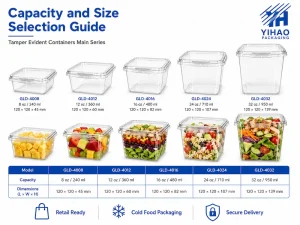
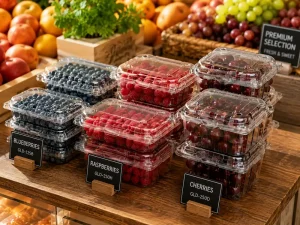
For chilled display, produce clamshell containers are often used for fruit, berries, and fresh produce where visibility and protection matter. For snack and fresh-cut programs, fresh snack containers help separate portion logic from broad material claims: the buyer should still confirm material, intended use, and food contact documentation before wholesale ordering.
PP for Hot Food and Microwave-Oriented Applications
PP is commonly selected for warm food, prepared meals, deli takeaway, and microwave-oriented packaging when the product structure is designed for that use. Buyers should still confirm the actual container design, lid compatibility, temperature expectation, and food type. A PP base with a separate lid may have different use limitations from a fully PP container or a container with a PET lid.
For prepared food programs, buyers often compare microwave safe containers with clear chilled display options. This comparison should be made by application, not by price alone. If the food will be reheated, the packaging material and structure deserve a separate compliance discussion.
PLA and Compostable Packaging Claims
PLA is often associated with compostable packaging, but buyers should treat compostability as a claim that depends on material specification, certification context, and actual waste management infrastructure. Compostable does not automatically mean recyclable, and recyclable does not automatically mean compostable. Buyers should confirm the claim wording before printing labels or publishing product pages.
Recyclable Food Containers and Recycled Plastic: What Needs Verification
Recyclability and recycled content are two different topics. A container may be made from recyclable PET but still depend on local collection and recycling systems. A container may include recycled PET, but recycled content must be suitable for food contact when used in food packaging.
For wholesale programs, buyers should separate three questions:
- Is the packaging made from a material that is commonly recyclable in the target region?
- Does the local recycling system actually accept that packaging format?
- If recycled plastic is used, is the recycled input and process suitable for food contact use?
This is especially important for recycled PET hinged deli containers and clear rPET-related packaging. The buyer should request supplier support for material statements and avoid broad claims such as “100% sustainable” unless the claim is verified for the product, market, and disposal system.
| Claim Type | What Buyers Should Confirm | Risk If Not Confirmed |
|---|---|---|
| Food grade packaging | Direct food contact suitability and intended use | Unsafe application or rejected shipment |
| Recyclable food containers | Material type and local recycling acceptance | Misleading sustainability claim |
| Recycled PET packaging | Food contact suitability of recycled plastic process | Compliance gap for food-contact use |
| Microwave safe packaging | Material, structure, lid, and heat-use conditions | Warping, failure, or consumer complaint |
| Tamper evident packaging | Seal design, tear strip, lock structure, and handling test | Poor retail trust or weak security signal |
Retail Display Packaging: Compliance Is Also a Merchandising Issue
Retail display packaging must balance compliance, product visibility, stacking, sealing, label area, and consumer handling. For supermarkets and convenience stores, packaging is part of the selling surface. A clear container that looks good but fails under stacking pressure, fogging, leakage, or lid misalignment creates both operational and brand problems.
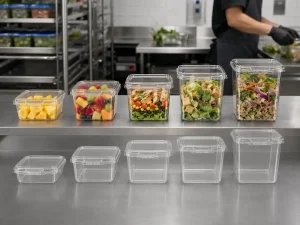
For chilled salad, fruit, deli, and grab-and-go programs, buyers often use chilled deli and salad packaging to improve visibility while keeping food portions organized. Clear PET bowls, hinged containers, and separate-lid formats help buyers match different food types with different presentation needs.
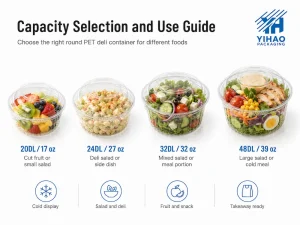
For example, clear PET salad bowls are often selected for salads, chilled noodles, fruit mixes, and takeaway meals where product visibility supports impulse purchase. The compliance question still remains: is the packaging suitable for the intended food, temperature, contact time, and market claim?
Manufacturer Documentation Checklist for Wholesale Orders
A serious wholesale supplier should help buyers organize documentation before a bulk order. The exact document package depends on the market, product, material, and application, but the buyer should know what to ask for early.
| Document or Information | When to Ask | Buyer Purpose |
|---|---|---|
| Material specification | Before sample confirmation | Confirm PET, rPET, PP, PLA, or mixed structure |
| Food contact statement | Before purchase order | Confirm direct food contact suitability |
| Intended use guidance | Before selecting SKU | Match food type, temperature, and application |
| Available test support | Before large-volume import | Support importer or retailer documentation review |
| Declaration of Compliance where applicable | Before EU-facing import or private label launch | Support food contact material review and buyer records |
| Migration-related documentation where applicable | Before selling plastic food contact materials in regulated markets | Support intended-use and material safety evaluation |
| Recycled content information | Before sustainability claim | Avoid unsupported rPET or recycled plastic claims |
| Product samples | Before bulk order | Check size, lid fit, clarity, stacking, and real food use |
| Production confirmation | Before repeat order | Maintain consistent structure, color, thickness, and packaging |
Supplier Red Flags Buyers Should Avoid
Not every supplier that offers a low price is suitable for food packaging. Buyers should be cautious when a supplier cannot explain material, application, or documentation clearly. A supplier who avoids use-condition questions may not be prepared for supermarket, import, distributor, or private-label projects.
Common red flags include:
- The supplier uses “food grade” without explaining material or intended use.
- The supplier claims every product is microwave safe without material-specific limits.
- The supplier says all recycled plastic is automatically suitable for food contact.
- The supplier pushes bulk orders before sample testing.
- The supplier cannot identify whether the product is PET, rPET, PP, PLA, or mixed material.
- The supplier cannot support basic documentation discussion.
- The supplier does not ask about food type, temperature, filling condition, or target market.
- The supplier offers too many vague SKUs without building a practical product matrix.
Common Mistakes Buyers Make When Checking Food Packaging Regulations
Many packaging mistakes happen before production starts. Buyers can reduce risk by avoiding broad assumptions and forcing every supplier conversation back to food type, material, use condition, documentation, and market claim.
- Using the phrase “food grade” without confirming the exact material and intended use.
- Assuming recyclable packaging and recycled-content packaging mean the same thing.
- Choosing PET packaging for applications that require heat-resistant PP structures.
- Publishing sustainability claims before checking local recycling acceptance.
- Requesting a bulk quote before confirming samples, lid fit, stacking, and food contact documentation.
- Ignoring destination-market differences between the United States, European Union, and other sales regions.
- Using one documentation checklist for every product category instead of matching documents to application risk.
- Comparing suppliers only by unit price without reviewing production control and repeat-order consistency.
Wholesale Supplier Checklist by Product Category
Different product categories require different compliance and application checks. Buyers should not use one universal checklist for every SKU. A fresh fruit container, bakery clamshell, tamper-evident deli pack, cold drink cup, and microwave food container each require a different sourcing conversation.
| Packaging Category | Common Application | Main Buyer Check | Recommended Supplier Discussion |
|---|---|---|---|
| Fresh produce packaging | Berries, cut fruit, produce trays | Clarity, venting, stacking, food contact use | Confirm PET/rPET material and chilled display suitability |
| Bakery containers | Cake slices, muffins, pastries, desserts | Dome height, hinge strength, display clarity | Confirm direct food contact and dessert protection needs |
| Deli and salad containers | Salads, fruit mixes, cold noodles, deli sides | Lid fit, leakage resistance, cold shelf handling | Confirm food type, dressing contact, and stacking |
| Tamper-evident containers | Grab-and-go food, sealed retail packs | Tear strip, lock structure, visible security | Confirm seal performance and consumer opening experience |
| Cold cups and lids | Iced coffee, smoothies, juice, milk tea, matcha | Cup-lid compatibility, clarity, crack resistance | Confirm cup diameter, lid type, and beverage menu |
| Microwave safe containers | Prepared meals, hot deli, takeaway meals | Material heat performance and lid compatibility | Confirm PP structure, use conditions, and heating guidance |
For food safety-focused retail projects, buyers often add tamper evident containers to reduce uncertainty after packing. For higher-trust sealed food programs, secure tamper evident food containers provide a visible opening signal that supports chilled retail, grab-and-go, and prepared food merchandising.
How to Compare a Manufacturer and a Trading Supplier
Buyers often compare factories, trading companies, and wholesale distributors. Each supplier model can work, but the buyer must understand what support is available. A manufacturer usually has stronger product development, tooling, material discussion, sampling, and production control. A trading supplier may offer more sourcing flexibility but may be weaker in direct technical control.
| Comparison Point | Manufacturer Advantage | Trading Supplier Risk | Buyer Action |
|---|---|---|---|
| Material confirmation | Direct access to production details | May rely on third-party answers | Ask for material specification |
| Sample adjustment | Faster structure and fit discussion | Limited influence over tooling or design | Test samples before bulk order |
| Documentation support | More direct product data access | May delay or simplify compliance answers | Request documents early |
| Bulk consistency | Better production control | Multiple factories may create SKU variation | Confirm repeat-order specifications |
| Custom packaging | Better OEM and private label coordination | Extra communication layer | Clarify artwork, tooling, and sample approval |
How Buyers Should Prepare Before Requesting a Quote
Many packaging quote requests are too vague. “Please quote food containers” is not enough. A supplier cannot properly recommend packaging without knowing the food type, capacity, temperature, display channel, sealing need, and order stage.
Before contacting a supplier, buyers should prepare:
- Food type: fruit, salad, bakery, deli, hot meal, drink, snack, or mixed application.
- Use condition: chilled, ambient, takeaway, retail shelf, delivery, or microwave-oriented use.
- Material preference: PET, rPET, PP, PLA, paper-plastic, or open recommendation.
- Structure preference: hinged, separate lid, tamper-evident, round, square, rectangular, or compartment.
- Target market: domestic sales, EU import, US import, regional distribution, or private label retail.
- Branding needs: plain packaging, label area, custom printing, embossing, sleeve, or OEM program.
- Order stage: sample evaluation, trial order, distributor stock, or long-term wholesale supply.
For beverage brands, cafes, and juice shops, cold cups and lids require cup-lid compatibility checks before bulk ordering. A clear cold cup system should be matched with flat lids, dome lids, strawless lids, or straw-slot lids according to the beverage menu. For iced coffee, lemonade, iced tea, smoothies, and milk tea, PET/RPET clear cold cups should be evaluated by clarity, lid fit, crack resistance, and intended cold beverage use.
Practical Wholesale Food Packaging Regulations Checklist
The following checklist helps buyers screen suppliers before sample purchase or bulk order confirmation.
| # | Checklist Question | Pass Standard | Buyer Note |
|---|---|---|---|
| 1 | Does the supplier identify the material clearly? | PET, rPET, PP, PLA, or other structure is clearly stated | Avoid vague “plastic container” descriptions |
| 2 | Is the packaging intended for direct food contact? | Supplier can explain food contact suitability | Do not rely only on marketing wording |
| 3 | Does the supplier ask about food type? | Supplier checks cold food, oily food, acidic food, dry food, or hot food use | Food type affects risk evaluation |
| 4 | Is temperature use confirmed? | Chilled, ambient, hot, or microwave-oriented use is clarified | PET and PP should not be treated the same |
| 5 | Are recycled plastic claims supported? | Supplier provides recycled content and food contact discussion | rPET claims require careful review |
| 6 | Are recyclability claims market-specific? | Supplier avoids universal claims and discusses local recycling limits | Local infrastructure matters |
| 7 | Can samples be tested before bulk order? | Supplier supports real-use sample evaluation | Test lid fit, stacking, clarity, and leakage |
| 8 | Can the supplier support repeat-order consistency? | Specifications are confirmed before production | Critical for distributors and chains |
| 9 | Does the supplier understand retail display needs? | Visibility, label area, stacking, and shelf handling are discussed | Packaging must sell and protect |
| 10 | Is the supplier careful with legal claims? | Supplier avoids overpromising certification or approval | Good suppliers are precise, not loud |
Final Note / Practical Takeaway
FAQ
1. What are food packaging regulations?
Food packaging regulations are rules and requirements that help ensure packaging materials are suitable for food contact, safe for intended use, and supported by proper material and supplier documentation. For buyers, the practical focus is material identity, food contact suitability, use conditions, recycled content, and market-specific compliance expectations.
2. What does food grade packaging mean?
Food grade packaging means the packaging material is suitable for its intended food contact application. Buyers should not treat the phrase as a universal guarantee. The supplier should clarify the material, food type, temperature condition, and available documentation before wholesale ordering.
3. Are recyclable food containers automatically compliant for food contact?
No. Recyclability and food contact suitability are different topics. A container may be recyclable in some local systems, but buyers still need to confirm whether the material is suitable for direct food contact and whether recycled content claims are supported.
4. What documents should wholesale food packaging buyers request?
Buyers should request material specifications, food contact statements, intended use guidance, available test support, Declaration of Compliance where applicable, recycled content information where relevant, and sample confirmation before bulk orders. The exact documentation package depends on the product, market, food type, and application.
5. How should buyers compare food packaging manufacturers and suppliers?
Buyers should compare suppliers by material clarity, documentation support, sample testing, application guidance, production consistency, custom packaging ability, and willingness to discuss food type and use conditions. A strong supplier asks practical questions before quoting a bulk order.
6. Does FDA approve food packaging?
FDA does not treat every finished food package as a simple product approval. Food packaging buyers should review whether the materials and food contact substances are suitable for the intended use, and request supplier documentation that supports the target food type, temperature condition, and market application.
References
- U.S. Food and Drug Administration, Packaging & Food Contact Substances.
- U.S. Food and Drug Administration, Understanding How FDA Regulates Substances that Come into Contact with Food.
- U.S. Food and Drug Administration, Recycled Plastics in Food Packaging.
- U.S. Food and Drug Administration, Guidance for Industry: Use of Recycled Plastics in Food Packaging.
- European Commission, Food Contact Materials – Food Safety.
- European Commission, Legislation for Food Contact Materials.
- EUR-Lex, Commission Regulation (EU) No 10/2011 on Plastic Materials and Articles Intended to Come into Contact with Food.
- EUR-Lex, Commission Regulation (EU) 2022/1616 on Recycled Plastic Materials and Articles Intended to Come into Contact with Foods.
Deep-Dive Insights
How should buyers turn food packaging regulations into a sourcing workflow?
Buyers should start with the food application, not the container catalog. The correct workflow is food type first, then temperature condition, then material, then structure, then documentation, then claim wording. This prevents buyers from choosing attractive packaging that later fails under retail handling, importer review, or sustainability claim checks.
Why does “food grade” need more context?
Food grade packaging is meaningful only when it is connected to intended use. A clear PET container for chilled fruit, a PP container for prepared meals, a PET cold cup for iced drinks, and a tamper-evident pack for sealed retail food each need a different practical review. Buyers should ask suppliers to explain material, food contact suitability, food type, contact time, and temperature condition instead of accepting a single generic claim.
What is the practical difference between recyclable and recycled packaging?
Recyclable describes whether a packaging format can enter a recycling system under local conditions. Recycled describes the material input used to make the packaging. A recycled PET container may support sustainability goals, but food contact suitability still depends on the recycled plastic source, recycling process, intended use, and destination market expectations. Buyers should keep these two claims separate in supplier communication, product labels, and website content.
Which packaging option is stronger for retail food safety programs?
For chilled grab-and-go, fresh-cut fruit, deli salads, bakery desserts, and prepared food, the strongest packaging option is usually the one that combines clear product visibility, suitable food contact material, stable lid fit, practical stacking, and documentation support. Tamper-evident structures add another trust layer when the food is sold through supermarkets, convenience stores, delivery channels, or unattended retail shelves.
What should procurement teams prioritize before bulk orders?
Procurement teams should prioritize sample testing, material confirmation, lid compatibility, stacking performance, label area, food contact documentation, and supplier consistency. The lowest unit price is not always the lowest total cost. Poor packaging creates leakage, returns, customer complaints, retail rejection, and weaker brand trust. A compliance-aware supplier protects both the product and the buyer’s long-term packaging program.
Why does this checklist improve supplier comparison?
This checklist turns a broad regulatory topic into a practical buyer decision system. Instead of asking whether a container is simply “compliant,” procurement teams can compare suppliers by material clarity, intended-use guidance, documentation readiness, recycled-content support, retail handling experience, and repeat-order stability. This creates a stronger foundation for wholesale food packaging programs.
© YIHAO Packaging. All rights reserved. All articles, product images, packaging designs, technical specifications, and website materials are protected by copyright. Unauthorized copying, reproduction, redistribution, modification, or commercial use is strictly prohibited without prior written permission.