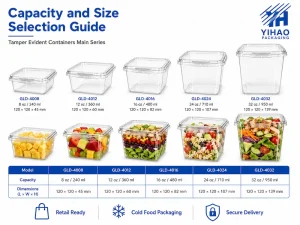
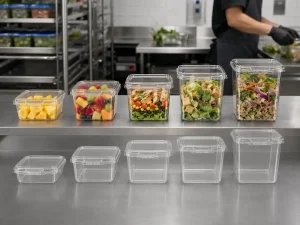
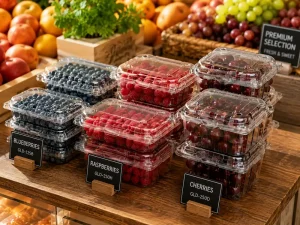
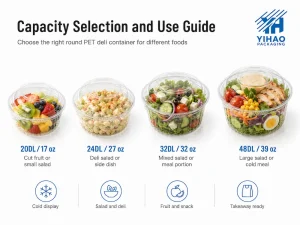
For food brands, supermarkets, cafes, bakeries, distributors, and foodservice buyers, retail display packaging is more than a container. It affects how fresh food looks under lighting, how safely it is handled, how efficiently staff can stock it, how clearly customers understand the product, and how confidently procurement teams communicate food contact and sustainability claims.
YIHAO supports food packaging buyers who need practical packaging solutions for fresh produce, salads, bakery items, cold drinks, chilled ready-to-eat foods, takeaway meals, and supermarket display programs. The right package should protect the product, present it clearly, match the sales channel, and support repeat wholesale supply.
However, retail packaging decisions are rarely simple. A clear PET clamshell may display fruit beautifully, but a paperboard pack may support a different brand message. A tamper evident container may improve customer confidence, but it may cost more than a basic hinged box. A PP container may handle warmer food better than PET, but it may not deliver the same cold shelf clarity. A recyclable food container may support sustainability communication, but recycling claims still depend on local collection, sorting, labels, adhesives, and material structure.
This guide compares retail display packaging with alternative packaging formats so buyers can choose based on real product needs, not only appearance or unit price.
What Is Retail Display Packaging?
Retail display packaging refers to packaging designed to present food clearly and attractively in a sales environment while still protecting product quality and supporting handling, storage, labeling, and checkout operations. It is commonly used for fresh-cut fruit, berries, salads, bakery items, desserts, snacks, chilled meals, deli foods, prepared foods, cold drinks, and grab-and-go products.
In many food categories, display performance has direct commercial value. Customers often make decisions within seconds. If the food looks fresh, clean, visible, portioned, and easy to carry, the package supports conversion. If the container looks cloudy, unstable, poorly sealed, oversized, underfilled, or difficult to open, even a good product can lose appeal.
Common retail display packaging formats include:
- Clear PET or rPET clamshell containers
- Fresh produce trays and vented fruit packs
- Hinged deli containers
- Round salad bowls with clear lids
- Square deli containers for salads and chilled meals
- Tamper evident food containers for grab-and-go items
- Clear bakery clamshells and cake containers
- Cold cups and lids for juice, iced coffee, fruit tea, smoothies, and refreshers
- PP containers for hot or reheatable takeaway food
For produce, chilled food, and bakery programs, buyers often start with fresh produce packaging containers because clear structure, ventilation, stackability, and shelf presentation are essential to the sales result.
Why Retail Display Packaging Matters for Food Buyers
Retail display packaging connects packaging design with business performance. It influences five areas that matter to professional buyers.
1. Product Visibility
Clear packaging allows customers to judge freshness, color, portion size, and ingredient quality before purchase. This is especially important for berries, fruit cups, salads, desserts, deli snacks, sushi, bakery items, and chilled ready-to-eat foods. For these categories, product visibility is not decoration. It is part of the selling function.
A clear hinged pack for fresh fruit packaging supports impulse buying because customers can see the actual product instead of relying only on labels or photos.
2. Food Contact Suitability
Packaging used for direct food contact should be reviewed according to the intended food type, storage condition, contact time, temperature, and market requirements. A container used for chilled berries has different expectations from a package used for hot deli meals, oily foods, acidic dressings, or microwave reheating.
Food grade packaging should be evaluated by material, food type, temperature, contact time, and regional compliance requirements rather than by the term “food grade” alone. Buyers should ask suppliers for appropriate material discussion and documentation support where required. A responsible manufacturer should help buyers compare PET, rPET, PP, paper-based structures, lids, films, and labels according to the actual food application.
3. Shelf Efficiency
Retail packaging must work for staff as well as customers. Stable stacking, carton efficiency, easy labeling, consistent lid fit, and predictable dimensions reduce daily handling issues. A package that looks good in a sample photo but collapses under chilled display stacking is not a strong retail solution.
4. Customer Confidence
For grab-and-go food, tamper resistance and closure security can influence trust. Buyers in supermarkets, airports, convenience stores, cafes, and delivery channels often compare simple hinged containers with tamper evident containers when food safety perception and handling control are important.
5. Claim Accuracy
Terms such as food grade, recyclable, recycled content, compostable, sustainable, and eco-friendly need careful use. Buyers should avoid absolute claims unless they have evidence for the material, market, and package design. For example, recyclable food containers may be recyclable in some local systems but not accepted in every region or facility.
Retail Display Packaging vs Alternative Packaging: Core Comparison
| Packaging Type | Main Advantage | Main Limitation | Best-Fit Applications | Buyer Checkpoint |
|---|---|---|---|---|
| Clear PET / rPET Display Packaging | High clarity and strong shelf appeal | Not suitable for high-heat use unless specifically designed | Fruit, salads, bakery, chilled snacks, cold display foods | Confirm food contact suitability, recycled content, lid fit, and local recycling acceptance |
| PP Food Containers | Better fit for hot food and reheating applications | Usually lower clarity than PET | Hot deli food, takeaway meals, prepared meals, microwaveable foods | Confirm temperature range, lid material, and reheating instructions |
| Paperboard Packaging | Strong natural or premium brand perception | May need coatings, windows, or liners for moisture and grease | Bakery, dry snacks, light meals, gift-style food packs | Check coating type, food contact layer, grease resistance, and recycling claim limits |
| Film-Sealed Trays | Efficient for controlled sealing and portioned products | Requires sealing equipment and film compatibility | Prepared foods, meat, seafood, salads, ready meals | Test sealing temperature, peel strength, leakage, and shelf-life needs |
| Compostable Packaging | Supports compostability positioning where infrastructure exists | Industrial composting access may be limited | Events, cafes, specific sustainability programs | Verify certification, disposal infrastructure, heat limits, and shelf-life performance |
Retail Display Packaging vs Alternative Packaging: Which One Should Buyers Choose?
The best packaging choice depends on what the food needs to do in the real sales environment. A package for chilled berries should not be judged by the same standard as a package for hot takeaway food. A bakery display pack may need dome height and presentation. A prepared meal tray may need heat resistance, sealing performance, or microwave compatibility. A grab-and-go food container may need tamper evidence more than decorative branding.
| Food / Sales Scenario | Best Packaging Direction | Reason | Buyer Priority |
|---|---|---|---|
| Fresh fruit, berries, salads, chilled snacks | Clear PET / rPET retail display packaging | Visibility drives freshness perception and purchase confidence | Clarity, ventilation, lid fit, stacking, chilled display stability |
| Hot meals and microwaveable takeaway food | PP containers or reheatable packaging | Heat and reheating performance matter more than maximum clarity | Temperature range, lid compatibility, reheating instructions |
| Premium bakery, dry snacks, gift-style food | Paperboard or hybrid packaging | Brand perception and printed design may be more important than full transparency | Food contact layer, grease resistance, window design, coating type |
| Centralized prepared food production | Film-sealed trays | Repeatable sealing and portion control support production efficiency | Film compatibility, seal strength, leakage testing, shelf-life needs |
| Grab-and-go, convenience retail, self-service displays | Tamper evident packaging | Visible opening control improves customer confidence | Tear strip design, closure security, opening experience, display fit |
Decision Matrix for Packaging Buyers
A decision matrix helps procurement teams compare retail display packaging with other packaging options before sample testing. This does not replace testing, but it helps buyers narrow the direction quickly.
| Buying Factor | Retail Display PET / rPET Packaging | PP Containers | Paperboard Packaging | Film-Sealed Trays | Tamper Evident Containers |
|---|---|---|---|---|---|
| Product Visibility | Excellent | Medium | Low to Medium | Medium | Excellent when clear PET is used |
| Cold Display Performance | Strong | Medium | Depends on coating and structure | Strong when properly sealed | Strong for grab-and-go display |
| Hot Food Suitability | Limited unless designed for heat | Strong | Depends on lining and use condition | Depends on tray material | Depends on material |
| Branding Flexibility | Medium | Medium | Strong | Medium | Medium |
| Food Safety Perception | Strong when clarity and closure are stable | Strong for hot food applications | Depends on structure and sealing | Strong with controlled sealing | Very strong for self-service food |
| Recyclability Claim Complexity | Medium | Medium | High when coated or laminated | High when multi-material | Medium to High depending on design |
| Best Use Case | Fresh produce, salads, bakery, chilled foods | Hot meals, reheatable food, takeaway | Bakery, dry snacks, premium food packs | Prepared foods and centralized production | Grab-and-go, convenience retail, self-service food |
When Clear Retail Display Packaging Is the Better Choice
Clear display packaging is usually the stronger choice when visual merchandising is central to the sale. It helps buyers show real product quality instead of hiding it behind printed graphics. For fresh food, the customer often wants to inspect color, moisture, ripeness, texture, and portion size before purchase.
Fresh Produce and Fruit Packs
For berries, grapes, kiwi, apples, mango, melon, dragon fruit, fruit cups, and mixed fruit snacks, clear packaging helps communicate freshness and portion value. Ventilation, anti-fog performance, and structure matter because produce continues to release moisture and may be stored under chilled conditions.
For assorted retail packs, compartment PET clamshell packaging helps separate different fruit or snack items while keeping the display clean and organized.
Fresh-Cut Fruit and Snack Containers
Fresh-cut fruit needs packaging that balances clarity, lid fit, leak resistance, and chilled handling. A package for mango cubes, apple slices, grapes, nuts, or mixed snack portions should prevent messy movement while allowing customers to see the combination clearly.
For larger chilled display programs, fresh-cut fruit containers are suitable when buyers need practical display volume, takeaway convenience, and clear presentation.
Party Trays and Multi-Compartment Retail Packs
Retailers often use compartment trays for fruit platters, sushi assortments, bakery samplers, deli snacks, and party-sharing packs. The purpose is not only containment. It is also portion control, visual arrangement, and product separation.
A multi-compartment chilled display tray supports organized merchandising for supermarkets, cafes, and catering-style retail packs.
Deli, Salad, and Grab-and-Go Foods
Deli and salad buyers often need packaging that looks clean under lighting, stacks well in cold cases, and allows customers to see ingredients clearly. Clear hinged containers, round bowls, square containers, and separate-lid formats each serve different merchandising goals.
For everyday salads and snacks, PET hinged deli containers are practical for chilled display, portion visibility, and grab-and-go handling.
When Alternative Packaging May Be Better
Clear retail display packaging is valuable, but it is not always the best answer. Buyers should compare alternatives when temperature, branding, sustainability goals, production method, or customer trust requirements are more important than full visibility.
Choose PP Containers for Hot or Reheatable Foods
PET is commonly selected for cold display and clarity, while PP is often used for warmer applications and reheating needs. Buyers handling hot deli food, prepared meals, takeaway meals, or microwaveable items should compare PP structures carefully.
For prepared food counters and takeaway channels, microwave safe containers may be more appropriate than clear PET packaging when reheating performance is part of the use case.
A practical example is PP prepared meal packaging, which supports prepared food counters, takeaway meals, and operational handling where heat performance matters more than crystal-clear cold display.
Choose Paper-Based Packaging for Certain Brand Positions
Paperboard packaging can work well for bakery items, dry foods, gift-style products, and brands that want a natural or premium presentation. However, buyers should not assume paper is automatically simpler from a compliance or sustainability perspective. Coatings, windows, grease barriers, adhesives, inks, and moisture resistance all affect real performance and claim accuracy.
Choose Film-Sealed Trays for Production Efficiency
Film-sealed trays may be better for centralized production, shelf-life control, and repeatable sealing operations. They are common in ready meals, meat, seafood, prepared salads, and certain deli applications. The tradeoff is that buyers need sealing equipment, film compatibility, and clear testing standards.
Choose Tamper Evident Packaging for Trust-Sensitive Channels
For airports, convenience stores, delivery food, supermarket grab-and-go, school foodservice, and self-service cold cases, tamper evident packaging may be more important than the lowest container cost. Tear-strip structures and secure closures support consumer confidence and reduce uncertainty after handling.
For peg display and cold-case foods, a tamper evident clear container helps combine product visibility with visible opening control.
Food Packaging Compliance: What Buyers Should Check
Food packaging compliance should be reviewed before price comparison. A low-cost package that does not match the food type, region, storage condition, temperature condition, or documentation expectation can create higher risk than the savings justify.
| Compliance Area | What Buyers Should Confirm | Why It Matters |
|---|---|---|
| Food Contact Suitability | Material type, intended use, food type, temperature, and documentation support where required | Packaging should match direct food contact conditions |
| Plastic Food Packaging Safety | PET, rPET, PP, lids, films, coatings, inks, and adhesives used in the final structure | Safety review should include the full package, not only the main tray |
| Recyclability Claims | Local collection, sorting, label design, adhesives, contamination, and material compatibility | Recyclable claims depend on real systems, not only resin type |
| Recycled Content Claims | rPET content, supplier statement, intended food contact use, and market expectations | Buyers need accurate communication for brand and retail programs |
| Use Conditions | Cold display, frozen storage, ambient shelf, takeaway handling, hot filling, or microwave reheating | The same package may not fit every use condition |
Buyers should also separate “food grade” from “right for this food.” A material may be suitable for certain food contact uses but still not fit oily food, hot filling, acidic dressings, microwave reheating, or long chilled display without further review. Strong supplier communication should connect the packaging material with the actual food, temperature, storage, and sales channel.
Recyclable Food Containers: Strong Opportunity, Careful Claims
Recyclable food containers are increasingly important for food brands, but buyers should treat recyclability as a design and market-access question. A package may use a widely recognized plastic such as PET, yet the final package may still be affected by labels, adhesives, colors, sleeves, contamination, food residue, local collection rules, and sorting capabilities.
Transparent PET and rPET containers usually support stronger visibility and clearer material identification than dark or heavily printed packaging. However, black trays, deep colors, full-body sleeves, large labels, incompatible adhesives, and multi-material structures may make recovery more difficult in some recycling systems. Buyers should ask suppliers to clarify material type, recycled content claim support, label compatibility, and local recycling assumptions before using strong sustainability wording.
For chilled salads, fruits, and ready-to-eat foods, PET/rPET food containers support clear display and responsible material discussion when buyers verify food contact suitability and local recycling acceptance.
Strong buyer practice includes:
- Avoiding vague claims such as “100% eco-friendly” without proof
- Checking whether the whole package or only part of it is recyclable
- Reviewing label and adhesive compatibility
- Confirming whether the package is accepted in the target selling region
- Testing how food residue affects collection and sorting
- Keeping sustainability wording accurate and qualified
Retail Display Packaging by Application
Supermarkets
Supermarkets need packaging that supports cold-case organization, fast stocking, clear product comparison, and consistent presentation across multiple SKUs. Clear PET and rPET packaging are common choices for fruit, salads, desserts, bakery packs, and chilled prepared foods.
For salad and fresh food programs, clear square food containers help create organized shelf blocks and practical stacking in retail display cases.
Cafes and Grab-and-Go Counters
Cafes often need smaller runs, mixed menu flexibility, and packaging that works for both display and takeaway. Clear cups, salad bowls, clamshells, and deli containers help customers see what they are buying while allowing staff to prepare items ahead of rush periods.
Bakeries
Bakery buyers should balance visibility, dome height, frosting protection, moisture control, and premium presentation. Cake slices, cupcakes, muffins, croissants, pastries, and dessert samplers often need clear lids or hinged structures that prevent crushing while keeping the product visible.
Foodservice and Distribution
Foodservice buyers need consistent supply, carton efficiency, repeat order stability, and packaging that works across multiple customer types. Wholesale buyers should compare sample quality, carton packing, minimum order logic, SKU consistency, and supplier communication before scaling.
How Buyers Should Compare Retail Display Packaging and Alternatives
A smart packaging comparison should move from application to material to supplier, not from price alone.
Step 1: Define the Food and Sales Channel
Start with the food category. Is it berries, cut fruit, salad, bakery, dessert, deli meal, cold drink, hot food, or reheatable meal? Then define the sales channel: supermarket cold case, cafe counter, delivery, takeaway, catering, wholesale distribution, or convenience retail.
Step 2: Confirm Temperature and Handling Conditions
Cold display packaging should be tested under chilled lighting and condensation conditions. Hot food packaging should be tested for heat tolerance and lid fit. Takeaway packaging should be tested for carrying, stacking, and opening.
Step 3: Compare Structure and Function
Buyers should compare hinged lids, separate lids, dome lids, flat lids, vented structures, tamper evident bands, compartment layouts, round bowls, square containers, and trays. The best structure depends on the product, not only the material.
Step 4: Check Packaging Claims
Terms such as food grade packaging, recyclable food containers, sustainable packaging, rPET packaging, and plastic food packaging safety should be used carefully. Buyers should confirm what each claim means and whether it applies to the target market.
Step 5: Test Samples Before Wholesale Orders
Sample testing should include real product filling, sealing or lid fit, stacking, label placement, display lighting, condensation, takeaway handling, carton storage, and customer opening experience. Empty samples are useful, but they do not reveal full performance.
Buyer Checklist Before Choosing Retail Display Packaging
- Confirm the exact food type and sales channel
- Confirm cold, ambient, hot, frozen, or microwave use conditions
- Compare PET, rPET, PP, paperboard, tray, film, and tamper evident options
- Check direct food contact suitability for the intended use
- Review lid fit, leak resistance, ventilation, anti-fog needs, and stacking strength
- Test packaging under real retail display lighting
- Confirm label placement and barcode readability
- Review local recyclability acceptance before making claims
- Ask for documentation support where required
- Compare carton packing, storage efficiency, and repeat order consistency
- Request samples before confirming wholesale orders
- Choose a supplier that understands both packaging structure and food application
Why Work With YIHAO for Retail Display Packaging?
YIHAO provides practical food packaging solutions for buyers who need clear display, food contact discussion, wholesale supply support, and packaging structure matching. Instead of choosing a package only from a catalog image, buyers can compare material, lid type, compartment layout, display function, chilled handling, tamper evident needs, and order consistency.
For wholesale buyers comparing retail display packaging options, sample testing across real food type, display temperature, stacking condition, label placement, and carton handling is the fastest way to reduce packaging risk before bulk orders.
The strongest packaging decision is not always the clearest container, the cheapest quote, or the most sustainable-sounding option. It is the package that fits the product, protects the food, supports the claim, works in the store, and can be supplied consistently.
Conclusion: Choose Retail Display Packaging by Use Case, Not by Appearance Alone
Retail display packaging is powerful because it helps customers see freshness, portion value, and product quality. For fresh produce, salads, bakery items, chilled snacks, desserts, and grab-and-go foods, clear PET and rPET packaging often deliver strong shelf performance.
Alternative packaging still has important value. PP containers may be better for hot or reheatable meals. Paperboard may support specific bakery or premium brand positioning. Film-sealed trays may fit centralized production. Tamper evident packaging may be essential for trust-sensitive self-service channels.
Professional buyers should compare packaging through a structured process: food type, temperature, retail display need, material, closure, compliance, recyclability claim, handling, supplier support, and sample testing. When these factors are reviewed together, packaging becomes a stronger business tool instead of just a container.
FAQ
1. What is retail display packaging?
Retail display packaging is packaging designed to present food clearly and attractively in a retail environment while protecting the product and supporting handling, storage, labeling, and customer convenience. It is commonly used for fruit, salads, bakery items, desserts, chilled food, deli snacks, and grab-and-go products.
2. Is retail display packaging always made from PET?
No. PET and rPET are common because they offer strong clarity, but retail display packaging may also use PP, paperboard, trays, lids, films, tamper evident structures, or hybrid formats depending on food type, temperature, branding, and operational needs.
3. Are recyclable food containers always recyclable everywhere?
No. Recyclability depends on local collection programs, sorting systems, material type, label design, adhesives, contamination, color, and full package structure. Buyers should confirm local acceptance before making strong recyclable claims.
4. How should buyers choose between PET and PP food packaging?
Buyers should usually compare PET and rPET for cold display, clarity, fruit, salad, bakery, and chilled food applications. PP is often better for warmer food, hot takeaway, and reheatable meals. The final choice should match temperature, food type, lid fit, and compliance expectations.
5. What should buyers test before ordering retail display packaging wholesale?
Buyers should test actual food in the package, lid fit, stacking, leakage, label placement, barcode readability, chilled display performance, condensation, customer opening, carton storage, and handling during takeaway or retail stocking.
References
- U.S. Food and Drug Administration, Packaging & Food Contact Substances.
- U.S. Food and Drug Administration, Recycled Plastics in Food Packaging: Chemistry Considerations.
- European Commission, Regulation (EC) No 1935/2004 on Materials and Articles Intended to Come into Contact with Food.
- European Commission, Regulation (EU) No 10/2011 on Plastic Materials and Articles Intended to Come into Contact with Food.
- Federal Trade Commission, Green Guides for Environmental Marketing Claims.
- Electronic Code of Federal Regulations, 16 CFR Part 260, Guides for the Use of Environmental Marketing Claims.
- U.S. Environmental Protection Agency, Plastics: Material-Specific Data.
- Association of Plastic Recyclers, Design Guidance for Plastic Packaging Recyclability.
Deep-Dive Insights
How should buyers think about retail display packaging? Retail display packaging should be treated as a performance system. The container, lid, label, material, closure, shelf lighting, temperature, food type, carton packing, and sustainability claim all work together. A clear package that displays fruit beautifully may be the right choice for chilled produce, while a PP container may be better for reheatable prepared meals.
Why does alternative packaging still matter? Alternative packaging formats help buyers solve different problems. Paperboard may support a natural brand image. Film-sealed trays may improve production control. Tamper evident packaging may improve trust. PP packaging may support hot food. The best choice depends on the buyer’s sales channel, food type, temperature, and handling process.
What is the practical buyer answer? For most chilled retail display programs, clear PET or rPET packaging is the first option when visibility drives purchase decisions. PP becomes stronger when heat or reheating matters. Paperboard fits brand-led dry or bakery applications. Tamper evident packaging becomes essential when customer trust and self-service handling are priorities.
What should buyers do before ordering? Do not choose packaging only by photo, unit price, or sustainability wording. Test the real food, confirm the intended use, review compliance expectations, check local recyclability claims, and compare supplier reliability before confirming wholesale orders.
Final Note / Practical Takeaway
© YIHAO Packaging. All rights reserved. All articles, product images, packaging designs, technical specifications, and website materials are protected by copyright. Unauthorized copying, reproduction, redistribution, modification, or commercial use is strictly prohibited without prior written permission.