For supermarkets, cafes, bakeries, foodservice operators, fresh produce brands, deli counters, and packaging distributors, food grade packaging is a purchasing decision with direct impact on food safety, shelf presentation, customer confidence, and repeat-order stability. A container may look clear, strong, and attractive, but buyers still need to confirm whether the material, structure, documentation, and intended use match the food application.
Many packaging problems begin before production. A buyer selects a clear container without checking temperature use. A brand requests recyclable food containers but does not confirm local recycling acceptance. A food team asks for “food grade” packaging but does not define whether the food is chilled, oily, acidic, hot-filled, frozen, or reheated. A distributor compares prices without checking lid fit, carton packing, migration support, or supplier traceability.
This guide gives food packaging teams a practical framework for evaluating food packaging compliance, material safety, recyclable food containers, retail display packaging, plastic food packaging safety, and supplier capability before placing a wholesale order. As a food packaging manufacturer and solution provider, YIHAO focuses on packaging choices that support real food categories, including fresh produce, fruit, salad, deli foods, bakery items, cold drinks, prepared meals, and grab-and-go retail programs.
What Food Grade Packaging Means for Food Packaging Teams
Food grade packaging refers to packaging materials and finished articles intended to come into contact with food under defined conditions of use. This definition matters because food-contact suitability is not universal. A package that is suitable for chilled fruit may not be suitable for hot food. A clear PET clamshell for bakery display may not be suitable for microwave reheating. A paper-based box with a window may involve different food-contact surfaces than the outer paper board.
Food packaging teams should always define the use condition first. The key questions are simple but important: What food will touch the package? Is the food dry, moist, oily, acidic, sugary, dairy-based, or high in fat? Will the food be stored cold, displayed at room temperature, frozen, hot-filled, or reheated? How long will the food remain in contact with the container? Will the packaging be used for direct food contact, transport protection, retail display, or secondary outer packaging?
Once these questions are clear, the buyer can select materials and structures more accurately. PET and rPET are often used for clear chilled display packaging. PP is commonly selected for many hot food and reheating applications. Paper-based packaging is useful for bakery and takeaway presentation, but coatings, windows, liners, or inserts must still be reviewed as part of the full food-contact system.
Why Compliance Should Be Checked Before Design and Price
Packaging design and unit price are important, but food packaging compliance should be reviewed before artwork, tooling, or mass production. A beautiful package that does not match the food type, temperature condition, or market requirement can create avoidable risk for the buyer.
For international buyers, compliance should not be reduced to one generic sentence such as “food grade material.” A stronger review includes material type, food-contact suitability, intended use, temperature condition, supplier declaration, sample testing, and market-specific requirements. Buyers should also separate legal compliance from performance testing. A container may be made from a food-contact material but still fail in real operations if the lid leaks, the base deforms, the stack collapses, or the product fogs during chilled display.
Food Grade Packaging Compliance Checklist
The following checklist helps procurement teams review packaging before confirming wholesale orders. It is especially useful when comparing multiple suppliers, preparing internal approval files, or launching new food packaging programs.
| Compliance Item | What Buyers Should Request | Why It Matters |
|---|---|---|
| Material declaration | Clear identification of PET, rPET, PP, paper board, coating, liner, or other food-contact material. | Confirms what material is actually touching the food. |
| Food-contact suitability statement | Supplier statement or documentation showing intended food-contact use. | Reduces risk from vague “food grade” claims. |
| Intended use condition | Cold fill, chilled display, ambient storage, hot fill, freezer use, or microwave reheating where applicable. | Material safety and performance depend on real use conditions. |
| Temperature guidance | Practical temperature range or use limitation for the container and lid system. | Prevents deformation, cracking, leakage, or unsafe misuse. |
| Migration or safety test support | Relevant test support where required by the target market and product application. | Supports internal compliance review and buyer confidence. |
| Recycled content documentation | rPET or recycled-content support when recycled material is claimed. | Helps distinguish real recycled content from marketing language. |
| Traceability and production control | Batch control, material sourcing control, mold consistency, and inspection process. | Improves repeat-order stability and complaint handling. |
| Sample testing before bulk order | Samples tested with real food, real filling process, stacking, transport, and storage conditions. | Finds practical problems before mass production. |
Material Selection Table for Food Grade Packaging
Material selection should be based on food category and use condition, not only cost. The table below gives food packaging teams a practical comparison for common food packaging materials.
| Material | Best-Fit Food Applications | Common Packaging Formats | Buyer Note |
|---|---|---|---|
| PET | Fresh produce, fruit, salad, deli snacks, bakery display, cold food, cold drinks. | Clear clamshells, hinged containers, bowls, trays, cups, lids. | Strong choice for clarity and chilled retail display; confirm use conditions before hot applications. |
| rPET | Chilled food, fruit containers, salad containers, deli packs, retail display packaging. | Clear hinged packs, bowls, produce containers, snack containers. | Useful for recycled-content goals; confirm food-contact suitability and recycled-content documentation. |
| PP | Hot food, prepared meals, deli meals, takeaway, reheatable food. | Meal trays, microwave safe containers, soup containers, deli bowls. | Better suited than PET for many heat-related applications; confirm lid compatibility and reheating guidance. |
| Paper-based packaging | Bakery, desserts, dry food, takeaway, branded retail packs. | Paper boxes, window boxes, trays, sleeves, folding cartons. | Review coatings, windows, liners, and direct-contact surfaces, not only the outer paper board. |
| Hybrid packaging | Bakery, chilled meals, premium retail display, mixed material presentation. | Paper-plastic combinations, trays with lids, windowed boxes. | Check recyclability claims carefully because mixed materials may complicate recycling. |
PET and rPET Packaging for Clear Retail Display
PET is widely used in retail display packaging because it offers high clarity, good stiffness, attractive shelf appearance, and practical forming performance. Food brands use PET packaging for fresh produce, bakery items, cold salads, deli snacks, fruit cups, and cold beverage programs where product visibility helps drive purchase decisions.
rPET adds another purchasing consideration: recycled content. For buyers looking for recyclable food containers or recycled-content packaging, rPET can support a more sustainability-oriented packaging strategy when the recycled material source, food-contact suitability, and target market expectations are properly reviewed. Buyers should not assume that every rPET package is automatically suitable for every food-contact use. Documentation and intended-use confirmation still matter.
For chilled deli and snack programs, PET hinged containers are useful when buyers need clear product visibility, secure closure, and efficient shelf handling. For a more specific retail-ready option, recycled PET hinged deli containers support chilled salad, deli snack, and fresh food display applications where clarity and structure both matter.
PP Packaging for Hot Food and Reheating Applications
PP is commonly selected for food applications involving hot meals, prepared food, takeaway, and reheating because it generally offers better heat resistance than PET in many foodservice conditions. However, buyers should still confirm the exact container structure, lid material, food type, filling temperature, and consumer reheating instructions before using PP packaging for microwave-related programs.
For supermarkets, restaurants, meal prep brands, and foodservice teams, microwave safe containers are practical when packaging must support chilled storage and reheating. The buyer should evaluate whether the container keeps its shape, whether the lid remains compatible after handling, whether venting is required, and whether the package performs reliably with real food portions.
Paper-Based and Hybrid Food Packaging
Paper-based packaging is often used for bakery, desserts, dry foods, premium takeaway, and branded retail presentation. Buyers like paper-based packaging because it can create a natural appearance and strong branding surface. However, food-contact review should still include coatings, grease barriers, plastic windows, inner trays, adhesives, and liners.
For bakery and dessert programs, bakery containers should protect product shape, decoration, height, and freshness. A cake slice, muffin, cupcake, pastry, or dessert sampler may require different dome height, base stability, window clarity, and closure strength. The best packaging should make the product attractive without crushing decoration or creating handling problems.
Plastic Food Packaging Safety: What Buyers Should Actually Check
Plastic food packaging safety depends on more than the plastic name. PET, rPET, PP, and other materials must be evaluated based on formulation, food-contact suitability, use condition, processing control, and finished packaging performance.
Buyers should start with food type. Oily foods, acidic dressings, dairy desserts, fresh-cut fruit, high-sugar bakery items, hot rice, fried snacks, and chilled salads all create different packaging demands. Then buyers should evaluate contact time, temperature, and handling. A container used for a two-hour chilled display does not face the same conditions as a container used for multi-day storage, delivery, freezing, or reheating.
The structure also matters. Strong rim design, clean lid fit, secure locking, controlled venting, smooth edges, stacking strength, and carton packing all affect food packaging performance. Many real-world complaints are caused by poor closure, lid mismatch, weak stacking, or deformation rather than the material name itself.
Retail Display Packaging: Safety, Visibility, and Shelf Efficiency
Retail display packaging must protect food while helping shoppers make quick purchase decisions. Clear packaging is powerful because customers can see color, portion size, ingredient layering, texture, freshness, and quality before buying. This is especially important for fruit, salad, deli food, bakery items, desserts, and grab-and-go meals.
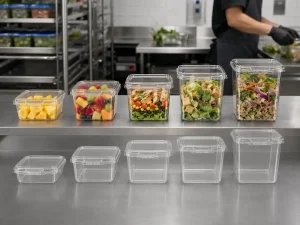
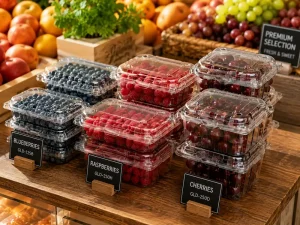
For produce programs, fresh produce packaging containers need clarity, ventilation, stacking strength, and protection against bruising. For deli counters and chilled food shelves, deli and salad containers need lid stability, leak resistance, easy filling, and strong shelf presentation. For larger party, catering, or assorted food displays, multi-compartment retail display trays help separate different foods while maintaining a clean visual layout.
Good retail display packaging should not hide product weakness. If fogging, lid gaps, crushed corners, weak bases, or unstable stacking appear on the shelf, the food looks less reliable even when the food itself is high quality. Packaging teams should therefore test real shelf presentation before confirming a wholesale order.
Recyclable Food Containers: How to Avoid Weak Sustainability Claims
Recyclable food containers are important for modern packaging strategies, but recycling claims must be used carefully. Recyclable does not automatically mean recycled content, and recycled content does not automatically mean the final package is accepted by every recycling system.
Recycled content describes what the package is made from. Recyclability describes whether the package can realistically enter a recycling stream after use. These two ideas are related, but they are not the same. Buyers should check material type, color, label design, adhesive choice, contamination risk, local recycling acceptance, and whether the package uses unnecessary mixed materials.
Clear mono-material PET or rPET packaging can be a strong option for chilled food, fruit, deli snacks, and retail display when it is designed and communicated properly. For example, PET/rPET food containers support product visibility and a more sustainability-oriented packaging message when matched with the right market and application.
Food Packaging Regulations: A Practical Buyer View
Food packaging regulations differ by target market, material, food type, and intended use. Food packaging teams do not need to memorize every regulation, but they do need a reliable approval process. The buyer should ask whether the packaging is intended for the target food-contact use, whether relevant documentation is available, whether recycled materials are properly supported, and whether the packaging design creates additional labeling or recycling claim concerns.
For the U.S. market, buyers commonly review food-contact substance status, intended conditions of use, and supplier support for food-contact applications. For EU-oriented projects, buyers should pay attention to food contact material framework requirements, safety and inertness principles, declarations where applicable, migration-related review, traceability, and packaging waste requirements. For recycled plastics, buyers should request clearer documentation because recycled materials require additional review of process suitability and purity for food-contact applications.
This article is a buyer guide, not legal advice. Final compliance should be confirmed according to the product, market, material, food type, and local regulatory requirements. The practical takeaway is clear: buyers should not rely on generic “food grade” wording alone. They should build a documentation and sample-testing process before bulk purchasing.
Supplier Audit Checklist for Manufacturer, Wholesale, and Supplier Selection
Choosing the right manufacturer is part of food packaging risk control. A low unit price may become expensive if the supplier cannot maintain consistent dimensions, provide documentation, control carton packing, or support repeat orders.
| Audit Area | Buyer Question | Strong Supplier Signal |
|---|---|---|
| Material knowledge | Can the supplier explain PET, rPET, PP, and paper-based packaging by application? | The supplier recommends materials based on food type, temperature, and display condition. |
| Compliance support | Can the supplier provide suitable food-contact documentation for the intended use? | Documentation matches the material, product, and application instead of using generic wording. |
| Production consistency | Can the supplier maintain stable dimensions, lid fit, wall thickness, and closure performance? | Mold control, production inspection, and repeat-order QC are clearly managed. |
| Retail display performance | Does the packaging maintain clarity, stacking strength, and shelf appearance after filling? | Samples perform well under real filling, storage, transport, and display conditions. |
| Wholesale capability | Can the supplier support bulk orders, export packing, carton labeling, and stable lead time? | Packaging, cartons, pallets, and communication are organized for B2B purchasing. |
| Customization ability | Can the supplier support custom size, private label, embossing, printing, or branded packaging? | Customization is explained with tooling, MOQ, artwork, lead time, and approval steps. |
Sample Testing Before Bulk Orders
Sample testing is one of the most effective ways to reduce purchasing risk. Food packaging teams should not test empty containers only. They should test packaging with real food, real filling weight, real storage temperature, real stacking pressure, and real transport conditions.
A good sample test should include lid closure, leakage check, stacking test, shelf display review, label placement, carton packing, and customer handling simulation. For chilled products, buyers should check fogging, condensation, clarity, and lid security after refrigeration. For hot or reheatable foods, buyers should check deformation, venting, lid compatibility, and handling after heating. For retail display products, buyers should check whether the food still looks fresh and premium after the expected shelf period.
Application Guide by Food Category
Fresh Produce and Fresh-Cut Fruit
Fresh produce packaging should protect the product while keeping it visible. Berries, grapes, apple slices, kiwi, mango, melon, and mixed fruit packs need clarity, ventilation, stacking strength, and resistance to crushing. Fresh-cut fruit also requires moisture control and stable closure because condensation and juice movement affect shelf appearance.
For separated fruit and snack packs, clear compartment snack containers help divide ingredients while keeping the product attractive for grab-and-go retail shelves.
Deli, Salad, and Chilled Prepared Foods
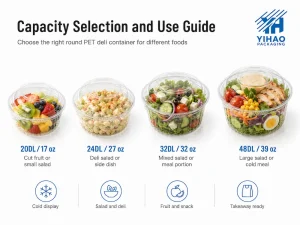
Deli and salad packaging should combine visibility, lid stability, portion control, and leakage resistance. Chilled salads, pasta salads, fruit salads, side dishes, and snack meals often benefit from clear PET or rPET containers because shoppers can see freshness and ingredient quality before buying.
For round chilled food applications, clear PET/rPET containers support retail display, practical handling, and a clean food presentation for deli and salad programs.
Bakery and Dessert Packaging
Bakery packaging must protect decoration, height, texture, and product shape. Cakes, pastries, muffins, cupcakes, dessert cups, and assorted bakery items need packaging that prevents crushing while showing the product clearly. Buyers should check dome height, base stability, lid strength, and display angle before ordering.
Cold Drinks and Beverage Packaging
Cold drink packaging must be reviewed as a cup-and-lid system. Iced coffee, smoothies, milk tea, fruit tea, matcha drinks, refreshers, lemonade, soda, flavored cold brew, protein drinks, and sparkling fruit drinks require cup clarity, rim strength, lid compatibility, crack resistance, and takeaway comfort.
For beverage programs, cold cups and lids should be selected according to drink type, ice level, foam height, sealing expectation, straw or strawless lid preference, and branding needs.
Tamper-Evident and Secure Food Packaging
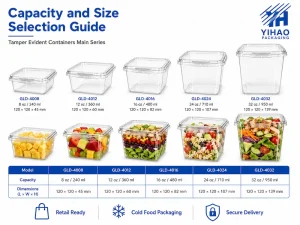
For supermarkets, convenience stores, delivery-sensitive products, and grab-and-go counters, secure packaging helps protect product integrity and consumer trust. tamper evident containers use visible opening indicators, tear strips, or secure locking structures to make unauthorized opening easier to detect.
For chilled retail packs that need both visibility and security, clear tamper-evident containers help food teams combine display value with stronger product protection.
Common Buyer Mistakes to Avoid
The first mistake is choosing packaging only by appearance. High clarity is valuable, but it does not replace food-contact suitability, use-condition matching, and supplier documentation.
The second mistake is assuming one material works for every food. PET is strong for clear chilled display, while PP is more suitable for many heat-related food applications. Paper-based packaging can be attractive, but coatings, windows, and liners need review.
The third mistake is using sustainability language too broadly. Recyclable, recycled content, compostable, reusable, and lower-plastic claims are different concepts. Buyers should avoid unclear claims that are not supported by market reality or supplier documentation.
The fourth mistake is ignoring the lid. Many complaints come from weak closure, poor rim fit, leakage, cracked lids, or unstable stacking. Buyers should test the complete container-and-lid system.
The fifth mistake is skipping sample testing. Photos and specifications are useful, but they cannot replace real food testing, transport simulation, shelf display checks, and internal approval review.
How Food Packaging Teams Should Build a Better Purchasing Process
A better purchasing process starts with application definition. Before asking for a quote, buyers should define the food type, portion size, storage condition, display channel, target market, packing method, sustainability expectation, and documentation requirement. This makes supplier communication more accurate and reduces unnecessary sample rounds.
After that, buyers should compare standard options before custom development. Standard packaging often provides faster lead time, lower tooling risk, and proven structure. Custom packaging is valuable when the buyer needs a unique size, branded presentation, private label solution, custom printing, special compartments, or a dedicated retail program.
For wholesale orders, buyers should request samples, confirm packaging drawings or specifications, review carton packing, check pallet loading, and define acceptance criteria. A professional supplier should help buyers move from product selection to sample approval, compliance review, production confirmation, and repeat-order management.
Deep-Dive Insights
How should buyers define food grade packaging before asking for a quote?
Buyers should define the food application first: food type, temperature condition, contact duration, storage environment, display channel, and target market. This prevents suppliers from giving generic material recommendations and helps the buyer compare packaging based on real use instead of surface appearance.
Why does food packaging compliance need both documents and practical testing?
Documents help buyers review food-contact suitability, material information, and market requirements. Practical testing shows whether the packaging actually performs during filling, closing, stacking, transport, refrigeration, heating, or shelf display. Strong purchasing decisions need both.
What is the biggest misunderstanding about recyclable food containers?
The biggest misunderstanding is treating recycled content and recyclability as the same thing. Recycled content explains what material is used in the package. Recyclability depends on whether that package can be collected, sorted, and processed in the target market after use.
Which option should food packaging teams prioritize for retail display?
For chilled retail display, buyers should prioritize clarity, lid fit, stacking strength, anti-fog performance where needed, and food-contact suitability. PET and rPET containers often perform well in these applications, but the final choice should still match the food type and storage condition.
What should procurement teams consider before placing wholesale orders?
Procurement teams should check supplier documentation, sample performance, carton packing, repeat-order consistency, customization capability, and communication quality. The lowest unit price is not always the best buying decision if the packaging creates leakage, deformation, compliance questions, or retail complaints.
Final Note / Practical Takeaway
FAQ
1. What does food grade packaging mean?
Food grade packaging means the packaging material and finished article are intended for food contact under defined use conditions. Buyers should confirm the food type, contact duration, temperature condition, and supplier documentation before placing orders.
2. What documents should buyers ask for when buying food grade packaging?
Buyers should request material information, food-contact suitability support, intended-use guidance, relevant test support where applicable, recycled-content documentation when claimed, and supplier traceability information.
3. Are PET and rPET containers suitable for all food packaging applications?
No. PET and rPET are strong choices for many clear chilled and ambient display applications, but they are not universal solutions for every hot food or reheating use. Buyers should match the material with the food type and temperature condition.
4. Are recyclable food containers the same as recycled-content containers?
No. Recycled-content containers include recycled material in the package. Recyclable containers are designed to enter a recycling stream after use where local recycling systems accept them. Buyers should verify both claims separately.
5. How should food packaging teams test samples before wholesale orders?
Food packaging teams should test samples with real food, real filling weight, lid closure, leakage risk, stacking pressure, refrigeration or heating where relevant, transport simulation, label placement, and retail shelf display.
References
- U.S. Food and Drug Administration, Packaging & Food Contact Substances.
- U.S. Food and Drug Administration, Understanding How FDA Regulates Substances that Come into Contact with Food.
- U.S. Food and Drug Administration, Guidance for Industry: Use of Recycled Plastics in Food Packaging.
- U.S. Food and Drug Administration, Recycled Plastics in Food Packaging.
- European Commission, Food Contact Materials Legislation.
- European Union, Regulation (EC) No 1935/2004 on Materials and Articles Intended to Come into Contact with Food.
- European Union, Regulation (EU) 2025/40 on Packaging and Packaging Waste.
- Codex Alimentarius and international food safety guidance resources related to food hygiene, packaging, and risk control.
© YIHAO Packaging. All rights reserved. All articles, product images, packaging designs, technical specifications, and website materials are protected by copyright. Unauthorized copying, reproduction, redistribution, modification, or commercial use is strictly prohibited without prior written permission.