What Branded Food Packaging Means for Wholesale Buyers
Branded food packaging refers to food packaging that carries a business identity through structure, material, appearance, label design, printing, carton marks, and consistent product presentation. It may include custom printed cups, branded lids, clear food containers, private label clamshells, OEM packaging formats, sleeve-ready trays, or custom food containers designed for retail display and takeaway service.
For wholesale buyers, branded packaging is not decoration alone. A logo creates recognition, but packaging structure creates trust, usability, and repeat purchase confidence. If the container does not fit the food, if the lid does not close correctly, if the label blocks visibility, or if the supplier cannot repeat the same packaging specification, the branding will not solve the real problem.
YIHAO supports food packaging buyers with practical packaging formats for fresh produce, bakery items, deli foods, chilled ready-to-eat meals, cold beverages, and takeaway applications. In a branded packaging project, the goal is not to make every package look overly decorative. The goal is to make the food look clean, sellable, consistent, safe to handle, and ready for repeat wholesale supply.
Why Buyers Choose Branded Food Packaging
Food packaging has become part of how customers judge freshness, hygiene, convenience, and brand quality. A clear container with a neat label area, a cup with stable logo printing, or a tamper-evident pack with clean retail presentation does more than hold food. It influences whether the product feels professional enough for a chilled shelf, a delivery order, a cafe counter, a supermarket grab-and-go display, or a private label retail program.
Wholesale branded food packaging helps buyers solve several practical business needs:
- Brand recognition: packaging repeats the brand identity across cups, lids, containers, labels, sleeves, and cartons.
- Retail presentation: clear PET, rPET, and selected PP formats help customers see product freshness, color, portion size, and quality.
- Operational consistency: stable packaging structures reduce confusion between lids, containers, labels, and SKU groups.
- Wholesale repeatability: buyers need packaging that can be reordered with consistent size, appearance, material, and packing method.
- Private label readiness: a reliable supplier should support artwork review, sample confirmation, specification records, and long-term supply planning.
This is why branded packaging should be planned as a complete sourcing system, not as a single printed item. The strongest projects usually connect food category, container type, lid style, material, label position, print area, carton packing, and reorder logic.
Manufacturer Checklist for Branded Food Packaging
When buyers compare a branded food packaging manufacturer, the first question should not be “Can you print my logo?” A better question is: “Can this manufacturer help my packaging look consistent, function correctly, and scale from sample testing to wholesale supply?”
1. Confirm the Food Category First
Different food categories need different packaging logic. Fresh fruit, bakery desserts, cold drinks, chilled salads, deli snacks, prepared meals, and tamper-evident retail foods do not share the same structure requirements.
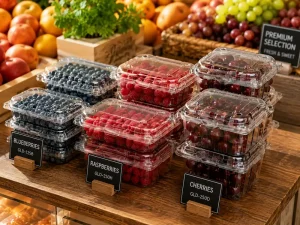
For fruit and produce brands, fresh produce packaging containers should support product visibility, portion presentation, stacking, retail handling, and ventilation where needed. For cafes and drink chains, cold cups and lids must match drink volume, lid style, straw or strawless service, ice level, and takeaway handling. For bakeries, bakery containers need enough headspace, clean visibility, and reliable protection for cakes, pastries, muffins, desserts, and baked snacks.
A strong manufacturer should help buyers narrow the project by food type first, then select material, structure, and branding method. This prevents a common mistake: trying to force one container style across too many different food programs.
2. Match Material to Food Use
Material choice affects clarity, strength, temperature suitability, presentation, labeling, and branding method. PET and rPET are commonly selected for cold food display, chilled snacks, fresh-cut fruit, salad bowls, bakery clamshells, and clear cold cups because they support product visibility and a clean retail look. PP is often selected for food formats where stronger heat resistance or reheating suitability is part of the buyer’s product plan.
For OEM plastic packaging, the buyer should confirm intended food contact conditions, filling temperature, storage environment, display channel, handling process, and end-use instructions. A chilled salad container, a cold brew cup, a fruit clamshell, and a microwaveable prepared meal container require different material logic.
Buyers should avoid starting with the question, “What is the cheapest plastic box?” A better starting point is to define the food, temperature condition, shelf display requirement, lid style, label placement, and branding method before comparing unit price.
3. Check Existing Mold and Structure Options
Many branded packaging projects do not need a fully new mold at the beginning. In many cases, buyers can start with existing stock structures and apply labels, stickers, sleeves, direct printing, or carton branding before investing in exclusive tooling.
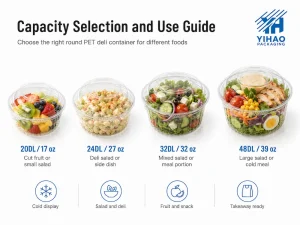
For example, a cafe brand may begin with clear PET cups for iced coffee, matcha, refreshers, lemonade, fruit tea, smoothies, milk tea, and flavored cold brew. A chilled food brand may use hinged deli containers for salads, snacks, fruit portions, and ready-to-eat cold foods. A foodservice buyer may compare round food containers for larger chilled meals, salad portions, fruit mixes, and takeaway display.
This approach helps buyers test market response before committing to complex custom development. It also reduces risk when building a branded packaging line across several SKUs.
4. Evaluate Printing, Labeling, and Branding Methods
Branded food packaging can be achieved through several methods. The best option depends on order volume, artwork complexity, packaging shape, budget stage, retail channel, product information needs, and whether the buyer needs short-term flexibility or long-term brand consistency.
| Branding Method | Best For | Buyer Advantage | Key Checkpoint |
|---|---|---|---|
| Custom labels | Small to medium trial orders | Flexible, fast to update, useful for multiple SKUs | Confirm label area, adhesion, moisture exposure, and barcode position |
| Direct printing | Higher-volume cups, lids, and selected container formats | Cleaner brand appearance and stronger visual consistency | Confirm artwork file, print area, color tolerance, and sample approval |
| Sleeves or wraps | Private label retail programs and premium product lines | More design space and stronger shelf communication | Confirm fit, application process, packaging visibility, and storage condition |
| Carton branding | Distributor and wholesale supply | Improves warehouse identification and repeat-order management | Confirm carton marks, SKU code, product description, and export handling |
| Existing packaging plus brand sticker | Early-stage food brands, cafes, bakeries, and test programs | Lower development risk and easier SKU testing | Confirm sticker placement does not block product visibility or food information |
For many first-time buyers, labels or stickers are often the most practical way to test market fit. Direct printing becomes more attractive when the buyer has stable artwork, stable order volume, and clear packaging specifications.
5. Review Artwork Before Sampling
Artwork review is one of the most important steps in custom OEM food packaging. A packaging manufacturer should not move directly from logo file to bulk order. Buyers should confirm artwork size, color expectations, print area, barcode position, nutrition label area, legal text space, product visibility, and whether the packaging surface supports the selected decoration method.
For custom printed cups, the artwork must match the cup’s shape and usable print area. For clear containers, the brand area should not block the food too heavily. For tamper-evident packs, the label should not interfere with tear strips, locks, lid closure, or opening direction.
A good manufacturer will help the buyer evaluate how the packaging looks in real use, not only how the flat artwork looks on a screen.
Supplier Checklist for Wholesale Branded Food Packaging
A manufacturer produces packaging. A supplier supports the buyer through communication, samples, order coordination, packing, documentation, shipment, and repeat orders. For international wholesale buyers, supplier quality is just as important as product structure.
1. Confirm Communication Efficiency
Branded packaging projects usually involve more details than standard stock orders. Buyers need to confirm artwork, material, size, structure, packing, label area, carton marks, shipping terms, sample details, and bulk order requirements. Slow or unclear communication creates unnecessary mistakes.
A capable manufacturer should be able to ask the right questions early: What food will be packed? Is the product chilled, frozen, ambient, hot-filled, or reheated? Does the buyer need printing, labeling, sleeves, or plain packaging? Is the order for retail display, delivery, takeaway, supermarket shelves, or foodservice distribution?
2. Ask for Samples Before Bulk Production
Samples are not a formality. They are the most practical way to test whether the container fits the food, whether the lid closes correctly, whether the label position works, whether the product looks good on shelf, and whether the buyer’s team can use the packaging efficiently.
For custom food containers, sample testing should include real food weight, lid fit, stacking, handling, condensation, label placement, and display appearance. For drink programs, buyers should test cup-lid matching, drink level, ice level, straw or strawless use, and takeaway handling. For bakery packaging, buyers should test dessert height, surface protection, and display stability.
3. Confirm Wholesale Packing and Repeat Order Logic
Branded packaging is often connected to repeat purchasing. Buyers should confirm whether the supplier can support stable carton packing, clear item identification, consistent product appearance, and repeat-order communication.
For distributors, carton labeling and product code consistency matter. For food brands, packaging appearance must remain stable across multiple batches. For cafes and bakeries, staff need packaging that is easy to identify and use during busy service hours.
Wholesale packaging is not only about the unit product. It is also about how the packaging is stored, counted, transported, reordered, and used by teams.
Buyer Qualification Checklist: Good Supplier Signals vs Risk Signals
When comparing suppliers for branded food packaging, buyers should look for practical signals. A good supplier does not only accept a logo file. A good supplier checks whether the packaging can support the food, the brand, and the wholesale order process.
| Supplier Area | Good Signal | Risk Signal | Buyer Action |
|---|---|---|---|
| Artwork Review | Checks print area, label size, barcode space, and product visibility | Only asks for a logo file and moves quickly to bulk order | Request artwork layout confirmation before sampling |
| Sampling Process | Encourages real food testing before production | Pushes bulk production without sample confirmation | Test packaging with actual food, lids, labels, and storage conditions |
| Structure Matching | Recommends packaging by food category and use condition | Uses one container format for all food applications | Compare cups, lids, trays, bowls, clamshells, and containers by use case |
| Repeat Orders | Keeps SKU records, artwork files, carton marks, and specifications | No clear reorder file or product specification record | Confirm how repeat orders will be tracked before the first bulk order |
| Communication | Asks about food type, storage condition, display channel, and branding method | Gives vague answers without application questions | Choose suppliers who help prevent mistakes before production |
From Artwork to Bulk Order: A Practical Branded Packaging Workflow
A successful branded packaging project should follow a staged workflow. This reduces risk, improves sample accuracy, and helps buyers build packaging systems that can be repeated in future orders.
| Workflow Step | What Buyers Should Confirm | Why This Step Matters |
|---|---|---|
| 1. Food Application Confirmation | Food type, storage condition, filling temperature, display channel, and service scenario | The packaging must match the real food use before branding is planned |
| 2. Structure Selection | Cup, lid, clamshell, tray, bowl, compartment container, or separate-lid container | The structure controls product fit, handling, stacking, visibility, and customer experience |
| 3. Artwork and Label Area Review | Logo size, print area, label position, barcode space, legal text area, and product visibility | Good artwork planning prevents printing errors and blocked food visibility |
| 4. Sample Testing | Real food fit, lid closure, stacking, condensation, transport handling, and retail display | Samples reveal practical problems before wholesale production |
| 5. Pre-Production Confirmation | Material, size, packing method, artwork version, carton marks, and supplier records | Clear confirmation reduces mistakes during the production stage |
| 6. Wholesale Packing and Reorder Record | Carton quantity, product code, SKU name, artwork file, and reorder specification | Repeat-order stability depends on accurate records, not memory |
This workflow is especially useful for buyers moving from plain food packaging to branded food packaging, private label food packaging, or more complete OEM plastic packaging programs.
Branded Food Packaging vs Private Label Food Packaging
Branded food packaging and private label food packaging are closely related, but they are not always the same.
Branded packaging focuses on visible brand identity. It may include a logo, brand color, label, printed cup, carton mark, or retail-ready design. Private label packaging often goes further. It usually supports a retail brand, supermarket line, food distributor, or brand owner that sells products under its own name. Private label projects may require more consistency across product families, stronger packaging documentation, more structured artwork approval, and tighter repeat-order control.
| Comparison Area | Branded Food Packaging | Private Label Food Packaging |
|---|---|---|
| Main Purpose | Show brand identity on packaging | Support a retail or distributor-owned product line |
| Common Users | Cafes, bakeries, restaurants, foodservice brands, drink shops | Supermarkets, distributors, retail food brands, chain operators |
| Branding Method | Logo printing, labels, stickers, sleeves, carton marks | More complete packaging identity across multiple SKUs |
| Order Planning | Often starts with sample testing or moderate wholesale orders | Usually needs stronger SKU planning and long-term supply control |
| Supplier Requirement | Good artwork support and packaging matching | Stable supplier management, repeat-order consistency, and project coordination |
For many buyers, the right path is gradual. Start with branded stock packaging, test the food program, confirm stable sales, then move toward more complete private label or OEM packaging development.
Best Applications for Custom OEM Food Packaging
Custom OEM food packaging works best when buyers already understand the food category, target channel, and packaging role. The strongest projects usually come from clear business use cases.
Custom Printed Cups for Cold Drink Brands
Cold drink brands often need packaging that supports visual presentation and takeaway convenience. Clear cups show drink color, ice level, toppings, fruit inclusions, foam, matcha layers, lemonade, refreshers, smoothies, milk tea, fruit tea, iced coffee, and flavored cold brew.
For beverage menus, PET flat lids, dome lids, and strawless lids should be selected according to how the drink is served. A simple iced coffee may need a flat lid. A smoothie or whipped topping drink may need extra headspace. A no-straw takeaway program may need a sip-through lid. Branding should support the drink menu rather than fight against it.
Custom Food Containers for Chilled Retail Display
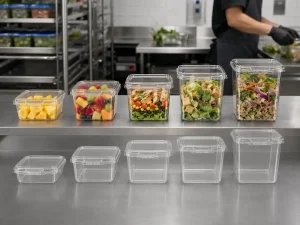
Chilled retail foods depend heavily on visibility. Fruit cups, salads, deli snacks, cold noodles, fresh desserts, sandwiches, and ready-to-eat foods often sell better when customers can inspect product color and portion quality quickly.
For this reason, clear PET and rPET containers are practical for custom food containers used in supermarket displays, grab-and-go shelves, cafes, and convenience stores. Buyers can use labels, stickers, or sleeves while keeping the food visible.
Bakery and Dessert Packaging for Brand Presentation
Bakery packaging must balance protection and appearance. Cake slices, muffins, cupcakes, brownies, pastries, cookies, and chilled desserts need packaging that protects shape while making the product look fresh.
For dessert brands, clear bakery clamshells help show the product while reducing handling damage. Branding can be applied through labels, stickers, sleeves, or outer cartons depending on order size and product positioning.
Tamper-Evident Packaging for Retail Trust
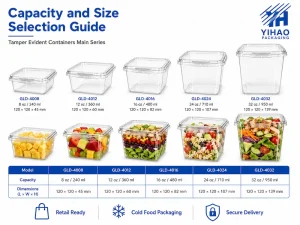
When food is sold through chilled retail display, takeaway shelves, delivery channels, or grab-and-go programs, buyers often want stronger safety signals. tamper evident containers help communicate that the food has not been opened after packing.
For branded programs, tamper-evident structures must be planned carefully. The label or printed area should not block the opening feature, tear strip, locking structure, or customer instructions. A well-designed pack should look branded while still making the safety feature easy to understand.
Prepared Food and Hot Food Packaging
Prepared meals, deli foods, hot takeaway items, and reheatable food programs need packaging that matches actual use conditions. If the food is intended for reheating, buyers should compare material suitability and confirm packaging use instructions before ordering.
For these applications, microwave safe containers may be more suitable than clear cold-food packaging. Branding may be added through labels, sleeves, or carton marks, but the packaging structure must still match the food’s temperature and handling requirements.
Common Mistakes Buyers Should Avoid
Choosing Packaging Only by Price
Low unit price is not useful if the container does not fit the food, the lid is unstable, the label blocks product visibility, or the packaging looks inconsistent on shelf. Buyers should compare total packaging performance, not only cost per piece.
Printing Too Early Before Testing the Structure
Some buyers want printed packaging before they have confirmed the right container size, lid type, food weight, or shelf display style. This creates risk. Structure testing should come before large-scale branded production.
Using One Format for Too Many Foods
A single container rarely works well for every product. Fruit, salad, deli foods, desserts, and drinks each need different packaging logic. Buyers should build a practical packaging matrix instead of forcing all products into one format.
Blocking Product Visibility with Oversized Labels
Clear packaging is valuable because it shows the food. If a label is too large, the packaging may lose its strongest retail advantage. Brand identity should support product visibility, not hide it.
Ignoring Lid and Container Compatibility
For cups, bowls, trays, and containers, lid fit is critical. A beautiful branded container still fails if the lid does not match correctly or if staff cannot use it efficiently. Buyers should confirm lid matching during the sample stage.
Forgetting Reorder Consistency
Branded packaging must be repeatable. Buyers should keep records of product size, material, artwork version, label position, carton marking, and supplier communication. Without clear records, repeat orders become risky.
FAQ About Wholesale Branded Food Packaging
1. What information should buyers provide before ordering branded food packaging?
Buyers should provide the food type, packaging size, material preference, storage condition, service channel, branding method, artwork file, label or print area requirement, sample expectation, and wholesale order plan. This helps the supplier recommend packaging that matches the real application instead of only quoting a generic container.
2. Is branded food packaging better with printing or labels?
It depends on the project stage. Labels and stickers are flexible for early testing, multiple SKUs, and smaller branded programs. Direct printing is stronger for stable repeat orders, consistent artwork, and larger-volume packaging programs. Buyers should confirm structure and sample performance before choosing the final branding method.
3. Can branded food packaging be used for both cups and containers?
Yes. Branded food packaging can be used for custom printed cups, lids, bowls, trays, clamshells, bakery containers, salad containers, fruit containers, deli containers, and tamper-evident containers. The branding method should match the packaging shape, material, food visibility, and real service scenario.
4. How should buyers test branded food packaging before wholesale orders?
Buyers should test samples with real food, real lids, real labels, and real handling conditions. Important checks include food fit, lid closure, stacking, condensation, product visibility, label placement, transport handling, shelf display, staff usability, and whether the branding supports the food instead of blocking it.
5. What makes a good branded food packaging supplier?
A good branded food packaging supplier asks about food application, material needs, container structure, lid matching, artwork layout, label position, carton marks, sample testing, and repeat-order records. The best supplier helps buyers reduce mistakes before bulk production, not only accept a logo file.
References
- U.S. Food and Drug Administration, Packaging & Food Contact Substances information.
- U.S. Food and Drug Administration, Guidance for Industry: Use of Recycled Plastics in Food Packaging.
- European Commission, Food Contact Materials regulatory information.
- European Commission, Packaging and Packaging Waste Regulation policy materials.
- European Commission, Regulation (EC) No 1935/2004 on materials and articles intended to come into contact with food.
- European Union, Regulation (EU) No 10/2011 on plastic materials and articles intended to come into contact with food.
- Industry packaging buyer practice: sample testing, artwork review, carton marking, and repeat-order management.
- YIHAO packaging category planning and product application structure for food packaging buyers.
Deep-Dive Insights
How buyers should plan branded food packaging from food use first
Buyers should start from the food application, not the logo. A cold drink cup, fruit container, bakery clamshell, deli bowl, salad pack, and prepared meal container each has a different structure requirement. The right branded packaging project begins with food type, storage condition, lid matching, product visibility, label area, and handling process before artwork is finalized.
Why logo-first packaging creates sourcing risk
A logo can create recognition, but it cannot fix poor packaging structure. If the cup does not match the lid, if the container blocks food visibility, if the label covers the product, or if the supplier cannot repeat the same specification, the branded project becomes unstable. Branding should strengthen packaging performance, not hide packaging weakness.
What supplier signals matter before bulk production
A strong supplier asks practical questions before quoting. These questions should cover food type, material, packaging size, closure structure, artwork layout, label position, carton packing, and repeat-order records. Buyers should be careful when a supplier only asks for a logo file and pushes bulk production without sample testing.
Option: labels vs direct printing vs sleeves
Labels are practical for early-stage testing, multiple SKUs, seasonal products, and flexible product information. Direct printing is stronger for stable repeat orders and cleaner brand presentation. Sleeves and wraps provide more design space for private label retail programs. The best option depends on order stability, artwork maturity, product range, and how much visibility the food still needs.
Consideration: when to move from stock packaging to private label packaging
Many buyers should begin with existing packaging structures and branded labels before moving into private label or OEM development. Once the food program, sales volume, SKU structure, and repeat-order demand become stable, buyers can consider more advanced private label packaging, direct printing, or custom OEM plastic packaging. This staged path reduces risk and keeps packaging decisions grounded in real market demand.
Final Note / Practical Takeaway
© YIHAO Packaging. All rights reserved. All articles, product images, packaging designs, technical specifications, and website materials are protected by copyright. Unauthorized copying, reproduction, redistribution, modification, or commercial use is strictly prohibited without prior written permission.