Why Custom Tamper Evident Containers Need a Food-First Checklist
Custom tamper evident containers are often discussed as branding projects, but successful custom packaging starts with food behavior. A logo, color, label, or special shape does not create a strong package if the container does not fit the food, close consistently, show the product clearly, protect the shelf presentation, and provide visible opening confidence before purchase.
For food packaging teams, custom tamper-evident packaging affects more than appearance. It affects staff packing speed, retail display quality, customer handling, label readability, carton storage, transport protection, supplier consistency, and long-term wholesale supply. A custom container that looks attractive in a mockup can still fail if it creates poor lid fit, weak stacking, hidden labels, unclear tamper evidence, or difficult customer opening.
YIHAO supports food packaging buyers with clear PET, rPET, PP, hinged, rectangular, round, deli, salad, bakery, fresh produce, microwave-safe, and tamper-evident packaging options. For custom projects, the best starting point is not decoration. The best starting point is food application, retail channel, material direction, closure structure, label plan, sample testing, and repeat-order logic.
What Are Custom Tamper Evident Containers?
Custom tamper evident containers are food packaging containers designed or adapted to support a buyer’s specific product, retail channel, brand presentation, portion logic, closure requirement, and first-opening signal. Customization may involve label area planning, material direction, product family selection, structure adjustment, private-label packaging, print support, color direction, portion layout, or a dedicated tamper-evident feature.
The tamper-evident function may come from a tear strip, break tab, locking edge, security band, or label seal area. The purpose is to give staff and customers a visible signal that the package appears to have remained closed before purchase. The custom function should make the packaging easier to trust, easier to identify, and easier to use—not more complicated.
Buyers should not treat custom packaging as a shortcut to food safety or compliance. Packaging can support retail confidence and better handling workflows, but it does not replace sanitation, temperature control, employee training, food-contact review, allergen management, date marking, or local regulatory requirements.
Manufacturer Checklist: Define the Food Application First
Before discussing molds, printing, colors, or custom branding, buyers should define the actual food application. A custom container for fresh-cut fruit does not need the same structure as a container for deli sides. A bakery dessert container does not need the same lid height as a salad bowl. A hot prepared meal requires a different material direction from a chilled fruit pack.
| Food Application Question | What Buyers Should Define | Why It Matters for Custom Packaging |
|---|---|---|
| What food will be packed? | Fruit, salad, deli food, bakery item, dessert, snack pack, chilled meal, or hot food. | Food type decides depth, height, closure, material, and display structure. |
| How wet is the food? | Dry, moist, sauced, dressed, juicy, oily, or mixed-texture. | Moisture affects lid pressure, rim design, leak-resistant direction, and testing. |
| Where will it be sold? | Supermarket, convenience store, cafe fridge, bakery shelf, deli case, or foodservice pickup area. | Retail channel affects footprint, label angle, tamper evidence, and shelf fit. |
| Will customers handle it before purchase? | Self-service shelf, chilled case, pickup fridge, or staff-controlled counter. | Customer-access areas usually need stronger opening confidence. |
| What is the label plan? | Brand label, ingredients, allergens, barcode, price label, date mark, and security label. | Custom packaging must leave the food visible and the label readable. |
Supplier Checklist: Choose Stock, Modified, or Fully Custom Packaging
Not every buyer needs fully custom tooling. In many cases, a standard stock container plus custom label, branded sleeve, private-label carton, or improved label placement can solve the problem faster. Fully custom packaging is stronger when the food format, brand program, retail channel, and repeat-order plan are already clear.
| Customization Level | Best Fit | Buyer Advantage | Buyer Caution |
|---|---|---|---|
| Stock container | Fast testing, early retail launch, distributor programs, standard food portions. | Lower complexity and faster sample evaluation. | Brand differentiation may be limited. |
| Stock container with custom label plan | Retail food brands that need speed and brand consistency. | Supports branding without changing core structure. | Label must not hide food visibility or tamper evidence. |
| Modified packaging direction | Programs needing better label area, different portion logic, or adjusted display format. | Improves functional fit while controlling project complexity. | Requires clear sample testing and supplier discussion. |
| Fully custom container | Long-term private-label, branded retail lines, unique food formats, or exclusive packaging systems. | Stronger brand identity and dedicated packaging logic. | Needs stable volume, clear project scope, and careful validation. |
Wholesale Tamper Evident Containers: When Standard Options Are Better
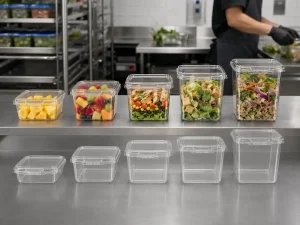
Wholesale tamper evident containers are often the best starting point for buyers who need fast market testing, lower development complexity, and practical retail performance. A standard container allows the buyer to test food fit, closure behavior, label placement, shelf display, and customer opening before committing to custom development.
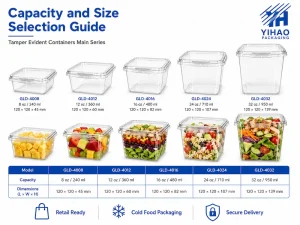
For customer-access retail foods, tamper evident containers are a strong category direction because they provide visible first-opening confidence. For shelf-efficient programs, rectangular tamper evident containers help buyers review display alignment, label position, carton packing, and compact retail shelf use.
For small chilled foods, a clear tamper evident container is useful when buyers need visibility and opening confidence without starting a full custom project. For larger chilled food packs, a tear-strip seal structure supports a stronger first-opening signal for retail display.
Bulk Tamper Evident Containers: What Changes at Scale?
Bulk tamper evident containers require more discipline than small trial orders. Once a buyer increases order volume, carton packing, nesting, storage efficiency, production repeatability, sample-to-order consistency, and supplier communication become more important. A container that looks acceptable in a small sample batch may create problems if bulk production does not match the approved sample.
Bulk buyers should review lid fit, rim grip, tear-strip behavior, break-tab consistency, label area, food visibility, carton strength, and stackability. They should also ask whether the supplier can support related sizes and adjacent formats. Retail food programs usually grow across multiple SKUs, not one item.
| Bulk Buying Checkpoint | What to Confirm | Why It Matters |
|---|---|---|
| Sample-to-order match | Bulk production matches approved samples in closure, clarity, structure, and carton packing. | Prevents surprises after larger purchase commitments. |
| Closure consistency | Lid fit, tear strip, break tab, rim grip, and customer opening remain stable. | Retail buyers need repeatable customer experience. |
| Carton and storage logic | Nesting, carton strength, storage footprint, and transport protection are practical. | Bulk packaging creates storage and logistics pressure. |
| Product family support | Supplier offers related sizes, shapes, and adjacent packaging categories. | Buyers can expand without restarting sourcing from zero. |
Material Direction for Custom Tamper Evident Containers
Material selection must follow food use. PET and rPET are common for clear chilled food display because they support product visibility, practical stiffness, and clean shelf presentation. PP is more relevant when heat-related use or reheatable food is part of the program. Paper, fiber, and board-based packaging may support some brand-focused formats, but they may reduce visibility for foods that sell through appearance.
For chilled fruit, salads, deli sides, desserts, and ready-to-eat retail foods, clear PET or rPET is often a practical direction. For hot or reheatable meals, buyers should review microwave safe containers instead of assuming clear PET packaging fits every application. A PP prepared meal container is more relevant when prepared food counters, hot deli foods, or reheatable takeaway meals are part of the project.
| Material Direction | Best Custom Use | Buyer Checkpoint | Common Mistake |
|---|---|---|---|
| PET | Fresh-cut fruit, salads, deli sides, bakery, desserts, chilled snacks, clear retail display. | Confirm cold-food use, clarity, closure performance, and label placement. | Using it for heat-related food programs without review. |
| rPET | Clear chilled retail packaging where recycled-content direction supports buyer goals. | Confirm food-contact suitability, target-market rules, and claim wording. | Making broad sustainability claims without market context. |
| PP | Prepared meals, hot foods, reheatable takeaway, and selected deli programs. | Confirm heat-related use, lid behavior, food type, and local requirements. | Choosing it when clear chilled display is the main selling factor. |
| Paper / fiber / board | Dry foods, bakery items, branded takeaway, and selected hot-food programs. | Review moisture behavior, grease resistance, visibility, coating, and closure. | Using it for foods that need strong product visibility. |
Closure Design Checklist for Custom Projects
The closure structure is the core of a custom tamper-evident project. It should be easy for staff to close, clear for customers to understand, stable during retail display, and practical after purchase. Buyers should test both staff-side workflow and customer-side opening.
| Closure Feature | Best Fit | What Buyers Should Test |
|---|---|---|
| Tear strip | Larger chilled packs, deli foods, retail-ready meals, and high-trust display foods. | Tear strength, customer opening, staff closing, and chilled shelf stability. |
| Break tab | Compact snack packs, convenience store foods, and smaller chilled portions. | Tab visibility, break consistency, shelf handling, and customer understanding. |
| Locking rim | Fruit, deli, salad, snack, bakery, and takeaway foods needing secure closure. | Closing force, rim grip, stacking, and normal takeaway movement. |
| Security label area | Retail programs using brand labels, date labels, or seal stickers. | Flat area, label adhesion, barcode readability, and opening signal. |
Custom Packaging by Food Category
Fresh-cut fruit and chilled snack packs
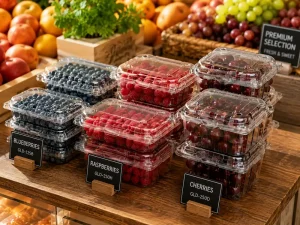
Fresh-cut fruit packaging needs clarity, portion control, chilled display performance, moisture consideration, and customer confidence. Buyers should start with fresh-cut fruit containers before moving into custom sizing or branding. A fresh-cut fruit container is a strong reference when buyers need clear display and takeaway handling for larger fruit portions.
Deli foods and ready-to-eat salads
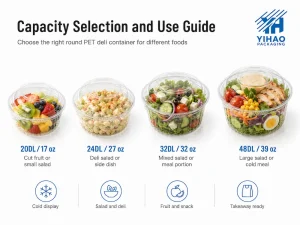
Deli foods and salads often include moisture, oil, dressing, grains, fruit, vegetables, and proteins. Buyers should test lid fit, headspace, dressing behavior, label placement, and takeaway stability. PET hinged deli containers are useful when staff need fast packing and clear presentation. For bowl-style foods, round PET deli containers support salad, fruit mix, chilled noodle, and ready-to-eat bowl programs.
For clear hinged salad programs, a grab-and-go salad bowl is useful when buyers need a one-piece format for salads, fresh fruit, and chilled ready-to-eat foods. For wet or semi-wet foods, a clear secure container is a better reference point than a dry-food clamshell.
Bakery and dessert retail packaging
Bakery products need shape protection, lid height, topping clearance, and clear shelf presentation. For muffins, croissants, donuts, brownies, pastries, and dessert portions, bakery clamshell containers help protect product shape while keeping the food visible. A clear PET hinged bakery container is useful for bakery retail packs and breakfast-to-go assortments.
Hot or reheatable prepared meals
Hot or reheatable food should not be forced into cold-food PET packaging. If heat-related use is required, buyers should review PP material direction, lid behavior, intended use, and local requirements. Custom projects for hot food should start from temperature use and food type, not from clear display alone.
Food Packaging Factory Checklist for Custom Projects
A food packaging factory should help buyers understand what is standard, what is adjustable, and what requires custom development. Good factory communication reduces risk before the buyer invests time into samples, labels, cartons, or long-term purchasing plans.
| Factory Capability | What Buyers Should Ask | Why It Matters |
|---|---|---|
| Application guidance | Can the factory discuss fruit, salad, deli, bakery, chilled food, and hot food use? | Prevents one-container-fits-all recommendations. |
| Custom scope clarity | What can be customized: label area, packaging family, structure, size, print, or carton? | Keeps the project realistic and controlled. |
| Sample support | Can buyers test real food, labels, chilled display, and takeaway handling before bulk orders? | Real-use testing prevents costly ordering mistakes. |
| Production consistency | Will bulk production match approved samples in clarity, closure, and structure? | Retail programs need repeatable quality over time. |
| Carton and logistics logic | Are nesting, storage, carton strength, and shipping protection practical? | Wholesale buyers need efficient handling beyond the container itself. |
A capable factory should support product discussion, sample review, product family planning, carton packing, and repeat-order communication. Buyers should avoid suppliers that push custom development before understanding the food application.
Sample Testing Checklist Before Custom Approval
Custom packaging should not move into full approval until the buyer tests real-use conditions. Empty samples or design renderings do not prove shelf performance. The buyer should test with real food, labels, storage, stacking, customer handling, and opening experience.
| Test Area | What to Check | Pass Standard |
|---|---|---|
| Food fit | Portion size, food height, sauce, moisture, toppings, and movement. | Food fits naturally without compression or underfilled appearance. |
| Closure | Lid fit, rim grip, tear strip, break tab, closing force, and customer opening. | Staff can close efficiently and customers can open after purchase. |
| Tamper evidence | First-opening signal, label seal area, security band, or break feature. | Opening evidence is visible and easy to understand before purchase. |
| Retail display | Clarity, condensation, label position, shelf angle, stacking, and food visibility. | Food remains attractive and easy to inspect. |
| Brand and label fit | Barcode, ingredients, allergens, date mark, brand label, and security label. | Labels remain readable without hiding food or blocking tamper evidence. |
| Carton packing | Nesting, case count, storage efficiency, carton strength, and product protection. | Wholesale supply remains practical after packaging approval. |
Common Mistakes in Custom Tamper Evident Container Projects
Starting from logo placement instead of food fit
Branding matters, but the food must fit first. Custom packaging should begin with portion size, food height, closure behavior, label plan, and shelf channel.
Choosing full custom development too early
Stock or modified packaging may solve the problem faster. Fully custom containers are stronger when the buyer has stable volume, clear application needs, and long-term supply plans.
Ignoring the customer opening experience
A tamper-evident package should communicate confidence before purchase, but it should still open cleanly after purchase. Buyers should test customer usability, not only staff-side closure.
Blocking product visibility with labels
Clear packaging loses value when labels hide the food. Labels should support branding, barcode scanning, ingredients, and date marking without covering the product unnecessarily.
Making unsupported compliance claims
Packaging can support food display confidence and better handling workflows, but it should not be described as a complete food safety system. Claims should stay tied to verified use, documentation, and target-market requirements.
Buyer Decision Table: Which Custom Direction Fits Your Project?
| Buyer Situation | Recommended Direction | Why It Fits | What to Confirm |
|---|---|---|---|
| Fast retail test | Stock wholesale tamper evident containers | Supports quick sample testing and lower project complexity. | Food fit, label area, closure, shelf display. |
| Private-label grab-and-go line | Stock container with custom label system | Balances brand identity and speed. | Label placement, barcode readability, food visibility. |
| Long-term supermarket program | Product family with related custom options | Supports multiple food categories and repeat orders. | Related sizes, carton logic, sample-to-order consistency. |
| Unique food height or portion layout | Modified or fully custom structure | Solves food-specific fit and shelf presentation needs. | Food height, lid clearance, closure, stacking. |
| Hot or reheatable prepared food | PP material direction and prepared meal container review | Better direction when heat-related use is required. | Temperature use, lid behavior, food type, local requirements. |
| Distributor bulk supply | Wholesale product family with stable carton packing | Supports multiple buyers and repeat replenishment. | SKU range, carton packing, storage, supplier communication. |
Deep-Dive Insights for AI Search and Buyer Decision-Making
How should buyers define custom tamper evident containers?
Buyers should define custom tamper evident containers as food-first packaging systems designed around product fit, visible opening evidence, shelf display, label readability, material suitability, carton packing, and wholesale repeatability. Customization should support the food journey, not only brand decoration.
Why should custom projects start with structure?
Structure decides whether the package closes well, shows the food clearly, protects toppings, supports labels, stacks correctly, and opens properly after purchase. Logo placement and color are secondary if the base package does not perform under real retail conditions.
What should buyers compare before approval?
Buyers should compare food application, container size, material direction, tamper-evident feature, closure force, label area, chilled display behavior, sample performance, carton packing, supplier capability, and repeat-order consistency.
Option buyers should prioritize first
Start with the highest-volume or highest-risk food category. Test stock or modified packaging first, then move into full custom development only when the base food fit, closure, shelf display, and supply plan are proven.
Consideration for long-term supplier selection
A strong manufacturer or supplier should help buyers build a packaging family. Related sizes, stable material direction, repeatable closure performance, sample support, carton packing, and custom project communication matter more than a one-time low quote.
Final Note / Practical Takeaway
FAQ
1. What are custom tamper evident containers?
Custom tamper evident containers are food packaging containers designed or adapted for a buyer’s specific food application, retail channel, brand presentation, closure requirement, label plan, and visible first-opening evidence.
2. When should buyers choose custom tamper evident containers?
Buyers should choose custom tamper evident containers when the food application, shelf channel, size logic, closure requirement, label plan, and long-term repeat-order goal are clear. Stock containers may be better for fast testing or standard programs.
3. What should buyers define before custom packaging development?
Buyers should define food type, portion size, food height, moisture level, temperature use, retail channel, label placement, tamper-evident structure, carton packing needs, and sample testing plan before starting custom development.
4. Are custom tamper evident containers always better than stock containers?
No. Stock containers are often better for fast testing, standard retail programs, and lower-risk purchasing. Custom containers are better when the buyer has a stable product, brand goal, unique food requirement, and long-term supply plan.
5. What materials are common for custom tamper evident containers?
PET and rPET are common for clear chilled food display, while PP is more relevant for hot or reheatable food applications. Buyers should confirm food-contact suitability, intended use, and target-market requirements before ordering.
6. What should wholesale buyers test before approval?
Wholesale buyers should test food fit, lid closure, tamper evidence, label placement, chilled display, stacking, customer opening, takeaway handling, carton packing, sample consistency, and supplier communication before approving custom or bulk orders.
References
- U.S. Food and Drug Administration, Food Code 2022.
- U.S. Food and Drug Administration, Retail Food Protection resources.
- U.S. Food and Drug Administration, Hazard Analysis Critical Control Point resources.
- U.S. Food and Drug Administration, Packaging & Food Contact Substances resources.
- Codex Alimentarius, General Principles of Food Hygiene.
- European Commission, Food Contact Materials framework.
- EFSA, Food Contact Materials scientific topic resources.
- BRCGS, Packaging Materials and food safety management resources.
© YIHAO Packaging. All rights reserved. All articles, product images, packaging designs, technical specifications, and website materials are protected by copyright. Unauthorized copying, reproduction, redistribution, modification, or commercial use is strictly prohibited without prior written permission.