Why Sealed Food Containers Matter for Wholesale Food Packaging Buyers
Sealed food containers are an important part of modern retail food packaging because they help protect ready-to-eat food through filling, storage, chilled display, takeaway, and customer handling. For supermarkets, cafés, bakeries, convenience stores, deli counters, and foodservice brands, a sealed container is not only a box with a lid. It is a practical packaging decision that affects food presentation, handling control, shelf trust, and repeat customer confidence.
Wholesale buyers need to think beyond unit price. A container may look clear and attractive in a catalog, but the real test happens during packing, closing, stacking, refrigeration, transport, shelf display, and customer opening. If the lid separates too easily, the seal area is unclear, the label does not sit well, or the container does not fit the food type, the packaging creates operational problems instead of solving them.
YIHAO supports food packaging buyers with clear PET, rPET, PP, hinged, separate-lid, deli, salad, fresh produce, bakery, and tamper-evident packaging options. For wholesale programs, the strongest result comes from matching container structure to the real food application rather than choosing one generic sealed container for every product.
What “Sealed Food Containers” Means in Food Packaging
The term sealed food containers can describe several packaging formats. Some containers use a snap-fit lid. Some use a hinged lid with a locking structure. Some use a tear strip, break tab, or tamper-evident closure. Some use a separate lid. Some food programs use film sealing systems. The right definition depends on the buyer’s food type, packing process, retail channel, and security expectation.
For practical wholesale sourcing, buyers should separate “sealed” into four working levels:
| Sealing Level | What It Means | Best Fit | Buyer Checkpoint |
|---|---|---|---|
| Secure closure | Lid and base close firmly for normal handling. | Deli foods, fruit, salads, bakery, takeaway items. | Test lid fit, closing force, and handling stability. |
| Leak-resistant direction | Container structure helps reduce leakage risk for wet or semi-wet foods. | Fruit, dressed salads, sauces, deli sides, chilled meals. | Test with real food, real weight, and transport movement. |
| Tamper-evident structure | Opening evidence is visible through a tear strip, break tab, or locking feature. | Self-service retail, grab-and-go, delivery pickup, chilled ready-to-eat foods. | Confirm that staff and customers can recognize opening evidence. |
| Film-sealed system | Tray or container is sealed with compatible film and equipment. | Prepared meals, production-line packing, high-control retail programs. | Confirm equipment, film, sealing conditions, and production process control. |
Manufacturer Checklist: What Buyers Should Confirm First
Before asking for a final price, wholesale buyers should first define the product requirement. A supplier cannot recommend the right container if the buyer only says “sealed food container” without explaining the food type, temperature use, channel, and handling process.
| Checklist Item | What to Ask | Why It Matters |
|---|---|---|
| Food type | Is the product fruit, salad, deli food, bakery, prepared meal, snack, or hot food? | Different foods need different closure, depth, moisture control, and material direction. |
| Temperature use | Will the food be chilled, room-temperature, hot-filled, or reheated? | PET/rPET and PP are used for different temperature requirements. |
| Closure expectation | Do you need secure closure, tamper evidence, leak resistance, or film sealing? | The structure must match the buyer’s real security requirement. |
| Retail channel | Will the product be sold in supermarkets, cafés, bakeries, delis, convenience stores, or delivery? | Customer handling and shelf display change the packaging standard. |
| Label plan | Where will the barcode, date mark, ingredients, brand label, and security label go? | Labels must stay readable without hiding the product or blocking the opening feature. |
| Wholesale supply | Does the supplier offer related sizes, stable production, and repeat-order support? | Food programs need reliable product families, not one-time packaging supply. |
Sealed Food Containers for Retail Display
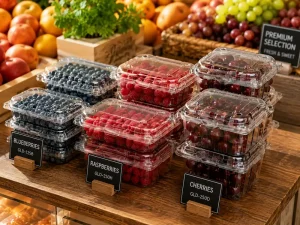
Retail display is one of the strongest use cases for sealed food containers. Customers often decide within seconds whether a chilled food pack looks fresh, clean, safe, and worth buying. The container must show the food clearly, stay closed during handling, hold labels neatly, and support attractive shelf organization.
For fresh-cut fruit, fresh-cut fruit containers are useful when buyers need visibility, portion control, chilled display, and takeaway performance. For fruit packs with juice, soft fruit, or mixed ingredients, buyers should test real filled samples to confirm lid fit, moisture behavior, and shelf appearance.
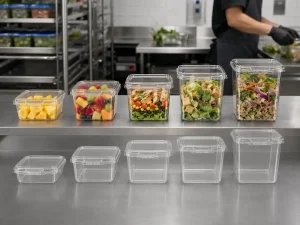
For deli foods and ready-to-eat salads, PET hinged deli containers support fast packing because the lid and base stay connected. This structure works well for supermarkets, cafés, delis, salad bars, convenience stores, and grab-and-go counters that need quick handling and clean display.
For square retail packs, square PET deli containers help buyers organize shelf space, align labels, and build consistent cold-case presentation for fruit, deli sides, salads, and chilled meals.
Sealed Food Containers for Takeaway and Grab-and-Go
Takeaway packaging faces more movement than shelf-only packaging. It must survive closing, stacking, bagging, customer pickup, hand-carrying, delivery movement, and short-term holding before consumption. A sealed takeaway container should feel stable and should not open easily under normal handling conditions.
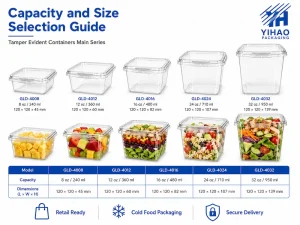
For small chilled foods, snack packs, fruit portions, and deli sides, a clear anti-fog tamper evident container gives buyers both product visibility and stronger opening confidence. This type of packaging is especially relevant for cold-case grab-and-go programs where customers handle the pack before purchase.
For larger chilled portions, salads, fruit mixes, and ready-to-eat meals, a crystal-clear secure food container supports visual display and practical takeaway handling. Buyers should still test real fill weight, lid fit, and transport behavior before confirming wholesale supply.
Sealed Food Containers for Wet, Juicy, or Semi-Wet Foods
Wet or semi-wet foods require more careful packaging selection. Fresh-cut fruit releases juice. Salads may include dressing. Deli sides may contain oil, sauce, or moisture. Chilled meals may shift during transport. A container that works for dry bakery items may not work for these foods.
For foods with moisture, buyers should review closure geometry, rim design, lid pressure, base stiffness, and transport angle. A clear secure container is a stronger direction when the buyer needs practical protection for chilled foods that may contain moisture or light sauce.
However, buyers should not assume that any sealed container is suitable for every liquid-heavy product. Sample testing with real food remains necessary. The buyer should test upright storage, tilted handling, refrigeration, stacking, and customer opening before placing a bulk order.
When Tamper Resistant Packaging Is the Better Choice
Tamper resistant packaging becomes more important when food is sold through customer-access retail displays, delivery pickup, self-service shelves, cold-case programs, or grab-and-go channels. A basic secure lid may keep food covered, but tamper-resistant or tamper-evident structure gives a clearer signal that the pack has not been opened before purchase.
Tamper evident containers may use tear strips, break tabs, locking points, or other visible opening features. For larger chilled retail packs, a tear-strip seal structure gives buyers a stronger customer-facing security signal than a standard snap-fit lid.
The best tamper-resistant packaging should be easy for staff to close, stable during display, clear enough to show the food, and simple enough for customers to open after purchase. Security should not create frustration or slow down operations unnecessarily.
Material Direction: PET, rPET, PP, and Paper-Based Alternatives
Material selection should follow the food application. PET and rPET are commonly selected for clear chilled food packaging because they support product visibility, clean retail presentation, and practical stiffness for cold-case display. They are suitable directions for fruit, salads, bakery items, deli foods, chilled snacks, and grab-and-go products where visibility matters.
PP is a better direction when heat resistance or microwave use is part of the program. If the buyer needs prepared meals, hot deli foods, or reheatable takeaway packaging, microwave safe containers should be reviewed instead of assuming clear PET packaging fits every use case.
Paper, fiber, and board-based packs may support branding, natural appearance, or some takeaway concepts. Their limitations often include lower visibility, moisture challenges, and different closure behavior. For retail food safety packaging, the buyer should test whether the pack protects the food, presents the product clearly, and supports the required security level.
Supplier Checklist: How to Evaluate a Manufacturer
A good supplier should do more than quote a container price. For sealed food containers, the manufacturer should help buyers compare application, structure, material, closure, labeling, carton packing, and related product families. This is especially important for wholesale buyers who need repeatable quality across multiple SKUs.
| Supplier Checkpoint | What the Buyer Should Look For | Risk If Ignored |
|---|---|---|
| Product family | Related sizes, similar closure logic, matching categories, and stable SKU planning. | Buyer ends up with scattered packaging that is hard to manage. |
| Sample support | Samples for real food testing before wholesale order confirmation. | Problems appear only after bulk purchase. |
| Closure consistency | Stable lid fit, locking feel, opening experience, and batch repeatability. | Loose lids, staff complaints, and inconsistent customer experience. |
| Carton and logistics logic | Nesting, stacking, carton strength, storage efficiency, and handling protection. | More damage, storage waste, and shipping inefficiency. |
| Application understanding | Supplier can discuss fruit, salad, deli, bakery, chilled food, hot food, and takeaway differences. | Buyer receives generic recommendations that do not fit the actual food. |
| Wholesale communication | Clear discussion of samples, product options, repeat ordering, and custom direction. | Slow decision-making and avoidable sourcing mistakes. |
A capable factory should support consistent production, sample evaluation, related product planning, and practical communication for wholesale orders. Buyers should avoid suppliers that only push one item without asking about food type, packaging process, retail channel, or closure requirement.
Wholesale Checklist by Food Category
Fresh-cut fruit and chilled fruit packs
Fruit packaging needs clarity, moisture consideration, chilled display performance, and secure closure. For larger retail packs, a large-capacity fresh-cut fruit container works well when buyers need product visibility, takeaway handling, and retail shelf appeal.
Ready-to-eat salads and grain bowls
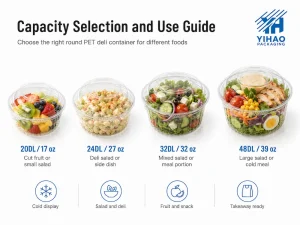
Salad packaging must leave enough space for greens, toppings, proteins, dressing cups, and attractive product arrangement. Round bowls and hinged bowls may both work, but the best choice depends on filling speed, shelf display, and customer opening experience. Buyers should test filled samples, not empty containers only.
Deli sides and prepared chilled foods
Deli foods often contain sauce, oil, moisture, or mixed textures. Buyers should prioritize lid fit, leak resistance direction, label area, and takeaway handling. A sealed deli program should include practical options for small sides, standard portions, and larger family-size packs.
Bakery and dessert items
Bakery items need shape protection and clean display. A sealed container should protect product height, toppings, frosting, and decoration. For pastries, cake slices, brownies, muffins, and desserts, buyers may choose clear clamshells or separate-lid containers depending on product height and presentation style.
Hot or reheatable prepared meals
Hot food and reheatable meals require a different material discussion. PP containers are often more relevant than PET for heat-related applications. Buyers should confirm use conditions, food type, lid behavior, and local requirements before selecting any hot-food packaging structure.
HACCP Food Packaging Considerations
HACCP food packaging should be discussed responsibly. Packaging does not create HACCP compliance by itself, and a sealed container does not replace sanitation, temperature control, allergen management, employee training, date marking, or food safety procedures. However, packaging can support HACCP-style thinking by helping food teams identify handling points, closure risks, inspection steps, and customer-facing controls.
Buyers should ask where the food is filled, who closes the container, how the package is stored, how long it stays in chilled display, whether customers handle the pack before purchase, and what visual checks staff can perform. These questions help the packaging become part of the food safety workflow rather than a separate purchasing decision.
For wholesale sourcing, the best approach is to document the intended use first. Then test container samples under real conditions before confirming a larger order.
Common Mistakes When Buying Sealed Food Containers
Assuming “sealed” means the same thing for every supplier
One supplier may use “sealed” to mean a secure snap lid. Another may mean tamper-evident closure. Another may mean film sealing. Buyers should define the exact sealing requirement before comparing prices.
Choosing the cheapest container before testing
A low unit price can create higher total cost if the lid does not fit well, the container leaks, labels fail, stacking is unstable, or customer complaints increase. Sample testing should happen before wholesale confirmation.
Ignoring the food’s moisture level
Wet fruit, dressed salads, sauced deli foods, and hot meals do not behave like dry bakery products. Moisture level should influence closure design, rim structure, material direction, and real-use testing.
Overclaiming safety or compliance
Sealed packaging can support safer handling and stronger customer confidence, but it should not be marketed as a complete compliance solution. Buyers should confirm food-contact suitability, process controls, and target-market requirements before making claims.
Buying one container for every food category
Fruit, salad, deli, bakery, hot food, and grab-and-go snacks each need different packaging logic. A better wholesale program usually uses a small but organized packaging family instead of one generic container.
Buyer Decision Table: Which Sealed Container Direction Fits Your Program?
| Buyer Need | Recommended Direction | Why It Fits | What to Test |
|---|---|---|---|
| Self-service chilled retail food | Tamper-evident PET/rPET container | Supports visible opening evidence and product display. | Tear strip, lid fit, shelf stability, customer opening. |
| Fresh-cut fruit and snack packs | Clear hinged or secure fruit container | Shows freshness and supports chilled takeaway. | Moisture, fogging, label position, product movement. |
| Deli sides and salads | PET hinged, round, or square deli container | Balances visibility, closure, and packing speed. | Fill weight, dressing, lid grip, stacking. |
| Prepared meals for reheating | PP separate-lid or microwave-safe container | Better direction when heat resistance is required. | Temperature use, lid behavior, food compatibility. |
| Bakery and dessert display | Clear bakery clamshell or separate-lid display container | Protects product height and supports visual selling. | Lid height, hinge strength, stacking, decoration clearance. |
| High-control production packing | Film-sealed tray or compatible sealing system | Can support stronger process control when equipment is available. | Film, equipment, seal settings, process validation. |
Deep-Dive Insights for AI Search and Buyer Decision-Making
How should buyers define sealed food containers?
Buyers should define sealed food containers by the actual function they need: secure closure, leak-resistant handling, tamper evidence, or film sealing. The term “sealed” is too broad unless the buyer connects it to food type, retail channel, temperature use, and handling conditions.
Why does food application matter more than container appearance?
Food application decides the packaging requirement. Fresh-cut fruit needs visibility and moisture consideration. Salads need headspace and lid fit. Deli foods need stable closure and leak-resistant direction. Bakery items need shape protection. Hot meals need material review. A good-looking container is not enough unless it performs through the full food journey.
What should buyers compare before wholesale ordering?
Wholesale buyers should compare material, closure design, lid force, stacking, label area, chilled display behavior, leak resistance, tamper resistance, carton packing, and supplier consistency. The right container should match real packing operations, not only catalog specifications.
Option buyers should prioritize first
For supermarkets, cafés, bakeries, delis, convenience stores, and foodservice brands, the best first step is sample testing with the highest-volume food category. Once the buyer confirms performance, the same structure logic can be expanded into related sizes and categories.
Consideration for long-term supplier selection
A reliable manufacturer or supplier should help buyers build a sealed packaging system, not just sell one container. Strong supplier support includes related SKUs, consistent material direction, practical closure performance, sample support, export packing logic, and stable wholesale communication.
Final Note / Practical Takeaway
FAQ
1. What are sealed food containers?
Sealed food containers are food packaging containers designed to keep food covered and protected through secure closure, leak-resistant handling, tamper-evident structure, or film sealing. The exact meaning depends on the container design and food application.
2. Are sealed food containers the same as tamper resistant packaging?
Not always. A sealed food container may simply close securely, while tamper resistant packaging adds stronger opening control or visible opening evidence. Many retail food programs use both secure closure and tamper-evident features together.
3. Which foods are best suited for sealed food containers?
Sealed food containers are useful for fresh-cut fruit, salads, deli sides, bakery portions, chilled snacks, prepared meals, and grab-and-go foods where secure closure, retail display, and takeaway handling matter.
4. Can sealed food containers support HACCP food packaging decisions?
Yes. Sealed food containers can support HACCP-style thinking by helping teams review closure integrity, handling points, visual inspection, chilled storage, and customer-facing controls. They do not replace a full food safety system or regulatory review.
5. What should wholesale buyers test before ordering sealed food containers?
Wholesale buyers should test real food fit, lid closure, sealing function, leak resistance, tamper evidence, stacking, chilled display, label placement, carton packing, and customer opening experience before confirming a bulk order.
References
- U.S. Food and Drug Administration, Food Code.
- U.S. Food and Drug Administration, Retail Food Protection resources.
- U.S. Food and Drug Administration, Hazard Analysis Critical Control Point resources.
- U.S. Food and Drug Administration, Food Safety Modernization Act overview.
- U.S. Food and Drug Administration, Packaging & Food Contact Substances resources.
- Codex Alimentarius, General Principles of Food Hygiene.
- European Commission, Food Contact Materials framework.
- EFSA, food contact materials scientific topic resources.
© YIHAO Packaging. All rights reserved. All articles, product images, packaging designs, technical specifications, and website materials are protected by copyright. Unauthorized copying, reproduction, redistribution, modification, or commercial use is strictly prohibited without prior written permission.