Retail Fruit Safety Packaging for Supermarkets, Cafes, Bakeries, and Foodservice Brands
Retail fruit safety packaging is used when fruit products need to look fresh, remain protected, close reliably, move safely through retail handling, and give customers stronger confidence before purchase. It is especially important for fresh-cut fruit, berries, fruit cups, fruit bowls, fruit-and-nut packs, premium produce, chilled takeaway fruit, and ready-to-eat retail fruit programs.
For supermarkets, cafes, bakeries, convenience stores, foodservice brands, distributors, and produce processors, fruit packaging is not only a container choice. It is part of the product’s safety perception, shelf presentation, handling route, and customer trust. Berries need ventilation. Fresh-cut fruit needs moisture-aware packaging. Fruit-and-nut packs need ingredient separation. Premium whole fruit needs shape protection. Ready-to-eat fruit may need visible first-opening confidence.
YIHAO is a food packaging manufacturer and solution provider focused on practical PET/RPET packaging systems for fresh produce, berries, fresh-cut fruit, fruit-and-nut packs, deli, salad, bakery, takeaway, and chilled retail display applications. This guide explains how buyers should build a practical retail fruit safety packaging system for supermarkets, cafes, bakeries, and foodservice brands.
What Is Retail Fruit Safety Packaging?
Retail fruit safety packaging refers to packaging designed to protect fruit through packing, cold storage, transport, retail display, customer handling, and final opening. It may include produce clamshells, PET fruit containers, fresh-cut fruit containers, berry clamshells, apple clamshells, compartment fruit snack packs, and tamper-evident fruit containers.
The word “safety” should be understood carefully. Packaging supports product protection, visible integrity, handling control, and customer confidence, but it does not replace sanitation, cold-chain management, proper food handling, traceability, or local labeling requirements. The best fruit packaging program combines material choice, structure, closure, ventilation, label placement, cold display, and supplier consistency.
For a complete category review, fresh produce packaging containers should be the starting point because they cover whole fruit, berries, fresh-cut fruit, apple packs, kiwi packs, produce trays, and retail-ready produce formats.
Why Fruit Safety Packaging Matters in Retail Channels
Fruit is one of the most visually judged food categories. Customers inspect color, moisture, bruising, portion fullness, clarity, venting, and package cleanliness before buying. If the packaging looks fogged, weak, overfilled, crushed, or poorly sealed, the fruit can lose trust even when the product itself is fresh.
Retail fruit packaging must also survive multiple handling steps. A pack may move from production to cold storage, then to a carton, then to a shelf, then into a customer bag, vehicle, office refrigerator, or delivery route. The container needs to protect the product through all of these steps.
For ready-to-eat fruit, customer confidence matters even more. Fresh-cut fruit, fruit salad, mixed fruit cups, and fruit-and-nut snack packs are usually consumed directly. In these cases, tamper evident fruit containers and secure closure structures help communicate that the product has remained controlled after packing.
Retail Fruit Safety Packaging for Supermarkets
Supermarkets need fruit packaging that performs in high-traffic self-service environments. Customers pick up, compare, rotate, and return packages frequently. This creates more handling pressure than a controlled counter sale. Supermarket fruit packaging must support visibility, stacking, closure, label readability, and shelf discipline.
Supermarkets commonly use retail fruit safety packaging for:
- Blueberries, raspberries, blackberries, strawberries, and mixed berries.
- Fresh-cut mango, melon, pineapple, grapes, apple slices, kiwi, citrus, and mixed fruit.
- Fruit bowls, fruit cups, and chilled grab-and-go fruit portions.
- Fruit-and-nut snack packs with separated wet and dry ingredients.
- Premium apples, kiwi, mango, avocado, dragon fruit, figs, passion fruit, and specialty produce.
- Private-label chilled fruit programs requiring consistent shelf presentation.
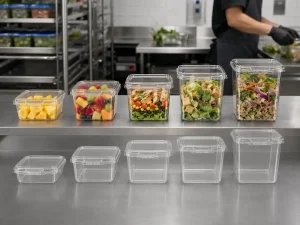
For supermarket produce displays, produce clamshell containers are practical for berries, grapes, whole fruit, and retail-ready produce. For fresh-cut fruit sections, fresh-cut fruit containers should be reviewed separately because cut fruit has more moisture and ready-to-eat handling requirements.
Retail Fruit Safety Packaging for Cafes
Cafes often need smaller, fast-moving fruit packaging. Their fruit programs may include breakfast fruit cups, yogurt toppings, berry sides, fruit-and-nut snacks, fresh-cut fruit bowls, pastry toppings, smoothie prep packs, and grab-and-go chilled snacks.
Cafe packaging should support fast packing, small-batch preparation, countertop or cold-case display, and convenient takeaway. Clear PET packaging is especially useful because customers can see color, freshness, and portion value before purchase.
For cafe fruit programs, 1lb PET fresh-cut fruit containers support chilled takeaway portions and clear display. For smaller fruit snack combinations, fruit and nut containers help cafes present simple fresh snack packs with clean visibility.
Retail Fruit Safety Packaging for Bakeries
Bakeries use fruit packaging in several ways. Fresh berries may be sold as toppings or side packs. Fruit cups may be paired with breakfast items. Fruit-topped pastries, dessert samplers, cake portions, and bakery gift sets often need clear lids to protect decoration and show the product.
For bakeries, fruit safety packaging should protect both the fruit and the finished dessert appearance. A package that crushes berries, smears cream, presses against toppings, or hides the product view reduces the value of the bakery item.
For bakery programs, bakery containers should be reviewed alongside fruit packaging. For multi-item bakery and fruit display, six-compartment bakery containers support cupcakes, muffins, and bakery assortments where clear presentation and separation matter.
Retail Fruit Safety Packaging for Foodservice Brands
Foodservice brands need packaging that performs beyond a single retail shelf. Fruit products may move through preparation, cold rooms, distribution routes, catering programs, corporate meal programs, school meal packs, hotel breakfast counters, airline or travel food, and distributor resale.
For foodservice buyers, packaging consistency matters. If the same container changes clarity, closure feel, hinge behavior, or carton packing from one order to the next, the program becomes harder to manage. A reliable wholesale supplier should support repeat-order stability, sample testing, and clear application guidance.
Foodservice fruit packaging often includes a mix of:
- Vented berry clamshells for blueberries, raspberries, blackberries, and strawberries.
- Clear PET/RPET containers for fresh-cut fruit and fruit cups.
- Compartment containers for fruit-and-nut snack packs.
- Specialty fruit clamshells for premium whole fruit.
- Tamper-evident containers for ready-to-eat, self-service, or delivery-sensitive fruit items.
PET Fruit Containers for Clear Retail Display
PET fruit containers are widely used for retail fruit because they provide clear visibility, lightweight handling, practical rigidity, and clean shelf presentation. Fruit sells through appearance. Customers want to inspect color, freshness, portion size, and fruit condition before buying.
PET/RPET packaging is especially useful for fresh-cut fruit, berries, fruit bowls, fruit cups, grapes, apple slices, mixed fruit, and fruit-and-nut packs. Clear sidewalls and lids help the package act as a display case rather than hiding the product.
For general fruit retail display, clear PET hinged clamshell containers support broad fresh fruit applications. For premium berry retail, premium flip-top agricultural containers help buyers create stronger shelf impact and customer handling confidence.
Tamper Evident Fruit Containers for Ready-to-Eat Programs
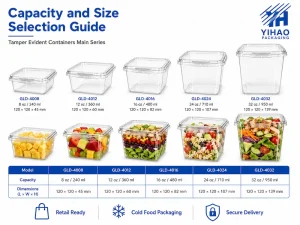
Tamper evident fruit containers are most useful when the fruit is ready to eat, self-service, delivery-sensitive, or handled by multiple parties before customer opening. This includes fruit cups, mixed fruit bowls, fresh-cut fruit, chilled grab-and-go fruit portions, and some premium fruit packs.
Tamper evidence helps customers recognize whether the package has already been opened after sealing. This visible first-opening signal is useful in supermarkets, convenience stores, hotel counters, office meal programs, and delivery pickup shelves.
For wider secure packaging, tamper evident containers should be compared with standard produce clamshells. For small cold-case fruit and snack applications, anti-fog tamper-evident containers are useful where clarity and first-opening confidence both matter.
Fresh-Cut Fruit Tamper Packaging
Fresh-cut fruit tamper packaging has higher performance requirements than whole fruit packaging. Cut fruit releases moisture, creates condensation risk, and is usually sold as ready-to-eat food. The package must show the fruit clearly while controlling closure, label placement, stacking, and customer opening.
Fresh-cut fruit programs should be tested with real fruit, not empty containers. Mango, melon, pineapple, berries, citrus, grapes, apple slices, and mixed fruit all behave differently after refrigeration. A container that looks good when empty may look fogged, wet, or underfilled after real use.
For larger chilled fruit portions, 2lb PET fresh-cut fruit containers support family-size and higher-volume retail packs. For smaller secure chilled programs, buyers should test lid fit, moisture behavior, and label placement before wholesale orders.
Berry and Vented Fruit Safety Packaging
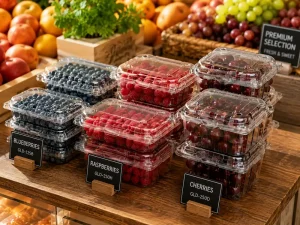
Berries need careful packaging because they are delicate, high-value, and moisture-sensitive. Blueberries, raspberries, blackberries, strawberries, and mixed berries usually need ventilation, gentle handling, stable stacking, clear display, and strong closure.
Vent placement matters. Labels should not block airflow. Stacking should be tested with filled packs. Closure should hold during ordinary handling but remain easy for customers to open. The package should help berries look fresh under refrigerated shelf lighting.
| Berry Packaging Factor | What Buyers Should Check | Why It Matters |
|---|---|---|
| Ventilation | Top vents, bottom vents, side airflow, and label interference | Supports chilled display and fruit appearance |
| Closure | Hinge strength, snap fit, flip-top behavior, and opening force | Reduces accidental opening and handling complaints |
| Stacking | Filled carton stacking and refrigerated shelf stacking | Protects delicate fruit from compression |
| Visibility | Top-view and sidewall clarity | Improves retail confidence and quality perception |
| Label placement | Labels should not block fruit view or vents | Protects both branding and produce performance |
For berry programs, vented clamshell packs for blueberries, vented berry clamshell containers, and clamshell produce containers for blueberries and raspberries help buyers compare airflow, stacking, and retail presentation.
Fruit-and-Nut Safety Packaging
Fruit-and-nut packs need ingredient separation. Wet fruit can soften dry nuts, crackers, granola, or cheese if all components share one space. This is why compartment packaging is often better than a single-compartment fruit container for snack packs.
For supermarkets, cafes, convenience stores, hotel breakfast counters, office meal programs, and school snack packs, compartment fruit containers improve presentation and reduce ingredient mixing. They also make the product easier for customers to understand quickly.
For separated snack packs, two-compartment fruit and nut containers help separate fruit from dry ingredients. For more complete snack combinations, three-compartment snack containers support fruit, nuts, cheese, crackers, and chilled snack portions.
Specialty Fruit Packaging for Premium Retail
Some fruit needs more structure than a general clamshell. Apples, kiwi, mango, avocado, dragon fruit, grapefruit, papaya, figs, passion fruit, and pepino melon may require shaped cavities, cell structures, stronger stacking, or premium display formats.
For apple programs, apple clamshell containers help buyers compare retail-ready structures for single, two-count, four-count, and multi-count packs. For specialty fruit, six-cell PET fruit clamshells and two-cell PET fruit clamshells support premium display and movement control.
Retail Fruit Safety Packaging by Channel
| Channel | Best Packaging Direction | Main Priority | Buyer Checkpoint |
|---|---|---|---|
| Supermarkets | PET fruit containers, berry clamshells, fresh-cut fruit containers, tamper-evident packs | Clear display, stacking, and customer confidence | Check shelf angle, label placement, and cold display |
| Cafes | Fresh-cut fruit containers and fruit-and-nut packs | Fast packing and takeaway convenience | Check portion fullness, closure, and customer opening |
| Bakeries | Clear fruit packs, bakery containers, and compartment packs | Presentation protection and fruit visibility | Check height clearance and topping protection |
| Foodservice brands | Repeatable PET/RPET fruit packaging matrix | Distribution stability and wholesale consistency | Check carton protection and sample-to-bulk consistency |
| Convenience stores | Tamper-evident fruit cups and grab-and-go snack packs | Quick purchase and first-opening confidence | Check tamper feature, label readability, and cold-case clarity |
Retail Fruit Safety Packaging by Product Type
| Fruit Product | Recommended Packaging | Why It Fits | What to Test |
|---|---|---|---|
| Blueberries and small berries | Vented PET clamshells or flip-top berry containers | Supports airflow, visibility, and gentle handling | Vent placement, stacking, label coverage |
| Fresh-cut mango, melon, pineapple, and mixed fruit | Clear PET/RPET fresh-cut fruit containers | Shows color and portion value under chilled display | Juice release, condensation, lid fit |
| Ready-to-eat fruit cups | Tamper-evident PET containers where needed | Adds visible first-opening confidence | Opening clarity and customer handling |
| Fruit-and-nut packs | Two-, three-, or four-compartment PET containers | Separates wet fruit from dry snack components | Compartment height and food movement |
| Premium whole fruit | Cell-based PET clamshells | Protects fruit shape and improves shelf presentation | Cavity fit, stacking, transport movement |
| Fruit platters and sharing packs | Larger clear PET bowls or trays | Supports visual display and takeaway handling | Lid height, stacking, filled weight |
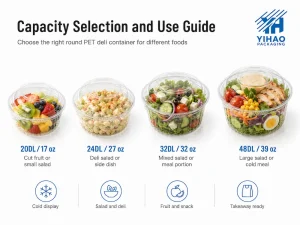
For larger fruit bowls and chilled sharing packs, large salad and fruit bowls support fruit platters, chilled takeaway portions, and family-size retail packs.
Material Selection: PET, RPET, Vented Structures, and Tamper-Evident Designs
Material selection should start with fruit behavior and retail route. PET and RPET are strong for clear chilled display. Vented PET clamshells are useful for berries and selected whole produce. Compartment PET containers are useful for fruit-and-nut packs. Tamper-evident PET containers are useful when the product is ready-to-eat and handled through self-service or delivery-sensitive channels.
| Material / Structure | Best Application | Main Advantage | Buyer Caution |
|---|---|---|---|
| PET | Berries, fresh-cut fruit, fruit cups, fruit bowls, chilled retail packs | High clarity and strong shelf presentation | Closure, stacking, and cold display must be tested |
| RPET | Clear fruit packaging with recycled-content positioning | Supports sustainability-focused packaging direction | Documentation and market requirements must be checked |
| Vented clamshell | Berries, grapes, delicate produce, selected whole fruit | Supports airflow and retail-ready handling | Labels should not block key vents |
| Compartment PET structure | Fruit-and-nut packs and mixed snack packs | Separates wet and dry components | Internal walls and food movement need testing |
| Tamper-evident PET structure | Ready-to-eat fruit, self-service retail, delivery-sensitive packs | Visible first-opening confidence | Tamper evidence does not automatically mean leak-proof |
What Retail Fruit Safety Packaging Can and Cannot Do
Retail fruit safety packaging supports product protection and customer confidence, but buyers should avoid overclaiming. Packaging is one part of a food safety system, not the entire system.
What good fruit packaging can support:
- Clear visibility so customers can inspect fruit quality.
- Better handling control through closure and structure.
- Ventilation for berries and selected produce.
- Moisture-aware presentation for fresh-cut fruit.
- Stacking stability in cartons, shelves, and takeaway handling.
- Visible first-opening confidence where tamper-evident structure is used.
- Cleaner label placement and retail shelf organization.
What buyers must manage separately:
- Food-contact material suitability.
- Cold-chain temperature control.
- Sanitation and packing procedures.
- Fruit washing, cutting, and handling protocols.
- Local label, date code, traceability, and compliance requirements.
- Leak-resistant performance for juice, syrup, or high-moisture fruit.
Wholesale Supplier Checklist
When sourcing from a food packaging factory, buyers should evaluate application knowledge, not only unit price. A reliable manufacturer or supplier should understand fruit behavior, PET/RPET clarity, vented clamshell design, fresh-cut fruit packaging, tamper-evident structures, carton protection, sample testing, and repeat-order consistency.
Ask these questions before confirming wholesale orders:
- Does the supplier offer produce clamshell containers, berry clamshells, fresh-cut fruit containers, apple clamshells, fruit snack packs, and tamper-evident containers?
- Can the supplier recommend packaging by channel: supermarket, cafe, bakery, foodservice, convenience store, or distributor?
- Can the supplier recommend packaging by fruit type: berries, grapes, apple, kiwi, mango, dragon fruit, mixed fruit, or fresh-cut fruit?
- Are PET and RPET options available with suitable documentation where needed?
- Which options support ventilation, strong closure, compartment separation, or tamper-evident first-opening features?
- Can samples be tested with real fruit before bulk confirmation?
- How are clear PET surfaces protected from scratches during shipment?
- Can the supplier maintain sample-to-bulk consistency in clarity, rim shape, hinge behavior, venting, closure, and carton packing?
- Can the supplier help reduce SKU overlap across a fruit packaging range?
Sample Testing Before Wholesale Orders
Buyers should test retail fruit safety packaging with actual fruit before wholesale approval. Empty samples are not enough. Real fruit changes packaging performance because it adds moisture, weight, movement, pressure, and visual quality variables.
| Test Area | What to Check | Why It Matters |
|---|---|---|
| Fruit fit | Portion fullness, fill height, cavity fit, and fruit movement | Protects appearance and reduces bruising |
| Closure | Lid engagement, hinge strength, snap fit, tab behavior, opening force | Supports handling reliability and customer experience |
| Venting | Vent location, airflow path, and label interference | Important for berries and selected whole produce |
| Moisture | Juice release, condensation, mixed fruit behavior, and lid clarity | Critical for fresh-cut fruit and chilled fruit packs |
| Cold display | Clarity, shelf angle, label view, and fruit appearance after refrigeration | Improves retail confidence and purchase value |
| Stacking | Filled packs in cartons, shelves, cold rooms, and takeaway bags | Reduces deformation and handling damage |
| Tamper evidence | Visible first-opening feature before and after opening if required | Supports customer confidence in self-service channels |
| Bulk consistency | Sample-to-order clarity, closure, venting, structure, and carton protection | Reduces repeat-order quality risk |
How to Build a Retail Fruit Safety Packaging Matrix
A practical packaging matrix helps buyers avoid random SKU selection. Each container format should have a defined role in the fruit program.
| Packaging Role | Recommended Structure | Best Channel | Procurement Logic |
|---|---|---|---|
| Berry retail packs | Vented hinged clamshells or flip-top berry containers | Supermarkets, produce brands, distributors | Ventilation, visibility, gentle handling, and stacking |
| Fresh-cut fruit packs | Clear PET/RPET container with secure closure | Cold shelves, cafes, grab-and-go retail | Moisture control, clarity, and ready-to-eat confidence |
| Fruit-and-nut snack packs | Two-, three-, or four-compartment PET containers | Convenience stores, cafes, supermarket snack shelves | Separates wet fruit from dry snack components |
| Premium whole fruit packs | Structured PET clamshells or cell-based fruit clamshells | Premium produce display, gifting, export retail | Shape protection and strong shelf presentation |
| Ready-to-eat self-service fruit | Tamper-evident PET containers where needed | Supermarkets, delivery, third-party handling | Visible first-opening confidence |
| Bakery and fruit dessert support | Clear bakery containers or compartment containers | Bakeries, cafes, supermarket bakery | Presentation protection and separation |
Common Buying Mistakes to Avoid
Choosing by Size Before Fruit Behavior
Fruit packaging should not be selected by capacity alone. Berries, grapes, apple packs, fresh-cut fruit, fruit cups, and fruit-and-nut packs all behave differently. Start from fruit texture, moisture, ventilation needs, and handling route.
Ignoring Ventilation for Berries
Berry packaging needs airflow planning. Labels, sleeves, or stickers should not block vents. Buyers should test the final labeled package, not only the empty sample.
Assuming Tamper Evidence Means Leak-Proof
Tamper-evident packaging shows visible first-opening evidence. It does not automatically guarantee leak-proof performance for fruit juice, syrup, dressing, or high-moisture cut fruit. Leak-resistant behavior must be tested separately.
Using One Container for Every Channel
Supermarkets, cafes, bakeries, and foodservice brands need different packaging logic. One universal container usually creates poor fit somewhere in the program.
Approving Empty Samples Only
Empty samples do not show condensation, bruising, fruit movement, juice release, label blocking, stacking pressure, or customer opening behavior. Real fruit testing is necessary.
Adding Too Many Similar SKUs
Too many similar fruit containers create warehouse pressure and packing confusion. A focused matrix with clear roles performs better than a large catalog of overlapping options.
Buyer Decision Framework
Use this framework when selecting retail fruit safety packaging:
- Define the channel: supermarket, cafe, bakery, convenience store, foodservice, distributor, or delivery route.
- Define the fruit: berries, grapes, apples, kiwi, mango, dragon fruit, fresh-cut fruit, mixed fruit, fruit cups, or fruit-and-nut packs.
- Confirm the food state: whole fruit, cut fruit, washed fruit, mixed fruit, ready-to-eat fruit, or snack combination.
- Choose the material: PET/RPET for clear chilled display and retail visibility.
- Select the structure: vented clamshell, flip-top berry container, fresh-cut fruit container, cell-based clamshell, compartment fruit pack, or tamper-evident container.
- Define the safety signal: reliable closure, stronger snap fit, compartment separation, or visible tamper-evident first-opening feature.
- Test real conditions: filling, closing, labeling, venting, refrigeration, stacking, transport, shelf display, and customer opening.
- Evaluate the supplier: sample support, carton protection, repeat consistency, and application guidance.
FAQ
1. What is retail fruit safety packaging used for?
Retail fruit safety packaging is used for berries, fresh-cut fruit, fruit cups, fruit bowls, fruit-and-nut packs, specialty fruit, chilled takeaway fruit, and ready-to-eat fruit programs that need protection, visibility, reliable closure, and customer confidence.
2. When should buyers choose tamper evident fruit containers?
Buyers should choose tamper evident fruit containers when fruit is cut, portioned, ready to eat, self-service, delivery-sensitive, premium, or handled by multiple parties before customer opening.
3. Are PET fruit containers suitable for retail fruit safety packaging?
Yes. PET fruit containers are suitable for many retail fruit safety packaging applications because they provide clear visibility, lightweight handling, practical rigidity, and strong chilled retail presentation.
4. What is the difference between secure fruit packaging and tamper evident produce containers?
Secure fruit packaging is a broader system that includes closure, stacking, venting, moisture control, label placement, and fruit protection. Tamper evident produce containers add a visible first-opening signal where customer confidence matters.
5. What should buyers test before wholesale ordering?
Buyers should test real fruit fit, closure, ventilation, moisture behavior, condensation, label placement, stacking, cold display, tamper-evident function where needed, carton protection, and sample-to-bulk consistency before wholesale ordering.
6. How should buyers choose a fruit packaging manufacturer or supplier?
Buyers should choose a manufacturer or supplier that understands fruit type, PET/RPET material, vented clamshell design, fresh-cut fruit packaging, tamper-evident options, carton protection, sample testing, and wholesale repeat-order consistency.
References
- U.S. Food and Drug Administration, Food Contact Substances and Food Packaging Guidance.
- U.S. Food and Drug Administration, Food Tampering and Consumer Packaging Guidance.
- U.S. Department of Agriculture, Fresh Produce Handling and Food Safety Resources.
- European Commission, Regulation (EC) No 1935/2004 on Materials and Articles Intended to Come into Contact with Food.
- European Commission, Regulation (EU) No 10/2011 on Plastic Materials and Articles Intended to Come into Contact with Food.
- European Food Safety Authority, Guidance on Plastic Recycling Processes for Food Contact Materials.
- Association of Plastic Recyclers, APR Design Guide for Plastics Recyclability.
- GS1, General Guidance on Retail Barcode and Label Placement.
Final Note / Practical Takeaway
© YIHAO Packaging. All rights reserved. All articles, product images, packaging designs, technical specifications, and website materials are protected by copyright. Unauthorized copying, reproduction, redistribution, modification, or commercial use is strictly prohibited without prior written permission.