Choosing the right hinged containers is not only a packaging purchase. It is a structural decision that affects how food looks on the shelf, how fast staff can pack orders, how well products stack during takeaway service, and how confidently buyers manage a complete chilled food packaging range.
For supermarkets, bakeries, deli counters, fruit brands, meal-prep kitchens, cafes, and foodservice distributors, hinged packaging remains one of the most practical structures because the lid and base are connected. This reduces lid-matching errors, supports faster packing, and keeps the packaging system simple across retail display, takeaway, and chilled food applications.
YIHAO works as a food packaging manufacturer and solution provider for buyers who need clear PET/RPET food containers, clamshell packaging, deli containers, fruit packaging, bakery packaging, and wholesale packaging support. This article explains how to compare hinged container structures before selecting a packaging range.
Best Hinged Containers at a Glance
Different foods need different container structures. The best hinged container is not always the largest container or the clearest container. It is the structure that fits the food, the selling channel, and the packing workflow.
| Use Case | Best Container Structure | Recommended For | Main Buying Reason |
|---|---|---|---|
| Retail display | Clear PET clamshell containers | Bakery, fruit, sandwiches, chilled snacks | High visibility and simple open-close structure |
| Takeaway food | PET hinged deli containers | Salads, deli sides, grab-and-go meals | Fast packing and attached-lid convenience |
| Chilled food shelf | Square PET containers | Fruit, salad, prepared food, deli portions | Efficient shelf alignment and stable stacking |
| Bowl-style fresh food | Round containers | Salad bowls, fruit bowls, chilled noodles | Better top-view presentation and ingredient layering |
| Mixed snack packs | Compartment containers | Fruit and nuts, cheese packs, meal kits, platters | Food separation and portion control |
Why Hinged Containers Matter in Retail and Takeaway Packaging
The main value of hinged containers is operational simplicity. A separate lid system needs lid matching, inventory coordination, and more staff attention during packing. A hinged structure keeps the lid attached to the base, which makes the container faster to open, fill, close, and display.
For busy chilled counters and takeaway operations, this structure reduces small but costly mistakes. A salad shop does not need staff to search for a matching lid during lunch service. A bakery does not need to pair every dessert base with a separate top. A supermarket can stock ready-to-eat fruit, deli sides, sandwiches, pastries, or chilled snacks in packaging that is already structurally complete.
This is why many buyers use hinged lid food containers as a core packaging structure across multiple departments. The same concept supports fresh produce, bakery items, deli foods, cold snacks, and chilled grab-and-go meals, while different shapes and depths solve different product needs.
Food Container Structure Guide: Start with the Food, Not the Box
A useful food container structure guide starts with the food inside the package. Buyers often compare packaging by capacity first, but structure matters earlier than size. The food’s shape, moisture level, topping height, display value, portion logic, and packing speed should decide whether the best option is a clamshell, round bowl, square container, or compartment layout.
A sandwich needs flat support and enough corner strength. A fruit platter needs clear visibility and optional sections. A chilled noodle salad needs depth and lid security. A cake slice needs dome height and protection for decoration. Mixed snacks need separation so nuts, fruit, cheese, and dips stay organized.
When buyers define the product first, hinged containers become easier to select. The question is not “Which container looks good?” The better question is: “Which structure protects the food, improves display, fits the sales channel, and keeps packing efficient?”
Best Hinged Containers by Food Type
This comparison gives buyers a faster way to match food categories with hinged packaging structures.
| Food Type | Best Hinged Container Option | Why It Works | Best Sales Channel |
|---|---|---|---|
| Fresh-cut fruit | Clear PET clamshells or divided fruit containers | Shows color, freshness, and portion value clearly | Supermarkets, convenience stores, chilled grab-and-go shelves |
| Salads and deli foods | PET hinged deli containers or square PET containers | Supports chilled portions, fast packing, and clear retail appeal | Deli counters, salad shops, cafes, supermarkets |
| Bakery and desserts | Bakery clamshell containers or high-dome hinged containers | Protects toppings, frosting, layers, and surface decoration | Bakeries, cafes, dessert shops, retail bakery cases |
| Sandwiches and wraps | Flat or medium-depth clamshell containers | Provides simple packing and clean product visibility | Takeaway counters, convenience stores, foodservice chains |
| Snack packs | Two-, three-, or four-compartment containers | Keeps fruit, nuts, cheese, and dips separated | Retail snack shelves, meal-prep brands, grab-and-go programs |
| Prepared chilled meals | Square or larger PET hinged deli containers | Balances capacity, stacking, and shelf presentation | Supermarkets, cafes, foodservice distributors |
Clamshell Containers for Clear Retail Display
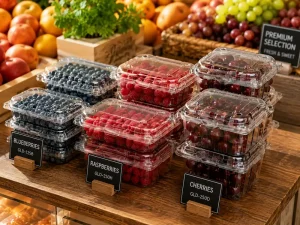
clamshell containers are among the most common hinged packaging choices because they offer strong product visibility and a simple open-close experience. A clear clamshell structure works especially well for food that sells through appearance, including berries, fruit portions, pastries, sandwiches, bakery assortments, chilled snacks, and ready-to-eat items.
For retail display, the clamshell format gives buyers three advantages. First, the transparent body allows shoppers to see color, freshness, portion size, and texture. Second, the hinged structure keeps the lid and base aligned. Third, the container is easy for staff to fill and close repeatedly during high-volume production.
Produce buyers often use produce clamshell containers for berries, grapes, small fruits, and fresh retail packs because visibility is part of the purchase decision. Bakery buyers use clear hinged clamshells for cake slices, rolls, muffins, croissants, cookies, and small dessert assortments where shape protection and display clarity matter together.
For takeaway operations, clamshell packaging also supports fast packing. A deli counter can place sandwiches or side items into sandwich clamshell packs without managing separate lids. When portion size increases, larger grab-and-go clamshells support more generous chilled food and takeaway portions.
PET Hinged Deli Containers for Everyday Chilled Food
PET hinged deli containers are a practical starting point for chilled and takeaway food programs. They suit salads, fresh fruit, nuts, deli sides, cold dishes, bakery snacks, and grab-and-go portions.
The main buying advantage is balance. PET hinged deli containers offer clear display, attached-lid convenience, and everyday packing efficiency. This makes them useful for supermarkets, cafes, foodservice brands, and distributors that need one container family to support multiple food applications.
For small snacks, sides, and compact fresh food portions, small hinged deli containers keep the package lightweight and portion-focused. For daily salads, deli sides, and chilled snack packs, medium hinged deli containers give buyers a practical middle range. For fuller salads and mixed fresh food, larger deli snack containers create more room for ingredients without forcing buyers into oversized packaging.
For higher-volume chilled meals, family portions, or larger grab-and-go programs, large hinged deli containers and extra-capacity hinged food containers support bigger portions while keeping the same attached-lid logic.
Round Containers for Salads, Fruit Mixes, and Chilled Bowls
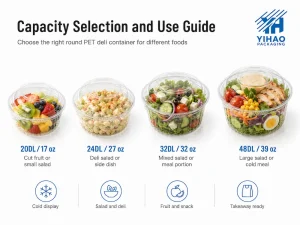
round containers are useful when the food has a bowl-style presentation. Salads, fruit mixes, chilled noodles, grain bowls, yogurt toppings, and shared chilled portions often look better in a round format because the ingredients can be layered or arranged naturally.
Round PET containers are especially strong for food that benefits from a wide top view. A salad with greens, protein, vegetables, and toppings needs a display surface that communicates freshness quickly. A mixed fruit bowl needs visibility from the top and side. A chilled noodle or deli bowl needs enough depth to hold ingredients without making the package look overfilled.
Round formats also work well for premium chilled takeaway because they create a more finished presentation than a flat box. For catering and shared retail display, round compartment trays help separate different foods while keeping the overall package visually balanced.
Square Containers for Shelf Efficiency and Stable Stacking
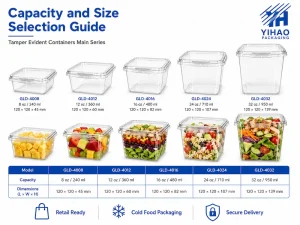
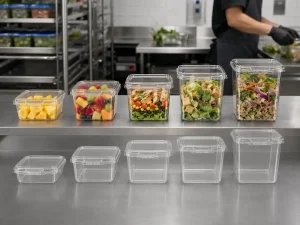
square containers are ideal when shelf efficiency, stacking, and clean product alignment matter. Compared with round shapes, square containers use shelf space more efficiently and create a neat block-style retail presentation.
For chilled foods, square formats work well for salads, fruit portions, deli sides, cut vegetables, prepared meals, and snack packs. The corners help define the package footprint, which is useful for supermarkets and convenience stores that need consistent rows in refrigerated shelves.
Square PET containers also support a clear premium look. When the sidewalls are transparent and the lid is well matched, buyers can show fresh ingredients while maintaining a stable, organized shelf layout. For standard chilled food programs, compact square deli containers work for smaller portions, while mid-size square food containers suit everyday salads, fruit, and deli meals.
Compartment Containers for Portion Control and Food Separation
compartment containers solve a different problem: separation. When foods need to stay visually and physically divided, a single open cavity is not enough. Two-compartment, three-compartment, four-compartment, five-compartment, and six-compartment formats help buyers manage mixed foods without losing presentation control.
For fruit and snack packs, two-compartment containers separate fruit from nuts, cheese, dips, or dry toppings. Three-compartment containers support balanced snack combinations. Four-compartment layouts work for fruit-and-nut variety packs or retail sampler packs. Larger multi-compartment trays work for sushi, party platters, deli assortments, bakery samplers, and chilled shared packs.
For fresh-cut and snack packaging, two-compartment fruit and nut containers suit simple pairings, while four-compartment snack containers help create more varied retail packs.
How to Choose Hinged Container Size for Retail and Takeaway Food
Size selection should follow the food’s portion logic. Buyers should avoid choosing a container only because it looks larger in a catalog. Oversized packaging can make portions look weak, while undersized packaging can crush toppings, reduce visibility, and create poor closing performance.
| Size Logic | Best For | Recommended Structure | Buyer Note |
|---|---|---|---|
| Small portions | Nuts, fruit sides, snack packs, small bakery portions | Small PET hinged deli containers or small clamshells | Keep the package compact so the portion looks full |
| Medium portions | Daily salads, deli sides, fruit cups, sandwiches | Medium hinged deli containers or square PET containers | Balance display area with practical filling volume |
| Large portions | Prepared chilled meals, family portions, shared fruit packs | Large hinged deli containers or round bowls | Check stacking strength and lid closure after filling |
| Deep food structure | Layered salads, chilled noodles, bulky fresh food | Round or deeper PET hinged containers | Choose depth without hiding the food from view |
| Flat food structure | Sandwiches, pastries, flat bakery items | Flat clamshell containers | Support shape protection and easy takeaway handling |
Best Hinged Containers for Retail Display
The best hinged containers for retail display are clear, stable, easy to stack, and shaped around the product’s visual value. Retail food packaging does not only protect food; it sells the food before a customer touches it.
For berries and fresh produce, the container should show color clearly and support airflow when ventilation is needed. For bakery products, the lid shape should protect toppings, frosting, layers, and surface decoration. For deli and chilled food, the container should display ingredients without making the portion look flat or crowded. For mixed snacks, compartment design should make the variety obvious at first glance.
This is why retail buyers often combine several structures in one packaging program. They may use produce clamshells for fruit, bakery clamshells for desserts, round containers for salads, square containers for chilled sides, and compartment containers for snack assortments. The goal is not to force every food into the same box. The goal is to create a packaging system that feels consistent while allowing each food type to look its best.
For broader category planning, retail food packaging pages should guide buyers by application, structure, and material rather than showing a random product list.
Best Hinged Containers for Takeaway and Grab-and-Go Food
Takeaway packaging needs speed, closure confidence, and handling convenience. A container that looks good on the shelf but slows down staff during service is not the right structure for busy foodservice operations.
For takeaway, hinged packaging offers a practical advantage because the lid is always attached. Staff open, fill, close, and hand off the pack with fewer steps. This supports sandwich counters, salad shops, bakeries, cafes, convenience stores, and supermarkets that prepare food in batches or during peak service windows.
grab-and-go food packaging works best when the structure supports both display and movement. A chilled fruit pack must look fresh in the refrigerator and remain stable when a customer carries it away. A bakery clamshell must protect the product in the display case and during transport. A deli container must close securely enough for handling, stacking, and short-distance takeaway use.
Best Hinged Containers for Chilled Food Programs
Chilled food packaging requires clear visibility, stable closure, and structure that performs in refrigerated merchandising. hinged containers are widely used for chilled applications because they support ready-to-eat product lines without complicating lid inventory.
For chilled salads, fruit, cold dishes, deli sides, bakery desserts, and snack packs, PET/RPET material direction is especially relevant because buyers often need clarity and product visibility. The packaging should support cold-case presentation while keeping the food easy to inspect visually.
fresh-cut fruit containers should highlight color, freshness, and portion value. PET hinged deli containers should support daily chilled meals and snacks. Square containers should make refrigerated shelves look organized. Round containers should improve bowl-style presentation. Compartment containers should keep ingredients separated until purchase and consumption.
Hinged Containers vs Separate Lid Containers
Both hinged containers and separate lid containers have value, but they solve different problems. Hinged containers are better when speed, lid-base alignment, and simple inventory matter. Separate lid containers are better when bowl presentation, modular lid matching, or premium base-lid systems are the priority.
| Structure | Best For | Main Advantage | Buyer Consideration |
|---|---|---|---|
| Hinged containers | Retail display, takeaway, chilled grab-and-go food | Attached lid, fast packing, simple handling | Choose the right depth and closure for each food type |
| Separate lid containers | Salad bowls, premium prepared foods, modular food programs | Flexible lid matching and bowl presentation | Requires accurate lid-base compatibility management |
| Compartment containers | Snack packs, meal kits, fruit combinations, platters | Food separation and portion control | Compartment count must match real eating behavior |
| Tamper-evident containers | Delivery, cold-case retail, secure ready-to-eat food | Visible opening control and consumer trust | Use when security is more important than simple opening |
Working with a Hinged Container Manufacturer for Wholesale Supply
Wholesale buyers should not choose hinged containers only by price per piece. The better decision is based on structure, material direction, application fit, supplier consistency, and long-term packaging range support.
A reliable hinged container manufacturer should help buyers compare structures, not simply push one product. For supermarkets, distributors, food brands, and foodservice operators, the supplier’s ability to explain application fit is often as important as the product catalog itself.
Before placing a wholesale order, buyers should confirm the following points:
- Standard product range: Does the supplier offer small, medium, and large hinged container options?
- Structure coverage: Are clamshell containers, round containers, square containers, and compartment containers available for different food programs?
- Sample review: Can the buyer test closure feel, stacking, filling, and chilled display performance before bulk order planning?
- Material direction: Does the supplier clearly explain PET/RPET options and intended food contact applications?
- Carton and SKU planning: Can the supplier help buyers organize packaging by food category, capacity, and channel?
- Custom support: Can the supplier discuss custom packaging, branding, embossing, label space, or packaging adjustments when standard products are not enough?
- Wholesale supply stability: Can the supplier support repeat orders, seasonal programs, and future product range expansion?
For food packaging buyers, the strongest supplier is not always the one with the most SKUs. The better supplier is the one that helps build a packaging system: one structure for fruit, one for bakery, one for deli, one for salads, one for snack packs, and one for larger prepared food portions.
Material Considerations for PET/RPET Hinged Food Packaging
PET and RPET are commonly selected for clear chilled food packaging because they support food visibility and a clean retail look. For buyers, the key is to match material direction with the application instead of making broad environmental claims that may depend on local recycling systems and market rules.
For cold food, PET/RPET hinged packaging is commonly used for fruit, salad, bakery, deli, and snack products. Buyers should confirm food contact suitability, intended use, storage conditions, and local regulatory requirements with their supplier before final procurement.
Procurement teams should keep claims accurate. Use terms such as PET, RPET direction, clear display, recyclable where locally accepted, and food contact suitability only when the actual product documentation and market rules support the statement.
How to Build a Practical Hinged Container Range
A practical hinged container range should cover application, capacity, shape, and structure without creating too many unnecessary SKUs. For most buyers, the best range starts with a few clear product groups:
- Clamshell containers: For bakery items, sandwiches, fresh produce, berries, and general retail display.
- PET hinged deli containers: For salads, fruit, deli sides, cold dishes, and daily grab-and-go food.
- Round containers: For salad bowls, fruit bowls, chilled noodle bowls, and shared fresh food portions.
- Square containers: For shelf-efficient salads, fruit, deli meals, and prepared chilled foods.
- Compartment containers: For fruit-and-nut packs, snack combinations, meal kits, party trays, and portion-controlled retail packs.
Buyers should avoid creating a container range that looks large but lacks logic. A better range has fewer structures with clear roles. Each structure should answer one main question: what food does it serve best?
Buyer Checklist Before Ordering Hinged Containers Wholesale
Before confirming a wholesale order, review the container from both a buyer and operator perspective:
- Does the container match the food’s height, shape, and moisture level?
- Does the lid close smoothly after filling?
- Does the pack stack cleanly in storage and retail display?
- Does the clear material show the product attractively?
- Does the shape support the intended channel: supermarket, deli, bakery, cafe, delivery, or convenience store?
- Does the supplier offer related structures for future product expansion?
- Does the packaging support brand presentation without overcomplicating SKUs?
This checklist helps buyers avoid one of the most common procurement mistakes: choosing a container that looks acceptable in a sample photo but performs poorly in daily packing, shelf display, or takeaway handling.
Final Recommendation: Choose by Structure, Then by Size
The best hinged containers are chosen by structure first and size second. A clamshell, round bowl, square container, and compartment tray may all hold chilled food, but they do not communicate the same value to shoppers or perform the same way in operations.
Use clamshell containers when visibility and simple hinged display matter. Use round containers when the food benefits from bowl-style presentation. Use square containers when shelf efficiency and stacking are priorities. Use compartment containers when separation, portion control, and variety are part of the product value.
For supermarkets, foodservice operators, bakeries, deli counters, fruit brands, and wholesale distributors, this structure-first approach creates a cleaner packaging system, better retail presentation, and stronger long-term SKU planning.
FAQ
1. What are hinged containers used for?
Hinged containers are used for retail display, takeaway food, chilled meals, bakery products, fresh produce, deli sides, salads, fruit packs, sandwiches, and snack combinations. The attached lid helps staff pack faster and reduces lid-matching mistakes.
2. Are clamshell containers the same as hinged containers?
Clamshell containers are one common type of hinged container. A clamshell has a connected lid and base, usually with a clear structure that supports product visibility for bakery, produce, sandwich, snack, and chilled food packaging.
3. What is the difference between hinged containers and clamshell containers?
Hinged containers are a broad packaging category with an attached lid and base. Clamshell containers are a specific hinged format, usually designed with a fold-over structure for clear display, takeaway packing, and simple retail handling.
4. Are PET hinged containers suitable for cold food?
PET hinged containers are commonly used for chilled food applications such as salads, fresh fruit, deli sides, bakery items, snacks, and grab-and-go meals. Buyers should confirm intended use, food contact suitability, and storage conditions with the supplier before ordering.
5. Should I choose round containers or square containers for chilled food?
Choose round containers when the food benefits from bowl-style presentation, such as salads, fruit bowls, or chilled noodles. Choose square containers when shelf efficiency, stacking, and clean retail alignment are more important.
6. When should buyers use compartment containers?
Buyers should use compartment containers when foods need separation, portion control, or a more organized presentation. They are suitable for fruit-and-nut packs, snack combinations, meal kits, party trays, deli assortments, and chilled retail samplers.
7. How should wholesale buyers compare hinged container suppliers?
Wholesale buyers should compare suppliers by structure range, material direction, closure consistency, application knowledge, size options, custom support, and the ability to guide buyers across clamshell, round, square, and compartment food packaging needs.
References
- U.S. Food and Drug Administration, Packaging & Food Contact Substances.
- U.S. Food and Drug Administration, Understanding How FDA Regulates Substances that Come into Contact with Food.
- European Commission, Food Contact Materials Legislation.
- Regulation (EC) No 1935/2004 on Materials and Articles Intended to Come into Contact with Food.
- U.S. Environmental Protection Agency, Sustainable Packaging.
- U.S. Environmental Protection Agency, Sustainable Materials Management.
- Grand View Research, Food Packaging Market Size & Share Industry Report.
- Industry packaging buyer practices across chilled food, bakery, deli, and grab-and-go retail applications.
Deep-Dive Insights
How should buyers think about hinged containers beyond basic capacity?
Buyers should evaluate hinged containers as part of a structure system, not as isolated plastic boxes. Capacity matters, but structure decides whether the food looks full, whether the lid closes correctly, whether the pack stacks cleanly, and whether the product fits the intended retail or takeaway environment.
Why do clamshell, round, square, and compartment formats all matter?
Each format solves a different packaging problem. Clamshell containers support clear display and simple takeaway. Round containers improve bowl-style presentation. Square containers improve shelf efficiency and stacking. Compartment containers protect ingredient separation and portion logic. A strong packaging range uses each structure where it performs best.
What should wholesale buyers avoid when selecting hinged packaging?
Wholesale buyers should avoid choosing only by the lowest unit price or by one attractive sample photo. Poor structure matching can create weak shelf presentation, slow packing, unstable stacking, and customer complaints. The better approach is to test real food portions, real staff packing speed, and real retail shelf conditions before confirming long-term supply.
What makes a hinged container supplier more valuable?
A strong supplier helps buyers compare food type, packaging structure, material direction, size logic, carton planning, and future SKU expansion. This makes the supplier more useful than a simple catalog seller because buyers need packaging systems that support ongoing retail, takeaway, and chilled food programs.
Final Note / Practical Takeaway
© YIHAO Packaging. All rights reserved. All articles, product images, packaging designs, technical specifications, and website materials are protected by copyright. Unauthorized copying, reproduction, redistribution, modification, or commercial use is strictly prohibited without prior written permission.