Tamper Evident Salad Containers: Buyer Guide for Food Packaging Teams
Tamper evident salad containers are designed for salad and chilled ready-to-eat food programs where freshness presentation and package integrity matter at the same time. A salad container must show the food clearly, protect the ingredients, support practical packing, close reliably, and help customers understand that the package has not been opened after sealing.
For supermarkets, cafes, convenience stores, delis, salad brands, meal prep kitchens, foodservice teams, and packaging distributors, salad packaging is no longer only a clear bowl or a hinged box. Retail salad programs now include leafy salads, grain bowls, fruit salads, deli salads, cold noodles, protein bowls, pasta salads, snack salads, and grab-and-go meals. These products move through cold storage, shelf display, takeaway handling, delivery routes, and customer opening. The package has to perform through the full route.
YIHAO is a food packaging manufacturer and solution provider focused on practical PET/RPET packaging systems for fresh food, salad, deli, fruit, bakery, takeaway, and retail display applications. This buyer guide explains how food packaging teams should choose tamper evident salad containers, compare PET deli containers, evaluate secure deli packaging, and build a reliable wholesale sourcing process.
What Are Tamper Evident Salad Containers?
Tamper evident salad containers are salad packaging containers designed with a visible first-opening feature. This feature may use a tear strip, breakaway tab, locking band, integrated closure, security tab, or other structure that changes once the package is opened. The purpose is simple: customers and food teams should be able to see whether the package has already been opened after sealing.
These containers are commonly used for ready-to-eat salads, deli salads, pasta salads, fruit salads, grain bowls, cold noodles, salad kits, snack bowls, and chilled prepared meals. Some formats are round salad bowls. Some are square or rectangular PET deli containers. Some are hinged clamshells. Some use separate lids. The correct format depends on the salad type, packing process, retail channel, and customer use.
For buyers comparing broader secure packaging options, tamper evident containers should be reviewed as a category before selecting a specific salad format. This helps teams compare round, rectangular, hinged, square, and multi-section secure packaging options in one practical matrix.
Why Tamper Evidence Matters for Retail Salad Packaging
Salads are visually inspected before purchase. Customers look at leaf freshness, topping color, fruit quality, dressing position, portion fullness, condensation, and label information. If the package looks fresh but the closure feels uncertain, the product loses trust. For ready-to-eat salads, customer confidence is part of the packaging value.
Retail salad packaging often sits in self-service shelves, convenience store coolers, supermarket prepared food sections, hotel grab-and-go displays, and delivery pickup areas. These channels involve multiple handling steps. A tamper-evident structure helps show that the container was sealed after packing and has not been opened unnoticed.
Tamper evidence does not replace food safety procedures or proper cold-chain control. It is a packaging integrity signal. Buyers should treat it as one part of a complete salad packaging system: material, lid, label, cold display, stacking, food fit, and supplier consistency all still matter.
Best Applications for Tamper Evident Salad Containers
Ready-to-Eat Leafy Salads
Leafy salads need height, air space, topping protection, and clean visibility. Greens, tomatoes, cucumbers, cheese, nuts, fruit, chicken, egg, grains, and dressing cups should look fresh and organized inside the pack. A container that is too shallow compresses toppings. A container that is too large makes the salad look underfilled.
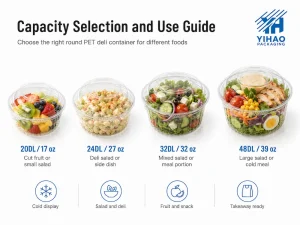
For round salad programs, round PET containers are useful because they support bowl-like presentation and ready-to-eat use. For smaller retail salads, grab-and-go salad bowls work well for compact salads and fresh fruit portions. For fuller salad meals, premium meal salad bowls provide more room for toppings, leafy volume, cold noodles, and grain bowls.
Deli Salads and Prepared Cold Sides
Deli salads often include pasta salad, potato salad, coleslaw, bean salad, quinoa salad, tabbouleh, cold noodles, and chilled prepared sides. These foods are denser than leafy salads and often contain sauce, oil, or dressing. They need containers that support portion control, stable lid fit, and easy spooning.
For this application, tamper evident deli containers help buyers package dense ready-to-eat foods with stronger opening confidence. PET/RPET clarity is useful when the product depends on visible ingredients, but buyers should test real foods because sauce, moisture, oil, and dense fill weight affect lid performance.
Fruit Salads and Fresh-Cut Fruit Bowls
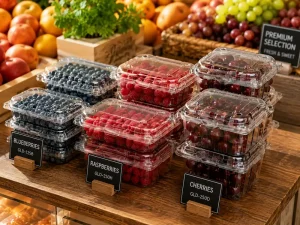
Fruit salads and fresh-cut fruit bowls rely heavily on visual freshness. Mango, melon, grapes, berries, pineapple, kiwi, citrus, and mixed fruit portions should stay visible and attractive under cold display lighting. A secure closure helps the product feel more retail-ready when sold through self-service shelves.
For fresh produce teams, fresh-cut fruit containers should be evaluated alongside salad containers. Some fruit salads fit round bowls, while mixed fruit portions may require different clear PET formats depending on portion size, moisture, and shelf display goals.
Grain Bowls, Protein Bowls, and Cold Noodle Meals
Many salad programs now include more than greens. Grain bowls, protein bowls, cold noodle meals, pasta bowls, and chilled meal salads need stronger portion planning. These foods often have heavier ingredients, sauce, toppings, and layered components. Buyers should choose container depth and lid clearance based on real fill height, not only nominal capacity.
For grab-and-go meal packaging, tamper evident salad containers help connect visual presentation with package integrity. Customers can inspect the meal before buying and still see that the package has a first-opening feature.
Private Label and Supermarket Salad Lines
Private label salad lines need packaging consistency across several SKUs. A supermarket may sell small side salads, meal salads, fruit salads, pasta salads, and family-size salad bowls under the same brand. If every container looks different or closes differently, the line feels less disciplined.
For supermarket programs, buyers should build a container range with consistent material clarity, compatible lid logic, stable label placement, and clear tamper-evident communication. This creates a more professional retail shelf and reduces operational confusion.
PET/RPET Material: Why Clear Packaging Matters
PET and RPET are widely used for chilled salad and deli packaging because they provide clear visibility, clean presentation, and practical rigidity. For PET deli containers, the material helps customers inspect product color, ingredient quality, portion size, and freshness before purchase.
RPET can support recycled-content positioning when documentation and local market requirements support that direction. Buyers should avoid vague sustainability claims. Material decisions should be supported by supplier documentation, food-contact suitability review, and market-specific requirements.
| Material Direction | Best-Fit Application | Main Advantage | Buyer Checkpoint |
|---|---|---|---|
| PET | Leafy salads, fruit salads, deli salads, chilled bowls | High clarity and strong retail display | Check food-contact suitability and chilled-use fit |
| RPET | Clear chilled salad packaging with recycled-content positioning | Supports sustainability-focused packaging direction | Confirm documentation and market requirements |
| PP or heat-suitable material | Prepared foods requiring heat or microwave use | Better fit for selected hot food applications | Usually less crystal-clear than PET for cold salad display |
Buyers should not use PET/RPET salad containers as the default for hot-fill or microwave applications unless the material and structure are specifically suitable for that use. For cold salad, fruit salad, deli salad, and chilled grab-and-go meals, clear PET/RPET packaging remains a strong direction.
Container Shape: Round, Square, Rectangular, or Hinged?
The best salad container shape depends on the food. Round containers feel more like bowls and work well for leafy salads, grain bowls, fruit bowls, and cold noodles. Square containers create efficient shelf blocking and can work well for deli meals and compact salad portions. Rectangular containers are useful when the food has a directional layout. Hinged containers improve packing speed because the lid and base stay connected.
| Container Format | Best Salad Use | Main Benefit | Buyer Caution |
|---|---|---|---|
| Round salad containers | Leafy salads, grain bowls, cold noodles, fruit salads | Bowl-like eating experience and strong top-view display | May use more shelf width than square packs |
| Square PET containers | Deli salads, fruit, compact meal salads, chilled sides | Efficient shelf blocking and organized display | Less natural for salad meals eaten directly from the bowl |
| Rectangular PET containers | Prepared foods, longer food layouts, salad kits | Good directional arrangement | Less soft and bowl-like for tossed salads |
| PET hinged deli containers | Fast pack-out salads, fruit, deli foods, grab-and-go foods | Lid and base stay connected during operation | Hinge strength and closure feel must be tested |
For food teams that need fast packing, PET hinged deli containers are a practical category to compare. Specific formats such as clear recycled PET hinged deli containers and grab-and-go hinged deli containers can support salad, snack, deli, and chilled prepared food programs when the buyer prioritizes connected-lid handling.
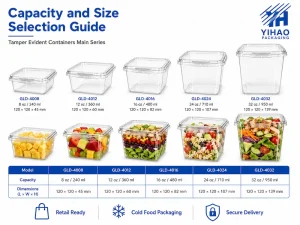
Size Logic: How Food Packaging Teams Should Choose Capacity
Capacity should be selected by food behavior, not by a number on a product list. A leafy salad may need more height than a dense pasta salad. A fruit salad may need a clear top view. A grain bowl may need enough room for mixing. A deli salad may need compact fill appearance and strong lid engagement.
| Salad Type | Packaging Logic | Buyer Test |
|---|---|---|
| Small side salads | Compact PET/RPET container or small hinged deli pack | Portion should look full, not underfilled |
| Fruit salads | Clear PET container with strong visibility | Check moisture, clarity, and label placement |
| Meal salads | Medium to large round salad bowl | Check topping height and lid clearance |
| Deli salads | Compact bowl, square container, or hinged deli pack | Check dense fill weight, sauce behavior, and spooning access |
| Shared salad portions | Large round bowl or catering-style format | Check loaded stacking, carton strength, and transport movement |
For smaller chilled sides and fruit portions, small clear PET/RPET containers are useful. For medium prepared food portions, medium clear food containers support fruit, deli sides, desserts, and compact salad applications. For larger salad programs, large salad and fruit bowls support family-size salads, fruit platters, and chilled takeaway portions.
Lid and Closure: The Part Buyers Cannot Treat as Secondary
The lid decides whether the container works in real operations. A salad bowl with excellent clarity but weak closure is not a reliable packaging solution. A secure lid should close consistently, protect toppings, support stacking, and open clearly for the customer.
For tamper evident salad containers, buyers should evaluate both closure strength and first-opening communication. The tamper-evident feature must be visible, logical, and strong enough to survive packing and transport. At the same time, the customer should be able to open the package without confusion or excessive force.
| Lid Type | Best Application | Main Benefit | Buyer Checkpoint |
|---|---|---|---|
| Flat clear lid | Compact salads, fruit, deli sides | Clean stacking and simple retail display | Check lid engagement and opening force |
| Dome lid | Leafy salads, toppings, fruit volume, cold noodles | More height and better topping protection | Check carton height and shelf space |
| Hinged lid | Fast pack-out salad counters and grab-and-go foods | Reduces lid-matching errors | Check hinge strength and snap-fit closure |
| Tamper-evident closure | Self-service retail, delivery, convenience stores | Visible first-opening confidence | Check tab strength and customer opening clarity |
For large bowl systems, matching PET salad bowl lids should be tested with the bowl body. For secure takeaway presentation, PET/RPET dome lids can help protect taller salad and fresh food presentations when lid height matters.
When Should Buyers Choose Tamper Evident Salad Containers?
Buyers should choose tamper evident salad containers when the salad is ready to eat, visually inspected by customers, and sold through a channel where first-opening confidence matters.
This format is especially useful when:
- The salad is sold through a supermarket self-service shelf.
- The product is sold in a convenience store cooler.
- The package may be handled by delivery partners or third-party pickup staff.
- The salad line is private label or premium retail positioned.
- The product includes ready-to-eat ingredients that customers want to trust.
- The package must show both freshness and closure integrity.
- The brand wants a more controlled and professional retail shelf impression.
For smaller cold-case secure foods, anti-fog tamper-evident containers are useful to review. For larger refrigerated foods that need tear-strip style opening evidence, clear PET tamper-evident containers can support secure chilled display applications.
When Regular Salad Containers May Be Enough
Tamper-evident packaging is useful, but it is not automatically required for every salad. Regular salad containers may be enough when food is packed and handed directly to the customer, sold through a staffed counter, consumed quickly, or managed within a controlled foodservice environment.
For example, a cafe that prepares salads behind the counter and hands them directly to customers may not need tamper-evident closure for every item. A supermarket grab-and-go program, however, often benefits from visible first-opening evidence because the product sits in a self-service environment.
The buying decision should be based on channel risk, customer trust expectations, food type, and handling route. Do not add tamper-evident structure only because it sounds more premium. Add it where it improves real retail confidence.
Retail Salad Packaging: Display, Labeling, and Shelf Behavior
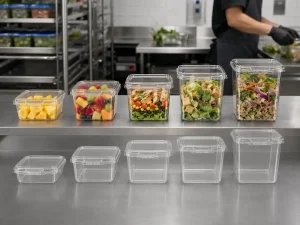
Retail salad packaging must make the salad easy to buy. The package should show freshness, identify the product, support required label information, and protect the food through chilled display. A good salad container should look clean and full without hiding the most attractive ingredients.
Buyers should review:
- Top-view visibility: shoppers should see toppings, greens, fruit, proteins, or grains clearly.
- Sidewall clarity: the package should show portion depth and ingredient layers.
- Condensation behavior: refrigerated display should not block food visibility.
- Label placement: labels should not cover the main selling view or tamper-evident feature.
- Stacking: containers should remain stable in shelves, cartons, and takeaway bags.
- Opening experience: customers should open the pack without spilling or damaging the salad.
For square retail formats, square PET deli containers are useful when shelf blocking and compact display matter. Products such as square PET deli containers for salad and fruit and large square PET deli containers can support salad, fruit, and chilled meal programs where a square footprint fits the shelf plan better.
Grab and Go Meal Packaging: How Salad Containers Fit the Wider Program
Grab and go meal packaging usually includes more than salads. It may include fruit bowls, deli sides, sandwiches, snack packs, cold noodles, desserts, and prepared meals. Salad containers should be selected as part of this wider system, not as isolated products.
A strong grab-and-go program may use:
- Small PET/RPET containers for sides, dressings, toppings, and fruit portions.
- Hinged PET deli containers for quick salad, fruit, and snack packing.
- Round PET salad bowls for meal salads, grain bowls, and cold noodles.
- Square PET containers for compact deli and salad display.
- Tamper-evident containers for self-service retail and delivery-sensitive foods.
- PP or heat-suitable containers for selected reheatable prepared meals.
For prepared food programs that include hot or reheatable items, buyers should also compare microwave safe containers. Salad packaging and heat-related prepared food packaging should not be treated as the same material decision.
Supplier Selection Checklist for Tamper Evident Salad Containers
When sourcing from a food packaging factory, buyers should evaluate the full system: material clarity, lid compatibility, tamper-evident function, carton protection, sample support, and repeat-order consistency. A reliable manufacturer or supplier should help buyers match the container to real salad applications, not only quote a price.
Ask these questions before choosing a manufacturer, wholesale supplier, or export partner:
- Which salad container formats are available: round, square, rectangular, hinged, or separate-lid?
- Are PET, RPET, PP, or other material options available depending on the food application?
- Which containers support tamper-evident closure or visible first-opening evidence?
- Can the supplier recommend options for leafy salads, deli salads, fruit salads, grain bowls, and grab-and-go meals?
- Are matching lids available and tested with the selected container sizes?
- Can samples be tested with real salad foods before wholesale confirmation?
- How are containers packed to reduce scratching, deformation, and lid mismatch?
- Can the supplier maintain sample-to-bulk consistency in clarity, rim shape, lid fit, and closure behavior?
- Can the supplier help reduce SKU overlap instead of selling too many similar containers?
Sample Testing Before Wholesale Orders
Food packaging teams should test tamper evident salad containers with actual food before bulk orders. Empty samples do not reveal enough. Leafy greens, fruit, sauce, dressing, proteins, grains, cold noodles, and dense deli salads all create different packaging demands.
| Test Area | What to Check | Why It Matters |
|---|---|---|
| Food fit | Fill height, topping space, dressing cup position, portion appearance | Prevents crushed toppings and empty-looking packs |
| Lid closure | Closing force, lid engagement, tab strength, opening clarity | Protects packing speed and customer experience |
| Tamper evidence | Visible first-opening feature before and after opening | Supports customer trust in self-service channels |
| Cold display | Clarity, condensation, label position, shelf angle | Improves retail appeal and product recognition |
| Stacking | Filled shelf stacking, carton stacking, takeaway bag movement | Reduces product damage and handling complaints |
| Moisture behavior | Dressing, fruit juice, sauce, oily ingredients, dense deli salads | Confirms real food performance before bulk approval |
| Bulk consistency | Sample-to-order clarity, rim shape, lid fit, and closure behavior | Reduces repeat-order quality risk |
Common Buying Mistakes to Avoid
Choosing by Capacity Only
Nominal capacity does not tell the full story. A leafy salad needs height. A fruit salad needs visibility. A dense deli salad needs compact fill control. A cold noodle bowl needs mixing space. Buyers should test real food fit before approving the size.
Assuming Tamper Evidence Means Leak-Proof
Tamper-evident closure shows first-opening evidence. It does not automatically guarantee leak-proof performance for every dressing, sauce, fruit juice, or moist deli salad. Leak-resistant behavior must be tested separately.
Ignoring Label Placement
Labels can strengthen branding, but they can also hide the food. For retail salad packaging, the food is the selling image. Labels should not cover the best product view or the tamper-evident feature.
Using PET/RPET for the Wrong Temperature
PET/RPET packaging works well for many cold and chilled salad applications, but it should not be treated as the default material for hot-fill or microwave foods. Temperature requirements must be confirmed before material selection.
Approving Empty Samples Only
Empty containers do not show how food behaves after filling, chilling, stacking, transport, and opening. Buyers should test actual salad products before wholesale ordering.
Buyer Decision Framework
Use this framework when choosing tamper evident salad containers for a new food program:
- Define the salad type: leafy salad, fruit salad, deli salad, grain bowl, cold noodles, protein bowl, or prepared chilled meal.
- Confirm the channel: staffed counter, self-service shelf, convenience store, delivery, foodservice, or private label retail.
- Choose the material: PET/RPET for clear chilled display; heat-suitable materials for heated prepared foods.
- Select the format: round bowl, square container, hinged deli container, rectangular pack, or separate-lid system.
- Define the security level: regular secure lid or visible tamper-evident structure.
- Test the real route: filling, closing, labeling, refrigeration, stacking, transport, shelf display, and customer opening.
- Evaluate the supplier: sample support, carton protection, repeat consistency, and product range logic.
FAQ
1. What are tamper evident salad containers used for?
Tamper evident salad containers are used for ready-to-eat salads, deli salads, fruit salads, grain bowls, cold noodles, protein bowls, and grab-and-go meals that need clear display and visible first-opening confidence.
2. Are tamper evident salad containers better than regular salad containers?
They are better when the salad is ready to eat, sold through self-service retail, delivery, convenience stores, or third-party handling channels. Regular salad containers may be enough for staffed counters or low-risk direct handoff.
3. What material is best for clear retail salad packaging?
PET and RPET are common choices for clear chilled retail salad packaging because they support product visibility, lightweight handling, and clean shelf presentation. Heat-related applications should be evaluated separately.
4. What is the difference between PET deli containers and tamper evident salad containers?
PET deli containers focus on clear food display and practical chilled packaging. Tamper evident salad containers add a visible first-opening feature, which is useful when customer confidence and package integrity matter in self-service or delivery channels.
5. What should buyers test before wholesale ordering?
Buyers should test real salad fit, lid closure, tamper-evident function, cold display clarity, label placement, stacking, moisture behavior, customer opening, and sample-to-bulk consistency before wholesale ordering.
6. How should buyers choose a manufacturer or supplier?
Buyers should choose a supplier that understands salad applications, PET/RPET material, lid matching, tamper-evident structure, carton protection, sample testing, repeat-order consistency, and wholesale food packaging requirements.
References
- U.S. Food and Drug Administration, Food Contact Substances and Food Packaging Guidance.
- U.S. Food and Drug Administration, Food Tampering and Consumer Packaging Guidance.
- European Commission, Regulation (EC) No 1935/2004 on Materials and Articles Intended to Come into Contact with Food.
- European Commission, Regulation (EU) No 10/2011 on Plastic Materials and Articles Intended to Come into Contact with Food.
- European Food Safety Authority, Guidance on Plastic Recycling Processes for Food Contact Materials.
- Association of Plastic Recyclers, APR Design Guide for Plastics Recyclability.
- RecyClass, Design for Recycling Guidelines for PET Packaging.
- GS1, General Guidance on Retail Barcode and Label Placement.
Final Note / Practical Takeaway
© YIHAO Packaging. All rights reserved. All articles, product images, packaging designs, technical specifications, and website materials are protected by copyright. Unauthorized copying, reproduction, redistribution, modification, or commercial use is strictly prohibited without prior written permission.