Choosing food packaging sounds simple until a buyer has to compare clarity, heat resistance, shelf display, lid security, sustainability claims, unit cost, carton efficiency, and supplier reliability at the same time. A supermarket needs packaging that sells food visually. A cafe needs packaging that works fast at the counter. A bakery needs packaging that protects presentation. A foodservice brand needs stable supply, consistent quality, and packaging that performs across multiple outlets.
This is why a practical food packaging comparison should not start with a generic question like “Which material is best?” It should start with a sharper purchasing question: which packaging material fits the food, the sales channel, the storage condition, the customer experience, and the brand promise?
YIHAO is a food packaging manufacturer and solution provider focused on clear, functional, and wholesale-ready packaging for fresh produce, deli foods, salads, bakery items, cold drinks, and prepared meals. This guide compares PET, rPET, PP, and PLA packaging from a buyer’s perspective, helping procurement teams make faster, more practical, and more defensible decisions before bulk ordering.
Why Food Packaging Comparison Matters Before Wholesale Purchasing
Material selection affects much more than the container itself. It affects how food looks in the display case, how staff handle packing, how customers carry the product, how the package performs during transport, and how confidently a brand can explain its packaging choice.
For supermarkets, poor packaging creates direct losses: foggy lids reduce shelf appeal, weak closures increase leakage complaints, and poorly matched sizes waste display space. For cafes, the wrong cup or lid slows service and weakens the takeaway experience. For bakeries, a container with the wrong dome height can damage frosting, fruit toppings, cream layers, or delicate decoration. For foodservice brands, inconsistent packaging creates operational friction across locations.
A strong food packaging comparison helps buyers judge packaging by actual performance instead of material labels alone. PET, rPET, PP, and PLA each serve different use cases. None is perfect for every food. The best result comes from matching the material to the product and confirming supplier capability before scaling wholesale orders.
Food Packaging Comparison Matrix: PET vs PP vs PLA vs rPET
| Material | Best Use Cases | Main Strengths | Key Limitations | Buyer Checkpoint |
|---|---|---|---|---|
| PET | Cold food, salads, fruit, bakery display, cold drinks, deli packs | High clarity, strong display value, good stiffness, retail-friendly appearance | Not suitable for high-heat microwave use unless specifically designed and verified | Confirm clarity, lid fit, anti-fog needs, food-contact documentation, and recycling compatibility |
| rPET | Cold food containers, deli packaging, salad bowls, fresh-cut fruit packs, cold cups | Clear display with recycled material positioning; strong fit for sustainability-focused retail | Recycled content and food-contact suitability must be verified by supplier documentation | Confirm actual rPET content, food-contact suitability, material consistency, and compliance documents |
| PP | Hot food, prepared meals, takeaway dishes, microwave-safe food packaging | Better heat resistance than PET; practical for hot-fill and microwave-related applications when designed for that use | Usually less crystal-clear than PET; weaker premium shelf display for cold products | Confirm temperature range, lid sealing, microwave suitability, oil resistance, and deformation control |
| PLA | Cold drinks, cold food, compostable-positioned packaging programs | Plant-based material story; useful where certified compostable packaging is requested | Industrial composting access is critical; heat resistance is limited compared with PP | Confirm compostability certification, local acceptance, storage conditions, and claim wording |
PET Food Containers: Best for Clear Display and Cold Food Retail
PET food containers are one of the most practical options for chilled retail food, fresh produce, salads, bakery items, and cold drink packaging. PET’s biggest advantage is clarity. In supermarkets and grab-and-go displays, customers often decide by sight before reading the label. Clear packaging lets the customer see freshness, portion size, food color, topping quality, and product arrangement before purchase.
For refrigerated shelves, PET food containers work especially well for fresh-cut fruit, deli sides, chilled snacks, salads, sandwiches, and ready-to-eat portions. PET also supports strong structures in clamshells, hinged containers, bowls, cups, lids, trays, and bakery domes.
For bakeries, PET is valuable because it protects the product while keeping visual appeal strong. Cakes, cupcakes, muffins, rolls, croissants, brownies, and tiramisu portions need packaging that preserves shape and supports impulse buying. A clear PET bakery clamshell or dome container gives customers confidence before they touch the pack.
For supermarkets, PET also supports category consistency. Buyers can use clear PET for fruit clamshells, salad bowls, square deli containers, bakery packs, cold cups, and tamper-evident cold-case containers. This creates a cleaner visual system across departments.
Still, PET is not the right answer for every food. It is mainly a cold-chain and ambient display material. If the food is hot-filled, reheated, or microwaved, buyers should move toward PP or another verified heat-resistant structure instead of assuming PET will perform.
rPET Packaging: Best for Clear Packaging with Recycled Material Positioning
rPET packaging uses recycled PET content and is widely requested by retailers and food brands that want clearer sustainability positioning without losing transparent shelf appeal. For many chilled food categories, rPET gives buyers a practical balance: visual clarity, familiar PET performance, and a recycled-material story.
rPET is especially relevant for fresh fruit packaging, salad containers, cold cups, chilled deli packs, and takeaway foods that need clean appearance. A buyer comparing virgin PET and rPET should not only ask for a price difference. The better questions are: what recycled content is used, whether the material is food-contact suitable for the intended application, whether the clarity is consistent, and whether the supplier can provide documentation when required.
For grab-and-go meals, clear PET/rPET food containers help brands show freshness while supporting recycled-material communication. For salads and fruit mixes, clarity matters because customers judge freshness quickly. If the material looks grey, cloudy, or inconsistent, the packaging weakens the product even before the customer reads the label.
rPET should be treated as a verified purchasing decision, not a slogan. Buyers should avoid broad claims such as “eco-friendly packaging” unless the claim is backed by accurate recycled-content data, food-contact suitability, and local recycling or waste-system context. Clear language such as “made with recycled PET content where specified” is safer and more professional than exaggerated environmental claims.
PP Food Containers: Best for Hot Food, Prepared Meals, and Microwave-Safe Applications
PP food containers serve a different role from PET. PP is the stronger choice when the packaging needs better heat resistance. For supermarkets selling prepared meals, delis packing hot sides, cafes offering takeaway meals, and foodservice operators handling reheatable dishes, PP is often the practical material direction.
PP is commonly used for hot food containers, microwave-safe prepared meal containers, soup-related packaging, deli takeaway boxes, and food counter packs. Compared with PET, PP usually does not deliver the same crystal-clear display. But for hot meals, that trade-off is acceptable because heat resistance and shape stability are more important than premium transparency.
Buyers comparing PET and PP should not ask which material is “better.” They should ask what the food needs. For chilled salad, PET usually sells the product better. For hot rice, pasta, cooked vegetables, or prepared meals, PP food containers are the safer direction when the structure is designed for heat and microwave-related use.
A strong PP purchase specification should include container size, lid type, intended food temperature, oil or sauce contact, stacking requirements, storage condition, and microwave expectations. If the container will be used for reheating, buyers should ask for clear confirmation from the supplier rather than relying on generic PP assumptions.
For foodservice operations, PP hot food containers support practical takeaway handling where warmth, sauce, and transport stability matter. The best PP packaging is not only heat-resistant; it also has stable lid fit, controlled stacking, and enough rigidity for real delivery conditions.
PLA Compostable Containers: Best for Cold Use and Verified Compostable Programs
PLA compostable containers are often chosen when a buyer wants plant-based or compostable-positioned packaging. PLA has value, but it must be used honestly. It is not a universal replacement for PET or PP. PLA performs best in cold food and cold drink applications, and its compostable value depends heavily on certification, collection, and access to industrial composting systems.
For cafes, PLA cold cups may fit specific sustainability programs where customers and local waste systems understand compostable packaging. For events, campuses, closed foodservice venues, and controlled collection environments, PLA can be more practical than in open public waste streams. In uncontrolled retail settings, the compostability story becomes weaker if the local infrastructure cannot process the material.
Buyers considering PLA compostable containers should ask for compostability certification, storage guidance, temperature limitations, shelf-life expectations, and accepted disposal routes. PLA should not be described as automatically compostable everywhere. Professional buyers should use precise language such as “certified industrially compostable where accepted by local facilities.”
PLA also requires careful logistics. High-temperature storage, hot-fill use, and unsuitable transport conditions can create deformation risk. A cafe using PLA for iced drinks may have a good experience. A foodservice operator using PLA for hot meals will likely face performance problems. This is why PLA must be compared by use case, not by sustainability language alone.
Food Packaging Comparison by Business Type: Supermarkets, Cafes, Bakeries, and Foodservice
Supermarkets
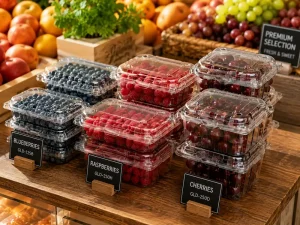
Supermarkets need packaging that supports shelf display, product protection, fast replenishment, and customer trust. PET and rPET are usually strong choices for chilled retail categories because they show the food clearly. For produce departments, fresh produce packaging should protect berries, grapes, cut fruit, and snack packs while keeping color and freshness visible.
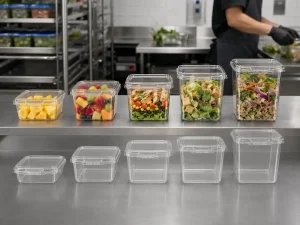
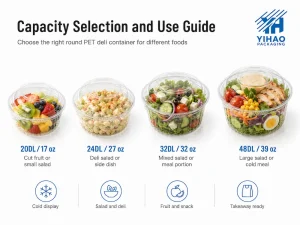
For deli and salad shelves, PET bowls, hinged containers, and square packs work well because the food must be visible from multiple angles. Square containers also improve shelf organization because they reduce wasted space compared with some round formats. For ready meals and hot deli products, PP is more practical because heat resistance becomes the priority.
Cafes
Cafes need packaging that supports speed. Staff must fill cups, close lids, hand over drinks, and keep the line moving. For iced coffee, lemonade, smoothies, milk tea, matcha, refreshers, iced tea, cold brew, and sparkling fruit drinks, PET and rPET cold cups offer clear appearance and reliable drink presentation.
cold cups and lids should be compared as a system, not as separate items. A beautiful cup with an unstable lid still fails. A cafe buyer should test lid fit, straw-slot performance, sip-through comfort, dome height for foam or toppings, and cup-wall stiffness under real counter conditions.
For beverage-focused operators, PET/RPET cold cups support clear drink presentation across iced coffee, matcha, refreshers, lemonade, and chilled specialty beverages.
Bakeries
Bakeries need packaging that protects shape, toppings, frosting, cream layers, and visual detail. PET is usually the leading choice because bakery products sell visually. A clear dome or hinged clamshell shows texture, decoration, portion size, and freshness.
bakery containers should be selected by product height, base stability, dome clearance, anti-fog needs, closure strength, and display angle. A cake slice needs a different container from a cupcake set. A croissant pack needs room for shape and texture. A dessert sampler needs compartment control so flavors and toppings stay separated.
For display-focused bakery items, clear PET cake slice containers help protect delicate portions while keeping the product visible in the bakery counter or chilled dessert case.
Foodservice Brands
Foodservice brands compare packaging across more demanding conditions. They need stable supply, repeatable structure, reliable sealing, carton efficiency, and packaging that works across outlets. For chilled grab-and-go food, PET and rPET are practical. For hot meals, PP is stronger. For controlled compostable programs, PLA may work, but only if disposal conditions are defined.
When buyers source from a food packaging manufacturer, they should evaluate tooling stability, material selection, packaging consistency, sampling support, carton packing, export experience, and custom branding capability. A low unit price is not valuable if lid fit changes between batches or if the container becomes unstable under real food weight.
Food Type Comparison: Which Material Fits Which Product?
| Food or Drink Type | Recommended Material Direction | Reason |
|---|---|---|
| Fresh berries, grapes, and cut fruit | PET or rPET | High clarity, strong shelf display, practical for chilled produce departments |
| Ready-to-eat salads and deli sides | PET or rPET | Clear visibility supports freshness cues and grab-and-go sales |
| Hot meals and reheatable foods | PP | Better heat resistance and practical performance for warm takeaway applications |
| Cake slices, cupcakes, pastries, and desserts | PET | Clear domes and hinged structures protect shape while supporting display |
| Iced coffee, matcha, refreshers, juice, and smoothies | PET, rPET, or PLA depending on program | PET/rPET provides clarity; PLA fits selected cold-use compostable programs |
| Security-sensitive cold-case foods | PET tamper-evident packaging | Clear display plus visible opening evidence improves retail confidence |
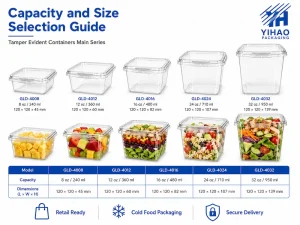
For supermarkets and convenience channels, deli containers are useful for salads, fruit, deli meals, and chilled prepared foods where shelf layout matters. For security-sensitive refrigerated foods, tamper-evident containers add visible protection and help customers identify whether a package has been opened.
In cold cases, tamper-evident cold-case containers are especially valuable for grab-and-go foods that require both visibility and security. The material choice still matters, but closure design becomes equally important.
How to Choose Food Packaging in 5 Practical Steps
A useful food packaging comparison should lead to action. Buyers can simplify the decision by using a five-step process before requesting samples or placing wholesale orders.
| Step | Buyer Question | Recommended Direction |
|---|---|---|
| 1 | Is the food cold, ambient, hot, frozen, or reheatable? | Cold display usually points to PET/rPET; hot or reheatable meals usually point to PP |
| 2 | Does the product need strong visual display? | Choose PET or rPET when clarity directly supports purchase decisions |
| 3 | What closure type is required? | Compare hinged lids, separate lids, dome lids, flat lids, and tamper-evident structures |
| 4 | What claim will the brand make? | Verify recycled content, recyclability, compostability, and food-contact documentation before printing claims |
| 5 | Has the package been tested with real food? | Test samples with actual food weight, sauce, moisture, stacking, transport, and customer handling |
This process prevents buyers from choosing packaging by material name alone. A clear PET container may look ideal in a catalog, but it still needs the right lid fit and structure. A PP container may handle hot meals well, but it still needs good stacking strength and lid stability. A PLA cup may fit a compostable program, but only when local disposal conditions support the claim.
Common Packaging Selection Mistakes That Increase Cost
Packaging mistakes often look small at the purchasing stage but become expensive after launch. A container that saves a little on unit price may create product loss, customer complaints, repacking labor, or brand damage. Buyers should watch for these common mistakes during a food packaging comparison.
| Mistake | Why It Creates Cost | Better Purchasing Action |
|---|---|---|
| Using PET for hot food applications | Heat may cause deformation or performance failure if the container is not designed for that use | Use PP or another verified heat-resistant structure for hot meals |
| Choosing PLA without composting access | The compostable message loses value if local facilities do not accept the package | Confirm certification, local acceptance, and disposal route before launch |
| Buying only by unit price | Weak lids, poor clarity, or unstable stacking can create higher total operating costs | Compare total packaging performance, not only the lowest quote |
| Ignoring carton packing efficiency | Poor packing increases storage pressure and shipping cost | Review carton size, pieces per carton, pallet loading, and warehouse handling |
| Overusing sustainability claims | Unverified claims create compliance risk and customer distrust | Use accurate, document-supported wording for recycled, recyclable, or compostable claims |
Sustainability Comparison: Recyclable, Recycled, Compostable, and Practical
Sustainability language is where many packaging comparisons become weak. Buyers should separate four ideas: recyclable, recycled content, compostable, and actual local disposal outcome. These terms are related, but they do not mean the same thing.
PET may be recyclable in many systems, but actual acceptance varies by region and package format. rPET uses recycled material, but buyers must verify the percentage and food-contact suitability. PLA may be compostable under industrial conditions, but it needs the right certification and collection route. PP may be practical for hot food, but local recycling acceptance is not always the same as PET bottle recycling.
A professional food packaging comparison should avoid absolute claims. Instead of saying “this packaging is 100% sustainable,” buyers should use measurable statements: recycled content where specified, recyclable where facilities accept it, certified industrially compostable where accepted, or designed for reduced material use while maintaining food protection.
Wholesale Buyer Checklist for Comparing Food Packaging Suppliers
Material comparison only solves half the problem. The supplier must also deliver stable production, documentation, structure consistency, and practical customization. When comparing a packaging manufacturer, wholesale partner, or supplier, buyers should review the following points before placing large orders.
| Checklist Area | What Buyers Should Confirm |
|---|---|
| Material Fit | PET, rPET, PP, or PLA selected according to food type, temperature, and sales channel |
| Food Contact | Documentation suitable for the intended market and application |
| Container Structure | Lid fit, hinge strength, closure feel, stacking, wall thickness, and anti-leak performance |
| Visual Quality | Clarity, surface finish, color consistency, anti-fog needs, and shelf presentation |
| Customization | Logo printing, label area, embossing, private mold options, carton branding, and sample support |
| Wholesale Supply | MOQ, carton packing, lead time, repeat order stability, and export packing strength |
| Compliance Claims | Recycled, recyclable, compostable, and sustainable wording supported by evidence |
Best Practical Choice by Scenario
Best for Supermarket Cold Display: PET or rPET
PET and rPET are strong choices for cold-case food because clarity drives sales. Fresh fruit, cut fruit, deli salads, desserts, and chilled snacks all benefit from transparent packaging. rPET is especially useful when a retailer wants recycled material positioning without sacrificing visibility.
Best for Hot Takeaway Meals: PP
PP is the more practical direction for hot food and microwave-related use. It is the right material to compare when the product includes cooked meals, hot deli foods, oily sides, or reheatable takeaway portions. Buyers should always confirm the specific container’s temperature and microwave suitability.
Best for Bakery Display: PET
PET works well for bakery packaging because visual quality is a sales tool. Cakes, muffins, pastries, cookies, croissants, rolls, and dessert portions all need clear structure and product protection. Dome height and base stability are as important as material choice.
Best for Compostable Programs: PLA
PLA fits cold-use compostable packaging programs where certification, customer education, and industrial composting access are in place. It is not a universal answer for every foodservice brand, but it is valuable in controlled environments.
Need Help Choosing the Right Food Packaging Material?
For supermarkets, cafes, bakeries, and foodservice brands, material selection should match real food conditions, not only catalog categories. YIHAO supports PET, rPET, PP, and PLA packaging selection for wholesale buyers who need clear display, secure closure, custom packaging options, and stable supply.
Share your food type, target capacity, lid requirement, storage condition, and sales channel with our team to compare suitable packaging options before bulk ordering. A clear sample test before production helps reduce packaging risk, improve shelf performance, and build a more reliable supply plan.
How to Choose the Right Packaging Without Overcomplicating the Decision
The fastest way to choose is to start with the food, not the material. If the food is cold and visual, start with PET or rPET. If the food is hot or reheatable, start with PP. If the buyer has a certified compostable program and the product is cold-use, consider PLA. If the brand needs recycled material positioning and clear display, compare rPET options carefully.
Then test the package with real food. Empty sample testing is not enough. Add the salad dressing, fruit juice, frosting, cooked rice, sauce, or chilled drink. Test stacking, transport, lid opening, fogging, leakage, and customer handling. Packaging should be judged in real selling conditions, not only under showroom lighting.
Finally, compare suppliers by consistency. A good supplier helps buyers select the right structure, not just the cheapest material. The best packaging decision is the one that protects food, supports the sales channel, strengthens brand trust, and remains stable across repeat wholesale orders.
FAQ
1. What is the best material for food packaging?
The best material depends on the food and use condition. PET and rPET are strong for cold display packaging, PP is better for hot food and microwave-related applications, and PLA is suitable for selected cold-use compostable programs with proper certification and disposal infrastructure.
2. Is PET better than PP for food containers?
PET is better for clear cold food display, while PP is better for hot food and reheatable meals. PET gives stronger visual clarity, but PP provides better heat resistance when the container is designed for that purpose.
3. Is rPET safe for food packaging?
rPET can be used for food packaging when the recycled material and process are suitable for the intended food-contact application. Buyers should request supplier documentation, intended-use details, and recycled-content information before confirming wholesale orders.
4. Are PLA compostable containers suitable for hot food?
PLA is generally better for cold food and cold drink applications. For hot food, PP is usually the stronger material direction. Buyers should confirm PLA temperature limitations and compostability certification before use.
5. What should supermarkets compare before buying wholesale food packaging?
Supermarkets should compare clarity, lid fit, shelf space efficiency, food-contact documentation, stacking strength, anti-fog performance, carton packing, repeat order stability, and whether sustainability claims are accurate for the local market.
References
- U.S. Food and Drug Administration, Recycled Plastics in Food Packaging.
- Federal Trade Commission, Green Guides for Environmental Marketing Claims.
- Electronic Code of Federal Regulations, 16 CFR Part 260, Guides for the Use of Environmental Marketing Claims.
- U.S. Environmental Protection Agency, Plastics: Material-Specific Data.
- European Commission, Packaging and Packaging Waste Regulation.
- EUR-Lex, Regulation (EU) 2025/40 on Packaging and Packaging Waste.
- Association of Plastic Recyclers, APR Design Guide for Plastics Recyclability.
- European Bioplastics, Performance in Industrial Composting and EN 13432 Guidance.
Deep Dive Insights
How should buyers compare PET, PP, PLA, and rPET beyond material names?
Buyers should compare packaging by food temperature, shelf display value, closure strength, handling process, supplier documentation, and local disposal reality. PET and rPET are strong for cold visual display. PP is stronger for hot and reheatable meals. PLA is useful for selected cold-use compostable programs where certification and industrial composting access are confirmed.
Why does food type matter more than the material label?
The same material can perform well in one application and fail in another. PET may be excellent for a cold fruit clamshell but unsuitable for a hot meal. PP may be practical for hot takeaway food but less attractive for premium bakery display. PLA may fit cold drinks in a controlled compostable program but create problems when used in high-temperature storage or unsupported waste systems.
What option works best for brands that need both visibility and sustainability positioning?
For cold food and beverage programs, rPET is often the strongest middle path because it keeps the clear look of PET while supporting recycled-material communication. The key is documentation. Buyers should confirm recycled content, food-contact suitability, and consistency before using rPET claims in retail or wholesale branding.
What should wholesale buyers consider before requesting a quote?
Before requesting a quote, buyers should define food type, capacity, lid structure, storage temperature, display environment, packing method, target market, and expected claim language. This makes supplier communication more accurate and prevents the common mistake of comparing only unit price while ignoring performance, compliance, and total operating cost.
How does supplier capability influence the final packaging decision?
A reliable supplier does more than sell containers. It helps buyers match material, structure, lid fit, carton packing, customization, and production consistency. For supermarkets, cafes, bakeries, and foodservice brands, supplier stability directly affects launch quality, repeat orders, and customer experience.
Final Note / Practical Takeaway
© YIHAO Packaging. All rights reserved. All articles, product images, packaging designs, technical specifications, and website materials are protected by copyright. Unauthorized copying, reproduction, redistribution, modification, or commercial use is strictly prohibited without prior written permission.