Food packaging buyers are no longer choosing containers by price and appearance alone. Sustainability claims, local waste systems, retailer requirements, food-contact safety, heat resistance, shelf display, and wholesale supply stability now influence every material decision. This is especially true when comparing PLA compostable containers with PET, PP, and rPET packaging.
PLA, PET, PP, and rPET are not interchangeable materials. Each one solves a different packaging problem. PLA supports compostable packaging programs when the disposal route is controlled. PET supports crystal-clear chilled food presentation. PP supports hot food and microwave applications. rPET supports recycled-content packaging while keeping the clarity advantages of PET.
YIHAO works with food brands, distributors, and packaging buyers that need practical material selection across compostable, recyclable, and recycled-content packaging. For professional buyers, the goal is not to select the material with the best marketing language. The goal is to choose the material that protects food quality, supports credible claims, fits local disposal systems, and remains stable for repeat wholesale orders.
What Are PLA Compostable Containers?
PLA compostable containers are food packaging containers made from polylactic acid, a plant-based bioplastic commonly produced from renewable feedstocks such as corn starch or sugarcane. PLA is widely used in cold cups, clear lids, chilled food containers, dessert packaging, salad containers, and controlled foodservice programs where compostable packaging is part of the buyer’s sustainability strategy.
The main value of PLA is its compostable positioning. However, buyers need to understand the limitation behind that claim. PLA is not the same as ordinary plastic recycling. It should not be placed into the PET recycling stream. In most commercial applications, PLA requires industrial composting conditions, including controlled temperature, moisture, microbial activity, and processing time.
This means PLA is strongest when the buyer can confirm the end-of-life route. For example, PLA compostable cold cups are practical for cold drinks, juice bars, smoothie shops, campuses, stadiums, events, and closed-loop foodservice locations where compostable packaging can be collected with food scraps and sent to the right facility.
Why Buyers Compare PLA with PET, PP, and rPET Packaging
Buyers usually compare PLA with PET, PP, and rPET because each material supports a different commercial priority. PLA is often selected for compostable packaging goals. PET is selected for visual clarity and chilled retail display. PP is selected for heat resistance and microwave use. rPET is selected when buyers want recycled-content value with clear food presentation.
This is why the phrase PET vs PP vs PLA packaging should not be treated as a simple “which one is best” comparison. The better question is: which material fits the food temperature, sales channel, shelf-life requirement, disposal route, and buyer claim?
For chilled foods such as fruit, salads, bakery items, sandwiches, and cold deli packs, PET food containers remain a strong choice because they provide clean transparency and reliable retail display. For hot meals and reheatable takeaway, PP food containers are more practical because they offer stronger heat resistance. For buyers focused on recycled-content packaging, rPET packaging provides a balance between visibility and recycled-material positioning.
PLA vs PET vs PP vs rPET: Buyer Comparison Table
| Material | Best Use Cases | Main Strength | Main Limitation | Typical Buyer Risk | Best Procurement Question |
|---|---|---|---|---|---|
| PLA | Cold drinks, chilled snacks, salads, desserts, controlled events | Compostable positioning when certified and collected correctly | Usually requires industrial composting and is not ideal for hot food | Overclaiming compostability without local acceptance | Is this item certified and accepted by composting facilities in our target market? |
| PET | Fresh fruit, salads, bakery, deli, chilled grab-and-go food | High clarity, strong shelf display, good rigidity | Not suitable for microwave or high-heat applications | Using clear PET for applications that require heat resistance | Does this container match our chilled food display, lid fit, and anti-fog needs? |
| PP | Hot meals, microwave food, deli takeaway, prepared meals | Heat resistance and practical microwave performance | Lower glass-like clarity than PET in many formats | Choosing PP where premium clear display is more important than heat resistance | What temperature range and reheating conditions does this container support? |
| rPET | Clear chilled food containers, salads, fruit, cold snacks, retail display | Recycled content with PET-like clarity | Availability and recycled-content percentage depend on supply chain | Making recycled-content claims without stable documentation | Can the supplier provide recycled-content and food-contact documentation? |
How Buyers Should Choose: A Practical Material Decision Flow
The strongest purchasing decision starts with application logic, not material preference. Buyers should use a step-by-step decision flow before choosing PLA compostable containers, PET, PP, or rPET packaging.
Step 1: Start with Food Temperature
If the product is hot, oily, reheatable, or microwave-oriented, PP should be reviewed first. If the product is cold, chilled, or displayed in a refrigerated case, PLA, PET, and rPET can all be considered depending on the disposal route and brand goal.
Step 2: Confirm Shelf Display Requirements
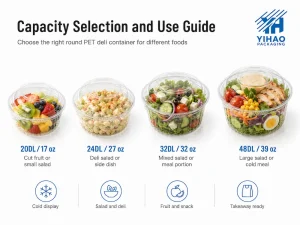
If the food needs strong visual presentation, PET and rPET are usually stronger. Clear fruit portions, salads, desserts, and chilled snacks sell better when customers can see freshness, color, and portion size. PET salad bowls are effective when presentation directly influences purchase decisions.
Step 3: Check Local Composting or Recycling Access
PLA only delivers its compostable value when the local market can process it correctly. If industrial composting is not available, the buyer should reconsider whether PLA is the best choice. In markets with stronger recycling infrastructure, PET or rPET may create a more realistic end-of-life pathway.
Step 4: Verify Claim Documents
Buyers should request compostability certification for PLA, recycled-content documentation for rPET, food-contact documents for all materials, and heat-use information for PP. Sustainability claims should be based on the actual product, not generic material assumptions.
Step 5: Match Material to Wholesale Supply Stability
A good material is not enough if the supplier cannot maintain consistent production. Wholesale buyers should confirm tooling stability, lid compatibility, carton packing, batch consistency, labeling requirements, and custom branding options before placing repeat orders.
When PLA Compostable Containers Are the Better Choice
PLA compostable containers are a better choice when composting access is real, controlled, and documented. This usually happens in closed-loop environments such as stadiums, campuses, office cafeterias, festivals, food courts, hospitality programs, and corporate catering systems.
In these settings, PLA packaging can be collected together with food waste and sent to the correct composting facility. The buyer can also control bin signage, staff training, consumer instructions, and post-use handling. This makes the compostable claim more credible and easier to manage.
PLA is also useful for brands that want plant-based packaging for cold food and beverage applications. Juice bars, smoothie shops, salad retailers, dessert sellers, and event caterers often prefer PLA when the visual appearance needs to stay clean and the brand wants to communicate compostable packaging. However, buyers should avoid broad or vague claims. PLA is not automatically compostable in every environment, and it is not a shortcut for poor disposal planning.
When PET Food Containers Are the Better Choice
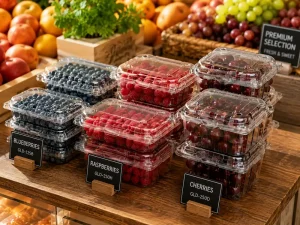
PET is usually the stronger choice when food visibility matters most. Fresh-cut fruit, berries, salads, bakery items, sandwiches, cold deli packs, and grab-and-go meals rely on visual appeal. PET gives buyers the clarity needed to show freshness, texture, color, and portion value.
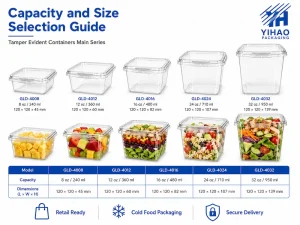
For chilled retail programs, PET also offers practical structure. It supports clear lids, hinged formats, stacking, labeling, anti-fog options, and strong shelf presentation. square PET containers are especially useful when buyers want better shelf efficiency, clean stacking, and organized refrigerated display.
PET is not the right choice for microwave use or high-heat food. Buyers should not use PET simply because it looks premium. The material must match the filling temperature and consumer use case. When the product is chilled and display-driven, PET is a practical and commercially strong choice.
When PP Food Containers Are the Better Choice
PP is the better choice when food is hot, greasy, sauced, reheatable, or microwave-oriented. Prepared meals, rice bowls, noodles, pasta, roasted vegetables, cooked protein, deli meals, and takeaway dishes usually need heat resistance more than glass-like clarity.
For this reason, prepared meal packaging often uses PP because it protects structure during hot filling, counter display, delivery, and reheating. hot food packaging also needs dependable lid fit and temperature performance.
The trade-off is appearance. PP is practical and durable, but it does not usually deliver the same premium transparency as PET or rPET. Buyers should use PP where function is more important than crystal-clear display.
Where rPET Packaging Fits in the Decision
rPET packaging is important because many buyers want the clarity of PET while adding recycled-content value. For chilled foods, clear rPET food containers help maintain product visibility while supporting a recycled-material story.
rPET is especially relevant for supermarkets, convenience stores, cafes, and prepared-food brands that want sustainable packaging without sacrificing shelf appeal. Customers still need to see the product clearly. For salads, fruit, desserts, cold snacks, and layered food, visibility directly affects trust and purchase intent.
However, rPET also requires supply chain discipline. Buyers should confirm recycled-content availability, food-contact suitability, color consistency, clarity stability, and documentation. A recycled-content claim must match the actual product supplied, especially for export, retail, and private-label projects.
Cost, MOQ, and Supply Chain Considerations for Wholesale Buyers
Material choice affects cost, but buyers should not evaluate cost only by unit price. PLA, PET, PP, and rPET each carry different procurement considerations. For a wholesale buyer, the real cost includes material availability, certification, tooling, lid matching, packing efficiency, storage conditions, shipping volume, and repeat-order stability.
PLA may require more careful claim documentation, storage guidance, and end-of-life explanation. PET and PP usually have mature supply chains and broad application coverage. rPET depends on recycled resin availability, food-contact approval, and consistent recycled-content sourcing. These factors affect production planning and long-term pricing more than a simple material comparison.
Buyers should also confirm carton quantity, pallet loading, nesting height, lid compatibility, sample approval, labeling requirements, and private-label packing before placing large orders. A reliable manufacturer should help buyers compare these details before mass production, instead of recommending one material for every project.
For distributors and foodservice brands, the best strategy is often a mixed-material catalog. PLA can serve controlled compostable programs. PET and rPET can serve clear chilled food applications. PP can serve hot and microwave food. This material ladder gives buyers more flexibility across different food categories and regional waste systems.
How to Choose by Food Type and Temperature
Food temperature is the most direct filter. Cold food, hot food, and microwave food should not be placed into the same packaging decision.
For cold beverages such as iced coffee, smoothies, fruit tea, refreshers, matcha drinks, lemonade, and chilled juices, PLA, PET, and rPET can all be considered. PLA supports compostable positioning when collection is controlled. PET cold cups support clear mainstream cold drink packaging. rPET cold cups support recycled-content messaging where supply is available.
For salads, fresh-cut fruit, bakery portions, sandwiches, desserts, and chilled snacks, PET and rPET are usually strong because they support clear presentation. PLA can also be considered when the brand has a credible composting pathway and the container structure fits the product’s shelf-life needs.
For hot meals, microwave meals, and reheatable deli food, PP is usually the right starting point. Buyers should not choose PLA or PET for high-heat applications unless the specific product grade and use conditions have been validated.
How to Choose by Disposal Route
The material only delivers its environmental value when the end-of-life route is realistic. This is where many packaging decisions fail.
Choose PLA compostable containers when industrial composting is available, the product is certified, and collection can be managed. This works best in controlled environments where packaging and food scraps are collected together.
Choose PET or rPET when the market has stronger recycling infrastructure than composting infrastructure, and when the package design matches local collection and sorting rules. Buyers should avoid broad recyclable claims unless the actual container format, label, color, and local market conditions support that claim.
Choose PP when heat resistance, microwave use, and hot food performance are the main requirements. PP may not look as clear as PET, but it often protects hot meals better and reduces the risk of deformation during use.
Compliance and Labeling: The Risk Buyers Should Not Ignore
Sustainability claims are not just marketing language. They are part of packaging risk management. Terms such as compostable, recyclable, biodegradable, recycled content, plant-based, and eco-friendly must be used carefully.
For PLA, buyers should request compostability certification, food-contact documentation, disposal guidance, and any storage or temperature-use limits. The claim should be specific, such as “commercially compostable where accepted,” when that wording matches the product and market. Broad claims that imply the package will break down anywhere create avoidable risk.
For PET and rPET, buyers should verify recyclability design, recycled-content claims, and food-contact suitability. For PP, buyers should verify microwave or heat-use conditions when those claims are important to the application. A professional supplier should provide documentation that matches the actual item being purchased.
Wholesale Buying Checklist for PLA, PET, PP, and rPET Packaging
- Food type: Is the product cold, hot, oily, wet, dry, acidic, or delicate?
- Temperature condition: Will the package be refrigerated, frozen, hot-filled, reheated, or microwaved?
- Display need: Does the product need high clarity for retail conversion?
- Disposal route: Is industrial composting or recycling realistically available in the target market?
- Claim support: Can the supplier provide certification, test reports, food-contact documents, or recycled-content records?
- Structure: Does the project require a hinged lid, separate lid, tamper-evident seal, compartment design, or anti-fog feature?
- Supply stability: Can the supplier maintain material consistency and lid fit across repeat wholesale orders?
- Branding: Does the project require custom printing, embossing, labels, private-label carton packing, or retail-ready packaging?
Buyer Scenario: Which Material Should You Choose?
Scenario 1: Juice Bar or Smoothie Chain
If the business sells cold drinks and has a controlled composting program, PLA is a strong option. If the market does not accept PLA compostable packaging, PET or rPET may be more practical. The buyer should compare PLA compostable containers with PET and rPET drink cups based on disposal access, lid compatibility, clarity, branding, and cost.
Scenario 2: Supermarket Fresh-Cut Fruit Program
PET or rPET is usually stronger because visibility drives purchase decisions. Fruit color, freshness, condensation control, stacking performance, and label placement all matter in refrigerated retail display. PLA should only be selected when composting access is confirmed and the structure supports the product’s shelf-life needs.
Scenario 3: Hot Meal Takeaway Counter
PP is the practical choice. Hot prepared food requires heat resistance, structure retention, grease tolerance, and reliable lid fit. PLA and PET should not be used as default hot meal packaging.
Scenario 4: Closed-Loop Campus or Event Catering
PLA becomes more attractive when the operator controls collection. In this environment, signage, bins, staff training, and composting partners can be aligned. This gives compostable packaging a clearer and more credible role.
Scenario 5: Export Distributor Building a Multi-Material Catalog
A distributor should not rely on one material. A stronger catalog includes PLA for controlled compostable programs, PET and rPET for clear chilled food, PP for hot and microwave applications, and category-specific lids for drinks, deli, bakery, and fresh produce.
Final Recommendation: Do Not Buy the Material First
The biggest mistake is choosing a material before defining the application. Material selection should follow the food type, filling temperature, display need, sales channel, disposal route, compliance claim, and supply chain plan.
Choose PLA compostable containers when composting is real, certified, and controlled. Choose PET when chilled food clarity and retail display matter most. Choose PP when heat resistance and microwave use are required. Choose rPET when buyers want recycled-content positioning while keeping the visual advantages of PET.
Professional packaging buyers should treat material selection as an operational decision, not a slogan. The best packaging material is the one that protects food, supports credible claims, fits local infrastructure, and can be supplied consistently at wholesale scale.
FAQ
1. Are PLA compostable containers safe for food packaging?
PLA compostable containers are commonly used for food packaging when they are manufactured for food-contact applications and supplied with the correct documentation. Buyers should request food-contact information, compostability certification, and application guidance before placing wholesale orders.
2. What is the difference between PLA and PET food containers?
PLA is a plant-based material selected for compostable packaging programs when industrial composting is available. PET is a petroleum-based plastic widely used for clear chilled food containers because it offers strong transparency, rigidity, and retail display value.
3. Can PLA containers be used for hot food?
PLA is generally better suited for cold food and cold beverage applications. For hot food, reheatable meals, and microwave use, PP food containers are usually a stronger choice because they provide better heat resistance and structure retention.
4. Are PLA containers recyclable or compostable?
PLA containers are designed for composting when the product is certified and accepted by the correct composting facility. They should not be treated as ordinary PET or PP recycling. Buyers should confirm local composting acceptance before making compostable claims.
5. Which is better for wholesale food packaging, PLA, PET, PP, or rPET?
The best material depends on the application. PLA is suitable for controlled compostable programs, PET is strong for clear chilled food display, PP is better for hot and microwave food, and rPET supports recycled-content packaging while keeping PET-like clarity.
References
- Federal Trade Commission, Guides for the Use of Environmental Marketing Claims, 16 CFR Part 260.
- Biodegradable Products Institute, BPI Certified Compostable Products and Packaging Program.
- NatureWorks, Ingeo Food Serviceware Application Information.
- U.S. Environmental Protection Agency, Composting and Sustainable Management of Food.
- CalRecycle, SB 54 Plastic Pollution Prevention and Packaging Producer Responsibility Act.
- European Union, Regulation (EU) 2025/40 on Packaging and Packaging Waste.
- Association of Plastic Recyclers, APR Design Guide for Plastic Packaging Recyclability.
- Sustainable Packaging Coalition, Understanding the Role of Compostable Packaging in North America.
Deep-Dive Insights: What Buyers Should Understand Before Switching to PLA Compostable Containers
How should buyers evaluate PLA compostable containers?
Buyers should evaluate PLA compostable containers by application, certification, disposal route, temperature limit, and supplier documentation. PLA performs best when the buyer can connect the package to a real industrial composting system instead of relying on a broad environmental claim.
Why does local infrastructure matter?
Compostable packaging only creates value when the target market accepts and processes it correctly. If industrial composting is unavailable, PET, PP, or rPET may provide a more practical packaging route depending on the food type and customer use case.
What role do PET, PP, and rPET still play?
PET remains important for clear chilled food display. PP remains important for hot food and microwave applications. rPET remains important for buyers that want recycled-content packaging with strong visual clarity. PLA is not a full replacement for all plastic packaging materials; it is one strategic option within a broader material system.
Option buyers should consider
A mixed-material packaging catalog is often stronger than a single-material strategy. PLA can serve compostable cold food programs, PET and rPET can serve chilled retail packaging, and PP can serve hot prepared meals. This approach gives distributors, foodservice brands, and retailers better flexibility across regions and product categories.
Consideration for wholesale purchasing
Before switching materials, buyers should confirm MOQ, carton packing, lid compatibility, labeling, certification documents, lead time, and repeat-order stability. A professional food packaging supplier should help buyers match material claims with real operating conditions.
Final Note / Practical Takeaway
© YIHAO Packaging. All rights reserved. All articles, product images, packaging designs, technical specifications, and website materials are protected by copyright. Unauthorized copying, reproduction, redistribution, modification, or commercial use is strictly prohibited without prior written permission.