Choosing the best PP food containers is not simply about finding a plastic box with a lid. For supermarkets, deli counters, takeaway restaurants, central kitchens, prepared meal brands, and chilled food suppliers, the real buying question is more practical: which container protects the food, closes reliably, stacks cleanly, handles real service conditions, and supports repeat wholesale ordering?
YIHAO is a food packaging manufacturer and solution provider focused on practical food container systems for fresh food, chilled meals, deli products, takeaway foods, bakery items, and ready-to-eat packaging applications. In real procurement, buyers rarely compare PP alone. They usually evaluate PP food containers against PET food containers, rPET packaging, and PLA compostable containers because each material solves a different packaging problem.
This article focuses on where PP performs best: takeaway meals, deli foods, cold dishes, chilled food packaging, prepared meals, and label-driven retail display. It also explains when PET food containers are a better choice for clarity, when PLA compostable containers need careful disposal conditions, and how buyers should compare PET vs PP vs PLA packaging before choosing a wholesale supplier.
Why PP Food Containers Are a Practical Choice for Food Packaging Buyers
PP, or polypropylene, is widely used in food packaging because it delivers a useful balance of strength, lightweight structure, lid compatibility, and operational practicality. For food packaging buyers, this matters more than a single material slogan. A container must survive filling, stacking, transport, shelf handling, customer pickup, and sometimes reheating or chilled storage.
The strongest value of PP food containers is functional performance. PP is often selected when the food is meal-like, heavier, saucier, oilier, or served through takeaway and prepared food channels. Compared with crystal-clear display materials, PP usually gives better practical handling for foods that need structure more than maximum transparency.
This is why microwave safe containers are often associated with PP-based packaging systems. Buyers still need supplier confirmation before making microwave claims, but PP is usually a more logical direction than PET when the food category involves heat, prepared meals, or takeaway service.
Best PP Food Container Types by Application
The best PP food containers are not one universal container type. Different food businesses need different PP formats. A deli counter needs a different container from a central kitchen, and a cold dish supplier needs a different solution from a hot takeaway brand. The table below gives a practical selection framework for B2B buyers.
| Application | Best PP Container Type | Why It Works | Best Buyer Fit |
|---|---|---|---|
| Takeaway meals | PP container with separate lid | Supports stacking, portion control, and practical meal handling | Restaurants, meal prep brands, foodservice counters |
| Deli counters | Large PP deli food container | Useful for chilled sides, cooked food, retail takeaway, and larger portions | Supermarkets, delicatessens, prepared food suppliers |
| Cold dishes | PP prepared food container | Stable structure for marinated food, noodles, side dishes, and chilled meals | Asian food counters, chilled food brands, takeaway suppliers |
| Hot takeaway | PP hot food container | More suitable than PET for heat-related meal packaging when properly specified | Takeaway restaurants, catering brands, prepared meal kitchens |
| Fresh meat rolls and protein portions | PP food container with secure separate lid | Provides cleaner protection and stronger handling for heavier food portions | Meat counters, deli suppliers, chilled protein packers |
For prepared meal and counter display programs, prepared meal containers with separate lids are a strong starting point. For larger retail takeaway portions, large deli food packs provide a more practical format for chilled sides, cooked dishes, and ready-to-eat meals.
Where PP Food Containers Perform Best
PP food containers perform best when the food packaging task is functional, not purely visual. That does not mean PP cannot be used for retail display. It means buyers should use PP where the product is sold by portion, label, meal type, convenience, or foodservice practicality rather than crystal-clear shelf appearance.
Prepared Meals and Takeaway Food
Prepared meals need packaging that supports filling, closing, stacking, and transport. PP works well in this channel because the container body usually feels more stable for meal portions than lightweight display packaging. For takeaway meals, a PP container with a separate lid gives staff a practical packing process and gives customers a cleaner serving experience.
For food counters and prepared meal suppliers, hot food takeaway containers are more relevant than clear PET clamshells when the main requirement is service performance rather than visual display.
Deli Foods and Retail Takeaway Packs
Deli foods often include oils, sauces, mixed textures, cooked vegetables, pasta salads, potato salad, marinated food, hummus, dips, chicken slices, deli meat portions, and chilled side dishes. These foods need a container that protects the product and remains stable during customer handling.
For this type of application, cold food and retail takeaway packs give buyers a practical PP direction. The container does not need to act like a premium display box. It needs to hold the food cleanly, support the lid, and work reliably in the service process.
Cold Dishes and Chilled Food
Chilled food packaging includes cold noodles, pasta salad, potato salad, marinated vegetables, chilled ready meals, cold side dishes, cooked protein portions, dips, and prepared deli foods. PP works well when these products are heavier, sauce-based, or selected by label and portion size.
For cold dishes and chilled meal packs, cold dishes and hot takeaway meals can use PP formats when the container structure, lid type, and food-contact requirements match the application.
Fresh Meat Rolls and Protein Packaging
Fresh meat rolls, sliced proteins, prepared protein portions, and chilled meat-based foods usually need stronger packaging than light snack packs. PP gives buyers a practical structure for food protection and handling. For these applications, fresh meat and roll packaging is a better direction than a fragile display-only container.
PP Food Containers for Retail Display: The Correct Positioning
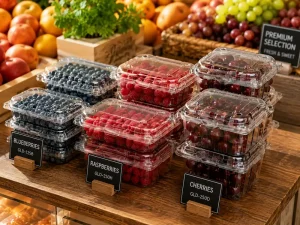
PP can be used for retail display, but it should be positioned correctly. PP is not the best choice when the product needs crystal-clear visibility. If the food sells through bright color, layered freshness, or premium visual appeal, PET or rPET often performs better. This is especially true for fruit, leafy salad, bakery desserts, and fresh snack packs.
However, retail display is not always about maximum transparency. Many products are sold by label, portion, meal type, nutrition claim, flavor, convenience, or price point. In these situations, PP can work very well. PP is suitable for label-driven and meal-driven retail display, especially when the product is a prepared meal, cold dish, deli side, marinated food, chilled noodle pack, cooked vegetable portion, or ready-to-eat meal.
| Retail Display Scenario | Is PP a Good Fit? | Reason | Better Alternative When Needed |
|---|---|---|---|
| Prepared meals with printed labels | Yes | Purchase decision depends on meal type, label, and portion | PET only if clear visual display is essential |
| Deli sides and cold dishes | Yes | PP supports stable packing and practical food handling | PET for higher shelf visibility |
| Fresh-cut fruit | Usually not first choice | Fruit relies heavily on visual freshness | PET or rPET |
| Premium salad display | Limited | Clear appearance is often more important | PET salad bowls or rPET containers |
| Chilled ready meals | Yes | Meal function and portion format matter more than full transparency | PET only for premium clear presentation |
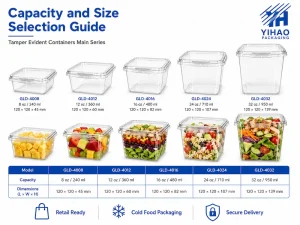
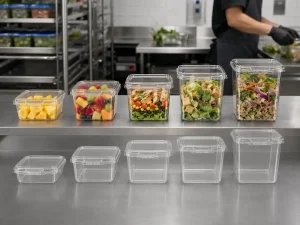
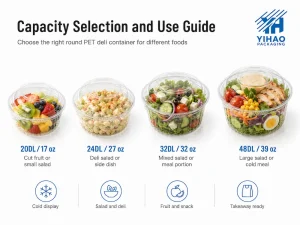
For chilled foods where visibility is the main conversion driver, buyers should also review deli and salad containers, clear PET salad bowls, and square PET containers.
PP Food Containers for Takeaway: The Strongest Use Case
Takeaway packaging is where PP food containers become especially valuable. A takeaway package must be practical for staff, stable for transport, and acceptable for the customer. It must close properly, stack efficiently, resist deformation, and keep the food in a clean serving format.
PP performs well in this environment because it supports stronger body structure, better lid matching, stable stacking, and takeaway-friendly handling. These benefits matter during busy service hours when staff need fast packing and customers expect the food to arrive cleanly.
For takeaway meals, PP is often more practical than PET because the buying decision is not based only on visibility. A customer ordering a prepared meal, noodle dish, rice dish, deli side, or hot takeaway portion cares about convenience, portion size, leakage control, and overall handling. PP packaging fits this logic better than a clear display-only container.
PP Food Containers for Chilled Food: Strong for Meal-Like Products
Chilled food does not always need crystal-clear packaging. Some chilled products sell through freshness appearance, while others sell through meal function, flavor, portion, or convenience. This is why buyers should separate chilled food into two groups.
The first group includes products that need maximum visibility: fresh-cut fruit, colorful salads, layered desserts, bakery portions, and premium snack packs. PET or rPET is usually better here. The second group includes meal-like chilled foods: cold noodles, pasta salad, potato salad, marinated vegetables, cooked protein portions, hummus, dips, deli meat portions, cold side dishes, and chilled ready meals. PP is often a stronger practical choice for this group.
| Chilled Food Type | Recommended Material Direction | Why | Buyer Priority |
|---|---|---|---|
| Cold noodles and pasta salad | PP | Stable structure for heavier and sauce-based foods | Lid fit, portion depth, takeaway handling |
| Potato salad and deli sides | PP | Practical for retail takeaway and deli service | Stacking, filling speed, stable body shape |
| Fresh-cut fruit | PET / rPET | Clear visibility supports freshness perception | Clarity, anti-fog needs, shelf appeal |
| Premium leafy salad | PET / rPET | Visual freshness drives purchase | Transparency and display shape |
| Chilled ready meals | PP | Meal format and handling matter more than full clarity | Portion control, label space, lid security |
When PP Is Better Than PET, rPET, or PLA
A strong PET vs PP vs PLA packaging comparison should not ask which material is universally best. It should ask when PP is the best answer. PP is better when the food is meal-like, takeaway-driven, functional, heavier, warm-use oriented, or selected by label and portion rather than visual freshness.
PP is not the best answer when the food must look extremely clear on shelf. In that case, PET cold cups, PET containers, or rPET packaging may create better display value. PP is also not a compostability solution. If the project requires compostability positioning, PLA may be considered, but only under the right cold-use and industrial composting conditions.
| Buyer Question | Choose PP When… | Choose PET / rPET When… | Choose PLA When… |
|---|---|---|---|
| Does the food need strong handling? | Yes, especially for meals and takeaway food | Only if display clarity is more important | Only for cold-use programs with disposal support |
| Does the food need crystal-clear display? | Not the first choice | Yes, PET and rPET are stronger | Limited clarity and use-case restrictions |
| Is the product takeaway-focused? | Yes, PP is usually practical | Better for cold visual display | Only when the market supports compostable collection |
| Is sustainability messaging important? | Use verified material and recycling claims carefully | rPET may support recycled-content positioning | Use only with accurate compostability claims |
Where PET Food Containers and rPET Packaging Still Win
PP is strong, but it should not be forced into every chilled retail project. PET food containers and rPET packaging still win when visual presentation is the main selling factor. Clear PET packaging helps customers see freshness, color, portion shape, toppings, layers, and product quality before purchase.
For salads, fruit cups, bakery desserts, snack packs, and premium cold display, PET or rPET often creates stronger shelf impact. For sustainability-positioned clear packaging, recycled PET hinged deli containers are relevant when buyers want both clear appearance and recycled material direction.
The key is not to make one material do every job. A smart packaging range may use PP for meals and deli foods, PET for clear chilled display, rPET for recycled-content display projects, and PLA only for specific compostability-focused cold-use programs.
Wholesale Buying Checklist for PP Food Containers
Before choosing a PP food containers manufacturer, wholesale supplier, or factory partner, buyers should test the packaging from both product and operation angles. A container that looks fine in a sample photo may still fail if the lid fit, stacking height, portion depth, carton packing, or material claim is wrong.
| Checklist Item | What to Check | Why It Matters |
|---|---|---|
| Food type | Oil, sauce, weight, temperature, chilled or takeaway use | Material choice must match real food conditions |
| Lid fit | Closure strength, matching lid, stacking behavior | Poor lid fit causes leakage, returns, and customer complaints |
| Container depth | Actual food portion and headspace | Wrong depth affects presentation and filling efficiency |
| Display requirement | Clear visibility or label-driven retail display | Determines whether PP, PET, or rPET is the better material |
| Supplier documentation | Material specification, food-contact suitability, claim support | Prevents unverified microwave, recyclable, recycled, or compostable claims |
A capable food packaging manufacturer should not recommend one material for every project. The right supplier should explain when PP is the best option and when PET, rPET, or PLA will produce a better packaging result.
Common Mistakes When Choosing PP Food Containers
Mistake 1: Expecting PP to Look Like PET
PP is practical and strong, but it is not the best material for crystal-clear display. If visual clarity is the main sales driver, PET or rPET is usually the better direction.
Mistake 2: Choosing PET for Food That Needs PP Functionality
PET looks clear, but it is not always the best choice for meal-like takeaway foods. If the food is heavier, warmer, saucier, or more operationally demanding, PP is often more practical.
Mistake 3: Treating All PP Containers as Microwave Safe
PP is commonly associated with heat-related use, but buyers should not assume every PP container and lid is microwave safe. The final claim depends on material specification, lid design, product structure, and supplier documentation.
Mistake 4: Using PLA Claims Without Composting Infrastructure
PLA compostable containers need the right disposal conditions. Without industrial composting infrastructure and clear customer guidance, compostability claims can create confusion and compliance risk.
Mistake 5: Buying Only by Unit Price
The cheapest container is not always the lowest-cost packaging solution. Weak lid fit, unstable stacking, poor portion match, or wrong material selection can damage food presentation and increase operational problems.
How to Build a Smarter PP-Based Packaging Mix
A strong food packaging plan often combines several materials instead of forcing one material across every SKU. A supermarket or prepared food brand may use PP for prepared meals, PET for fresh salad display, rPET for sustainability-positioned chilled packs, and PLA for limited compostability programs where infrastructure supports the claim.
For example, a chilled food brand could use PP food containers for cold noodles, deli sides, and ready meals. It could use PET for fruit and salad display. It could use rPET packaging for premium chilled snack packs where recycled-content positioning matters. This mixed-material strategy gives buyers better performance than treating one material as the answer to every packaging problem.
For cup-based cold beverage programs, buyers can also compare PP cold cups with PET and PLA cup options. The same logic applies: PP is practical, PET is clear, rPET supports recycled-content display positioning, and PLA depends on composting infrastructure.
FAQ
1. What are PP food containers best used for?
PP food containers are best used for takeaway meals, deli foods, prepared dishes, cold side dishes, chilled ready meals, and meal-like food packaging where structure, lid fit, stacking, and practical handling are more important than maximum crystal-clear display.
2. Are PP food containers good for retail display?
Yes, PP food containers are good for label-driven and meal-driven retail display, such as prepared meals, deli sides, chilled noodles, and ready-to-eat foods. For premium visual display, fresh fruit, leafy salads, and desserts, PET or rPET containers usually create better clarity.
3. Are PP food containers better than PET food containers?
PP is better for many takeaway, deli, and prepared meal applications because it provides practical handling and stable structure. PET is better when clear shelf display is the main priority. The best choice depends on food type, temperature use, lid structure, and display requirements.
4. What is the difference between PET, PP, and PLA packaging?
PP is mainly used for functional food packaging and takeaway applications. PET is mainly used for high-clarity chilled display. PLA is used for compostability-positioned cold packaging where proper industrial composting conditions exist. Buyers should compare PET vs PP vs PLA packaging by application, not by slogan.
5. How should wholesale buyers choose PP food containers?
Wholesale buyers should check food type, portion size, lid fit, stacking performance, display needs, material documentation, and supplier capability. A reliable supplier should explain when PP is suitable and when PET, rPET, or PLA would create a better packaging result.
References
- U.S. Food and Drug Administration, 21 CFR 177.1520 Olefin Polymers.
- European Union, Commission Regulation (EU) No 10/2011 on plastic materials and articles intended to come into contact with food.
- European Commission, Packaging and Packaging Waste Regulation (EU) 2025/40 overview.
- Association of Plastic Recyclers, APR Design Guide for Plastics Recyclability.
- U.S. Environmental Protection Agency, Plastics: Material-Specific Data.
- Federal Trade Commission, Guides for the Use of Environmental Marketing Claims.
- European Bioplastics, EN 13432 certified bioplastics and industrial composting guidance.
- TÜV SÜD, EN 13432 biodegradable packaging certification overview.
Deep Dive Insights
How should buyers decide whether PP is the best material?
Buyers should choose PP when the food is meal-like, takeaway-focused, heavier, sauce-based, or selected by label and portion size. PP is strongest when packaging must support handling, stacking, lid matching, and service efficiency. It is not the first choice when the product depends on premium transparent display.
Why does PP work well for takeaway and deli food?
Takeaway and deli foods place pressure on the container during filling, closing, stacking, transport, and customer handling. PP food containers are practical because they support stronger body structure and more functional foodservice use than many display-only packaging formats.
What should buyers compare before switching from PET to PP?
Before switching from PET to PP, buyers should compare shelf appearance, food weight, lid fit, food temperature, oil or sauce content, retail channel, and customer expectation. PET may win on clarity, while PP may win on practical meal packaging performance.
Which option is better for sustainability positioning?
No material should be called sustainable without context. rPET can support recycled-content positioning when documentation is available. PLA can support compostability positioning only where industrial composting conditions exist. PP remains a practical packaging material, but recycling and claim language must follow local rules and actual infrastructure.
What is the most practical wholesale strategy?
The best wholesale strategy is to build a mixed packaging system. Use PP for takeaway meals and deli foods, PET for clear chilled display, rPET for recycled-content display packaging, and PLA only for carefully managed compostability programs. This approach gives buyers stronger performance than using one material across every product line.
Final Note / Practical Takeaway
© YIHAO Packaging. All rights reserved. All articles, product images, packaging designs, technical specifications, and website materials are protected by copyright. Unauthorized copying, reproduction, redistribution, modification, or commercial use is strictly prohibited without prior written permission.