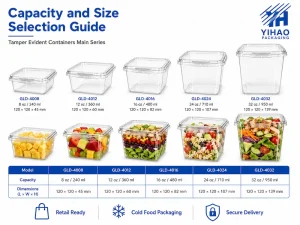
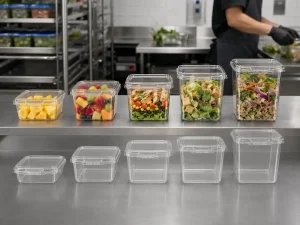
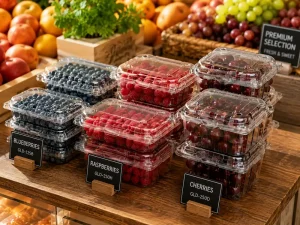
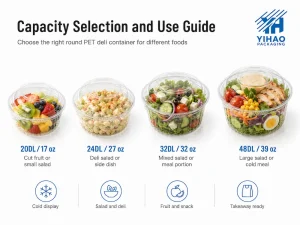
Choosing PET food containers is not only a material decision. For food packaging teams, it affects shelf visibility, food presentation, cold-chain handling, lid fit, portion planning, packaging cost, sustainability messaging, freight efficiency, and long-term supplier reliability. A clear container that looks attractive in a catalog still needs to perform during filling, stacking, refrigeration, transportation, retail display, and takeaway handling.
YIHAO works with food brands, distributors, supermarkets, cafes, bakeries, salad shops, fruit suppliers, and prepared-food teams that need practical food packaging systems rather than generic plastic boxes. The best packaging decision starts with one direct question: what job does the container need to complete for the food?
For chilled food, the answer often points toward PET or rPET packaging. PET offers excellent transparency, a clean retail appearance, lightweight rigidity, and strong compatibility with many fresh-food applications. PP food containers remain important for hot food and microwave-oriented packaging. PLA compostable containers support selected compostability programs when local infrastructure and certification requirements are clear. Each material has value, but each material belongs in a different purchasing lane.
Why PET Food Containers Remain a Strong Choice for Chilled Food Packaging
PET food containers are especially effective when the product must be visible before purchase. Fresh-cut fruit, salad bowls, bakery clamshells, deli sides, chilled snacks, cold beverages, and grab-and-go meals all depend on appearance. Customers judge freshness quickly. If the packaging looks cloudy, weak, or distorted, the food loses value before the label is even read.
This is why many food teams choose PET for PET hinged deli containers, clear produce clamshells, salad bowls, bakery packs, and cold cup systems. PET supports a crisp transparent look that performs well under supermarket lighting, cafe counters, convenience-store chillers, and takeaway display cases.
For foodservice operators, the advantage is operational as well as visual. PET containers are lightweight, stackable, and suitable for high-volume packing workflows. For wholesale buyers, this reduces storage pressure and simplifies carton planning. For brand owners, PET supports clear labeling, custom shapes, embossed logos, and consistent retail display.
However, PET is not a universal solution for every food application. It is primarily a strong choice for cold and chilled food use. When the food is hot, oily at high temperature, or intended for reheating, buyers should review PP food containers or other heat-tolerant formats instead. The most common purchasing mistake is treating all plastic packaging materials as interchangeable. They are not.
PET vs PP vs PLA Packaging: Which Material Should Food Teams Choose?
The comparison between PET vs PP vs PLA packaging should begin with real use conditions, not marketing slogans. A food packaging material must match temperature, food type, visibility needs, transportation, disposal route, branding requirements, and order volume.
| Material | Best-Fit Applications | Main Strengths | Buyer Watch Points | Best Buying Decision |
|---|---|---|---|---|
| PET | Chilled food, fresh fruit, salads, bakery portions, deli sides, cold drinks | High clarity, strong display value, lightweight rigidity, clean retail appearance | Not the first choice for microwave heating or hot-fill applications | Choose PET when chilled display and product visibility matter most |
| rPET | Chilled food packaging with recycled-content positioning | Clear appearance, recycled-content story, familiar PET-like performance | Requires food-contact documentation and reliable material traceability | Choose rPET when sustainability messaging and PET performance must work together |
| PP | Prepared meals, hot takeaway food, microwave-oriented packaging | Better heat resistance, practical toughness, strong fit for reheating | Usually less clear than PET for premium transparent display | Choose PP when heat resistance matters more than crystal-clear presentation |
| PLA | Selected cold food and cold drink programs with compostability goals | Bio-based positioning and compostability potential when certified | Requires local composting acceptance, correct labeling, and claim control | Choose PLA only when the disposal route supports compostable packaging |
For chilled salads, fresh fruit, bakery portions, and retail-ready snacks, PET food containers usually provide the clearest selling advantage. For reheatable meals, microwave safe containers and PP-based systems are more practical. For compostability-driven programs, PLA compostable containers belong in the discussion only when the buyer understands certification, local acceptance, collection routes, and customer behavior.
Material Selection Matrix for Food Packaging Buyers
Food packaging teams often need a fast material decision before moving into sample testing. The following matrix gives a practical starting point for comparing PET, PP, PLA, and rPET packaging by buyer requirement.
| Buyer Requirement | PET | PP | PLA | rPET |
|---|---|---|---|---|
| Cold food display | Excellent | Medium | Good | Excellent |
| Heat resistance | Low to medium | Strong | Limited | Low to medium |
| Transparency | Excellent | Medium | Good | Excellent |
| Recycled-content story | Limited | Limited | No | Strong |
| Compostability claim | No | No | Possible with certification | No |
| Main buyer use | Chilled display packaging | Hot or reheatable meals | Compostable packaging programs | Sustainable chilled packaging |
How to Choose PET Food Containers by Food Category
The right PET format depends on the food category. Food packaging teams should not choose by ounce capacity alone. Product height, moisture level, topping protection, shelf layout, lid security, and stacking behavior all affect performance.
| Food Category | Recommended Container Type | Why PET Works | Buyer Checkpoint |
|---|---|---|---|
| Fresh-cut fruit | Hinged clamshell, clear bowl, lidded tray | Shows color, freshness, cut quality, and portion value | Check ventilation, anti-crush structure, and lid fit |
| Salad | Round bowl, square deli container, hinged deli pack | Displays toppings, greens, grains, proteins, and dressing presentation | Check lid security, stacking strength, and food height |
| Bakery dessert | Bakery clamshell, high-dome container, flat-lid dessert tray | Protects visual value while keeping cakes and toppings visible | Check lid height, base rigidity, and anti-deformation performance |
| Deli sides | Square PET container, hinged deli container, portion cup | Supports portion control and organized chilled display | Check closure feel, leakage risk, and shelf blocking |
| Cold drinks | PET cold cup with matching flat or dome lid | Shows drink color, ice, foam, fruit inclusions, and branding labels | Check lid compatibility, diameter system, and cup clarity |
Best Applications for PET Food Containers
Fresh Produce and Fresh-Cut Fruit
Fresh produce packaging needs visibility, ventilation logic, stacking strength, and stable shape retention. For berries, grapes, apple slices, fruit mixes, and snack packs, PET clamshells and trays help customers see color, cut quality, and portion size. Clear packaging also supports fast inspection during retail handling.
Food teams that sell fruit cups, fruit platters, and chilled fruit mixes often use fresh-cut fruit containers to balance visibility with portion control. A fruit supplier should not choose packaging only by volume. The container must protect delicate edges, reduce crushing, and maintain a clean display after transportation.
Deli, Salad, and Grab-and-Go Meals
For salads, pasta salads, cold noodles, deli sides, fruit salads, and chilled meal components, PET supports a clean and modern presentation. Round bowls, square deli containers, and hinged packs each serve different display needs. Round bowls are strong for premium chilled salads. Square containers improve shelf blocking and space efficiency. Hinged deli containers simplify fast packing for foodservice teams.
For buyers building a flexible refrigerated food program, round PET containers and square PET containers should be compared by food height, topping visibility, shelf layout, and lid security. The best choice is rarely about shape alone. It is about how the container supports the food’s selling moment.
Bakery and Chilled Dessert Packaging
Bakery products need structure. Cheesecake slices, brownies, tiramisu portions, cream rolls, cupcakes, muffins, cookies, and decorated desserts lose value when the lid touches the topping or when the base bends during handling. PET bakery packaging provides clear display while keeping the product visually protected.
For retail bakery programs, bakery clamshell containers work well because the customer sees the dessert without opening the package. Clear PET also helps small bakeries, supermarket bakeries, and dessert brands create a more premium chilled-shelf impression without overcomplicating SKU planning.
Cold Drinks and Beverage Menus
PET is also widely used in cold beverage packaging. Iced coffee, cold brew, lemonade, smoothies, matcha, refreshers, fruit tea, sparkling fruit drinks, protein drinks, and flavored cold brew require cups and lids that look clean, fit consistently, and support menu expansion. A transparent cup shows color layers, fruit inclusions, foam, ice, and branding labels clearly.
For beverage teams, PET cold cups are not just drink holders. They are part of the visual identity of the drink menu. Lid compatibility, diameter logic, cup wall clarity, stacking, and carton quantity all matter when the business moves from small daily sales to multi-store wholesale purchasing.
rPET Packaging: Useful Sustainability Value, but Documentation Matters
rPET packaging gives buyers a practical way to discuss recycled content while keeping many PET performance advantages. In food packaging, rPET must be treated carefully. Buyers should not accept vague recycled-content claims without asking for documentation. Food-contact suitability, recycled-content percentage, material traceability, and market-specific compliance all need supplier confirmation.
For brands that want clearer sustainability positioning, recycled PET hinged deli containers support a strong chilled-food story when the packaging is matched to the correct food type. rPET packaging is especially relevant for supermarkets, salad brands, fresh-food chains, and distributors that want a more circular material message without shifting entirely into compostable packaging.
Still, rPET is not a shortcut to automatic environmental credibility. A buyer should confirm whether the material is suitable for the intended food-contact use, whether the supplier can provide supporting documents, and whether the packaging structure remains consistent across repeat production. Strong sustainability messaging requires strong purchasing discipline.
PP Food Containers: Where PP Makes More Sense Than PET
PP food containers are important in applications where heat resistance matters. Prepared meals, hot takeaway dishes, reheatable food, deli meals, and microwave-oriented packaging often require PP because PET is not normally selected for high-heat use. For food teams selling both chilled and reheatable products, PET and PP usually belong in the same procurement strategy but serve different roles.
A practical sourcing approach is simple: use PET for chilled display-driven foods, and use PP when reheating or higher temperature tolerance is central to the product experience. For example, a supermarket might use PET for salads and fruit bowls, then choose PP prepared food containers for hot takeaway meals or reheatable deli items.
This separation helps packaging teams avoid performance complaints. A container that looks attractive but fails in the wrong temperature condition damages trust. A good supplier should help buyers map PET, PP, PLA, and rPET packaging by application instead of pushing one material for every job.
PLA Compostable Containers: Useful, but Not a Universal Replacement
PLA compostable containers are often discussed as an alternative to conventional plastic packaging materials. They have a place in the market, especially for buyers with a verified compostable packaging program. But PLA should not be presented as a simple one-for-one replacement for PET in every application.
The correct question is not only “Is PLA more sustainable?” The correct question is “Does this sales channel have the right collection, certification, composting infrastructure, labeling, and customer behavior to support compostable packaging?” Without that system, compostable claims become weak and potentially misleading.
PLA packaging is generally more relevant for selected cold-food or cold-drink applications than for high-heat food use. Buyers should check temperature limits, lid fit, storage conditions, certification, and local acceptance before committing to bulk orders. For many chilled retail foods, PET food containers still provide stronger clarity, structure, and mainstream supply stability.
How Food Packaging Teams Should Evaluate PET Food Containers
1. Match the Container to the Food, Not Just the Capacity
Capacity alone does not define fit. A 16oz container for leafy salad has a different performance requirement from a 16oz container for fruit cubes, deli sides, or snack mixes. Buyers should check food height, topping protection, moisture level, sauce separation, ventilation needs, and whether the food will be stacked in transit.
For premium chilled items, a clear PET food container gives stronger value when the lid height, base rigidity, and closure feel match the product. A container that looks correct in a sample photo still needs carton testing and real packing trials.
2. Confirm Lid Security and Closure Design
Lid fit is one of the most underestimated details in food packaging. A beautiful PET container fails commercially if the lid pops open during delivery, if staff struggle to close it, or if the hinge weakens after repeated handling. For hinged containers, check snap feel, hinge strength, closure alignment, and how easily staff close the pack during peak hours.
For separate-lid systems, test the fit between base and lid across different production batches. Slight inconsistency creates leakage complaints, especially in deli, salad, and fresh-cut fruit applications. Strong suppliers control tooling, material thickness, trim quality, and packing method to keep performance consistent.
3. Review Shelf Display and Merchandising Logic
Food packaging is part of retail selling. A round bowl may look premium, but a square container may use shelf space more efficiently. A high lid may protect toppings, but it may reduce carton efficiency. A flat lid may improve stacking, but it may not protect tall food. Buyers should compare display value and logistics efficiency together.
For chilled meal and salad programs, square PET containers for salad and deli meals support organized shelf blocking and clear front-facing product presentation. For premium salad bowls, round PET options provide a different visual feel. The right answer depends on the sales environment.
4. Check Labeling, Branding, and Customization Needs
Food brands often start with plain stock packaging, then move toward customized packaging as volume grows. PET works well with labels, sleeves, embossing, and selected custom shapes. For private-label projects, the buyer should confirm artwork handling, sampling lead time, carton labeling, barcode needs, logo placement, and whether the supplier supports OEM or private-label packaging programs.
A capable manufacturer should guide buyers through tooling feasibility, minimum order planning, carton size, stacking tests, and sample review. The strongest supplier relationship is not based on the lowest unit price alone. It is based on repeatable quality, stable communication, and fewer hidden packaging failures.
5. Ask for Food-Contact and Material Documentation
For export and wholesale purchasing, documentation matters. Buyers should request material information, food-contact suitability details, recycled-content documentation where relevant, and packaging specifications. Markets differ, so buyers should confirm the target market requirements before printing claims or placing a large order.
This is especially important for rPET packaging and PLA compostable containers. Recycled-content and compostability claims must be controlled. A supplier that cannot explain the material clearly is not the right partner for serious food packaging teams.
How to Work with a PET Food Containers Manufacturer or Wholesale Supplier
A good PET food containers manufacturer or wholesale supplier should do more than quote a unit price. For professional food packaging teams, the supplier should help confirm material choice, container structure, lid compatibility, carton packing, sample testing, export documentation, and long-term batch consistency.
Before placing a wholesale order, buyers should ask for real samples and test them with actual food. The test should include filling, closing, stacking, refrigeration, transport simulation, label placement, and customer-facing display. A container that performs well in these steps is far more valuable than a low-cost container that creates leakage, cracking, or shelf presentation issues.
For custom packaging projects, the manufacturer should explain mold feasibility, material options, logo placement, wall thickness, sample timing, carton configuration, and private-label packing requirements. For distributors and foodservice brands, the supplier should also support stable repeat orders, clear SKU naming, carton marks, and practical communication across purchasing cycles.
| Supplier Capability | Why It Matters | What Buyers Should Confirm |
|---|---|---|
| Sample support | Reduces packaging failure before wholesale ordering | Real food test, lid test, stacking test, carton test |
| Material guidance | Prevents wrong material selection | PET, rPET, PP, and PLA recommendation by food type |
| Customization support | Supports brand growth and private-label packaging | Logo, label area, mold feasibility, carton branding |
| Documentation | Supports compliance review and buyer confidence | Material information and food-contact documents where applicable |
| Wholesale stability | Protects long-term supply and repeat quality | Batch consistency, lead time, packing method, communication process |
Wholesale PET Food Containers: How to Build a Smarter SKU Plan
Wholesale buyers often buy too many sizes too quickly. This creates warehouse pressure, slower inventory turnover, and confusion for foodservice staff. A better approach is to build a core packaging system around the main product groups.
For example, a supermarket prepared-food team might use one family of PET salad bowls, one family of square deli containers, one hinged deli line, one fresh-cut fruit line, and one bakery clamshell line. This gives the team enough flexibility without creating a messy packaging room.
A practical wholesale SKU plan should include:
- Core sizes for daily high-volume foods
- One or two premium formats for higher-margin products
- Separate PET and PP choices based on temperature use
- Clear rules for chilled food, hot food, bakery, fruit, and drink packaging
- Consistent carton labeling and storage logic
- A sample approval process before large-volume purchasing
For fruit-heavy menus, clear PET hinged clamshell containers support retail display and fast product inspection. For salad-heavy menus, PET bowls and square containers create a stronger foundation. For hot meals, PP should be separated into its own purchasing lane.
Common Buying Mistakes to Avoid When Ordering PET Food Containers
Buyer guides are useful only when they prevent real mistakes. The following issues appear frequently when teams source plastic packaging materials too quickly or compare suppliers only by price.
| Common Mistake | Why It Creates Risk | Better Buyer Action |
|---|---|---|
| Choosing by ounce capacity only | Food height, topping protection, and stacking needs may be ignored | Test the container with real food before bulk ordering |
| Using PET for hot food applications | Material mismatch can create performance complaints | Use PP food containers for reheatable or hot-food programs |
| Ignoring lid compatibility | Loose lids create leakage, handling issues, and customer complaints | Check base-lid fit across samples and repeat batches |
| Accepting vague rPET claims | Weak documentation damages sustainability credibility | Ask for recycled-content and food-contact documentation |
| Buying too many SKUs too early | Warehouse complexity and slow inventory turnover increase | Build a focused core SKU system first |
| Comparing unit price only | Low price may hide cracking, cloudiness, weak closure, or poor carton efficiency | Compare total packaging performance, not only unit cost |
Supplier Checklist for PET Food Containers
Before choosing a PET food containers supplier, food packaging teams should ask direct questions. A professional supplier should answer clearly and provide practical recommendations rather than vague claims.
| Buyer Question | Why It Matters | What a Strong Supplier Should Provide |
|---|---|---|
| Which food types is this container designed for? | Prevents material mismatch and performance complaints | Application guidance by chilled food, salad, fruit, bakery, deli, or drink use |
| Is PET, rPET, PP, or PLA more suitable for my product? | Aligns material with temperature, display, and disposal needs | Clear material comparison without forcing one option |
| Can I test samples with real food? | Validates closure, clarity, stacking, and transport performance | Sample support and practical testing suggestions |
| What customization options are available? | Supports branding, private label, and long-term differentiation | Tooling, logo, label, embossing, and carton branding guidance |
| What documents are available? | Supports compliance review and customer confidence | Material specifications and food-contact documentation where applicable |
FAQ: PET Food Containers
1. Are PET food containers safe for food packaging?
PET food containers are widely used for food packaging, especially for chilled and cold-food applications. Buyers should still confirm food-contact suitability, material documentation, and market-specific requirements with the supplier before placing wholesale orders.
2. Are PET food containers microwave safe?
PET food containers are not normally selected for microwave-oriented or high-heat food applications. For reheatable meals, hot takeaway food, and microwave use, PP food containers are usually the more practical choice.
3. What foods are best packed in PET containers?
PET containers are best suited for chilled foods that benefit from clear presentation, including fresh-cut fruit, salads, deli sides, bakery portions, cold snacks, desserts, and cold beverages. They are especially useful when shelf visibility influences customer purchase decisions.
4. What is the difference between PET, PP, PLA, and rPET food packaging?
PET is mainly used for clear chilled display packaging. PP is stronger for hot food and reheatable meals. PLA supports selected compostable packaging programs when certification and local composting acceptance are clear. rPET packaging includes recycled PET content and can support recycled-content positioning when proper documentation is available.
5. How do I choose a PET food containers manufacturer or wholesale supplier?
Choose a supplier that provides sample support, application guidance, lid-fit consistency, material documentation, customization options, stable wholesale production, and clear communication. A strong supplier helps food packaging teams reduce risk, not just lower unit price.
References
- U.S. Food and Drug Administration, Packaging & Food Contact Substances guidance and inventories.
- European Commission, Commission Regulation (EU) No 10/2011 on plastic materials and articles intended to come into contact with food.
- European Food Safety Authority, recycled plastic materials and food contact material safety assessment information.
- European Food Safety Authority, scientific guidance for mechanical PET recycling processes used in food and drink packaging.
- Association of Plastic Recyclers, PET Thermoform Packaging Design Resource Document, RES-PET-01.
- Association of Plastic Recyclers, APR Design Guide for Plastics Recyclability.
- Biodegradable Products Institute, certified compostable products and packaging certification information.
- ASTM International, resin identification and compostability standards commonly referenced in packaging material evaluation.
Deep-Dive Insights for Food Packaging Buyers
How should food packaging teams think about PET? Treat PET as a high-clarity chilled-food material, not a universal plastic solution. It is strongest when visibility, shelf appeal, lightweight structure, and retail presentation influence purchase behavior.
Why does material comparison matter? PET, PP, PLA, and rPET packaging each answer a different buyer problem. PET solves chilled display. PP solves heat resistance. PLA supports selected compostability goals. rPET supports recycled-content positioning when documentation is available.
What should buyers ask before wholesale ordering? Ask for real samples, lid-fit testing, carton information, material documentation, customization options, and application-specific recommendations. Serious packaging decisions are confirmed through real food trials, not only catalog photos.
Option to consider: Build a core packaging system with PET for chilled display foods, PP for hot or reheatable foods, and PLA only for compostability programs with verified local acceptance.
Practical consideration: The best food packaging supplier is not simply the cheapest supplier. It is the partner that helps buyers reduce quality complaints, protect food value, support repeat wholesale orders, and keep packaging performance consistent.
Final Note / Practical Takeaway
© YIHAO Packaging. All rights reserved. All articles, product images, packaging designs, technical specifications, and website materials are protected by copyright. Unauthorized copying, reproduction, redistribution, modification, or commercial use is strictly prohibited without prior written permission.