For buyers searching for wholesale food containers, the right partner is not only a supplier with stock items. A reliable food packaging container manufacturer should help supermarkets, cafes, bakeries, foodservice brands, distributors, and private-label food companies choose packaging by food type, material, closure style, display needs, and operational workflow.
This matters because food containers are not neutral packaging. A clear PET clamshell affects how fruit looks under refrigerated lighting. A hinged deli container affects how salads, cut fruit, and grab-and-go meals travel from a cold shelf to a customer’s table. A bakery clamshell protects croissants, muffins, cupcakes, cake slices, brownies, and chilled desserts while keeping the product visible enough to sell without opening the package.
For serious buyers, wholesale food containers should support more than bulk pricing. They should improve shelf display, protect food structure, simplify packing, reduce SKU confusion, match lids correctly, and keep repeat purchasing stable across branches and seasons. This is where a capable plastic food packaging manufacturer, PET container manufacturer, or factory-backed food packaging supplier creates stronger long-term value than a random low-cost source.
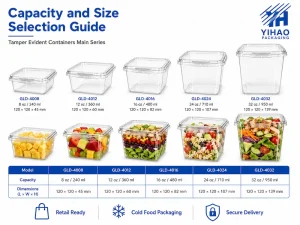
YIHAO supports wholesale food packaging buyers with clear PET/RPET containers, bakery packaging, deli and salad containers, tamper-evident containers, cold cups and lids, fresh produce packaging, and prepared food container solutions. The goal is direct: help buyers build a practical packaging system that looks good, packs efficiently, and supports real food sales.
Why Wholesale Food Containers Matter More Than Generic Bulk Packaging
The word “wholesale” often makes buyers think only about quantity. In food packaging, that view is too limited. Wholesale food containers must work across repeated orders, multiple menu items, different branch locations, changing seasonal products, and daily staff operations. A supermarket may need berry clamshells, fruit containers, salad bowls, tamper-evident packs, bakery clamshells, and cold cup systems at the same time. A cafe may need iced drink cups, pastry packs, cake slice containers, and small takeaway food containers. A foodservice distributor may need packaging lines that serve restaurants, bakeries, supermarkets, dessert shops, and catering brands.
When buyers source these items separately without a clear system, operational problems appear quickly. Lids do not match. Similar containers compete with each other. Storage space fills with too many slow-moving SKUs. Staff choose the wrong pack size during busy hours. Retail shelves look inconsistent. A low-cost container becomes expensive when it creates customer complaints, product damage, or frequent reorder confusion.
A stronger wholesale strategy starts by grouping containers by food scenario. Fresh produce needs visibility and ventilation logic. Bakery products need height protection and clean display. Deli and salad items need secure closure, leak resistance, stacking stability, and cold shelf presentation. Cold drinks need cup-lid compatibility. Prepared food lines need material suitability, portion control, and dependable handling strength.
This is why professional buyers should treat wholesale food containers as a packaging system instead of a collection of disconnected products.
What Makes a Reliable Wholesale Food Container Manufacturer?
A reliable food packaging container manufacturer does more than supply containers by carton quantity. The manufacturer should understand food categories, material behavior, packaging structure, shelf display, closure design, and wholesale purchasing logic. This is especially important for buyers who need recurring supply or private-label support.
For supermarkets, the supplier should understand refrigerated display, stacking, clear visibility, and department-level packaging needs. For cafes, the supplier should provide compatible cold cups and lids for iced coffee, matcha, refreshers, smoothies, juice, lemonade, milk tea, and fruit tea. For bakeries, the supplier should help match container height and structure to muffins, croissants, cupcakes, cake slices, brownies, cookies, and chilled desserts. For foodservice brands, the supplier should understand delivery handling, grab-and-go packaging, prepared food portions, and repeat ordering stability.
When comparing a plastic food packaging manufacturer, PET container manufacturer, disposable food container factory, or general food packaging supplier, buyers should check whether the company can provide practical guidance in these areas:
- Material selection for PET, RPET, PP, and paper-PET hybrid packaging.
- Container-lid compatibility across product series.
- Food scenario planning for supermarkets, cafes, bakeries, and foodservice brands.
- Stable wholesale supply and repeat order consistency.
- OEM, private label, and custom packaging support when needed.
- Factory-side quality control and sample review before bulk purchasing.
The best supplier is not simply the cheapest. The best supplier helps buyers reduce mistakes before they become expensive.
Key Buyer Groups That Need Wholesale Food Containers
Supermarkets and Grocery Retailers
Supermarkets need packaging that works across departments. Fresh produce, bakery, deli counters, salad bars, chilled meals, prepared foods, snacks, and cold drinks all require different container structures. A strong supermarket packaging plan usually includes fresh produce packaging containers, bakery containers, deli bowls, square PET containers, tamper-evident packaging, and cold cup systems.
For supermarkets, packaging must sell visually. Clear PET containers help customers judge freshness, color, portion value, and product quality quickly. Stackable structures support refrigerated shelf organization. Secure closures reduce accidental opening during handling. For cut fruit, salads, and chilled ready-to-eat foods, buyers should pay attention to clarity, lid fit, anti-fog options where relevant, and pack shapes that match shelf layout.
Cafes and Coffee Shops
Cafes need a practical packaging mix that supports speed and menu flexibility. Most cafe buyers start with cold cups, flat lids, dome lids, strawless lids, pastry containers, cake slice packs, and small takeaway containers. Beverage trends change fast, so cafe packaging should support iced coffee, cold brew, matcha, refreshers, lemonade, fruit tea, smoothies, sparkling fruit drinks, flavored cold brew, and protein drinks.
For cafe buyers, cup-lid compatibility is one of the most important details. A strong PET container manufacturer or cold cup supplier should provide clear matching guidance so buyers do not waste time testing unrelated lids and cups.
Bakeries and Dessert Brands
Bakeries sell through appearance, freshness, and protection. Croissants, muffins, cupcakes, cake slices, Swiss rolls, brownies, cookies, tiramisu portions, mousse desserts, and chilled cakes all need containers that protect shape while showing the product clearly.
For bakery buyers, bakery containers should be selected by product height, portion count, display angle, stacking needs, and takeaway handling. Clear PET clamshells are practical when product visibility is part of the sale. Paper-base dessert boxes with clear PET lids can also support a premium visual style for gift-ready dessert assortments.
Foodservice Brands and Distributors
Foodservice brands and distributors need durable SKU planning. Their customers may include restaurants, salad shops, cafes, bakeries, supermarkets, catering companies, fresh food brands, and prepared meal sellers. This makes wholesale food containers a product-line decision, not just an order decision.
For distributors, a balanced wholesale catalog should include fast-moving categories such as PET hinged deli containers, square deli containers, round salad bowls, fresh-cut fruit containers, bakery clamshells, tamper-evident containers, cold cups, lids, and selected PP containers for heat-related use. A distributor should avoid filling the catalog with too many similar sizes. The best wholesale mix covers real food scenarios with clear purpose.
Wholesale Food Container Product Line Selection Guide
Buyers often need a fast way to compare product lines before choosing samples. The table below organizes common wholesale food container categories by buyer type, best use case, and purchasing value.
| Product Line | Best For | Main Buyer Type | Wholesale Value |
|---|---|---|---|
| Fresh Produce Containers | Berries, grapes, fresh-cut fruit, chilled produce | Supermarkets, fruit brands, distributors | Clear display, ventilation logic, shelf-ready packing |
| Bakery Containers | Croissants, muffins, cupcakes, cake slices, desserts | Bakeries, cafes, dessert brands | Shape protection, product visibility, takeaway display |
| Deli and Salad Containers | Salads, fruit bowls, deli meals, chilled sides | Supermarkets, salad shops, foodservice brands | Stacking, lid fit, cold shelf presentation |
| Tamper-Evident Containers | Grab-and-go food, retail meals, delivery pickup | Supermarkets, prepared food brands, distributors | Visible security, consumer trust, safer handling |
| Cold Cups and Lids | Iced coffee, smoothies, matcha, refreshers, fruit tea | Cafes, beverage shops, foodservice distributors | Cup-lid compatibility, drink visibility, menu flexibility |
| Microwave Safe Containers | Prepared meals and selected heat-related applications | Restaurants, catering brands, meal prep companies | Material suitability, portion control, takeaway convenience |
This type of matrix helps buyers avoid random purchasing. A supermarket may not need ten similar deli packs. It may need a clear fresh produce line, a bakery line, two salad sizes, one tamper-evident range, and one cold cup series. A cafe may not need a wide container catalog, but it does need strong cup-lid matching and reliable bakery packaging. Wholesale efficiency comes from selecting the right product families, not simply buying more SKUs.
Material Choices: PET, RPET, PP, and Paper-PET Hybrid Options
PET and RPET for Clear Retail Display
PET is widely used for clear food packaging because it offers strong transparency, lightweight handling, and retail display value. RPET supports similar packaging applications while incorporating recycled content where supply, food-contact suitability, and market requirements allow. For chilled fruit, salads, bakery items, deli sides, snacks, and cold beverages, PET/RPET packaging keeps food visible and clean on shelf.
When buyers search for a PET container manufacturer, they should not stop at “clear material.” They should check hinge strength, lid fit, rim structure, stacking stability, wall feel, anti-fog needs, sealing style, and whether the design matches the product’s real use. A clear container still fails if the closure is loose, the height is wrong, or the stack becomes unstable in a refrigerated display.
PP for Prepared Foods and Heat-Related Use Cases
PP is commonly selected where buyers need stronger heat tolerance or prepared food packaging. Not every disposable food container is suitable for hot meals or microwave-related use, so buyers must match the material to actual filling temperature, storage condition, and consumer use.
For foodservice brands, this distinction is critical. PET works well for many chilled and cold display applications, while PP is more suitable for selected prepared food and heat-related packaging. Buyers sourcing from a disposable food container factory should confirm intended use before ordering, especially when a product line includes both chilled ready-to-eat foods and warm takeaway meals.
Paper-PET Hybrid Packaging for Dessert and Premium Display
Some bakery and dessert scenarios benefit from paper-base packaging with a clear PET lid. This structure combines a premium base appearance with food visibility. It works well for dessert samplers, premium cake portions, gift-style assortments, chilled dessert packs, and bakery display items that need both presentation and protection.
However, hybrid packaging should be selected for a clear purpose. Buyers should evaluate stacking, lid clarity, moisture exposure, anti-fog needs, and how the package will be handled in retail or delivery. Packaging should support both appearance and operational stability.
How to Build a Wholesale Container Matrix by Food Scenario
A practical wholesale packaging matrix starts with food type. This is more reliable than starting with random container sizes. Below is a food-scenario decision structure buyers can use before contacting a food packaging supplier.
| Food Scenario | Recommended Container Direction | Main Buying Priority | Common Buyer Type |
|---|---|---|---|
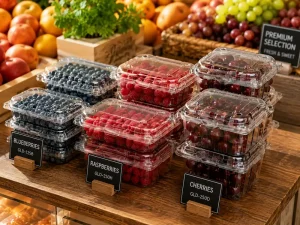
| Fresh berries and produce | Vented PET clamshells and clear produce containers | Visibility, ventilation, shelf-ready display | Supermarkets, fruit brands, distributors |
| Fresh-cut fruit and snack packs | Clear PET fruit containers and divided snack packs | Portion logic, leak resistance, product separation | Supermarkets, grab-and-go brands, cafes |
| Salads and deli sides | PET hinged deli containers, round bowls, square deli containers | Lid fit, stacking, cold shelf presentation | Deli counters, salad shops, supermarkets |
| Bakery and desserts | Clear bakery clamshells, cake slice packs, pastry containers | Height protection, clarity, anti-crush structure | Bakeries, cafes, dessert brands |
| Tamper-sensitive grab-and-go foods | Tamper-evident PET containers | Food safety signal, secure closure, retail trust | Supermarkets, delivery brands, chilled food sellers |
| Cold drinks | PET/RPET cold cups with compatible lids | Cup-lid matching, clarity, menu flexibility | Cafes, beverage shops, foodservice distributors |
| Prepared meals and hot takeaway | Selected PP prepared food containers | Material suitability, closure, meal portioning | Restaurants, catering brands, foodservice operators |
This structure prevents overbuying. A buyer may not need many similar deli containers. They may need three practical sizes, one compatible lid system, one square option for shelf efficiency, and one larger bowl for salads or shared chilled food. The right matrix reduces SKU confusion and makes wholesale ordering easier.
Recommended Wholesale Food Containers for Supermarkets
Supermarkets need containers that support high product turnover and clean shelf organization. A strong supermarket wholesale plan usually includes produce clamshells, fresh-cut fruit containers, deli containers, salad bowls, tamper-evident packs, bakery clamshells, and cold drink cups.
For produce departments, clear PET and vented clamshells help berries, grapes, kiwi, apples, and fresh produce remain visible while supporting handling and stacking. For fresh-cut fruit, a clear PET fresh-cut fruit container gives customers a direct view of color and portion value. Fruit is often purchased visually, so the container must protect the product without hiding it.
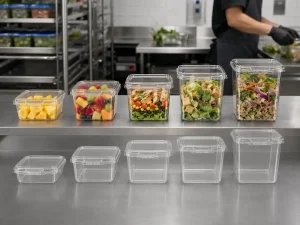
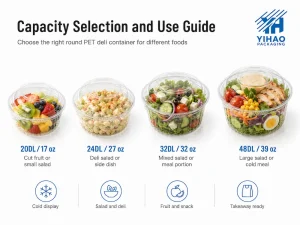
For deli departments, deli and salad containers should support both chilled display and takeaway handling. Round salad bowls work well for leafy salads, fruit mixes, chilled noodles, and shared portions. Hinged deli containers work well for sides, snacks, sandwiches, and ready-to-eat items. Square PET containers help maximize shelf space and create a neat retail look.
For chilled ready-to-eat foods, tamper-evident containers strengthen customer confidence. A visible tamper-evident structure supports grab-and-go retail, delivery pickup, and prepared food programs where the package may pass through several handling points before purchase.
Recommended Wholesale Food Containers for Cafes
Cafes need packaging that fits daily speed. Staff should be able to choose cups, lids, pastry containers, and small food packs without confusion. A cafe wholesale order should prioritize fewer compatible systems rather than many unrelated items.
For beverages, cold cups and lids are the foundation. A strong cup system should support iced coffee, cold brew, iced tea, lemonade, juice, smoothies, milk tea, matcha, refreshers, sparkling fruit drinks, and flavored cold brew. Menu flexibility matters because seasonal drinks drive impulse purchases. A clear PET/RPET cup also supports visual presentation for layered drinks, fruit inclusions, foam toppings, and colorful refreshers.
For a modern beverage menu, a PET/RPET cold cup can cover popular mid-to-large drink formats while keeping the beverage visible. Buyers should match the cup with suitable flat, dome, or strawless lids depending on the drink style.
Cafes also need bakery packaging. Croissants, bagels, muffins, donuts, cookies, and cake portions should not be packed into containers that flatten the product. A PET hinged bakery container gives cafes a practical option for mixed bakery packs and takeaway display.
Recommended Wholesale Food Containers for Bakeries
Bakeries sell with appearance first. Packaging must protect the shape and show the product clearly. For wholesale bakery buyers, the main decision points are product height, portion count, display style, closure security, and how the pack stacks during transport.
Cake slice containers should match the height of cheesecake, mousse cake, tiramisu, or layered sponge cake. Cupcake and muffin containers should protect frosting or domed tops. Pastry containers should avoid crushing delicate layers. Cookie and brownie containers should provide enough structure without wasting space.
Bakeries that supply supermarkets or cafes should think beyond one product. A bakery packaging line may include single-portion dessert packs, two-count or four-count cupcake containers, clamshells for croissants and muffins, cake slice containers, roll cake containers, and paper-base boxes with clear lids for premium assortments. The best wholesale food containers for bakery operations are not only attractive; they make repeated packing faster and reduce product damage.
Recommended Wholesale Food Containers for Foodservice Brands
Foodservice brands need packaging that supports daily operations, not only display. For restaurants, catering brands, prepared meal sellers, and distributors, the container must survive filling, stacking, delivery handling, customer transport, and storage. This makes structure and closure more important than a simple photo comparison.
For chilled meals and grab-and-go items, PET hinged deli containers are practical because they combine clear display with easy operation. A recycled PET hinged deli container works well for larger chilled portions, deli sides, fruit mixes, snack meals, and grab-and-go food programs.
For shelf efficiency, square PET deli containers are worth considering. Square and rectangular footprints often use shelf space more efficiently than round packs. A PET square deli container is useful for salads, fruit, deli meals, and chilled food portions where neat stacking and retail display matter.
For prepared meals that involve heat-related use, buyers should evaluate microwave safe containers and confirm intended application with the supplier. This is especially important when a product line includes both chilled ready-to-eat foods and hot takeaway meals. Mixing unsuitable materials into the wrong use case creates avoidable quality and compliance risks.
Need Wholesale Food Containers for Your Product Line?
Wholesale Buying Criteria: What Professional Buyers Should Check
1. Food-Contact Suitability
Food packaging must be suitable for its intended contact use. Buyers should ask suppliers for material information and relevant compliance documentation based on the target market. Temperature, fat content, acidity, storage time, and filling conditions all affect packaging selection. A reliable food packaging supplier should discuss intended use before recommending a container.
2. Container-Lid Compatibility
Lid mismatch is one of the most common wholesale packaging problems. Buyers often focus on container size but overlook lid series, rim structure, dome height, flat lid fit, and packaging family compatibility. This problem is especially common with cold cups, salad bowls, square deli containers, and separate-lid food containers.
3. Clear Size Logic
A good wholesale packaging line does not need every possible size. It needs the right size ladder. For example, a deli line may include small, medium, and large portions. A cold cup line may include a practical drink-size series. A bakery line may separate single portions, multi-count packs, and larger assortment packs.
4. Stackability and Storage Efficiency
Wholesale orders take warehouse space. A container that looks good but nests poorly can increase storage pressure. A lid that stacks unstably can slow packing lines. For supermarkets and distributors, stackability has direct operational value.
5. Display Clarity and Anti-Fog Needs
Clear PET packaging is valued because it shows the food. In chilled environments, condensation and fogging can reduce visibility. For fresh-cut fruit, chilled desserts, deli foods, and cold-case items, buyers should consider whether anti-fog options or specific lid designs are needed.
6. Branding and Custom Packaging Potential
Not every buyer needs custom printed packaging at the beginning. However, growing brands often need future options such as label areas, private-label packaging, custom printing, sleeve compatibility, embossed branding, or carton-level branding. When choosing wholesale food containers, buyers should consider whether the same supplier can support brand development later.
How to Compare a Food Packaging Manufacturer, Supplier, and Distributor
Buyers often use the words manufacturer, wholesale, and supplier together, but they are not the same. A manufacturer makes or controls production. A supplier may source and provide products. A distributor buys and resells. Each model has value, but buyers should understand the difference before placing large wholesale orders.
| Supplier Type | Main Strength | Possible Limitation | Best For |
|---|---|---|---|
| Food Packaging Container Manufacturer | Production control, customization, technical feedback | Requires clearer project planning | Brands, distributors, long-term wholesale buyers |
| Food Packaging Supplier | Flexible sourcing and product access | Product consistency depends on sourcing control | Small to mid-size buyers testing categories |
| Disposable Food Container Factory | Factory-direct communication and product development | Buyers need to define use cases clearly | OEM, private label, recurring wholesale orders |
| Distributor | Local stock, quick replenishment, mixed products | Less direct customization control | Foodservice operators needing nearby supply |
For long-term wholesale food containers, the best result often comes from a manufacturer or factory-backed supplier that understands both product structure and buyer scenarios. The lowest quote is not always the strongest offer if the supplier cannot provide stable quality, practical matching advice, or future product expansion.
Compliance and Sustainability Considerations for Wholesale Buyers
Food packaging compliance is not a marketing slogan. Buyers should confirm intended use, material suitability, and target market requirements before placing repeat orders. For plastic food packaging, market requirements may involve food-contact rules, packaging waste rules, recyclability expectations, labeling responsibilities, recycled content discussions, and restrictions on certain materials or additives depending on region.
For PET packaging, recyclability also depends on design details such as color, labels, adhesives, closures, and how the item behaves in sorting and recycling systems. For buyers, the practical takeaway is not to chase a generic “eco” label. The stronger approach is to define the market, confirm food-contact use, choose material based on application, avoid unnecessary material complexity, and work with a supplier that understands PET/RPET design, packaging performance, and documentation needs.
Common Mistakes When Buying Wholesale Food Containers
Buying by Price Only
Low price loses value quickly when containers crack, lids loosen, stacking fails, or food display looks weak. Price matters, but it should be evaluated together with structure, material, consistency, and actual use case.
Choosing Too Many Similar SKUs
Wholesale buyers often overbuild their packaging line. Many similar containers create confusion. A smarter structure uses fewer, stronger SKUs with clear purpose. This improves warehouse control and makes reordering easier.
Ignoring Lid Systems
Containers and lids must be treated as one system. This applies to salad bowls, cold cups, square deli containers, and separate-lid food containers. Buyers should confirm exact compatibility before ordering.
Using One Material for Every Food Type
PET, RPET, PP, and paper-PET hybrid packaging serve different needs. Cold display, hot meals, chilled desserts, bakery packs, and cold drinks should not be forced into the same material logic.
Not Planning for Future Branding
Many buyers start with plain packaging and later need branding. Choosing a supplier with custom packaging capability from the beginning makes future upgrades easier.
Wholesale Food Container Selection Checklist
Before placing a wholesale order, buyers can use this checklist to reduce risk:
- Define the food category: produce, bakery, deli, salad, beverage, prepared meals, or snack packs.
- Confirm food temperature: cold, chilled, room temperature, hot fill, or reheating-related use.
- Check material direction: PET, RPET, PP, or paper-PET hybrid.
- Confirm container-lid compatibility.
- Evaluate display clarity, anti-fog needs, and shelf appearance.
- Test stacking, nesting, and warehouse efficiency.
- Review closure strength and handling performance.
- Ask for food-contact and market-related documentation where needed.
- Plan SKU levels by actual sales scenario, not only by capacity.
- Confirm whether custom branding, private label, or OEM support may be needed later.
Why Work with YIHAO for Wholesale Food Containers
For buyers who need a practical packaging partner, YIHAO focuses on clear food packaging solutions for fresh produce, bakery, deli, salad, tamper-evident, cold drink, and prepared food applications. The value is not only in providing containers; it is in helping buyers organize containers by real use scenarios.
Supermarket buyers need clean shelf display and reliable replenishment. Cafes need compatible cups, lids, and bakery packs. Bakeries need clear containers that protect product shape. Foodservice brands need packaging that supports delivery, takeaway, chilled display, and repeat ordering. Distributors need product families that are easy to explain and easy to sell.
As a food packaging container manufacturer and food packaging supplier, YIHAO supports buyers looking for clear PET/RPET packaging, practical SKU planning, and wholesale-ready food container categories. For buyers comparing a plastic food packaging manufacturer, PET container manufacturer, or disposable food container factory, the most important question is not only “What is the price?” It is “Can this supplier help me build a packaging line that works across real food operations?”
FAQ
1. How do I choose a wholesale food container supplier?
Choose a wholesale food container supplier by checking material expertise, food-contact suitability, container-lid compatibility, product range, sample support, wholesale supply stability, and whether the supplier understands your food category. A reliable supplier should recommend packaging by real food use, not only by size or unit price.
2. What are wholesale food containers used for?
Wholesale food containers are used for fresh produce, cut fruit, salads, deli foods, bakery items, desserts, cold drinks, prepared meals, snacks, and grab-and-go retail foods. They are commonly purchased by supermarkets, cafes, bakeries, restaurants, foodservice distributors, and private-label food brands.
3. Can a food packaging manufacturer provide custom PET containers?
A food packaging manufacturer may support custom PET containers, private-label packaging, printed cups, branded cartons, labeling areas, or product development depending on product structure, tooling requirements, order plan, and customization goals. Buyers should discuss the food type, target market, and packaging purpose before starting customization.
4. Are PET food containers suitable for supermarkets and chilled display?
PET food containers are widely used for supermarkets and chilled display because they provide strong clarity, lightweight handling, and clean shelf presentation. They are commonly used for fresh produce, cut fruit, bakery items, salads, deli foods, snacks, and cold beverages. Buyers should confirm the intended food-contact use and temperature conditions with the supplier.
5. What is the MOQ for wholesale food containers?
The MOQ for wholesale food containers depends on product type, size, material, stock availability, customization needs, packaging method, and order structure. Stock items usually have a different MOQ logic from custom packaging. Buyers should provide target product use, container size, material direction, and estimated order volume when asking for a quote.
6. Is it better to buy from a manufacturer or a general supplier?
For long-term wholesale projects, buying from a manufacturer or factory-backed supplier often provides stronger production consistency, technical feedback, product development support, and customization options. A general supplier may be useful for flexible sourcing, but buyers should evaluate quality control and supply stability carefully.
References
- U.S. Food and Drug Administration, Packaging & Food Contact Substances.
- U.S. Food and Drug Administration, Understanding How FDA Regulates Substances that Come into Contact with Food.
- European Union, Commission Regulation (EU) No 10/2011 on plastic materials and articles intended to come into contact with food.
- European Union, Regulation (EU) 2025/40 on packaging and packaging waste.
- European Commission, Packaging and Packaging Waste Regulation overview.
- U.S. Environmental Protection Agency, Sustainable Materials Management and Sustainable Packaging guidance.
- Association of Plastic Recyclers, APR Design Guide for PET Rigid Packaging.
- NAPCOR, PET packaging material and recyclability information.
Deep Dive Insights
How wholesale food containers influence retail sales
Retail food packaging directly affects how customers judge freshness, portion value, and product quality. Clear PET and RPET containers are especially useful for supermarkets, cafes, and bakeries because they allow customers to see color, texture, layers, toppings, and food condition before purchase. For fresh produce, salads, desserts, and cold drinks, visibility often supports faster purchase decisions.
Why manufacturer-side support matters
A manufacturer-side packaging partner can help buyers avoid common sourcing mistakes such as mismatched lids, overcomplicated SKU structures, unsuitable material choices, and weak closure performance. For recurring wholesale buyers, factory-side support is valuable because the packaging decision affects daily operations, not only product appearance.
What buyers should prioritize before requesting a quote
Before requesting a quote, buyers should define the food type, target market, storage condition, filling temperature, portion size, display method, and customization requirement. These details help the supplier recommend the correct PET, RPET, PP, bakery, deli, cold cup, tamper-evident, or prepared food packaging direction.
Option-based packaging strategy
A practical wholesale strategy usually combines several packaging families instead of relying on one container type. Supermarkets may need fresh produce containers, tamper-evident packs, bakery clamshells, and salad bowls. Cafes may need cold cups, lids, pastry containers, and small dessert packs. Foodservice brands may need deli containers, square PET containers, and selected microwave safe containers. The strongest packaging system matches food scenarios with clear purchasing logic.
Consideration for long-term brand growth
Buyers planning long-term growth should choose packaging that leaves room for branding, private label development, product line expansion, and repeat ordering. A stable food packaging manufacturer helps buyers move from basic wholesale purchasing to a more structured packaging strategy that supports product presentation, operational efficiency, and brand recognition.
Final Note / Practical Takeaway
© YIHAO Packaging. All rights reserved. All articles, product images, packaging designs, technical specifications, and website materials are protected by copyright. Unauthorized copying, reproduction, redistribution, modification, or commercial use is strictly prohibited without prior written permission.