Hot deli food packaging fails quickly when the container is chosen only by size and price. Warm meals, sauces, oil, steam, stacking pressure, takeaway handling, and microwave reheating all test the package before the customer even opens it. For supermarkets, delis, foodservice brands, prepared meal suppliers, and wholesale distributors, hot deli food containers must be evaluated as a functional packaging system, not a basic disposable item.
YIHAO works as a food packaging manufacturer and solution provider for buyers who need practical packaging for prepared meals, deli counters, hot takeaway food, chilled ready meals, and reheatable food programs. In this category, the strongest buying question is not “Which container is cheapest?” The better question is: “Which container protects the food, fits the operation, supports reheating expectations, and performs consistently across repeat wholesale orders?”
This manufacturer and supplier checklist helps B2B buyers compare hot deli food containers, microwave safe deli containers, prepared food containers, deli meal containers, reheatable deli packaging, and PP deli packaging before sample approval and bulk purchasing.
Why Hot Deli Food Containers Need a Clear Buying Standard
Hot deli food creates more packaging pressure than cold salads, fresh produce, bakery desserts, or dry snacks. Cooked entrées, rice bowls, pasta, roasted vegetables, grilled proteins, mashed potatoes, soups with thick sauces, and hot deli sides introduce heat, moisture, oil, sauce movement, steam, and weight into the same package.
A weak container creates visible problems quickly. Lids may loosen after steam exposure. Bases may soften after hot filling. Stacks may become unstable during transport. Sauces may move into the rim area. Customers may reheat the meal without understanding whether the lid should be removed or vented. These problems affect more than packaging cost. They affect food appearance, customer confidence, operational speed, and repeat orders.
For this reason, wholesale buyers should define performance standards before comparing quotations. A container for short-hold hot takeaway is not always the same as a container for chilled prepared meals that customers reheat later. A supplier that understands this difference gives buyers better long-term value than a supplier that only quotes by volume and carton quantity.
Define the Application Before Choosing the Container
Before asking for samples, buyers should define the actual food, temperature condition, portion size, lid requirement, reheating expectation, sales channel, and packing process. This prevents the wrong container from entering testing and reduces wasted sample rounds.
1. Food Type and Moisture Level
Different foods behave differently in the same container. Rice bowls, pasta, curry-style meals, roasted vegetables, hot proteins, noodles, deli sides, and sauced entrées all place different stress on the base and lid. Oily foods need stronger attention to material compatibility and edge performance. Sauced foods need better lid security. Steam-heavy meals need clear handling and reheating instructions.
When selecting hot deli food containers, buyers should list the food categories that will be packed most often. This list should include high-moisture foods, oily foods, heavy meals, sauced dishes, reheatable items, and chilled prepared meals. A supplier can only recommend the right structure when the real application is clear.
2. Selling Condition: Hot-Held, Chilled, Takeaway, or Reheated Later
Prepared food packaging often moves through multiple stages. A meal may be filled warm, cooled, displayed chilled, transported by the customer, and reheated later. Another meal may be filled hot and eaten quickly. These two conditions should not be treated as the same packaging problem.
For reheatable meals, microwave-safe claims should be product-specific, not material-only. Buyers should confirm whether the base, lid, or full container system is intended for microwave use. This is especially important for microwave safe deli containers, because lid instructions often differ from base instructions.
3. Portion Size and Meal Format
Packaging should match the meal format. Single portions, family-size sides, foodservice takeaway meals, grab-and-go prepared meals, catering add-ons, and supermarket deli portions require different capacity logic. Too much empty space reduces perceived value and increases food movement. Too little headspace increases lid contact, sauce transfer, and customer dissatisfaction.
Buyers should compare base depth, usable volume, rim height, lid clearance, and the appearance of the food after filling. In wholesale purchasing, a container that looks correct when empty may perform poorly when filled with real food. The sample test should use actual menu items, not only dry inspection.
Material Checklist: Why PP Deli Packaging Is Common for Hot Food
For many hot and reheatable food programs, PP deli packaging is commonly selected because polypropylene offers practical heat resistance, rigidity, weight control, and manufacturability when the grade and product structure match the intended use. It is widely used for hot takeaway meals, prepared food containers, deli meal containers, and reheatable packaging formats.
However, buyers should avoid a lazy shortcut: “PP” does not automatically solve every hot food packaging problem. The correct question is whether the specific PP container is designed, documented, and tested for the actual food-contact and reheating conditions. The supplier should explain intended use clearly before bulk purchasing.
| Checklist Item | What Buyers Should Confirm | Why It Matters |
|---|---|---|
| Material Type | Confirm PP material and intended food-contact use. | Supports hot deli and prepared meal packaging decisions. |
| Microwave Use | Confirm whether the base, lid, or both are intended for microwave reheating. | Prevents incorrect customer use and packaging complaints. |
| Food Compatibility | Test oily, acidic, sauced, and high-moisture foods. | Real meals behave differently from water or dry sample tests. |
| Temperature Guidance | Ask for supplier guidance on filling and reheating conditions. | Clarifies practical operating limits. |
| Lid Material | Check whether the lid is PP or another material and whether it should be removed before heating. | Lid misuse is a common risk in reheatable deli packaging. |
| Stacking Strength | Test filled containers under warehouse, transport, and retail handling conditions. | Prevents deformation, unstable pallets, and poor shelf presentation. |
For buyers building a hot food range, a PP hot food container with a separate lid structure gives practical value for deli takeaway, prepared meals, and food counter packaging. Separate-lid formats help buyers manage filling, closing, replacement, stacking, and display consistency across different portion sizes.
Container Structure: Base, Lid, Rim, and Stackability
Container structure is just as important as material. In hot deli programs, structure controls closing performance, leakage resistance, stacking behavior, customer handling, and visual presentation. A low-quality base can deform after filling. A weak rim can reduce lid security. A poor lid fit can create leakage during transport. A shallow base can make sauced food look unstable.
Base Rigidity
The base should hold shape after filling. For heavier foods such as pasta, rice, potatoes, roasted vegetables, proteins, and mixed entrées, buyers should test how the base behaves when lifted from one side, stacked, and carried in a bag. A container that feels acceptable when empty may become weak after filling with hot or moist food.
Rim and Closure Fit
The rim must support consistent lid attachment. Deli staff often close hundreds or thousands of containers per day. A lid that needs excessive pressure slows packing and increases fatigue. A lid that closes too loosely creates leakage risk. The ideal closure feels stable, repeatable, and practical for counter staff.
Lid Clarity and Customer View
Hot deli food packaging does not always require a fully clear lid, but retail display benefits from visibility. Customers make faster buying decisions when they can see portion size, color, and ingredients. For prepared meals sold from chilled cases, a clear or well-presented lid can improve shelf appeal. For delivery and back-of-house operations, lid strength may matter more than display clarity.
Stacking and Nesting
Wholesale packaging must work before and after filling. Empty containers should nest efficiently to save storage space. Filled containers should stack safely within the supplier’s recommended limits. Buyers should test stacking after real filling, cooling, and transport because heat and moisture may change performance.
Buyer Decision Matrix for Hot Deli Food Containers
Different buyers need different priorities. A supermarket deli counter does not judge packaging the same way as a prepared meal brand or a wholesale distributor. The table below helps buyers connect the use case with the correct supplier question.
| Buyer Scenario | Recommended Packaging Focus | Key Supplier Question |
|---|---|---|
| Supermarket hot deli counter | Fast closing, lid fit, stacking strength | Can staff close the lid quickly during peak service? |
| Prepared meal program | Microwave guidance, portion control, display quality | Is the base designed for reheating with clear lid instructions? |
| Foodservice takeaway | Leakage control, base rigidity, carton efficiency | Has the container been tested with sauced and oily foods? |
| Retail chilled meal display | Meal visibility, lid clarity, condensation control | Does the package maintain a clean appearance after cooling? |
| Wholesale distributor | Repeat supply, carton protection, SKU consistency | Can the manufacturer maintain consistent dimensions across bulk orders? |
Manufacturer Checklist for Wholesale Hot Deli Food Containers
A manufacturer should do more than supply a container. For wholesale hot deli food containers, the manufacturer should help buyers match material, size, lid structure, use case, sample testing, and production consistency. This is especially important for supermarket groups, distributors, foodservice chains, meal-prep brands, and retail deli programs that buy in large quantities.
When reviewing a factory, buyers should look beyond product photos. Production capability, mold consistency, quality control, export packing, carton strength, and sample response all affect the final purchasing result.
1. Product Range and Size Logic
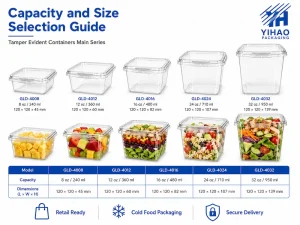
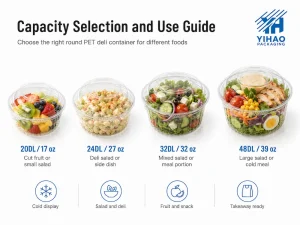
A qualified manufacturer should offer a practical range rather than one isolated size. Hot deli food buyers often need several portion options for sides, entrées, family-size meals, takeaway portions, and retail display. A connected size range keeps packaging consistent across the menu and improves procurement efficiency.
For example, a prepared meal container supports food counters and takeaway packaging where buyers need a clean base-and-lid format for cooked meals. For higher-volume deli programs, a large PP deli food container helps support bigger portions, family sides, and retail display meals.
2. Documentation and Intended Use
Documentation matters for food packaging buyers. Ask the supplier for material information, food-contact declarations where applicable, intended-use guidance, and available testing information for the selected product. A responsible supplier should not simply say “microwave safe” without explaining whether the base, lid, or full package is intended for microwave use.
This is especially important for reheatable deli packaging. Some packages are designed for microwave reheating with the lid removed. Some may support vented heating. Some lids are intended only for storage and transport. The supplier should make these instructions clear before bulk orders.
3. Real Food Sample Testing
Do not approve hot deli food containers based only on empty-sample inspection. Test real menu items. Fill containers with rice, pasta, sauced meals, hot vegetables, deli proteins, oily foods, and chilled prepared meals. Close them under normal staff conditions. Stack them. Let them sit. Transport them. Reheat them according to the intended customer use. Then check base shape, lid fit, condensation, odor, staining, leakage, and overall presentation.
A PP prepared food container should be tested across both cold and hot takeaway scenarios if buyers plan to use one packaging family for multiple menu sections.
4. Quality Consistency Across Bulk Orders
Wholesale purchasing requires repeatability. A sample that performs well once is not enough. Buyers should confirm carton quantity, dimensional tolerance, lid-base matching, production batch control, and packing method. If the packaging will be used in automated or semi-automated filling lines, dimensional consistency becomes even more important.
Ask how the manufacturer controls defects, how shipment inspection is handled, and how lids and bases are protected during export packing. The best supplier is not always the cheapest supplier. The stronger supplier is the one that reduces operational surprises after the order arrives.
Supplier Checklist: What to Ask Before Bulk Orders
A reliable supplier should answer practical questions clearly. For wholesale hot deli food containers, buyers should ask for more than price, MOQ, and lead time. The key questions should connect directly to food safety expectations, operational performance, and daily use.
| Supplier Question | Strong Answer Should Include | Buyer Risk If Ignored |
|---|---|---|
| Is the container designed for hot food or reheatable prepared meals? | Clear intended-use explanation based on material and structure. | Wrong package selected for hot deli use. |
| Is the lid microwave-safe or should it be removed? | Specific instruction for base and lid separately. | Customer misuse and complaints. |
| Can you provide samples for real food testing? | Sample support before bulk commitment. | Performance problems discovered too late. |
| What portion sizes are available? | Connected size range for sides, entrées, and takeaway meals. | Inconsistent packaging across the menu. |
| How do you pack cartons for export? | Carton strength, protection method, and pallet guidance. | Damaged lids, crushed bases, or storage waste. |
| Can you support repeat wholesale orders? | Stable production capacity and repeatable specifications. | Supply interruptions or product inconsistency. |
Wholesale Buying Factors: Price Is Only One Part of Cost
For procurement teams, unit price matters. But with hot deli food containers, the lowest price can become expensive if the container causes leakage, slow packing, lid mismatch, customer complaints, or excessive breakage during transport.
1. Operational Cost
If staff need extra time to close each container, the real cost increases. If lids are difficult to align, packing speed drops. If containers stick during separation, busy deli counters lose efficiency. A smooth-running container improves labor efficiency and reduces frustration.
2. Product Loss Cost
Leakage, deformation, and poor stacking can damage meals. A failed container may waste not only the package but also the food inside. For prepared meals, the food value is usually much higher than the container value, so packaging failure becomes a direct margin problem.
3. Brand Presentation Cost
Hot deli meals often compete in a crowded retail environment. A clean, stable, well-fitted package helps the meal look intentional. A weak or messy package makes the food look less valuable, even when the food quality is strong.
4. Customer Complaint Cost
Customers remember leaking sauce, unstable lids, and confusing reheating instructions. Packaging that supports a better customer experience protects the brand after the customer leaves the store.
Application Scenarios for Hot Deli and Prepared Food Packaging
Wholesale buyers often need one packaging system to support multiple food scenarios, especially when building a broader deli food packaging range for hot meals, chilled sides, prepared foods, and takeaway portions.
Supermarket Hot Deli Counters
Supermarkets need containers that staff can fill quickly and close securely. Hot sides, roasted vegetables, rice dishes, pasta, cooked proteins, and meal combinations need reliable bases and lids. A good container supports both front-of-house display and back-of-house packing efficiency.
Prepared Meal Programs
Prepared meal containers are used for chilled meals that customers reheat later. In this case, buyers should pay close attention to PP food container structure, lid instruction, and reheating guidance. The container should support the menu’s actual heating expectation.
Deli Meal Takeaway
Deli meal containers should protect food during short-distance transport. For takeaway orders, lid fit, base rigidity, and sauce control matter more than decorative design. A PP deli food container gives buyers a practical option for retail takeaway packaging where food handling, closure, and portion control need to stay consistent.
Foodservice and Catering
Foodservice buyers often need bulk cases, repeat orders, and packaging that performs under pressure. For catering, the container may be packed in larger quantities, transported in stacks, and handled by multiple staff members before reaching the customer. Carton strength and filled-container stacking tests become important.
Convenience Stores and Grab-and-Go Meals
Convenience stores need clean presentation and simple customer instructions. Reheatable deli packaging should make the meal look easy to buy and easy to use. If the lid must be removed before heating, the instruction should be clear to reduce customer misuse.
How to Compare Samples Before Approving a Supplier
Sample comparison should be systematic. Buyers should avoid comparing only appearance. A repeatable testing process makes supplier comparison more objective and protects the buyer from approving a container that performs well when empty but fails during real hot food use.
| Test Area | How to Test | Pass Standard |
|---|---|---|
| Filling Test | Fill with actual hot deli food, not only water. | Base holds shape and portion looks presentable. |
| Closure Test | Close lids repeatedly under normal staff speed. | Lid closes securely without excessive force. |
| Leakage Test | Test sauced and oily foods during handling and transport. | No unacceptable leakage from rim or lid edge. |
| Stacking Test | Stack filled containers as they would be handled in real operations. | No serious deformation or unstable stack behavior. |
| Reheating Test | Follow intended microwave instructions for the base and lid. | Package performs according to supplier guidance. |
| Display Test | Place filled containers under retail-style display conditions. | Food remains visually attractive and package stays neat. |
When Hot Deli Food Containers May Not Be the Right Choice
PP hot deli containers are practical for many prepared meals, hot sides, takeaway foods, chilled meals, and reheatable deli portions, but they are not the right answer for every food program. Buyers should use other packaging formats when the product requires oven baking, long-term frozen storage validation, high-barrier modified atmosphere packaging, liquid-heavy soup service, or premium table-ready presentation.
This boundary matters because many packaging failures happen when one container format is forced across incompatible food applications. Defining limits early helps procurement teams protect food quality, customer experience, and supplier accountability.
Common Mistakes Buyers Should Avoid
Mistake 1: Choosing by Price Before Use Case
Price should be compared only after the use case is clear. Hot filling, microwave reheating, chilled display, takeaway transport, and catering delivery each create different requirements. A low price is not useful if the container does not match the job.
Mistake 2: Assuming Every PP Container Is Microwave-Safe
PP is commonly used for reheatable food packaging, but buyers still need supplier confirmation for the specific product. Ask whether the base, lid, or full package is intended for microwave use. Ask for intended-use guidance and test with real foods.
Mistake 3: Ignoring Lid Instructions
Many customer problems come from lid misuse. Some lids should be removed before heating. Some may need venting. Some are intended for transport only. The supplier should provide clear instructions that buyers can pass to retail teams and customers.
Mistake 4: Testing Only One Food Type
A container may pass with rice but fail with oily pasta. It may hold vegetables well but stain with strong sauces. It may stack well when cold but soften when filled warm. Test the foods that represent the real menu.
Mistake 5: Treating Supplier and Manufacturer as the Same Thing
A trading supplier may provide access to many products, but a direct manufacturer often gives better control over mold consistency, material selection, quality checks, and repeat production. Buyers should understand who controls the product and who takes responsibility when a problem appears.
Final Manufacturer and Supplier Checklist
Before placing wholesale orders, use this checklist to keep purchasing decisions disciplined:
- Confirm the main use case: hot fill, chilled prepared meal, microwave reheating, takeaway, retail display, or catering.
- Confirm PP material and intended food-contact use.
- Confirm whether the base, lid, or both are intended for microwave heating.
- Test real hot deli foods, including oily, sauced, heavy, and high-moisture meals.
- Check lid fit, rim strength, stacking behavior, and base rigidity after filling.
- Review carton packing, pallet handling, and export protection.
- Ask for documentation and supplier guidance before bulk purchasing.
- Compare total operating cost, not only unit price.
- Choose a manufacturer or supplier that supports repeat orders and consistent specifications.
FAQ: Hot Deli Food Containers
1. What material is commonly used for hot deli food containers?
PP is commonly used for hot deli food containers and prepared food containers because it offers practical heat resistance, rigidity, and manufacturability when the selected grade and structure match the intended use.
2. Are all PP deli containers microwave-safe?
No. Buyers should confirm the supplier’s intended-use guidance for the specific base and lid. Some containers are intended for reheating with the lid removed, while others may have different instructions.
3. Can hot deli food containers be used for both hot and cold prepared meals?
Many PP deli containers are used for both hot takeaway meals and cold prepared foods, but buyers should confirm the supplier’s intended-use guidance, lid instructions, and real food testing results before using one container across multiple menu categories.
4. What should buyers test before ordering wholesale deli meal containers?
Buyers should test real food filling, lid fit, leakage, stacking, microwave reheating instructions, oil resistance, sauce behavior, carton packing, and display appearance before placing bulk orders.
5. How should buyers compare hot deli food container suppliers?
Buyers should compare product range, documentation, sample support, production consistency, quality control, export packing, repeat-order capacity, and practical knowledge of hot food and reheatable packaging applications.
Final Note / Practical Takeaway
References
- U.S. Food and Drug Administration, Packaging & Food Contact Substances.
- Electronic Code of Federal Regulations, 21 CFR 177.1520, Olefin Polymers.
- U.S. Food and Drug Administration, Understanding How FDA Regulates Substances that Come into Contact with Food.
- USDA Food Safety and Inspection Service, Cooking Safely in the Microwave Oven.
- USDA Food Safety and Inspection Service, Leftovers and Food Safety.
- European Commission, Food Contact Materials Framework Guidance.
- Association of Plastic Recyclers, Design Guidance for Plastic Packaging.
- Foodservice Packaging Institute, Foodservice Packaging Resources and Material Guidance.
Deep Dive Insights
How should buyers judge hot deli food containers beyond price?
Buyers should judge hot deli food containers by filled-food performance, lid closure, reheating guidance, stacking behavior, carton protection, and repeat production consistency. Unit price matters, but operational failure creates higher hidden cost through food loss, staff delays, leakage complaints, and poor shelf presentation.
Why does microwave-use guidance need to be product-specific?
Microwave-use guidance should be confirmed for the exact container system because the base and lid may have different use conditions. A PP base may be intended for reheating while a lid may need to be removed, vented, or used only for storage and transport. Clear supplier guidance helps buyers reduce customer misuse and protect brand trust.
What makes PP deli packaging practical for wholesale prepared meals?
PP deli packaging is practical for many prepared meal and hot takeaway programs because it combines useful rigidity, heat tolerance, lightweight handling, and scalable manufacturing. The strongest results come when the container structure, lid fit, portion size, and supplier documentation match the buyer’s actual food application.
What should procurement teams ask before approving bulk orders?
Procurement teams should ask whether the container is designed for hot food, chilled prepared meals, or microwave reheating; whether the lid has separate instructions; whether real food samples can be tested; whether the manufacturer can maintain repeat specifications; and whether export cartons protect bases and lids during shipment.
Which buyer groups benefit most from this checklist?
This checklist is most useful for supermarkets, deli counters, prepared meal brands, foodservice distributors, convenience store chains, catering suppliers, and wholesale packaging buyers that need stable prepared food containers, deli meal containers, and reheatable deli packaging for repeat purchasing.
© YIHAO Packaging. All rights reserved. All articles, product images, packaging designs, technical specifications, and website materials are protected by copyright. Unauthorized copying, reproduction, redistribution, modification, or commercial use is strictly prohibited without prior written permission.