Choosing hot food packaging is a technical purchasing decision, not just a container-size decision. Hot meals create steam, oil contact, sauce movement, lid pressure, stacking stress, delivery vibration, and customer reheating conditions. For restaurants, supermarkets, foodservice distributors, meal prep brands, and takeaway operators, packaging must protect the meal while supporting real operating conditions.
YIHAO supplies food packaging solutions for retail, takeaway, foodservice, and wholesale buyers. For hot meals and microwave-related applications, buyers usually focus on PP because polypropylene is widely used for PP microwave safe containers, polypropylene microwave containers, PP food containers, heat resistant PP containers, and microwaveable takeout containers. This FAQ answers the most common questions buyers ask before ordering hot food packaging for prepared meals, deli counters, restaurants, supermarkets, and meal prep programs.
What Is Hot Food Packaging?
Hot food packaging refers to containers, bowls, trays, and lids designed for warm-filled, heated, takeaway, delivery, or microwave-related food applications. These packs are commonly used for rice bowls, pasta, noodles, curries, roasted vegetables, cooked meat portions, deli meals, supermarket prepared foods, meal prep portions, and foodservice takeaway programs.
The key question is not only whether the container holds food. Buyers need to confirm whether the packaging fits the intended heat condition, food type, filling process, lid style, reheating route, and wholesale handling requirement. A container used for chilled food display should not automatically be used for hot meals unless its material and design support that purpose.
For buyers comparing hot meal formats, the most relevant starting point is microwave safe containers. This category is more suitable for heated meals than cold-display PET packaging because it focuses on containers intended for microwave and hot takeaway use.
What Materials Are Best for Hot Food Packaging?
PP is one of the most practical materials for hot food packaging because it provides a useful balance of heat resistance, light weight, foodservice handling, stiffness, and cost efficiency. When a container is designed and labeled for microwave-related use, PP is commonly selected for hot meals, reheatable food, and takeaway packaging.
However, buyers should not treat every plastic container as microwaveable. PET, RPET, paperboard, bagasse, aluminum, and PP all have different strengths. The best material depends on whether the food is hot-filled, reheated, chilled, oily, saucy, acidic, dry, heavy, or transported in stacked delivery conditions.
| Material | Best Use | Hot Food Suitability | Buyer Notes |
|---|---|---|---|
| PP | Hot meals, microwaveable meals, takeaway, meal prep | Strong option when designed for intended heat use | Check microwave labeling, lid fit, food contact documentation, and sample testing |
| PET / RPET | Cold food display, salads, fruit, bakery, chilled deli | Not the main choice for microwave hot meals | Excellent clarity for chilled display, but not the default material for hot reheating |
| Paperboard with coating | Takeaway bowls, dry or moderately moist foods | Depends on coating and food type | Grease resistance, sauce resistance, and lid compatibility must be checked |
| Bagasse / molded fiber | Takeaway meals and fiber-based packaging programs | Depends on structure, lining, and food condition | Moisture resistance, oil resistance, and lid fit require practical testing |
| Aluminum | Oven-ready, catering, and heat-holding applications | Good for heat holding, not a standard microwave option | Do not position as microwaveable unless the application is specifically designed and instructed |
Are PP Microwave Safe Containers Suitable for Takeout Meals?
PP microwave safe containers are commonly used for takeout meals because they support a practical balance of heat performance, portion control, lid stability, stacking, and customer reheating. For foodservice operations, this makes PP a strong choice for rice bowls, noodles, pasta, curry, cooked vegetables, hot deli food, and prepared meals.
The phrase “PP” alone is not enough. Buyers should confirm whether the specific container is intended for microwave-related use, whether the base and lid are compatible, and whether the supplier provides suitable product information for the target market. A professional supplier should avoid broad claims and explain the actual intended use clearly.
For deli counters and takeaway meals, hot food packaging with a separate lid is useful when buyers need better filling efficiency, stable closure, and practical handling for prepared meals.
What Sizes Should Buyers Choose for Hot Food Packaging?
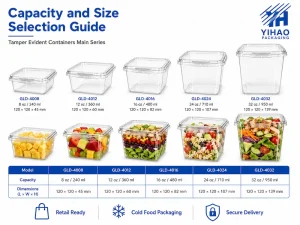
Size selection should follow food behavior, not only catalog volume. Buyers should consider portion weight, food height, sauce level, oil content, rice or noodle expansion, steam space, label placement, stacking pressure, and delivery route. A container that looks correct on a catalog page may fail if the real meal is too tall, too oily, too heavy, or too saucy.
| Buyer Need | Suggested Container Type | Best For | Key Check |
|---|---|---|---|
| Single-serve meals | Medium PP food containers | Rice, pasta, noodles, hot deli meals | Portion depth, lid fit, stacking stability |
| Saucy meals | Deeper PP containers with separate lids | Curry, stew, sauced pasta, mixed hot meals | Tilt handling, sauce movement, closure performance |
| Retail prepared meals | Stackable PP microwave safe containers | Supermarkets, deli counters, chilled-to-reheat meals | Label space, display stability, reheating instructions |
| Meal prep programs | Standardized polypropylene microwave containers | Weekly meal prep, central kitchens, delivery programs | SKU consistency, nesting, carton packing |
| Foodservice wholesale | Multi-size PP container range | Distributors, restaurant groups, catering suppliers | Repeat order stability, lid compatibility, pallet planning |
For prepared-food counters and takeaway programs, prepared meal containers help buyers standardize portion control, simplify filling, and support more consistent takeaway packaging.
What Foods Are Commonly Packed in Polypropylene Microwave Containers?
Polypropylene microwave containers are commonly used for foods that require hot filling, takeaway handling, or reheating. The most common applications include:
- Rice bowls and grain bowls
- Noodle meals and pasta portions
- Hot deli food and supermarket prepared meals
- Meal prep portions for weekly food programs
- Cooked vegetables, proteins, and mixed hot meals
- Restaurant takeaway and delivery meals
- Food counter display where meals may be reheated by the consumer
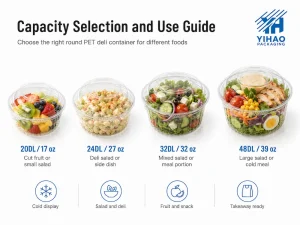
For higher-volume meals, shared portions, and foodservice display packs, PP deli food containers provide more internal space and better support for larger takeaway meals.
Can One Hot Food Packaging Range Cover Both Hot and Cold Foods?
Yes, but buyers should define the use clearly. Some PP food containers are used for both cold dishes and hot takeaway meals, which helps distributors and foodservice operators simplify their SKU range. However, cold food storage, warm filling, and microwave reheating are different performance conditions.
For mixed menus, PP food containers support wider prepared-food use because they can serve deli counters, cooked meal lines, chilled prepared dishes, and takeaway operations when selected correctly.
Buyers should still test actual food. Cold pasta salad, oily stir-fry, rice meals, sauced noodles, and hot roasted vegetables behave differently inside the same container.
How Should Wholesale Buyers Test Heat Resistant PP Containers?
Before placing a wholesale order, buyers should test heat resistant PP containers under realistic use conditions. A simple catalog review cannot replace actual food testing.
1. Heat and microwave test
Test the container with the actual food type, typical portion weight, expected heating time, and microwave power used by customers. Confirm whether the base softens, bends, stains, warps, or changes shape. Do not test only with water; oily and saucy foods often create different results.
2. Lid fit and steam behavior
Hot food creates steam pressure. Buyers should check whether the lid stays stable, whether the lid is easy to open, whether there is deformation, and whether the product requires venting instructions.
3. Leak and tilt test
Sauces, soups, curries, and oily foods should be tested with tilted handling, delivery movement, and short-distance transport. A container may stack well in a carton but still fail when moved inside delivery bags.
4. Stacking and compression test
For wholesale buyers, stacking is not optional. Test filled containers in display trays, delivery routes, cartons, and storage. Look at lid pressure marks, base distortion, and customer opening experience.
5. Label and sleeve compatibility
Hot food brands often need labels, nutrition stickers, sleeves, or branded wraps. Test whether label placement stays readable and whether condensation affects packaging appearance.
| Test Item | What to Test | Why It Matters |
|---|---|---|
| Microwave reheating | Actual food, target time, expected microwave power | Confirms base performance under realistic heat |
| Steam pressure | Lid fit after hot filling and reheating | Reduces lid popping, deformation, and poor opening experience |
| Sauce movement | Tilt, shake, delivery movement, and oily foods | Helps prevent leakage during takeaway and delivery |
| Stacking pressure | Filled containers in cartons, trays, and delivery bags | Protects meal appearance and customer experience |
| Label compatibility | Nutrition labels, date labels, sleeves, and branding | Supports retail display and prepared-meal operations |
What Should Buyers Ask a Hot Food Packaging Manufacturer?
A professional hot food packaging manufacturer should answer practical questions clearly. Buyers should not stop at price, size, and carton quantity. The supplier should explain intended use, material, lid design, quality control, sample testing, customization route, and shipment planning.
When evaluating a food packaging factory, buyers should ask:
- Is the container made from PP material suitable for the target hot food application?
- Is the product intended for microwave-related use?
- What lid style is available: separate lid, hinged lid, vented lid, or matching flat lid?
- Can the supplier provide food contact documentation for the target market?
- Can samples be tested with oily, saucy, and heavy foods?
- What is the carton packing method and pallet loading suggestion?
- Can the supplier support wholesale orders, repeat shipments, and SKU consistency?
- Is custom branding, carton labeling, private-label packaging, or OEM discussion available?
What Should Buyers Know Before Ordering Microwaveable Takeout Containers?
Microwaveable takeout containers should be selected based on the full food journey: kitchen filling, hot holding, takeaway handling, delivery movement, customer storage, microwave reheating, and final eating experience. If any step is ignored, packaging complaints may appear even when the container looks correct during sample review.
For restaurants and prepared-food brands, the safest purchasing logic is to test containers with the real menu. Rice meals, soup-like dishes, greasy pasta, curry, noodles, roasted meat, and mixed vegetables place different stress on the container and lid.
For buyers packing protein portions, deli meals, or hot takeaway foods, microwaveable takeout containers with separate lids provide a practical structure for filling, transport, and retail-ready handling.
Common Mistakes Buyers Make When Choosing Hot Food Packaging
Mistake 1: Treating all plastic containers as microwaveable
Not all plastic containers are made for microwave or heat-related use. Buyers should confirm material, intended use, supplier documentation, product labeling, and actual food testing before ordering.
Mistake 2: Ignoring the lid
The base gets most of the attention, but the lid often decides whether the packaging succeeds. Hot food creates steam, condensation, and pressure. Weak lid fit can create leakage, poor customer experience, or deformation during handling.
Mistake 3: Choosing size by catalog photo only
Food height, sauce level, rice expansion, toppings, and delivery route all affect container choice. Buyers should test actual food portions instead of choosing only from a product image.
Mistake 4: Overloading one SKU
One container cannot do everything. A SKU that works for dry rice may not work for soup, curry, oily noodles, or heavy pasta. A professional hot food packaging range should include logical sizes and structures for different food types.
Mistake 5: Ignoring wholesale supply consistency
Restaurants, supermarkets, and meal prep brands need stable supply, consistent dimensions, and repeatable lid fit. The cheapest option becomes expensive if it causes repacking, customer complaints, or supply gaps.
Hot Food Packaging Buyer Checklist
| Checklist Item | What to Confirm | Why It Matters |
|---|---|---|
| Material | PP material for hot and microwave-related use | Supports better heat-related performance than cold-display materials |
| Intended Use | Warm fill, hot takeaway, microwave reheating, or chilled prepared food | Prevents mismatched material selection |
| Lid Fit | Separate lid closure, venting behavior, opening experience | Controls leakage, steam pressure, and customer handling |
| Size Range | Small, medium, large, and meal-specific formats | Improves menu matching and distributor SKU planning |
| Food Test | Actual rice, pasta, curry, noodles, oil, sauce, and protein meals | Real food behaves differently from water-only tests |
| Documentation | Food contact information and target-market support | Helps buyers manage compliance and procurement review |
| Wholesale Supply | Carton packing, lead time, repeat order stability, MOQ discussion | Supports long-term restaurant, distributor, and retail programs |
| Customization | Labeling, carton branding, private-label options, OEM discussion | Supports brand recognition and differentiated selling |
Manufacturer, Wholesale, and Supplier Questions
When choosing a manufacturer, wholesale partner, or supplier for hot food packaging, buyers should compare more than unit price. A professional supplier should help buyers reduce product mismatch, clarify material choices, provide samples, and support repeat orders.
What should an importer ask before bulk orders?
Importers should ask for product size, material, intended use, sample availability, carton packing, lead time, documentation, and whether the supplier can support consistent repeat orders. For PP hot food items, the buyer should also ask whether the base and lid are tested together under realistic food conditions.
What should a restaurant group ask?
Restaurant groups should ask whether the container supports their actual menu: rice, pasta, noodles, curry, roasted proteins, vegetables, soups, or sauces. They should test the container in takeaway bags and customer reheating scenarios before switching packaging.
What should a supermarket prepared-food team ask?
Supermarket teams should ask about shelf presentation, label space, stacking, lid security, food visibility, customer instructions, and whether the same container can serve multiple prepared-meal programs.
What should a distributor ask?
Distributors should ask which sizes have the broadest demand, whether lids are compatible across multiple bases, how cartons are packed, and whether the supplier can provide stable supply for recurring wholesale orders.
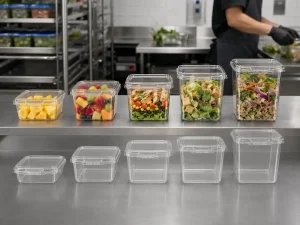
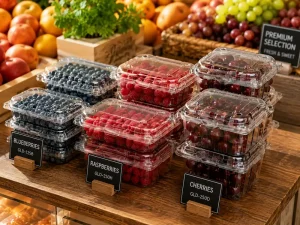
For chilled and hot prepared-food programs, retail takeaway packaging should be tested across display, transport, and customer handling before large-scale purchasing.
FAQ: Hot Food Packaging Questions Buyers Ask Most Often
1. What is the best material for hot food packaging?
PP is one of the most practical materials for hot food packaging because it is commonly used for microwaveable takeout containers, prepared meal containers, and heat-related foodservice applications when designed for that intended use.
2. Are all PP food containers microwave safe?
No. Buyers should not assume that every PP food container is automatically microwave safe for every condition. Confirm intended use, product labeling, supplier documentation, actual food testing, and lid behavior before bulk ordering.
3. What foods are commonly packed in polypropylene microwave containers?
Polypropylene microwave containers are commonly used for rice bowls, noodles, pasta, cooked vegetables, deli meals, meal prep portions, takeaway food, and supermarket prepared meals.
4. What size hot food packaging should I order first?
Start with the most common menu portions: one compact side-dish size, one single-meal size, and one larger prepared-meal or deli size. Test each with actual food weight, sauce level, lid fit, and heating route before expanding the range.
5. Should hot food containers have vented lids?
Some hot food containers benefit from venting or loose-cover instructions because steam pressure can affect lid fit and customer opening experience. The best solution depends on food type, lid design, heating route, and delivery conditions.
6. Can PP containers be used for both cold and hot foods?
Some PP containers are suitable for both cold dishes and hot takeaway meals, but buyers should confirm the intended use for each product. Cold display, warm fill, and microwave reheating are different requirements.
7. How do I choose a hot food packaging supplier?
Choose a supplier that can explain material, intended use, size logic, lid compatibility, sample testing, documentation, carton packing, customization options, and repeat-order stability. For wholesale programs, supplier reliability is as important as unit price.
References
- U.S. Food and Drug Administration, Packaging & Food Contact Substances
- U.S. Food and Drug Administration, Food Packaging & Other Substances that Come in Contact with Food
- U.S. Department of Agriculture Food Safety and Inspection Service, Cooking with Microwave Ovens
- European Commission, Regulation (EU) No 10/2011 on Plastic Materials and Articles Intended to Come into Contact with Food
- EUR-Lex, Plastic Materials and Articles in Contact with Food Regulation
- 21 CFR Part 177, Indirect Food Additives: Polymers
- Food packaging industry practice for PP microwaveable takeout containers and prepared meal packaging
- B2B packaging procurement practice for sample testing, lid fit, carton packing, and wholesale ordering
Deep Dive Insights
How buyers should think about hot food packaging
Hot food packaging should be selected from the full food journey, not from container appearance alone. A correct decision starts with the food type, portion weight, sauce level, oil content, filling temperature, delivery distance, and reheating behavior.
Why PP remains a practical material for hot meals
PP remains a practical choice because it fits many hot takeaway and microwave-related applications when the product is designed for that intended use. For buyers comparing PP microwave safe containers, polypropylene microwave containers, and heat resistant PP containers, the main evaluation point is not only material name, but actual structure, lid compatibility, and supplier support.
What separates a weak supplier from a serious supplier
A weak supplier only gives size, price, and carton quantity. A serious supplier explains intended use, material logic, lid behavior, food testing, documentation, packing method, repeat-order control, and customization options. For wholesale hot food packaging programs, supplier stability directly affects customer complaints, repacking cost, and long-term purchasing confidence.
What buyers should do before scaling orders
Before moving into large wholesale orders, buyers should test real meals in real operating conditions. Rice, noodles, curry, pasta, oily food, protein meals, and chilled-to-reheat dishes should be tested separately. The best purchasing decision is built on sample testing, not assumptions.
Final Note / Practical Takeaway
© YIHAO Packaging. All rights reserved. All articles, product images, packaging designs, technical specifications, and website materials are protected by copyright. Unauthorized copying, reproduction, redistribution, modification, or commercial use is strictly prohibited without prior written permission.