Why Microwave Safe Deli Containers Matter for Prepared Food Programs
Microwave safe deli containers are important because prepared food packaging now needs to support more than basic storage. A container may hold chilled meals, hot takeaway food, deli sides, rice bowls, pasta, cooked vegetables, or meal prep portions. It may move from factory packing to refrigerated storage, retail display, delivery, office lunch, and home reheating.
For supermarkets, restaurants, cloud kitchens, cafeterias, foodservice distributors, and meal prep brands, the container affects convenience, safety perception, and repeat purchase value. A strong prepared meal can lose value when the package warps, leaks, traps steam incorrectly, feels weak in hand, or gives unclear reheating guidance.
This is why buyers should evaluate microwave safe containers by material, structure, lid compatibility, food type, fill weight, heating instructions, and supplier reliability. Price matters, but a low-cost container that fails during real use creates higher long-term cost through complaints, replacement orders, food loss, and brand damage.
YIHAO provides practical food packaging solutions for chilled, takeaway, ready-to-eat, and prepared meal applications. For microwave-related packaging, the right choice should always match the actual food, target market, reheating condition, lid requirement, and wholesale order expectation.
What Does “Microwave Safe” Mean for Deli Containers?
“Microwave safe” should mean that the container is suitable for the intended reheating condition when used according to supplier instructions. It does not mean every plastic food container can be placed in a microwave. It also does not mean every part of the packaging system, including the lid, label, film, or insert, is automatically suitable for heating.
For microwave safe food containers, buyers should confirm three things before ordering: the base material, the lid material, and the intended heating instruction. A container used for short reheating of prepared food is different from a container exposed to high-fat food, sealed steam pressure, long heating time, or high-liquid meals.
The safest B2B sourcing approach is to ask the supplier for the intended use condition, test samples with real food, and create clear customer instructions. This is especially important for takeaway meals, hot deli food, prepared food displays, and meal prep programs that may be reheated by end users outside the original foodservice environment.
Are PP Deli Containers Automatically Microwave Safe?
PP microwave containers are widely used because polypropylene is commonly selected for food packaging that needs better heat resistance than many clear chilled-display plastics. However, PP does not mean automatic microwave approval in every situation.
Wall thickness, lid material, container depth, oil content, sauce level, heating time, food density, steam pressure, and actual instructions all affect real-use performance. A PP container designed for chilled storage may not perform the same as a PP container designed and tested for reheating. A PP base may be suitable for reheating, while the lid may need to be removed, loosened, or vented.
For buyers, the better question is not only “Is it PP?” The better question is: “Is this exact PP container and lid system suitable for our food, our heating instruction, our target market, and our order specification?”
| Material / Component | Common Packaging Role | Microwave-Use Logic | Buyer Check |
|---|---|---|---|
| PP Base | Prepared meals, deli food, hot takeaway, meal prep | Commonly selected for microwave-related disposable food packaging | Confirm exact use condition, food type, temperature range, and supplier documentation |
| PP Lid | Storage, stacking, transport, limited reheating applications | May require venting, loosening, or removal depending on design | Ask whether the lid is microwave suitable or storage-only |
| PET / RPET Lid | Clear chilled display and visibility | Should not be assumed suitable for microwave heating | Use only according to supplier instructions |
| Label / Film / Sleeve | Branding, sealing, product information | May affect heating, steam release, or customer instruction | Confirm whether it should be removed before reheating |
When Should Buyers Choose PP Microwave Containers?
Buyers should consider PP prepared meal container formats when the food may be reheated, packed for takeaway, stored before service, or sold as a convenient heat-and-eat meal. PP is especially relevant for rice bowls, pasta, noodles, cooked vegetables, hot deli sides, protein meals, prepared meals, and food counter packs.
If the food is mainly a cold display item, clear PET or RPET may be more suitable because product visibility becomes the main selling point. If the food may be reheated, PP-based microwave safe packaging is usually the more practical starting point. The buyer still needs sample testing, but the material direction becomes clearer.
A practical decision rule is simple: choose visibility-first packaging for cold display, and choose heat-use packaging for reheating convenience. Mixing these two goals without testing often leads to poor performance.
Food Type vs Container Choice
Different foods behave differently during storage, transport, and reheating. Rice and pasta hold heat and steam. Sauced meals shift during movement. Oily food may create higher stress on the container. Soup and liquid-heavy food require stronger leak-control logic. Cold salads and fruit need clarity more than heat resistance.
| Food Type | Recommended Container Direction | Main Packaging Priority | Buyer Check |
|---|---|---|---|
| Rice bowls / pasta / noodles | PP microwave container | Heat resistance, steam release, portion stability | Test fill weight, lid fit, and reheating instruction |
| Sauced meals / curry / cooked dishes | PP food container with secure lid | Leak control, rigidity, oil and sauce performance | Test transport movement and heating behavior |
| Soup / high-liquid food | Specialized PP soup or liquid container | Sealing, venting, spill resistance | Confirm lid security and heating instructions |
| Cold salad / chilled deli food | PET / RPET deli or salad container | Clarity, chilled display, freshness presentation | Do not assume microwave suitability |
| Meal prep portions | PP meal prep container | Portion control, stacking, reheating convenience | Test after chilled storage and repeated handling |
Common Uses for Microwave Safe Takeout Containers
Microwave safe takeout containers serve many B2B channels. A supermarket prepared meal line, a restaurant takeaway program, and a meal prep brand may all need microwave-related packaging, but they do not always need the same size, shape, lid system, or strength level.
1. Supermarket Prepared Meals
Supermarket prepared meals need stable presentation, portion consistency, stacking performance, and clear customer reheating instructions. A large PP deli food container format is suitable for rice meals, pasta portions, cooked sides, protein meals, and value-added takeaway programs.
2. Deli Counters and Hot Food Bars
Deli counters need containers that perform during fast service. The container should support quick filling, secure closing, handoff, stacking, and customer transport. Buyers should test hot deli sides, oily foods, and sauced items before locking the specification.
3. Restaurant Takeaway and Delivery
For delivery, heat suitability is only one part of the decision. The container also needs to protect food during movement. A PP hot food container supports takeaway meals, deli portions, and prepared foods where structure, lid fit, and food protection matter.
4. Meal Prep and Subscription Food Programs
Meal prep containers need portion control, stacking efficiency, cold storage performance, and reheating convenience. Buyers should test how the container performs after refrigerated storage, packing pressure, transport, and customer reheating.
5. Office Lunch and Institutional Catering
Cafeterias, office meal suppliers, schools, and catering teams often need standardized containers that work across repeated daily meals. A stable PP container range simplifies storage, menu planning, packing speed, and reorder management.
6. Cold-to-Hot Food Programs
Some foods are packed cold but eaten hot. These products require more attention than ordinary cold storage packaging. Buyers should evaluate the complete journey: packing, chilling, transport, display, reheating, and final eating experience.
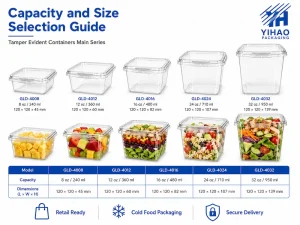
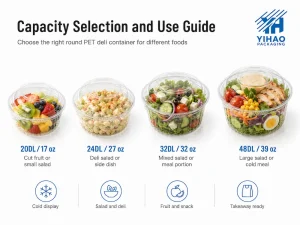
How to Choose Sizes for Microwave Safe Deli Containers
Size affects portion value, food presentation, cost control, stacking, transport, and customer experience. A container that is too small causes lid pressure, food compression, and leakage risk. A container that is too large makes the portion look weak and increases material cost.
For microwave safe deli containers, buyers should select size according to food weight, food height, sauce level, expected steam release, lid clearance, and menu value. It is better to test adjacent capacities before placing a wholesale order because the right size is often discovered through real food filling, not empty-sample inspection.
| Food Program | Typical Container Logic | Best Fit Use | Buyer Check |
|---|---|---|---|
| Small deli sides | Compact PP container | Cooked vegetables, rice sides, small pasta, deli samples | Check fill line and lid clearance |
| Single meal portions | Medium PP meal container | Rice bowls, noodles, pasta, curry meals, protein bowls | Test weight, sauce movement, and reheating instructions |
| Large takeaway meals | Larger PP deli container | Family meals, combo meals, large prepared portions | Check stacking strength and transport stability |
| Protein or meat portions | Shallow PP food container | Cooked meat, fresh meat roll, deli assortments, prepared protein | Confirm liquid level, lid fit, and food-contact suitability |
Can You Microwave Deli Containers With Lids?
This is one of the most important questions for buyers because the base and lid may not always be designed for the same heating condition. Some PP containers use PP lids, while others use clear lids for visibility and storage. A clear lid may look convenient, but it should not be treated as microwave suitable unless the supplier confirms it.
For PP deli food container packaging, the instruction may be remove the lid, loosen the lid, vent the lid, or use the lid only for storage and transport. Buyers should never recommend fully sealed microwave heating unless the packaging system is specifically designed and tested for that use.
Clear instructions reduce customer complaints. If the lid should be removed before heating, say so. If the lid should be loosened or vented, say so. If a label or sleeve should be removed, say so. This small detail strongly affects safety perception and user experience.
Microwave Safe Containers vs Cold Deli and Salad Containers
The difference between microwave safe containers and cold deli containers is not only material. It is the whole use condition. Cold containers are usually selected for visibility, chilled display, anti-fog performance, freshness presentation, and grab-and-go merchandising. Microwave safe food containers are selected for heat-related convenience, reheating, and prepared meal value.
| Container Type | Main Use | Material Direction | Best For |
|---|---|---|---|
| Microwave safe deli containers | Prepared meals and reheating | Usually PP when disposable plastic is required | Rice bowls, pasta, noodles, hot deli food, meal prep |
| Cold deli and salad containers | Chilled display and grab-and-go food | Often PET / RPET for clear visibility | Salads, fruit, chilled noodles, cold sides, fresh snack packs |
| Tamper evident containers | Visible first-opening control | Depends on product design and use condition | Grab-and-go, deli, chilled foods, safety-focused retail packs |
If the food is cold and visual appeal is the first priority, deli and salad containers may be the better category. If the food may be reheated by the customer, PP-based microwave safe packaging deserves priority. If product integrity and first-opening evidence are central to the retail program, tamper evident containers can be part of the broader packaging strategy.
Ordering Questions Buyers Should Ask Before Wholesale Purchasing
Before placing a wholesale order, buyers should ask more than “Is it microwave safe?” A professional sourcing conversation covers material, base and lid structure, food type, heating instruction, carton packing, sample testing, customization, documentation, production consistency, and reorder support.
Material and Food-Contact Questions
Ask what material is used for the base and lid, whether the container is PP, whether the lid is also suitable for the intended heating condition, and what food-contact support can be provided for the target market. For microwave safe food containers, the intended use condition should be confirmed before artwork, labeling, and bulk ordering.
Size and Structure Questions
Ask for usable capacity, lid clearance, wall rigidity, stack height, carton packing, and recommended fill level. For oily, sauced, or high-moisture foods, sample testing should include real food instead of water-only or empty-container review.
Customization and Branding Questions
Ask whether the supplier supports label area planning, carton marks, private label packaging, adjusted thickness, color options, or custom mold development. Customization should improve packing efficiency and brand communication, not simply change the appearance.
Factory and Supply Questions
Ask how the factory controls sample approval, raw material consistency, production inspection, carton packing, shipment communication, and repeat-order stability. For foodservice buyers, stable supply is often more valuable than a very small unit-price difference.
Wholesale Supplier Checklist for Microwave Safe Deli Containers
A reliable supplier should help buyers reduce risk before mass purchasing. Instead of asking for “cheap microwave containers,” buyers should provide food type, portion weight, lid requirement, heating instruction, order volume, target market, and packaging route.
| Checklist Item | Why It Matters | Buyer Action |
|---|---|---|
| Material confirmation | Prevents confusion between PP, PET, RPET, and coated materials | Request material details for both base and lid |
| Intended use | Microwave suitability depends on real use condition | Define reheating method, food type, and lid instruction |
| Food testing | Real food behaves differently from empty samples | Test oily, sauced, wet, dense, and high-moisture foods if relevant |
| Size range | Adjacent sizes may perform better for portion value | Compare at least two sizes before locking the order |
| Stacking and transport | Prepared meals often move through multiple handling points | Check stack pressure, carton fit, and delivery movement |
| Wholesale stability | Repeat orders need consistent structure and packing | Confirm specification control, inspection, and reorder communication |
Common Mistakes When Buying Microwave Safe Takeout Containers
The first mistake is choosing by appearance only. A clean-looking food container may still be unsuitable for reheating if the material, wall thickness, lid, and intended use are wrong. The second mistake is choosing by price only. A cheaper container can create higher cost later if it causes leakage, weak stacking, poor reheating experience, or customer complaints.
The third mistake is ignoring the lid. Many buyers focus on the base because it holds the food, but the lid affects stacking, transport, steam release, safety instructions, and customer experience. The fourth mistake is assuming one container fits every menu item. Rice, pasta, oily meals, soups, proteins, and deli sides behave differently during heating and movement.
The fifth mistake is approving a sample without real food testing. Buyers should test the actual food, filling weight, storage condition, transport movement, and reheating instruction. This is especially important for PP food container programs used for proteins, deli products, and prepared meals.
How to Build a Better Microwave Safe Container Range
A strong container range usually includes more than one size. Small containers support sides and deli portions. Medium containers support single meals. Larger containers support high-value takeaway meals, family portions, and foodservice programs. For buyers, a logical range makes procurement easier and helps different menu items stay consistent in presentation.
For a wholesale program, start with the most common menu types and build the range around real portion weights. Then decide which formats need clear lids, venting logic, label areas, tamper-evident support, or carton-level customization. A coherent range should reduce decision friction for the packing team, purchasing team, and end customer.
FAQ
1. Are PP deli containers microwave safe?
PP deli containers are commonly selected for microwave-related food packaging, but not every PP container should be treated as microwave safe without supplier confirmation. Buyers should confirm the exact base material, lid material, heating instruction, food type, and intended use condition before ordering.
2. Can you microwave deli containers with lids?
That depends on the lid material and tested design. Some lids should be removed, loosened, or vented before heating. Buyers should never assume the lid is microwave suitable just because the base is PP. Clear instructions from the manufacturer should guide final customer use.
3. What does microwave safe mean for plastic food containers?
Microwave safe means the container is suitable for the intended reheating condition when used according to supplier instructions. It does not mean every plastic container, lid, label, film, or sleeve can be heated. Real food testing and clear usage guidance are important.
4. Are black plastic takeout containers microwave safe?
Black plastic takeout containers may be microwave safe if they are made from suitable PP material and designed for the intended heating condition. Buyers should confirm the material, lid use, food-contact support, and reheating instruction instead of judging by color alone.
5. Can microwave safe food containers be reused?
Disposable microwave safe food containers are usually designed for intended foodservice use, not long-term repeated household reuse. Reuse depends on product design, food type, cleaning condition, deformation, staining, odor, and supplier guidance. Buyers should provide clear instructions for the target market.
6. What should buyers confirm before ordering wholesale microwave safe takeout containers?
Buyers should confirm material, size, lid fit, food-contact support, intended heating use, sample performance, carton packing, customization options, MOQ, lead time, production consistency, and supplier documentation before placing a wholesale order.
References
- U.S. Food and Drug Administration. “Microwave Ovens.” FDA Radiation-Emitting Products Resources.
- U.S. Food and Drug Administration. “Packaging & Food Contact Substances.” FDA Food Ingredients & Packaging.
- U.S. Food and Drug Administration. “Understanding How FDA Regulates Substances that Come into Contact with Food.” FDA Consumer Information.
- Electronic Code of Federal Regulations. “21 CFR 177.1520 — Olefin Polymers.” U.S. Government Publishing Office / eCFR.
- European Commission. “Commission Regulation (EU) No 10/2011 on Plastic Materials and Articles Intended to Come into Contact with Food.” EUR-Lex.
- USDA Food Safety and Inspection Service. “Cooking with Microwave Ovens.” Food Safety Basics.
- Food Safety Magazine. “FDA’s Multiple Conditions of Use.” Regulatory Commentary on Food Contact Applications.
- Plastics Industry Association. “Plastic Food Packaging and Material Guidance.” Industry Resource Materials.
Deep-Dive Insights for Buyers
How should buyers think about microwave safe deli containers?
Buyers should think in use conditions, not labels only. The right container must match the food, storage process, transport route, reheating method, lid instruction, customer behavior, and target market. A PP base is often a strong starting point, but the final decision still depends on the exact container design and real-food testing.
Why does PP matter in microwave safe food containers?
PP matters because it is commonly selected for heat-related prepared food packaging, especially when buyers need disposable containers for rice bowls, pasta, noodles, cooked vegetables, deli sides, hot takeaway meals, and meal prep programs. However, PP still needs specification control, lid guidance, and supplier confirmation.
What option is better for cold display?
If the product is a chilled salad, fresh fruit portion, bakery dessert, cold deli item, or grab-and-go snack, clear PET or RPET packaging may deliver stronger shelf visibility. Buyers should separate cold presentation needs from reheating needs instead of forcing one material into every application.
What should wholesale buyers prioritize?
Wholesale buyers should prioritize material clarity, real-food sample testing, lid-use instructions, size logic, carton packing, documentation support, and repeat supply stability. The strongest supplier is not simply the lowest-price option. The strongest supplier helps buyers reduce packaging risk before mass production.
What is the practical next step before bulk ordering?
The practical next step is to request samples based on real food weight, lid requirements, reheating instructions, delivery conditions, and target market documentation. Buyers should confirm performance with actual meals before approving wholesale production.
Final Note / Practical Takeaway
© YIHAO Packaging. All rights reserved. All articles, product images, packaging designs, technical specifications, and website materials are protected by copyright. Unauthorized copying, reproduction, redistribution, modification, or commercial use is strictly prohibited without prior written permission.