Why Microwave Safe Takeout Containers Matter for Food Packaging Buyers
For food packaging buyers, the real question is not simply whether a container is plastic, paper, fiber, or aluminum. The bigger issue is whether the package can survive real takeout conditions: hot filling, delivery stacking, sauce contact, customer reheating, lid pressure, and repeat wholesale orders. That is why microwave safe takeout containers need to be evaluated as a complete foodservice packaging system, not just as a single container.
Takeout food has changed from simple short-distance delivery into a full reheating experience. Customers buy rice bowls, pasta, grilled protein meals, curries, deli sides, meal prep portions, and ready-to-eat dishes with the expectation that the package supports convenient handling after purchase. A container that looks strong at room temperature may still fail during microwave reheating if the material, lid, food type, or usage instructions are not matched correctly.
For a restaurant chain, supermarket deli counter, central kitchen, meal prep brand, or foodservice distributor, the container is part of the product system. A suitable microwave package must support hot-fill or chilled-to-reheat use, hold its shape during handling, match the food’s oil and moisture level, close securely, stack efficiently, and communicate reheating suitability clearly.
As a food packaging manufacturer, YIHAO focuses on practical packaging selection for wholesale buyers, supermarkets, restaurants, and prepared food teams. When evaluating microwave safe containers, buyers should compare the whole packaging system instead of only checking price per piece.
Fast Decision Matrix: Which Packaging Should Buyers Choose?
| Buyer Scenario | Best Packaging Choice | Main Reason |
|---|---|---|
| Hot meals for microwave reheating | PP microwave containers | Better balance of heat resistance, cost control, and takeout convenience. |
| Cold salads, fruit, and fresh deli display | PET or rPET containers | Clear visibility and chilled shelf presentation matter more than reheating. |
| Oven-ready meals | CPET or aluminum containers | Higher heat applications require oven-focused packaging. |
| Dry snacks, bakery items, and sandwiches | Paper, PET, or bakery packaging | Microwave performance is usually not the primary requirement. |
| Meal prep and prepared food programs | PP microwave containers or validated CPET trays | Portion control, stacking, reheating, and repeat supply all matter. |
What Makes a Takeout Container Microwave Safe?
A microwave safe package is designed for reheating under defined conditions. It is not enough for a container to look strong or feel thick. Buyers need to confirm whether the material, structure, lid, and labeling are suitable for the intended reheating scenario. In many foodservice cases, PP is preferred because polypropylene generally offers better heat tolerance than standard PET and many cold-food packaging plastics.
However, not every PP package should automatically be treated as suitable for every microwave condition. The buyer still needs to confirm supplier guidance, food contact suitability, reheating instructions, lid ventilation, portion weight, and whether the container is designed for oily, moist, acidic, or high-sugar foods. A reliable supplier does not only sell PP microwave containers; it explains how those containers should be used.
Core Evaluation Points for Microwave Safe Food Containers
| Buyer Checkpoint | Why It Matters | Practical Buying Question |
|---|---|---|
| Material | Different materials react differently to heat, steam, oil, and reheating time. | Is the container made from PP, CPET, paper-based material, PET, or another structure? |
| Microwave Suitability | Only containers designed and labeled for microwave use should be used for reheating. | Can the supplier confirm microwave reheating suitability for the intended application? |
| Lid Structure | Steam pressure affects safety, deformation, and customer experience. | Should the lid be vented, loosened, removed, or replaced before reheating? |
| Food Type | Oil, sauce, moisture, acidity, and sugar affect packaging performance. | Is the container intended for rice meals, pasta, hot deli foods, soups, sides, or meal prep? |
| Stacking and Transport | Wholesale users need stable storage, packing speed, and delivery efficiency. | Does the container stack reliably before and after filling? |
| Supplier Support | Bulk orders require consistent production and repeatable quality. | Can the manufacturer provide samples, specifications, and batch consistency? |
PP Microwave Containers: The Mainstream Choice for Hot Takeout and Meal Prep
For many foodservice programs, PP prepared meal containers are the most practical choice for hot meals and reheatable takeaway. PP offers a balance of heat resistance, strength, cost control, and lightweight handling. This makes it suitable for prepared meals, rice bowls, noodles, pasta, hot deli foods, cooked vegetables, and chilled meals that customers reheat later.
The key advantage of microwave safe takeout containers made from PP is that they connect kitchen operations with consumer reheating convenience. A central kitchen can fill meals in advance, a store can display them in a grab-and-go area, and the consumer can reheat the meal without transferring it into another dish, as long as the packaging instructions support that use.
Where PP Microwave Containers Perform Well
- Prepared meal packaging for supermarkets and central kitchens
- Restaurant takeaway meals with rice, noodles, pasta, or cooked dishes
- Meal prep programs that require portion control and reheating convenience
- Deli counters selling hot sides, cold dishes, and ready-to-heat foods
- Foodservice distribution where lightweight stacking and carton efficiency matter
For larger hot meals or bulkier deli portions, buyers can evaluate large PP deli containers. For hot takeaway and prepared food counters, PP hot food containers give buyers a stronger direction than general cold-food packaging.
Do Not Evaluate the Base Without the Lid
Many packaging problems happen because buyers only test the container base. In real microwave use, the lid may need to be removed, loosened, or vented. If the lid is not designed for microwave reheating, the package should not be promoted as a complete microwave-ready system.
The lid controls steam pressure, leakage risk, condensation, stacking performance, and customer handling. A tight-fitting lid helps during delivery, but the same tight seal may create pressure during reheating. Buyers should ask the supplier for clear reheating instructions for both the base and the lid. This is especially important for sauced meals, rice bowls, pasta, cooked vegetables, and deli foods that release steam quickly.
Practical Lid Questions Buyers Should Ask
| Lid Question | Why It Matters | Buyer Action |
|---|---|---|
| Should the lid stay on during reheating? | The lid may deform, trap steam, or affect reheating safety. | Request supplier instructions for microwave use. |
| Should the lid be loosened or vented? | Steam pressure can affect container shape and customer handling. | Test the exact food with the exact lid. |
| Is the lid made from the same material as the base? | The base and lid may have different heat performance. | Confirm material details for both parts. |
| Does the lid remain stable after hot filling? | Hot food may soften the seal or change lid fit. | Test stacking after filling and closing. |
Microwave Safe Takeout Containers vs PET Containers
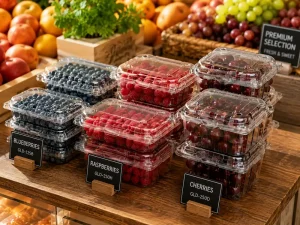
PET is a display-first material, not a reheating-first material. PET and rPET containers are excellent for clear cold-food presentation, especially salads, fresh fruit, bakery items, chilled deli foods, and retail display. They offer strong transparency, shelf appeal, and clean product visibility. But standard PET packaging is not normally the first choice for microwave reheating.
This does not mean PET is weak packaging. It means PET serves a different job. If the product needs cold visibility, clean display, anti-fog discussion, chilled merchandising, or transparent premium presentation, PET and rPET containers work well. If the product needs customer reheating in a microwave, the buyer should move toward microwave safe food containers designed for that use.
| Packaging Type | Best Use | Buyer Warning |
|---|---|---|
| PP Microwave Containers | Hot meals, takeout, meal prep, deli reheating | Confirm microwave guidance, lid use, and food type suitability. |
| PET / rPET Containers | Cold foods, fresh salads, fruit, bakery, chilled display | Do not assume standard PET is suitable for microwave reheating. |
| Clear PET Deli Packaging | Fresh food visibility and refrigerated display | Best for cold-chain presentation, not hot reheating unless specifically designed for it. |
When a buyer’s menu includes both chilled salads and reheatable meals, the smart approach is not to force one material across every food item. A chilled salad line may use deli and salad containers, while a hot meal line uses PP microwave packaging. This separation improves performance and reduces customer complaints.
Microwave Safe Takeout Containers vs Paper Food Packaging
Paper packaging is brand-friendly, but not automatically microwave-ready. Paper food packaging is popular because it supports a natural appearance, printed branding, and a familiar takeaway feel. It works well for dry foods, bakery items, fries, snacks, sandwiches, and some short-hold hot food applications. But paper-based containers often depend on coatings, linings, or laminated layers to resist oil and moisture. That makes microwave evaluation more complicated.
Some paper containers are suitable for limited reheating, while others are not. Greasy food, saucy meals, and long microwave exposure may weaken the structure, soften seams, or affect the lining. Buyers should not select paper packaging only because it looks sustainable. The real question is whether it can protect the food, survive the service condition, and match the customer’s reheating behavior.
When Paper Packaging Makes Sense
- Dry or low-moisture takeaway foods
- Short-hold foods that do not require direct microwave reheating
- Brands that need strong printed presentation
- Bakery, snack, sandwich, and light meal applications
When PP Microwave Containers Are the Better Choice
- Rice bowls, pasta, noodles, hot protein meals, and sauced dishes
- Customer reheating is part of the product experience
- Leak resistance and shape retention matter more than paper texture
- The buyer needs consistent wholesale packing performance
Microwave Safe Takeout Containers vs Molded Fiber and Bagasse Packaging
Fiber packaging needs real sauce and oil testing before bulk use. Molded fiber and bagasse packaging have gained attention in takeaway and foodservice because they are often positioned as fiber-based alternatives to plastic packaging. They offer a natural surface, good rigidity for some foods, and a sustainability-focused brand image. For dry or moderately moist foods, they can work well. For high-sauce, high-oil, or long holding-time meals, buyers need to test performance carefully.
Fiber-based packaging may absorb moisture, soften during transport, or require additional lining for oily foods. If the container must support microwave reheating, buyers should confirm whether the exact product is designed for microwave use and whether the lining, lid, and structure are suitable for the food type. It is a mistake to assume every fiber package is automatically better for hot meals.
| Buyer Factor | PP Microwave Containers | Molded Fiber / Bagasse |
|---|---|---|
| Hot Meal Reheating | Strong choice when designed for microwave use | Needs exact product confirmation |
| Oil and Sauce Resistance | Generally practical for many prepared foods | Depends heavily on lining and structure |
| Brand Image | Functional, clean, foodservice-oriented | Natural, fiber-based, sustainability-oriented |
| Stacking Consistency | Usually strong for wholesale operations | Depends on molding precision and moisture exposure |
Microwave Safe Takeout Containers vs Aluminum Containers
Aluminum is oven-oriented, not microwave-convenience-oriented. Aluminum containers are common for oven-ready foods, catering trays, baked dishes, roasted meals, and high-heat cooking environments. They offer strong heat performance in conventional ovens and provide a sturdy feel for certain foodservice applications. But aluminum is not the default choice for microwave reheating. Metal packaging requires very careful appliance compatibility and supplier instructions.
For buyers serving customers who expect quick microwave reheating at home or in an office, aluminum is usually less convenient than microwave safe takeout containers. It may work well for oven instructions, catering transport, and premium hot dishes, but it adds confusion when customers want microwave convenience. PP containers provide a clearer reheating message for everyday takeaway meals.
Choose Aluminum When:
- The food is mainly oven-heated or baked
- The menu includes roasted meats, casseroles, baked pasta, or catering trays
- The service format focuses on oven-to-table rather than microwave reheating
Choose PP Microwave Containers When:
- The customer reheats meals in a microwave
- The food is sold as takeout, meal prep, or ready-to-heat deli food
- The brand wants simple reheating instructions and convenient handling
Microwave Safe Takeout Containers vs CPET Trays
CPET is stronger for specialized ready meals, but PP is more practical for everyday takeout. CPET trays are often used in ready meal programs because they can support higher temperature applications than standard PET and are commonly associated with dual ovenable or microwave-ready meal formats, depending on design. They can be a strong option for airline meals, frozen meals, premium ready meals, and industrial prepared food systems.
PP containers are often more practical for restaurants, deli counters, meal prep brands, and wholesale takeaway programs where cost control, lightweight handling, and everyday microwave reheating matter. CPET is better when the product positioning requires higher temperature use, oven compatibility, or a more specialized ready-meal tray system.
| Application | Recommended Direction | Reason |
|---|---|---|
| Restaurant Takeaway Meals | PP microwave containers | Good balance of reheating convenience and cost control. |
| Supermarket Chilled Prepared Meals | PP or CPET | Depends on temperature range, shelf format, and reheating instructions. |
| Frozen Ready Meals | CPET or validated PP system | Requires stronger testing for freezing, reheating, and food compatibility. |
| Everyday Meal Prep | PP microwave containers | Practical for portion control, stacking, and consumer reheating. |
How Buyers Should Choose Microwave Safe Takeout Containers
The right packaging decision starts with the food, not the material. A buyer should first map the food’s temperature, moisture, oil level, portion weight, shelf life, reheating method, and transport distance. Then the buyer can compare materials. Choosing packaging before understanding the food often creates performance problems later.
1. Define the Actual Reheating Scenario
Will the customer reheat the meal for 30 seconds, 2 minutes, or longer? Will the food be reheated from chilled or room temperature? Will the lid stay on, be loosened, be vented, or be removed? These questions directly affect the container specification.
2. Match Container Depth to the Food
Rice bowls, pasta, sauced meals, and hot deli sides need enough depth to reduce spill risk. Shallow trays may work for portioned meals, but deep containers are better for saucy foods. For meal prep programs, microwave safe meal prep containers with a separate lid can help buyers separate filling, closing, stacking, and reheating considerations.
3. Evaluate Lid Fit and Steam Behavior
The lid is often where packaging problems appear. A tight lid may help transport, but reheating creates steam pressure. Buyers need clear instructions for whether the lid should be removed, vented, or loosely placed during microwave use. A container is not complete without a lid strategy.
4. Test With Real Food, Not Water Only
Water testing is useful, but it does not represent every meal. Oil, sauce, sugar, salt, and protein behave differently under heat. Buyers should test the actual menu item in the actual container before approving a wholesale order.
5. Check Stacking After Filling
Containers that stack well when empty may behave differently after filling with hot food. Weight, steam, lid tension, and transport vibration all affect performance. Wholesale buyers should test carton packing, shelf stacking, delivery bag handling, and back-of-house storage.
6. Choose a Manufacturer That Understands Foodservice Use
A good manufacturer does not only provide a quotation. It should help buyers compare materials, request samples, adjust specifications, and choose packaging based on food application. For larger programs, working with a food packaging factory gives buyers better control over production consistency, customization, and long-term supply.
How to Work With a Microwave Safe Containers Manufacturer
When buyers source microwave safe takeout containers from a manufacturer, the discussion should go beyond unit price. A reliable supplier should help confirm material selection, container depth, lid matching, carton packing, sample testing, and repeat production stability. For wholesale projects, buyers should also ask whether the factory can support multiple sizes under the same packaging family, because restaurants, supermarkets, and meal prep brands rarely use only one portion size.
This is especially important for prepared meal programs. A small rice bowl, a medium pasta portion, a deep sauced meal, and a deli side may all need different container depths. If the supplier can support a coordinated packaging range, buyers reduce operational complexity and improve visual consistency across the menu.
| Wholesale Sourcing Question | Why It Matters | Expected Supplier Support |
|---|---|---|
| Can the supplier provide multiple sizes? | Foodservice programs often need different portion formats. | Size range, matching lids, carton details, and sample options. |
| Can the supplier support repeat orders? | Wholesale buyers need stable quality across batches. | Production consistency and clear communication. |
| Can the supplier help test real menu items? | Real food performance is more important than appearance only. | Sample support and application-based guidance. |
| Can the packaging be matched to retail or delivery use? | Supermarkets, restaurants, and meal prep brands use containers differently. | Application-specific recommendations. |
Best Applications for Microwave Safe Food Containers
Microwave safe food containers are strongest when the food is meant to be reheated and eaten from the same package. This is especially important for takeout meals, meal prep programs, deli counters, and prepared food sections where customers want convenience without transferring food into another bowl.
Restaurant and Cloud Kitchen Takeaway
Restaurants and cloud kitchens need packaging that supports speed, portion control, heat retention, and delivery handling. For rice meals, noodles, pasta, curry, cooked vegetables, and protein bowls, PP containers are often more practical than paper or PET alternatives.
Supermarket Deli and Prepared Food Counters
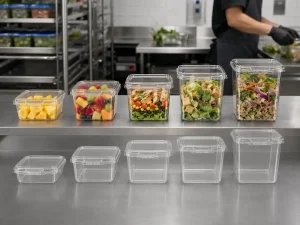
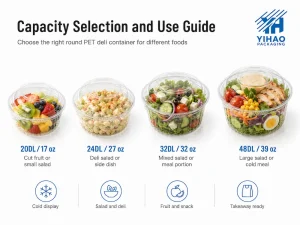
Deli counters sell both cold and hot foods. Cold salads may use clear PET containers, while hot sides and ready-to-heat meals need PP deli food containers or another microwave-compatible packaging system.
Meal Prep and Subscription Meal Programs
Meal prep brands need reliable portioning, stacking, labeling, and reheating convenience. The container must perform from production to delivery to consumer storage and reheating. In this segment, meal prep containers should be selected for both operational efficiency and customer use.
Foodservice Distribution and Wholesale Supply
Distributors need packaging that moves cleanly through cartons, warehouses, delivery routes, and customer operations. For wholesale orders, buyers should compare nesting efficiency, carton quantity, lid matching, pallet handling, and damage rate, not just unit price.
Supplier Checklist for Wholesale Microwave Safe Containers
Before placing a bulk order, buyers should request enough information to evaluate safety, performance, and supply stability. This is especially important when sourcing from a new supplier or developing a new prepared food line.
| Supplier Question | Why Buyers Should Ask |
|---|---|
| What material is used for the container and lid? | The base and lid may have different heat behavior. |
| Is the product designed for microwave reheating? | Buyers need application-specific confirmation, not general claims. |
| What reheating instructions should appear on packaging? | Clear instructions reduce misuse and customer complaints. |
| Can samples be tested with real menu items? | Real food testing is more useful than appearance checks only. |
| Does the supplier offer different sizes or shapes? | Food programs often need multiple portions under one packaging family. |
| Can the factory support stable repeat orders? | Wholesale buyers need consistency across batches. |
| Are lids, cartons, and labeling options available? | A complete system reduces mismatch and procurement complexity. |
Common Buying Mistakes to Avoid
The biggest mistake is assuming that any takeout container can be microwaved. Many packages are designed for cold display, short transport, or single-use holding, not direct reheating. Buyers should also avoid selecting packaging only by price, thickness, or appearance. A low-cost package that warps, leaks, or confuses customers creates higher total cost.
Mistake 1: Using Cold-Food Packaging for Hot Reheating
Clear PET packaging works well for chilled food display, but it should not be used as a microwave solution unless the exact product is designed and confirmed for that purpose.
Mistake 2: Ignoring the Lid
The base may be microwave compatible while the lid requires removal or venting. Buyers must confirm the complete package, not only the container base.
Mistake 3: Testing Empty Containers Only
Real food creates steam, oil exposure, weight, and pressure. Empty testing cannot show full performance.
Mistake 4: Choosing One Package for Every Menu Item
Cold salads, bakery items, hot meals, soups, rice dishes, and frozen meals may need different packaging systems. Smart buyers use a portfolio instead of forcing one container across every SKU.
Decision Framework: Which Packaging Should Buyers Choose?
| Food Program | Best Packaging Direction | Reason |
|---|---|---|
| Hot Takeaway Rice Meals | PP microwave containers | Balanced heat resistance, cost, and reheating convenience. |
| Cold Salads and Fresh Deli Foods | PET or rPET deli containers | Clear presentation and chilled shelf appeal matter more than reheating. |
| Meal Prep Subscription Meals | PP microwave containers or validated CPET trays | Requires stacking, portioning, and reheating performance. |
| Dry Bakery or Snack Foods | Paper, PET, or bakery containers | Microwave use is usually not the primary requirement. |
| Oven-Ready Meals | CPET or aluminum | Oven compatibility may matter more than microwave convenience. |
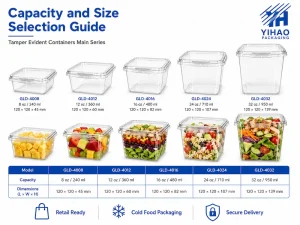
| Secure Refrigerated Foods | Tamper-evident or cold display containers | Security, freshness, and shelf display are the priority. |
For buyers selling reheatable meals, microwave safe takeout containers remain the most direct and practical choice. For buyers selling cold food, bakery items, or produce, alternative packaging may perform better. The right decision is not “plastic vs paper” or “PP vs PET.” The right decision is matching material to food behavior and customer use.
FAQ
1. What are microwave safe takeout containers?
Microwave safe takeout containers are food containers designed for reheating under defined microwave conditions. Buyers should confirm the material, lid use, food type, supplier guidance, and whether the package is labeled or documented for microwave reheating.
2. Are PP microwave containers better than PET containers for hot meals?
For reheatable hot meals, PP microwave containers are usually more suitable than standard PET containers. PET containers are better for clear cold-food display, fresh salads, chilled deli foods, bakery packaging, and produce presentation.
3. Can all takeout containers go in the microwave?
No. Buyers and consumers should not assume that all takeout containers are microwave safe. The container must be designed for microwave use, and the lid instructions should be checked before reheating.
4. Are PP microwave containers safe for meal prep?
PP microwave containers are commonly used for meal prep when the container is designed for food contact and microwave reheating. Buyers should still confirm the supplier’s usage guidance, lid instructions, portion weight, food type, and real reheating conditions before wholesale purchasing.
5. How should buyers choose a microwave safe containers supplier?
Buyers should choose a supplier that provides samples, material information, application guidance, lid matching, size options, stable wholesale supply, and clear recommendations for real food testing before bulk ordering.
References
- U.S. Food and Drug Administration, Food Packaging & Other Substances that Come in Contact with Food – Information for Consumers.
- U.S. Food and Drug Administration, Understanding How the FDA Regulates Substances that Come into Contact with Food.
- U.S. Food and Drug Administration, Packaging & Food Contact Substances.
- USDA Food Safety and Inspection Service, Cooking Safely in the Microwave Oven.
- USDA Food Safety and Inspection Service, Leftovers and Food Safety.
- European Food Safety Authority, Food Contact Materials Overview.
- Food Packaging Forum, Food Contact Materials and Chemical Migration Resources.
- Institute of Food Technologists, Food Packaging and Safety Discussion Resources.
Deep Dive Insights
How should buyers think about microwave packaging beyond material names?
Material is only the starting point. A buyer should evaluate the full packaging system: base, lid, food type, fill temperature, reheating instruction, delivery handling, stacking pressure, and customer behavior. A PP container may be suitable for many microwave applications, but the final decision should still depend on the exact food and reheating scenario.
Why are PP microwave containers often selected for foodservice takeout?
PP microwave containers are widely used because they provide a practical balance of heat resistance, lightweight handling, cost control, and portion flexibility. For restaurants, supermarkets, and meal prep brands, this balance is often more useful than choosing a package based only on appearance or sustainability messaging.
What should buyers compare when reviewing alternative packaging?
Buyers should compare whether the package is designed for display, reheating, oven use, delivery, or shelf presentation. PET is strong for cold visibility. Paper is strong for branding. Fiber packaging is attractive for natural presentation but needs real food testing. Aluminum is oven-oriented. CPET supports more specialized ready meal formats. PP microwave containers remain one of the most practical options for everyday reheatable takeout.
What is the most important sourcing consideration?
The most important sourcing consideration is whether the supplier understands the buyer’s real food application. A reliable supplier should not push one container for every use. It should help buyers match container depth, lid structure, material, carton packing, and sample testing to the actual menu, sales channel, and wholesale order plan.
Final Note / Practical Takeaway
© YIHAO Packaging. All rights reserved. All articles, product images, packaging designs, technical specifications, and website materials are protected by copyright. Unauthorized copying, reproduction, redistribution, modification, or commercial use is strictly prohibited without prior written permission.