Why Microwave Safe Food Containers Matter for Modern Food Packaging
Prepared food is no longer limited to a restaurant counter. Supermarkets sell chilled rice bowls, pasta meals, soup portions, deli entrees, protein meals, and ready-to-heat lunch packs. Cafes and foodservice brands prepare takeaway meals for office customers. Cloud kitchens need stable reheatable packs for delivery. Meal prep brands build weekly menus around portion control, reheating convenience, and consistent presentation.
This is why microwave safe food containers have become a practical category for food packaging teams. The container must support filling, sealing, stacking, transport, chilled storage, and final reheating by the consumer. A weak package may look acceptable at packing time but fail during delivery or heating. A good package supports the full route from production to consumption.
For buyers sourcing microwave safe containers, the main question is simple: will the container match the food, heating behavior, lid system, sales channel, and wholesale supply plan? The answer requires more than a generic “microwave safe” label. It requires material logic, real food testing, and clear instructions for use.
What “Microwave Safe” Should Mean for Packaging Buyers
For food packaging teams, “microwave safe” should be treated as an intended-use claim, not a decoration. A container should be selected for the specific food type, expected heating time, heating temperature range, grease level, moisture level, and lid behavior. Buyers should also confirm whether the container is intended for reheating only, hot filling only, chilled storage plus reheating, or short microwave warming by the end user.
A professional buyer should ask three direct questions before placing a wholesale order:
- Is the container material designed for microwave reheating under the expected use condition?
- Does the lid need to be removed, loosened, vented, or replaced before heating?
- Has the supplier provided clear usage guidance for food contact, heating, and handling?
This matters because microwave performance is affected by food composition. Oily sauces, cheese, curry, tomato sauce, rice, pasta, soup, and meat-based dishes heat differently. Some foods create steam pressure quickly. Some create hot spots. Some stain or soften packaging surfaces. The container must be reviewed with the real food application, not only an empty sample.
Microwave Safe Food Containers Are Not Automatically Oven Safe
A common procurement mistake is treating “microwave safe” as the same as oven safe, freezer-to-microwave safe, hot-fill safe, or suitable for every high-fat food application. These claims are not identical. A container designed for short microwave reheating may not be suitable for conventional ovens, air fryers, prolonged high-temperature heating, or direct contact with extremely hot oil-based foods.
For buyers, this distinction is important. Microwave safe food containers should be approved according to the exact food route: filling temperature, chilled storage, delivery movement, reheating time, lid position, food weight, and consumer handling. If a product needs oven heating, freezer storage, or extended high-temperature exposure, buyers should confirm those requirements separately with the manufacturer or supplier before ordering.
Why PP Is Commonly Used for Microwave Safe Food Containers
Among disposable and semi-disposable food packaging materials, polypropylene is widely selected for reheatable food packaging because it offers better heat resistance than many clear display plastics used for cold food. For this reason, PP microwave containers are commonly used for prepared meals, hot food takeaway, deli foods, lunch bowls, and meal prep programs.
However, buyers should not assume that every PP container is automatically suitable for every microwave use. Material grade, wall thickness, container depth, lid design, food type, and heating condition still matter. A thin container designed only for brief warming may not perform the same as a heavier container designed for sauced meals or prepared food counters.
For food teams comparing PP prepared meal containers, the buyer should check practical details such as rim strength, base stability, lid fit, nesting, carton packing, and whether the container keeps its shape after normal reheating. A sample should be tested with the actual product, not only inspected visually.
Microwave Safe Containers vs Cold Display Containers
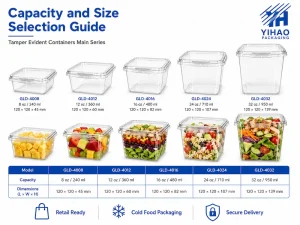
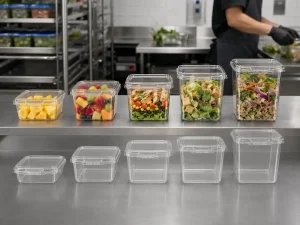
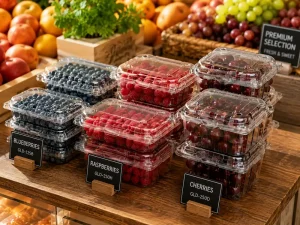
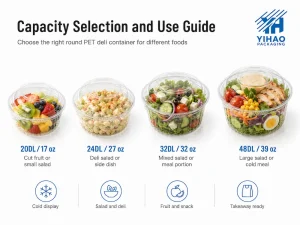
One common mistake is using a cold display container for a reheatable meal. Clear PET or rPET packaging is excellent for chilled fruit, salads, bakery items, cold deli packs, and retail visibility, but standard PET/rPET packaging should be treated as cold or chilled display packaging unless the supplier clearly confirms a different intended use.
This distinction is important for buyers who manage both chilled and reheatable food categories. A fresh fruit cup, salad bowl, bakery clamshell, and cold snack pack may need high clarity and anti-fog display. A rice bowl, sauced pasta meal, curry portion, or hot deli pack needs heat resistance, steam management, and reheating instructions.
| Packaging Need | Typical Better Fit | Buyer Logic |
|---|---|---|
| Fresh fruit, salad, bakery display | Clear PET/rPET containers | Visibility, cold shelf display, lightweight handling |
| Prepared meals for reheating | PP microwave containers | Heat resistance, foodservice handling, reheating convenience |
| Hot takeaway meals | PP hot food containers | Better fit for warm food and short reheating needs |
| Retail deli meals | PP deli food containers | Stacking, portion control, prepared food presentation |
| Meal prep programs | PP meal prep containers | Consistent portions, repeat use logic, delivery convenience |
For chilled categories that do not require reheating, buyers can still use clear display packaging. For reheatable categories, buyers should move toward microwave safe food containers designed for that purpose.
Best Applications for Microwave Safe Food Containers
Prepared Meals and Supermarket Ready Meals
Supermarket prepared food sections need packaging that supports filling, chilled merchandising, labeling, stacking, and consumer reheating. Rice meals, pasta meals, noodles, roasted vegetables, protein portions, and mixed entrees require containers that remain stable through handling and reheating.
A separate lid structure is often useful because it allows faster filling and clearer lid handling instructions. Buyers reviewing large PP deli food containers should check portion size, lid security, steam behavior, and stacking performance before bulk purchasing.
Takeout Meals and Delivery Food
Microwave safe takeout containers are especially important for delivery brands because customers often reheat food after it arrives. The package must survive transport before it ever reaches the microwave. That means the buyer should evaluate leakage, lid grip, base stiffness, bag loading, and carton consistency.
For sauced foods, the lid system matters. A container that handles dry rice may not handle oily noodles or curry in the same way. Buyers should test actual food, delivery movement, short reheating, and post-heating handling. A strong takeaway package reduces complaints and protects the brand experience.
Meal Prep Containers
Meal prep containers need repeatable sizing, clean stacking, portion visibility, and reheating convenience. Meal prep brands often build weekly menus around different proteins, vegetables, grains, sauces, and side dishes. The container must support production efficiency and customer reheating habits.
For this category, buyers should compare single-compartment and divided formats. Single-compartment containers work for pasta, rice bowls, stews, and mixed meals. Divided formats work for protein, vegetables, rice, and sauce separation. The supplier should help buyers match structure to food behavior instead of selling one generic container for every meal.
Deli Foods and Prepared Counter Items
Microwave safe deli containers are useful for hot or reheatable deli foods, including prepared vegetables, cooked meats, grains, pasta sides, noodles, and daily lunch portions. For deli counters, the packaging must support quick filling, clean stacking, customer visibility, and reheating instructions.
A buyer comparing PP deli food containers should check whether the same range can serve multiple deli SKUs without causing lid confusion or display inconsistency. The better the packaging system, the easier it is to manage repeat orders and store operations.
Container Selection by Food Type
Different foods create different packaging pressure during microwave reheating. Buyers should match the container to food weight, oil level, moisture content, sauce behavior, steam release, and final handling experience. This food-type logic is especially useful for wholesale buyers building a complete range of microwave safe food containers.
| Food Type | Better Container Direction | Buyer Check |
|---|---|---|
| Rice meals and grain bowls | PP microwave food containers | Steam release, base stiffness, lid venting, portion weight |
| Pasta with sauce | PP containers with secure lids | Oil level, tomato sauce staining, lid grip, leakage control |
| Soups and stews | Deeper PP deli or prepared meal containers | Spill resistance, lid instruction, steam pressure behavior |
| Cooked vegetables and deli sides | Small or medium PP deli containers | Portion control, stacking, label area, reheating instruction |
| Meal prep sets | Single or divided PP meal prep containers | Compartment logic, menu fit, weekly packing efficiency |
| Hot takeaway meals | PP hot food containers | Transport strength, bag loading, post-heating handling |
Material Selection: What Buyers Should Compare
Material selection should start with the food’s real route. Is the food packed hot, warm, chilled, or frozen? Will the consumer microwave it for a short time? Will the lid stay on? Will the food contain oil, sugar, tomato sauce, cheese, or strong seasoning? These questions are more important than choosing by material name alone.
| Material / Structure | Common Packaging Role | Important Buyer Check |
|---|---|---|
| PP | Microwave safe containers, hot food containers, prepared meals | Confirm intended heating condition, lid instruction, and sample performance |
| PET / rPET | Cold food, fruit, salad, bakery, chilled display | Do not use for microwave applications unless specifically confirmed |
| Paper + coating | Takeout boxes, hot food, dry meals | Check grease resistance, moisture behavior, and coating compliance |
| Bagasse / fiber | Hot food and takeaway in some markets | Check moisture, oil resistance, lid fit, and market requirements |
| CPET or specialty heat-resistant trays | Higher heat applications in specific programs | Confirm exact temperature, heating method, and supplier documentation |
For most standard prepared meal and takeout reheating programs, PP is the practical starting point. But the correct decision still depends on confirmed use conditions and real product testing.
Lid Design, Venting, and Heating Instructions
The lid is not a small detail. It determines filling speed, stacking stability, leakage control, steam release, and consumer instructions. Many microwave packaging issues come from lid misuse rather than base failure.
Buyers should confirm whether the lid is microwave suitable, whether it should be removed before heating, whether it should be loosened, and whether the pack needs a venting instruction. Steam pressure can build quickly during heating, especially with rice, soup, noodles, vegetables, and sauced meals.
For wholesale packaging programs, lid clarity and worker training also matter. If a foodservice team uses several similar lids, mismatch risk increases. A good packaging system reduces confusion through clear rim fit, stable nesting, and straightforward product identification.
Microwave Safety Testing Points Buyers Should Confirm Before Bulk Orders
Buyers should never approve microwave safe food containers by looking at an empty sample only. A real test should include the actual food, filling temperature, chilled storage condition, transport route, reheating time, lid behavior, and customer handling pattern.
| Testing Point | What to Check | Why It Matters |
|---|---|---|
| Base deformation after heating | Check warping, softening, sagging, or unstable bottom shape | Protects meal presentation and customer handling safety |
| Lid fit after reheating | Check whether the lid loosens, tightens, cracks, or traps steam | Reduces leakage, steam pressure, and opening issues |
| Oil-heavy food performance | Test curry, cheese, meat sauce, oily noodles, and hot deli meals | Oil-rich foods often create stronger heat stress than dry foods |
| Sauce and steam behavior | Check condensation, steam release, splashing, and lid instruction needs | Improves user experience and reduces complaints |
| Stacking after filling | Test filled containers in trays, bags, cartons, and chilled storage | Supports foodservice speed and wholesale operation stability |
| Label readability | Check barcode, reheating instruction, ingredient label, and brand label | Helps retail teams maintain clear customer communication |
| Real-food sample testing | Test actual menu items, not only water or empty containers | Reveals real deformation, staining, leakage, and handling risks |
How to Test Microwave Safe Food Containers Before Wholesale Orders
1. Test with Real Food
Use the actual menu item: rice, pasta, noodles, soup, curry, vegetables, protein meals, or deli sides. Check whether the base softens, stains, warps, leaks, or becomes hard to handle after heating.
2. Test the Lid and Rim
Confirm whether the lid stays secure during transport and whether the container can be opened safely after heating. If the lid is not intended for heating, instructions must be clear.
3. Test Stacking and Carton Loading
Wholesale buyers need packaging that performs before and after filling. Test nested empty containers, filled stacks, carton packing, and store handling.
4. Test Label Placement
Labels should stay readable and should not interfere with opening, venting, barcode scanning, or customer reheating instructions. For prepared meals, the label is part of the safety communication system.
5. Test Multiple Food Conditions
Dry rice, oily noodles, tomato pasta, cheese dishes, soup, and sauced protein meals behave differently. A container that works for one food may not be ideal for another.
Supplier Checklist for Microwave Safe Food Containers
Choosing a packaging manufacturer is not only about unit price. For microwave packaging, a supplier should understand material behavior, food application, lid design, sample testing, and repeat wholesale supply.
| Buyer Question | Why It Matters | What to Request |
|---|---|---|
| What material is used? | Material determines heating suitability and food contact logic | Material name, intended use, and food contact information |
| Is the container intended for microwave reheating? | Prevents misuse of cold-food packaging | Usage guidance and sample validation |
| How should the lid be used during heating? | Reduces steam pressure and handling risk | Lid instruction, venting guidance, label wording |
| Can samples be tested with real food? | Real food exposes warping, staining, leakage, and lid issues | Sample set for actual menu testing |
| Is wholesale supply stable? | Packaging consistency affects operations | Repeat supply plan, carton packing details, SKU consistency |
| Can the supplier support custom branding? | Brand owners need packaging that supports retail identity | Label area, printing options, OEM discussion if available |
A strong supplier should help buyers compare food type, material, structure, and usage condition. If a supplier only quotes the cheapest container without asking about heating, food type, and lid use, the buyer should be cautious.
Wholesale Buying Logic: How to Build a Practical Microwave Container Range
Food packaging teams often need more than one container. A practical range usually includes small deli portions, medium lunch containers, large prepared meal packs, and possibly divided meal prep formats. The goal is not to buy too many SKUs. The goal is to build a controlled range that covers real menu needs without creating lid confusion.
For a starting product range, buyers can organize microwave packaging around these groups:
- Small PP containers for sides, deli portions, and compact prepared foods
- Medium PP containers for lunch bowls, rice meals, pasta, noodles, and hot takeaway foods
- Large PP containers for family portions, retail meal packs, and deli counter meals
- Special structure containers for sauces, separated meals, or high-moisture foods
For buyers comparing PP hot food containers, the selection should be based on menu behavior and operational speed. If workers can fill, close, label, stack, and pack the container efficiently, the packaging improves both customer experience and back-of-house productivity.
Common Mistakes When Buying Microwave Safe Food Containers
Choosing Only by Price
The lowest unit price may create higher hidden costs through leakage, returns, customer complaints, poor stacking, or wrong lid matching. For reheatable foods, packaging failure is highly visible to the consumer.
Using Clear Cold Packaging for Reheatable Food
Clear cold packaging is valuable for salads, fruit, bakery, and chilled display. It should not be treated as a microwave packaging substitute unless the supplier confirms the intended use.
Ignoring the Lid Instruction
A base may be microwave suitable while the lid requires removal or venting. Packaging teams should make instructions visible and easy to follow.
Testing Empty Containers Only
Empty-container testing does not reveal the impact of oil, steam, sauce, food weight, and hot spots. Real food testing is essential.
Confusing Microwave Safe with Oven Safe
Microwave safe does not automatically mean oven safe. Buyers should confirm oven, freezer, hot-fill, and high-fat food requirements separately instead of assuming one container covers every heating condition.
Buying Too Many Unrelated SKUs
Too many sizes and lid systems create warehouse complexity. A smart wholesale range uses a controlled set of sizes with clear application logic.
Why Work with YIHAO for Microwave Safe Food Containers?
YIHAO supports food packaging buyers with application-based packaging selection for fresh food, deli meals, prepared foods, takeout, meal prep programs, chilled retail display, and wholesale packaging supply. For buyers sourcing microwave safe food containers, the key value is not only finding a PP container. The value is choosing a packaging structure that matches the real food route.
YIHAO packaging solutions cover PP prepared meal containers, deli food containers, hot food containers, and related packaging options for prepared meal programs. Buyers can compare PP prepared food containers with other microwave safe packaging formats to build a range that fits menu size, filling speed, storage, and reheating needs.
For distributors and foodservice buyers, stable wholesale supply is especially important. Consistent container dimensions, carton packing, lid fit, and repeat ordering reduce operational risk. For brand owners, packaging should also support labeling, custom presentation, and clear customer instructions.
Talk to a Microwave Safe Food Containers Supplier Before Ordering
Before placing a wholesale order, buyers should prepare clear application details for the packaging supplier. The more specific the request, the easier it is to match the right microwave safe food containers to the actual food program.
A buyer can share the following information with a microwave safe food containers supplier:
- Food type, such as rice meals, pasta, soup, deli sides, hot takeaway meals, or meal prep portions
- Expected portion size and filling weight
- Filling condition, such as hot filling, warm filling, chilled packing, or cold storage before reheating
- Expected microwave reheating time and consumer usage instructions
- Lid preference, including separate lid, hinged lid, venting need, or lid removal instruction
- Labeling method, barcode position, brand sticker area, and heating instruction placement
- Estimated monthly order volume and wholesale supply schedule
This information helps the supplier recommend a more accurate PP microwave packaging structure instead of quoting a generic food container. For brands that want better shelf consistency, fewer complaints, and smoother repeat orders, sample testing should come before bulk purchasing.
Buyer Decision Matrix for Microwave Safe Food Containers
| Buyer Scenario | Recommended Direction | Key Check Before Ordering |
|---|---|---|
| Supermarket prepared meals | PP microwave containers with secure lids | Chilled storage, label area, reheating instruction |
| Restaurant takeout | PP takeout containers with stable stacking | Leakage, delivery handling, lid grip |
| Meal prep programs | Single or divided PP meal prep containers | Portion control, menu fit, weekly packing efficiency |
| Deli counters | PP deli containers for hot or reheatable foods | Fast filling, display consistency, lid instruction |
| Wholesale distributors | Controlled SKU range across several sizes | Repeat supply, carton efficiency, category coverage |
FAQ About Microwave Safe Food Containers
1. What are microwave safe food containers usually made from?
Many microwave safe food containers are made from PP because polypropylene is commonly used for reheatable prepared food packaging. Buyers should still confirm the supplier’s intended use, heating guidance, food contact information, and sample performance before wholesale orders.
2. Are all PP containers microwave safe?
No. PP is commonly used for microwave packaging, but every container should still be checked based on material grade, wall thickness, lid design, food type, and heating condition. Buyers should not rely on material name alone.
3. Can PET containers be used in the microwave?
Standard clear PET and rPET containers are mainly used for cold food, fruit, salad, bakery, and chilled retail display. They should not be used for microwave heating unless the supplier specifically confirms the intended use.
4. Should the lid stay on during microwave heating?
It depends on the lid material and container design. Some lids may need to be removed, loosened, or vented before heating. Buyers should request clear instructions from the supplier and test the package with real food.
5. How should buyers test microwave safe takeout containers?
Buyers should test the real food application, filling weight, sauce level, chilled storage, delivery route, reheating time, lid behavior, leakage, stacking, and post-heating handling before placing bulk orders.
6. Are microwave safe food containers also oven safe?
Not automatically. Microwave safe, oven safe, freezer safe, and hot-fill safe are different use claims. Buyers should confirm the exact intended use with the supplier before choosing a container for high-temperature or oven-based applications.
References
- U.S. Food and Drug Administration, Packaging & Food Contact Substances.
- U.S. Food and Drug Administration, Food Types and Conditions of Use for Food Contact Substances.
- USDA Food Safety and Inspection Service, Cooking Safely in the Microwave Oven.
- European Commission, Food Contact Materials.
- Regulation (EC) No 1935/2004 on materials and articles intended to come into contact with food.
- Commission Regulation (EC) No 2023/2006 on Good Manufacturing Practice for food contact materials.
- Commission Regulation (EU) No 10/2011 on plastic materials and articles intended to come into contact with food.
- Commission Regulation (EU) 2025/351 and industry regulatory updates on plastic food contact materials.
Deep-Dive Insights: How Food Packaging Teams Should Think About Microwave Safe Containers
How should buyers define microwave safe food containers?
Buyers should define microwave safe food containers by intended use, not by a simple product name. The container, lid, food type, heating condition, and customer instruction must work together before the product is approved for wholesale purchasing.
Why does PP matter in reheatable food packaging?
PP gives buyers a practical material direction for many prepared meal and takeout applications. The final decision still depends on sample testing, lid behavior, food composition, and supplier documentation.
What should buyers compare before wholesale ordering?
Buyers should compare material, structure, lid design, venting, food compatibility, stacking, carton packing, label area, usage instructions, and repeat supply stability. These details affect both customer experience and back-of-house operation.
Which option works best for meal prep containers?
Single-compartment PP containers fit mixed meals, pasta, rice bowls, and sauced entrees. Divided formats fit portion-control programs where protein, vegetables, grains, and sauces need separation.
What is the biggest risk in microwave packaging selection?
The biggest risk is treating one generic container as suitable for every hot food, chilled meal, microwave scenario, oven use, and delivery route. Real food testing is the most reliable way to reduce packaging mismatch.
What should buyers ask a manufacturer or supplier?
Buyers should ask about intended use, material, lid instruction, sample testing, carton packing, repeat supply, labeling area, and suitable food categories. A good microwave safe food containers manufacturer should help match the package to the real food route instead of quoting only by size.
Final Note / Practical Takeaway
© YIHAO Packaging. All rights reserved. All articles, product images, packaging designs, technical specifications, and website materials are protected by copyright. Unauthorized copying, reproduction, redistribution, modification, or commercial use is strictly prohibited without prior written permission.